Enterprise Model & Intelligence Decision Matrix
Introduction
The shift from deterministic software engineering to probabilistic intelligence systems requires a significant evolution in engineering governance. Left unguided, application teams naturally gravitate toward "hype-driven architecture," selecting the largest, most visible foundation models for trivial tasks or attempting to build fragile, over-engineered agentic systems for workflows better served by traditional code.
The Enterprise Model and Intelligence Decision Matrix serves as the definitive architectural gate for your organization. It forces rigorous, multi-dimensional alignment between business utility, total cost of ownership (TCO), operational risk, and technical feasibility. By mandating this matrix across your engineering organization, you ensure that every AI capability is treated as a predictable, auditable, and cost-effective enterprise asset.
1. The Core Philosophy: From Probabilistic Chaos to Architectural Determinism
Traditional software engineering relies on deterministic logic: an explicit input yields a predictable output. Generative AI and Large Language Models (LLMs) introduce probabilistic execution: inputs are mapped against high-dimensional vector spaces to generate statistically likely outputs.
When scaled across an enterprise with hundreds of micro-processes, unchecked probabilistic execution leads to:
-
Token Inflation & Uncapped Costs: Using a frontier model (e.g., GPT-4 class) for simple data extraction when a specialized 7-billion-parameter model or an OCR script costs 99% less.
-
Architectural Drift: Different product teams selecting varying model vendors, hosting paradigms, and vector databases, fragmenting the enterprise's data boundary.
-
Compliance and Safety Exposure: Lack of standardized output validation schemas, leading to prompt injections, hallucinations, or toxic outputs reaching production environments.
The Matrix corrects this by establishing a strict taxonomy. Every workload must be documented across six foundational pillars before a single line of production code is deployed.
2. Deep Dive: The Six Pillars of the Decision Matrix
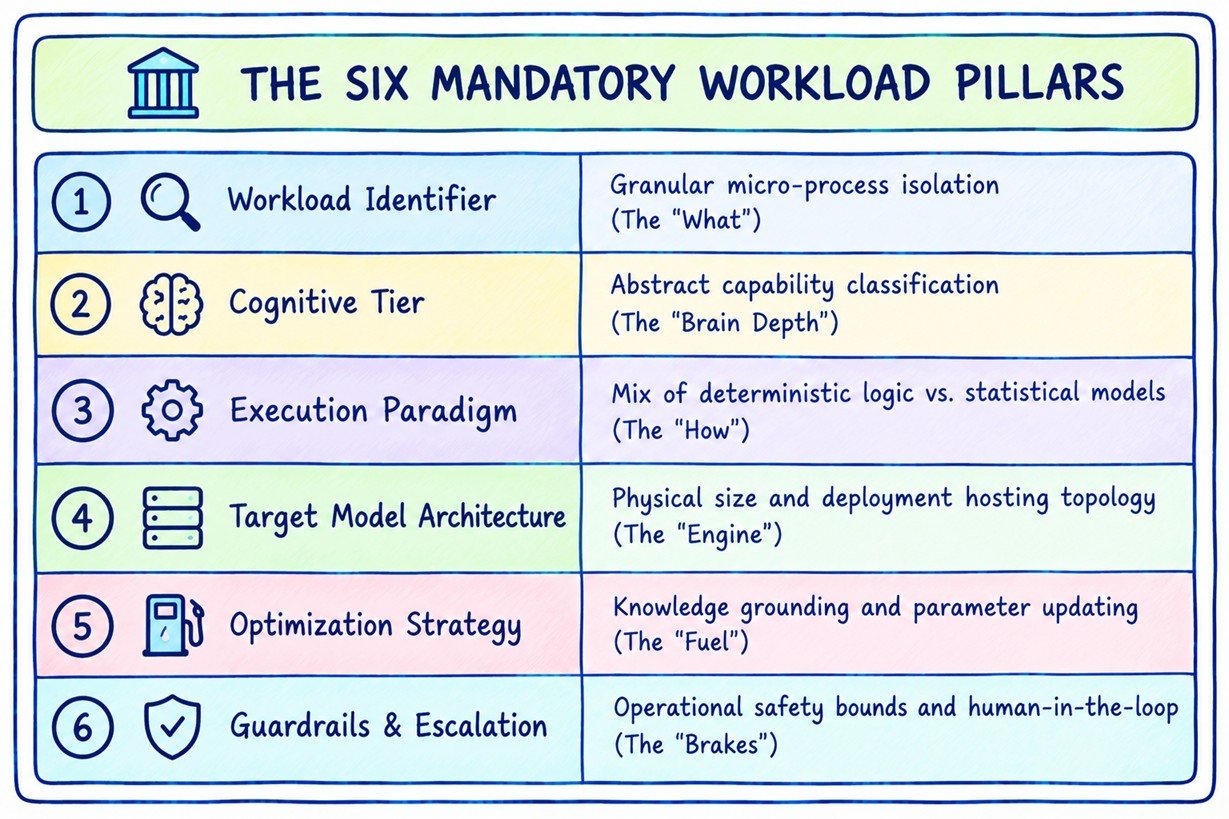
Pillar 1: Workload Identifier
The matrix explicitly forbids broad, sweeping categories like "Customer Service AI" or "Legal Copilot." Workloads must be isolated to their lowest atomic enterprise micro-process.
- Definition: A distinct, measurable task within a business value stream that possesses clear inputs, defined processing bounds, and deterministic success criteria.
- Examples:
billing-invoice-extraction,contract-clause-anomaly-detection,customer-churn-sentiment-scoring,knowledge-base-semantic-search. - Strategic Value: Granular isolation allows leadership to deprecate, upgrade, or swap underlying models for a single micro-process without breaking adjacent business logic.
Pillar 2: Cognitive Tier
Classifying the cognitive depth of a task prevents the over-allocation of compute resources. Leaders must enforce a strict categorization based on the level of cognitive abstraction required:
- Pattern Recognition: Superficial data processing. Classifying text strings, extracting entities, or identifying known anomalies in a dataset. Low reasoning requirements.
- Information Synthesis: Compressing and restructuring unstructured data. Summarizing multi-page financial disclosures, generating daily operational reports, or translating technical documentation.
- Complex Reasoning: Multi-step logical deduction. Cross-referencing conflicting compliance policies, validating code logic, or diagnosing systems based on disparate error logs.
- Agentic Execution: Autonomous loop systems. Dynamic tool call planning, self-reflection, auto-correction, and executing sequences of events across external APIs to achieve a high-level goal.
Pillar 3: Execution Paradigm
An intelligence strategy must not abandon classic software engineering. This pillar defines the balanced split between traditional code and probabilistic models:
- Deterministic Logic: Pure code (Python, Go, Java) handling regex, mathematical calculations, rule-based routing, and rigid database queries.
- Traditional Machine Learning (ML): Statistical models (XGBoost, Random Forests, Linear Regressions) optimized for tabular data prediction, fraud scores, classification, and numerical forecasting.
- Foundation Models (GenAI): Autoregressive LLMs, Vision-Language Models (VLMs), or embedding models used to handle highly unstructured text, image, audio, or video processing.
Enterprise rule: A workload should always lean toward the lowest-cost, most deterministic paradigm capable of achieving the required performance threshold.
Pillar 4: Target Model Architecture
This pillar dictates the balance between model parameter size and hosting topology. Product teams must explicitly map their needs against financial and data residency constraints:
- Small Language Models (SLMs) [1B–8B Parameters]: Highly specialized, fast, and cost-effective. Ideal for edge deployment, low-latency applications, or single-turn classification.
- Medium/Large Models [9B–70B Parameters]: Balanced performance for multi-step reasoning, intricate instruction-following, and robust retrieval-augmented generation.
- Frontier Models [70B+ / Mixture-of-Experts]: Maximum reasoning capacity. Reserved strictly for highly ambiguous, complex reasoning or orchestrating agentic workflows.
- Deployment Modes:
- Serverless/Hosted APIs: Third-party managed infrastructure (e.g., OpenAI, Anthropic, AWS Bedrock). Low operational overhead, high external data risk.
- Private Cloud/Self-Hosted: Open-weight models (e.g., Llama, Mistral) containerized via vLLM/TGI and hosted inside internal enterprise Kubernetes clusters (AKS, EKS, GKE). High operational overhead, absolute data sovereignty.
Pillar 5: Optimization Strategy
Raw base foundation models lack domain context and enterprise-specific knowledge. Teams must choose the most cost-effective method to bridge this gap:
- Prompt Engineering (Zero/Few-Shot): Structuring instructions and providing in-context examples directly within the context window. Lowest engineering effort, high token consumption over time.
- Retrieval-Augmented Generation (RAG): Dynamic injection of relevant context sourced from an internal corporate vector database (e.g., Pinecone, Milvus, pgvector). Grounding models in real-time, proprietary data without modifying model weights.
- Fine-Tuning (PEFT/LoRA/Full): Altering the internal weights of an open-weight model using curated enterprise training data. Used to instill specialized domain vocabulary, enforce strict structural output styles, or optimize small models to perform at frontier-model levels for narrow tasks.
Pillar 6: Guardrails and Escalation
The final pillar addresses risk mitigation, alignment, and operational reliability. No model connects to an enterprise asset or customer interface without satisfying three programmatic safety layers:
- Structured Generation Schemas: Enforcing strict JSON or Pydantic outputs using tools like Instructor or Outlines. This ensures that the probabilistic model outputs conform perfectly to API schemas expected by downstream deterministic systems.
- Tool Validation Rules: Programmatic validation of any code execution, database call, or API request generated by a model before it reaches production systems.
- Human-in-the-Loop (HITL) Thresholds: Establishing mathematical confidence boundaries. If an extraction or classification confidence score falls below a specific threshold (e.g., (< 0.85)), the workload programmatically triggers an escalation path to a human operator.
3. The Enterprise Model and Intelligence Decision Matrix: Reference Template
Below is the foundational governance matrix template. CTOs and engineering leaders should implement this as a living architecture registry.
| Workload ID | Cognitive Tier | Execution Paradigm | Target Model Architecture | Optimization Strategy | Guardrails & Escalation |
|---|---|---|---|---|---|
billing-invoice-extraction | Pattern Recognition | 30% Deterministic (OCR / Regex) 70% GenAI | SLM (8B Parameters) Self-Hosted (vLLM on Private EKS) | Few-shot Prompting + Structured Pydantic Output | • JSON schema validation • Regex total cost match • HITL if confidence < 92% |
legal-compliance-check | Complex Reasoning | 10% Deterministic (Metadata) 90% GenAI | Large Model (70B Parameters) Hosted VPC Instance | Advanced Graph RAG Contextualized corporate policy | • Citations required for answers • Guardrails text-moderation API • 100% human legal sign-off |
customer-intent-routing | Pattern Recognition | 80% Traditional ML (XGBoost) 20% GenAI | SLM (1B–3B Parameters) Self-Hosted on Edge | Fine-Tuned (LoRA) On historical routing logs | • Strict token limit output • Fallback route to generic agent pool on model timeout |
procurement-agent | Agentic Execution | 40% Deterministic (APIs) 60% GenAI | Frontier MoE Hosted API (Managed Gateway) | RAG (Vendor catalogues) + Few-Shot tool calling loops | • Mandatory API execution proxy • Financial cap: Human approval needed for purchases > $500 |
4. Leadership Implementation Playbook: Enforcing the Matrix
To successfully operationalize this framework across your engineering organization, implement the following steps:
-
Mandate the Architectural Gate: Integrate this matrix directly into your Architecture Review Board (ARB) or RFC process. A project cannot receive infrastructure budget allocation or production tokens until its row in the matrix is approved.
-
Establish Token & Compute Attribution: Map every workload ID directly to a unique API key, corporate billing tag, or dedicated Kubernetes namespace. This allows finance teams to track exact TCO down to individual business micro-processes.
-
Build an Internal Model Registry: Maintain a curated menu of internal self-hosted open-weight models (e.g., an enterprise-approved 8B and 70B parameter model) alongside approved hosted API endpoints. Prevent engineering teams from pulling unverified open-source weights into production.
-
Continuous Auditing: Review the matrix bi-annually. As smaller, open-weight models become more capable, systematically migrate workloads down the cognitive chain, moving tasks from frontier hosted APIs to smaller, highly optimized, self-hosted models to realize 10x cost reductions.
By anchoring your AI strategy around this structured framework, you replace ad-hoc experimentation with predictable, secure, and enterprise-grade intelligence systems.