Structured generation
Introduction
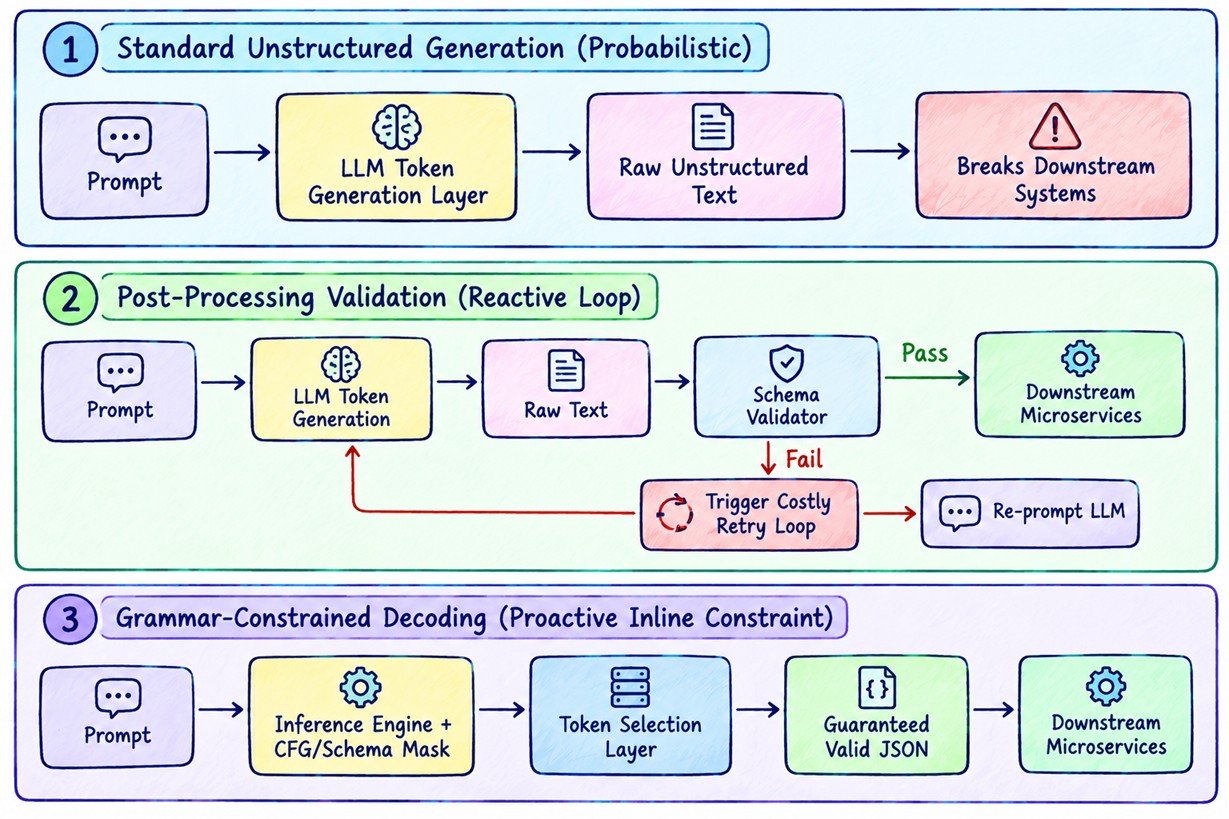
Unstructured text outputs from Large Language Models (LLMs) break production software code. While natural language generation is ideal for human consumption, traditional enterprise systems require strict, predictable data formats like JSON, XML, or SQL tables.
In a production microservices architecture, data predictability is binary: a payload is either compliant or broken. If an LLM changes a single key name, alters a bracket structure, or introduces an unexpected trailing comma, downstream databases and microservices will crash or throw unhandled exceptions. To deploy generative AI reliably at scale, engineering leadership must move past prompt engineering and enforce structural guarantees directly at the inference layer.
Structured generation turns a probabilistic text engine into a predictable, deterministic integration component. This guide provides a deep architectural breakdown of the three primary approaches to enforcing data structures, helping technology leaders select the right pattern for mission-critical enterprise systems.
Architectural Comparison Matrix
| Architectural Approach | Mechanism | Structural Guarantee | Latency Overhead | Compute Cost | Engineering Overhead |
|---|---|---|---|---|---|
| Prompt-Based Instruction | Natural language instructions inside the system prompt. | None (Probabilistic) | Low (Baseline) | Variable (High if retrying manually) | Low |
| Regex & JSON Schema Validation | Post-generation verification with retry loops. | Reactive (Guaranteed after success) | High (Compounded by failure rates) | High (Multiple API calls/tokens) | Medium |
| Grammar-Constrained Decoding | Logit bias modification at the token selection layer. | Proactive (100% Guaranteed) | Zero (Slightly reduces overall latency) | Optimized (Single pass) | High (Requires infrastructure control) |
Deep Dive: The Three Structural Architectures
Prompt-Based Instruction
This approach relies purely on natural language commands within the system or user prompt to request specific formats (e.g., "Return the data only as a valid JSON object with keys 'id' and 'status'").
-
The Mechanism: The model attempts to follow the structural instructions based purely on its training weights and attention mechanisms.
-
Why It Fails in Production: It is highly fragile. Because LLMs are fundamentally probabilistic next-token predictors, they possess no native concept of syntax rules. When encountering edge cases, complex text-processing tasks, or high-token payloads, the model will frequently deviate from the requested format. Common failure modes include adding conversational preambles ("Here is your JSON:"), dropping closing brackets, or hallucinating schema keys.
Regex and JSON Schema Validation
This method introduces external validation layers immediately after the model generates its text output, treating the LLM as a black box.
-
The Mechanism: The application layer intercepts the raw text output and passes it to a traditional parser or validator (e.g., a Pydantic model or JSON Schema validator). If the validation checks pass, the payload moves downstream. If validation fails, the architecture must trigger an automated retry loop, sending the error log back to the LLM to request a correction.
-
The Enterprise Bottleneck: While it eventually ensures data validity, it introduces severe latency jitter and compounding compute costs. If your system experiences a 10% failure rate under complex loads, one out of every ten transactions will suffer double or triple the baseline latency. This unpredictability violates strict Service Level Agreements (SLAs) and inflates your API token or compute spend.
Grammar-Constrained Decoding
This advanced strategy shifts structural enforcement from a reactive post-process to a proactive, in-flight constraint during token generation.
-
The Mechanism: Instead of letting the model freely select from its entire vocabulary, the inference engine integrates a Context-Free Grammar (CFG) or JSON Schema directly into the decoding loop. At every single token step, the engine calculates which tokens in the vocabulary would violate the structural schema. It then applies a logit bias of negative infinity ( -\infty ) to those invalid tokens, effectively masking them out. The model is forced to choose only from tokens that comply with your schema.
-
The Enterprise Benefit: This method guarantees 100% structural compliance on the very first pass. Because invalid tokens are blocked before they are written, the model cannot physically produce malformed syntax. This completely eliminates retry overhead, flattens latency curves, saves compute costs, and allows you to use smaller, faster models that would otherwise struggle with complex formatting rules.
System Workflow: Inference Control Topologies
Production Use Case: Automated Invoicing Pipelines
Consider an enterprise automated invoicing pipeline processing millions of multi-currency, multi-line financial documents. Passing unstructured text to a ledger system introduces catastrophic compliance and financial risk.
By implementing grammar-constrained decoding, engineering teams can bind the LLM to an exact JSON schema:
{
  "$schema": "http://json-schema.org",
  "title": "InvoicePayload",
  "type": "object",
  "properties": {
    "invoice_id": { "type": "string" },
    "line_items": {
      "type": "array",
      "items": {
        "type": "object",
        "properties": {
          "description": { "type": "string" },
          "quantity": { "type": "integer", "minimum": 1 },
          "unit_price": { "type": "number" }
        },
        "required": ["description", "quantity", "unit_price"]
      }
    },
    "tax_total": { "type": "number" },
    "currency_code": { "type": "string", "enum": ["USD", "EUR", "GBP", "JPY"] }
  },
  "required": ["invoice_id", "line_items", "tax_total", "currency_code"]
}
Business and Operational Impact
When the inference engine enforces this schema at the token level, it guarantees that every extracted line item, mathematical total, and ISO currency code aligns with the defined data model.
-
Direct System Integration: The resulting payload can be passed directly to enterprise accounting systems (such as SAP or Oracle) or core transactional databases via automated REST integration.
-
Zero Parsing Sanitization Layers: Engineers can eliminate brittle regex filters, try/catch blocks, and redundant validation middleware.
-
Deterministic Scaling: The system achieves the deterministic reliability of traditional software development while retaining the reasoning, extraction, and semantic understanding capabilities of state-of-the-art Large Language Models.
Strategic Recommendations for Leaders
-
Audit Existing Pipelines: Identify where your teams are currently relying on "prompt engineering" (e.g., "return valid JSON") for system-to-system integrations. Mark these as high-risk failure points.
-
Standardize on Inference-Time Constraints: Mandate that all production AI microservices handling structured data utilize inference engines that support native grammar constraints (such as vLLM, Hugging Face TGI, llama.cpp, or native structured output APIs from cloud vendors).
-
Decouple Logic from Schema: Require developers to define business objects using standard schemas (OpenAPI, JSON Schema, or Protocol Buffers). Let the infrastructure translate those schemas into decoding grammars automatically, preserving traditional DevOps practices.