The Inception Factory - Opportunity Discovery, Product Definition, and Intelligence Calibration
Introduction
The primary point of failure for enterprise Generative AI initiatives occurs long before a single line of application code is written or an infrastructure environment is provisioned.
The point of failure sits within TOGAF 10 Phase A (Architecture Vision) — specifically, during the translation of raw business ideas into production-viable engineering goals.
When an enterprise lacks a structured approach to filter and refine its ideas, it inevitably falls into The Technology-First Trap.
This happens when product teams select a highly advanced model first, and then go searching across the organization for a business problem to solve with it.
The result is a chaotic array of fragile proof-of-concept applications that:
- Lack clear business utility
- Introduce unmanaged compliance risks
- Drain infrastructure budgets
To eliminate this systemic issue, technology leaders must establish The Inception Factory.
This structured process acts as a rigorous filter, taking unstructured corporate ideas and transforming them into precisely calibrated, production-ready AI specifications.
1. The Opportunity Discovery Engine: Deconstructing Corporate Workflows
Enterprise architectures are built around business processes designed for complete predictability.
When integrating probabilistic AI components into these environments, you cannot simply layer an LLM over a monolithic business workflow.
Instead, the workflow must be systematically deconstructed into individual, discrete task layers.
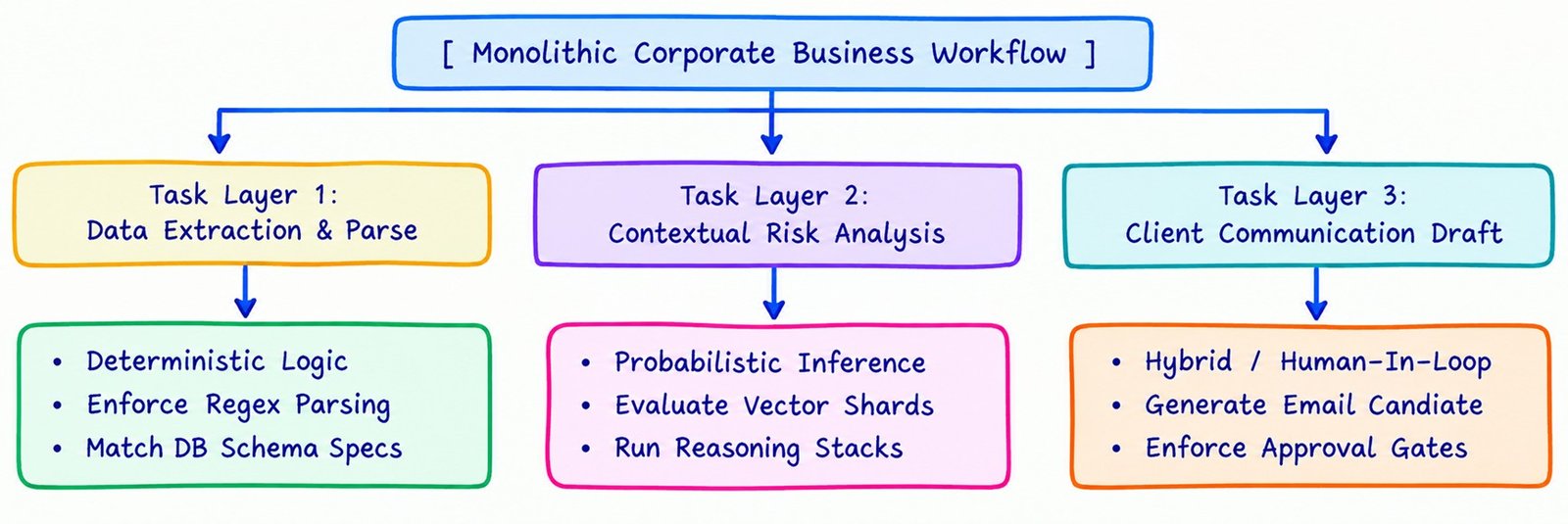
Each deconstructed task is analyzed and assigned to one of three processing buckets:
-
Deterministic Tasks: Operations that require absolute data precision and have zero tolerance for variability (e.g., executing financial ledger entries, parsing transaction IDs, or validating schema configurations). These tasks are handled strictly by structured code and traditional databases.
-
Probabilistic Tasks: Operations characterized by unstructured input spaces, semantic nuance, or open-ended text interpretation (e.g., summarizing long legal contracts, extracting intent from customer emails, or synthesizing cross-functional reports). These tasks are ideal candidates for language model pipelines.
-
Hybrid (Human-in-the-Loop) Tasks: Operations that combine probabilistic text generation with high-impact corporate actions (e.g., changing a client’s investment portfolio or approving an enterprise credit line). These tasks require generative models to create draft options, but must route the final execution through a human validation gate.
2. The Portfolio Prioritization Matrix
Enterprises frequently struggle with competing demands for AI resources from different business units. To maximize return on investment, engineering leaders must evaluate every proposed AI use case across a standardized matrix that weighs Strategic Business Value against Technical Delivery Feasibility.
The following prioritization table provides a structured evaluation framework for enterprise AI initiatives:
| Assessment Vector | High-Value / High-Feasibility Indicators | Low-Value / Low-Feasibility Indicators | Architectural Impact Mapping |
|---|---|---|---|
| Data Readiness & Lineage | Centralized, cleanly structured data available in modern warehouses (e.g., Amazon S3, Snowflake). Clear ownership and metadata definitions. | Data trapped in legacy on-premises silos, unstructured scan images, or lacking clear security classifications. | TOGAF Phase C (Data): Directly dictates whether you can build a clean RAG context pipeline. |
| Economic Unit Viability | High-volume, low-latency tasks where semantic caching can eliminate model costs for repeating queries. | Low-volume, long-context tasks that require running massive multi-step reasoning steps for every single call. | AI FinOps Core Metrics: Determines whether the cost per task will exceed the business value. |
| Compliance & Safety Surface | Internal productivity tooling with low risk exposure and limited data access requirements. | High-visibility, customer-facing interfaces managing sensitive PII, health information, or automated asset movements. | Systemic Risk Drift Controls: Dictates the complexity of the guardrail and evaluation layers you will need. |
| Core Workflow Impact | Eliminates manual bottleneck operations, reducing processing times from days to minutes. | Minor cosmetic updates to existing software interfaces that provide little to no operational cost reduction. | TOGAF Phase B (Business): Measures direct improvements in enterprise operational velocity. |
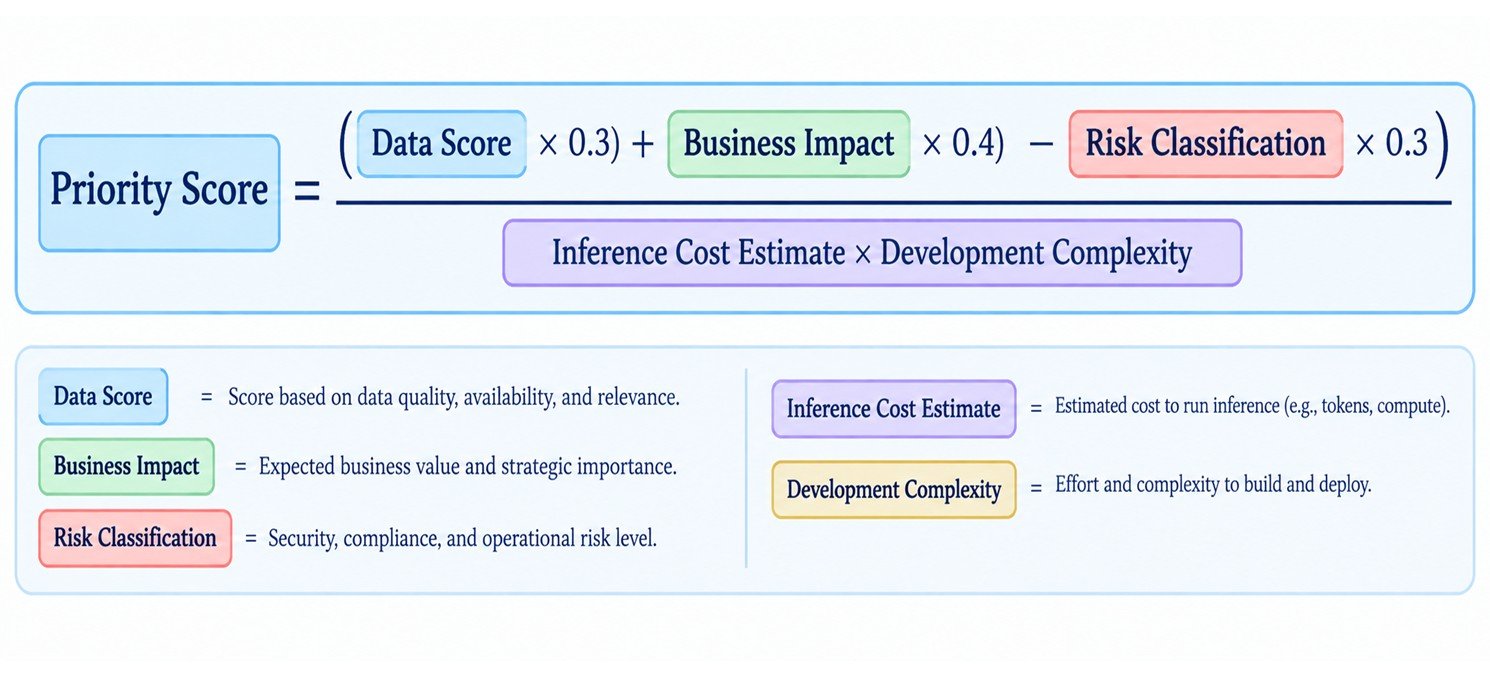
To calculate an objective priority score across competing projects, teams can use the following scoring equation during portfolio reviews:
Deep-Dive: The Data Readiness Assessment Template
Calculating a precise decimal value for the Data Score prevents subjectivity from skewing portfolio prioritization gates. Enterprise architects must evaluate the target use case's data ecosystem across four foundational pillars, assigning a decimal score between 0.0 and 1.0 for each.
1. The Four Pillars of AI Data Readiness
-
Pillar 1: Structural Accessibility & Interface Gravity
- 0.9 to 1.0 (Optimal): Data is consolidated in centralized cloud data warehouses (e.g., Snowflake, Amazon S3) with active, native connector patterns built into the Model Gateway fabric.
- 0.4 to 0.8 (Moderate): Data lives within decoupled relational databases or standard SaaS platforms requiring custom API connector patterns or batch ETL extraction runs.
- 0.0 to 0.3 (Critical): Data is trapped inside legacy, on-premises mainframes, unstructured scanned network images, or localized file systems lacking external API access layers.
-
Pillar 2: Semantic Cleanliness & Token Density
- 0.9 to 1.0 (Optimal): Content is natively text-searchable, token-dense, and cleanly formatted in structured JSON or Markdown text schemas with minimal non-breaking formatting noise.
- 0.4 to 0.8 (Moderate): Documents contain high visual layout noise, such as nested tabular multi-page matrices, embedded charts, or un-indexed PDFs requiring optical character recognition (OCR) preprocessing.
- 0.0 to 0.3 (Critical): Source materials consist of un-segmented raw transaction streams, handwritten fields, poor audio files, or un-curated chat logs suffering from extremely low information density.
-
Pillar 3: Metadata Context & Taxonomy Classification
- 0.9 to 1.0 (Optimal): Data assets feature rich, programmatically accessible metadata tags, explicit document lineage trees, and rigorous classification markers matching corporate policy models.
- 0.4 to 0.8 (Moderate): Base documents have basic structural metadata (e.g., file creation timestamps, author IDs) but lack semantic chunk tags or domain-specific classification parameters.
- 0.0 to 0.3 (Critical): Documents are entirely un-indexed, lack structural taxonomy schemas, and contain no version history or tracking attributes.
-
Pillar 4: Security, Privacy, and Sovereign Boundaries
- 0.9 to 1.0 (Optimal): Clear, documented data ownership boundaries are established. Content is entirely pre-cleared for processing under generic corporate security baseline guidelines.
- 0.4 to 0.8 (Moderate): Payload fields contain mixed-tier classifications requiring low-latency regular expression filters or basic rule-based masking configurations at the ingress perimeter.
- 0.0 to 0.3 (Critical): Inputs actively process un-segregated cross-border personal records, highly regulated health information, or strict trade secrets requiring geographically pinned cloud isolation zones.
2. The Final Data Score Calculation
To find the exact decimal metric to plug into your Priority Score equation, add the four values together and divide by four:
Data Score = (Pillar 1 Score + Pillar 2 Score + Pillar 3 Score + Pillar 4 Score) / 4
Technical Action Ledger for Architects
| Calculated Data Score | Maturity Tier | Architectural Action Required |
|---|---|---|
| 0.90 to 1.00 | High Readiness | Greenlight directly to the Product Definition Canvas gate. Pipeline requires zero custom ETL engineering. |
| 0.40 to 0.89 | Conditional Readiness | Phase a 2-week data staging track into the sprint backlog to build custom API connectors and OCR preprocessing pipelines. |
| 0.00 to 0.39 | Severe Structural Gap | Halt deployment pipeline. The metric fails platform security baselines. Initiative is rejected until dedicated data engineering teams extract, classify, and secure the data domain. |
3. The Product Definition Canvas
Once a use case passes the portfolio prioritization gate, it is formalized within a Product Definition Canvas.
This document serves as the formal architectural contract (TOGAF 10 Architecture Statement of Work) that aligns product managers, enterprise architects, and security teams on application boundaries.
The canvas must explicitly document three core operational parameters:
-
The User Interaction Paradigm: Specifies whether the system operates:
- Synchronously: Real-time conversational chat workspaces.
- Asynchronously: Background batch processing of large document repositories.
- Autonomously: Independent AI agents executing multi-step tasks across external APIs.
-
Data Security Boundaries: Defines the specific data classifications the application is cleared to process, mapping out the precise encryption, data masking, and multi-tenant isolation rules required.
-
The Target Evaluation Metrics: Establishes the specific baseline scores the application must achieve on golden datasets (e.g., minimum faithfulness scores for RAG systems) before it can be promoted to production.
4. Intelligence Calibration: Right-Sizing the Cognitive Stack
A common anti-pattern in enterprise AI development is over-engineering — using a highly expensive frontier model for simple text classification tasks that could be handled faster and more cost-effectively by a small language model or deterministic code.
Intelligence Calibration is the practice of analyzing the complexity of a task and matching it with the most efficient, cost-effective tool in your technology stack.
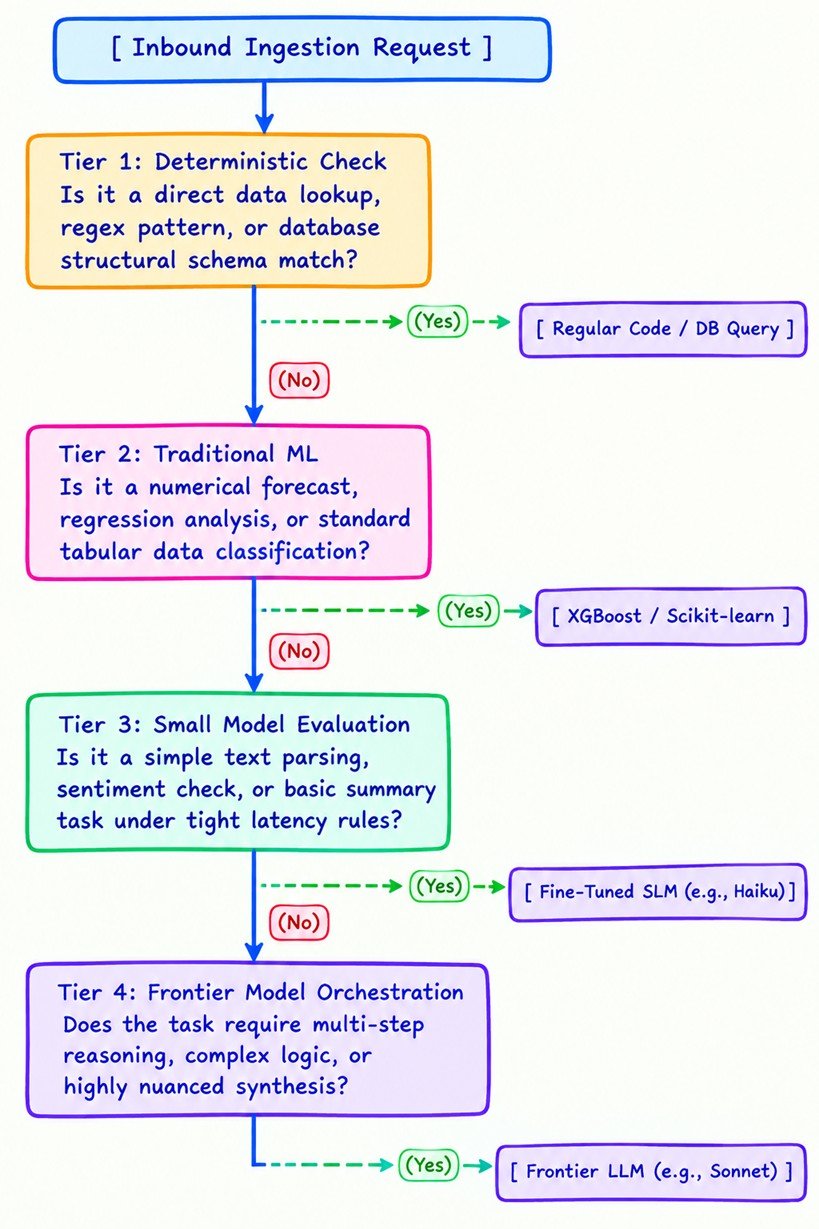
By systematically routing requests through this tiered intelligence stack, the enterprise platform can protect its compute resources, dramatically lower total token consumption, and maintain low latency across its application portfolio.
Architectural Disclaimer
The technical frameworks, architectural patterns, and systemic design guidelines presented in this text are intended solely for general enterprise software engineering, software platform development, and data infrastructure design optimization. They do not constitute professional technology deployment certifications, legal compliance guarantees, or operational advice for high-risk critical health or safety systems.