The Architectural Steering Engine - Portfolio Management, Lifecycle Governance, and Model Retirement
Introduction
The true test of an enterprise technology leader is not simply how fast their teams can launch new applications, but how effectively they can maintain control over those systems as they evolve.
Once an organization moves past its initial deployments and enters the phase of continuous operations, it encounters a new architectural challenge: Model Sprawl.
Without strict governance, an enterprise can quickly find itself supporting hundreds of redundant prompts, outdated software dependencies, and unoptimized model versions across different business units.
To prevent this complexity from stalling development, technology executives must deploy an Architectural Steering Engine.
Operating within TOGAF 10 Phase H (Architecture Change Management), this governance framework provides the tools and processes needed to manage your AI portfolio, track application lifecycles, and safely retire outdated models without disrupting core business workflows.
1. Portfolio Management: The AI Architecture Steering Committee
Managing a large portfolio of probabilistic systems requires a structured approach to evaluation that balances technical feasibility with business value.
The Architectural Steering Engine establishes a formal AI Architecture Steering Committee that meets regularly to audit the health of active systems and guide deployment strategies.
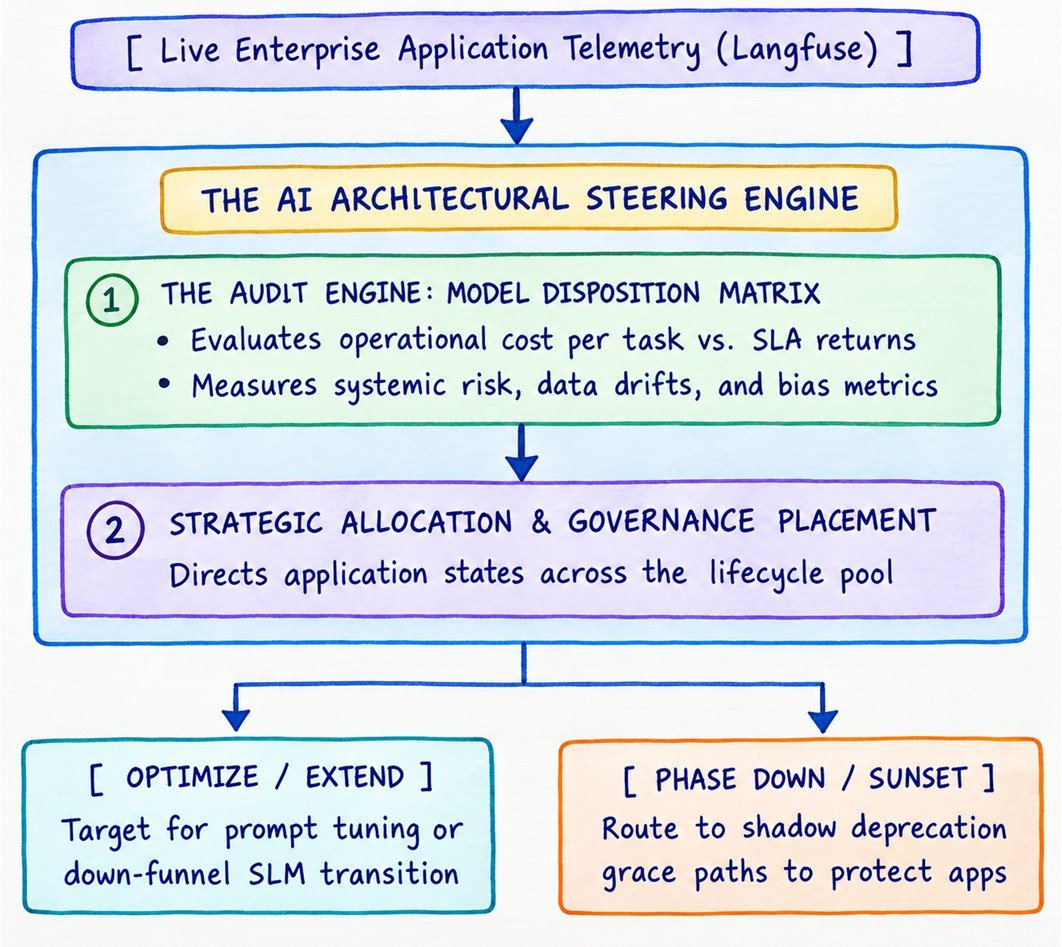
The committee monitors the health of all live software implementations using a data-driven Model Disposition Matrix. This framework evaluates applications across four key pillars:
-
Financial Unit Performance: Identifies applications whose operational costs have exceeded budgets due to changes in user request volume or context window sizes.
-
Accuracy and Alignment Integrity: Reviews real-time evaluation logs to catch applications suffering from hallucination spikes or performance drift caused by shifts in user data.
-
Regulatory Compliance Posture: Audits pipelines against evolving global data protection and AI governance mandates (such as the EU AI Act or ISO/IEC 42001 standards).
-
Business Utility Value: Confirms that the application is still actively helping the organization hit its operational velocity and cost-reduction KPIs.
2. Lifecycle Governance: The Triggers of Architectural Mutation
A model cannot remain unmanaged in production forever.
Upstream cloud providers constantly cycle their infrastructure, new open-weights small models (SLMs) regularly outperform older frontier versions, and target business needs naturally shift over time.
To manage these transitions smoothly, the platform team must guide all assets through a standardized, well-defined lifecycle matrix:
| Operational Lifecycle State | Definition & Platform Access Constraints | Data Logging & Observation Configuration | Target Core Transition Metrics |
|---|---|---|---|
| Active Production | The baseline deployment version. Cleared to receive all live client traffic from internal application gateways. | Full logging enabled. Real-time telemetry streams directly into Langfuse dashboards to track cost and quality benchmarks. | Normal operations. Monitored for sudden latency spikes or drops in accuracy scores. |
| Maintenance Shadowing | The candidate version is running in the background. The gateway routes a fraction of production traffic to it to test performance. | Dual-path logging active. The gateway records side-by-side performance comparisons between the baseline and candidate systems. | Requires a minimum safety evaluation match score of ≥ 90% compared to the baseline before promotion. |
| Deprecation Grace | The version is marked for sunset. It remains accessible to legacy codebases, but blocks onboarding for new applications. | Tracking enabled. The platform logs runtime exceptions and flags legacy application heads to update their endpoints. | Fixed grace window (typically 30 to 90 days) to migrate applications to the new default alias. |
| Formal Decommissioning | The version is completely disconnected. The gateway revokes its routing endpoints and purges its storage buckets. | Access logs archive to cold storage. The runtime environment throws explicit error flags for any unmigrated calls. | Zero active dependencies allowed across the enterprise footprint. |
3. Programmatic Model Retirement: The Immutable Alias Proxy
The primary risk when sunsetting an older model or prompt template is breaking down-funnel integrations.
If individual software teams hardcode direct model identifiers inside their code repositories, removing that model version will cause immediate application failures across the enterprise.
To eliminate this vulnerability, the Architectural Steering Engine isolates all application code behind an Immutable Alias Proxy managed through AWS Systems Manager (SSM) Parameter Store.
When a model reaches the end of its lifecycle, platform engineers can update its global routing pointer with a single configuration change, instantly updating all connected systems.
The implementation script below details this pattern. It acts as a secure platform gateway that checks dynamic configuration settings in real time, routes requests to the currently approved model, and automatically emits sunset warnings to Langfuse tracing spans if an application calls a version marked for retirement.
import os
import json
import logging
from typing import Dict, Any, Tuple
from fastapi import FastAPI, HTTPException, Header
from pydantic import BaseModel
import boto3
from langfuse import Langfuse

# Configure Steering Engine Logger
logging.basicConfig(level=logging.INFO)
logger = logging.getLogger("Architectural-Steering-Engine")

app = FastAPI(title="Architectural Steering Engine Gateway", version="1.0.0")

try:
    # Initialize Core Security & Telemetry Clients
    ssm_client = boto3.client("ssm", region_name=os.getenv("AWS_REGION", "us-east-1"))
    bedrock_runtime = boto3.client("bedrock-runtime", region_name=os.getenv("AWS_REGION", "us-east-1"))

    langfuse_telemetry = Langfuse(
        public_key=os.getenv("LANGFUSE_PUBLIC_KEY"),
        secret_key=os.getenv("LANGFUSE_SECRET_KEY"),
        host=os.getenv("LANGFUSE_HOST", "https://langfuse.com")
    )
except Exception as e:
    logger.critical(f"Steering Engine failed to start. Client initialization aborted: {str(e)}")
    raise

# --- Schemas ---
class RoutingRequest(BaseModel):
    user_prompt: str
    application_id: str
    requested_alias: str  # e.g., "core-intelligence-tier"

class RoutingResponse(BaseModel):
    response_text: str
    resolved_model_id: str
    lifecycle_status: str

# --- Platform Configuration Resolver ---
def resolve_model_routing_metadata(alias_name: str) -> Tuple[str, str]:
    """
    Queries AWS SSM Parameter Store to resolve the latest deployment target metadata.
    Decouples application code names from changing provider version identifiers.
    """
    parameter_path = f"/enterprise/ai/routing/{alias_name}"
    try:
        response = ssm_client.get_parameter(Name=parameter_path, WithDecryption=True)
        config = json.loads(response["Parameter"]["Value"])
        return config["target_model_id"], config["lifecycle_status"]
    except ssm_client.exceptions.ParameterNotFound:
        logger.error(f"Routing alias lookup configuration missing path: {parameter_path}")
        raise HTTPException(status_code=404, detail="Requested architectural routing alias undefined.")
    except Exception as e:
        logger.error(f"SSM Parameter Store synchronization error: {str(e)}")
        raise HTTPException(status_code=500, detail="Configuration registry lookup failure.")

def invoke_infrastructure_model(model_id: str, prompt: str) -> str:
    """Executes model inference via Amazon Bedrock with strict runtime boundary controls."""
    try:
        body = json.dumps({
            "anthropic_version": "bedrock-2023-05-31",
            "max_tokens": 512,
            "messages": [{"role": "user", "content": prompt}]
        })
        response = bedrock_runtime.invoke_model(
            body=body,
            modelId=model_id,
            accept="application/json",
            contentType="application/json"
        )
        return json.loads(response.get("body").read())["content"]["text"]
    except Exception as e:
        logger.error(f"Upstream runtime delivery crash on target model {model_id}: {str(e)}")
        raise HTTPException(status_code=502, detail="Upstream core inference engine timeout.")

# --- Core Steering Gateway Endpoint ---
@app.post("/api/v1/steer/execute", response_model=RoutingResponse)
def evaluate_and_route_request(payload: RoutingRequest):
    # 1. Resolve Dynamic Model Configuration from SSM Parameter Store
    model_id, lifecycle_status = resolve_model_routing_metadata(payload.requested_alias)

    # 2. Block Requests If The Model Is Fully Decommissioned
    if lifecycle_status == "DECOMMISSIONED":
        logger.critical(f"Security Alert: App {payload.application_id} attempted to call decommissioned alias {payload.requested_alias}")
        raise HTTPException(
            status_code=410,
            detail="The requested model architecture version has been decommissioned. Access Denied."
        )

    # 3. Initialize Observation Context within Langfuse
    trace = langfuse_telemetry.trace(
        name="Architectural-Steering-Ingress",
        user_id=payload.application_id,
        metadata={
            "routing_alias": payload.requested_alias,
            "resolved_model_id": model_id,
            "lifecycle_status": lifecycle_status
        }
    )

    # 4. Inject Telemetry Warnings If App Is Using A Deprecated Version
    if lifecycle_status == "DEPRECATION_GRACE":
        logger.warning(f"Deprecation Warning issued to application: {payload.application_id} for alias: {payload.requested_alias}")
        trace.update(tags=["USE_OF_DEPRECATED_ASSET"])
        trace.score(
            name="Lifecycle-Compliance-Violation",
            value=0.0, # Flag zero compliance score to trigger engineering alerts
            comment="Application is using an asset inside its deprecation grace window. Migration required."
        )

    # 5. Process Inference via Resilient Execution Layer
    inference_span = trace.span(name=f"Execute-Model-{payload.requested_alias}")
    try:
        output_text = invoke_infrastructure_model(model_id, payload.user_prompt)
        inference_span.end(output={"status": "SUCCESS"})
    except Exception as exc:
        inference_span.end(error=str(exc))
        raise

    # 6. Return Clean Payload Response to Client Application
    return RoutingResponse(
        response_text=output_text,
        resolved_model_id=model_id,
        lifecycle_status=lifecycle_status
    )
By routing all software requests through this dynamic steering layer, your enterprise platform can eliminate direct coupling between application logic and shifting vendor versions.
3.1 The Proactive Dependency Discovery Protocol
Transitioning a foundational model or a production prompt template from an Active Production state into Deprecation Grace introduces severe operational risk if down-funnel consumers are not explicitly mapped. While formal architecture registries capture authorized workflows, developers frequently spin up "shadow integrations", unvetted microservices or ad-hoc analytics scripts that directly consume internal AI endpoints without formal registration.
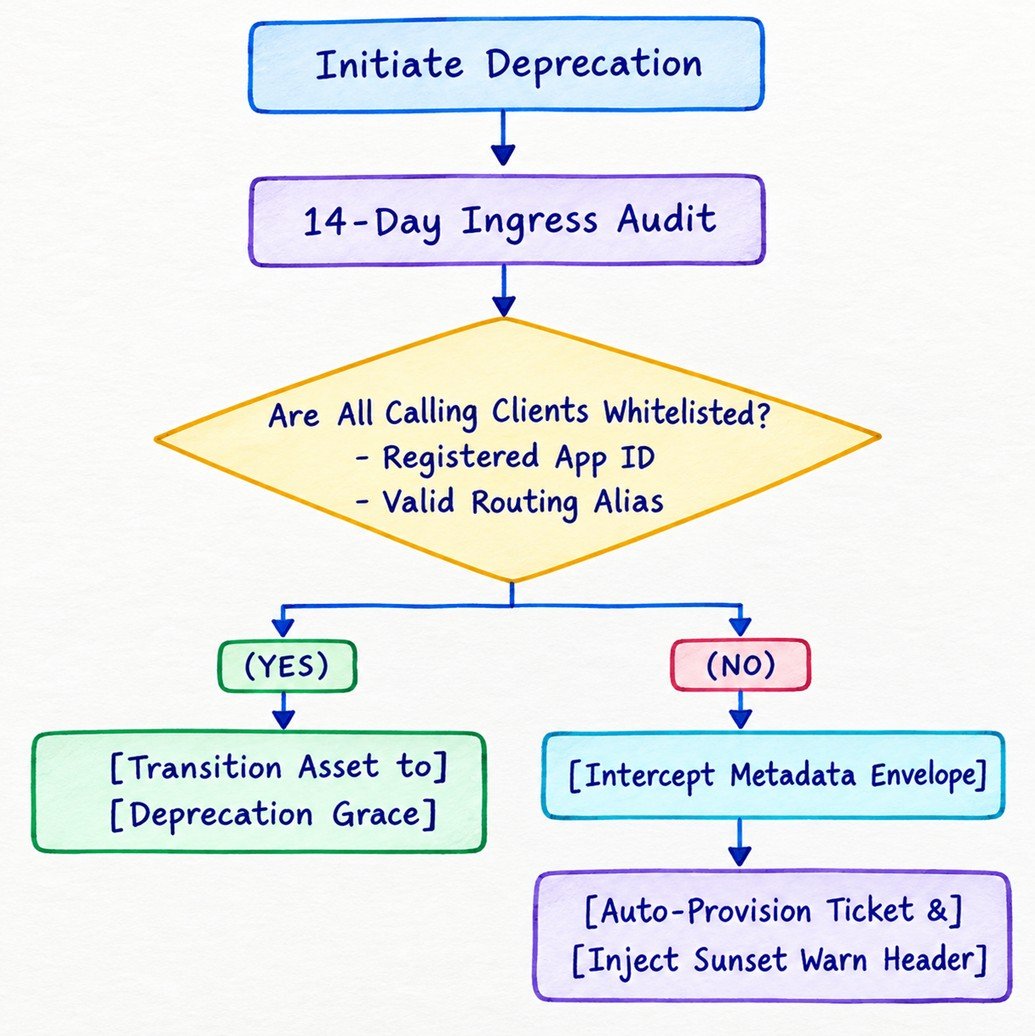
To prevent catastrophic system breakages during model deprecation, the platform enforces an automated Proactive Dependency Discovery Protocol powered by runtime network telemetry and metadata tracing.
The engine provides the architectural boundaries, change controls, and real-time observability needed to continuously evolve your systems, control technical debt, and ensure stable, secure operations as your AI portfolio expands across the enterprise.
1. The Ingress Trajectory Audit Window
The moment an architecture change order flags an asset for lifecycle demotion, the Model Gateway automatically initiates a mandatory, low-overhead 14-day Ingress Trajectory Audit. Rather than relying on manual, outdated documentation, the gateway's routing fabric acts as a live network sniffer, parsing the metadata envelope of every incoming API invocation hitting that specific model checkpoint.
The discovery engine profiles and logs the following runtime coordinates for every unmapped transaction:
- The Ingress Origin Path: The originating private IP address, virtual private cloud (VPC) endpoint subnets, and Kubernetes namespace identifiers of the client application cluster.
- The Identity Signature: The caller's IAM role, OpenID Connect (OIDC) identity claim, or client-supplied
application_idstring header. - Volumetric Metrics: The transaction frequency, peak concurrency patterns, and the average daily token consumption velocity of the calling entity.
2. Automated Ticket Engineering & Boundary Remediation
If the discovery protocol identifies a calling client whose identity parameters or routing paths do not match the authorized whitelist registered in the enterprise architecture database, the steering engine bypasses manual notifications and executes automated boundary remediation:
- Dynamic Ticket Provisioning: The gateway intercepts the unmapped request metadata and programmatically calls internal infrastructure management APIs (such as Jira Service Management or ServiceNow) to provision an engineering remediation ticket. This ticket automatically outputs the exact structural path, source code container tags, and token consumption graphs of the offending microservice.
- Downstream Warning Injection: Simultaneously, the gateway alters its runtime response headers for that specific client. It injects a non-breaking, standard payload metadata block,
X-Enterprise-AI-Sunset: TRUE; Target-Date: YYYY-MM-DD; Migration-Path: /v2/intelligence/core, forcing downstream client logs to emit visible compilation warnings, alerting application developers to migrate their endpoints before the decommissioning circuit breaker trips.
3.2 The Semantic Token Mapping Layer for Prompt Translation
A major bottleneck when executing programmatic model retirement is the structural variance in how different foundation models parse input text. A prompt template meticulously optimized for a legacy frontier model (e.g., specific XML tags used by Anthropic checkpoints) often degrades significantly in performance or outputs invalid syntax when hot-swapped to an alternate provider or a newly released Small Language Model (SLM). To break this architectural "prompt locking," the steering fabric deploys a Semantic Token Mapping Layer that functions as an automated prompt translation and normalization runtime.
1. Structural Context Normalization
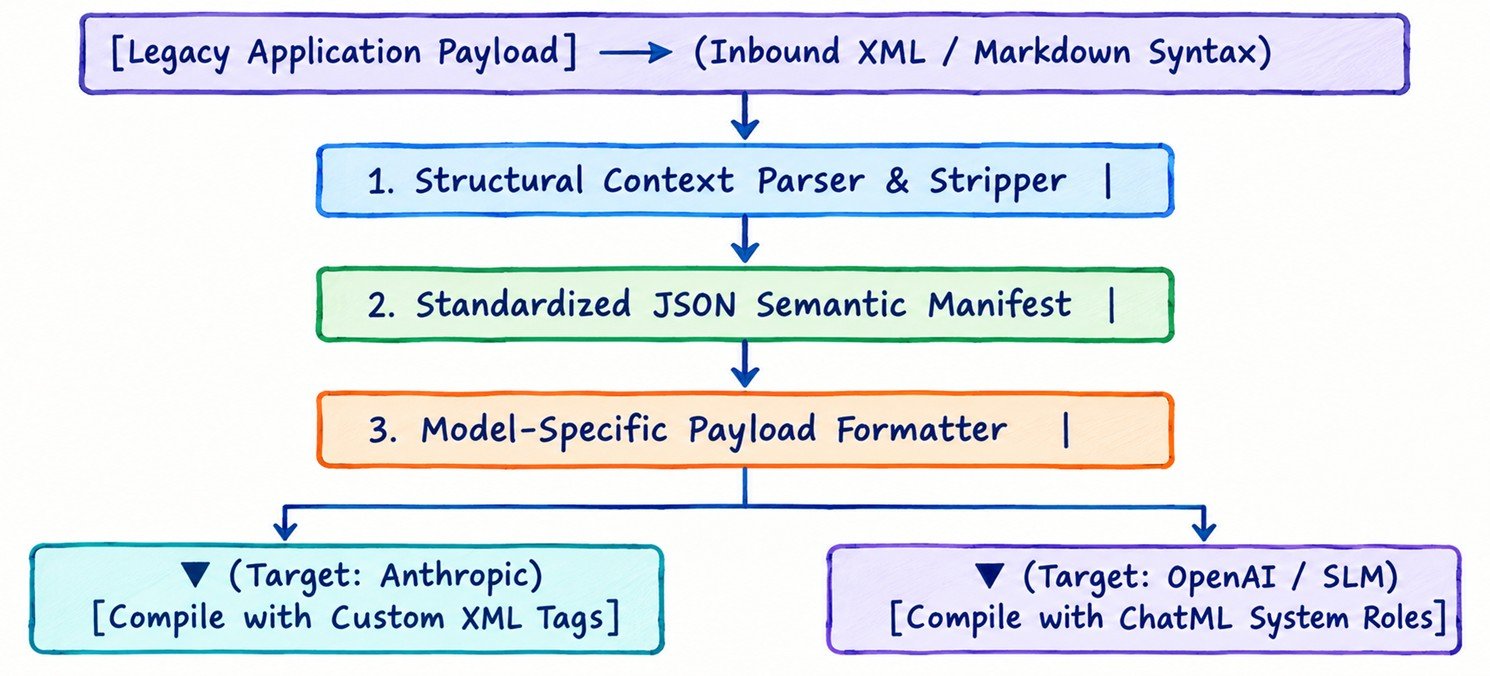
The Model Gateway interceptor does not pass raw, un-vetted ingress strings directly to newly targeted endpoints. When the AWS SSM Parameter Store registers a model swap event along a routing path, the gateway automatically passes the prompt string through an isolated Context Normalization Engine.
This layer executes line-rate regex manipulation and lightweight abstract syntax tree (AST) token parsing to perform two critical tasks:
- Syntax Stripping: The engine identifies and extracts provider-specific structural constructs, such as legacy
Human:/Assistant:conversational turn markers, custom system instruction blocks, or precise multi-shot XML structures (<context>,<instructions>). - Semantic Extraction: The raw intent, system guidelines, and user variable data are isolated and compiled into a temporary, provider-agnostic Standardized JSON Semantic Manifest.
2. Dynamic Payload Re-Compiling
Once the core semantic parameters are extracted into the intermediate manifest, the mapping layer passes the clean data payload through a target-specific compilation schema module. This module dynamically injects the appropriate formatting tags native to the newly active model architecture:
- ChatML / OpenAI Transitions: If the target model utilizes standard ChatML formatting, the engine dynamically translates the raw prompt block into structured system, user, and assistant object arrays inside the request payload body.
- Open-Source SLM Transitions (e.g., Llama/Mistral): If traffic is routed to a localized open-weights SLM, the engine automatically wraps the string context with the correct physical token indicators required by that model's tokenizer topology (e.g., injecting strict
[INST]and[/INST]delimiters).
By hosting this translation layer within the proxy middleware, the platform guarantees that underlying foundational models can be hot-swapped atomically at midnight without causing formatting regression errors or requiring application code redeployments.
3.3 The Cold Storage Archival & Audit Ledger
The final state in lifecycle governance, Formal Decommissioning, cannot simply mean deleting server endpoints and clearing active memory blocks. In highly regulated enterprise environments governed by frameworks like the EU AI Act, NIST AI Risk Management Framework, and ISO/IEC 42001, an organization must maintain strict historical auditability. Even after an AI model, prompt version, or weights checkpoint is completely removed from live compute routing, the architecture must preserve an unalterable, forensic record of how that intelligence layer operated during its production lifecycle.
The Cold Storage Archival & Audit Ledger operationalizes this requirement through immutable state snapshots and cryptographic retention zones.
1. The Forensic Snapshot Envelope
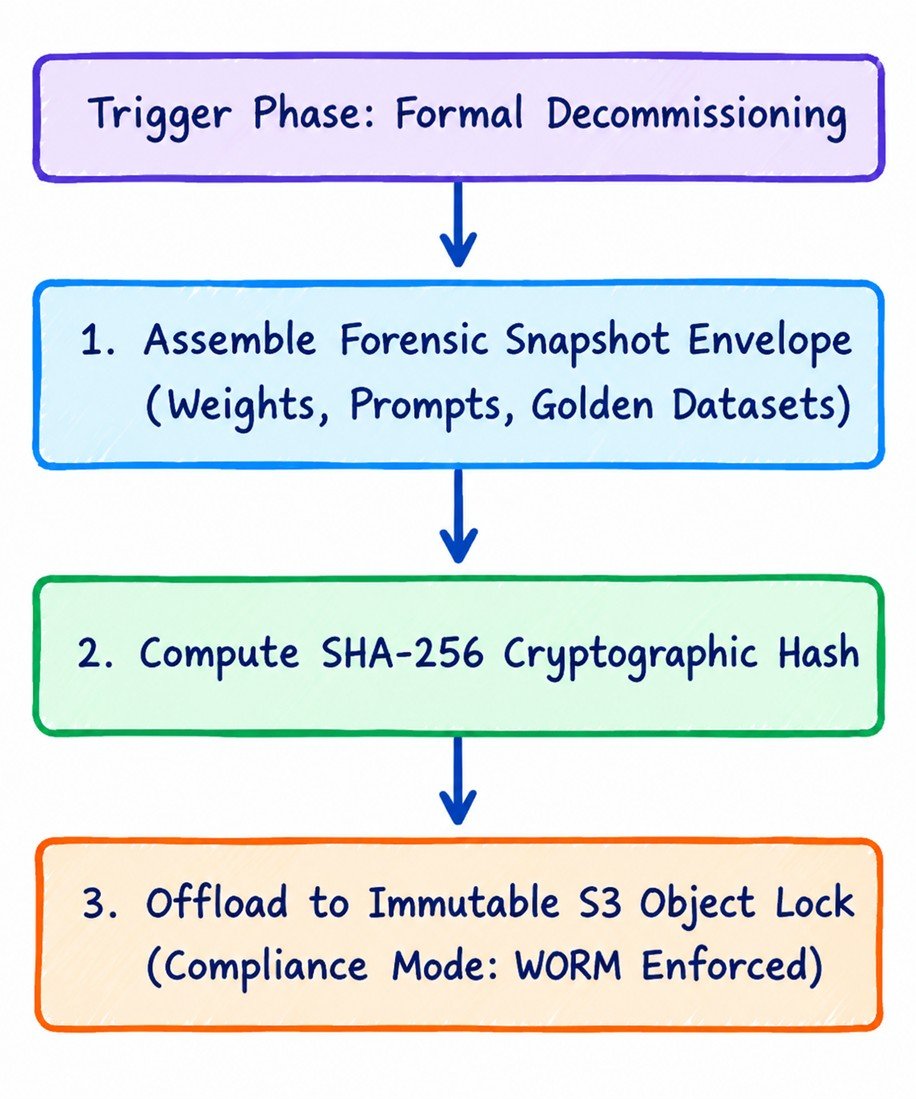
The moment an asset crosses the operational threshold into a decommissioned state, the platform blocks all client runtime connections and automatically triggers an automated pipeline to assemble a comprehensive Forensic Snapshot Envelope. This envelope acts as an isolated package containing every data artifact needed to completely reconstruct the system's decision-making state for future legal or internal audits.
The snapshot engine packages the following critical system assets:
- The Model Reference Architecture: If the application ran on a localized open-weights model, the specific weights checkpoint, hyperparameter files, and custom tokenizer matrices are bundled. For commercial API targets, the exact immutable vendor version string (e.g.,
anthropic.claude-v3-sonnet:0) is documented. - The Prompt Matrix Ledger: A complete version history of all production prompt templates, context-window system descriptions, and model routing parameters used over the lifecycle of the application.
- The Golden Calibration Dataset: The exact multi-shot evaluation datasets and historical testing metrics used to clear the asset during its initial CI/CD release gate.
2. Immutable Cryptographic Retention (WORM Storage)
To satisfy corporate legal verification requirements, the finalized Forensic Snapshot Envelope must be protected from accidental deletion, modification, or malicious tampering by internal administrators. The platform architecture guarantees this security by offloading the snapshot to a hardened storage layer utilizing Amazon S3 Object Lock configured in strict Compliance Mode:
- Write-Once-Read-Many (WORM) Enforcement: Once the snapshot file is written to the targeted compliance storage bucket, S3 blocks all drop, delete, or overwrite commands from any user, including root administrators, until a preconfigured corporate retention period (typically 7 to 10 years) has expired.
- Cryptographic Lineage Logging: The archiving service computes a SHA-256 cryptographic hash of the entire data envelope upon creation and records this digital signature to a read-only, distributed ledger. If a regulatory authority challenges a historical model output years later, the enterprise can pull the archived file from cold storage, verify its matching SHA signature, and confidently recreate the exact system environment to prove compliance.
Architectural Disclaimer
The technical frameworks, architectural patterns, and systemic design guidelines presented in this text are intended solely for general enterprise software engineering, software platform development, and data infrastructure design optimization. They do not constitute professional technology deployment certifications, legal compliance guarantees, or operational advice for high-risk critical health or safety systems.