Conclusion — The AI Production Factory Blueprint
Introduction
The journey from a fragile, hand-crafted Proof of Concept to an industrialized enterprise asset finishes at this exact coordinates: The AI Production Factory Blueprint.
Throughout this book, we have systematically pulled apart the myths surrounding Generative AI implementation, exposing the stark reality that a successful demo does not equal a production system.
Viability at scale demands that we abandon ad-hoc engineering in favour of structural repeatability, deterministic guardrails, and rigid cost accounting.
This blueprint serves as the final, immutable architectural ledger of The AI Architectural North Star. It condenses every operational phase, technological integration pattern, and capability gate detailed across this text into a unified corporate execution topology.
1. The End-to-End Factory Execution Topology
Moving an enterprise capability from a fragile concept to an industrialized runtime environment requires a highly structured, repeatable execution framework. As mapped in figure below, the complete lifecycle of the AI Production Factory integrates directly with the continuous feedback loops of the TOGAF 10 Architecture Development Method (ADM) across four distinct stages:
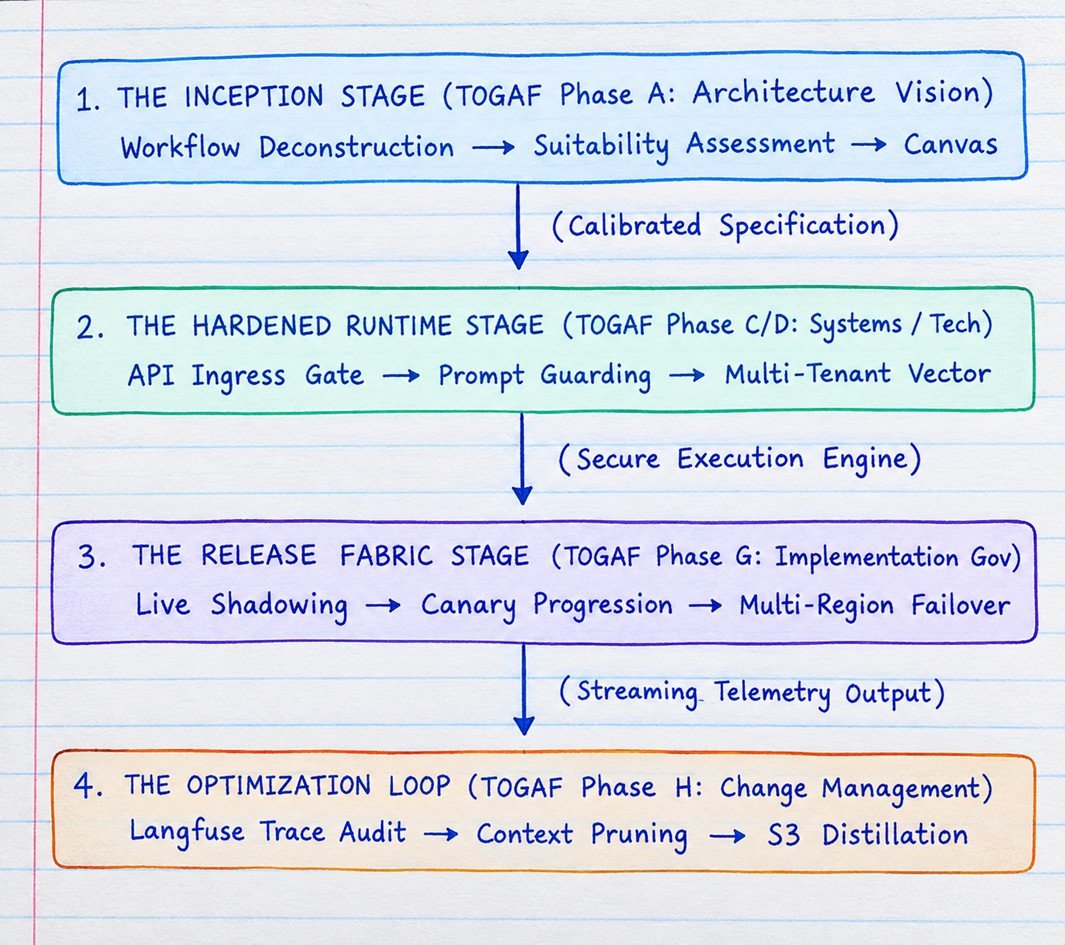
- The Inception Stage (TOGAF Phase A: Architecture Vision): Deconstructs raw workflows and runs suitability assessments to generate a calibrated specification canvas.
- The Hardened Runtime Stage (TOGAF Phase C/D: Information Systems & Technology Architecture): Establishes the secure execution engine by enforcing API ingress gates, prompt guarding, and multi-tenant vector isolation boundaries.
- The Release Fabric Stage (TOGAF Phase G: Implementation Governance): Manages the deployment lifecycle through live traffic shadowing, canary progressions, and automated multi-region failover protocols.
- The Optimization Loop (TOGAF Phase H: Architecture Change Management): Processes streaming telemetry output using Langfuse trace audits, context pruning, and S3 data distillation loops to continuously refine the system baseline.
2. The Comprehensive Systemic Checklist for Executive Sign-Off
Before any line-of-business (LOB) application is permitted to transition from staging environments into the live enterprise production fabric, it must satisfy every validation parameter across the core factory quadrants:
- Quadrant 1: Operational Security & Tenant Isolation
- Zero-Direct-Keys Enforced: All target model interactions route strictly through IAM-authenticated AWS Bedrock endpoints or the Model Gateway. No static API keys are hardcoded in application code repositories.
- Multi-Tenant Partition Verification: Vector index transactions systematically isolate multi-tenant workloads utilizing deterministic Pinecone Namespaces.
- Line-Rate Data Sanitization: Inbound queries pass through line-rate prompt guard checks, and outbound tokens are programmatically scanned to prevent PII leakage and data exfiltration.
- Quadrant 2: FinOps & Economic Calibration
- Active Semantic Caching: The application hooks directly into a shared Pinecone L2 cache Layer to capture repeating prompts, forcing token generation fees to zero for identical user interactions.
- Right-Sized Cognitive Stack: The workload utilizes a Cognitive Model Cascade, routing routine classification tasks to fine-tuned small language models (SLMs) and reserving expensive frontier models strictly for complex analytical reasoning.
- Granular Metadata Attribution: Every transaction streams custom metadata headers (
business_unit,application_id) to compute the exact running financial cost per successful business task.
- Quadrant 3: Continuous Quality Evaluation
- Automated Regression Gates: The deployment container hooks directly into a CI/CD validation script that runs simulated user transactions against localized golden datasets before release.
- Real-Time Quality Scoring: Live production text streams pass through an automated "LLM-as-a-Judge" evaluation process via Langfuse OpenTelemetry, continuously calculating faithfulness and accuracy metrics.
- Dynamic Fallback Readiness: Gateway circuit breakers are configured to automatically downgrade traffic routes to backup zones or stable fallback modules if response times spike or errors increase.
- Quadrant 4: Lifecycle Architecture & Resilience Engineering
- The Architectural Blast Radius Blueprint: Defines decoupled degradation matrices and gateway circuit breakers to handle foundational model provider outages without crashing the entire system.
- The Model Retirement Runbook: Establishes the quantitative criteria and zero-downtime hot-swapping protocols for deprecating legacy vendor versions.
3. Deep-Dive: Operational Security & Tenant Isolation
Deploying probabilistic, LLM-powered applications within an enterprise infrastructure framework introduces unique attack vectors and regulatory compliance risks. Unlike traditional deterministic software systems, AI platforms interact with dynamic, unpredictable data spaces. The Operational Security & Tenant Isolation Blueprint defines the strict architectural boundaries, cryptographic controls, and line-rate sanitization matrices necessary to enforce absolute data boundaries and protect corporate digital assets.
A. Cryptographic Identity & The Gateway Proxy Fabric (Zero-Direct-Keys)
To eliminate the risk of credential exposure and code repository leaks, the application architecture strictly forbids the storage, caching, or embedding of static API keys within containerized microservices or codebases. All foundational model interactions are brokered via an IAM-authenticated infrastructure proxy loop:
- Identity-Based Brokerage: Line-of-business applications authenticate to an internal Model Gateway using short-lived, ephemeral OpenID Connect (OIDC) tokens or native AWS IAM roles.
- The Model Gateway Encapsulation Layer: The Model Gateway acts as the sole custodian of upstream credentials. It dynamically fetches required provider secrets from a hardened vault (such as AWS Secrets Manager or HashiCorp Vault) at runtime. The gateway injects these credentials server-side directly into the outgoing TLS request to the target model provider endpoint (e.g., AWS Bedrock), ensuring keys never touch application log fabrics or client-side runtimes.
B. Multi-Tenant Partitioning via Deterministic Vector Namespaces
When building an Enterprise Knowledge Architecture that handles distinct corporate divisions or multiple external business clients, cross-tenant data pollution represents a catastrophic compliance failure. Rather than spinning up cost-prohibitive, separate database clusters for every entity, the platform achieves absolute logical data isolation within a shared infrastructure layer utilizing Pinecone Namespaces.
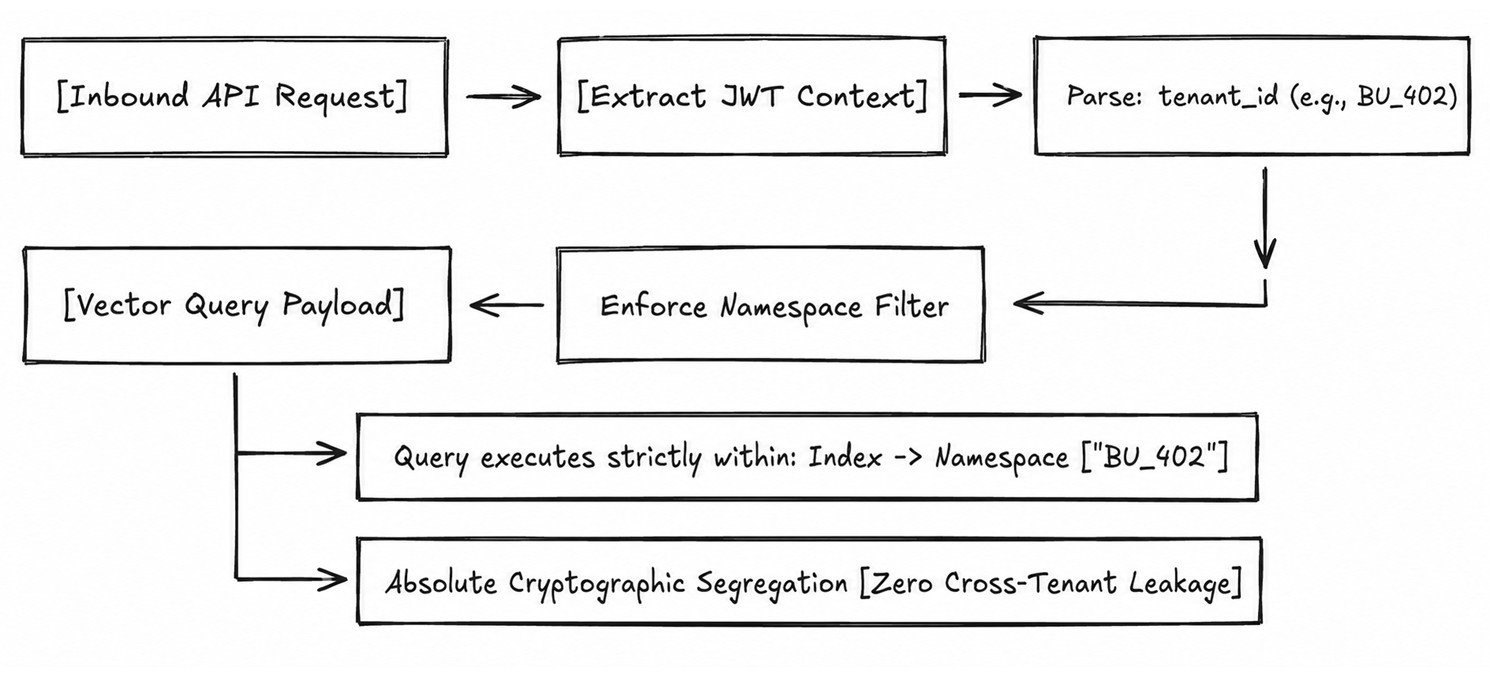
- Deterministic Route Injection: The middleware tier intercepts every inbound Vector Index transaction (upsert, query, delete) and extracts the authenticated tenant context from the incoming JSON Web Token (JWT).
- Isolated Index Routing: The system uses this extracted context to programmatically prefix all vector operations with a deterministic namespace identifier (e.g.,
Index.query(namespace="tenant_id_abc")). Pinecone strictly confines the mathematical nearest-neighbor search within that specific namespace boundary, providing absolute logical isolation and zero risk of cross-tenant data bleeding.
C. Line-Rate Ingress/Egress Data Sanitization
Probabilistic model context windows must be protected from external manipulation, and internal enterprise data must be guarded against exfiltration. The platform implements a two-way, non-blocking Line-Rate Sanitization Matrix operating at the gateway layer:
- Ingress Prompt Shielding: Every inbound string payload passes through a low-latency, line-rate interceptor before hitting the model engine. This layer uses lightweight classification models and regex engines to scan for prompt injection patterns, system-override anomalies, and malicious jailbreak payloads.
- Egress PII Token Obfuscation: Outbound text tokens stream directly through an automated data loss prevention (DLP) engine. The engine tokenizes and redacts sensitive Personally Identifiable Information (PII), including social security numbers, credit card strings, corporate financial markers, and internal IP addresses, before delivering the payload to the end-user client, closing the loop on potential data leaks.
4. Deep-Dive: The AI FinOps Unit Economics Framework
Deploying generative AI at enterprise scale requires abandoning speculative infrastructure budgeting in favor of rigid, transaction-level economic engineering.
The AI FinOps Unit Economics Framework provides the rigorous mathematical formulas, metadata attribution fabrics, and architectural caching methodologies required to achieve strict cost predictability and ensure positive margins across all line-of-business (LOB) workloads.
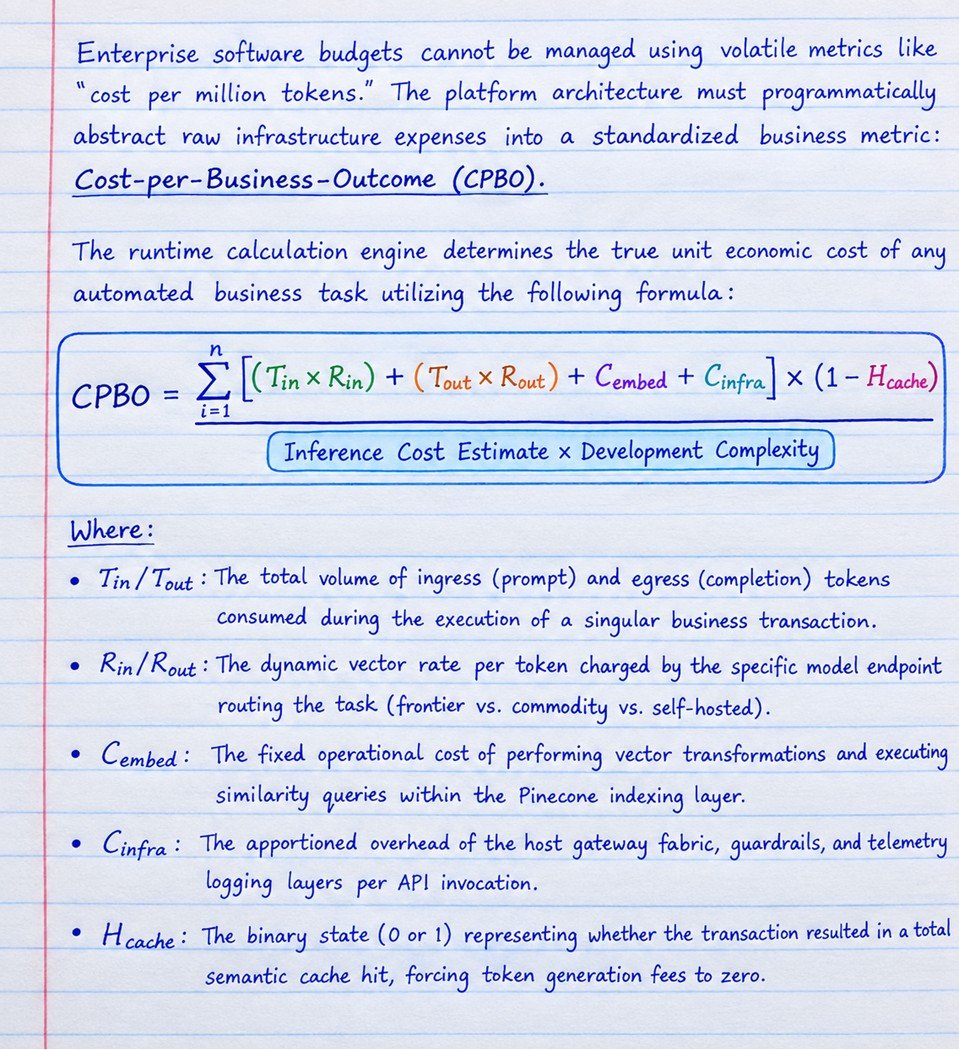
A. The Cost-per-Business-Outcome (CPBO) Formula
B. The Cache-Hit Amortization Matrix
To structurally lower the marginal cost of intelligence over time, the application tier hooks into a shared Pinecone L2 Semantic Cache Layer.
This layer uses vector similarity matching (with a rigid threshold of ≥ 0.96 cosine similarity) to capture repeating prompt patterns.
The financial scale benefits of the semantic cache are operationalized across three key parameters:
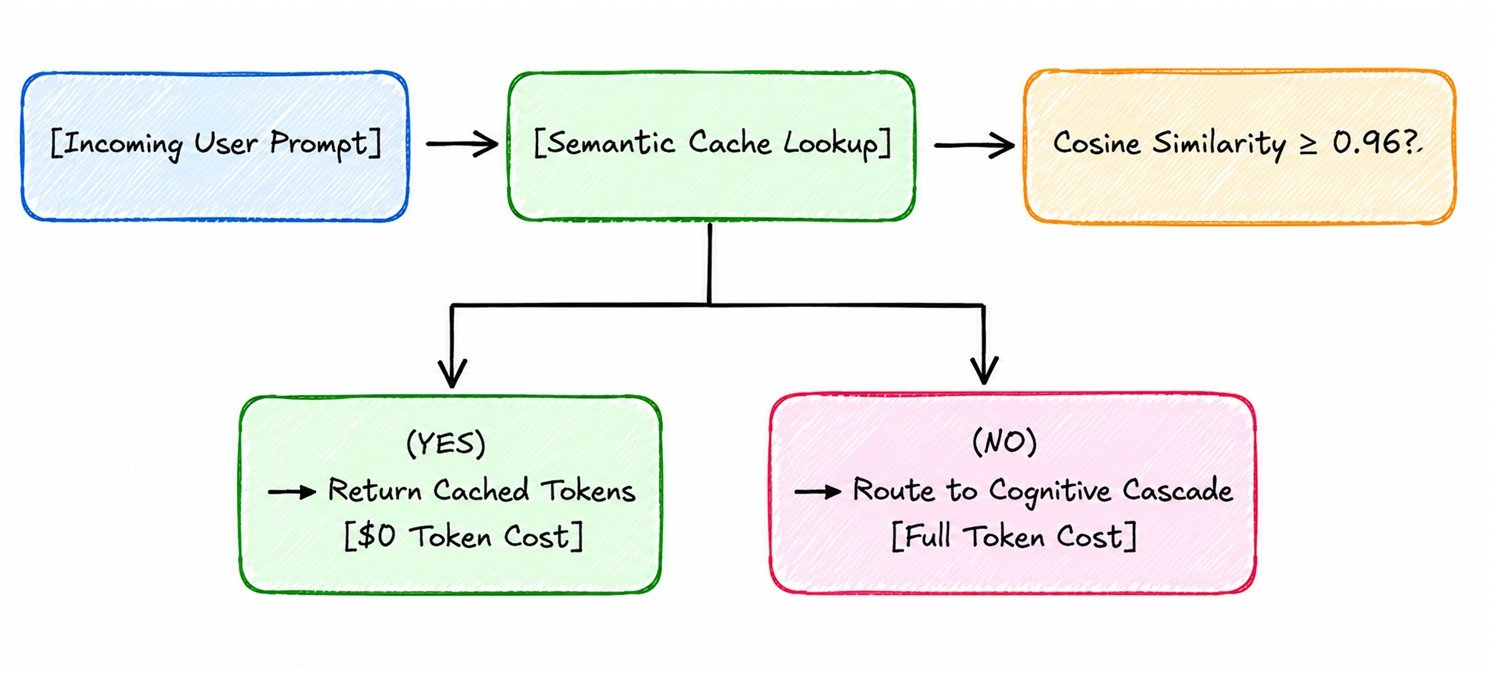
- Zero-Token Invalidation: When a cache hit occurs, the gateway bypasses the downstream foundation model entirely, resolving the transaction out of the local cache buffer. This forces the variable generation cost to exactly $0.00, protecting the enterprise from compounding costs during high-frequency user interactions.
- Prompt-Payload Warmup: The architecture mandates that common organizational data queries, seasonal reporting structures, and standard system prompts are pre-warmed and indexed within the cache during off-peak hours, driving down the overall morning scale cost of enterprise operations.
C. Granular Metadata Attribution & The Cognitive Cascade
To ensure absolute transparency, the API gateway enforces mandatory metadata injection on every payload envelope.
Every request must be programmatically stamped with immutable identifiers (business_unit, application_id, cost_center). These headers are streamed in real time to the enterprise billing ledger to calculate individual department resource consumption.
Simultaneously, workloads must execute via a Cognitive Model Cascade.
Routine tasks, such as text classification, entity extraction, and structural JSON parsing, are systematically routed to localized, hyper-efficient Small Language Models (SLMs).
Expensive frontier models are dynamically locked behind gatekeepers, reserved exclusively for unstructured analytical reasoning tasks that fail initial SLM verification.
5. Deep-Dive: The Probabilistic CI/CD & Drift Ledger
Deploying probabilistic systems into an enterprise production fabric requires an entirely new testing paradigm.
Traditional unit tests expect an exact, static output; LLM-powered applications, however, yield non-deterministic results that shift with every invocation.
The Probabilistic CI/CD & Drift Ledger establishes statistical evaluation gates, automated golden dataset pipelines, and real-time telemetry guardrails to ensure software quality remains predictable at scale.
A. Statistical Release Gates & Non-Deterministic Validation
The deployment pipeline eliminates binary pass/fail checks for core intelligence features.
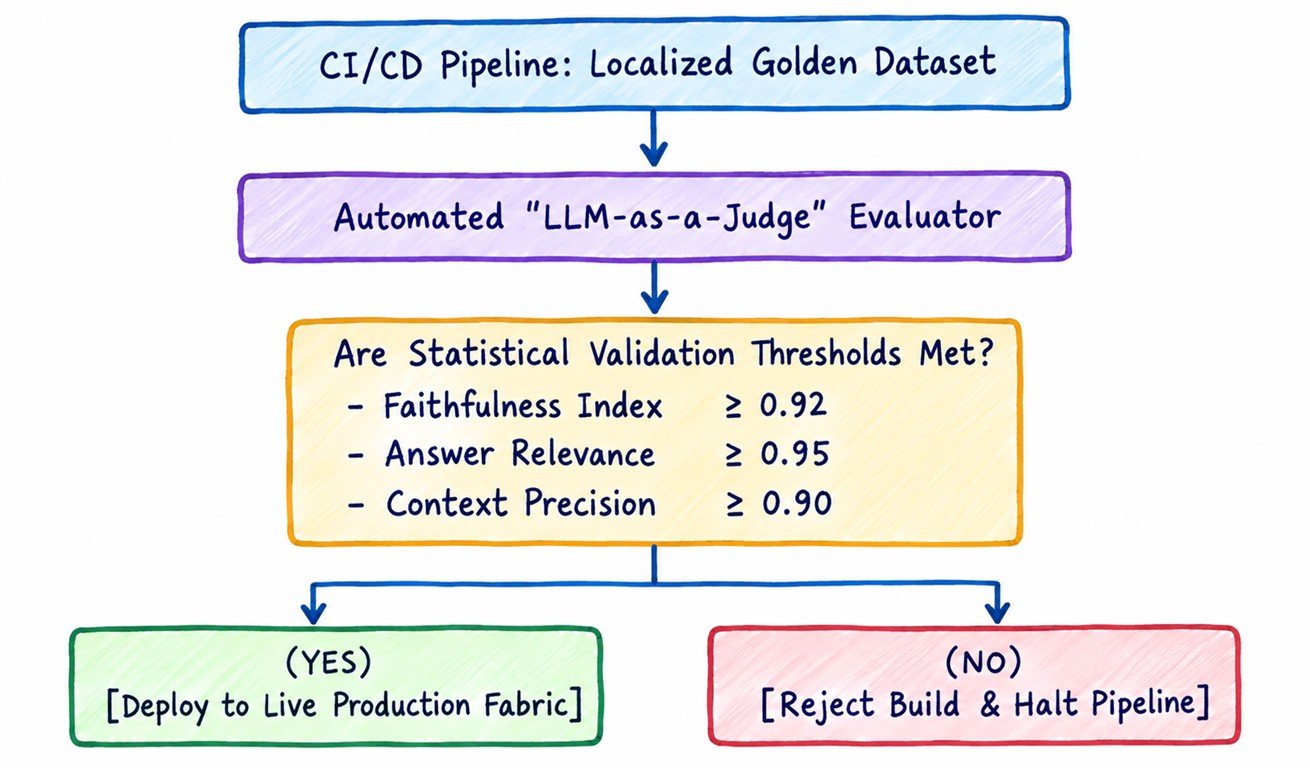
Instead, the continuous integration (CI) workflow packages the candidate application container and runs automated simulated user transactions against a localized, immutable Golden Dataset consisting of at least 500 verified production-equivalent prompt-response pairs.
To clear the deployment gate and earn an automated production release stamp, the candidate system must achieve or exceed statistical thresholds across three foundational metrics evaluated via an internal LLM-as-a-Judge topology:
- Faithfulness Index (≥ 0.92): Evaluates whether the generated output is strictly grounded in the retrieved context documents, preventing hallucinations and inaccurate data leakage.
- Answer Relevance Score (≥ 0.95): Measures the semantic alignment between the user's initial intent and the final generated response payload, ensuring the system maintains its business focus.
- Context Precision (≥ 0.90): Validates that the vector database retrieval layer surfaces highly relevant chunks at the top of the context payload, protecting the model's context window from noisy data.
B. Real-Time Telemetry & The Continuous Observation Loop
Once a workload transitions past the staging gate into live operations, the platform activates a continuous evaluation loop utilizing Langfuse OpenTelemetry middleware.
Every inbound query and outbound token stream is non-intrusively sampled and logged to an immutable system ledger.
- Automated Drift Detection: The observation engine aggregates live performance scores over a rolling 24-hour window. If the systemic faithfulness index drops by more than 4% against the established baseline, the platform automatically triggers an architectural alert to indicate potential model drift, vector database corruption, or changing user behavior patterns.
- Dynamic Gateway Circuit Breakers: If live quality scores plummet below an absolute critical safety threshold (e.g., faithfulness dropping below 0.85), gateway circuit breakers immediately trip. The system instantly reroutes live production traffic to a stable fallback model or pre-vetted static modules, completely shielding the customer experience from degraded outputs while engineering teams triage the underlying architecture.
6. Deep-Dive: Lifecycle Architecture & Resilience Engineering
Foundation models are volatile corporate assets subject to rapid vendor deprecation, version drift, and compounding regional cloud outages. This section provides enterprise architects with a rigorous framework to contain probabilistic system failures and execute zero-downtime model swap protocols across the live enterprise fabric.
A. The Architectural Blast Radius Blueprint
The system architecture enforces a decoupled, graceful degradation matrix across all intelligence tiers to ensure zero runtime downtime during upstream outages.
- The Intelligence Fallback Cascade: When a primary frontier model or regional cloud endpoint fails to meet predefined Service Level Objectives (SLOs), specifically a 99th percentile latency (p99) exceeding 4,500ms or an HTTP 5xx error rate above 1% over a moving 60-second window, gateway circuit breakers trip automatically.
- Cross-Provider Redundancy (Tier 1): The gateway immediately mirrors and shifts the active state to an identical model hosted in an alternate geographic availability zone, or transparently translates the prompt payload to an equivalent frontier model from a secondary vendor.
- The Core Capability Floor (Tier 2): If external cloud routing fails entirely, the system downgrades the business task to a localized, self-hosted Small Language Model (SLM) running on internal enterprise infrastructure (e.g., Llama 3 8B). The system executes the core task with a minor reduction in qualitative nuance, but preserves 100% operational availability.
- Deterministic Hard Stop (Tier 3): If all probabilistic layers fail, the system falls back to a deterministic middleware script that serves a static, user-friendly system message, completely preventing unhandled stack traces or raw API errors from reaching the end user.
B. The Model Retirement Runbook
A foundation model must be systematically flagged for retirement or replacement when it crosses objective organizational thresholds, such as a newly released model offering a 30% reduction in cost per million tokens at equivalent accuracy, or an upstream provider issuing an end-of-life (EOL) schedule.
- The Abstraction Gateway Pattern: Applications must never connect directly to vendor-specific SDKs. Instead, they interact with a standardized, internal gateway endpoint (e.g.,
/v1/intelligence/summarize). The application layer remains entirely blind to which specific foundation model is executing the backend task. - The Canary Re-Routing Phase: The migration engine utilizes a weighted canary deployment schema. Initial traffic to the new target model is restricted to 1% of active production payloads, while the remaining 99% routes through the legacy system.
- Shadow Evaluation & Atomic Rollback: During the canary phase, the gateway mirrors a subset of live transactions to both models simultaneously for real-time LLM-as-a-Judge scoring. If the new model triggers unexpected application exceptions or fails a critical safety guardrail at any point, the gateway executes an atomic rollback, instantly routing 100% of live traffic back to the legacy model checkpoint within ** < 50 milliseconds**.
7. Epilogue: The AI Architectural North Star
The organizations that ultimately dominate the landscape of the automated enterprise will not be those that simply wrote the flashiest prompt templates or raised the largest experimentation budgets.
The winners will be the firms that treated the shift from deterministic to probabilistic computing not as an experimental playground, but as an evolution in Enterprise Architecture.
By building your corporate capability upon an industrialized, self-healing platform layer, you isolate your systems from shifting vendor versions, control your infrastructure budgets, and build data protection zones that keep your assets secure.
The era of the fragile AI demo is formally over. The era of the industrialized AI production factory has begun.
8. Executive Companion Guide: The First 90 Days of Implementation
The transition to an industrialized AI Production Factory cannot be achieved overnight through a top-down mandate. It requires a deliberate, programmatic mobilization plan that matches architectural changes with your team's execution velocity.
For technology executives, including CTOs, CIOs, VPs, and Enterprise Solution Architects, this guide outlines the critical, non-negotiable operational milestones required over your first 90 days to successfully establish your AI Architectural North Star.
Phase I: Days 1 – 30 (Audit, Quarantine, and Baselines)
The first 30 days are dedicated to establishing baseline visibility and gaining absolute operational control over existing "shadow" AI initiatives across the enterprise footprint.
- Action Item 1: Revoke Static API Keys & Enforce IAM Scoping
- Operational Directive: Audit all line-of-business repositories. Mandate the deletion of all embedded vendor API keys. Force all application code to authenticate through centralized AWS IAM roles configured with strict least-privilege resource access policies.
- Action Item 2: Centralize Token Cost and Usage Ingress
- Operational Directive: Hook up all active application configurations to a shared cloud-native tracking plane. Gather accurate baselines on total daily token consumption, input/output token balance ratios, and compute overhead spend across every department.
- Action Item 3: Compile the Enterprise Use Case Inventory
- Operational Directive: Document every live AI project on a unified workspace using the Product Definition Canvas. Assess each initiative against the Portfolio Prioritization Matrix to flag and pause high-cost, low-value experiments.
Phase II: Days 31 – 60 (Constructing the Shared Platform Plane)
The second month focuses on building out your core shared infrastructure services to decouple individual application logic from your underlying multi-model plane.
- Action Item 4: Deploy the Hardened Model Gateway
- Operational Directive: Stand up a scalable, stateless microservice layer on Amazon ECS (Fargate). Force all production traffic to route through this common gateway layer using standardized, provider-agnostic endpoint schemas.
- Action Item 5: Instrumentalize Distributed Telemetry Spans
- Operational Directive: Deploy the Langfuse SDK across your gateway infrastructure. Mandate that every application interaction record explicit tracing metadata, including unique customer IDs, billing allocation tags, and transaction identifiers.
- Action Item 6: Assemble Systemic Golden Datasets
- Operational Directive: Require product management teams to compile a baseline set of evaluation test items (minimum 50 to 100 test queries) for each application type. Archive these datasets securely inside Amazon S3 buckets to establish automated quality baselines.
Phase III: Days 61 – 90 (Industrializing and Automating the Scale Loop)
The final 30 days lock in your governance controls, activate runtime optimizations to drive down token costs, and establish automated self-correcting feedback loops.
- Action Item 7: Enforce Pooled Data Multi-Tenancy
- Operational Directive: Migrate fragmented, isolated vector storage nodes into a unified Pinecone Serverless tier. Enforce absolute security boundaries by utilizing deterministic Namespaces wrapped in programmatic metadata verification checks.
- Action Item 8: Activate Automated Judge Gating in CI/CD Channels
- Operational Directive: Hook up your golden evaluation datasets directly into your automated deployment pipelines. Set up strict code promotion policies that instantly block prompt adjustments or model version changes if accuracy drops below 85% or toxicity climbs above 5%.
- Action Item 9: Launch Your First Model Distillation Run
- Operational Directive: Run background data extraction scripts over your telemetry logs to pull low-performing or high-cost transactions. Aggregate these examples into a clean training corpus to fine-tune lower-cost, high-performance small models (SLMs), successfully closing your first Optimization & Industrial Scale Loop.
Architectural Disclaimer
The technical frameworks, architectural patterns, and systemic design guidelines presented in this text are intended solely for general enterprise software engineering, software platform development, and data infrastructure design optimization. They do not constitute professional technology deployment certifications, legal compliance guarantees, or operational advice for high-risk critical health or safety systems.