The Optimization & Industrial Scale Loop - Optimize, Govern, and Scale
Introduction
The final, continuous phase of the AI Production Factory begins once an application portfolio has safely stabilized under production workloads.
Moving an individual AI product from zero to one verifies its technical viability; moving an entire organization from one to one hundred production apps requires a completely different approach to infrastructure management.
When dozens of independent systems consume infrastructure resources concurrently, unmanaged token consumption can rapidly erode business margins, while independent model configurations introduce widespread governance vulnerabilities.
To prevent cost overruns and maintain operational control at scale, enterprise architecture leaders must establish an Optimization & Industrial Scale Loop.
This architectural layer functions as a continuous feedback loop, gathering real-world telemetry from across the organization to automatically lower run costs, enforce compliance standards, and continuously improve lower-cost models.
1. The Optimization Plane: Active Token FinOps & Semantic Compression
At enterprise scale, managing infrastructure costs requires a shift from passive cost tracking to active runtime optimization.
The Optimization Plane intercepts all production payloads to compress prompts, manage context windows, and optimize routing logic before text string inputs hit the model networks.
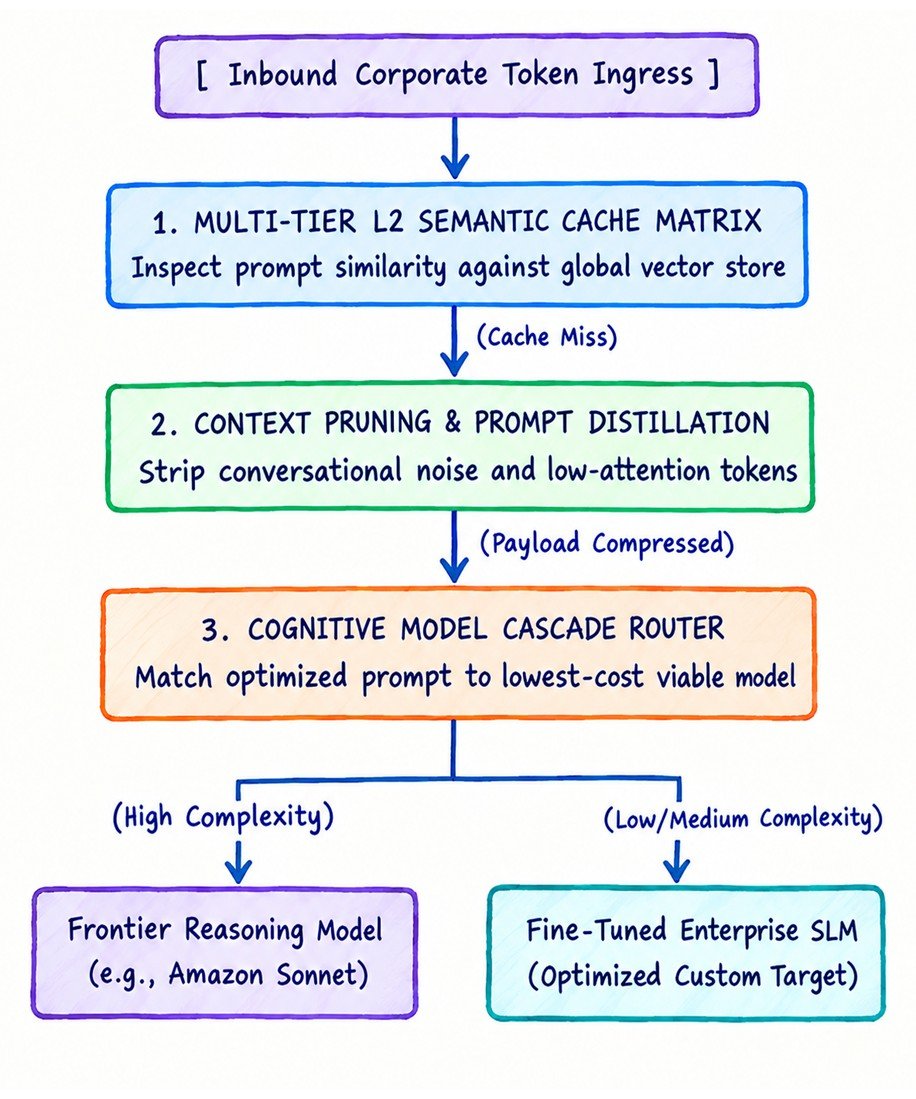
The Optimization Plane applies three core engineering methods to keep token costs under control:
-
Multi-Tier Semantic Cache Accumulation: The platform scales out an L2 cache structure using shared Pinecone environments. This database intercepts repeating questions across different departments (e.g., HR benefits questions or customer service inquiries), resolving them instantly without incurring any model processing costs.
-
Context Pruning and Prompt Distillation: The gateway strips out conversational filler words and low-attention token blocks from long prompts. This context compression can shrink large input strings by 20% to 40% before they are routed, delivering immediate latency and cost savings.
-
The Cognitive Model Cascade: Rather than relying exclusively on a single expensive frontier model, the platform runs a dynamic cascade architecture. It routes incoming requests to highly optimized, fine-tuned small language models (SLMs) by default, only escalating a task to a frontier model if intermediate evaluation gates detect complex analytical reasoning requirements.
Deep-Dive: The Automated Token Quota Throttling Engine
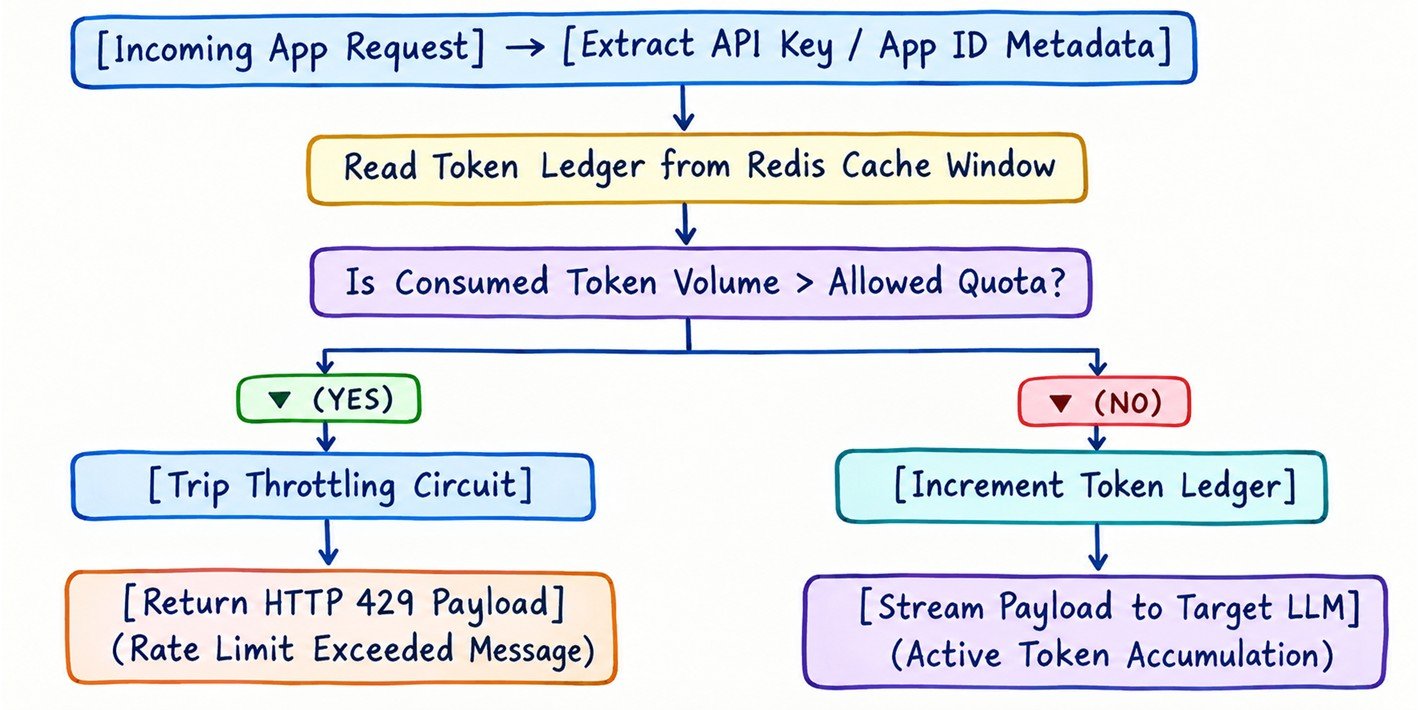
While semantic compression and model cascades protect enterprise budgets during standard usage, they do not inherently insulate infrastructure from catastrophic cost spikes caused by runaway application software loops, distributed denial-of-service (DDoS) token attacks, or unvetted high-volume batch testing in production. To protect the enterprise from sudden financial exposure, the Optimization Plane implements a real-time, non-blocking Automated Token Quota Throttling Engine directly within the gateway middleware layer.
A. Distributed Token Buckets and Sliding Window Ledgers
The throttling engine shifts away from legacy rate-limiting models that calculate basic HTTP request counts. Because a single un-vetted user query containing an enormous document payload can consume more financial resources than thousands of standard multi-turn text messages, the gateway tracks consumption using a distributed Token Bucket Algorithm mapped across sliding time windows.
- High-Performance In-Memory Tracking: The gateway utilizes an internal Redis cluster to maintain an ephemeral, globally synchronized token consumption ledger for every application deployment. Every inbound payload envelope is inspected to extract its unique routing attributes (
application_id,cost_center,api_key). - Active Volume Ingestion: Before a request is passed down-funnel to the target foundation model provider, the engine computes the raw token overhead of the input payload. If the application's cumulative token usage within its assigned window (e.g., a rolling 60-minute window) exceeds its strict corporate quota tier, the gateway trips a throttling circuit. It rejects the transaction instantly, returning an HTTP 429 (Too Many Requests) status code accompanied by a structured JSON error string:
{"error": "Enterprise token allocation exceeded for the active billing cycle."}.
B. Dynamic Priority Tiering and Automated Slack Relief
To prevent critical customer-facing production microservices from being blocked by lower-priority internal tasks during high-concurrency periods, the throttling architecture enforces a hard Dynamic Priority Matrix:
- Tier 1: Tier-One Mission Critical (Zero Throttling): Applied to live, user-facing client production apps. These channels operate with dynamic, self-expanding soft ceilings that automatically borrow unallocated token quotas from other corporate divisions when system capacity approaches saturation.
- Tier 2: Routine Corporate (Standard Quota): Applied to scheduled automated generation pipelines, background report builders, and internal tools. These pipelines face strict hard stops the moment their daily financial allocation is spent.
- Tier 3: Non-Production Sandbox (Restricted Limit): Applied to active development tracks, staging layers, and experimental playgrounds. This tier utilizes hyper-compressed sliding windows (e.g., a rolling 60-second window) to ensure a single malfunctioning script is caught and isolated within milliseconds before it can generate an expensive infrastructure bill.
2. The Governance Engine: Institutional Model Registry and Policy Enforcement
Scaling AI development across dozens of independent business units requires robust, automated platform controls.
Without centralized oversight, individual product teams frequently drift into ad-hoc development practices, spinning up redundant model access keys, using unapproved open-source models, or neglecting data security guidelines.
The Governance Engine resolves this challenge by acting as a single, central control layer for all model access, helping platform teams resolve scaling bottlenecks while enforcing corporate compliance policies:
| Scaling Friction Vector | Root Architectural Vulnerability | Automated Platform Engineering Adjustment |
|---|---|---|
| Siloed Shadow Key Procurement | Independent application teams hardcode individual cloud access credentials, bypassing corporate audit lines. | Revoke direct API key access. Force all application code to authenticate through centralized AWS IAM roles linked directly to the Model Gateway. |
| Policy Compliance Drift | New product lines skip safety validation checks, exposing applications to potential data leaks or compliance violations. | Implement automated Guardrail Policy Inheritance. Every new application endpoint spun up by the platform automatically inherits a base layer of corporate safety filters. |
| Model Version Depreciation | Cloud providers retire older model versions unexpectedly, causing unpatched downstream applications to fail. | Abstract model identifiers behind clean, platform-managed aliases (e.g., prod-default-slm). This lets platform engineers update the underlying model version without breaking application code. |
| Cross-Border Regulatory Violations | Applications processing international data accidentally route sensitive user data across restricted geographical boundaries. | Deploy localized API endpoint groups. The gateway automatically inspects regional metadata headers to pin inference tasks to approved local cloud data centers. |
Deep-Dive: Automated Guardrail Policy Inheritance
The primary challenge when scaling a decentralized AI development fabric across multiple independent business units is enforcing safety and compliance standards without introducing development bottlenecks. Forcing individual application teams to manually code content filters, data masking routines, and compliance checks leads to architectural drift, exposing the enterprise to structural data leaks or regulatory violations.
The Governance Engine solves this vulnerability by implementing Automated Guardrail Policy Inheritance directly within the platform's orchestration and provisioning planes.
A. Hierarchical Policy Blueprints
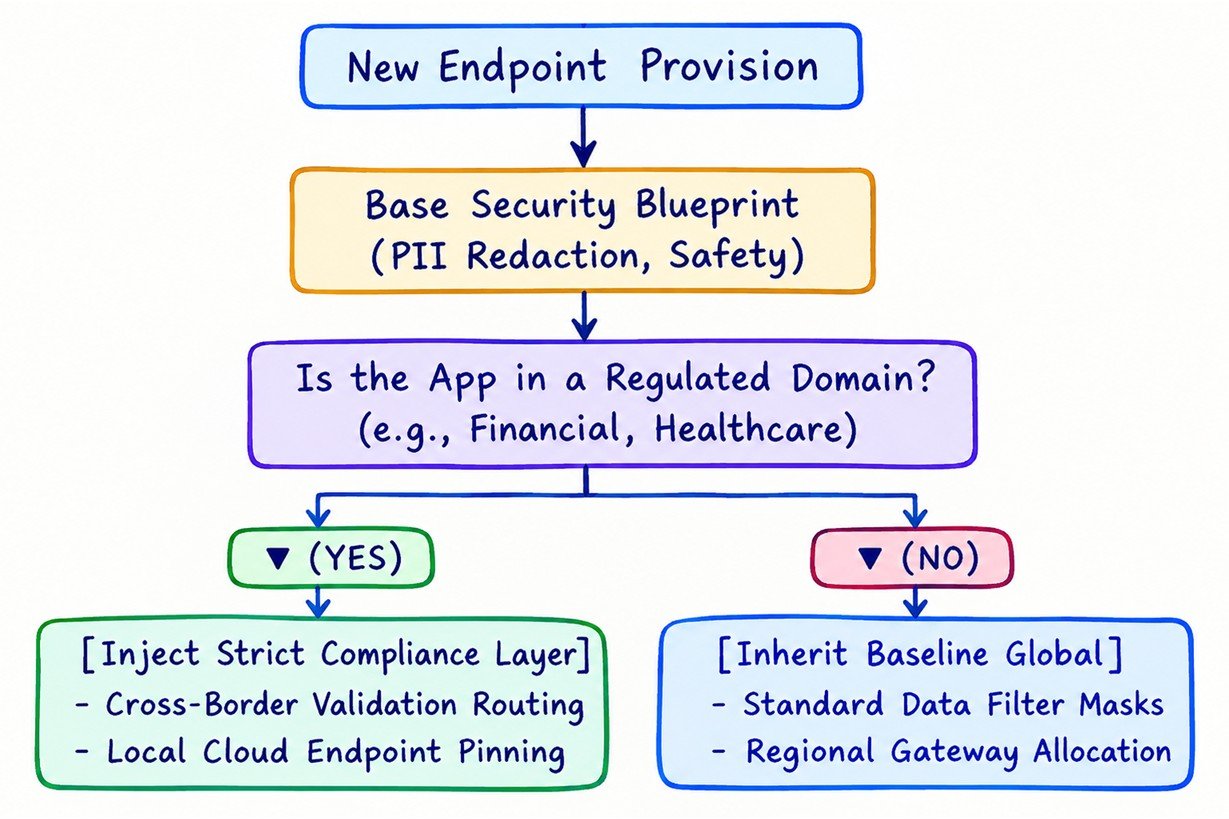
The platform structures corporate guardrail configurations into a hierarchical, object-oriented tree. When a developer or automated CI/CD pipeline registers a new application endpoint at the Model Gateway, the routing engine enforces policy compliance at runtime by wrapping the endpoint in a series of cascading security layers:
- The Global Baseline Blueprint (Root Layer): Every application deployed across the enterprise automatically inherits the global platform configuration. This baseline layer runs real-time input/output scanning to enforce basic safety filters, block obvious prompt injection patterns, and mask universal high-risk strings (such as plain-text passwords or clear-text corporate authentication keys).
- The Domain-Specific Subclass (Conditional Layer): Applications tagged with specific compliance metadata (
regulated_domain: financialordata_tier: restricted) automatically inherit an additional tier of runtime middleware. For example, a financial app's endpoint automatically injects automated PII tokens, strips out unauthorized credit card or routing numbers from model completions, and forces all underlying model inference traffic to stick to geographically locked cloud availability zones.
B. Declarative Platform Enforcement
Instead of requiring product teams to configure separate security packages, guardrail policies are managed declaratively using standardized infrastructure code. The platform engine reads these policies from a central repository and compiles them server-side inside the gateway proxy fabric:
- Immutable Configuration Schemas: Security teams define global filters inside an absolute, read-only configuration schema (such as an enterprise JSON or YAML policy manifest). Application teams can add custom, product-specific prompt rules, but they are programmatically barred from disabling or modifying the inherited base security filters.
- Zero-Overhead Inline Execution: The inherited policy rules run inline during the network session's input and output phases. Because this security wrapping executes at the gateway proxy layer, it ensures absolute corporate compliance across every single model endpoint, regardless of the programming language or orchestrator framework used by individual application teams.
3. Continuous Automation: The Closed-Loop Feedback Ingress
The ultimate goal of the Industrialized AI Engine is self-optimization.
By building an automated dataset generation pipeline, the platform can use production telemetry to continuously train and improve its own lower-cost model infrastructure.
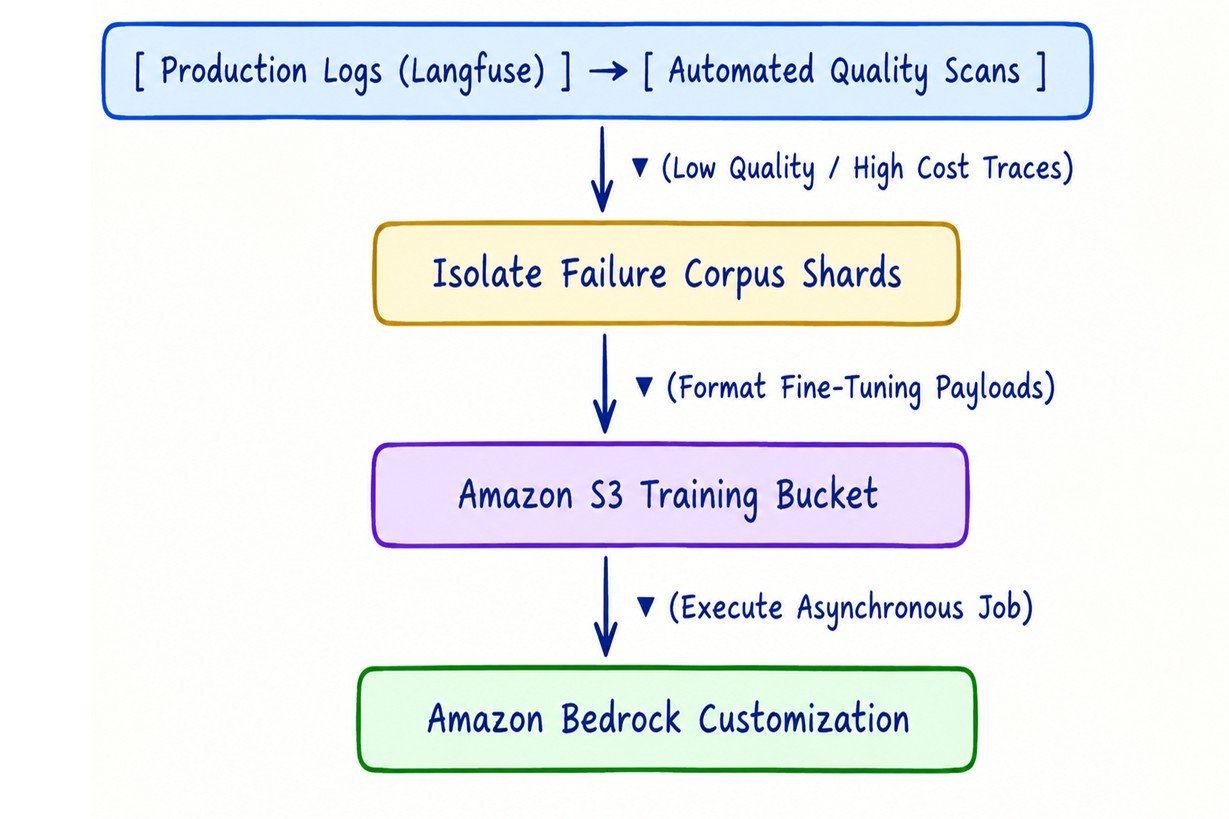
The following Python class implements this closed-loop feedback design.
The script queries the Langfuse API to sweep for production interactions that fell below quality benchmarks or required a high-cost frontier model fallback. It extracts these targeted examples, formats them into structured fine-tuning payloads, and saves them directly to an Amazon S3 bucket.
This automated process creates a high-quality training corpus, allowing the platform team to continuously train lower-cost small language models (SLMs) to handle complex corporate tasks.
import os
import json
import logging
import boto3
from typing import List, Dict, Any
from langfuse import Langfuse

# Configure Industrial Scale Loop Logger
logging.basicConfig(level=logging.INFO)
logger = logging.getLogger("Industrial-Scale-Loop")

class ClosedLoopFeedbackIngress:
    def __init__(self):
        """Initializes secure runtime data links to Langfuse Telemetry and Amazon S3 Core Ingestion Storage."""
        self.langfuse_client = Langfuse(
            public_key=os.getenv("LANGFUSE_PUBLIC_KEY"),
            secret_key=os.getenv("LANGFUSE_SECRET_KEY"),
            host=os.getenv("LANGFUSE_HOST", "https://langfuse.com")
        )
        self.s3_client = boto3.client("s3", region_name=os.getenv("AWS_REGION", "us-east-1"))
        self.target_bucket = os.getenv("ENTERPRISE_FINE_TUNE_BUCKET_NAME", "enterprise-model-distillation-data")

    def harvest_regression_traces(self, min_quality_score: float = 0.70, limit: int = 100) -> List[Dict[str, Any]]:
        """
        Queries the central Langfuse production database to extract low-scoring interactions.
        These targeted examples highlight system gaps, making them ideal payloads for model fine-tuning.
        """
        logger.info(f"Scanning Langfuse data logs for interactions with quality scores below: {min_quality_score}")

        try:
            # Fetch traces with low output scores from production logs
            traces_page = self.langfuse_client.get_traces(
                tags=["track-canary"], # Focus evaluation checks on new deployment tracks
                limit=limit
            )

            training_corpus = []
            for trace in traces_page.data:
                # Check for low-performing runs that are safe to use for training
                if trace.metadata.get("final_evaluation_accuracy", 1.0) < min_quality_score:
                    # Pull down corresponding generation details
                    generations = [g for g in trace.observations if g.type == "generation"]
                    if generations:
                        target_gen = generations[0]
                        training_corpus.append({
                            "prompt": target_gen.input,
                            "ideal_completion": target_gen.output
                        })

            logger.info(f"Successfully harvested {len(training_corpus)} optimization examples from production traces.")
            return training_corpus

        except Exception as e:
            logger.error(f"Failed to harvest performance traces from Langfuse API: {str(e)}")
            return []

    def export_to_s3_training_matrix(self, training_data: List[Dict[str, Any]], build_id: str) -> bool:
        """
        Transforms harvested trace examples into JSON Lines (JSONL) format
        and uploads them directly to an Amazon S3 training bucket.
        """
        if not training_data:
            logger.warning("No optimization examples provided. Skipping S3 upload job.")
            return False

        # Format records to conform with standard Amazon Bedrock fine-tuning schemas
        jsonl_payload = ""
        for record in training_data:
            formatted_entry = {
                "prompt": str(record["prompt"]),
                "completion": str(record["ideal_completion"])
            }
            jsonl_payload += json.dumps(formatted_entry) + "\n"

        target_key = f"distillation-runs/{build_id}_training_matrix.jsonl"

        try:
            logger.info(f"Uploading fine-tuning training dataset to S3: s3://{self.target_bucket}/{target_key}")
            self.s3_client.put_object(
                Bucket=self.target_bucket,
                Key=target_key,
                Body=jsonl_payload.encode("utf-8"),
                ContentType="application/jsonlines"
            )
            logger.info("S3 training matrix synchronization complete.")
            return True
        except Exception as e:
            logger.error(f"Failed to upload training dataset to Amazon S3 storage: {str(e)}")
            return False

    def orchestrate_factory_loop(self, execution_build_id: str):
        """
        Executes the continuous optimization loop. Extracts poor-performing production examples
        and packages them to automate down-funnel model customization.
        """
        # Step 1: Harvest low-performing production examples
        harvested_examples = self.harvest_regression_traces(min_quality_score=0.75, limit=50)

        # Step 2: Upload packaged data to S3 to make it available for Bedrock training runs
        success = self.export_to_s3_training_matrix(harvested_examples, execution_build_id)
        if success:
            logger.info(f"Closed-loop feedback cycle successfully completed for build: {execution_build_id}")
        else:
            logger.warning("Closed-loop feedback cycle exited without updating training assets.")

if __name__ == "__main__":
    # Simulate background execution inside a scheduled Amazon EventBridge pipeline container
    import uuid
    runtime_build_id = f"opt_loop_{str(uuid.uuid4())[:8]}"

    loop_engine = ClosedLoopFeedbackIngress()
    loop_engine.orchestrate_factory_loop(execution_build_id=runtime_build_id)
By connecting your live production telemetry directly to your dataset generation pipelines, the platform breaks free from manual development bottlenecks.
The system continuously adapts to real-world usage patterns, allowing you to systematically lower total cost per task, eliminate compliance risks, and steadily improve operational efficiency across the entire corporate enterprise.
Architectural Disclaimer
The technical frameworks, architectural patterns, and systemic design guidelines presented in this text are intended solely for general enterprise software engineering, software platform development, and data infrastructure design optimization. They do not constitute professional technology deployment certifications, legal compliance guarantees, or operational advice for high-risk critical health or safety systems.