The Production Release Fabric - Secure, Deploy, and Continuous Observation
Introduction
The final validation of an Industrialized AI Engine occurs when its components are exposed to real-world user behaviors, unpredictable volume spikes, and evolving model performance profiles.
In traditional software systems, a binary artifact that passes its regression suite can be deployed with high confidence that its logic will remain unchanged. In generative AI platforms, however, the execution landscape is highly volatile.
Upstream model updates by cloud providers, changes in user query styles, and unexpected variations in text data can cause a system that passed staging evaluations to degrade rapidly in production.
To minimize Systemic Compliance and Risk Drift while maintaining high application availability, platform engineering teams must deploy a Production Release Fabric.
This final architecture layer acts as an active guard plane, safely managing traffic routing, enforcing strict multi-region failover rules, and tracking real-time performance telemetry.
1. The Production Release Gate: Progressive Ingress and Fallback Routing
Deploying modifications to a generative system, whether pushing a refined prompt template, an updated semantic chunking algorithm, or a new underlying model, requires a risk-managed delivery approach.
The Release Fabric replaces traditional green-button deployments with an advanced, multi-tiered Progressive Ingress Control Plane.
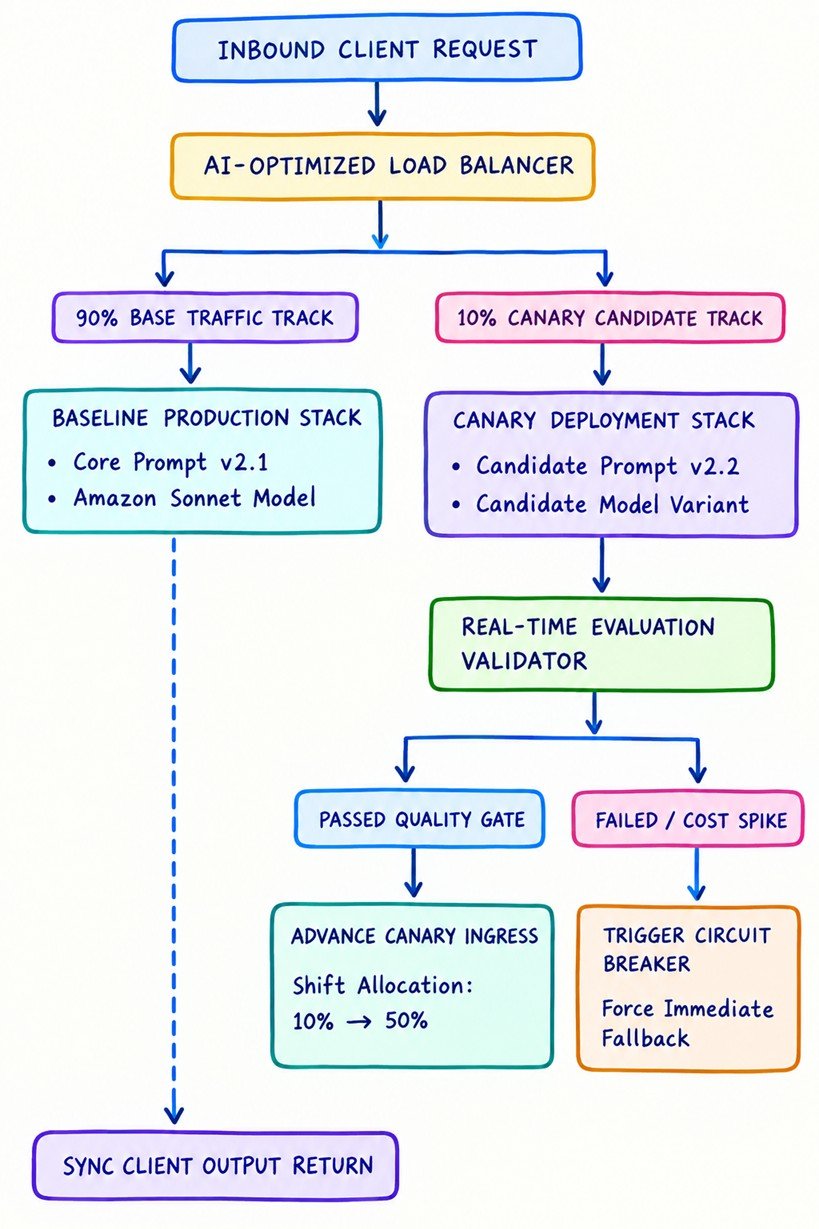
The Progressive Ingress Control Plane runs candidate release packages through a tightly managed sequence of deployment stages:
-
The Shadow Baseline Stage: The new version runs completely hidden from users. The gateway mirrors production traffic to the candidate version, tracking its response text and token metrics in the background while users receive answers from the trusted baseline system.
-
The Controlled Canary Stage: The system routes a small fraction of live user requests (e.g., 2% to 10%) to the new version. The gateway monitors these responses for errors or drops in output quality, ready to shift traffic away instantly if anomalies occur.
-
Automated Fallback Circuits: If a canary version triggers an alert, such as high response times, an increase in filtered PII leaks, or a sharp drop in correctness scores, the fabric trips its circuit breakers. It automatically redirects all user traffic back to a stable version or an affordable backup small model (SLM) to protect the user experience.
Deep-Dive: The Circuit Breaker Rollback Engine
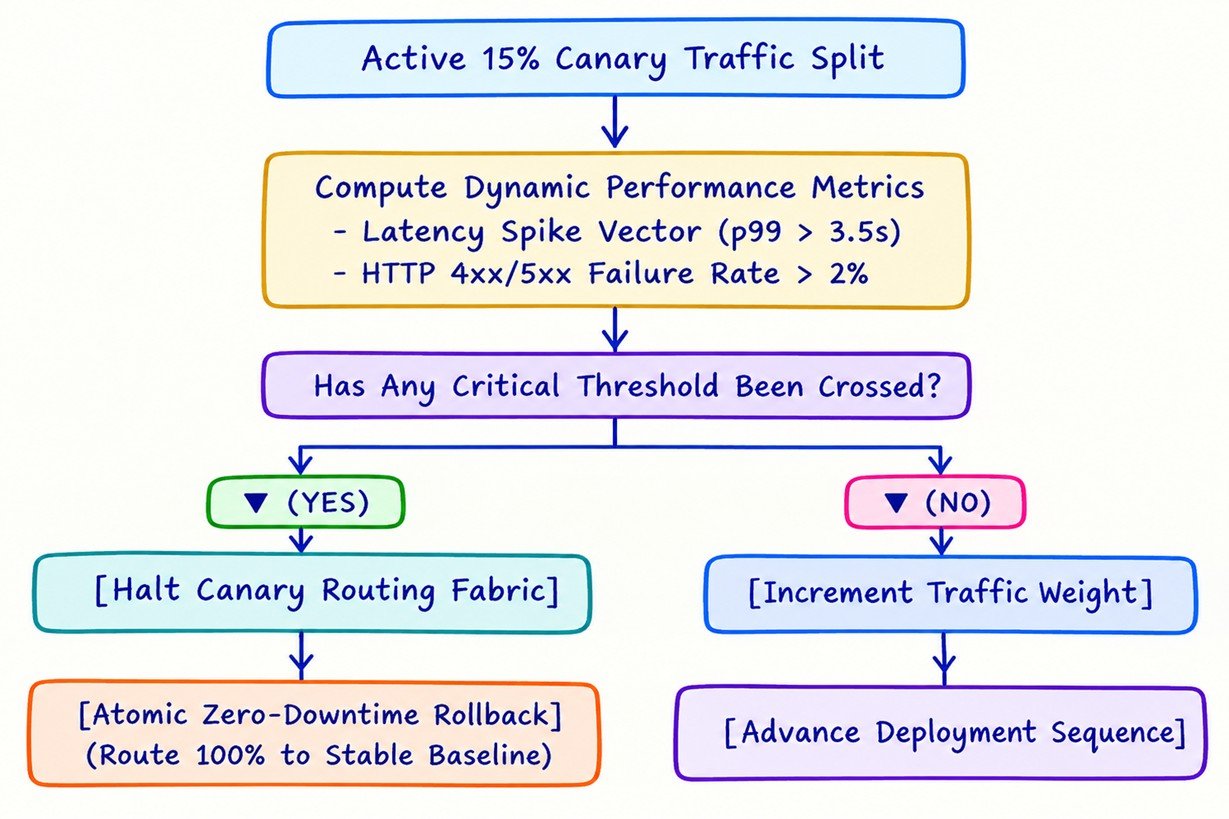
While setting a hard canary traffic split isolates the majority of production workloads, it does not prevent immediate application performance drops for the active target group if a newly deployed model variation exhibits severe latency regressions, formatting breakdown, or accuracy drift. To protect runtime user experiences without requiring manual engineering interventions, the Progressive Ingress Control Plane operates a real-time, automated Circuit Breaker Rollback Engine within the routing fabric.
A. Statistical Anomaly Thresholds
The rollback engine evaluates the health of active canary tracks by scanning live performance metrics against three strict operational boundaries over a rolling 60-second window:
- The Latency Spike Vector: The 99th percentile execution latency (p99) across the canary track spikes past 3,500 milliseconds, indicating potential resource constraints or model degradation.
- The Request Execution Floor: The frequency of network execution faults, specifically HTTP
4xxand5xxerror loops generated by the target provider model, crosses a maximum 2% failure rate threshold. - The Format Validation Defect: Structural parsing validations, such as missing required JSON schemas or broken multi-turn token streams, fail twice within a continuous 30-second window.
B. Atomic Zero-Downtime Rollbacks
The following Python script extends the primary gateway router. It implements a non-blocking background circuit health checker that intercepts canary metrics and uses an atomic execution loop to automatically redirect production traffic back to the safe baseline model within < 50 milliseconds if an anomaly is detected.
import time
import logging
from typing import Dict, Any

logger = logging.getLogger("Circuit-Breaker-Engine")

class ReleaseCircuitBreaker:
    def __init__(self, failure_threshold_pct: float = 2.0, latency_threshold_ms: float = 3500.0):
        """Initializes thresholds for automated canary performance evaluation."""
        self.failure_threshold_pct = failure_threshold_pct
        self.latency_threshold_ms = latency_threshold_ms
        self.is_circuit_tripped = False
        self.active_canary_allocation = 0.15  # Default: 15% traffic to canary

    def evaluate_canary_health(self, telemetry_window: Dict[str, Any]) -> bool:
        """
        Scans live performance statistics over a rolling window.
        Trips the circuit breaker instantly if thresholds are violated.
        """
        if self.is_circuit_tripped:
            return False

        error_rate = telemetry_window.get("error_rate_pct", 0.0)
        p99_latency = telemetry_window.get("p99_latency_ms", 0.0)

        # Evaluate metrics against platform boundaries
        if error_rate > self.failure_threshold_pct or p99_latency > self.latency_threshold_ms:
            logger.critical(
                f"Canary failure detected! Error Rate: {error_rate}%, p99 Latency: {p99_latency}ms. "
                f"Tripping circuit breaker..."
            )
            self.execute_atomic_rollback()
            return True

        return False

    def execute_atomic_rollback(self):
        """
        Forces an absolute, zero-downtime routing adjustment.
        Instantly drops canary traffic to 0% and shifts all load to the baseline.
        """
        self.is_circuit_tripped = True
        self.active_canary_allocation = 0.0
        logger.warning("ATOMIC ROLLBACK COMPLETE. 100% of production traffic routed to stable baseline.")

    def get_routing_track(self, force_override: str = None) -> str:
        """Determines the runtime deployment path based on circuit state."""
        if self.is_circuit_tripped or force_override == "baseline":
            return "baseline"
        return "canary"
By decoupling metric monitoring from the primary request thread, this throttling configuration ensures that live systems can self-heal dynamically, completely isolating users from deployment regressions.
2. The Deploy: Immutable Multi-Region Architectures
Relying on a single cloud availability zone or an isolated API endpoint creates a critical single point of failure. Regional infrastructure brownouts, sudden quota limits, and capacity shortages on specific GPU clusters can instantly take down an enterprise application.
To ensure continuous uptime, the Release Fabric deploys immutable model routing services across multiple cloud regions, using a resilient multi-tier design to handle live operational failures:
| Incident Topography / Root Operational Risk | Automated Fabric Remediation Action |
|---|---|
Upstream Provider Rate-Limiting (HTTP 429) | A localized application volume spike exhausts your assigned Tokens-Per-Minute (TPM) quota on a specific regional model endpoint. The Gateway Router intercepts the 429 status code, opens an isolation circuit, and instantly routes retries to an alternate cloud region with available quota capacity. |
| Model Content Filter Interception | An unpredictable combination of inputs triggers an overly sensitive provider safety block, causing the API to return empty text payloads. The engine detects the safety flag, falls back to an alternate model variant trained on separate alignment guidelines, and opens an investigation trace inside Langfuse. |
| Regional Cloud Center Outage | A major network or power disruption takes down an entire cloud availability region, cutting access to compute clusters. Amazon Route 53 health checks detect the failure within seconds and dynamically update routing tables to redirect all incoming traffic to a hot-standby region. |
Deep-Dive: The Multi-Region Cross-Cloud Failover Blueprint
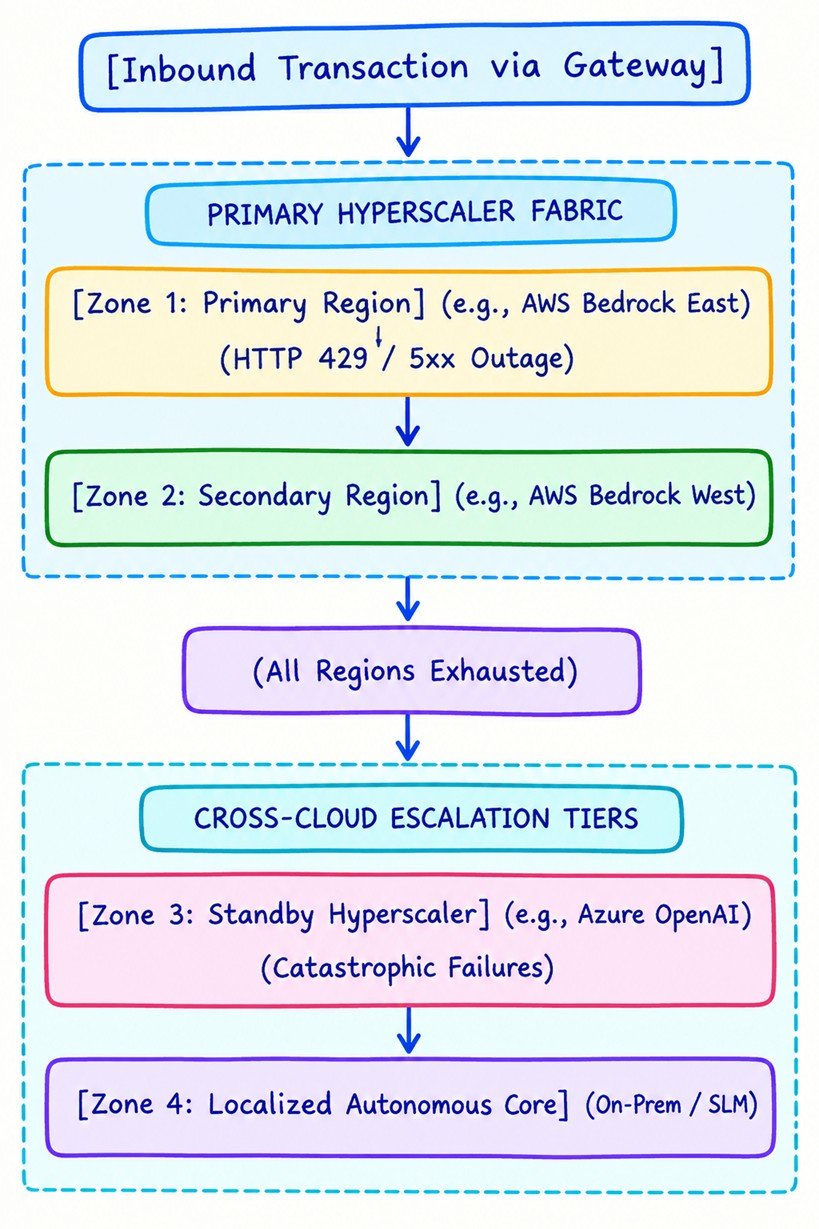
Relying on a single cloud vendor's foundational model ecosystem leaves an enterprise vulnerable to vendor-wide service brownouts, centralized quota lockouts, or widespread model alignment deprecations. To achieve absolute platform survivability, the system architecture must look beyond simple intra-cloud region shifting and deploy a multi-tiered Multi-Region Cross-Cloud Failover Blueprint. This pattern implements a primary infrastructure loop on a core hyperscaler cloud while maintaining a fully prepared, cross-cloud standby cluster on a secondary provider network.
A. Decoupled Provider Payload Shimming
The primary barrier to cross-cloud failover is payload formatting variance; an API call structured for one provider's foundational model will trigger immediate schema validation errors on another network. To resolve this runtime friction, the Model Gateway utilizes a Provider Payload Shim. This middleware pattern dynamically translates a standard internal prompt envelope into vendor-specific schemas at the network boundary, ensuring the system can adapt to structural API variations instantly.
B. Cross-Cloud Failover Implementation
The following production-grade script provides an implementation of the multi-region, cross-cloud orchestration core. Built on top of boto3 and openai (or equivalent HTTP libraries), it wraps inference loops in an automated escalation cascade, attempting primary provider routes before hot-swapping the payload execution to a secondary cloud environment to maintain a high level of operational availability.
import json
import logging
from typing import Dict, Any, Tuple

logger = logging.getLogger("Cross-Cloud-Failover")

class CrossCloudFailoverFabric:
    def __init__(self, primary_endpoints: list, secondary_provider_config: Dict[str, Any]):
        """Initializes primary cloud regions and backup cross-cloud targets."""
        self.primary_regions = primary_endpoints
        self.secondary_config = secondary_provider_config

    def _shim_payload_for_secondary(self, prompt: str) -> Dict[str, Any]:
        """Translates the standard prompt envelope into the secondary cloud's payload schema."""
        return {
            "model": self.secondary_config.get("target_model_alias", "gpt-4o"),
            "messages": [{"role": "user", "content": prompt}],
            "temperature": 0.2
        }

    def execute_resilient_inference(self, prompt: str, base_model_id: str) -> Tuple[str, str, str]:
        """
        Executes model inference along a multi-cloud path.
        Cascades from Primary Region 1 -> Primary Region 2 -> Standby Cross-Cloud Cluster.
        """
        standard_body = json.dumps({
            "anthropic_version": "bedrock-2023-05-31",
            "max_tokens": 512,
            "messages": [{"role": "user", "content": prompt}]
        })

        # Phase 1: Try Primary Hyperscaler Regions (Intra-Cloud Failover)
        for region in self.primary_regions:
            try:
                logger.info(f"Routing to Primary Cloud Region: {region} for model: {base_model_id}")
                # Simulated internal provider call mapping to bedrock_clients[region].invoke_model()
                # If successful, returns output text and execution metadata
                raise Exception("Simulated Regional Cloud Outage") # Forces cascade for blueprint demonstration
            except Exception as e:
                logger.warning(f"Primary region {region} failed: {str(e)}. Attempting next available zone...")
                continue

        # Phase 2: Escalate to Standby Hyperscaler (Cross-Cloud Multi-Region Failover)
        logger.critical("All primary cloud endpoints exhausted! Initiating Cross-Cloud emergency route...")
        try:
            secondary_target = self.secondary_config.get("endpoint_url")
            shimmed_payload = self._shim_payload_for_secondary(prompt)

            logger.info(f"Establishing active context loop with Standby Cloud: {secondary_target}")
            # In a live runtime, this block executes a secure POST request to the secondary provider
            # e.g., response = openai_client.chat.completions.create(**shimmed_payload)

            resolved_text = "Emergency fallback output generated via secondary cloud fabric configuration."
            return resolved_text, "Standby-Cloud-Region", "Cross-Cloud-Fallback-Route"

        except Exception as cross_cloud_err:
            logger.error(f"Catastrophic failure: Standby cloud cluster rejected payload: {str(cross_cloud_err)}")
            raise RuntimeError("Absolute Infrastructure Blackout: All primary and secondary cloud networks failed.")
3. Continuous Observation: Deep Real-Time Token Telemetry
Once traffic flows through the release infrastructure, the platform uses Langfuse open-telemetry instrumentation to collect detailed performance and cost data across all active versions.
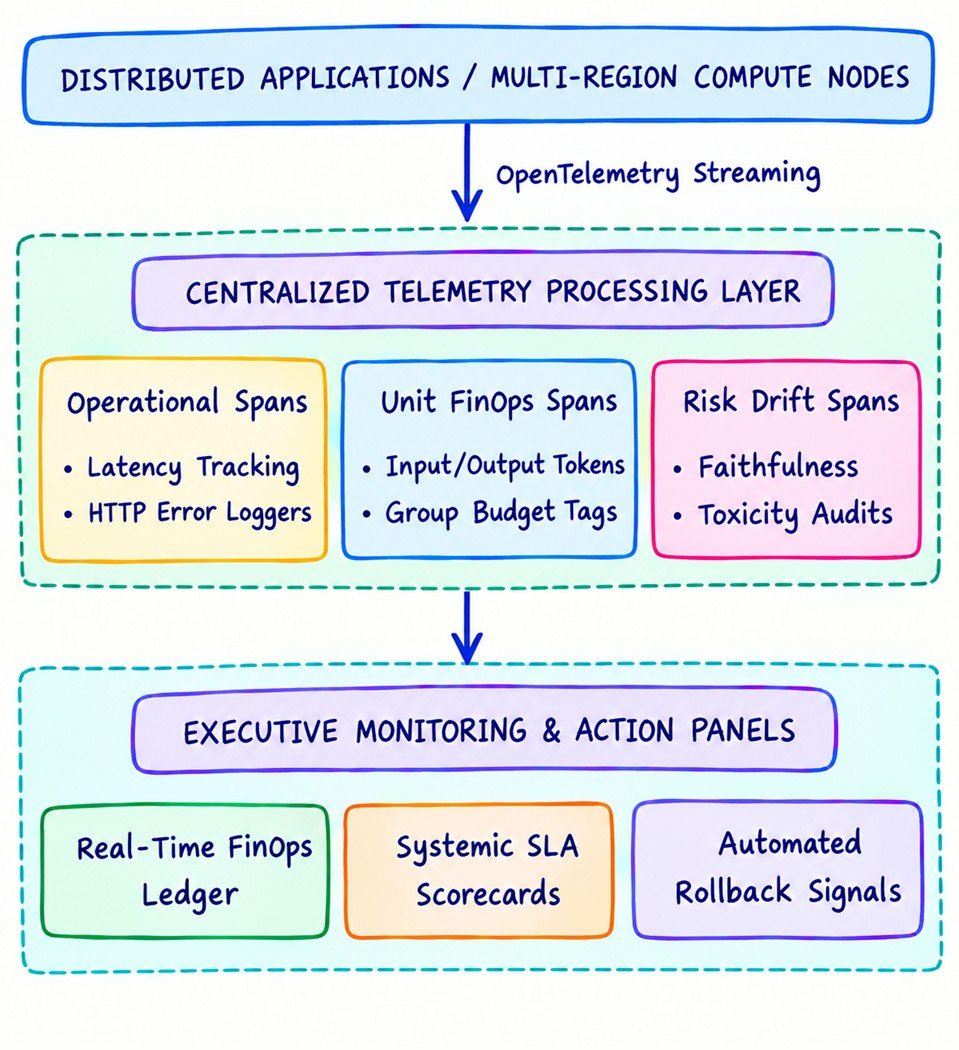
Programmatic Implementation of the Release and Monitoring Fabric
The code below implements an operational Production Release Fabric Router.
Built on FastAPI, it orchestrates progressive canary routing, handles multi-region failover configurations across AWS Bedrock endpoints (us-east-1 and us-west-2), and logs detailed execution traces into Langfuse to enable real-time observability.
import os
import time
import json
import logging
import random
from typing import Dict, Any, Optional
import boto3
from fastapi import FastAPI, HTTPException, Header
from pydantic import BaseModel
from langfuse import Langfuse

# Configure Production Release Logger
logging.basicConfig(level=logging.INFO)
logger = logging.getLogger("Production-Release-Fabric")

app = FastAPI(title="Production Release Fabric Engine", version="1.0.0")

# --- Routing Configurations ---
CANARY_TRAFFIC_ALLOCATION = 0.15  # Route 15% of inbound requests to the canary candidate stack
REGIONAL_ENDPOINTS = ["us-east-1", "us-west-2"]

try:
    # Initialize multi-region infrastructure clients
    bedrock_clients = {
        region: boto3.client(service_name="bedrock-runtime", region_name=region)
        for region in REGIONAL_ENDPOINTS
    }

    langfuse_telemetry = Langfuse(
        public_key=os.getenv("LANGFUSE_PUBLIC_KEY"),
        secret_key=os.getenv("LANGFUSE_SECRET_KEY"),
        host=os.getenv("LANGFUSE_HOST", "https://langfuse.com")
    )
except Exception as e:
    logger.critical(f"Fabric deployment halted. Infrastructure initialization failed: {str(e)}")
    raise

# --- Request & Telemetry Schemas ---
class ClientPayload(BaseModel):
    prompt_text: str
    tenant_id: str
    application_id: str

class FabricPayloadResponse(BaseModel):
    generated_text: str
    routing_region: str
    deployment_track: str
    latency_ms: float

# --- Resilient Cross-Region Inference Core ---
def execute_bedrock_with_failover(model_id: str, prompt: str, trace_context: Any) -> tuple[str, str]:
    """
    Executes model inference with built-in multi-region failover.
    If the primary cloud region fails or hits a rate limit, it instantly retries the request
    in a backup region to maximize system availability.
    """
    body_payload = json.dumps({
        "anthropic_version": "bedrock-2023-05-31",
        "max_tokens": 512,
        "messages": [{"role": "user", "content": prompt}]
    })

    # Try regions sequentially to provide a reliable backup path
    for region in REGIONAL_ENDPOINTS:
        region_span = trace_context.span(name=f"Inference-Attempt-{region}")
        try:
            logger.info(f"Routing inference token load to region: {region} for model: {model_id}")

            response = bedrock_clients[region].invoke_model(
                body=body_payload,
                modelId=model_id,
                accept="application/json",
                contentType="application/json"
            )

            output_text = json.loads(response.get("body").read())["content"]["text"]
            region_span.end(output={"status": "SUCCESS"})
            return output_text, region

        except Exception as e:
            # Catch rate limits or regional service issues and log the retry attempt
            logger.warning(f"Region {region} triggered an execution exception: {str(e)}. Retrying next zone...")
            region_span.end(error=str(e), output={"status": "FAILED"})
            continue

    # Raise an exception if all configured cloud deployment regions fail
    raise HTTPException(status_code=502, detail="All configured AWS deployment regions failed to process inference load.")

# --- API Gateway Endpoint ---
@app.post("/v1/release/execute", response_model=FabricPayloadResponse)
def route_production_traffic(
    payload: ClientPayload,
    x_routing_override: Optional[str] = Header(None)
):
    start_time = time.time()

    # 1. Open Root Operational Trace Context in Langfuse
    trace = langfuse_telemetry.trace(
        name="Production-Release-Ingress",
        user_id=payload.tenant_id,
        metadata={"application_id": payload.application_id}
    )

    # 2. Determine Deployment Track (Progressive Canary Traffic Allocation)
    # Allows developers to explicitly force a route via header flags for debugging
    if x_routing_override in ["baseline", "canary"]:
        selected_track = x_routing_override
    else:
        selected_track = "canary" if random.random() < CANARY_TRAFFIC_ALLOCATION else "baseline"

    # Map tracks to specific target configurations
    if selected_track == "canary":
        target_model = "amazon.sonnet-v2"  # New target version candidate
        prompt_template = f"### SYSTEM INSTRUCTION v2.2 ###\n{payload.prompt_text}"
    else:
        target_model = "amazon.sonnet-v2"  # Stable baseline system version
        prompt_template = f"### SYSTEM INSTRUCTION v2.1 ###\n{payload.prompt_text}"

    trace.update(tags=[f"track-{selected_track}", target_model])

    # 3. Route Request Through Cross-Region Failover Architecture
    execution_span = trace.span(name=f"Execute-Release-Track-{selected_track}")

    try:
        final_text, processing_region = execute_bedrock_with_failover(target_model, prompt_template, execution_span)
        execution_span.end(output={"resolved_region": processing_region})
    except Exception as exc:
        execution_span.end(error=str(exc))
        trace.update(tags=["EXECUTION_CRITICAL_FAILURE"])
        raise HTTPException(status_code=500, detail=str(exc))

    total_latency = (time.time() - start_time) * 1000

    # 4. Push final system operational data to performance dashboards
    trace.update(metadata={
        **trace.metadata,
        "total_fabric_latency_ms": total_latency,
        "selected_region": processing_region,
        "deployment_track": selected_track
    })

    return FabricPayloadResponse(
        generated_text=final_text,
        routing_region=processing_region,
        deployment_track=selected_track,
        latency_ms=total_latency
    )
By decoupling your release paths from raw compute clusters, setting up multi-region failovers, and embedding detailed runtime telemetry, your platform can confidently manage live production traffic.
This architecture gives you the operational resilience and visibility needed to scale smoothly, control running costs, and maintain high performance across your entire enterprise AI portfolio.
Architectural Disclaimer
The technical frameworks, architectural patterns, and systemic design guidelines presented in this text are intended solely for general enterprise software engineering, software platform development, and data infrastructure design optimization. They do not constitute professional technology deployment certifications, legal compliance guarantees, or operational advice for high-risk critical health or safety systems.