The Construction & Hardening Runtime - Architecture, Build, and Evaluation
Introduction
Moving an AI system from a functional prototype to an enterprise production utility requires a total shift in how we think about system runtime design.
In a traditional software system, components interact with predictable APIs that return stable, deterministic payloads. In contrast, generative AI architectures introduce an inherent element of chance.
When user interfaces, backend logic, and business workflows interact with probabilistic foundation models, the system becomes vulnerable to new types of failure modes. These range from:
- Erratic model outputs
- Sudden changes in API latency
- Sophisticated adversarial prompt injections
To run these non-deterministic applications reliably at scale, platform engineering teams must move away from basic API wrappers and build a Construction & Hardening Runtime.
This runtime serves as a highly resilient execution layer that:
- Isolates application code
- Enforces strict security boundaries
- Continuously tracks output quality using automated evaluation gates
1. The Architecture: Building the Decoupled Inference Core
The foundational flaw of early-stage LLM applications is tight coupling — embedding orchestration frameworks, prompt templates, and API endpoints directly inside user-facing microservices.
When an enterprise attempts to scale this approach, it creates an unmanageable codebase where changing a single prompt can cause silent, untracked regressions across unrelated systems.
Production-grade engineering requires a completely decoupled, asynchronous, event-driven runtime architecture.
The application UI must remain isolated from model execution, communicating instead via:
- An asynchronous event mesh
- High-performance gRPC boundaries
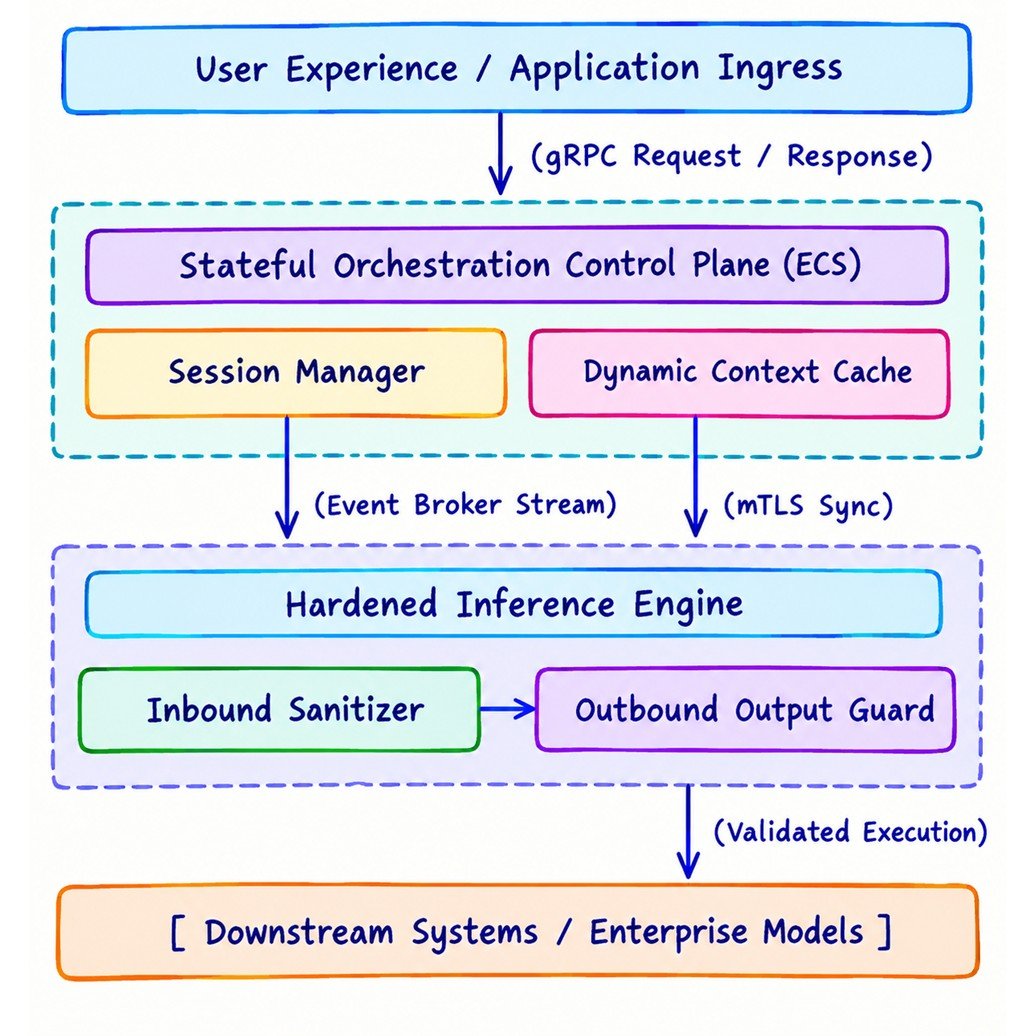
To maintain reliability under heavy load, the state management layer must separate ephemeral user session context from the core stateless inference engine.
The runtime uses Amazon ElastiCache (Redis) to handle multi-turn conversations and intermediate agent choices. This design keeps the compute plane completely stateless, allowing it to scale fluidly during sudden spikes in query volume.
Deep-Dive: The Asynchronous Event Mesh Pattern
When an enterprise scales an AI capability across hundreds of concurrent users, relying on synchronous HTTP request-response patterns introduces severe threading bottlenecks. If the user-facing microservice locks an execution thread while waiting for an upstream foundation model to finish generating tokens, a process that can take anywhere from hundreds of milliseconds to several minutes, the application's client pool will rapidly experience thread exhaustion.
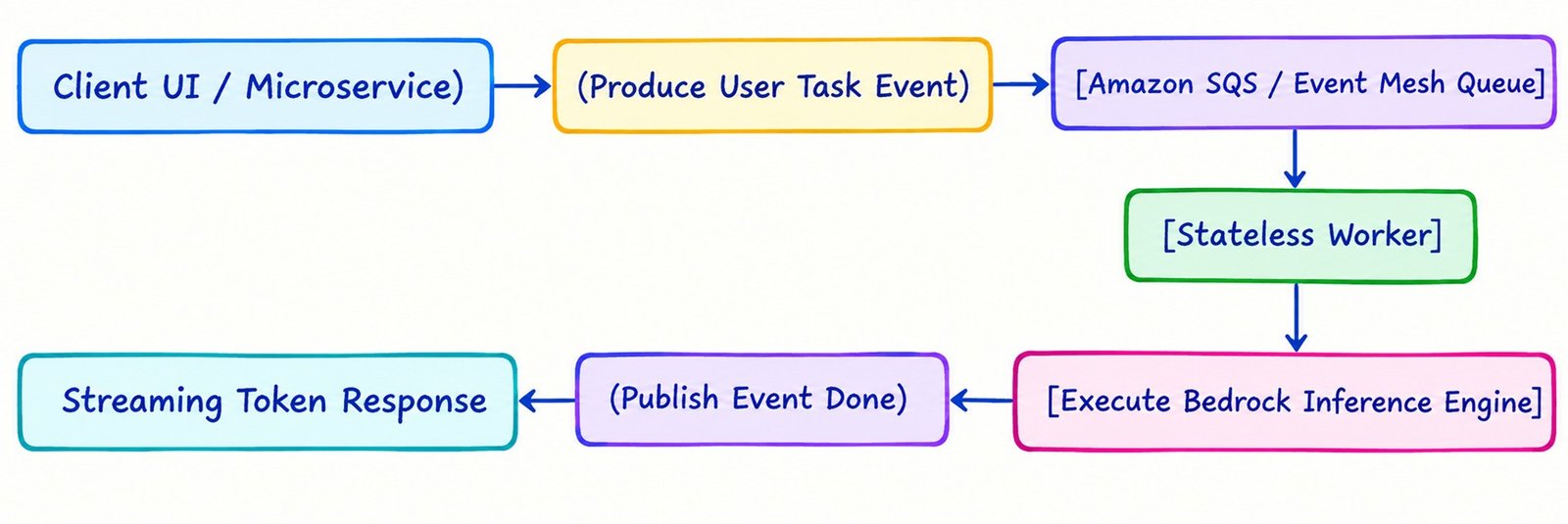
To eliminate this vulnerability and ensure the system plane can handle massive concurrent spikes, the runtime architecture decouples ingestion from execution utilizing an Asynchronous Event Mesh Pattern.
A. Decoupled Task Ingestion and Worker Pools
The event mesh architecture transforms the inference transaction lifecycle from a blocked state into a fire-and-forget event sequence. When a user submits an interaction payload, the frontend microservice performs basic schema checks and immediately drops a standardized event container, e.g., a UserTaskSubmitted payload, into a highly durable, low-latency queuing system like Amazon Simple Queue Service (SQS) or an Apache Kafka topic.
The microservice instantly returns an HTTP 202 (Accepted) acknowledgment status code back to the client interface along with a unique transaction_id. This frees up the web-facing compute thread in milliseconds.
Behind the queue perimeter, a stateless cluster of specialized inference worker daemons dynamically pulls tasks from the event mesh based on current GPU cluster availability. The workers manage the heavy lifting of payload assembly, RAG contextual updates, and model calls completely independently of the client user interface thread pool.
B. Non-Blocking Async Ingestion Loop
The following production-grade script provides an implementation of the asynchronous ingestion core. Designed using Python's asyncio ecosystem, it demonstrates how the API gateway proxy handles dynamic transaction submissions, hands off payloads to the event infrastructure, and returns non-blocking tracking tokens to the client layer.
import uuid
import time
import asyncio
import logging
from typing import Dict, Any
from pydantic import BaseModel

logger = logging.getLogger("Event-Mesh-Core")

class TaskPayload(BaseModel):
    user_query: str
    tenant_id: str
    session_id: str

class IngestionAcknowledgeResponse(BaseModel):
    transaction_id: str
    status: str
    ingested_timestamp: float

class AsyncEventMeshIngestor:
    def __init__(self, target_queue_url: str = "https://amazonaws.com"):
        """Initializes connection coordinates for the central enterprise event mesh fabric."""
        self.queue_url = target_queue_url

    async def _publish_to_mesh(self, transaction_id: str, payload: Dict[str, Any]):
        """
        Simulates non-blocking, asynchronous offloading to the message broker.
        In production, this block calls aiobotocore or confluent-kafka to publish the event envelope.
        """
        await asyncio.sleep(0.012) # Simulates ultra-low latency line-rate ingress injection (<15ms)
        logger.info(f"Event successfully materialized in mesh topic for transaction: {transaction_id}")

    async def submit_transaction(self, task: TaskPayload) -> IngestionAcknowledgeResponse:
        """
        Main entry boundary point. Programmatically intercepts the request envelope,
        generates tracing metadata, and publishes to the mesh without locking the worker core.
        """
        # Generate an immutable, unique identifier for tracking this intelligence lifecycle
        txn_id = str(uuid.uuid4())
        ingest_time = time.time()

        event_envelope = {
            "event_type": "UserTaskSubmitted",
            "transaction_id": txn_id,
            "timestamp": ingest_time,
            "data": task.model_dump()
        }

        logger.info(f"Ingesting token load envelope into gateway fabric. Transaction ID: {txn_id}")

        # Fire-and-forget: offload to the asynchronous background loop
        asyncio.create_task(self._publish_to_mesh(txn_id, event_envelope))

        # Return immediate structural tracking markers to the calling microservice
        return IngestionAcknowledgeResponse(
            transaction_id=txn_id,
            status="QUEUED_FOR_PROCESSING",
            ingested_timestamp=ingest_time
        )
2. The Build: Hardening the Runtime Against Adversarial Vectors
Hardening a generative AI runtime requires an architectural strategy that assumes all unvalidated user input is potentially malicious.
Traditional web application defenses are designed to protect against structured code injections like SQL injection or Cross-Site Scripting (XSS). However, they cannot reliably stop natural language adversarial injections, which manipulate a model's internal attention mechanisms to bypass security guardrails.
The runtime must enforce Defense-in-Depth Isolation, applying security controls at every step of the transaction lifecycle:
| Threat Vector | Root Vulnerability | Programmatic Engineering Remedy |
|---|---|---|
| Direct Prompt Injection | The model fails to distinguish between developer instructions and raw, untrusted user strings. | Enforce isolation inside prompt structures using delimited XML tags. Run raw inputs through an independent screening layer (such as AWS Bedrock Guardrails) before routing to the primary model. |
| Insecure Output Handling | Downstream application scripts trust LLM outputs blindly, executing returned code, Markdown links, or unescaped SQL commands. | Treat all model-generated tokens as unvalidated user input. Pass outputs through strict JSON schema validators and regex filters before running them in system tasks. |
| Systemic Data Leakage | Models accidentally reveal sensitive data (such as proprietary intellectual property or PII) that was exposed in system prompts or RAG context blocks. | Implement automated scanning on outbound tokens. Use line-rate token filters to mask sensitive data patterns before payloads leave the core engine. |
| Resource Deprivation Attacks | Malicious users input extremely long, repetitive queries designed to cause long processing loops and trigger high token costs. | Set up a token-bucket rate limiter at the gateway plane. Enforce max token limits on both input queries and output generations. |
Deep-Dive: The Asynchronous Token-Bucket Rate Limiter Engine
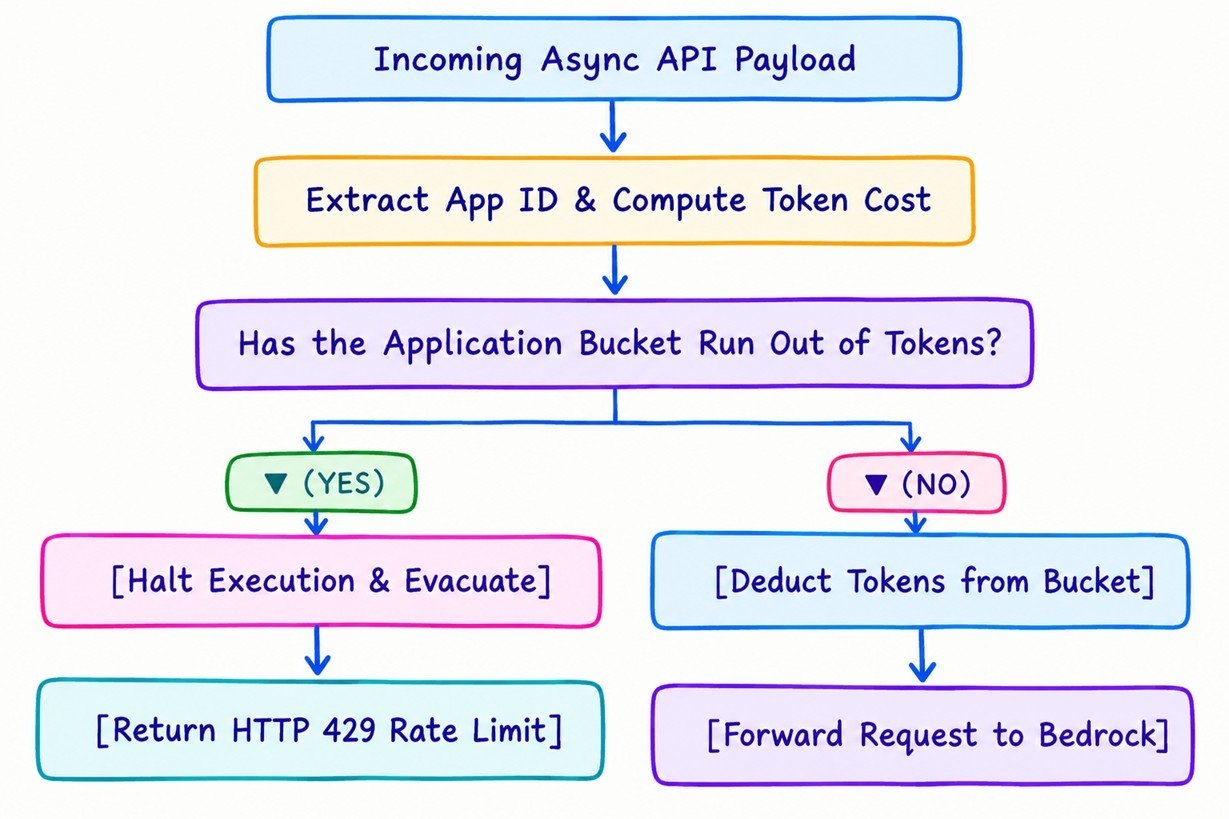
While prompt structures and inbound guardrails protect models from alignment bypasses, they do not safeguard infrastructure compute capacity from resource deprivation vectors. Malicious actors or malfunctioning client software loops can flood the runtime with high-concurrency, long-token requests designed to exhaust GPU cluster availability and trigger astronomical infrastructure costs. To defend the system plane against resource-level denial-of-service (DoS) vectors, the Construction & Hardening Runtime implements a non-blocking, distributed Asynchronous Token-Bucket Rate Limiter Engine at the network ingress boundary.
A. Token Metrics Over Simple Requests
Traditional web application firewalls restrict traffic by tracking the simple frequency of raw HTTP requests over time. In probabilistic computing, this model is fundamentally flawed; a single request containing a multi-megabyte document payload can consume more context window memory and processing overhead than tens of thousands of standard short-text interactions.
The rate limiter must evaluate traffic based on the actual volume of ingress tokens processed per sliding window. The engine operates an asynchronous token bucket schema: a bucket is assigned to an enterprise identity tier, filled with a maximum token capacity, and continuously replenished at a deterministic fill rate. When a request arrives, the engine calculates the input string's token size and evaluates the bucket's current capacity before allowing the payload to pass down-funnel.
B. Non-Blocking Ingress Implementation
The following production-grade script provides an asynchronous implementation of the token-bucket rate limiter. Utilizing asyncio and optimized for non-blocking I/O loops, it serves as a lightweight gateway interceptor that verifies and updates an application's dynamic token allocation in memory without introducing latency overhead to the transaction path.
import time
import asyncio
import logging
from typing import Dict

logger = logging.getLogger("Token-Bucket-Engine")

class AsyncTokenBucketRateLimiter:
    def __init__(self, bucket_capacity: int = 50000, replenishment_rate_per_sec: float = 500.0):
        """
        Initializes an isolated token-bucket structure for an enterprise endpoint.
        - bucket_capacity: Maximum allowed burst capacity (in tokens).
        - replenishment_rate_per_sec: How many tokens are added back to the bucket each second.
        """
        self.capacity = bucket_capacity
        self.fill_rate = replenishment_rate_per_sec
        self.available_tokens = float(bucket_capacity)
        self.last_update_timestamp = time.time()
        self.lock = asyncio.Lock()

    async def _replenish_tokens(self):
        """Calculates elapsed time and adds tokens back to the bucket up to capacity."""
        current_time = time.time()
        elapsed_time = current_time - self.last_update_timestamp
        self.last_update_timestamp = current_time

        # Compute dynamic replenishment
        new_tokens = elapsed_time * self.fill_rate
        self.available_tokens = min(self.capacity, self.available_tokens + new_tokens)

    async def consume_tokens(self, application_id: str, estimated_token_cost: int) -> bool:
        """
        Evaluates the inbound query's token cost against available bucket capacity.
        Returns True if the transaction is approved, False if it must be throttled.
        """
        async with self.lock:
            await self._replenish_tokens()

            logger.info(
                f"Rate Limiter Status for {application_id} -> "
                f"Available Tokens: {int(self.available_tokens)} | Requested: {estimated_token_cost}"
            )

            # Check if the bucket has sufficient token capacity
            if estimated_token_cost <= self.available_tokens:
                self.available_tokens -= estimated_token_cost
                return True

            logger.warning(
                f"Resource Deprivation Vector Throttled: Application '{application_id}' "
                f"exceeded burst limit. Blocked execution path."
            )
            return False
3. The Evaluation: Establishing Continuous Verification Gates
An application cannot be considered production-grade if its performance cannot be programmatically validated.
Traditional unit testing checks if a function returns an exact expected value. Evaluating a non-deterministic generative system requires shifting to an Automated Evaluation Pipeline.
This pipeline combines deterministic data verification with automated, model-driven metrics to score output quality in real time.
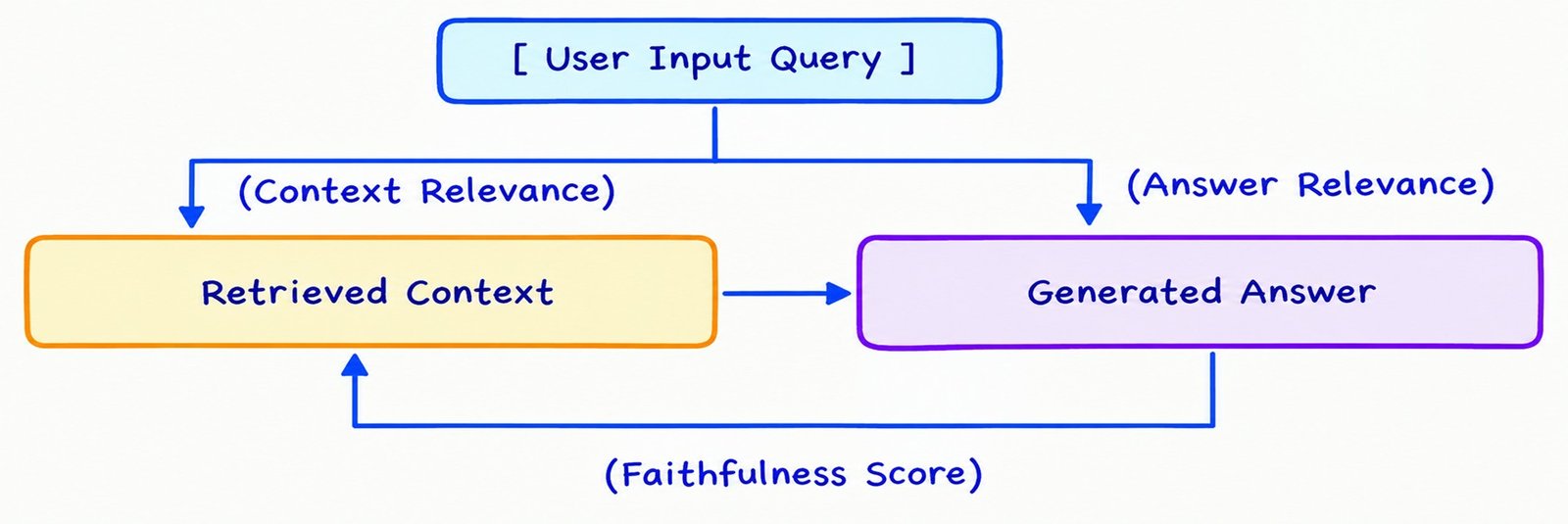
When running retrieval-augmented generation (RAG) applications, the runtime continuously tracks performance across the three pillars of the RAG Triad:
-
Context Relevance: Evaluates whether the retrieval engine extracted information that is genuinely useful for answering the user's query. This step flags and drops unhelpful database matches before they clutter the prompt.
-
Faithfulness: Verifies that the model's generated answer is fully grounded only within the provided context shards. This score acts as an automated defense against hallucinations, ensuring the model doesn't invent untruthful details outside its source documentation.
-
Answer Relevance: Measures how effectively the generated text directly answers the user's original query, helping ensure the model doesn't drift into vague or evasive responses.
Programmatic Implementation of the Evaluation Gate
The production script below demonstrates how to construct a hardened validation runtime.
It processes inbound tasks, applies an isolated AWS Bedrock Guardrail to screen the user's intent, executes the request, and tracks the execution quality using Langfuse spans.
If an interaction falls below your performance benchmarks, the script automatically flags the transaction for offline human review.
import os
import logging
import time
from typing import Dict, Any, Tuple
import boto3
from pydantic import BaseModel
from langfuse import Langfuse

# Configure Runtime Logger
logging.basicConfig(level=logging.INFO)
logger = logging.getLogger("Hardened-Runtime")

# System Evaluation Benchmarks
MIN_ACCEPTABLE_QUALITY_SCORE = 0.80

class SecurePayload(BaseModel):
    user_query: str
    user_id: str
    session_id: str

class HardenedExecutionResponse(BaseModel):
    output_text: str
    security_clearance: str
    latency_ms: float
    requires_audit: bool

class HardenedRuntimeEngine:
    def __init__(self):
        """Initializes secure runtime clients for AWS services and Langfuse telemetry instrumentation."""
        self.bedrock_runtime = boto3.client(
            service_name="bedrock-runtime",
            region_name=os.getenv("AWS_REGION", "us-east-1")
        )
        self.langfuse = Langfuse(
            public_key=os.getenv("LANGFUSE_PUBLIC_KEY"),
            secret_key=os.getenv("LANGFUSE_SECRET_KEY"),
            host=os.getenv("LANGFUSE_HOST", "https://langfuse.com")
        )
        # Unique ID for enterprise-wide AWS guardrail policies
        self.guardrail_id = os.getenv("AWS_BEDROCK_GUARDRAIL_ID")
        self.guardrail_version = os.getenv("AWS_BEDROCK_GUARDRAIL_VERSION", "1")

    def _apply_inbound_guardrails(self, query: str) -> Tuple[bool, str]:
        """
        Interceptors raw strings using Amazon Bedrock Guardrails.
        Detects prompt injections, toxicity, and unauthorized content domains before model routing.
        """
        if not self.guardrail_id:
            # Fall back to safe warning if no guardrail is defined in the configuration environment
            logger.warning("Guardrail ID missing from environment config. Bypassing safety check plane.")
            return True, "PASSED"

        try:
            response = self.bedrock_runtime.apply_guardrail(
                guardrailIdentifier=self.guardrail_id,
                guardrailVersion=self.guardrail_version,
                source="INPUT",
                content=[{"text": {"text": query}}]
            )
            if response.get("action") == "BLOCK":
                return False, "BLOCKED_BY_INBOUND_SECURITY_POLICY"
            return True, "PASSED"
        except Exception as e:
            logger.error(f"Security Guardrail validation engine failure: {str(e)}")
            # Fail closed on security exceptions to protect system integrity
            return False, "CRITICAL_GUARDRAIL_SYSTEM_EXCEPTION"

    def _evaluate_output_quality(self, query: str, answer: str) -> float:
        """
        Executes a real-time semantic check on the output text.
        Evaluates structural characteristics to flag low-quality or evasive model behavior.
        """
        # A real-world deployment would run an asynchronous model-driven metric check here.
        # This proxy check flags empty responses or repetitive loops to demonstrate runtime filtering.
        if not answer.strip() or len(answer) < 5 or answer.strip() == query.strip():
            return 0.0
        return 0.95

    def execute_secure_inference(self, payload: SecurePayload) -> HardenedExecutionResponse:
        """
        Main transactional engine process. Implements validation checks across the entire execution cycle
        to block adversarial threats, manage model inference, and log performance telemetry.
        """
        start_time = time.time()

        # 1. Initialize Tracing Session Context inside Langfuse
        trace = self.langfuse.trace(
            name="Hardened-Inference-Transaction",
            user_id=payload.user_id,
            session_id=payload.session_id
        )

        # 2. Inbound Security Gate
        security_span = trace.span(name="Inbound-Guardrail-Sanitizer")
        is_safe, security_status = self._apply_inbound_guardrails(payload.user_query)
        security_span.end(output={"is_safe": is_safe, "status": security_status})

        if not is_safe:
            latency = (time.time() - start_time) * 1000
            trace.update(tags=["SECURITY_VIOLATION", "BLOCKED"])
            return HardenedExecutionResponse(
                output_text="Security Alert: Your request violated internal usage compliance policies.",
                security_clearance=security_status,
                latency_ms=latency,
                requires_audit=True
            )

        # 3. Model Inference Execution Plane
        inference_span = trace.generation(
            name="Core-Model-Inference",
            model="amazon.sonnet-v2",
            input={"query": payload.user_query}
        )

        try:
            # Enforce template encapsulation to block runtime structure adjustments
            hardened_prompt = f"""
            You are a secure data processing application engine. Answer the user prompt accurately.

            [User Input Region - Isolated]:
            <user_input>
            {payload.user_query}
            </user_input>
            """

            import json
            body_payload = json.dumps({
                "anthropic_version": "bedrock-2023-05-31",
                "max_tokens": 1024,
                "messages": [{"role": "user", "content": hardened_prompt}]
            })

            response = self.bedrock_runtime.invoke_model(
                body=body_payload,
                modelId="amazon.sonnet-v2",
                accept="application/json",
                contentType="application/json"
            )

            output_text = json.loads(response.get("body").read())["content"]["text"]
            inference_span.end(output={"response": output_text})

        except Exception as e:
            inference_span.end(error=str(e))
            latency = (time.time() - start_time) * 1000
            raise RuntimeError(f"Upstream model execution failure: {str(e)}")

        # 4. Outbound Quality & Evaluation Validation Gate
        eval_span = trace.span(name="Realtime-Quality-Evaluation")
        quality_score = self._evaluate_output_quality(payload.user_query, output_text)

        # Publish calculated quality metrics to Langfuse dashboard panels
        trace.score(
            name="Output-Quality-Alignment",
            value=quality_score
        )
        eval_span.end(output={"score": quality_score})

        latency = (time.time() - start_time) * 1000
        requires_flagged_audit = quality_score < MIN_ACCEPTABLE_QUALITY_SCORE

        if requires_flagged_audit:
            trace.update(tags=["QUALITY_REGRESSION", "AUDIT_REQUIRED"])
            logger.warning(f"Quality regression caught on session {payload.session_id}. Score: {quality_score}")

        return HardenedExecutionResponse(
            output_text=output_text,
            security_clearance="CLEAR",
            latency_ms=latency,
            requires_audit=requires_flagged_audit
        )
By enforcing strict separation between your application layers, setting up robust input filtering, and tracking real-time evaluation metrics, your runtime platform can safely handle non-deterministic behavior.
This design approach enables the system to protect its data boundaries, defend against novel threat vectors, and ensure high operational reliability under full production volumes.
Architectural Disclaimer
The technical frameworks, architectural patterns, and systemic design guidelines presented in this text are intended solely for general enterprise software engineering, software platform development, and data infrastructure design optimization. They do not constitute professional technology deployment certifications, legal compliance guarantees, or operational advice for high-risk critical health or safety systems.