The AI Enterprise Maturity Roadmap & Continuous Architecture Evolution
Introduction
The installation of a repeatable product pipeline marks the transition of an enterprise from an exploratory AI tinkerer into an operational organization.
However, the architectural journey does not stop at the deployment of a single platform footprint. Over multi-year corporate horizons, individual components mutate, provider economics shift, and new structural capabilities modify the baseline requirements of the enterprise.
An organization cannot treat its technology topology as a static fixture; instead, it must implement an active architecture capable of continuous evolution.
Operating within TOGAF 10 Phase H (Architecture Change Management), technology leaders must deploy a highly structured, capability-driven roadmap.
This framework guides the organization away from isolated, fragile implementations and moves it toward a highly integrated, self-optimizing system utility. This systematic maturation balances innovative flexibility against corporate governance, financial cost management, and long-term infrastructure stability.
1. The Core Strategic Imperative: The Architecture Evolution Engine
When an enterprise scales its AI investments without a formal maturity blueprint, it inevitably hits a growth ceiling.
This barrier is characterized by deep infrastructure dependencies, soaring token costs, and a fragmented development landscape across different departments. This friction is a clear architectural indicator that your application portfolio has outgrown its underlying platform capabilities.
Continuous evolution requires a systematic approach that turns operational data into long-term strategic adjustments.
By capturing real-time telemetry from production nodes, the enterprise can continuously analyze its performance gaps. This feedback loop allows architects to proactively update platform frameworks, replace inefficient vendor models, and optimize infrastructure deployment patterns before structural bottlenecks impact business operations.
2. The 5-Stage Enterprise AI Maturity Framework
To guide this transformation, technology executives should measure and manage their progress using a highly structured 5-Stage Enterprise AI Maturity Framework.
This model expands on classic CMMI patterns to address the distinct challenges of managing non-deterministic software and token-driven economics:
IMAGE-13-20
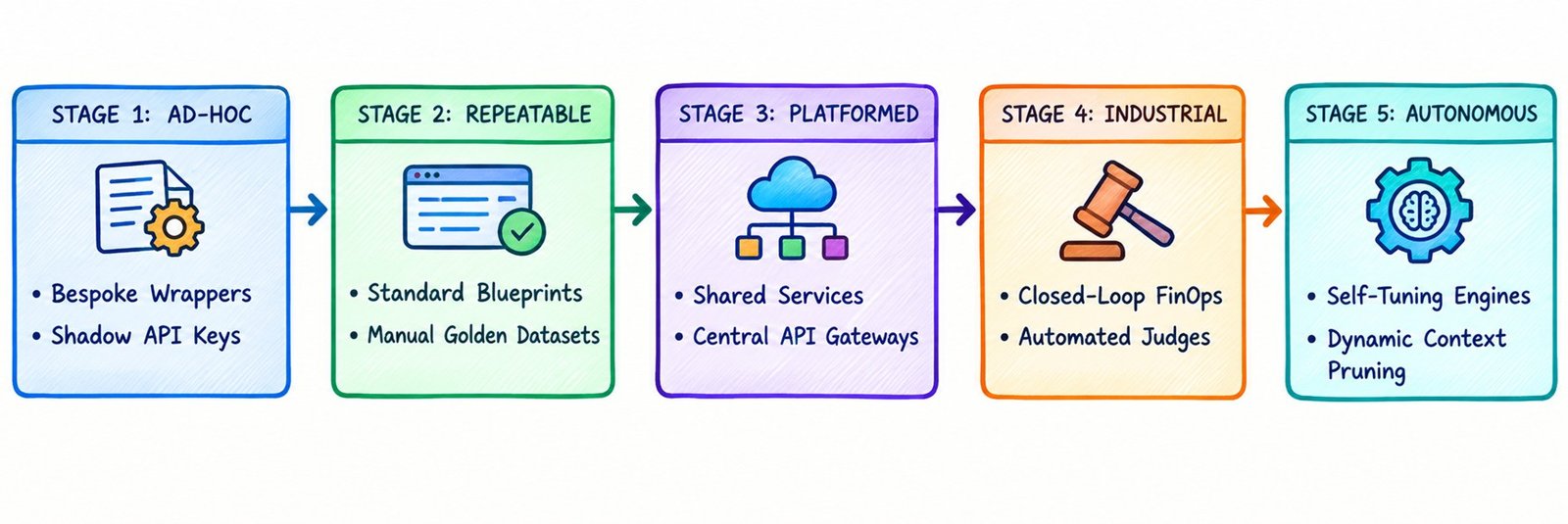
The matrix below maps the explicit technical characteristics, infrastructure configurations, and architectural expectations across each maturity plane:
| Maturity Dimension | Stage 1: Ad-Hoc / Reactive | Stage 2: Repeatable / Guided | Stage 3: Platform-ized / Shared | Stage 4: Industrialized / Metric-Driven | Stage 5: Self-Optimizing / Autonomous |
|---|---|---|---|---|---|
| Compute & Inference Architecture | Direct integration with raw vendor APIs. Hardcoded model connections inside app repositories. | Basic integration abstractions. Centralized developer reference templates using LangChain or LlamaIndex. | Enterprise Model Gateways. All application teams connect via provider-agnostic gRPC/REST proxy layers. | Dynamic Model Cascading. Requests automatically route to small (SLM) or large models (LLM) based on task complexity. | Autonomous Router Meshes. Live traffic routes across local private GPU environments and commercial hyperscalers. |
| Data Tier & Knowledge Fabric | Siloed data files. Raw strings passed inside prompts without structured vector search. | Disconnected vector databases spun up by individual teams. Fragmented ingestion pipelines. | Centralized Vector Fabric. Shared, multi-tenant database clusters isolated securely via Namespaces. | Context Engineering Hubs. Automated chunking, real-time embeddings, and semantic reranking pipelines. | Dynamic Hybrid Fabrics. Automated data synthesis graphs that clean, update, and manage their own indexes. |
| Observability & FinOps Controls | Zero visibility. Cloud spend evaluated manually through standard monthly cloud billing statements. | Basic application request logging. Simple tracking of API error response counts. | Centralized OpenTelemetry. Real-time dashboards tracking token metrics using customized app metadata tags. | Unit Economic Costing. Systems compute and optimize exact financial costs per successful business task. | Self-Managing Budgets. Platform controllers automatically throttle runaway loops or downgrade model targets. |
| Governance & Safety Boundaries | Post-deployment manual audits. High risk of data leaks or shadow AI development. | Documented security policies. Manual checklist evaluations conducted before a project goes live. | Automated Gateway Filters. Line-rate checking for prompt injections and sensitive PII masking. | Continuous Judge Evaluation. Automated datasets run systematically inside deployment pipelines. | Continuous Guardrail Adaptation. Security filters dynamically adjust parameters based on evolving threat patterns. |
3. Programmatic Gap Analysis: Executing TOGAF Phase H
Transitioning between maturity planes cannot rely on guesswork.
The platform must use systematic, metrics-driven rules to identify when an architecture layer has outgrown its current configuration limits and requires promotion.
IMAGE-13-21
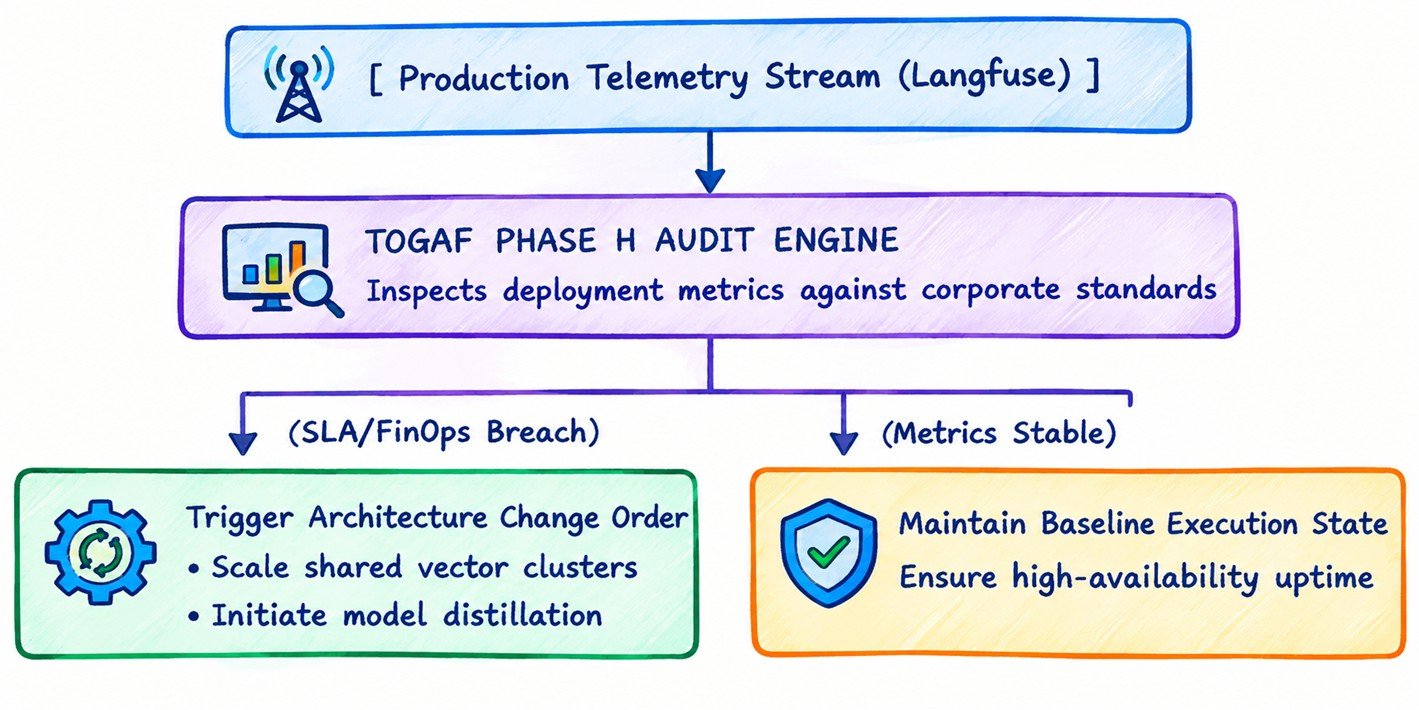
The steering infrastructure applies explicit architectural triggers to automate this gap analysis loop:
- The Platform Ingress Trigger: When cross-departmental auditing reveals that more than three separate business teams have deployed independent vector database instances, the platform trips a change order. This mandates the migration of those workloads onto the shared Enterprise Knowledge Fabric.
- The FinOps Optimization Trigger: If an application's cumulative token cost exceeds its assigned budget threshold by more than 15% within a 30-day window, the system flags a regression event. This forces the prompt configuration through an automated distillation cycle to reduce context size.
- The Quality Drift Trigger: When continuous evaluation judges detect that an application's accuracy scores have degraded below baseline parameters for more than 2% of daily live transactions, the system initiates an alert. This routes traffic to an isolated shadow tracking space to isolate model or prompt drift.
4. Continuous Architecture Evolution: Automated Maturity Verification Runtime
To actively enforce these maturity standards across a sprawling enterprise footprint, the platform deployment plane must run an automated compliance service.
The following production script implements an operational maturity audit utility. It queries Langfuse telemetry backends to pull performance statistics, evaluates those metrics against strict platform standards, saves compliance states to an Amazon DynamoDB governance table, and throws actionable configuration exceptions if an application drops into an unmanaged maturity plane.
import os
import logging
import time
import json
from typing import Dict, Any, List
import boto3
from pydantic import BaseModel
from langfuse import Langfuse

# Configure Maturity Auditing System Logger
logging.basicConfig(level=logging.INFO)
logger = logging.getLogger("Architecture-Maturity-Engine")

class ApplicationMaturityProfile(BaseModel):
    application_id: str
    business_unit: str
    computed_maturity_stage: int
    compliance_passed: bool
    audit_telemetry_summary: Dict[str, Any]

class AutomatedMaturityAuditor:
    def __init__(self):
        """Initializes secure communication lanes with AWS DynamoDB governance registries and Langfuse logs."""
        self.langfuse_client = Langfuse(
            public_key=os.getenv("LANGFUSE_PUBLIC_KEY"),
            secret_key=os.getenv("LANGFUSE_SECRET_KEY"),
            host=os.getenv("LANGFUSE_HOST", "https://langfuse.com")
        )
        self.dynamodb = boto3.resource("dynamodb", region_name=os.getenv("AWS_REGION", "us-east-1"))
        self.governance_table = self.dynamodb.Table(
            os.getenv("GOVERNANCE_REGISTRY_TABLE", "Enterprise-AI-Maturity-Registry")
        )

    def analyze_application_runtime_metrics(self, app_id: str) -> Dict[str, Any]:
        """
        Gathers operational telemetry directly from Langfuse tracking stores.
        Analyzes error behaviors, caching footprints, and cost configurations over active workloads.
        """
        try:
            # Query operational log summaries for the specific application target
            traces = self.langfuse_client.get_traces(user_id=app_id, limit=50)

            total_requests = len(traces.data)
            cache_hits = 0
            security_violations = 0
            total_accuracy_score = 0.0
            graded_counts = 0

            for trace in traces.data:
                # Audit semantic caching behaviors
                if trace.metadata.get("status") == "HIT" or trace.metadata.get("cache_savings_usd", 0) > 0:
                    cache_hits += 1

                # Check for logged security or guardrail violation tags
                if "SECURITY_VIOLATION" in trace.tags:
                    security_violations += 1

                # Gather and compile average quality scores from production judge loops
                accuracy = trace.metadata.get("final_evaluation_accuracy")
                if accuracy is not None:
                    total_accuracy_score += float(accuracy)
                    graded_counts += 1

            avg_accuracy = (total_accuracy_score / graded_counts) if graded_counts > 0 else 1.0
            cache_ratio = (cache_hits / total_requests) if total_requests > 0 else 0.0

            return {
                "total_monitored_calls": total_requests,
                "semantic_cache_utilization_ratio": cache_ratio,
                "recorded_security_breach_count": security_violations,
                "average_production_accuracy": avg_accuracy
            }
        except Exception as e:
            logger.error(f"Failed to pull trace logs from Langfuse database for app {app_id}: {str(e)}")
            # Return baseline conservative proxy properties on systemic lookup failures
            return {
                "total_monitored_calls": 0,
                "semantic_cache_utilization_ratio": 0.0,
                "recorded_security_breach_count": 1,
                "average_production_accuracy": 0.0
            }

    def compute_maturity_stage(self, summary: Dict[str, Any]) -> Tuple[int, bool]:
        """
        Executes strict score evaluations to assign a CMMI-aligned maturity stage.
        Verifies that applications actively use shared platform services and stay within safety limits.
        """
        # Baseline stage assumptions
        stage = 1
        compliance_passed = True

        if summary["total_monitored_calls"] == 0:
            return 1, False

        # Stage 2: Requires baseline metrics logging and clean security tracking
        if summary["total_monitored_calls"] > 0 and summary["recorded_security_breach_count"] == 0:
            stage = 2

        # Stage 3: Requires active use of platform shared services (e.g., semantic caching)
        if stage == 2 and summary["semantic_cache_utilization_ratio"] > 0.05:
            stage = 3

        # Stage 4: Requires high system accuracy verified by automated production judges
        if stage == 3 and summary["average_production_accuracy"] >= 0.85:
            stage = 4

        # Enforce corporate compliance constraints
        # Applications running at scale without utilizing shared platform caching layers fail baseline standards
        if stage < 3 and summary["total_monitored_calls"] > 1000:
            compliance_passed = False

        return stage, compliance_passed

    def execute_governance_audit_cycle(self, app_id: str, business_unit: str) -> ApplicationMaturityProfile:
        """
        Runs the full architectural verification cycle. Analyzes runtime metrics,
        calculates maturity positioning, and updates the central governance registry.
        """
        logger.info(f"Initiating Automated Maturity Verification for asset: {app_id}")

        telemetry_summary = self.analyze_application_runtime_metrics(app_id)
        stage, passed = self.compute_maturity_stage(telemetry_summary)

        profile = ApplicationMaturityProfile(
            application_id=app_id,
            business_unit=business_unit,
            computed_maturity_stage=stage,
            compliance_passed=passed,
            audit_telemetry_summary=telemetry_summary
        )

        try:
            # Save the calculated maturity profile to your DynamoDB governance table
            self.governance_table.put_item(
                Item={
                    "ApplicationID": profile.application_id,
                    "BusinessUnit": profile.business_unit,
                    "MaturityStage": profile.computed_maturity_stage,
                    "CompliancePassed": profile.compliance_passed,
                    "LastAuditTimestamp": int(time.time()),
                    "MetricsSummaryJson": json.dumps(profile.audit_telemetry_summary)
                }
            )
            logger.info(f"Maturity audit registry update success for application: {app_id}")
        except Exception as e:
            logger.error(f"Failed to record compliance profile in DynamoDB storage: {str(e)}")

        return profile
By embedding these automated capability checks directly into your platform management layer, enterprise architects can systematically eliminate technical debt.
The system provides the visibility, feedback loops, and guardrails needed to continuously optimize infrastructure costs, maintain compliance, and guide the entire organization toward a unified, highly mature AI capability.
Architectural Disclaimer
The technical frameworks, architectural patterns, and systemic design guidelines presented in this text are intended solely for general enterprise software engineering, software platform development, and data infrastructure design optimization. They do not constitute professional technology deployment certifications, legal compliance guarantees, or operational advice for high-risk critical health safety systems.