What an AI Architectural North Star is
Introduction
Enterprise AI initiatives face a common failure mode: they stall in a perpetual proof-of-concept (PoC) loop or collapse under production complexities. This breakdown occurs because organizations attempt to leap directly from a compelling AI Product Vision to low-level engineering implementation.
To bridge this chasm, technology leaders, including CTOs, VPs, and Directors, must establish an AI Architectural North Star.
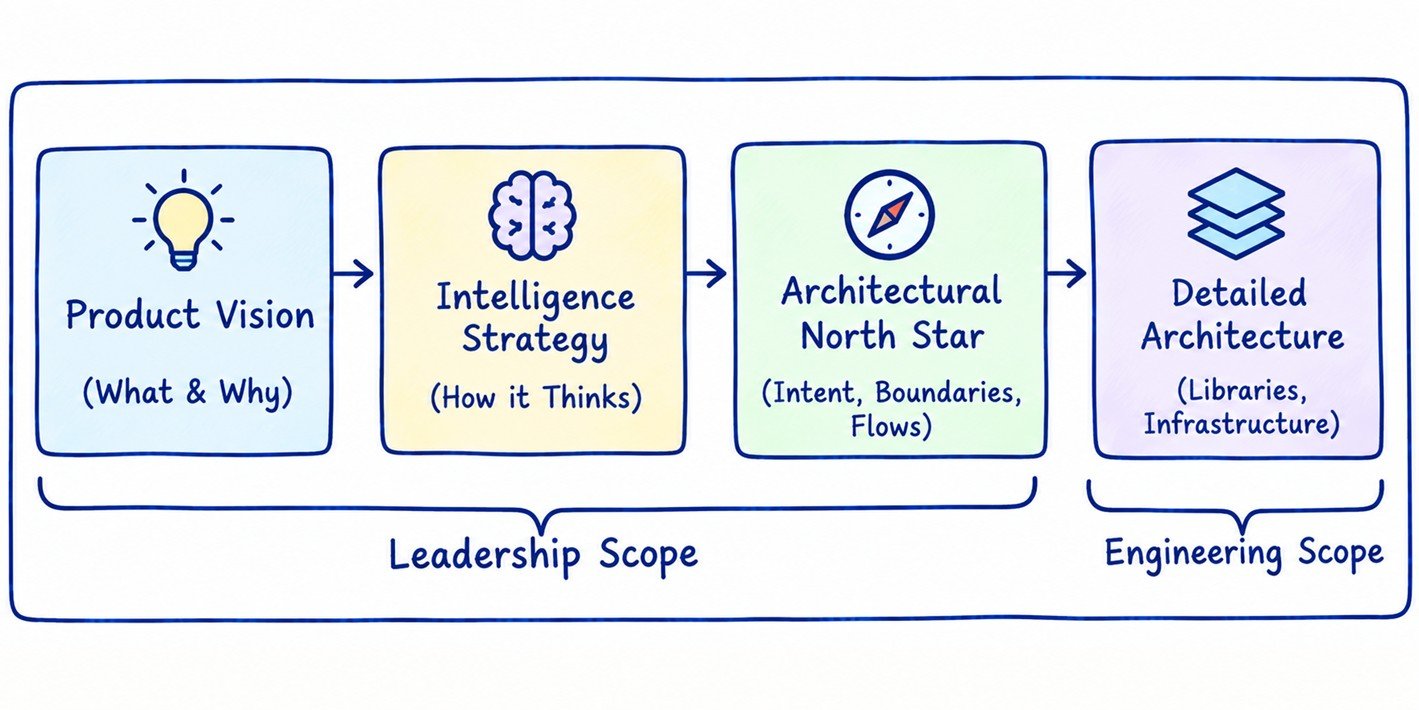
As pioneered by AI architecture leader Sanjoy Kumar Malik, the Architectural North Star sits precisely at the boundary between Product Strategy and detailed engineering execution. It is a strategic mechanism that defines what an AI system must fundamentally become for the Product Vision to succeed.
1. What is an AI Architectural North Star?
The AI Architectural North Star is a high-level, concrete blueprint that establishes the systemic foundation, core principles, boundaries, and intelligence flows of an AI product before detailed implementation begins.
What It Is Not
- It is not a conceptual, hand-waving presentation diagram. It is structurally rigorous and designed to expose hard technical realities, challenge product assumptions, and validate product viability.
- It is not a prescriptive technology stack list. It does not mandate specific code libraries, cloud providers, or database vendors.
- It does not replace detailed architecture. It provides the strategic direction from which implementation architects and engineering teams can safely develop localized, low-level technical specifications.
The Core Executive Distinction
- Product Vision: Defines what is worth building and why it deserves to exist.
- Intelligence Strategy: Defines how AI capabilities, models, context, reasoning, and human-in-the-loop triggers collaborate to create cognitive value.
- Architectural North Star: Defines how the entire macro-system needs to come together to safely operationalize that intelligence at scale.
2. The Eight Pillars of the North Star
The AI Architectural North Star provides engineering teams with five specific definitions from which they can build toward production without friction:
I. Architectural Intent
The intentional engineering philosophy of the product. It ensures that every technical system directly serves a specific business outcome. For example, if the Product Vision requires sub-second ambient assistance, the Architectural Intent mandates an infrastructure footprint optimized for streaming and token-to-token low latency, completely eliminating batch-processing paradigms from consideration.
II. System Boundaries & Trust Perimeters
AI applications introduce probabilistic behavior and significant security, compliance, and data privacy vectors. The North Star establishes clear structural boundaries:
- Where data must be strictly anonymized or masked before model ingestion.
- The explicit boundaries between deterministic enterprise software layers and probabilistic AI orchestration layers.
- Compliance and data sovereignty perimeters (e.g., where open-weight models must be self-hosted to comply with strict regulatory frameworks versus where cloud APIs are acceptable).
III. Major Design Choices
High-level structural patterns that govern the system's longevity. This includes declaring macro-level architectural choices, such as:
- Opting for an asynchronous, multi-agent orchestration framework over a single, monolithic, linear prompt chain.
- Establishing centralized state-management engines and semantic caching structures to control soaring token costs.
- Defining how the core intelligence engine connects to, reads from, and mutates enterprise transactional systems.
IV. Intelligence Flows
The choreography of data and cognition. The North Star maps out the movement of information across the system:
- How raw enterprise data streams into ingestion pipelines.
- How that data is structured into rich context (via vector indices, graph databases, or relational caches).
- How that context is injected into reasoning models.
- How model output is intercepted by guardrails, parsed into structured logic, and safely returned to the system or human user.
V. Critical Trade-offs
Building an AI system involves constant, conflicting engineering pressures. The North Star explicitly outlines which priorities win over others, removing ambiguity for developers:
- Cost vs. Capability: Accepting higher token latency and costs from frontier models to guarantee complex, multi-step reasoning accuracy.
- Latency vs. Sophistication: Intentionally choosing smaller, highly localized models to meet strict user performance guardrails, sacrificing cross-domain synthesis.
- Flexibility vs. Control: Enforcing highly rigid, deterministic guardrail layers that reduce model creativity but completely insulate the business from brand and operational risk.
VI. Intelligence & Model Strategy
Building an AI system involves constant, conflicting engineering pressures. The Intelligence & Model Strategy explicitly outlines which priorities win over others, removing ambiguity for developers:
- Frontier vs. Localized Intelligence: Accepting the higher latency and API costs of frontier models to handle complex reasoning, while routing routine tasks to smaller, local models to optimize speed and compute efficiency.
- Dynamic Retrieval vs. Static Knowledge: Prioritizing Retrieval-Augmented Generation (RAG) and tool use for real-time data accuracy, while using fine-tuning only when the system requires deep alignment with a specific style, tone, or proprietary domain.
- Agentic Autonomy vs. Deterministic Logic: Granting autonomous agents flexibility to solve open-ended workflows, while enforcing rigid, deterministic fallback logic to guarantee system stability and degraded-mode behavior during model failures.
- Vendor Optimization vs. Model Agnosticism: Designing a flexible, model-agnostic infrastructure that prevents vendor lock-in, while selectively leveraging proprietary features when they offer a decisive performance or cost advantage.
- Production Stability vs. Rapid Upgrades: Enforcing strict, automated evaluation guardrails that delay deployment to ensure safety, rather than instantly pushing cutting-edge model upgrades to production.
VII. Evaluation, Observability & Reliability
Building an AI system involves constant, conflicting engineering pressures. The Evaluation, Observability & Reliability framework explicitly outlines which priorities win over others, removing ambiguity for developers:
- Behavioral Validation vs. Operational Telemetry: Prioritizing semantic evaluation metrics (groundedness, safety, and task completion) to ensure the AI made the correct decision, rather than relying solely on traditional operational metrics like HTTP status codes.
- Rigorous Regression Guardrails vs. Deployment Velocity: Enforcing exhaustive testing against golden evaluation datasets to prevent regression, intentionally slowing down production updates to guarantee behavioral consistency.
- Deep Architectural Tracing vs. System Simplicity: Implementing end-to-end tracing across retrieval, orchestration, tools, and models, accepting higher system complexity to pinpoint exactly where an AI workflow degraded.
- Deterministic Metrics vs. Subjective Benchmarking: Anchoring success criteria to measurable, automated benchmark methodologies to eliminate ambiguity, while reserving human-in-the-loop escalation exclusively for high-risk anomalies.
VIII. Evolution & Governance
Building an AI system involves constant, conflicting engineering pressures. The Evolution & Governance framework explicitly outlines which priorities win over others, removing ambiguity for developers:
- Strict Version Control vs. Rapid Iteration: Enforcing rigorous architectural decision records and independent versioning for prompts, models, and knowledge bases, accepting slower prototyping speeds to prevent the system from becoming an ungoverned collection of assets.
- Deterministic Kill-Switches vs. Autonomous Agility: Deploying hardcoded rollback and kill-switch mechanisms that instantly override autonomous actions during anomalies, sacrificing agent flexibility to maintain absolute operational control.
- Formal Gateway Approvals vs. Vendor Flexibility: Requiring high-threshold change-approval workflows before introducing new models, vendors, or data sources, choosing architectural stability over immediate adoption of new ecosystem tools.
- Structured Deprecation vs. Legacy Tech Debt: Mandating comprehensive migration strategies for legacy models and prompts, investing developer time up front to eliminate systemic drift and maintain long-term codebase cleanliness.
Pillars at a glance
| Pillar | Core question |
|---|---|
| I. Architectural Intent | Why are we building it this way? |
| II. System Boundaries & Trust Perimeters | Where are the boundaries and what can be trusted? |
| III. Major Design Choices | What structural decisions govern the system? |
| IV. Intelligence Flows | How does data and cognition move through it? |
| V. Critical Trade-offs | Which competing priorities win? |
| VI. Intelligence & Model Strategy | Where does intelligence come from and how does it evolve? |
| VII. Evaluation, Observability & Reliability | How do we know the system works? |
| VIII. Evolution & Governance | How does the architecture change safely over time? |
3. Why Technology Leaders Must Enforce a North Star
Without an Architectural North Star, AI initiatives default to two destructive patterns that consume enterprise capital:
-
The Prototype Trap (Under-Engineering): Data scientists and developers build a fragile prototype using brittle prompt engineering, basic API scripts, and unoptimized vector stores. When exposed to enterprise-scale workloads, concurrent user traffic, and edge-case security risks, the system collapses, forcing an expensive ground-up rewrite.
-
The Over-Engineered Monolith: Lacking high-level intent, engineering teams build massively complex, expensive infrastructure. They provision high-compute GPU clusters, specialized real-time graph databases, and heavy orchestration layers for an application that structurally requires only semantic classification or simple automated workflows.
The Alignment Benefit
By introducing the Architectural North Star, technology executives achieve complete organizational alignment:
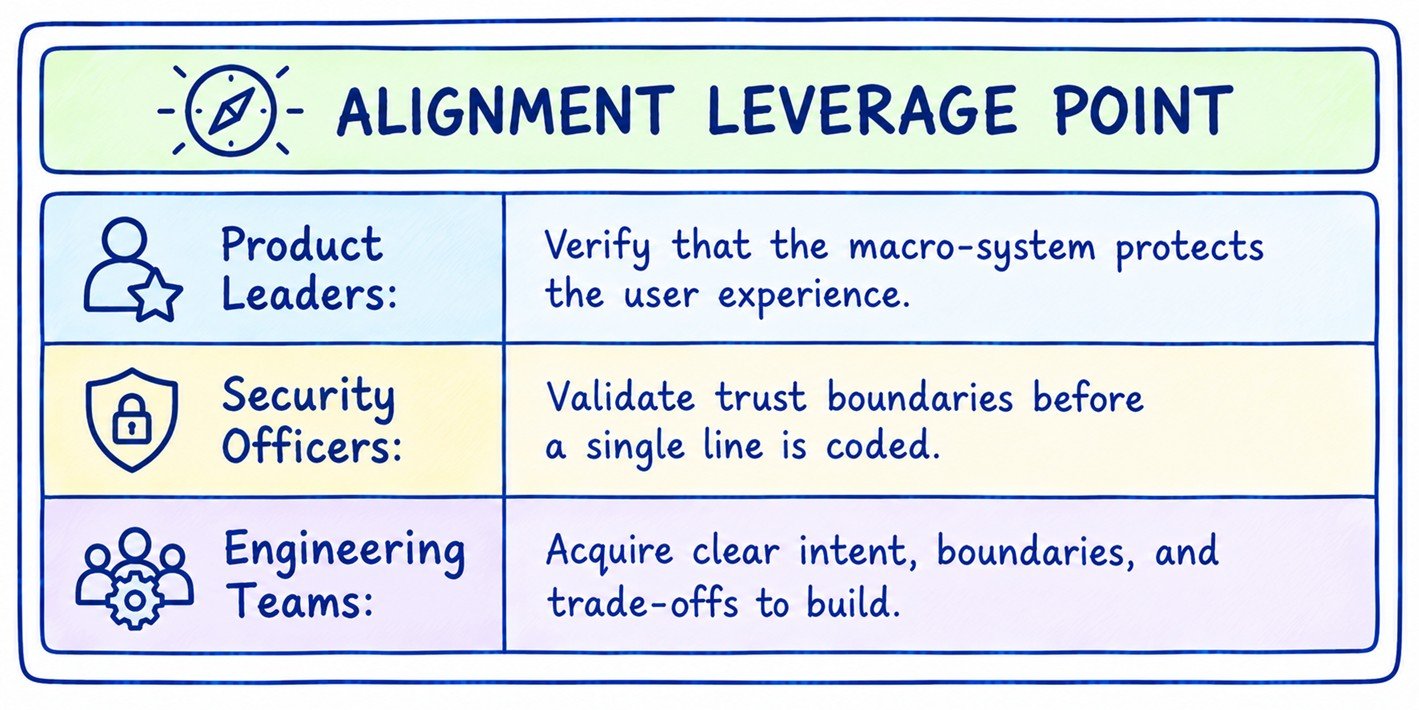
The North Star ensures that you do not simply build an AI model capability. It ensures you build a resilient, secure, and production-viable software ecosystem designed to evolve seamlessly as models change, frameworks shift, and underlying infrastructure continuously matures.