Architecture trade-offs
Introduction
Enterprise AI production systems require hard, zero-sum architectural trade-offs. As technology leaders, including CTOs, VPs, and Directors, you cannot maximize every system property simultaneously. Improving one performance dimension almost always systematically degrades another.
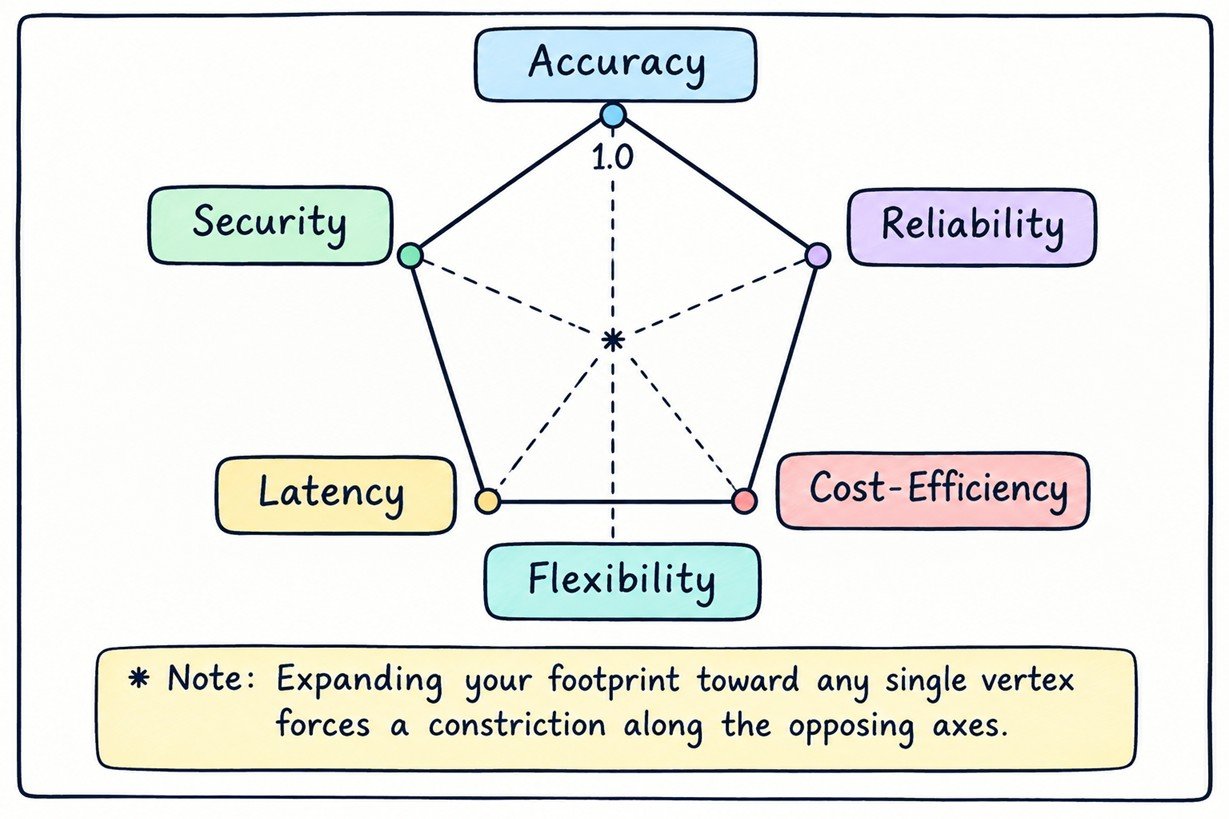
Designing a world-class AI infrastructure is not about finding a magical configuration that excels at everything. It is an exercise in deliberate, strategic compromise. You must carefully balance four primary architectural variables, Cost, Accuracy, Latency, and Security, along with the overarching tension between Flexibility and Reliability, to align system capabilities directly with your business requirements.
The Core Trade-Off Matrix
The table below outlines how prioritizing one architectural dimension inevitably strains its counterparts.
| Prioritized Dimension | Primary Technical Benefit | Direct Architectural Degradation | Strategic Impact on Business |
|---|---|---|---|
| High Accuracy | Exceptional contextual understanding; minimal hallucination rates. | Explodes API token costs and increases multi-step pipeline latency. | Best for high-stakes compliance, legal analysis, and core operations. |
| Low Latency | Near-instantaneous response times; excellent user experience. | Limits deep security verification and multi-model consensus checks. | Critical for customer-facing chatbots, live translation, and edge systems. |
| High Security | Complete data isolation; robust mitigation of prompt injections. | Introduces extensive processing overhead at ingress and egress gateways. | Non-negotiable for defense, financial transactions, and healthcare data. |
| Low Cost | Highly scalable; predictable operational expenditure (OpEx). | Relies on small, heavily quantized models with restricted reasoning capacity. | Ideal for high-volume, low-stakes internal text summarization. |
Deep Dive: The Architectural Axes
1. Cost vs. Accuracy
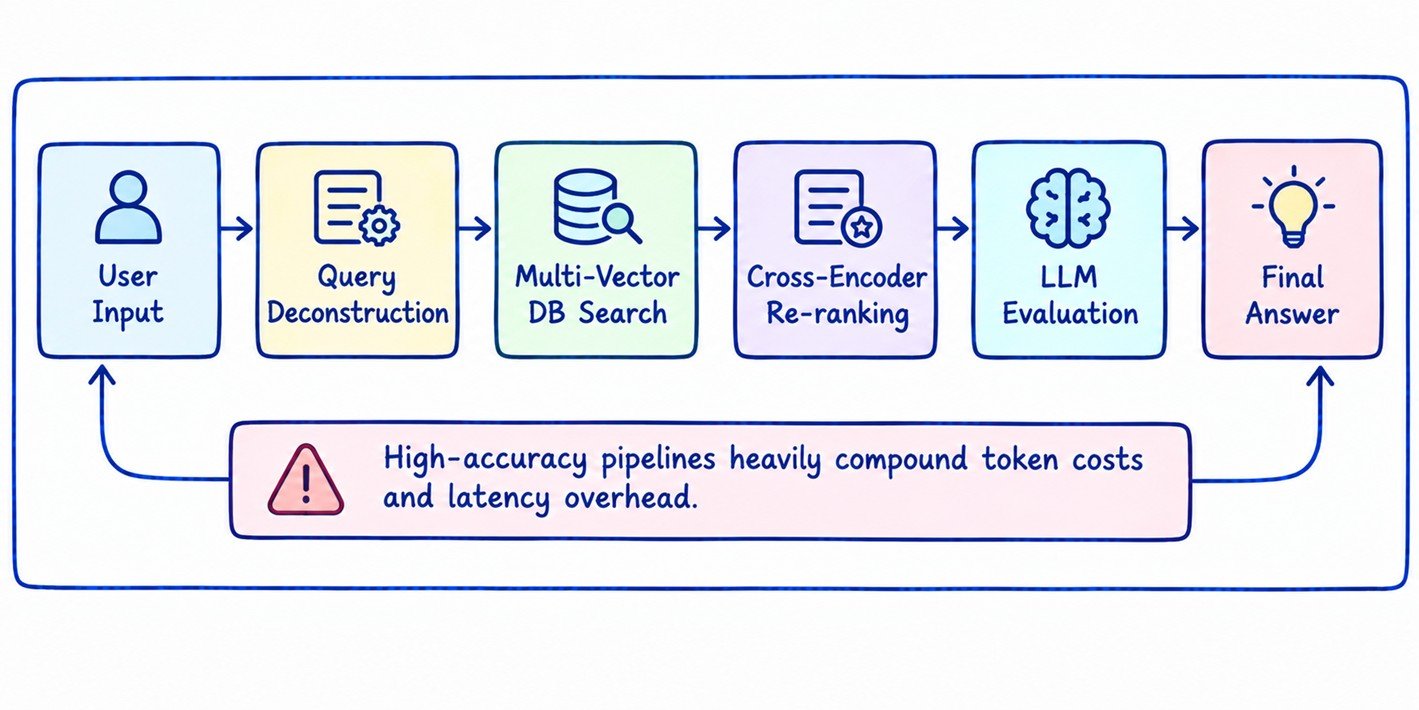
High-accuracy reasoning typically requires large foundation models, such as dense frontier models or massive Mixture-of-Experts (MoE) architectures, or extensive multi-step Retrieval-Augmented Generation (RAG) pipelines.
-
The Cost of Precision: Implementing high-fidelity RAG requires contextual chunking, multi-vector database lookups, cross-encoder re-ranking, and iterative LLM-as-a-Judge verification steps. These methods demand substantial compute power and can drive inference costs upward through compound token usage.
-
The Hazard of Economy: Conversely, cheap, compact models, such as heavily quantized open-weight models running on internal commodity hardware, drastically reduce costs. However, they typically exhibit higher error rates, narrower contextual windows, and greater susceptibility to hallucinations.
-
The Leadership Mandate: You must define the precise point where your specific application can tolerate lower accuracy to preserve capital. A customer-facing financial advisory tool requires an accuracy-first architecture, whereas an internal tool that aggregates news sentiment can safely run on a cost-optimized, compact model.
2. Latency vs. Security
In enterprise environments, real-time security screening is a strict operational requirement, yet it can become a significant bottleneck to system responsiveness.
-
The Ingress/Egress Tax: Evaluating inputs for adversarial prompt injections, jailbreaks, and toxic content takes processing time. Similarly, scanning outputs for data leakage, personally identifiable information (PII), intellectual property violations, and corporate compliance breaches adds synchronous evaluation hops.
-
The Speed-Vulnerability Paradox: Skipping or minimizing these verification steps can significantly improve response times, but it exposes the enterprise to regulatory liabilities, catastrophic data leaks, and brand damage.
-
The Leadership Mandate: Engineering teams must design systems to run essential safety checks asynchronously or through optimized, dedicated guardrail layers, such as highly parallelized, small classifier models, without creating unacceptable user-facing latency. SLAs must explicitly define acceptable latency thresholds alongside non-negotiable security guardrails.
3. Flexibility vs. Reliability
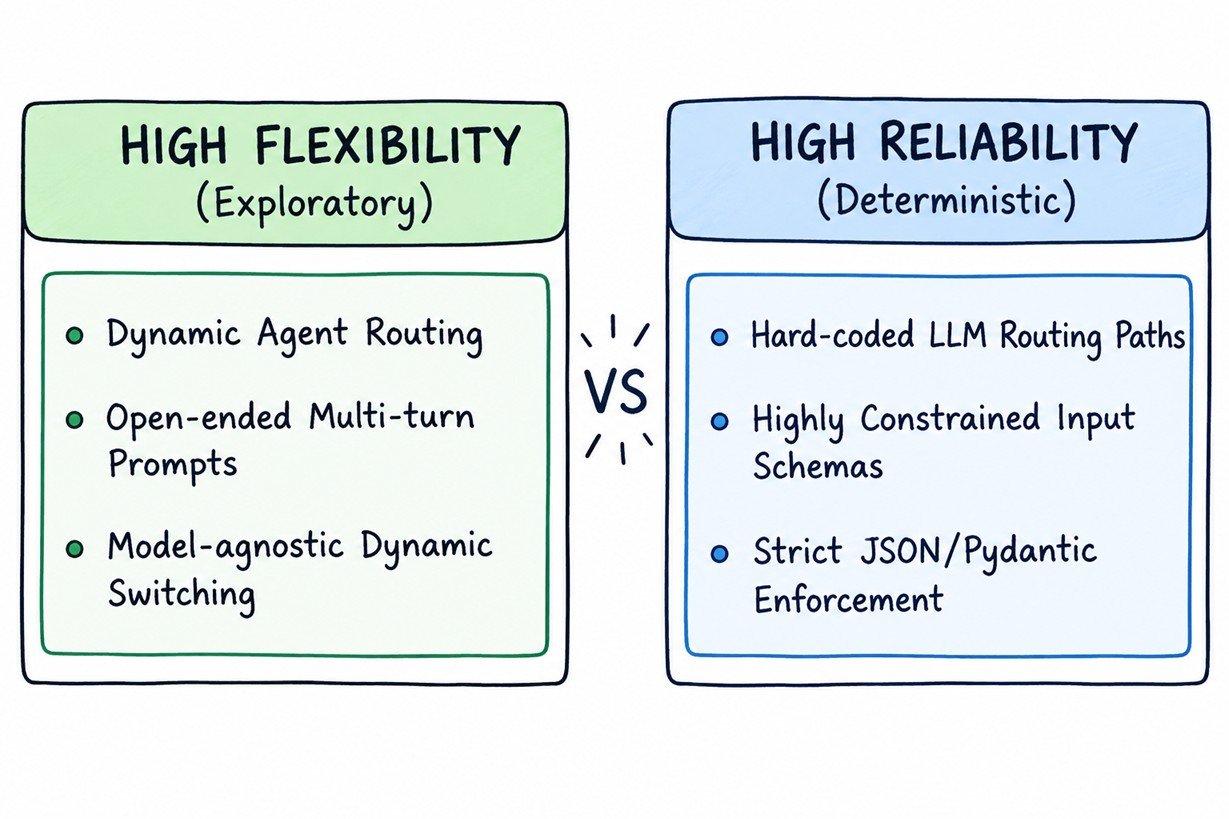
Building a flexible system that seamlessly accommodates any foundation model or wide-open user prompt introduces significant unpredictability into production systems.
-
The Chaos of Flexibility: Model-agnostic orchestration layers and agentic workflows allow your architecture to pivot dynamically as the model market evolves. However, giving models autonomy over tool execution paths makes system behavior non-deterministic, making tracking, testing, and debugging extremely difficult.
-
The Rigidity of Reliability: Strict enterprise reliability requires tightly constrained input schemas, deterministic code wrappers, structured output enforcement (e.g., Pydantic parsing), and hard-coded fallback routing paths. This structure vastly improves system stability and operational uptime, but it limits the creative reasoning capabilities and fluid adaptability that make generative AI valuable in the first place.
-
The Leadership Mandate: Your architectural blueprint must define the exact boundary between open-ended flexibility and deterministic control. Core transactional engines demand rigid reliability, while innovation sandboxes and assistive drafting tools can thrive with flexible architectures.
Architectural Profiles: Choosing Your Strategy
Rarely will you build an AI system that balances all variables perfectly in the middle. Instead, you must guide your engineering organization toward one of these predefined strategic profiles based on the specific use case:
Profile A: "Enterprise Core" (Deterministic)
- Top Priorities: Security, Reliability, Accuracy.
- Acceptable Compromises: High Latency, High Operational Cost.
- Typical Infrastructure: Private cloud deployments, multi-agent validation loops, Optical Character Recognition (OCR) pre-processing, and multi-layered ingress/egress guardrails.
Profile B: "Agile Innovation" (Exploratory)
- Top Priorities: Flexibility, Low Cost, Low Latency.
- Acceptable Compromises: Lower Accuracy Boundaries, Standard Security Baselines.
- Typical Infrastructure: Commercial SaaS API routers, aggressive caching layers (e.g., GPTCache), semantic caching, and open-ended playground environments.
Executive Checklist for AI Architects
When reviewing proposed AI architectures from your Directors and Principal Engineers, use these four qualifying questions to ensure they are making deliberate trade-offs rather than pursuing an impossible ideal:
-
"What is our fallback strategy when the primary frontier model encounters a high-latency spike or rate limit?" (Tests Reliability vs. Flexibility)
-
"Have we mapped token cost projections at 10x and 100x current user volumes based on our current RAG pipeline complexity?" (Tests Cost vs. Accuracy)
-
"Where do our security guardrails execute synchronously in the inference loop, and what is their exact latency penalty in milliseconds?" (Tests Latency vs. Security)
-
"If a model update changes the underlying model weights tomorrow, what deterministic software wrappers do we have in place to prevent downstream application failure?" (Tests Flexibility vs. Reliability)