Logical vs. physical architecture
Introduction
For engineering executives, including CTOs, VPs, and Directors, architectural design is a balancing act between long-term strategic vision and immediate operational execution. One of the most costly structural mistakes an organization can make is conflating Logical Architecture (what the system does) with Physical Architecture (how the system executes it).
When these two perspectives are mixed, systems become rigid, vendor lock-in becomes unavoidable, and technical debt accumulates exponentially. Maintaining a strict separation between these blueprints preserves strategic flexibility, protects capital investments, and ensures the enterprise can pivot in a volatile technology landscape.
1. Executive Summary: The Structural Divide
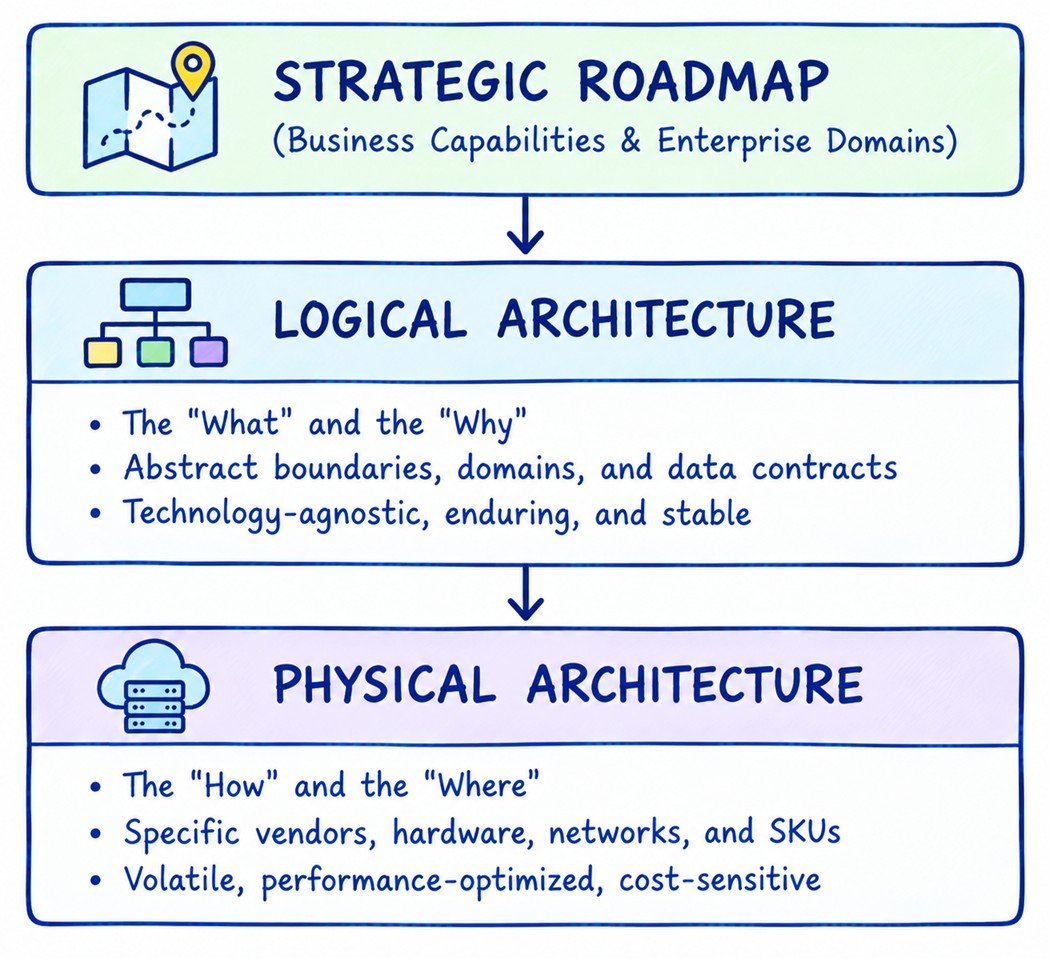
| Dimension | Logical Architecture | Physical Architecture |
|---|---|---|
| Primary Focus | Functional boundaries, data contracts, and system responsibilities. | Infrastructure deployment, runtime environments, and hardware/software SKUs. |
| Core Question | What needs to happen to fulfill the business capability? | How and Where do we execute this under real-world constraints? |
| Lifespan | Long-term (years to decades), tied to business domain evolution. | Short- to medium-term (months to years), tied to vendor lifecycles and cost. |
| Key Entities | Bounded contexts, abstract interfaces, domain events, and message schemas. | Kubernetes clusters, cloud regions, specific database engines, and CDN configurations. |
| Primary Value | Safeguards IP, prevents cognitive overload, and enforces domain purity. | Optimizes latency, manages cloud spend, and ensures high availability and compliance. |
2. Deep Dive: Logical Architecture (The Agnostic Blueprint)
The Logical Architecture represents the pure, conceptual framework of your system. It maps business capabilities directly into software domains without the noise of underlying infrastructure.
Core Characteristics
- Domain-Driven Boundaries: Modeled around business capabilities, such as identity verification, risk calculation, and ingestion orchestration, rather than framework capabilities.
- Contract-First Design: Focuses on the data schemas, APIs, and event payloads flowing between components, establishing rigorous operational boundaries.
- Technology Anonymity: Devoid of vendor names, specific open-source libraries, or hosting environments. It talks about "Message Brokers," not "Apache Kafka"; "Vector Registries," not "Pinecone."
Strategic Value for Leadership
- Preserving Intellectual Property: Your Logical Architecture is the true blueprint of your proprietary business logic. Technologies are ephemeral commodities; your structural workflow is your strategic asset.
- Onboarding and Cognitive Load Reduction: New engineering leads can understand the system's intent, data flows, and dependencies in hours, rather than drowning in the minutiae of cloud-native configurations or custom framework wrappers.
- Parallelized Engineering Teams: By formalizing logical interfaces early, disparate teams can build against abstract mocks simultaneously, eliminating cross-team blocking dependencies.
3. Deep Dive: Physical Architecture (The Operational Concrete)
The Physical Architecture translates abstract logical components into tangible, billable infrastructure. It addresses the uncompromising realities of physics, economics, and compliance.
Core Characteristics
- Resource Optimization: Maps out the exact compute types, such as AWS EC2 Graviton instances and serverless runtimes, storage tiers, such as NVMe SSDs and cold object storage, and networking configurations, such as VPC peering and transit gateways.
- Vendor-Specific Topologies: Explicitly details the third-party platforms, databases, and managed services powering the stack, such as PostgreSQL on AWS RDS, Snowflake, and Auth0.
- Operational Telemetry & Constraints: Dictates regional deployments, multi-zone replication strategies, backup cadences, and network perimeters required to meet target SLAs, RTO/RPO metrics, and compliance standards such as GDPR and HIPAA.
Strategic Value for Leadership
- Financial Engineering (CapEx/OpEx Control): Allows VPs and Directors to audit exactly where infrastructure spend is going and match unit costs to specific physical footprints.
- Performance Tuning & Scalability: Provides the direct levers needed to address latency, connection pooling, cache hit ratios, and hardware-level bottlenecks.
- Risk Management & Compliance: Defines the physical data residency boundaries needed to satisfy regulatory audits, isolating data per country or jurisdiction.
4. The Architectural Translation Layer: A Practical AI Example
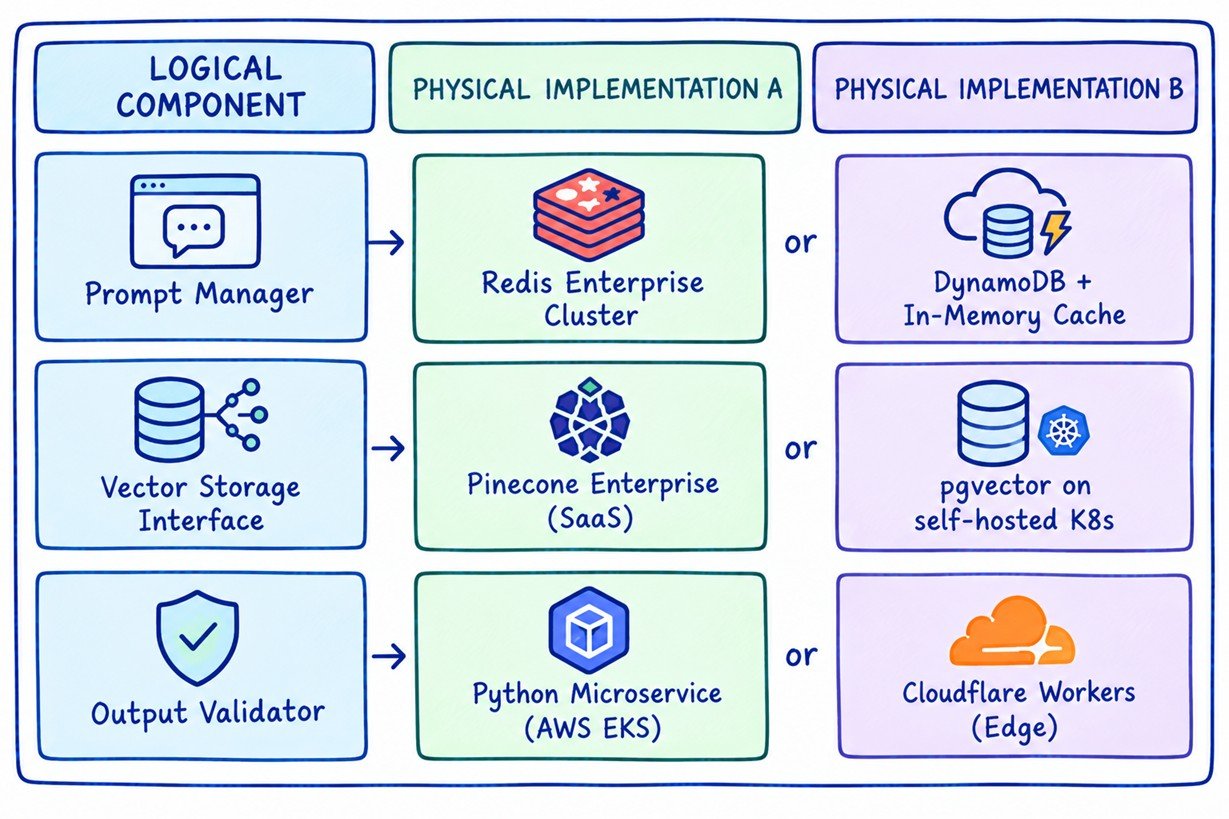
Consider a modern GenAI enterprise system. The table below illustrates how abstract logical requirements map to concrete physical implementations, demonstrating how the physical layer can evolve or change completely without disrupting the underlying logical design.
Breakdown of the Translation
-
Component 1: Prompt Manager
- Logical Definition: Responsible for retrieving, versioning, and injecting context variables into system prompts before sending them to the LLM core.
- Physical Implementation Option A: A Redis Enterprise cluster deployed across three AWS Availability Zones for ultra-low-latency caching.
- Physical Implementation Option B (Migration): An AWS DynamoDB table paired with a local DAX cache to reduce managed cluster overhead.
-
Component 2: Vector Storage Interface
- Logical Definition: Accepts embeddings, performs high-dimensional similarity searches, and enforces semantic distance thresholds.
- Physical Implementation Option A: A fully managed Pinecone Enterprise SaaS instance connected via AWS PrivateLink.
- Physical Implementation Option B (Migration): A self-hosted
pgvectorinstance running inside an isolated Kubernetes (EKS) StatefulSet to comply with strict data sovereignty mandates.
-
Component 3: Output Validator
- Logical Definition: Evaluates model outputs against programmatic rules, PII filters, and alignment guardrails before exposing data to the client presentation tier.
- Physical Implementation Option A: A custom Python microservice running in an autoscaling group on AWS EKS behind an Application Load Balancer.
- Physical Implementation Option B (Migration): An isolated Node.js script running at the network edge via Cloudflare Workers to eliminate cold starts and intercept malicious payloads closer to the user.
5. Architectural Anti-Patterns: The Cost of Conflation
When engineering organizations fail to enforce this separation, they fall victim to classic architectural traps that drain budgets and paralyze engineering velocity.
The "Vendor-Locked" Interface
- Symptom: Codebases where vendor-specific SDKs are imported directly into the core business logic layer, such as using specific DynamoDB attribute annotations inside core domain entities.
- Consequence: If the vendor changes its pricing, features, or service availability, you must rewrite core business applications. Migration costs become prohibitively high, trapping the organization in an unfavorable vendor contract.
The "Paper Architecture"
- Symptom: A logical diagram that is a direct copy of a cloud provider's icons without describing the actual functional workflows or domain boundaries.
- Consequence: The team loses sight of why components exist. They build infrastructure for the sake of infrastructure, resulting in over-engineered, distributed systems that are expensive to operate and fragile to maintain.
The "Leaky Abstraction"
- Symptom: Designing a logical interface that exposes physical limitations, such as propagating a database-specific connection timeout or error code all the way to the frontend client framework.
- Consequence: Changes to the physical topology trigger cascading failures across unrelated logical layers, breaking the predictability and maintainability of the software architecture.
6. Executive Action Plan: Implementing the Divide
To instill this discipline across your engineering organization, leaders should implement the following governance steps:
-
Mandate Dual Sign-Offs on Major Initiatives: Require RFCs (Requests for Comments) to explicitly feature two distinct sections: one for the Logical Domain Model (domain logic, boundaries, and invariants) and one for the Physical Deployment Strategy (hosting, cost projections, and vendor selection).
-
Enforce the Dependency Inversion Principle (DIP) at Scale: Ensure that core business logic depends strictly on abstract interfaces (Logical), while third-party integrations and infrastructure adapt to those interfaces through adapter patterns (Physical). Code that interacts directly with vendors should reside at the outermost perimeter of your repositories.
-
Run "Chaos Vendor" Tabletop Exercises: Challenge your architecture groups annually with strategic hypothetical scenarios: "If our primary cloud provider increases compute costs by 40% tomorrow, or if this SaaS database vendor goes out of business, exactly how many lines of core domain code would we have to modify to migrate?" The answer will reveal how healthy your architectural separation truly is.