Business, application, data, intelligence, integration, security, and infrastructure architecture
Introduction
An enterprise AI North Star must address the full corporate ecosystem. Focusing solely on the model layer is a critical failure point that results in expensive, isolated pilots that fail to scale. To achieve accurate, secure, and cost-effective production viability, technology executives must architect and govern seven interconnected layers designed for strict enterprise-grade robustness.
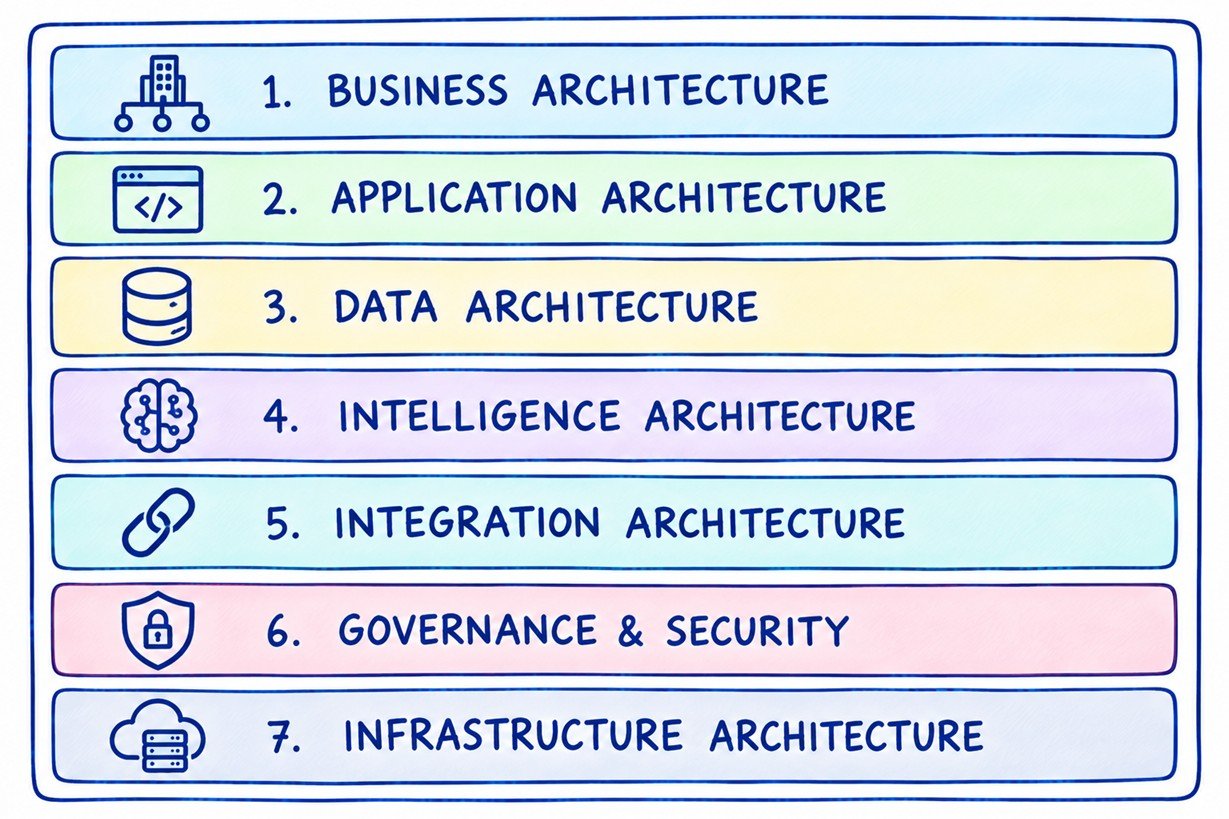
1. Business Architecture
The Business Architecture layer bridges technical capabilities with corporate strategy, ensuring that AI investments deliver quantifiable business value rather than expensive experimentation.
- Strategic Alignment: Every AI initiative must map directly to documented business problems, revenue growth vectors, or operational efficiency metrics.
- Process Transformation: Defines the exact business processes transformed by the system, identifying bottlenecks, friction points, and opportunities for systemic enhancement.
- Operational Workflows: Maps out user roles, human-in-the-loop (HITL) touchpoints, and functional handoffs between AI assistants and staff.
- Value Quantification: Establishes Key Performance Indicators (KPIs) such as cycle-time reduction, cost per transaction, automated resolution rates, and top-line contribution.
2. Application Architecture
The Application Architecture layer governs the user interfaces and presentation logic, translating complex backend model reasoning into deterministic, highly responsive software experiences.
- Interaction Paradigms: Manages diverse interaction modalities, including conversational interfaces, context-aware embedded widgets, and multi-agent systems.
- State Management: Orchestrates user experience state, manages high-concurrency sessions, and elegantly handles long-running asynchronous agent processes.
- Latency Mitigations: Implements streaming token delivery, proactive UI feedback loops, and fallback mechanics to maintain perceived application responsiveness.
- Experience Personalization: Adapts user interfaces dynamically based on active organizational roles, user historical patterns, and security access tiers.
3. Data Architecture
The Data Architecture layer is the foundational engine of truth for enterprise AI, governing the complete lifecycle of structured and unstructured information assets.
- Ingestion Pipelines: Operates real-time and batch pipelines that ingest, parse, and clean unstructured enterprise data formats such as PDFs, documents, wikis, audio, and logs.
- Vectorization & Indexing: Directs high-performance chunking, semantic embedding strategies, and metadata tagging to support hybrid lexical and semantic queries.
- Storage Frameworks: Coordinates transactional databases, distributed object stores, and low-latency vector databases with enterprise-scale indexing.
- Dynamic Retrieval (RAG): Feeds accurate, real-time context into model context windows through advanced Retrieval-Augmented Generation architectures, minimizing hallucinations.
4. Intelligence Architecture
The Intelligence Architecture layer acts as the system's reasoning engine, decoupling applications from specific AI models and structuring inherently probabilistic outputs.
- Model Routing: Dynamically shifts calls between Frontier LLMs, fine-tuned Small Language Models (SLMs), or traditional machine learning algorithms based on cost, latency, and complexity.
- Agentic Frameworks: Controls multi-agent choreography, memory persistence layers, planning loops, and programmatic tool utilization.
- Prompt Engineering: Standardizes and versions prompt templates, system instructions, and chain-of-thought pathways within an isolated environment.
- Deterministic Formatting: Enforces strict schema validation, such as JSON Schema or TypeChat, over model outputs before they reach downstream enterprise applications.
5. Integration Architecture
The Integration Architecture layer bridges the modern AI system with legacy enterprise software, creating an interoperable ecosystem across the organization.
- API Management: Standardizes RESTful, GraphQL, or gRPC interfaces connecting the orchestration layer to transactional backends.
- Event-Driven Fabric: Uses high-throughput message queues and distributed streaming platforms to trigger autonomous AI actions based on live corporate events.
- Legacy Connectivity: Links AI reasoning workflows with core internal systems, including ERP, CRM, HRIS, and core banking applications.
- Transactional Orchestration: Controls state machines to execute complex, multi-step actions across disparate third-party applications securely and reliably.
6. Governance & Security
The Governance and Security layer is a pervasive, non-negotiable fabric that protects enterprise assets, ensures regulatory compliance, and guarantees system trust.
- Data Protection: Enforces strict role-based access control (RBAC), row-level security (RLS), and automated personally identifiable information (PII) masking.
- Guardrails & Firewalls: Runs real-time prompt injection detection, toxic output filtering, and semantic brand alignment validation on all inputs and outputs.
- Compliance Auditing: Maintains immutable transaction ledger tracking for every model invocation, prompt version, retrieved chunk, and final output to support AI regulatory compliance.
- Observability & FinOps: Monitors token distribution, evaluation drift, request anomalies, and per-token compute costs to enforce financial boundaries.
7. Infrastructure Architecture
The Infrastructure Architecture layer provides the underlying physical and virtual compute resources needed to power the enterprise AI workload stack reliably.
- Compute Provisioning: Manages elastic clusters of GPUs, TPUs, and specialized AI accelerators alongside standard enterprise CPU architectures.
- Deployment Topologies: Orchestrates sovereign on-premise private clouds, hybrid configurations, and multi-tenant hyperscaler environments.
- Model Hosting: Runs optimized containerized inference endpoints utilizing advanced hardware quantization, caching networks, and batching layers.
- Scalability & Resilience: Delivers auto-scaling groups, geographic load balancing, failover zones, and disaster recovery strategies for mission-critical availability.
Architectural Layer Comparison
| Layer | Primary Objective | Key Technologies / Frameworks | Core Executive Metrics |
|---|---|---|---|
| Business | Strategic ROI & process alignment | Process Mapping, KPI Trees, Capability Models | ROI, Cost-per-Transaction, Cycle Time |
| Application | User experience & interaction orchestration | React, Next.js, WebSockets, Agent Framework UIs | Daily Active Users (DAU), Task Completion Rate, CSAT |
| Data | Real-time context & pipeline management | Kafka, Spark, Vector DBs (Pinecone, pgvector), dbt | Retrieval Latency, Index Recency, Data Freshness |
| Intelligence | Reasoning, routing, and cognitive logic | LangChain, LlamaIndex, Model Routers, vLLM | Token Efficiency, Output Accuracy, Hallucination Rate |
| Integration | Enterprise connectivity & interoperability | MuleSoft, Apache Camel, RabbitMQ, gRPC | API Availability, Sync Latency, Transaction Success |
| Governance | Risk management, safety, and compliance | Guardrails, OpenTelemetry, IAM, PII Masking | Compliance Audits, Blocked Injection Attacks, Cost/Token |
| Infrastructure | High-performance compute & scale | Kubernetes, NVIDIA Triton, AWS/Azure, Docker | Cluster Utilization, Model Inference Latency, Uptime |