From Product Vision → Intelligence Strategy → Architectural North Star
Introduction
Enterprise AI initiatives often fail because a critical disconnect exists between business intent and technical execution. You cannot build a sustainable, production-grade system by handing a high-level Product Vision directly to a development team. The transition requires a systematic translation layer.
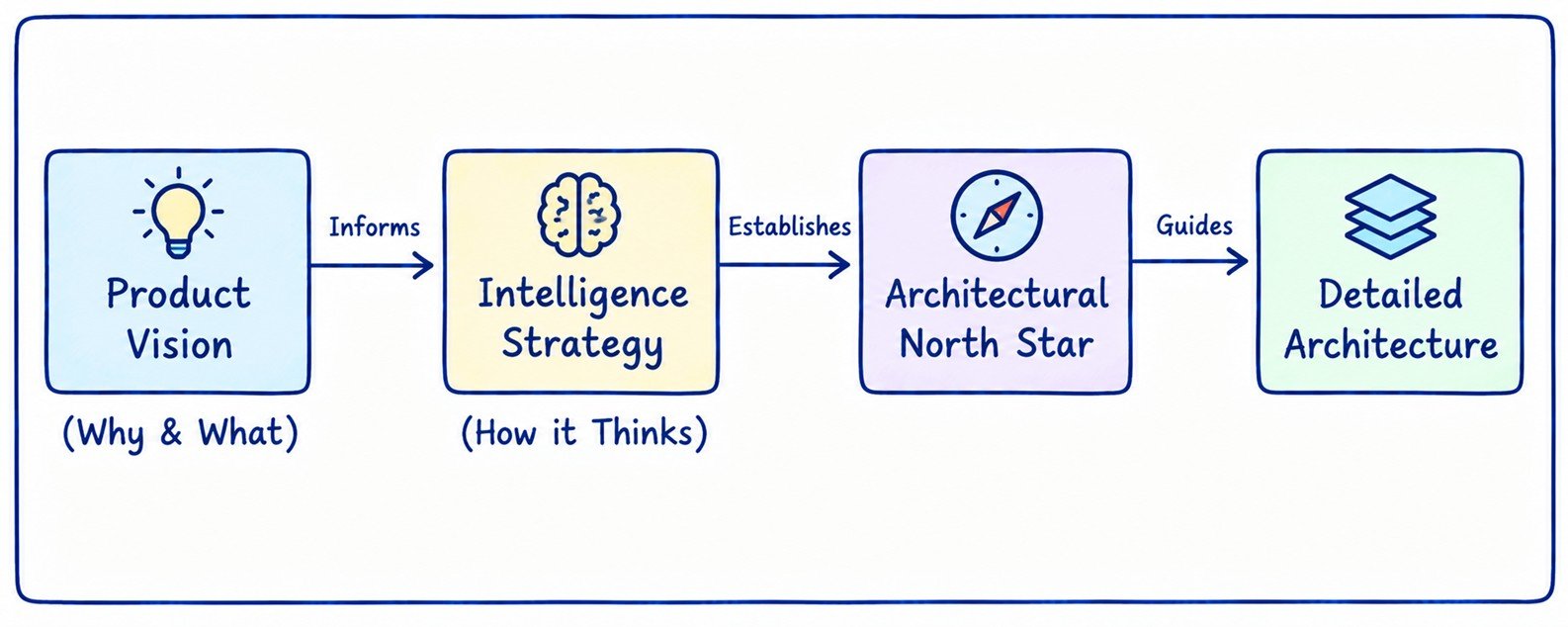
Technology leaders, including CTOs, VPs, and Directors, must implement a structured, sequential framework to convert business opportunities into engineering realities: Product Vision → Intelligence Strategy → Architectural North Star.
1. The Product Vision: Defining Business Value & User Experience
The Product Vision anchors the entire initiative by defining the "Why" and the "What" of the product. It translates a raw business opportunity into a clear strategic objective before any code is written.
- Problem & Value Definition: It identifies the precise user pain points, lost productivity, or operational inefficiencies the system is designed to solve.
- The Interaction Model: It establishes the core AI-enabled capabilities, the user experience (UX), and how humans and AI will collaborate within the workflow.
- Measurable Outcomes: It outlines the differentiation thesis and key success metrics that give the organization a compelling, ROI-driven reason to build.
2. The Intelligence Strategy: The Cognitive Blueprint
The Intelligence Strategy serves as the first essential translation layer. It determines how the system must think, process context, and reason to fulfill the defined Product Vision.
Skipping this stage results in catastrophic over-engineering, where teams build complex, expensive infrastructure for capabilities the product does not actually require.
- Reasoning Mode Selection: It evaluates and isolates the required intelligence capabilities, determining whether a workflow demands a foundational Large Language Model (LLM), a smaller domain-specific model (SLM), traditional machine learning, or deterministic code.
- Context & Tool Integration: It establishes the data and context strategy, deciding how the intelligence engine interacts with external knowledge, application tools, orchestration layers, and human-in-the-loop triggers.
- Routing & Escalation: It maps the boundaries of probabilistic logic, defining when an engineering flow should escalate from simple prompts to Retrieval-Augmented Generation (RAG), fine-tuning, or structured model routing.
3. The Architectural North Star: Bridging Vision and Execution
The Architectural North Star is the final strategic pillar that connects product intent with engineering reality.
Definition & Scope: What It Is (And Is Not)
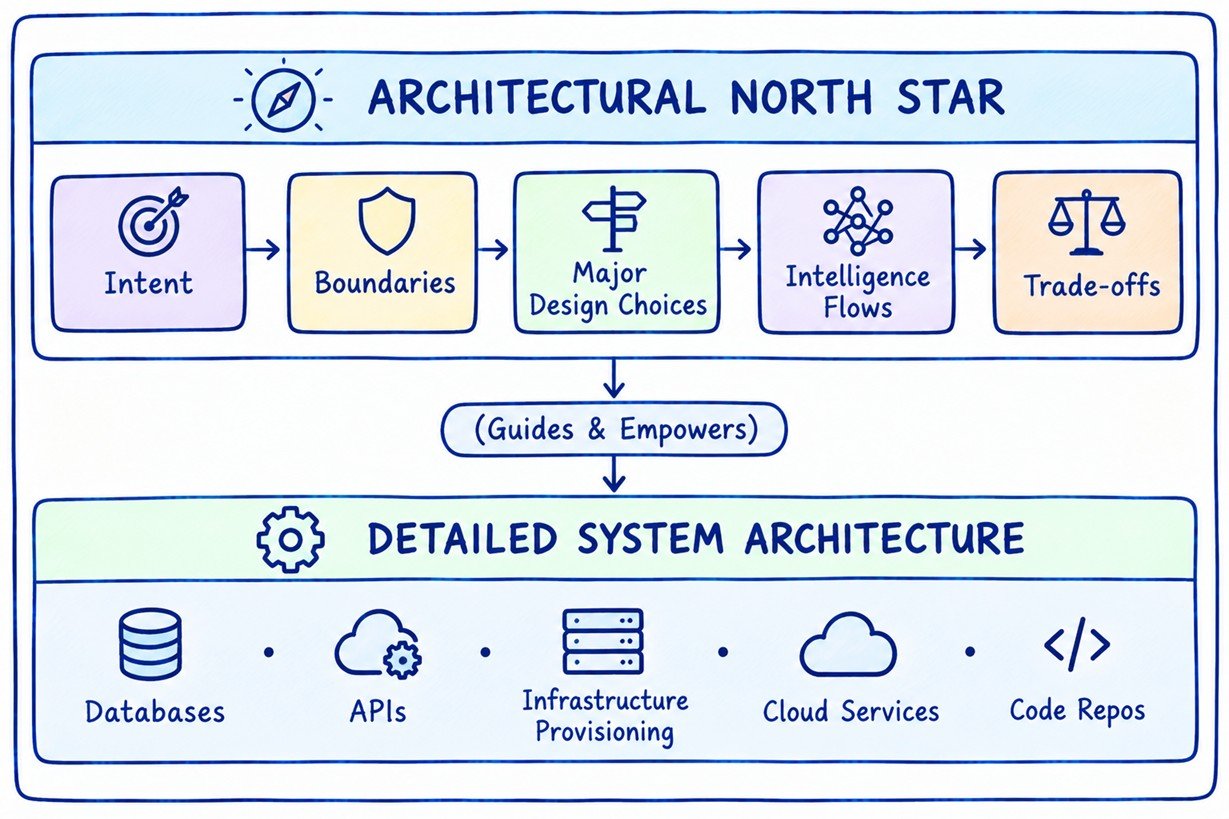
The Architectural North Star is not intended to replace detailed architecture, implementation, or deployment configurations. Instead, it serves as an overarching, high-level blueprint that aligns business, data, intelligence, security, and infrastructure concerns.
By defining the macro-system ahead of time, it provides architects and engineering teams with a clear direction from which detailed architecture can be safely developed.
Core Components of the North Star
The Architectural North Star explicitly provides engineering teams with five core pillars:
- Architectural Intent: The foundational philosophy of the system. It aligns execution with the Product Vision, ensuring that data pipelines directly support model context requirements and infrastructure accommodates end-user latency needs.
- System Boundaries & Trust: It defines the guardrails, isolation barriers, compliance perimeters, and trust boundaries required to move a probabilistic AI application from an experimental PoC into a secure enterprise environment.
- Major Design Choices: It establishes the high-level building blocks, such as selecting multi-agent orchestration frameworks, state management engines, and semantic caching structures, without dictating specific low-level code libraries.
- Intelligence Flows: It outlines the strategic choreography of data, defining how information streams from enterprise knowledge graphs or vector indexes through reasoning engines and back to the user interface.
- Critical Trade-offs: It identifies and accepts upfront structural compromises, such as balancing cost per token against accuracy, latency against deep reasoning complexity, or maximum security against system flexibility.
Alignment Matrix: The Leadership Checklist
Use this checklist during executive reviews to ensure your teams are not bypassing these critical architectural phases:
| Phase | Delivered By | Executive Focus | Failure Mode if Omitted |
|---|---|---|---|
| Product Vision | Product Management & Business Leaders | Business value, user workflows, ROI, and core utility. | Building technologically advanced software that fails to solve a real corporate problem. |
| Intelligence Strategy | AI Architects & Product Strategists | Cost-optimal cognitive mapping, model selection, and context routing. | Severe economic inefficiency, over-engineering, or highly unstable prompt logic. |
| Architectural North Star | Enterprise & Principal Solution Architects | Macro system intent, trust boundaries, major design choices, and trade-offs. | Fragile Prototypes: Engineering teams lack direction, creating codebases that fail under production loads. |
Strategic Summary for Technology Executives
True enterprise AI maturity requires resisting the urge to jump directly from a compelling idea into detailed infrastructure provisioning.
By enforcing the progression from Product Vision to Intelligence Strategy, and finalizing it into a robust Architectural North Star, you empower your engineering organization with the clear direction, boundaries, and intent needed to design resilient, production-ready, and sustainable enterprise systems.