Architecture Decision Records
Introduction
In deterministic software engineering, a specific input consistently yields a predictable output. In probabilistic engineering (AI, Machine Learning, and Large Language Model architectures), this predictability is reduced. System behavior shifts based on statistical weights, data distributions, and stochastic model outputs.
For technology executives, including CTOs, VPs, Directors, and Principal Architects, managing this inherent uncertainty requires shifting from casual governance to a rigorous, immutable framework. Architecture Decision Records (ADRs) serve as your organization's engineering ledger. They capture the structural context, explicit trade-offs, and long-term consequences of your technical choices. Without a formal ADR process, your organization risks losing institutional knowledge, incurring compounding technical debt, and experiencing "architectural drift" during team transitions.
1. The Strategic Imperative of ADRs in AI Governance
As an engineering leader, your primary responsibility is maximizing development velocity while minimizing structural risk. Probabilistic systems introduce non-linear risks that standard logging and documentation cannot adequately address.
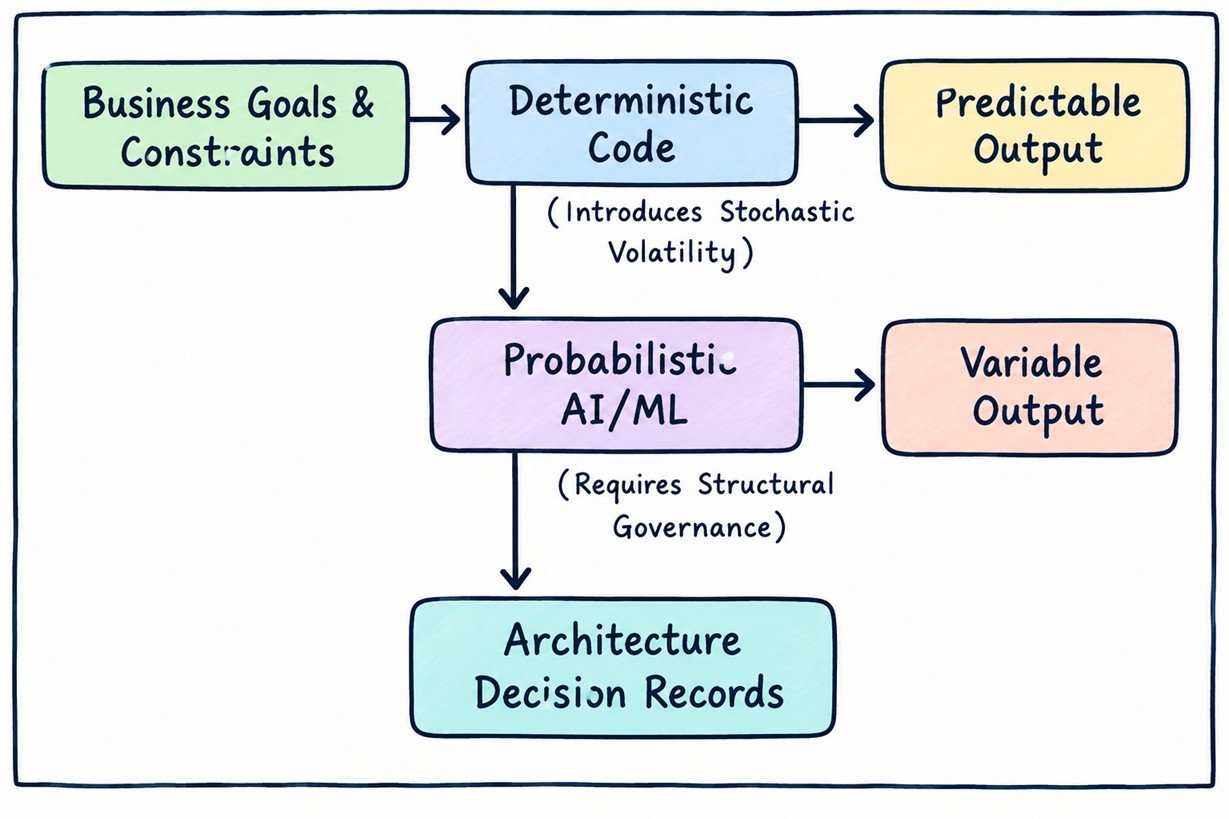
Why Casual Governance Fails
-
The "Slack Memory" Trap: Critical architectural choices, such as selecting an embedding model, choosing a vector database indexing strategy (HNSW vs. IVF-FLAT), or defining a prompt routing framework, often happen in temporary Slack channels, hallway conversations, or unrecorded Zoom calls. When engineers leave, the context behind those choices leaves with them.
-
The Illusion of Consensus: Without an immutable record, alignment is temporary. Teams frequently revisit solved problems, stalling development velocity and creating decision fatigue.
-
The Compliance Gap: As AI regulations tighten globally, systems must be auditable. An ADR provides an explicit audit trail demonstrating that data privacy, bias mitigation, and safety guardrails were intentionally considered during system design.
2. Anatomy of an Enterprise-Grade AI ADR
Every ADR must follow a strict, standardized Markdown template. It functions as an immutable log. Once an ADR is accepted, it is never edited. If a decision changes, a new ADR is authored to supersede the previous one.
The Standard ADR Metadata Matrix
| Section | Target Requirement | Leadership Focus |
|---|---|---|
| ID & Title | Unique identifier and a concise, outcome-driven title. | Ensures instant discoverability across the entire enterprise portfolio. |
| Status | Current lifecycle state: Proposed, Accepted, Rejected, or Superseded by ADR-[ID]. | Provides immediate clarity on the operational authority of the document. |
| Context | The technical problem, operational constraints, and baseline metrics. | Explains the "Why" behind the resource allocation and technical focus. |
| Decision | The concrete action, selected technologies, and implementation path. | Establishes the clear architectural direction and explicit boundaries. |
| Consequences | The direct trade-offs, financial impacts, and risk exposures. | Quantifies technical debt and details long-term operational costs. |
3. Deep Dive: Documenting the Technical Context
The Context section is where your team builds the business and technical case for a decision. For probabilistic architectures, this section requires far greater rigor than traditional software documentation. It must explicitly capture three distinct pillars:
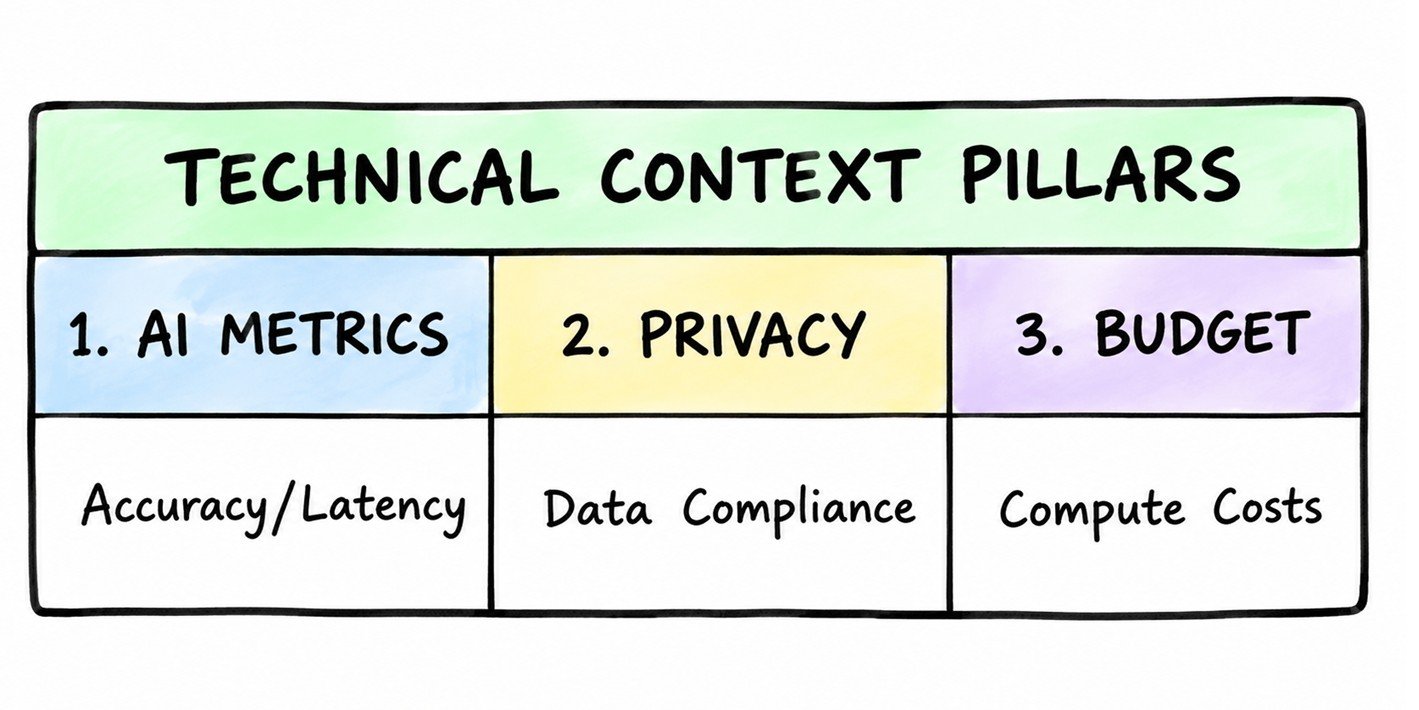
Pillar 1: Model & System Performance Metrics
Your architects must document the specific quantitative baselines driving the decision:
- Statistical Performance: Accuracy, F1-Score, ROC-AUC, or custom business evaluation metrics, such as RAG faithfulness.
- System Performance: Time-to-First-Token (TTFT), total latency p95/p99 bounds, and concurrent request throughput limits.
Pillar 2: Data Governance & Privacy Requirements
AI systems live and die by data access. The context must clearly state:
- Data residency requirements, including applicable regulations such as GDPR, HIPAA, and CCPA.
- Zero Data Retention (ZDR) mandates when evaluating third-party LLM providers.
- PII masking, anonymization strategies, and fine-tuning data leakage vectors.
Pillar 3: Financial & Resource Constraints
Every technical choice carries a hidden balance sheet. Document:
- Compute Budgets: Capital expenditures (CapEx) for self-hosting, such as A100/H100 clusters, versus Operational Expenditures (OpEx) for serverless API consumption.
- Development Velocity Costs: The time required for data collection, human-in-the-loop labeling, and model evaluation pipeline construction.
Alternative Evaluation Protocol
An ADR must never present a single path. It must document at least two to three viable alternatives alongside a rigorous evaluation rubric. For example, when choosing a vector database, the alternatives matrix might contrast managed solutions against self-hosted open-source variants across dimensions such as scale, latency, cost, and operational overhead.
4. Quantifying Long-Term Consequences
The Consequences section is the most valuable part of an ADR for engineering executives. It acts as an early warning system for your future engineering organization. Every choice is a compromise, and this section forces your architects to explicitly state what they are sacrificing.
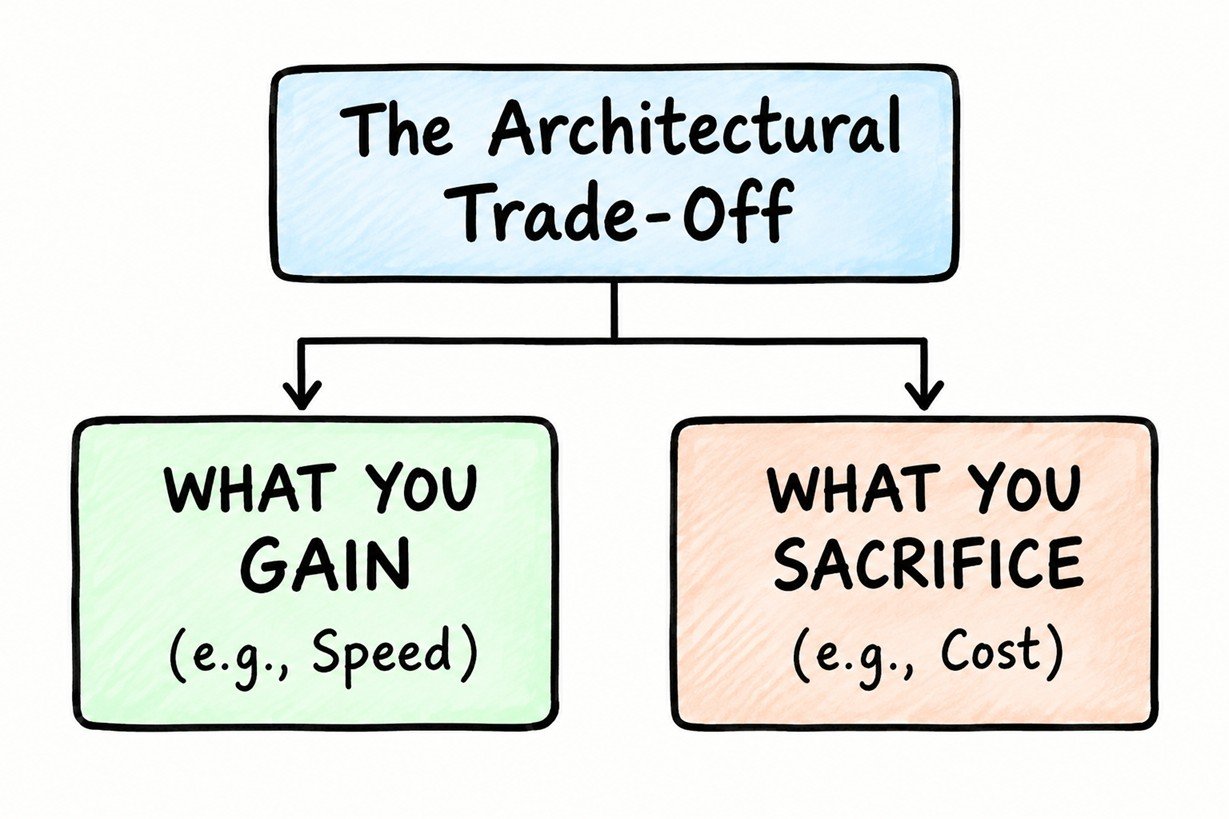
Key Dimensions of Architectural Trade-offs
1. System Latency vs. Model Expressiveness
- The Choice: Using a dense 70B parameter model versus a highly optimized 8B model.
- The Consequence: Choosing the larger model ensures higher accuracy but compromises user experience by driving p99 latency beyond acceptable thresholds. It may also require complex caching strategies or streaming architectures.
2. Total Cost of Ownership (TCO) & Scaling Surcharges
- The Choice: Serverless third-party APIs versus dedicated open-source deployments.
- The Consequence: Serverless APIs lower initial R&D costs but can introduce unpredictable cost scaling if production request volumes surge exponentially.
3. Team Velocity & Operational Complexity
- The Choice: Custom fine-tuning versus advanced Retrieval-Augmented Generation (RAG).
- The Consequence: Fine-tuning demands specialized ML platform engineers, extensive data pipelines, and ongoing training cycles. This can slow down product engineers compared to a plug-and-play RAG pattern.
4. Future Technical Debt & Vendor Lock-in
- The Choice: Deep integration into cloud-native AI ecosystems.
- The Consequence: Faster immediate delivery, but it creates structural lock-in. Migrating away from that cloud environment in the future could require a multi-month foundational rewrite.
5. Implementing ADR Governance Across Your Engineering Org
To make ADRs an operational reality rather than a dusty documentation shelf, implement these three leadership strategies:
-
Git-Driven Workflow: Store ADRs inside the codebase repository alongside the code (
/docs/adr/0001-use-langgraph-for-agents.md). Use pull requests for architectural reviews. Merging the PR means the architecture is officially accepted. -
The "No ADR, No Review" Mandate: As a VP or Director, refuse to sign off on major product roadmaps or capital expenditures for compute until the corresponding ADR is linked in the proposal.
-
Architectural Review Boards (ARB): Use ADRs as the primary reading material for quarterly architectural reviews. This ensures cross-functional alignment and prevents duplicate efforts across different business units.
A Production-ready, Enterprise-grade example of an AI Architecture Decision Record
ADR-0024 - Selection of Core LLM Engine for Enterprise Customer Support Automation
Metadata
- ID: ADR-0024
- Title: Selection of Core LLM Engine for Enterprise Customer Support Automation
- Status:
Accepted - Author: Principal AI Systems Architect
- Impact Level: Tier-1 (Core Business Infrastructure)
- Date: September 10, 2026
1. Context & Problem Statement
Our core product requires an automated customer support engine capable of interpreting complex enterprise multi-tenant database schemas, translating them into structured actions, and generating responses to user inquiries.
The system must handle a peak load of 500 concurrent requests, process multi-turn dialogues with a median context window of 32,000 tokens, and reliably extract valid JSON schema objects for downstream API tool calling.
Key Constraints & Requirements:
- Data Sovereignty (Hard Constraint): Tenant data includes PII and protected financial transactions. Corporate legal compliance dictates that this data must never be used for third-party model training or transferred out of our secure cloud perimeter.
- Latency Boundary: Time-to-First-Token (TTFT) must remain under 350ms, with an overall end-to-end response generation time under 2.5 seconds at \(p95\).
- Structured Output Reliability: The model must achieve a >99.5% success rate in generating syntactically valid JSON matching our tool-calling definition schema.
- Financial Cap: Total operational runtime cost (OpEx) must not exceed ₹1.25 per 1,000 combined tokens (Input + Output) at projected scale.
2. Alternatives Evaluated
The engineering team evaluated three architectural pathways over a 2-week benchmarking sprint:
Alternative A: Managed Commercial API (e.g., Anthropic Claude 3.5 Sonnet / OpenAI GPT-4o)
- Pros: Out-of-the-box state-of-the-art reasoning; near-zero operational overhead; native support for strict JSON schema mode.
- Cons: Variable public API latencies during regional peak hours; data egress requires custom, expensive enterprise zero-data-retention (ZDR) legal addendums; raw token pricing scales linearly with volume without economies of scale.
Alternative B: Self-Hosted Open-Source Frontier Model (e.g., Llama 3.1 70B Instruct via vLLM)
- Pros: Complete control over data perimeter (hosted entirely within our virtual private cloud); predictable hardware costs; can be deeply optimized using custom LoRA fine-tuning for structured tool calling.
- Cons: Requires dedicated GPU infrastructure provisioning (e.g., 8 x A100 or H100 clusters); infrastructure team must manage auto-scaling, cold-starts, and model serving runtimes.
Alternative C: Multi-Model Routing Architecture (Dynamic Tiering)
- Pros: Optimizes cost by routing simple queries to an open-source 8B model and complex reasoning queries to Alternative A.
- Cons: Introduces systemic complexity; routing logic adds an extra layer of latency; debugging non-deterministic system routing errors dramatically slows engineering velocity.
3. Decision
We will proceed with Alternative B: Self-Hosted Open-Source Frontier Model (Llama 3.1 70B Instruct) deployed on our internal Kubernetes cluster EKS utilizing the vLLM serving framework with FP8 quantization and tensor parallelism.
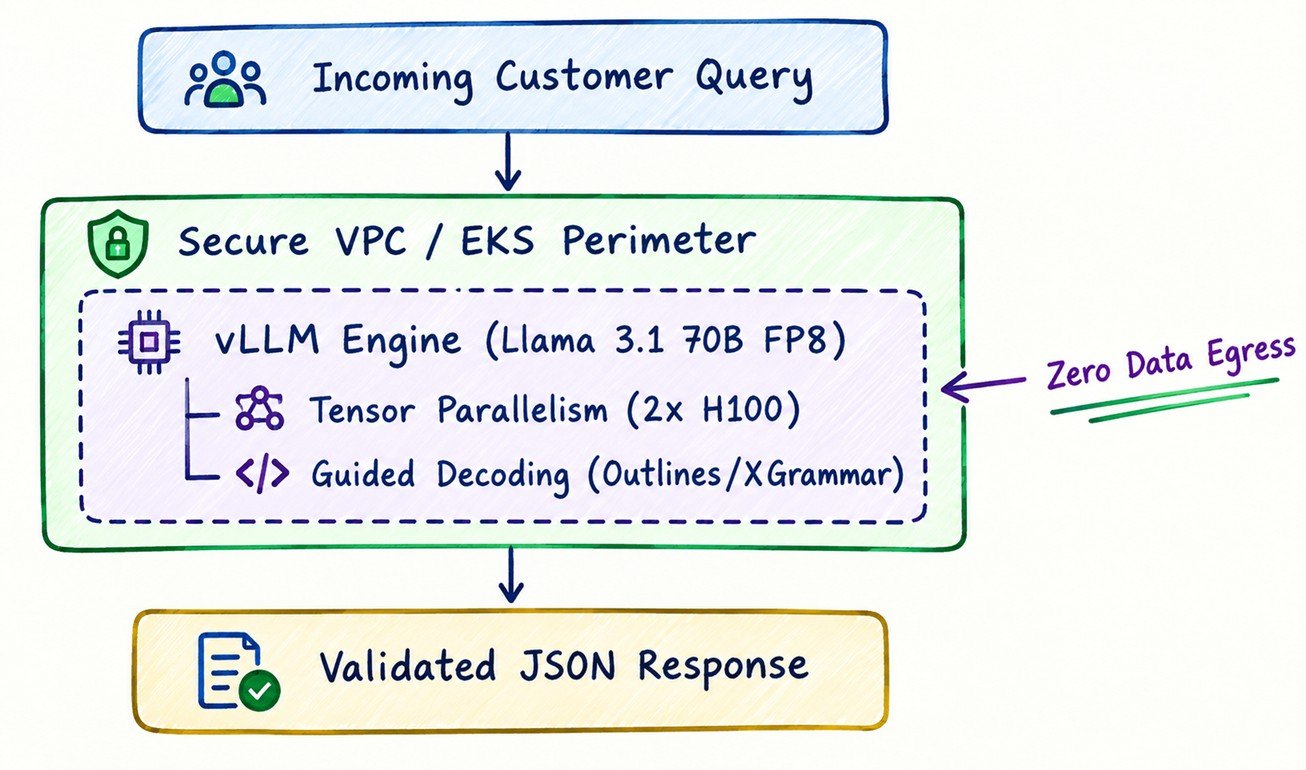
Strategic Rationale:
- Absolute Data Perimeter Compliance: By hosting the weights within our secure cloud instance, data never leaves our boundaries. This completely eliminates legal friction and guarantees adherence to our strict tenant privacy commitments.
- Cost Amortization at Scale: While initial hardware provisioning introduces a fixed capital expenditure, our projected steady-state transaction volume crosses the break-even point against commercial APIs within 90 days. Beyond this point, our cost per token falls by approximately 42%.
- Enforced JSON Structuring: By deploying our own inference stack, we can integrate open-source structured generation libraries (e.g.,
OutlinesorXGrammar) directly into the model's logits during decoding. This guarantees 100% syntactically valid JSON responses, outperforming commercial API JSON modes under heavy multi-tenant schema conditions.
4. Consequences & Operational Trade-offs
What We Gain (Benefits):
- Deterministic Costs: We transition from highly volatile, traffic-dependent commercial API bills to predictable, flat-rate cloud compute allocations.
- Hyper-Optimization Autonomy: The team can now execute low-rank adaptation (LoRA) fine-tuning loops using captured historical support tickets to consistently boost model accuracy over time.
- Uncapped Throughput: We are completely unlinked from third-party rate limits and regional API outages.
What We Sacrifice (Drawbacks and Risks):
- Infrastructure Overhead: The Cloud Operations team must now absorb the maintenance debt of managing GPU cluster health, node failures, and vLLM runtime memory leaks.
- Underutilized Capacity Surcharge: During non-peak hours (e.g., 01:00 to 05:00 IST), we continue to pay for idle GPU compute unless aggressive, functional scale-to-zero infrastructure policies are developed.
- Model Obsolescence Lock-in: Upgrading to a newer state-of-the-art open-source model in the future will require re-engineering the serving configuration and re-testing tensor parallel allocations.
5. Implementation Roadmap & Guardrails
- Infrastructure Provisioning (Immediate): Allocate 2 x H100 nodes via our infrastructure-as-code repository.
- Quantification Guardrail (Milestone 1): Validate that the FP8 quantized variant does not suffer an evaluation drop of more than 0.5% on our internal retrieval accuracy test suite compared to the unquantized BF16 baseline.
- Automated Superseded Path (Long-Term): This record will stand unless a future open-weight model matching these capabilities can run efficiently on significantly lower-tier hardware (e.g., a single L44 cluster), at which point a new ADR must be drafted to supersede this infrastructure footprint.
Enterprise ADR Validation Pipeline
This sub-section assumes you are currently host your pipelines on GitHub and you are GitHub-native microservice architecture.
To prevent pipeline fatigue, the workflow targets changes affecting System Topography, Interservice Contracts, or Data Layers. Changes to simple application code (like changing a log statement or fixing a typo) bypass the block.
In a microservices environment, architects can fall into the trap of using a single global repository with mixed histories, or distributed repositories with inconsistent rules. This solution handles both paradigms: Mono-repositories (validating based on service folder prefixes) and Poly-repositories (enforcing rules uniformly at the microservice repo level).
1. Architectural Strategy for Microservices
To prevent pipeline fatigue, the workflow targets changes affecting System Topography, Interservice Contracts, or Data Layers. Changes to simple application code (like changing a log statement or fixing a typo) bypass the block.
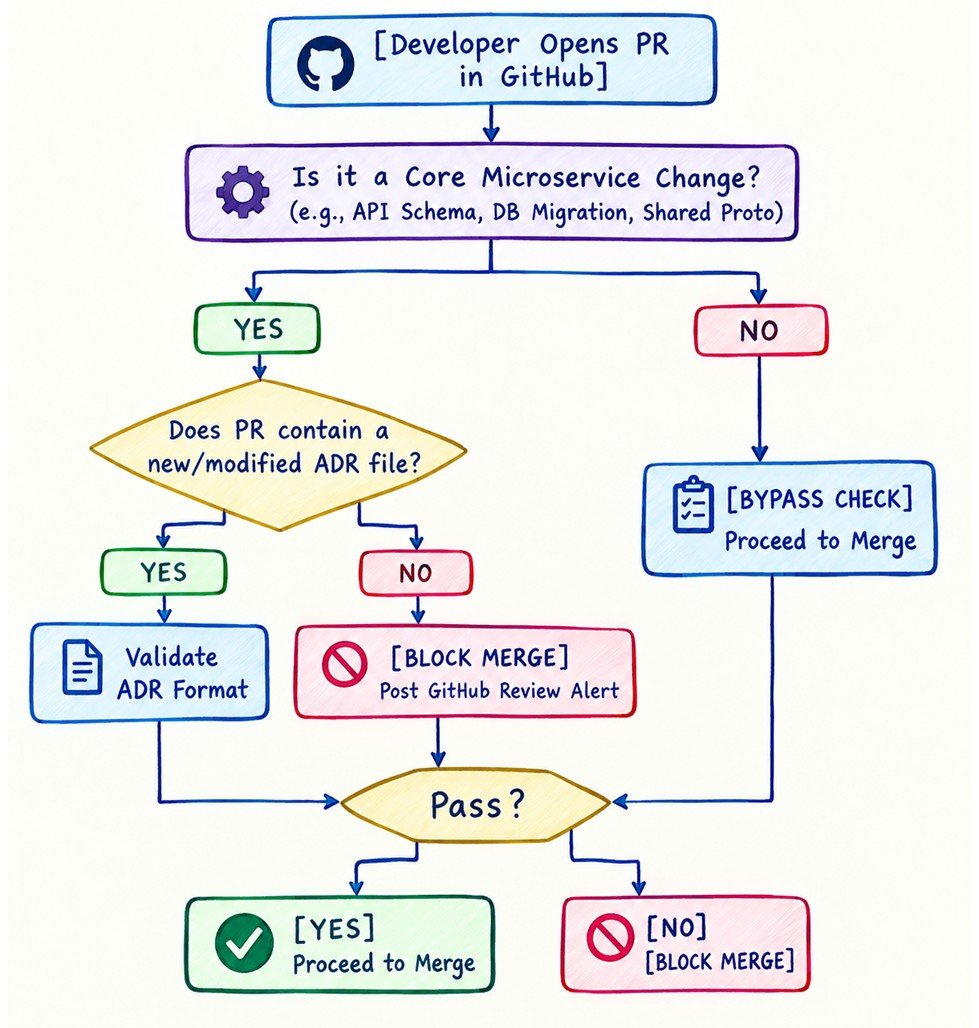
2. Production YAML Configuration for GitHub
Place this workflow file inside your repository at .github/workflows/adr-microservices-gate.yml.
This configuration leverages optimized regex matching to catch changes across your microservices mesh (e.g., data layers, API definitions, and deployments) while ignoring everyday feature commits.
name: ADR Microservices Governance Gate

on:
  pull_request:
    branches: [ main, master ]
    # Triggers strictly when structural components of a microservice change
    paths:
      - '**/api/v*/**'                 # API versioning updates / OpenAPI schemas
      - '**/migrations/**'             # Database schema changes
      - '**/proto/**'                  # gRPC / Protocol buffer definitions
      - '**/k8s/**'                    # Kubernetes deployment definitions
      - '**/helm/**'                   # Helm Charts
      - 'docs/adr/**'                  # Any manual updates to the ADR folder itself

permissions:
  contents: read
  pull-requests: write                 # Required to write automated review feedback

jobs:
  enforce-adr:
    name: Validate Architecture Compliance
    runs-on: ubuntu-latest

    steps:
      - name: Checkout Code Base
        uses: actions/checkout@v4
        with:
          fetch-depth: 0               # Fetches complete commit history for accurate diffing

      - name: Setup Node.js Environment
        uses: actions/setup-node@v4
        with:
          node-version: '20'

      - name: Install Linting Tooling
        run: npm install -g markdownlint-cli

      # GATE 1: Verify presence of ADR if a core microservice file was altered
      - name: Audit Structural Change Scope
        id: audit_changes
        run: |
          TARGET_BRANCH="origin/${{ github.base_ref }}"
          echo "Comparing current PR commits against baseline: $TARGET_BRANCH"

          # Isolate system-level file modifications
          STRUCTURAL_CHANGES=$(git diff --name-only $TARGET_BRANCH...HEAD | grep -E '(/api/v|/migrations/|/proto/|/k8s/|/helm/)') || true

          # Track matching ADR additions/modifications
          ADR_CHANGES=$(git diff --name-only $TARGET_BRANCH...HEAD | grep -E '^docs/adr/.*\.md$') || true

          if [ -n "$STRUCTURAL_CHANGES" ] && [ -z "$ADR_CHANGES" ]; then
            echo "::error::System-level architectural changes detected within your microservice path, but no corresponding Architecture Decision Record (ADR) file was added or updated under docs/adr/."
            echo "------------------------------------------------"
            echo "Modified files requiring architectural sign-off:"
            echo "$STRUCTURAL_CHANGES"
            echo "------------------------------------------------"
            exit 1
          fi
          echo "ADR Presence Check: PASSED (Valid documentation found or skip conditions met)."

      # GATE 2: Enforce structural headers against your corporate template
      - name: Validate ADR Structural Rules
        run: |
          if [ -d "docs/adr" ]; then
            echo "Executing format review on ADR docs..."

            # Use markdownlint to enforce correct syntax formatting rules
            markdownlint "docs/adr/*.md"

            # Scan each file to verify the corporate headers are explicitly spelled out
            for file in docs/adr/*.md; do
              # Bypass root indexes or documentation readmes
              if [[ "$file" =~ README.md || "$file" =~ index.md ]]; then continue; fi

              echo "Parsing architecture blocks for: $file"
              grep -q "### 1. Context & Problem Statement" "$file" || { echo "::error file=$file::Template error. Missing header '### 1. Context & Problem Statement'"; exit 1; }
              grep -q "### 2. Alternatives Evaluated" "$file"     || { echo "::error file=$file::Template error. Missing header '### 2. Alternatives Evaluated'"; exit 1; }
              grep -q "### 3. Decision" "$file"                   || { echo "::error file=$file::Template error. Missing header '### 3. Decision'"; exit 1; }
              grep -q "### 4. Consequences & Operational Trade-offs" "$file" || { echo "::error file=$file::Template error. Missing header '### 4. Consequences & Operational Trade-offs'"; exit 1; }
              grep -q "### 5. Implementation Roadmap & Guardrails" "$file"  || { echo "::error file=$file::Template error. Missing header '### 5. Implementation Roadmap & Guardrails'"; exit 1; }
            done
            echo "All discovered ADR structures match your organizational framework."
          else
            echo "Target 'docs/adr' directory empty or not found. Skipping formatting layer."
          fi
Note: Use code with caution.
3. GitHub Native Automation: CODEOWNERS Mapping
To ensure your engineering leadership (CTOs, Directors, and Principal Architects) automatically receive review requests when an ADR is modified, drop a CODEOWNERS file into your repository at .github/CODEOWNERS.
This ensures that while a developer can draft an ADR, it cannot be merged without explicit sign-off from your designated architectural leads.
.github/CODEOWNERS
# Core architects own the ADR directory across the entire repository spectrum

/docs/adr/                     @your-org/principal-architects @your-cto-github-handle
**/api/v*                      @your-org/api-governance-team
**/proto/                      @your-org/platform-core-team
4. GitHub Configuration Checkpoints (Settings Panel)
To make these blocks final and unskippable inside GitHub, apply these constraints to your protected branches (main/master):
- Go to Settings → Branches → Click Edit/Add Rule on your target branch.
- Check Require a pull request before merging.
- Check Require status checks to pass before merging and explicitly search for and select:
Validate Architecture Compliance. - Check Require conversation resolution before merging to ensure architectural debate notes cannot be swept aside before production deployment.
Architecture Decision Record (ADR) Governance Playbook
Document Version: 1.0.0
Target Audience: CTO, VPs, Engineering Directors, Principal & Staff Engineers
1. Governance Model Overview
To ensure speed without sacrificing architectural safety, decision-making authority is decentralized based on the Impact Radius of the choice.
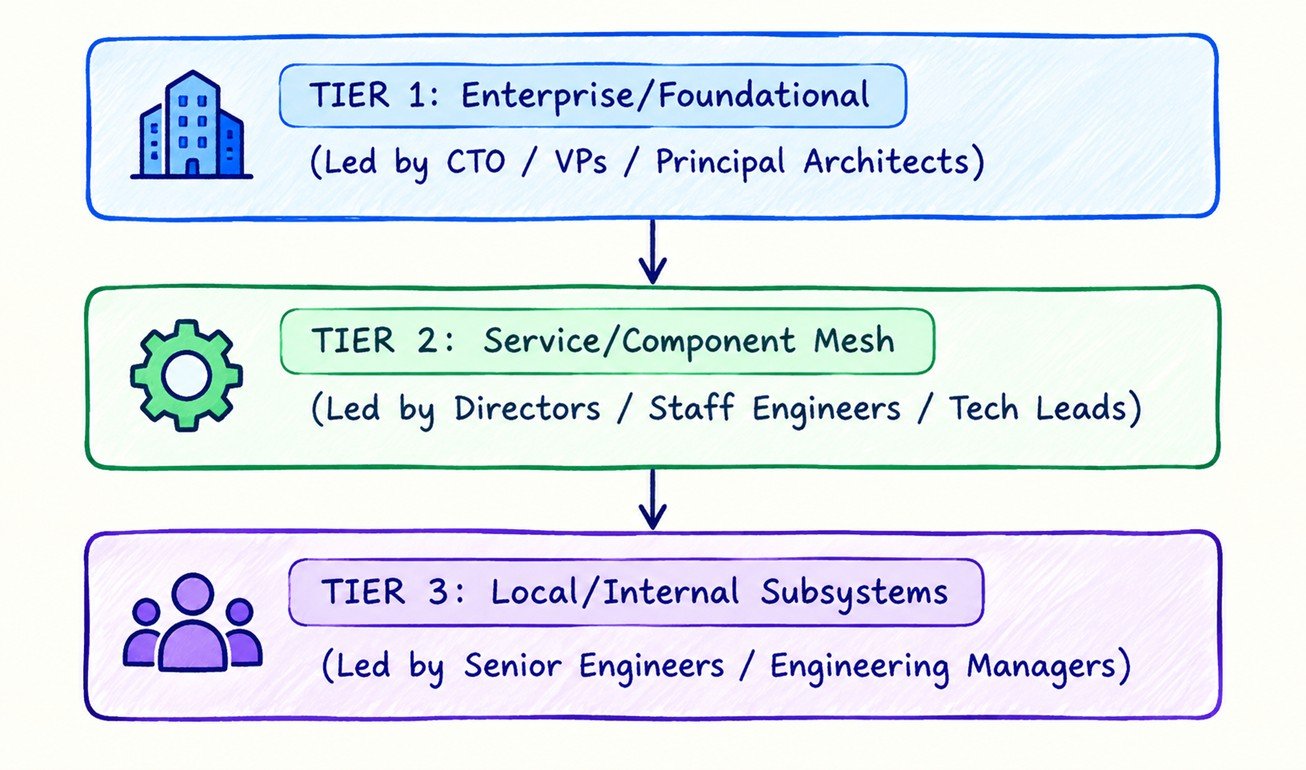
Every ADR follows a transparent workflow: Drafted by the engineers closest to the problem, Reviewed by cross-functional peers, and explicitly Approved/Rejected by the designated Architectural Authority.
2. The Three Architectural Tiers
Tier 1: Enterprise / Foundational Infrastructure
- Definition: High-impact choices that shift your core system strategy, introduce significant capital expenditures, or dictate long-term developer capabilities across the entire enterprise.
- Examples: Changing your primary cloud provider, selecting a core vector database engine for the organization, adopting a monorepo vs. polyrepo framework, or setting global data security/PII guardrails.
- Roles Matrix:
- Author: Principal Architects, Staff Engineers, or VPs of Engineering.
- Mandatory Reviewers: Cross-functional Directors of Engineering, Principal Architects, and Security/Compliance Leads.
- Approving Authority: CTO or VP of Infrastructure.
- Review Cycle SLA: Evaluated within 7 business days. Requires a formal sync presentation or architectural review board meeting.
Tier 2: Service / Component Mesh
- Definition: Structural choices that cross domain or microservice boundaries, alter external interfaces/contracts, or dictate runtime environments for individual business components.
- Examples: Transitioning an inter-service communication path from REST to gRPC, adding a database migration tool, altering an API gateway routing strategy, or defining a shared caching framework.
- Roles Matrix:
- Author: Staff Engineers, Senior Engineers, or Tech Leads.
- Mandatory Reviewers: Domain Architects, Peer Tech Leads, and the Engineering Manager of affected downstream services.
- Approving Authority: Engineering Director or Principal Domain Architect.
- Review Cycle SLA: Evaluated within 3 business days strictly inside the GitHub Pull Request thread. No mandatory meeting required unless requested by a reviewer.
Tier 3: Local / Internal Subsystems
- Definition: Low-risk, encapsulated implementation choices isolated inside a single microservice container or repository boundaries. These choices do not impact downstream dependencies or external service contracts.
- Examples: Introducing a new code-splitting library, adopting a utility paradigm within a single service, or changing a local queue consumer thread-pool count.
- Roles Matrix:
- Author: Any Engineer on the team.
- Mandatory Reviewers: Immediate team peers (Senior/Mid-level Engineers).
- Approving Authority: Engineering Manager (EM) or Team Tech Lead.
- Review Cycle SLA: Evaluated within 24 hours as part of standard peer code review.
3. Operational Protocols
The Approval Protocol
An ADR is officially Accepted and cleared for implementation when:
- The GitHub automated validation checks pass (validating template headers and layout).
- The mandatory reviewers drop an explicit GitHub Pull Request approval.
- The designated Approving Authority merges the PR into the master/main branch.
The Rejection Protocol
Rejection is a natural, healthy component of architectural evolution. If an ADR is Rejected:
- The Approving Authority changes the ADR status metadata field to
Rejected. - The Approving Authority must leave a detailed, objective written comment in the PR documenting the precise technical or financial reasoning behind the rejection.
- The PR is merged (not closed or deleted) into the
/docs/adrfolder.- Rationale: Documenting why the organization chose not to build something is just as valuable as documenting what it did build. It prevents future teams from wastefully pursuing the exact same rejected path.
The Conflict Resolution Pattern
When architects or engineering directors reach a total deadlock regarding a Tier 2 or Tier 3 decision, the issue is instantly escalated one level up:
- Tier 3 deadlocks escalate to the Domain Director.
- Tier 2 deadlocks escalate to the Enterprise Principal Architect / CTO.
- The escalated authority has 48 hours to issue a binding final decision to prevent engineering velocity stalls.
Addendum: Enterprise ARB Integration Notes (Scale 500+ Engineers)
For an organization with 500+ engineers and an active Architecture Review Board (ARB), the playbook must avoid creating a bureaucratic bottleneck. Instead of replacing your ARB, the ADR pipeline operationalizes it, shifting the ARB from a "gatekeeper" model to an asynchronous, data-driven "clearinghouse."
Add these specific adjustments as side notes or an appendix to your main governance playbook:
-
The "Asynchronous-First" ARB Filter:
- Only Tier-1 ADRs require an automated calendar slot on the weekly or bi-weekly ARB live agenda.
- Tier-2 ADRs are reviewed asynchronously by assigned ARB delegates directly inside GitHub. If an ARB delegate flags a cross-domain collision within 3 business days, they can manually escalate the PR, pulling it into the next live ARB session.
-
The ARB "Liaison" Pod System:
- At a scale of 500+ developers, the full ARB cannot review every system change. Divide your ARB into domain-specific pods (e.g., Data Infrastructure Pod, AI/ML Platform Pod, Core Security Pod).
- Each pod assigns a permanent ARB Liaison to specific business units or product groups. This liaison is automatically tagged via GitHub
CODEOWNERSand acts as the primary interface for Tier-2 sign-offs, keeping reviews fast and focused.
-
Global ADR Registries & Cross-Pollination:
- With 500+ engineers split across isolated product lines, teams will inevitably solve the exact same problems in silos.
- The Fix: The ARB must maintain a centralized, searchable global catalog (e.g., aggregated via Backstage, a shared GitHub Pages site, or internal documentation portals). Every time a Tier-1 or Tier-2 ADR is merged anywhere in the global enterprise, an automated webhook should publish the record to this index, ensuring complete architectural visibility across all business units.
-
The Post-Implementation Audit Framework:
- Six to twelve months after a Tier-1 ADR is stamped Accepted by the ARB, the original authors must present a 10-minute retrospective to the board.
- This session compares the predicted consequences outlined in Section 4 of the original document against actual production metrics (e.g., real infrastructure costs, actual latency, and unexpected operational dependencies). This feedback loop forces architects to write realistic, high-accuracy ADRs rather than idealistic proposals.