Mapping enterprise architecture principles to probabilistic AI systems
Introduction
Traditional Enterprise Architecture (EA) is anchored in deterministic certainty. Systems are engineered around a simple truth: given a specific input X, the system will always yield output Y.
Probabilistic Artificial Intelligence (AI)—powered by Large Language Models (LLMs) and foundation models—shatters this paradigm. AI components exhibit non-deterministic behavior, where the same input can yield subtly or drastically different outputs based on temperature, random seed variations, and contextual fluidities.
As technology leaders, you cannot govern a probabilistic ecosystem using deterministic guardrails. To successfully scale AI across the enterprise without compromising security, compliance, or brand equity, you must overhaul your core architecture tenets. This blueprint details the structural shift required across the three pillars of modern EA: Data Frameworks, System Reliability, and Enterprise Security.
1. Data Frameworks: From Fixed Schema to Fluid Context
The Deterministic Architecture
Traditional data architecture thrives on strict structural enforcement. Enterprise Data Warehouses (EDWs) and relational databases (RDBMs) rely on rigid schemas (DDL), primary/foreign key constraints, and transactional consistency (ACID). Data quality is managed at ingestion, ensuring every piece of information conforms exactly to predetermined fields and types.
The Probabilistic AI Shift
Generative AI treats unstructured text as its primary medium, operating within a fluid context window. Order is no longer maintained by cell-and-table boundaries, but by token management, semantic boundaries, and context retrieval optimization.
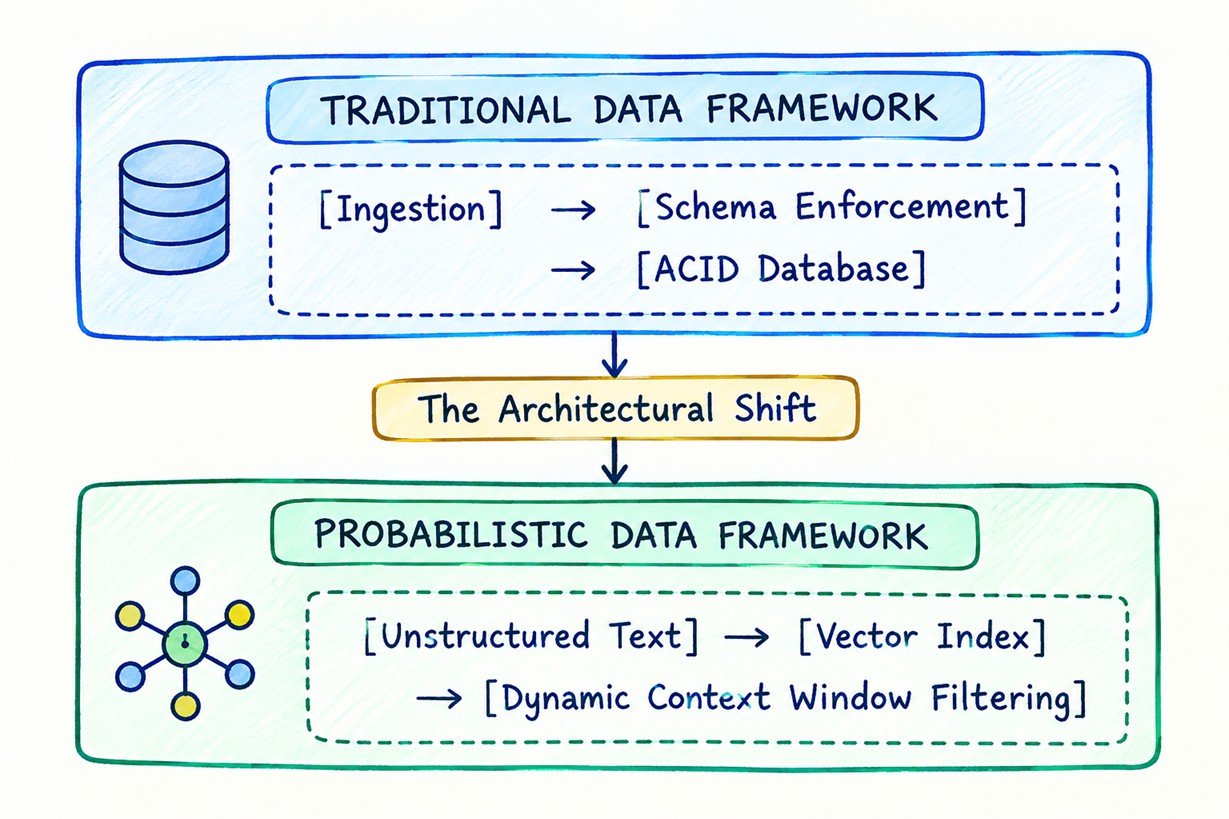
Strategic Leadership Directives
- Implement Context Hydration Frameworks: Replace static database querying with dynamic context compilation (e.g., Retrieval-Augmented Generation / RAG). Architects must build orchestration pipelines that dynamically fetch, rank, and inject relevant enterprise truth into the context window before execution.
- Establish Algorithmic Token Budgeting: Token limitations are the new hardware constraints. Leaders must treat token windows (128k, 1M tokens) as a finite computing resource, designing semantic compression algorithms and chunking strategies to minimize cost and maximize operational relevance.
- Enforce Prompt Boundary Engineering: Hardcoded application logic must be replaced with robust systemic prompt scaffolding. System prompts must contain absolute operational constraints to isolate the model's behavioral path, separating user intent from system instructions to prevent prompt injections.
2. Infrastructure & Operations: From Deterministic Uptime to Statistical Reliability
The Deterministic Architecture
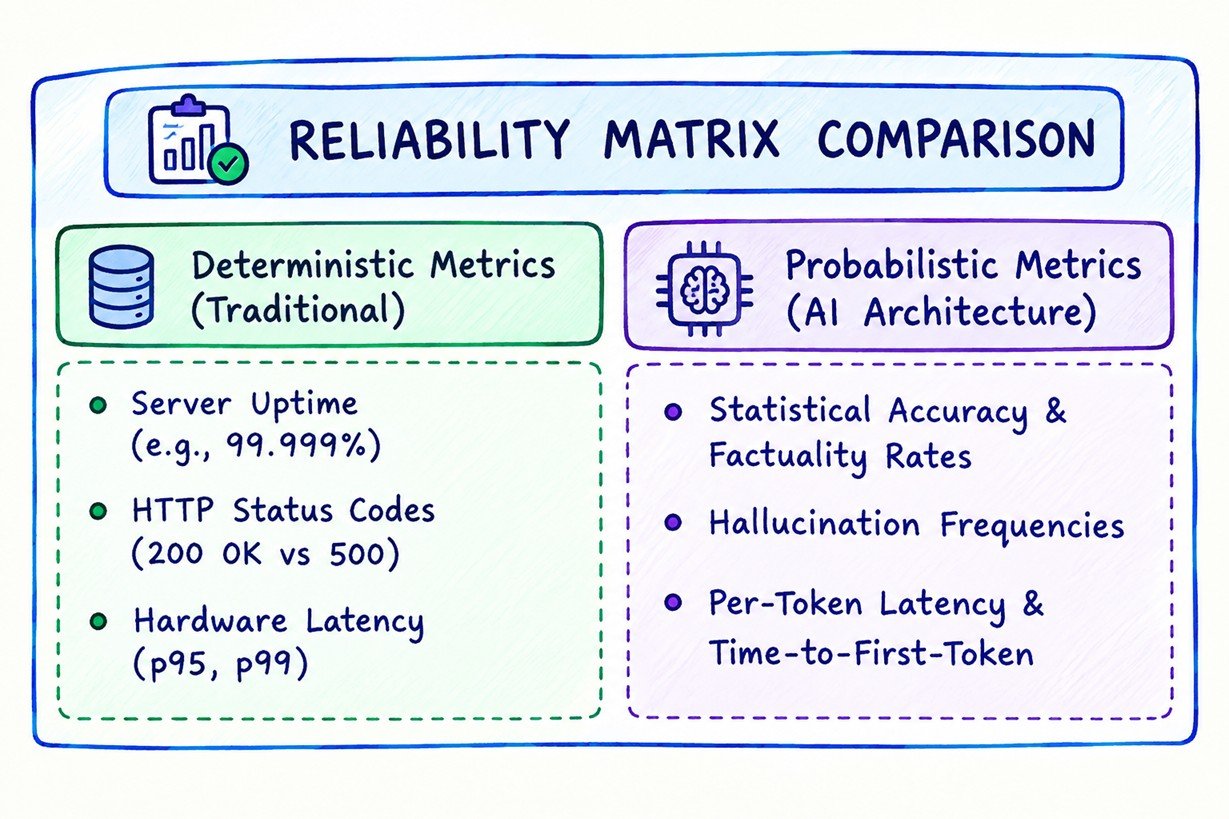
For decades, operational reliability meant keeping the hardware alive. Infrastructure success was measured linearly through server uptime (99.999% "five nines"), network bandwidth, CPU utilization, and HTTP response codes. If a server returned a 200 OK status, the system was considered healthy.
The Probabilistic AI Shift
In a probabilistic world, a system can be fully operational from an infrastructure perspective while producing entirely broken or toxic business outcomes. An LLM node can achieve 100% server uptime and minimal hardware latency while generating hallucinations, factual inversions, or corrupted outputs. Uptime is no longer a proxy for utility.
Strategic Leadership Directives
- Deploy LLM-Evaluators and Continuous Red-Teaming: Introduce secondary automated evaluation layers (LLM-as-a-judge) that continuously score production inputs and outputs against golden datasets. Track operational success through Statistical Faithfulness and Answer Relevance scores.
- Adopt Multi-Dimensional Observability: Expand standard Application Performance Monitoring (APM) dashboards to track probabilistic metrics:
- TTFT (Time to First Token): The true metric for user experience in streaming architectures.
- Hallucination Rate: Percentage of outputs failing semantic alignment checks.
- Cost Per Transaction: Tracked dynamically based on token consumption distributions rather than static compute hours.
- Design Graceful Degradation Pathways: Implement fallback mechanisms when confidence scores drop below a certain threshold. The system must automatically route requests from high-optimized small models to reasoning-level foundation models, or seamlessly transition to a human-in-the-loop workflow.
3. Security & Governance: From Static Access Control to Dynamic Policy Enforcement
The Deterministic Architecture
Traditional security relies on deterministic perimeters and predictable roles. Role-Based Access Control (RBAC) and Attribute-Based Access Control (ABAC) explicitly define who can read which table row or hit which API endpoint. Security validation occurs once at the gateway; if authenticated, the system executes the requested query explicitly.
The Probabilistic AI Shift
Natural language interfaces allow users to request information dynamically, traversing unstructured enterprise knowledge bases without structured barriers. This creates massive risk vectors for indirect prompt injection, data exfiltration, and accidental privilege escalation. An attacker can manipulate semantic context to bypass traditional role barriers hidden deep inside document repositories.
Strategic Leadership Directives
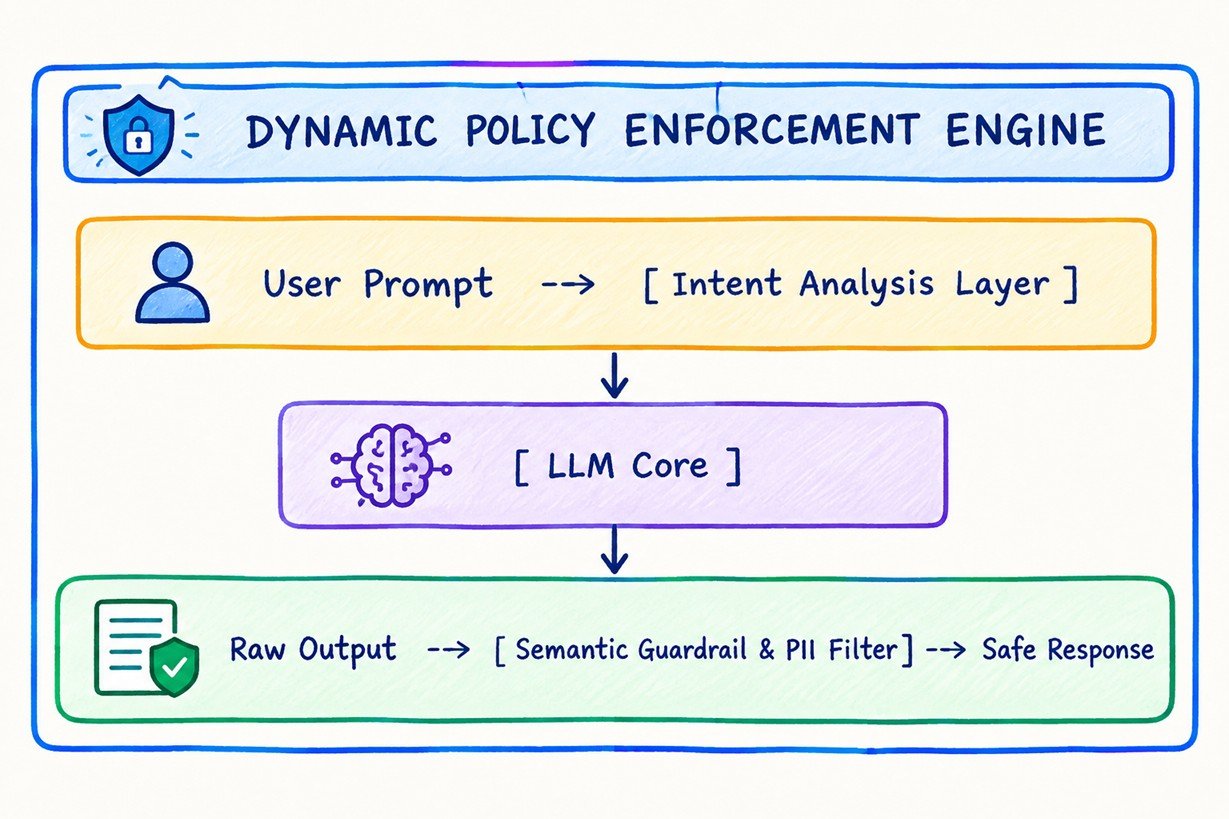
- Architect Real-Time Intent Analysis Layers: Implement interceptors before the prompt hits the model core. These layers utilize semantic classifiers to analyze the input for malicious intent, jailbreaks, and indirect injection vectors.
- Establish Semantic Guardrails and Egress Filtering: Implement real-time transactional filtering on the output (egress) side. Utilize programmatic guardrail frameworks to check the model's response for PII leaks, intellectual property violations, or toxic sentiment before it reaches the end application.
- Implement Zero-Trust Context Segmentation: Traditional database permissions must extend into the vector database level. Metadata-driven filtering must be enforced during the retrieval phase of RAG systems, guaranteeing the model can only "see" documents the specific authenticated user has permission to read.
4. The Enterprise Architecture Adaptation Matrix
To guide your transformation, use this matrix as a compass to audit your current system designs and migrate from traditional constraints to probabilistic realities.
| Architecture Pillar | Deterministic Paradigm | Probabilistic AI Paradigm | Core Governance Strategy |
|---|---|---|---|
| Data Architecture | Rigid Schema Definition (DDL, SQL Tables) | Fluid Context Windows (Tokens, Unstructured Data) | Vector Index Optimization, Dynamic Chunk Hydration |
| Operational Health | Server Uptime & Hardware Latency (99.999%, p99) | Statistical Reliability & Output Quality | LLM-As-A-Judge, TTFT Tracking, Golden Dataset Testing |
| Cybersecurity | Static Perimeter & RBAC (Predictable Access) | Dynamic Intent Control & Context Isolation | Ingress Intent Analysis, Egress Semantic Guardrails |
| Application Integration | Explicit API Contracts (REST, gRPC) | Semantic Interfacing (Natural Language Prompts) | Orchestration Frameworks (LangChain/LlamaIndex), Structured Output Enforcement |
This addendum is for your executive blueprint, formatted specifically for your vendor API deployment model and SOC2, GDPR, and HIPAA compliance frameworks.
Addendum: Governance & Compliance Framework for Vendor API Implementations
1. Data Architecture Addendum (GDPR & HIPAA Compliance)
When relying on third-party vendor APIs (e.g., OpenAI, Anthropic, Azure AI), data boundaries shift from internal network firewalls to external transport boundaries. Under GDPR and HIPAA, passing unstructured data to external endpoints requires strict isolation.
- Zero-Data-Retention (ZDR) Enforcements: Enterprise contracts must mandate explicit Zero-Data-Retention policies with the API vendor. Ensure that no customer data, PHI (Protected Health Information), or PII (Personally Identifiable Information) is used by the vendor for model training or retained in persistent logs.
- Decoupled De-Identification Engestion Pipelines: Prior to context hydration, implement an automated sanitization proxy. This layer must dynamically tokenize or mask PHI/PII using cryptographic hashes or synthetic data placeholders before the payload crosses the enterprise perimeter into the vendor API.
- Right-to-Be-Forgotten (Data Erasure) Context Rules: Because vector database indices store semantic embeddings of corporate data, they are subject to GDPR Article 17. The vector ingestion layer must catalog embeddings with precise metadata mapping back to the source user ID. If a user exercises their right to erasure, you must trigger a hard deletion of the corresponding vectors, as simple source document deletion leaves residual data in the semantic index.
2. Infrastructure & Operations Addendum (SOC2 Trust Services Criteria)
Vendor APIs introduce external systemic dependencies. SOC2 Type II compliance requires you to demonstrate operational control, availability, and processing integrity over systems you do not directly manage.
- API Gateway Intermediation & Auditing: Never allow client applications to call vendor APIs directly. All traffic must route through a centralized, enterprise-managed API gateway. This gateway acts as the deterministic audit log for SOC2, capturing inputs, outputs, system latency, and token consumption distributions.
- Synthetic Transaction Canary Testing: To measure processing integrity and availability beyond simple vendor status pages, run continuous synthetic test prompts ("canaries") through the pipeline. These verify that the vendor model's statistical accuracy and alignment scores have not degraded post-update.
- Multi-Vendor Redundancy & Circuit Breakers: To ensure the Availability criteria of SOC2, build runtime fallback abstractions. If the primary vendor API experiences a hard outage or a sudden surge in latency (p99 spikes), the architecture must automatically reroute requests to an alternative compliant vendor model without breaking application uptime.
3. Security & Governance Addendum (HIPAA BAAs & SOC2 Confidentiality)
Using external APIs means your perimeter is defined by API keys, transport encryption, and strict legal boundaries.
- Business Associate Agreements (BAAs): Under HIPAA, the API vendor acts as a Business Associate. A formal BAA must be signed with the provider, explicitly certifying that their infrastructure meets physical, technical, and administrative safeguards for hosting or processing ePHI.
- Dynamic Egress PII & PHI Reconstruction: If data masking was applied during ingestion, the egress (output) architecture must securely map the model's response back to the original entities within the secure enterprise perimeter. The vendor API never sees the decrypted mapping key.
- Automated Secrets Lifecycles: Vendor API keys must be treated as Tier-0 cryptographic assets. Store keys in dedicated hardware security modules (HSMs) or secret managers with automated, short-cycle rotation schedules, adhering strictly to SOC2 access control policies.
Conclusion: The Path Forward for Technology Leaders
Transitioning to probabilistic systems does not mean accepting chaos. It demands a shift in mindset from guaranteeing execution pathways to governing behavioral boundaries.
As CTOs, VPs, and Directors, your architectural success over the next decade will be defined by how effectively you design systems that embrace statistical variance while guaranteeing deterministic enterprise boundaries. Use this blueprint to evaluate every AI initiative in your pipeline, ensuring your infrastructure is built to withstand the unique mechanics of the probabilistic age.