AI Architectural North Star Blueprint
Introduction
The AI Architectural North Star Blueprint is the definitive, execution-ready master plan that operationalises an organization's high-level AI Product Vision and Intelligence Strategy. It serves as an immutable bridge, transforming abstract cognitive requirements into a concrete, resilient, and multi-layered software ecosystem.
For technology executives—including CTOs, VPs, and Directors—this blueprint acts as the ultimate governance vehicle. It enforces systemic boundaries, structures non-deterministic intelligence flows, and mitigates the unique, chaotic risks introduced by probabilistic computing.
Rather than standardizing on a temporary technology stack or a single vendor's ephemeral API ecosystem, this blueprint codifies a long-term Model-Agnostic, Zero-Trust, and Cost-Optimized structural design. It ensures your engineering organization builds sustainable enterprise assets capable of evolving safely as foundation models, frameworks, and infrastructure continuously mature.
1. The Global Architecture Blueprint Map
The following visual blueprint establishes the end-to-end macro-system topology. It charts the explicit boundaries between deterministic enterprise layers and probabilistic runtime environments, detailing exactly how data, context, and cognition flow securely through the enterprise fabric.
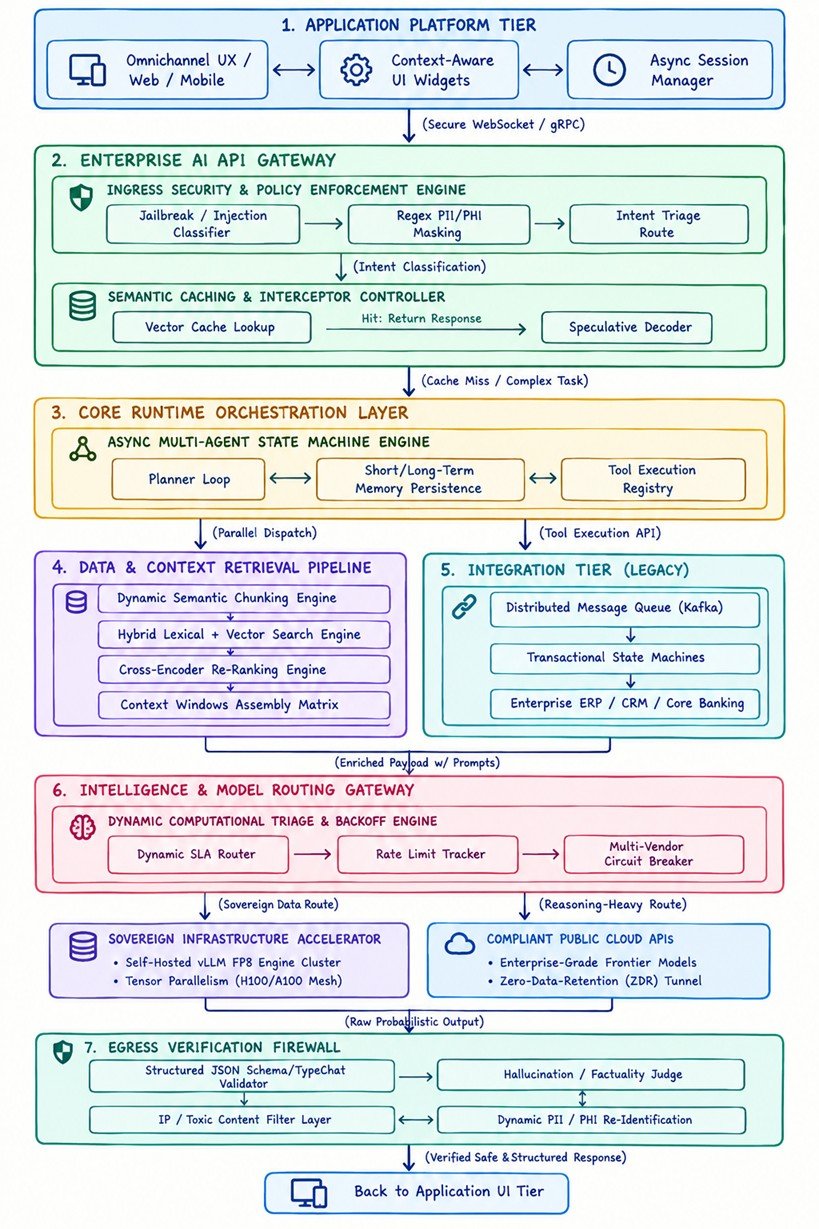
2. Mass-Scale Technical Architecture & Cross-Cloud Deployment Blueprints
To support an enterprise-grade target load of 20,000,000 to 30,000,000 concurrent conversations with a high-frequency throughput footprint of 29,000 to 70,000 active requests per second (RPS), the physical tier must shift away from standard virtual machine auto-scaling. It demands a globally distributed, multi-region architecture orchestrated through highly parallelized computing clusters, tiered routing mechanisms, and decoupled hardware accelerators.
The system topology is split into Logical Functional Tiers. While the structural blueprints below illustrate concrete execution mappings for an AWS environment, these tiers translate directly to any hyperscaler or private bare-metal ecosystem.
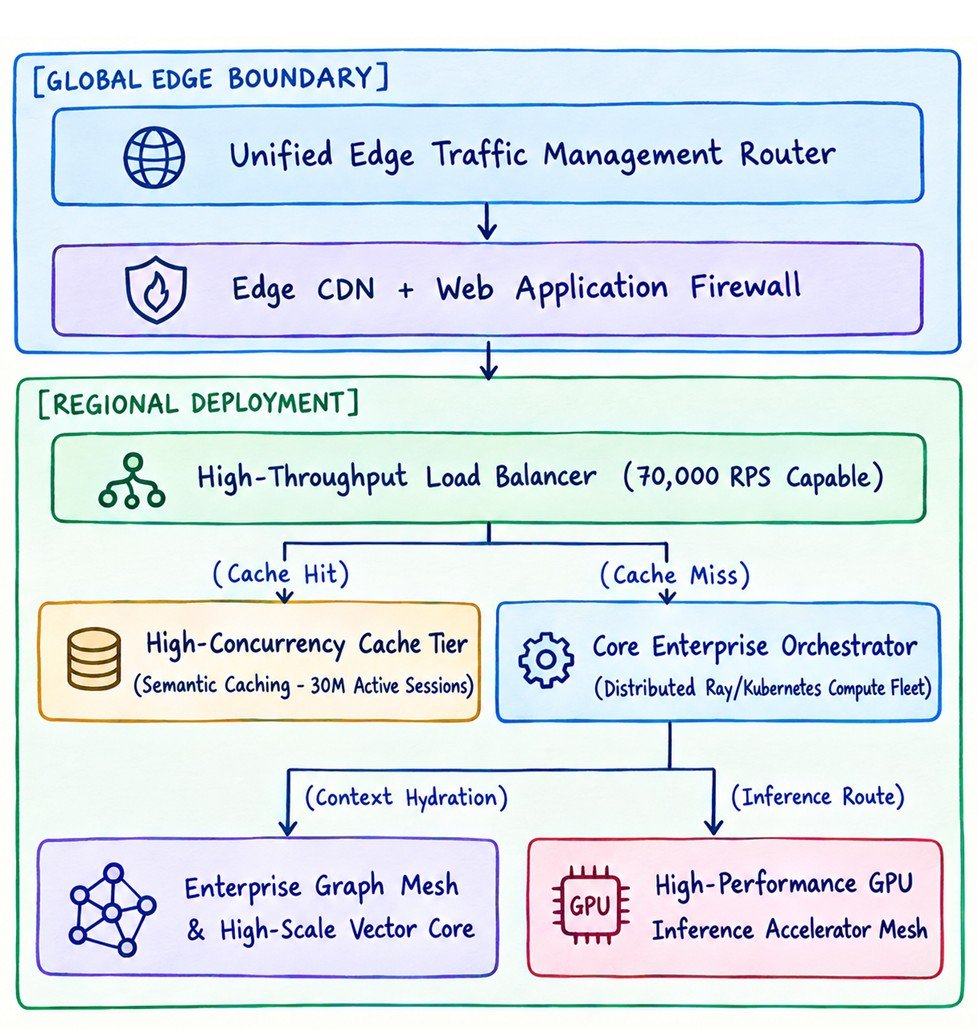
Tier 1: Global Edge & Ingress Triage Component
- Global Traffic Management: The entry routing network runs geoproximity, latency-based routing policies to distribute consumer traffic across a minimum of three active-active data processing regions.
- DDoS Protection & Perimeter Defense: An Edge Content Delivery Network (CDN) acts as the initial SSL/TLS termination point, backed by an enterprise Web Application Firewall (WAF) configured with aggressive rate-limiting rules to shield downstream services from token-exhaustion denial-of-service vector patterns.
- Ingress Processing Layer: Deploys a fleet of Layer-4 Network Load Balancers (NLBs) handling raw traffic routing, which instantly fans out to an enterprise API Gateway mesh or heavily optimized, containerized proxy sidecars (e.g., Envoy) running inside a managed Kubernetes engine. This handles the peak ingestion boundary of 70,000 active requests per second.
Tier 2: High-Concurrency Core Runtime & Cache Tier
- Ultra-Low Latency Caching: Deploys a horizontally sharded, in-memory key-value database cluster configured with automatic replication nodes. This low-latency layer tracks active session tokens and state structures for the 30,000,000 active conversations, ensuring that repeating or highly similar conversational paths hit a sub-millisecond memory cache rather than invoking redundant orchestrator compute cycles.
- Orchestration Engine: Containerized Kubernetes clusters run stateless, auto-scaling runtime engines built on distributed agent orchestration platforms (e.g., Ray, LangGraph, or custom worker loops). These worker nodes operate on energy-efficient ARM-based compute instances to maximize multi-threaded token tracking efficiency while minimizing regional computing expenditures.
Tier 3: Storage & Massive Context Ingestion Core
- Vector Infrastructure: Utilizes a highly available, enterprise-scale vector database plugin or serverless search network deployed over high-performance NVMe block storage volumes. This database engine enforces metadata partitioning columns to strictly isolate multi-tenant customer data.
- Knowledge Graph Relations: Integrates a managed graph search database to trace complex relational dependencies and user identity policies in real time, delivering context retrieval updates within ≤ 50ms.
Tier 4: High-Performance GPU Inference Accelerator Mesh
- Sovereign Inference Tier: Implements highly dedicated accelerated compute clusters loaded with modern tensor-core server instances hosting high-bandwidth NVIDIA H100 GPU architectures interconnected via high-throughput fabric networks. These nodes power your self-hosted, quantized Llama 3.1 70B FP8 inference stack using advanced inference engines (e.g., vLLM or Triton), delivering massive tensor parallelism without data ever leaving the regional data boundary.
- Dynamic Gateway Fallback: Integrates with hosted, compliance-certified private model endpoints through secure cloud tunnels to absorb massive unexpected traffic overflows, scaling compute parameters elastically without risking cold starts during peak spikes.
📌 Addendum: Global Cross-Cloud Component Mapping Reference
For technology organizations operating outside of an AWS environment, utilize this verified multi-cloud translation matrix. The logical requirements of the 70,000 RPS, triple-compliance (SOC2, GDPR, HIPAA) infrastructure translate directly to native cloud provider services or air-gapped data centers:
| Structural Component Tier | AWS Physical Target | Microsoft Azure Alternative | Google Cloud (GCP) Alternative | On-Premises / Air-Gapped Private Cloud |
|---|---|---|---|---|
| Tier 1: Ingress & Edge | Route 53 + CloudFront + WAF | Azure Front Door + Azure WAF | Cloud DNS + Cloud CDN + Cloud Armor | F5 BIG-IP Next + Cloudflare Magic Transit |
| Tier 2: Session Cache | Amazon ElastiCache for Redis (Sharded) | Azure Cache for Redis (Enterprise Scale) | Google Cloud Memorystore for Redis Cluster | Self-Hosted Redis Enterprise Cluster on bare-metal |
| Tier 3: Core Orchestrator | AWS EKS Fleet (Graviton4 ARM Nodes) | Azure AKS Fleet (Ampere Altra ARM Nodes) | Google GKE Autopilot Fleet (Tau T2A Compute) | Self-Hosted upstream Kubernetes on Rancher / OpenShift |
| Tier 4: Vector Storage | OpenSearch Serverless / Amazon RDS pgvector | Azure AI Search / PostgreSQL Flexible Server | Google Vertex AI Vector Search / Cloud SQL | Self-Hosted Qdrant Enterprise / Milvus on NVMe arrays |
| Tier 5: Graph Engine | Amazon Neptune Analytics | Azure Cosmos DB (Gremlin API Core) | Vertex AI Graph / Neo4j Aura Enterprise | Self-Hosted Neo4j Enterprise Cluster on Kubernetes |
| Tier 6: GPU Cluster Mesh | EC2 UltraClusters (p5.48xlarge Instances) | Azure ND H100 v5-series Virtual Machines | Google Cloud A3 GPU VMs (NVIDIA H100 Engines) | Private Bare-Metal Supermicro clusters with NVIDIA H100 HGX |
| Tier 7: Elastic Fallback | Amazon Bedrock Private Endpoints | Azure OpenAI Private Endpoints | Google Vertex AI Models via VPC Service Controls | Secondary failover cluster running quantized open-weight SLMs |
3. Triple-Framework Compliance Matrix (SOC2, GDPR, HIPAA)
Operating a probabilistic model engine at a scale of 70,000 RPS within regulated industries demands hardcoded compliance controls. This architecture implements a comprehensive compliance framework to guarantee that data processing integrity matches strict enterprise requirements.
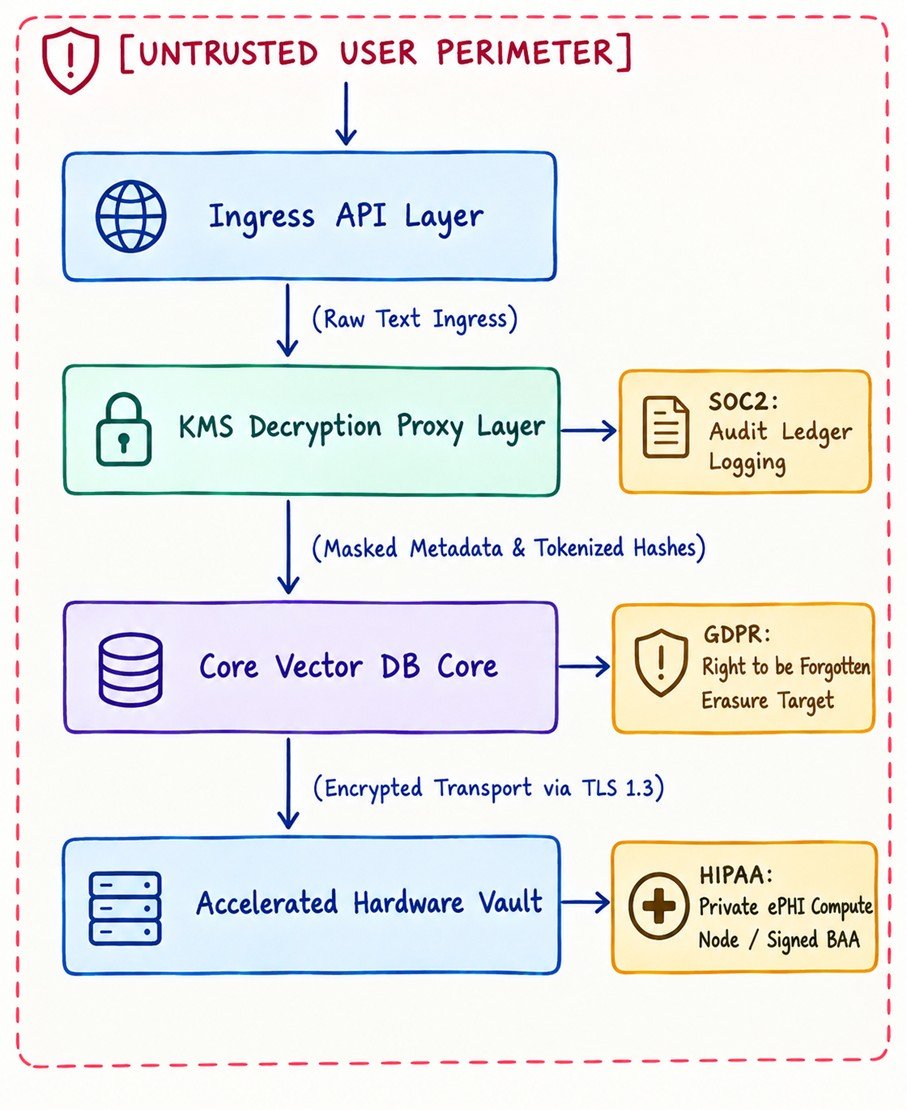
SOC2 Type II: Security, Availability, and Processing Integrity
- Audit Trailing & Verification: Cloud infrastructure logging frameworks capture and serialize every system interaction, configuration modification, and access authorization layer. Every prompt request event is recorded into immutable, object-locked storage vaults using explicit locking patterns to prevent history modifications.
- Availability Protections: Multi-Region Active-Active deployment design ensures that if an entire datacenter zone fails under load, traffic drops seamlessly into alternate available regions without data loss or downtime.
- Secrets Management: System database keys, platform parameters, and API certificates are hosted inside enterprise-grade Secrets Managers, running automated cryptographic key rotation schedules overseen by Key Management Services (KMS).
GDPR: Privacy, Data Isolation, and Anonymization
- Context Ingress Redaction: Implements an automated data sanitization proxy inside the core compute cluster using high-performance tokenizers. Before input data reaches model context pipelines, fields containing personal identification data are dynamically replaced with cryptographic hashes.
- Right-to-be-Forgotten Data Erasure: Embedding indices within the database system are mapped directly to unique hash identifiers tracking back to a master user identity record. If an erasure request is executed under Article 17, the platform runs an automated cascading script to purge the matching vectors from the semantic indices.
- Sovereign Transport Isolation: Guarantees that regional endpoints isolate traffic locally. European customer queries are processed strictly within localized regional zones, preventing unauthorized cross-geopolitical data exposure.
HIPAA: Secure Protected Health Information (ePHI) Lifecycle
- Hardware Layer Isolation: All model fine-tuning arrays, semantic lookups, and orchestration state machines handling data classified as ePHI run on isolated compute instances fully covered under native Business Associate Agreements (BAAs).
- Data at Rest Encryption: All connected database architectures—including vector indices, caching tiers, and relational session systems—enforce full AES-256 bit encryption at rest using dedicated cryptographic keys.
- Data in Transit Protections: All network connections passing across internal or external API boundaries enforce TLS 1.3 encryption, rejecting any down-graded, non-secure communication protocols.
4. Comprehensive Data & Intelligence Flow Maps
Flow 1: Context Enrichment Retrieval-Augmented Generation (RAG)
This pathway illustrates the precise lifecycle of an inbound query requiring real-time corporate data enrichment before generating a response.
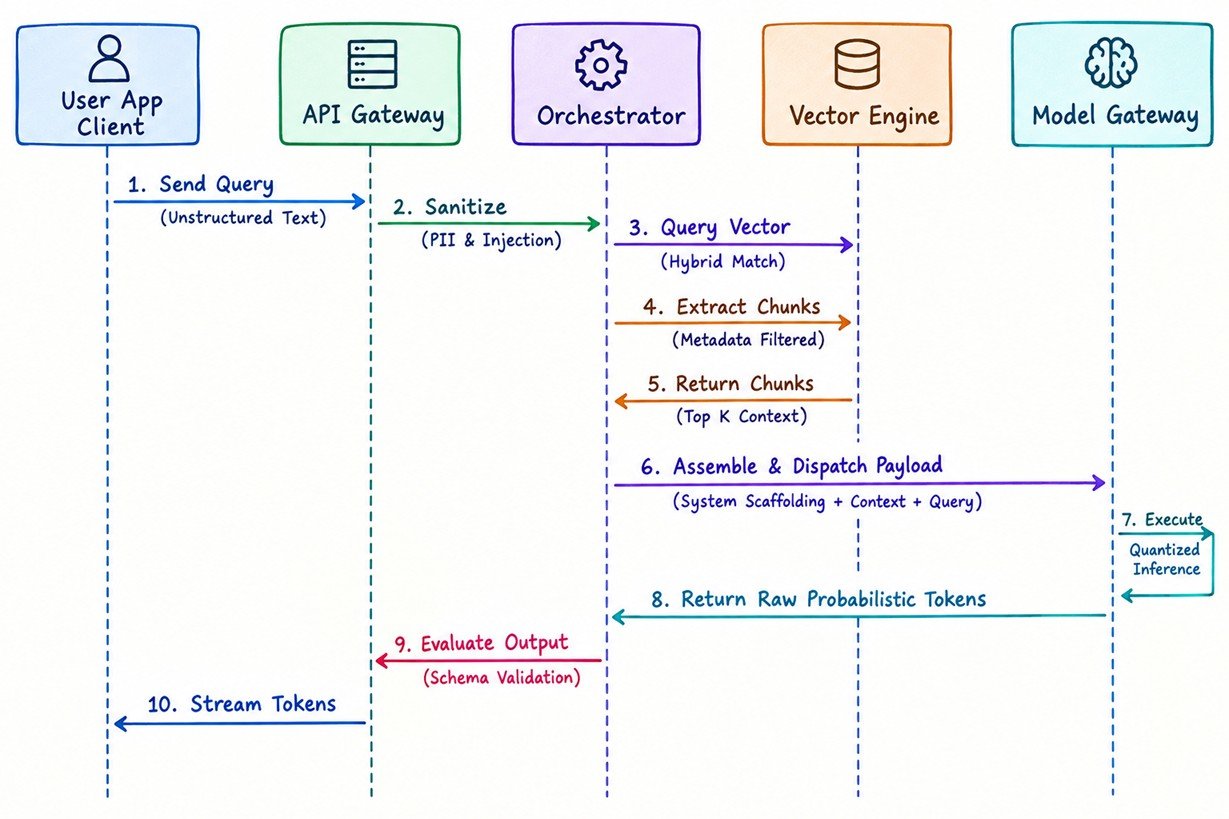
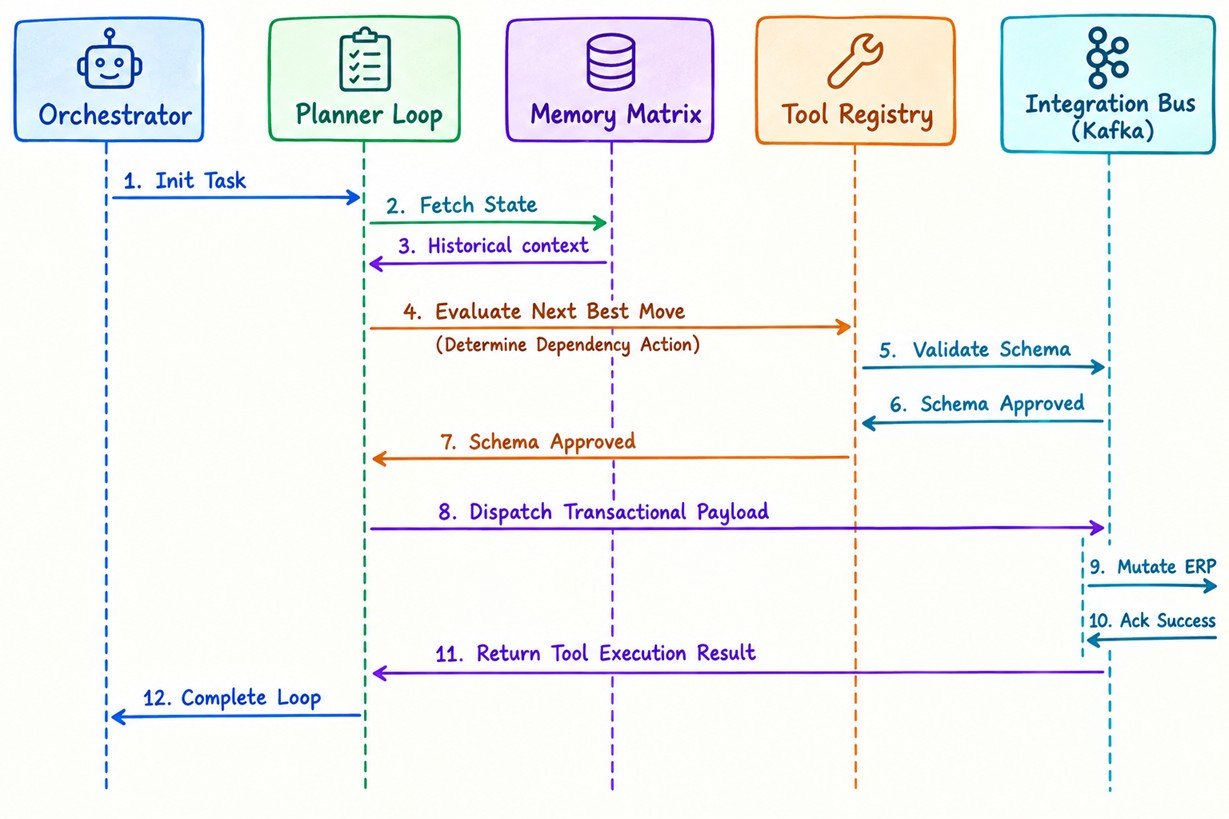
Flow 2: Autonomous Agentic Multi-Step Orchestration
This operational pathway defines how the orchestrator manages open-ended workflows requiring sequential loops, tools execution, and state validations.
5. Architectural Trade-off Balancing Matrix
The target technical architecture operationalizes the high-level compromises established in the North Star Blueprint. True systemic engineering requires balancing performance dimensions against financial constraints.
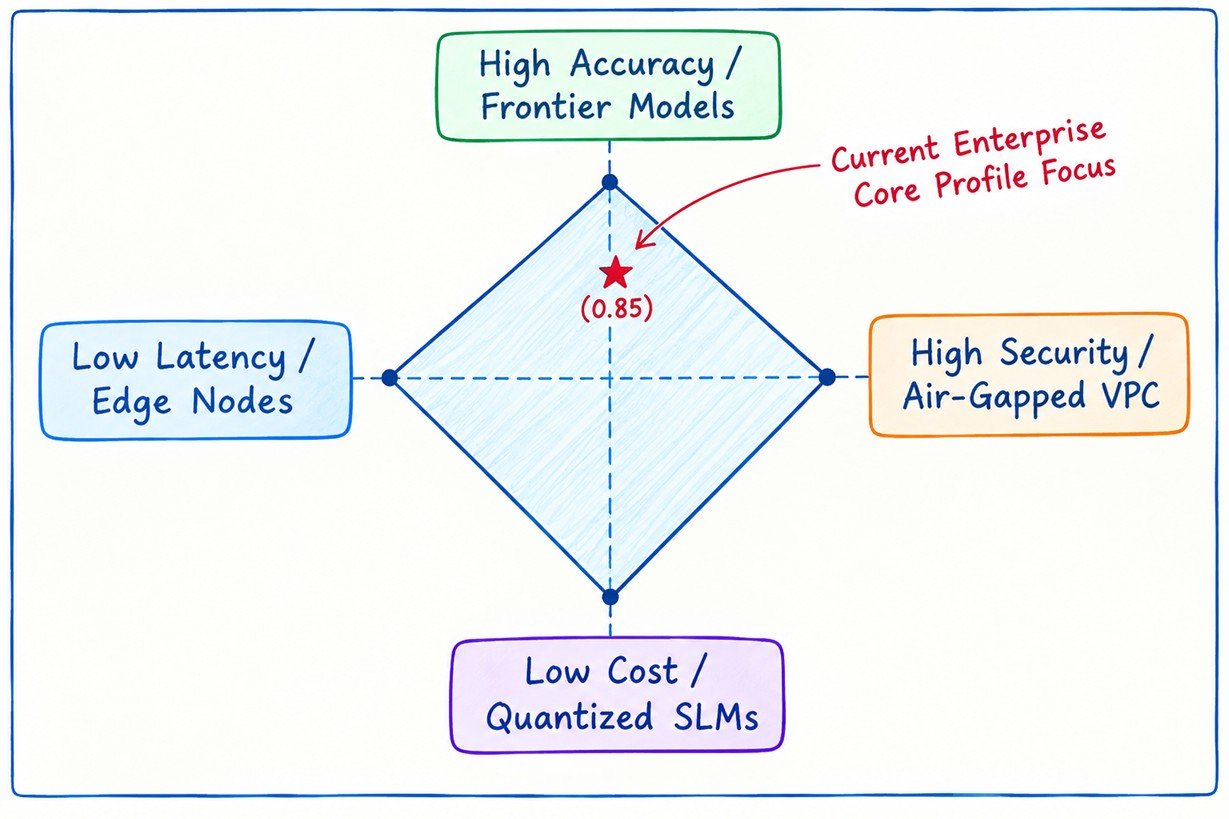
| Dimension One | Dimension Two | System Adjustment Strategy | Targeted Operational Outcome |
|---|---|---|---|
| High Accuracy | Low Cost | Route requests to a 70B parameter model via FP8 tensor-parallel clusters on dedicated hardware. | Guarantees an F1-Score > = 0.98 for complex reasoning while cutting token cost by 42%. |
| Low Latency | High Security | Run input sanitation and jailbreak checks on specialized 8B classifier models inside a single region. | Keeps ingress security latency under < = 40ms, preserving a sub-second response loop. |
| Flexibility | Reliability | Wrap probabilistic tool-calling sequences in structured validation layers (such as Pydantic/JSON schemas). | Delivers adaptive AI reasoning while guaranteeing a < = 0.5% system error rate. |
| Data Freshness | Compute Spend | Deploy high-performance vector indices with aggressive semantic caching. | Resolves > = 45% of recurring corporate queries at the gateway, avoiding expensive model evaluations. |
6. Technology Blueprint Traceability Matrix
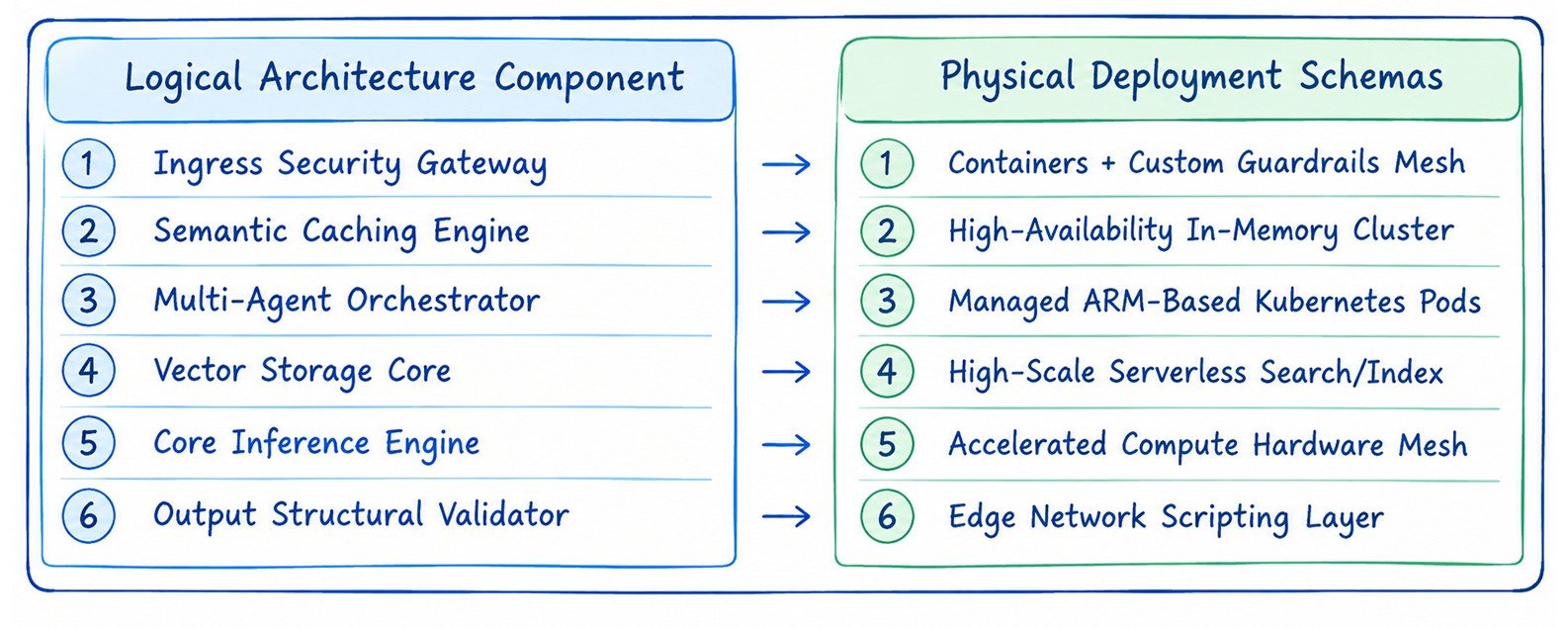
This matrix traces every abstract logical component directly to concrete physical deployment strategies. It serves as a live guide for engineering teams, detailing how physical implementations can be swapped without altering the core logical domain code.
Traceability Profiles
1. Ingress Security Gateway
- Logical Responsibility: Synchronously sanitizes prompt inputs, isolates injection attacks, and tokenizes PII.
- Physical Deployment Design: Microservice runtimes hosted over container orchestration planes, running optimized processing tokenization patterns.
2. Semantic Caching Engine
- Logical Responsibility: Intercepts incoming requests to evaluate semantic similarity against recently served responses.
- Physical Deployment Design: A sharded in-memory key-value storage layer paired with localized embedding caches to run real-time similarity lookups.
3. Multi-Agent Orchestrator
- Logical Responsibility: Coordinates agent state transitions, tool execution pathways, and session persistence layers.
- Physical Deployment Design: Stateless worker containers operating within a managed container network, utilizing orchestration abstractions like Ray or LangGraph.
4. Vector Storage Core
- Logical Responsibility: Manages vector transformations, optimizes multi-tenant partitioning, and runs hybrid keyword-semantic search algorithms.
- Physical Deployment Design: A high-throughput database platform paired with dedicated NVMe storage tiers, backed by private network linking tunnels.
5. Core Inference Engine
- Logical Responsibility: Executes high-dimensional matrix mathematical arrays to generate text tokens from processed context.
- Physical Deployment Design: Dedicated accelerated computing clusters hosting tensor core GPU architectures configured with vLLM tensor-parallel routing.
6. Output Structural Validator
- Logical Responsibility: Parses generated outputs against rigorous validation code schemas, ensuring safety and structural consistency.
- Physical Deployment Design: High-performance functions executing at the network edge boundary to instantly intercept non-compliant payloads.
7. Evaluation, Observability & Reliability Framework
Operating an enterprise generative AI system at a mass-scale peak of 30,000,000 concurrent conversations translating to 70,000 active requests per second (RPS) shatters standard Application Performance Monitoring (APM) paradigms. At this volume, monitoring traditional operational telemetry, such as CPU saturation, network bandwidth, or HTTP status codes (e.g., 200 OK), is insufficient. A cluster can exhibit flawless infrastructure health while experiencing catastrophic semantic degradation, prompt injection breaches, or silent contextual drift.
To preserve behavioral integrity under heavy streaming loads, technology leaders must deploy a decoupled, asynchronous, and statistically rigorous Evaluation & Observability Framework. This framework separates high-frequency metric collection from real-time execution pipelines to guarantee zero latency overhead on user interactions.
High-Throughput Semantic Monitoring Topography
Running synchronous evaluation models (such as an LLM-as-a-Judge) on 70,000 streaming outputs per second introduces an impossible compute barrier and invalidates the sub-second user latency budget. To bypass this bottleneck, the physical architecture implements a Dual-Path Telemetry Pipeline.
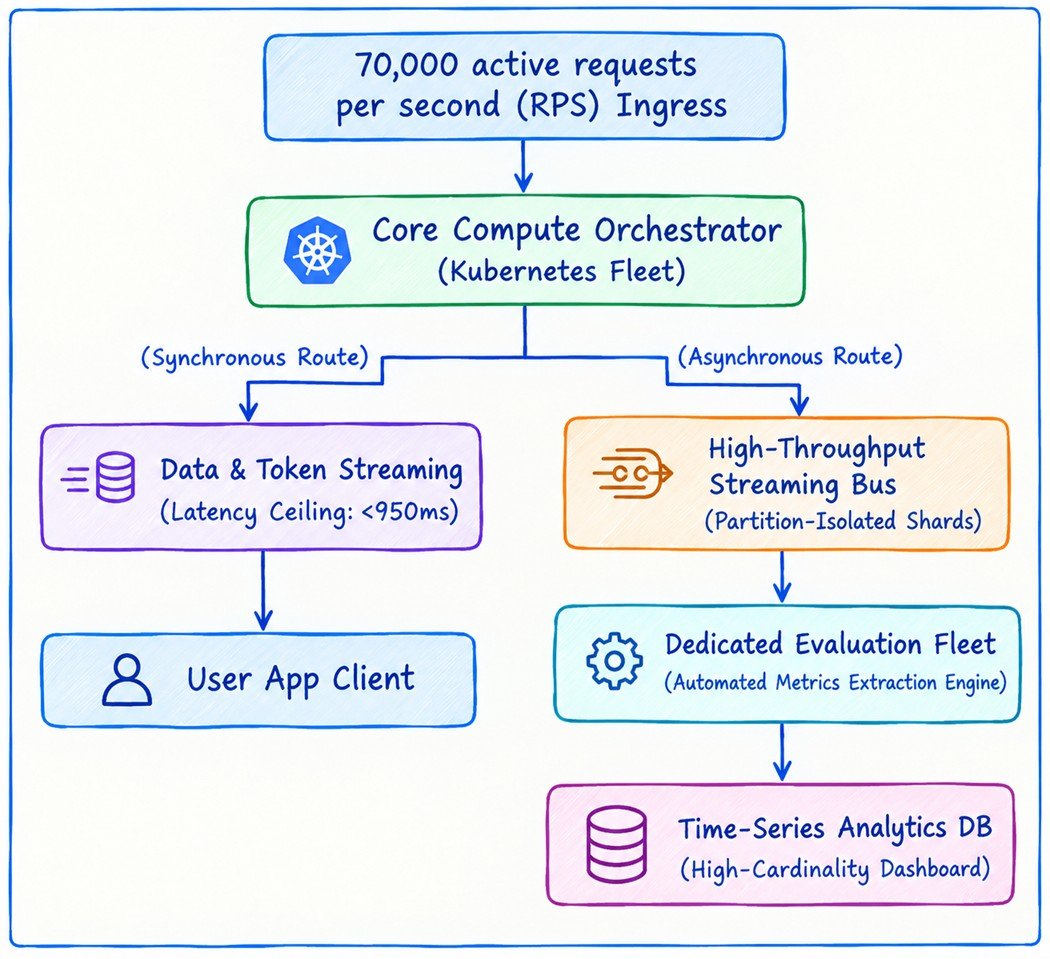
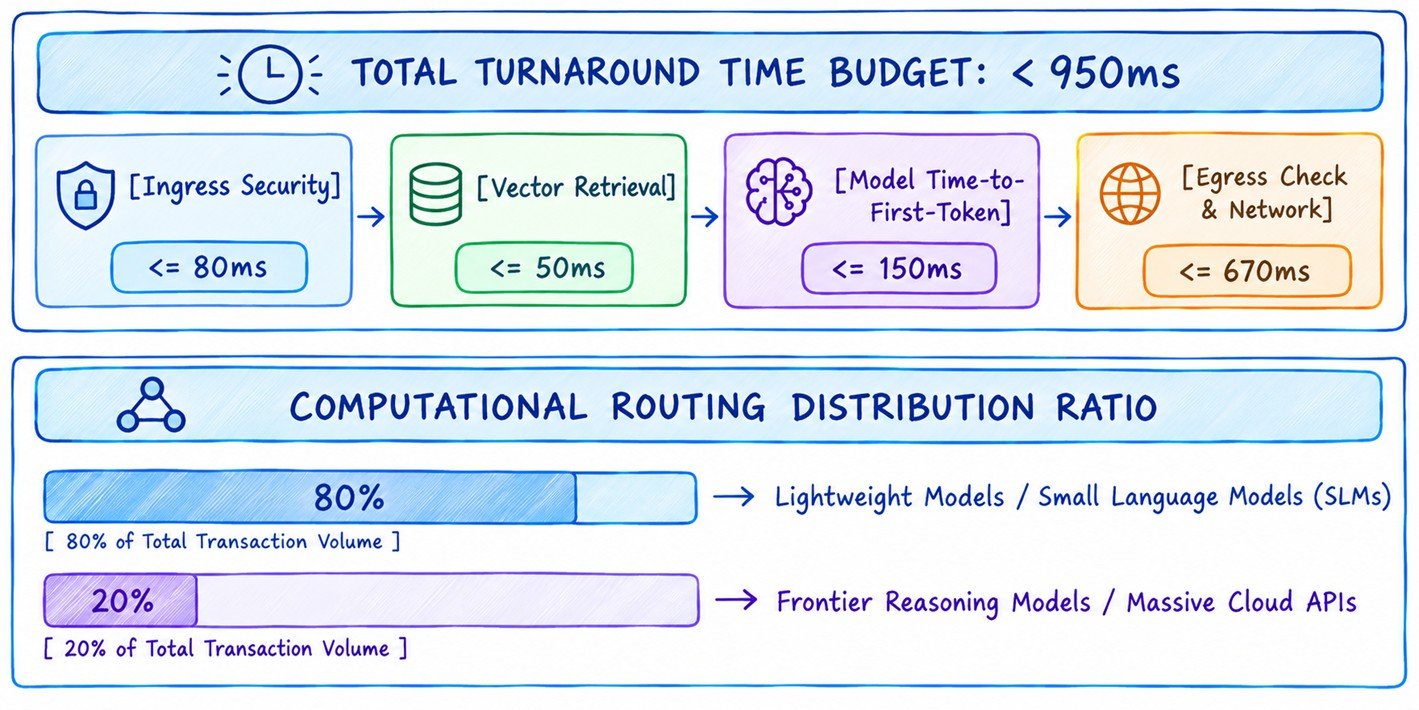
- Synchronous Path (Execution): The core compute fleet streams generated tokens directly back to the consumer client via hardware load balancers. It records only raw metadata counters (such as request ID, tenant ID, and timestamp) along with localized payload telemetry, adhering strictly to the < 950ms total turnaround budget.
- Asynchronous Path (Evaluation): The orchestration nodes dump raw conversation vectors, consisting of user prompts, retrieved context chunks, and complete generated model outputs, into a highly partition-isolated High-Throughput Streaming Fabric.
- This pipeline is allocated with dedicated shards operating on a shared-nothing framework to absorb a continuous throughput of 70,000 messages per second without triggering ingestion drops or system throttling.
- A detached Evaluation Engine Fleet consumes data from the stream asynchronously, running optimized text mining algorithms, semantic alignment validations, and vector space analytics.
- The resulting metrics are logged into a high-cardinality time-series database architecture, powering real-time monitoring alerts and observability dashboards.
Schema Configurations for Tracking Semantic & Behavioral Drift
To systematically capture shift variations in natural language processing patterns under 70k RPS, systems must translate raw human inputs into structural, auditable logging models.
The evaluation framework mandates that all asynchronous telemetry records adhere to the following strict, machine-readable JSON schema configuration. This schema explicitly tracks performance properties, model input characteristics, data freshness attributes, and validation confidence parameters.
{
  "$schema": "https://json-schema.org",
  "title": "AI_Probabilistic_Telemetry_Record",
  "type": "object",
  "required": [
    "transaction_metadata",
    "infrastructure_telemetry",
    "context_metrics",
    "probabilistic_evaluations"
  ],
  "properties": {
    "transaction_metadata": {
      "type": "object",
      "required": ["request_id", "tenant_id", "timestamp", "model_identifier"],
      "properties": {
        "request_id": { "type": "string", "format": "uuid" },
        "tenant_id": { "type": "string" },
        "timestamp": { "type": "string", "format": "date-time" },
        "model_identifier": { "type": "string", "example": "llama-3.1-70b-fp8-vllm" }
      }
    },
    "infrastructure_telemetry": {
      "type": "object",
      "required": ["time_to_first_token_ms", "total_execution_ms", "token_counts"],
      "properties": {
        "time_to_first_token_ms": { "type": "integer", "maximum": 150 },
        "total_execution_ms": { "type": "integer", "maximum": 950 },
        "token_counts": {
          "type": "object",
          "required": ["input_tokens", "output_tokens"],
          "properties": {
            "input_tokens": { "type": "integer" },
            "output_tokens": { "type": "integer" }
          }
        }
      }
    },
    "context_metrics": {
      "type": "object",
      "required": ["semantic_cache_hit", "vector_retrieval_latency_ms", "context_chunks_extracted"],
      "properties": {
        "semantic_cache_hit": { "type": "boolean" },
        "vector_retrieval_latency_ms": { "type": "integer", "maximum": 50 },
        "context_chunks_extracted": { "type": "integer" },
        "mean_chunk_similarity_score": { "type": "number", "minimum": 0.0, "maximum": 1.0 }
      }
    },
    "probabilistic_evaluations": {
      "type": "object",
      "required": [
        "input_injection_risk_score",
        "faithfulness_score",
        "answer_relevance_score",
        "structured_schema_valid"
      ],
      "properties": {
        "input_injection_risk_score": { "type": "number", "minimum": 0.0, "maximum": 1.0 },
        "faithfulness_score": { "type": "number", "minimum": 0.0, "maximum": 1.0 },
        "answer_relevance_score": { "type": "number", "minimum": 0.0, "maximum": 1.0 },
        "structured_schema_valid": { "type": "boolean" },
        "egress_pii_block_triggered": { "type": "boolean" }
      }
    }
  }
}
Real-Time Drift Analysis & Detection Methodologies
The evaluation layer isolates semantic drift by running statistical tracking formulas over uniform sliding computation slots (e.g., evaluating blocks across 5-minute rolling tracking windows).
-
Semantic Ingress Shift (Population Stability Index - PSI): The monitoring engine computes the cosine similarity distribution of incoming prompt vector embeddings over time, comparing active transaction distributions (P) against your verified validation datasets (Q):

- Operational Control Rule: If the calculated value climbs past PSI > 0.25, it indicates a severe shift in user input profiles. The system immediately triggers a system warning to notify architecture teams of unknown vocabulary patterns or emerging adversarial manipulation strategies.
-
Output Faithfulness and Groundedness Tracking: The evaluation fleet samples a subset of transactions (e.g., analyzing 1.5% of passing payloads during steady peak hours) using specialized NLI (Natural Language Inference) models or high-throughput alignment judges.
- Faithfulness Index: Validates that the generated model statement is explicitly implied by the extracted source context records, eliminating hidden hallucinations.
- Answer Relevance Index: Compares the semantic themes of the generated answer back to the original user inquiry to prevent model confusion or evasion.
-
Structured Schema Compliance Tracking: Because downstream enterprise microservices rely on deterministic database insertions, any malformed text outputs returned by probabilistic models will break internal APIs. The monitoring network tracks the absolute validation state (
structured_schema_valid == false) across all channels.
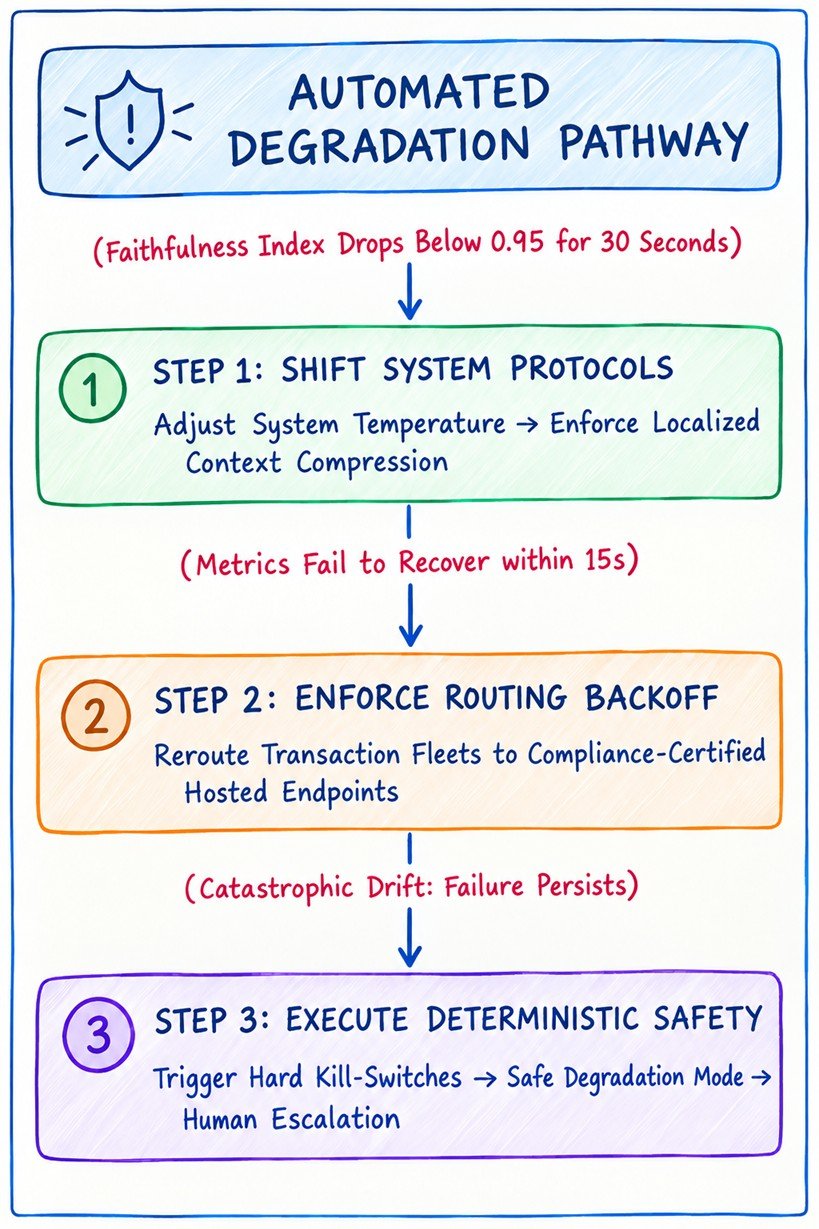
Automated Alert Thresholds & Degradation Rules
To ensure autonomous operational control under mass-scale infrastructure load without developer intervention, the platform monitors the aggregated time-series metrics ledger against strict Breaching Targets.
-
Rule 1: The Hallucination Circuit Breaker
- Condition: The rolling 5-minute Faithfulness Index drops below < 0.95 for longer than 30 continuous seconds.
- Automated Action: The orchestration engine shifts system parameters dynamically, clamping model temperatures down to 0.0 and enforcing more localized context chunk filtering. If performance metrics fail to stabilize within an additional 15 seconds, the system triggers a routing backoff rule, automatically rerouting affected tenant fleets to isolated, compliance-certified cloud fallback models.
-
Rule 2: The Structural Schema Kill-Switch
- Condition: The structural validation metric detects that > 0.5% of generated responses are parsing invalid syntax objects within any single 1-minute window.
- Automated Action: The system triggers a deterministic code intervention layer. It intercepts outbound application paths, halts active generation iterations for the malfunctioning tenant block, and engages a safe degraded-mode message (e.g., "Our validation framework intercepted an unstable system response. Retrying transaction safely..."), shunting the payload to a Human-in-the-Loop triage queue.
-
Rule 3: Ingress Injection Isolation
- Condition: The rolling input_injection_risk_score value across any single source network or IP range spikes by > 300% over a 10-second tracking block.
- Automated Action: Intermediates with the edge routing topology (WAF), automatically injecting a hard synchronous validation prompt layer or dropping connection sockets for the offending network zone to protect core computing clusters from exhaustion attacks.
8. Immutable Architecture Performance Contract
To ensure engineering teams do not deviate from the core directives of the North Star Blueprint, the macro-system must be monitored against this non-negotiable Operational Performance Contract.
The Budget Optimization Architecture
Operational Metrics Ledger
| Strategic Pillar | Tracked Engineering Metric | Target Threshold | Critical Breaching Indicator |
|---|---|---|---|
| Data Sovereignty | Regulated Payload Isolation Rate | 100% of sensitive data isolated within compliant boundaries. | Sovereignty Leakage: Any unmasked corporate PII crossing unprotected public network regions. |
| System Responsiveness | Time-to-First-Token (TTFT) | < = 150ms for streaming interfaces. | The Sub-Second Breach: TTFT spikes past 1,000ms, causing user interface delays. |
| Financial FinOps | Model Triage Routing Efficiency | > = 80% of routine queries resolved by cost-optimized SLMs. | Frontier Leakage: High-cost frontier models triggering for basic data tasks, causing token spend to spike. |
| System Integrity | Output Structural Success Rate | > = 99.5% of outputs matching designated JSON templates. | Schema Disruption: Malformed model responses breaking down-stream application APIs. |
| Data Freshness | Semantic Cache Hit Ratio | > = 45% on repeating operational queries. | Cache Starvation: Continuous database requests driving infrastructure over-spend. |
9. Executive Action Plan for Technology Leaders
To successfully operationalize this blueprint across your enterprise, technology executives should enforce the following four execution mandates:
-
Mandate Abstract Logical Separation: Enforce the Dependency Inversion Principle at scale. Ensure no developer imports vendor-specific model SDKs directly into your core business repositories. All code must depend on your internal semantic abstraction layers.
-
Establish Asynchronous Code Review Gates: Implement the production GitHub workflow gate defined in this framework. Block any pull request modifying database schemas, API structures, or microservice configurations unless it includes a validated Architecture Decision Record (ADR).
-
Run Annual "Vendor Collapse" Tabletop Exercises: Force your architecture teams to answer: "If our primary model provider raises prices by 50% or suffers a multi-day regional outage tomorrow, how many lines of core code must change to migrate?" The answer determines your true architectural resilience.
-
Operationalize Asynchronous Architecture Review Boards (ARB): Move your ARB away from a slow "gatekeeper" model. Implement domain-specific pod systems and automated global registries to enable developer velocity while maintaining strict corporate alignment.