Human-in-the-loop vs. human-on-the-loop
As enterprises rapidly transition from pilot projects to production-grade artificial intelligence systems, establishing robust governance models for AI-driven decisions is paramount. Technology leaders including CTOs, VPs, Heads of AI, and Enterprise Architects must treat human oversight not merely as a compliance checklist, but as a core architectural design pattern.
The chosen oversight model directly governs system reliability, liability exposure, operating costs, and throughput constraints. The two primary paradigms driving enterprise AI governance are Human-in-the-Loop (HITL) and Human-on-the-Loop (HOTL). Choosing between them requires a calculated trade-off between the cost of error and the velocity of execution.
1. Human-in-the-Loop (HITL): The Gatekeeper Paradigm
Architectural Pattern & Core Definition
The Human-in-the-Loop (HITL) model enforces synchronous oversight. The AI system acts as a sophisticated recommendation engine, but it is explicitly blocked from executing actions in production or downstream environments independently. Every single token, decision, or output generated by the model must route through a mandatory human validation interface. The human operator evaluates the context, verifies the accuracy, and triggers the final execution command. In this configuration, the human acts as the final firewall.
High-Stakes Target Environments
HITL is non-negotiable in zero-tolerance environments where model failure, hallucination, or algorithmic bias can result in physical harm, severe financial loss, legal liability, or structural reputational damage.
- Medical Diagnostics and Treatment: AI models can analyze radiologic scans or suggest patient-specific medication dosages, but a licensed physician must review and approve the recommendation before patient delivery.
- Algorithmic Trading & High-Value Capital Allocation: While automated systems flag market anomalies or propose multi-million dollar asset reallocations, executive human clearance is required to execute trades above specific risk thresholds.
- Automated Legal and Regulatory Filings: AI can draft contracts, compliance briefs, or regulatory disclosures, but legal counsel must manually verify every clause before submission to state bodies or courts.
Strategic Trade-offs: Safety vs. Velocity
The primary advantage of HITL is the near-total mitigation of catastrophic model failures. By positioning an expert at the inflection point of execution, organizations capture the speed of AI generation alongside the nuanced judgment of human reason.
However, this pattern introduces severe operational constraints. HITL inherently caps system throughput at the speed of human processing. It creates linear cost scaling; as transaction volumes increase, organizations must hire more human reviewers, eliminating the traditional marginal cost benefits of software automation. Furthermore, human fatigue during repetitive review cycles can lead to rubber-stamping, which inadvertently undermines the safety profile of the system.
2. Human-on-the-Loop (HOTL): The Supervisor Paradigm
Architectural Pattern & Core Definition
The Human-on-the-Loop model operates via asynchronous oversight. The AI model is granted the autonomy to ingest data, reason, decide, and execute transactions directly into production environments without real-time human intervention. The human operator is elevated to a supervisory or auditing role. Instead of approving every transaction, humans monitor the system’s health in real-time via telemetry dashboards, review post-execution exception logs, and intervene only when anomalous behavior or low-confidence outcomes occur.
High-Volume, Low-Risk Target Environments
HOTL is optimized for scenarios demanding immense scale, where the cost of an individual error is negligible or easily reversible, and where human-speed processing would cripple business operations.
- Enterprise Content Moderation: Social platforms and community forums process millions of uploads per minute. AI models automatically flag and remove violative content, while human reviewers handle complex appeals or edge cases captured in an exception log.
- Infrastructure Log Analysis & Threat Detection: Security Operations Centers (SOCs) deploy HOTL to ingest terabytes of system logs. The AI automatically isolates compromised nodes or blocks suspicious IPs, while engineers audit the system’s automated actions via retrospective reports.
- Draft Email & Customer Support Generation: For non-billing or low-tier support issues, AI agents resolve queries instantly. Human managers sample conversation transcripts to refine model prompts and assess customer satisfaction trends.
The Critical Role of Automated Guardrails
Operating a HOTL model without sophisticated automated safety nets is a critical architectural failure. Because execution is autonomous, organizations must implement multi-layered validation layers:
- Determinism Gateways: Programmatic validation layers (e.g., regex, schema validators, hardcoded business logic) that check model outputs for structural integrity before execution.
- Confidence Score Thresholding: The system evaluates the model’s internal probability score. If a decision falls below a 95% confidence interval, the architecture dynamically routes the transaction out of the HOTL pipeline and elevates it to a HITL queue for manual review.
- Anomalous Volume Tripping: Circuit breakers that halt the entire autonomous system if execution patterns deviate from statistical norms (e.g., if an automated support bot suddenly issues a massive volume of refunds).
Architectural Comparison Matrix
| Architectural Dimension | Human-in-the-Loop (HITL) | Human-on-the-Loop (HOTL) |
|---|---|---|
| Execution Mode | Synchronous | Asynchronous |
| Primary Value Metric | Risk Minimization / Accuracy | Operational Throughput / Scalability |
| Bottleneck Component | Human Reviewer Availability | Guardrail and Telemetry Design |
| Cost Scaling Model | Linear (Variable cost scales with volume) | Sub-linear (High fixed design cost, minimal variable cost) |
| Failure Surface | Human fatigue / Blind approval | Systemic, rapid propagation of cascading errors |
3. Engineering a Hybrid: Dynamic Escalate-to-Human Architecture
For enterprise architects, the optimal design is rarely a pure selection of one model over another. The gold standard of AI governance is a dynamic framework that shifts fluidly between HITL and HOTL based on real-time risk telemetry.
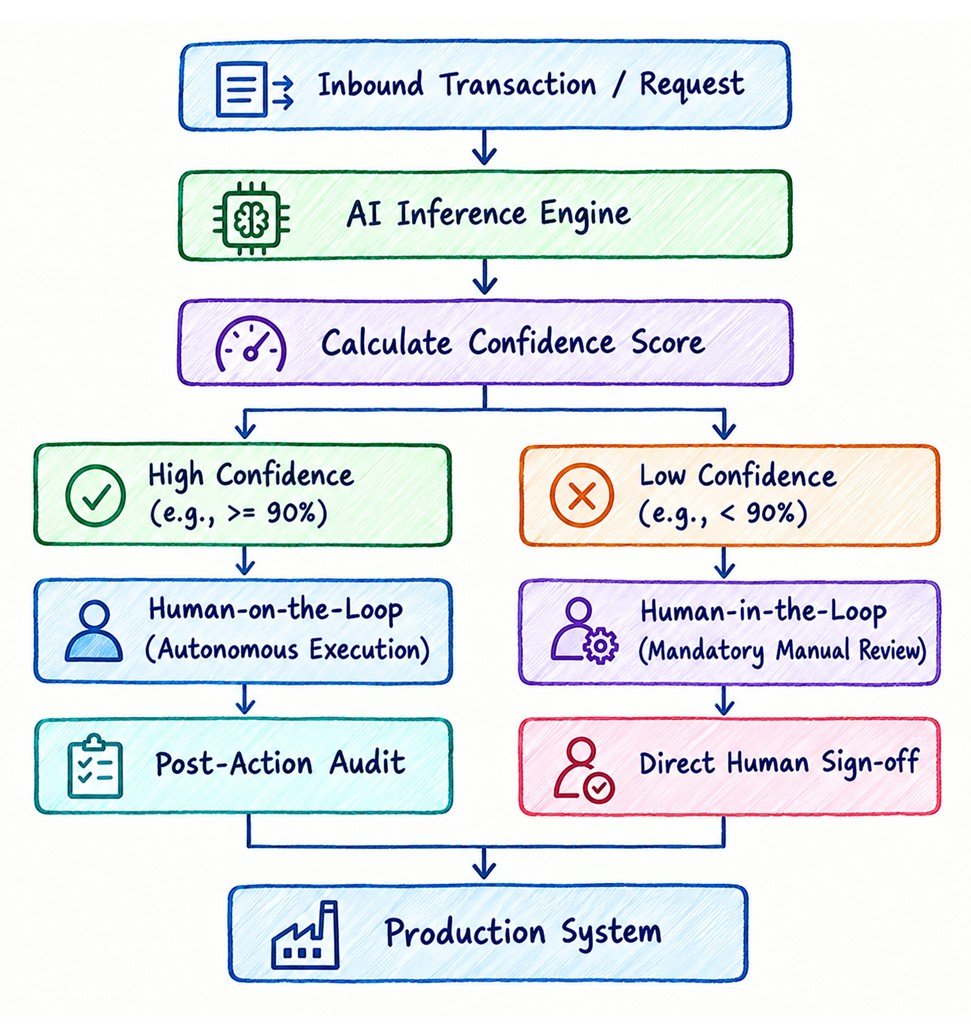
By engineering an internal routing engine driven by confidence scoring and financial or legal thresholds, technology leaders can deploy HOTL to absorb 90% of routine corporate workflows while automatically fallback-routing the remaining complex, high-risk 10% to a secure HITL queue. This approach ensures maximum scalability without compromising enterprise risk perimeters.