AI Product Vision Canvas
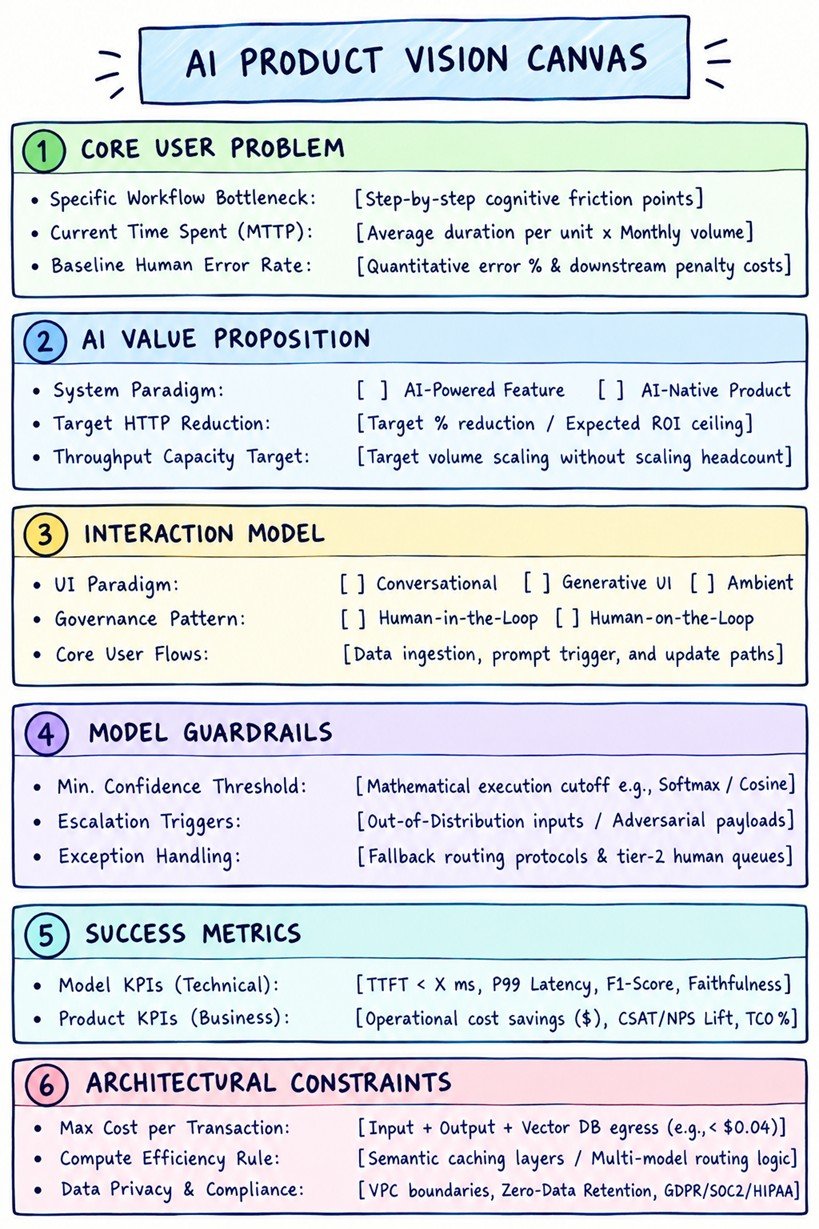
The AI Product Vision Canvas is the foundational blueprint that aligns business strategy, user experience, and technical architecture. This canvas must be finalized before selecting your technical stack or writing the first line of code. It enforces rigorous boundary definitions for the AI system, prevents catastrophic scope creep, and ensures that the engineering team builds against concrete, quantifiable business outcomes rather than speculative capabilities.
1. Core User Problem
AI systems fail when they are built as solutions in search of a problem. This block establishes the exact operational reality of the current state, ensuring the engineering team understands the financial and operational drag of the status quo.
Specific Workflow Bottleneck
-
Micro-Step Mapping: Deconstruct the exact phase of the existing lifecycle where cognitive overload or friction occurs. Avoid broad definitions like "the team spends too much time on reporting." Instead, isolate it: "Step 4 of the underwriting process requires manual cross-referencing of handwritten 10-K PDFs against unstructured financial tables."
-
Cognitive Load Classification: Identify if the bottleneck is due to data volume (too much information to parse), data velocity (information arriving faster than human processing speed), or data complexity (requiring rare, highly specialized domain expertise).
Current Time Spent on the Manual Task
-
Mean Time to Process (MTTP): Establish the exact average duration (in minutes or hours) an individual contributor spends executing a single unit of work.
-
Volume/Scale Multipliers: Multiply the MTTP by the average monthly volume of transactions to compute the aggregate organization-wide time sink (e.g., 14.5 hours/ticket × 1,200 tickets/month = 17,400 manual hours/month).
Baseline Human Error Rate
-
Quantitative Error Metrics: Quantify the frequency of human mistakes under the current paradigm (e.g., a 4.2% error rate in data entry or a 12% omission rate in compliance checks).
-
Downstream Cost of Error: Detail the direct financial, legal, or operational penalties incurred when these errors escape into production (e.g., compliance fines, customer churn, or engineering hours spent on remediation).
2. AI Value Proposition
This block defines the fundamental nature of the product architecture and sets clear, non-negotiable performance targets for the engineering and data science teams.
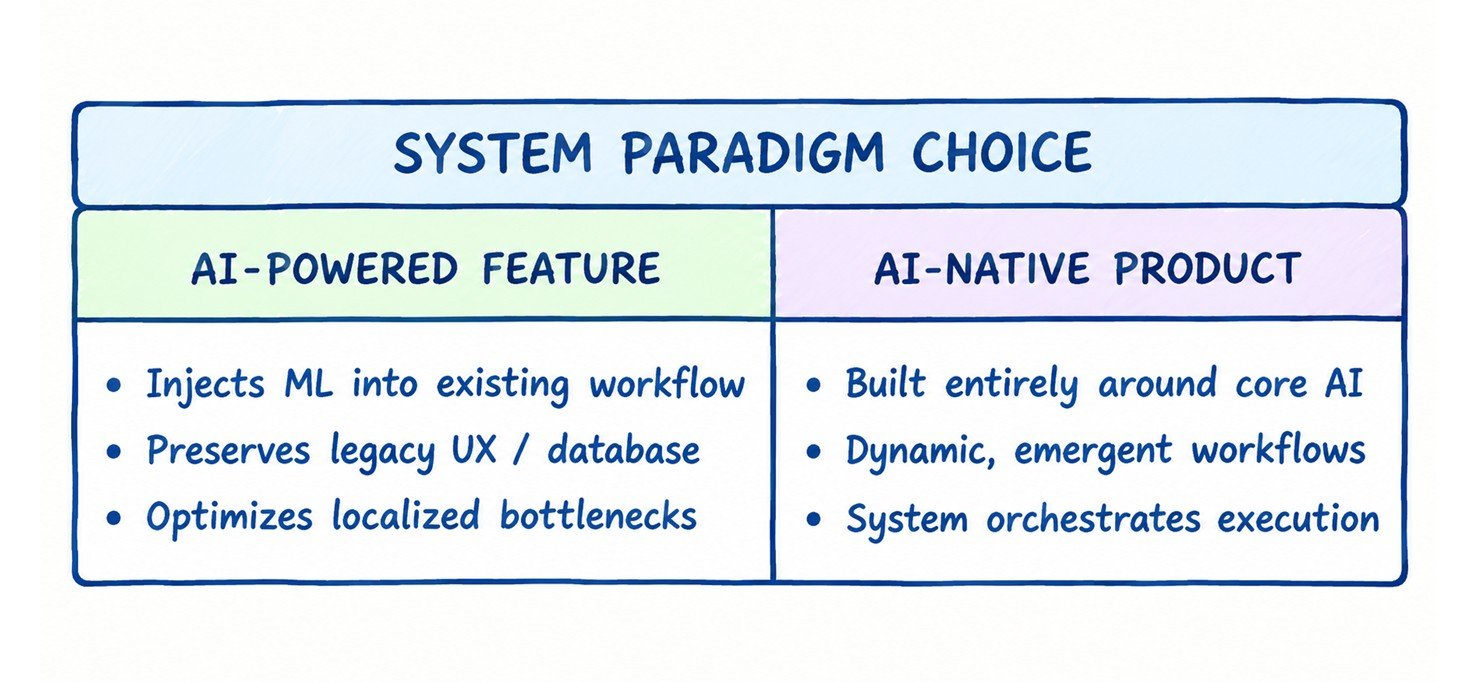
System Paradigm (Feature vs. Native)
-
AI-Powered Feature: The AI is injected into an established legacy software workflow. It replaces or optimizes a localized step (e.g., adding an autocomplete or text-summarization box inside an existing CRM system) without fundamentally changing the underlying database schema or user journey.
-
AI-Native Product: The entire product architecture is built from the ground up around the capabilities and limitations of AI. The user interface, data ingestion pipelines, and business logic are dynamic and emergent. Without the AI model, the product cannot function or exist (e.g., an autonomous agent that acts as a virtual employee, dynamically self-correcting its own execution loops).
Target Reduction in Task Completion Time
-
Contractual Efficiency Gains: Define the explicit percentage reduction in MTTP the system must deliver to justify its total cost of ownership (TCO) and research and development (R&D) capital expenditure (e.g., an 80% reduction in document review time).
-
Throughput Capacity Scaling: Define the anticipated increase in volume capacity without increasing human headcount (e.g., scaling transaction processing from 100 units/day to 5,000 units/day).
3. Interaction Model
The interaction model dictates the system's runtime governance, user experience architecture, and safety bounds. It determines how control loops are managed between humans and machines.
User Interface Paradigm
-
Conversational / Natural Language (Chat):
Best suited for open-ended discovery, complex reasoning exploration, and ad-hoc reporting. Requires deep guardrails against prompt injection and unstructured output handling.
-
Intent-Driven / Generative UI:
The system dynamically renders structural UI elements (tables, charts, forms, buttons) on the fly based on the user's inferred intent, minimizing open-ended typing and standardizing API calls.
-
Ambient / Invisible AI:
The AI operates quietly in the background without a dedicated chat interface, observing data streams or user logs, and injecting structured recommendations or executing automated background tasks directly within traditional UI components.
Governance Patterns
-
Human-in-the-Loop (HITL):
The AI operates strictly as an advisory system. It processes data and generates a draft or recommendation, but cannot commit changes to production or external APIs without explicit human authorization. This pattern is mandatory for high-stakes domains (legal, medical, core financial transactions).
-
Human-on-the-Loop (HOTL):
The AI operates autonomously at runtime, executing tasks and calling external APIs end-to-end. A human supervisor monitors an asynchronous telemetry dashboard, reviewing execution logs, and stepping in only to override errors or handle anomalies. This pattern is designed for high-velocity, lower-risk operations (e.g., high-volume ad bidding, automated log analysis).
4. Model Guardrails
Guardrails translate your corporate risk tolerance into algorithmic constraints and real-time execution logic.
Minimum Acceptable Confidence Score
-
Autonomous Execution Threshold: Establish the strict mathematical cutoff (e.g., cosine similarity, softmax probability score, or a custom ensemble validation metric) required for the system to act without human oversight.
-
Dynamic Routing: If the model's internal confidence score drops even 0.01 below this threshold, the execution path must branch instantly into an escalation queue.
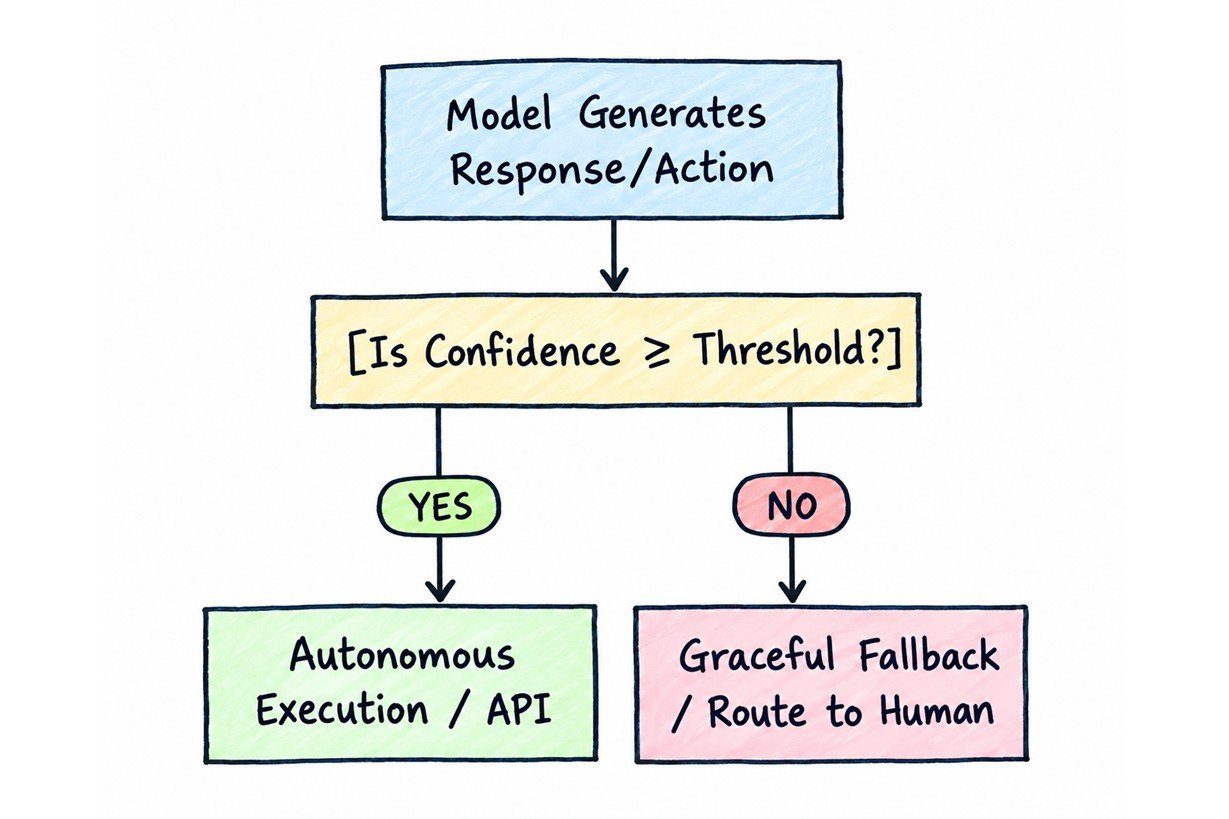
Explicit Triggers for Human Escalation
-
Out-of-Distribution (OOD) Inputs: Define the specific data patterns, structural file types, or unmapped edge cases that the model is forbidden from processing autonomously.
-
Toxic/Adversarial Payloads: Programmatic detection of jailbreaking attempts, prompt injection, or linguistic vectors designed to bypass safety boundaries.
-
Sentiment or Frustration Thresholds: In user-facing systems, real-time linguistic indicators of extreme customer dissatisfaction or circular confusion must trigger a silent, immediate handoff to a human Tier-2 support team.
5. Success Metrics
A successful AI product balances traditional business value with the unique, highly volatile realities of stochastic machine learning infrastructure.
Model KPIs (Technical Health)
-
Time-to-First-Token (TTFT): The maximum allowable milliseconds between a user submitting a request and the first stream of text rendering on screen (e.g., TTFT < 350ms).
-
End-to-End Latency / P99 Latency: The absolute time envelope for a complete transaction loop.
-
Output Accuracy & Alignment Metrics: Explicit evaluation metrics suited to the architecture, such as ROUGE/BLEU scores for summarization, F1-scores for classification, or custom LLM-as-a-judge evaluation frameworks evaluating faithfulness, relevance, and hallucination rates.
Product & Business KPIs (Financial Health)
-
Operational Cost Savings: The measurable financial delta between human-centric execution costs and AI infrastructure runtime costs.
-
Net Promoter Score (NPS) / CSAT Lift: The direct impact of the AI's speed and availability on the end-user experience.
-
System TCO Alignment: Tracking the system's inferencing cost reduction curve against user growth to guarantee margin expansion over time.
6. Architectural Constraints
Architectural constraints represent the hard boundary walls of your system. They dictate the feasibility of the project and protect the enterprise from financial and legal liabilities.
Maximum Allowable Token/Compute Cost per Transaction
-
Unit Economics Ceiling: Define the maximum financial cost allowed for a single API call or user interaction.
- Example: Total cost of input + output tokens + Vector DB reads/writes must not exceed $0.04 per document processed.
-
Caching & Routing Policies: Document the mandatory use of semantic caching layers (e.g., Redis VL) and dynamic model routing.
- Route simple requests to a small, fine-tuned open-weight model.
- Reserve frontier LLMs exclusively for highly complex reasoning tasks.
- The objective is to protect system margins and maintain predictable operating costs.
Strict Data Privacy & Compliance Boundaries
-
Data Transit Regulations: Document whether data can leave your localized tenant.
- Specify constraints regarding third-party APIs.
- Define when self-hosted, open-weight models within a private Virtual Private Cloud (VPC) are required.
-
Zero-Data Retention (ZDR) & Training Opt-Outs: Establish legal and technical mechanisms ensuring that consumer or enterprise data is never ingested into public foundational training datasets.
-
Regulatory Compliance Frameworks: Explicitly list the security standards that the AI data pipeline must inherit and maintain at every hop, including:
- HIPAA
- GDPR
- SOC 2 Type II
- FedRAMP
AI Product Vision Canvas