AI-powered features vs. AI-native products
For technology leaders such as CTOs, VPs, Directors, Heads of AI, and Enterprise Architects, navigating the current technological landscape requires a stark, uncompromising distinction between two product archetypes: AI-Powered Features and AI-Native Products.
Misclassifying these archetypes is one of the most expensive mistakes an organization can make. Treating a feature as a product leads to over-engineered, cost-heavy infrastructure. Conversely, treating a native product as a mere feature results in fragile, unscalable systems that collapse under production conditions.
This guide serves as an architectural blueprint and strategic framework for making this distinction and execution clear.
The Core Structural Distinction
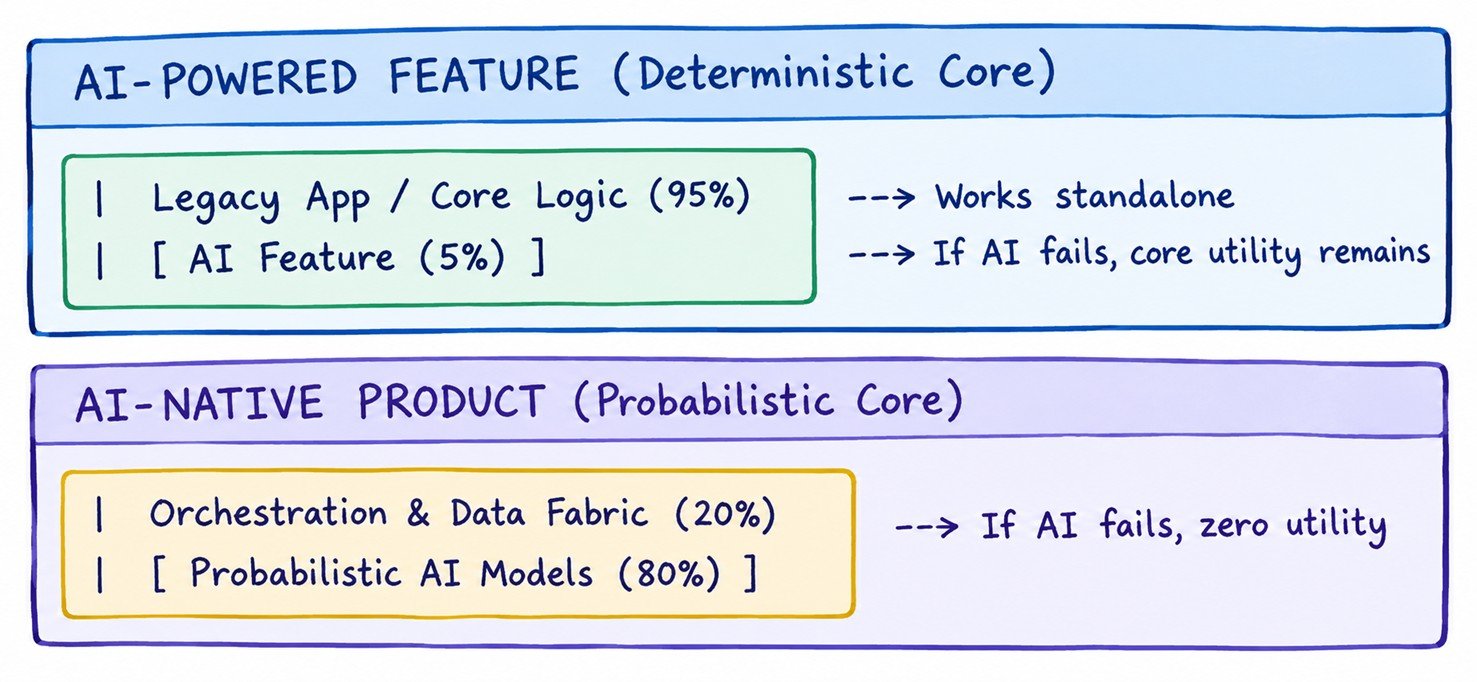
1. AI-Powered Features: Evolutionary Intelligence
AI-powered features inject intelligence into existing, deterministic software. They are additive, not foundational. The underlying application operates on hard-coded business logic, structured databases, and predictable user flows. The AI component acts as a layer of convenience or optimization.
- Core Characteristic: The system is fundamentally deterministic.
- The Baseline Test: If the AI model goes completely offline, does the user still receive 90%+ of the application's core value? If yes, it is a feature.
- Real-World Examples:
- Smart Compose / Autocomplete in a text editor (e.g., Google Docs). If the model fails, the user can still type, save, and export documents.
- Lead Scoring / Semantic Search Filters in a CRM (e.g., Salesforce). If the scoring engine drops, sales representatives can still manually log calls, view pipelines, and query data.
2. AI-Native Products: Revolutionary Architecture
AI-native products are built from the ground up assuming that probabilistic models are the primary engine of value creation. They do not merely consume AI; they are wrapped around AI. The core value proposition is entirely emergent, relying on the model's ability to reason, synthesize, and act autonomously.
- Core Characteristic: The system is fundamentally probabilistic.
- The Baseline Test: If the AI model goes offline, is the application rendered completely useless, offering zero utility? If yes, it is an AI-native product.
- Real-World Examples:
- Autonomous Coding Agents (e.g., Devin, advanced GitHub Workspace pipelines). Without the underlying LLM/reasoning engine, the agent cannot parse context, write code, run tests, or debug errors.
- Automated Legal Contract Review Systems. Systems designed to autonomously ingest thousand-page documents, redline liabilities, and map regulatory compliance across jurisdictions. Without the model, there is no software.
Comprehensive Executive Comparison
| Strategic Dimension | AI-Powered Feature | AI-Native Product |
|---|---|---|
| Core Dependency | Deterministic application logic. Traditional codebases (Java, Python, TypeScript) and relational/NoSQL databases drive the primary state. | Probabilistic AI models. Large Language Models (LLMs), Vision Models, Diffusion models, and fine-tuned domain-specific foundational systems drive the primary state. |
| Failure Impact | Reduced user convenience. The UX degrades gracefully. The user experiences a minor annoyance but completes their primary workflow. | Total system utility loss. The system encounters catastrophic failure. The interface has nothing to display; the workflow halts immediately. |
| Architecture | Standard API integration. Simple REST/gRPC endpoints calling external LLMs or localized, lightweight inference engines. | Multi-agent orchestration pipelines. Event-driven architectures, autonomous loop control, state machines, and dynamic routing engines. |
| Data Requirement | Low contextual payload. Minimal context window consumption. Passing a few lines of text or specific database records to get a deterministic response. | Massive ingestion and retrieval layers. Complex vector spaces, graph databases, hybrid search systems, and real-time streaming ETL pipelines. |
| Cost & Unit Economics | Predictable & Marginal. Minor incremental cost per API call. Easily budgeted within existing SaaS margin structures. | Volatile & Compute-Heavy. High token consumption, GPU provisioning requirements, continuous embedding updates, and expensive agent execution loops. |
| Development Risk | Minimal. Short development cycles. Standard QA processes apply since the edge cases are bounded by the deterministic application wrapper. | High & Unbounded. Emergent behaviors, hallucination mitigation, prompt drift, non-deterministic outputs, and continuous regression testing are required. |
Architectural Deep Dive & Strategy
Designing for AI-Powered Features
When building AI-powered features, your goal is isolation and minimal footprint. You must protect the core application from the instability of AI systems.
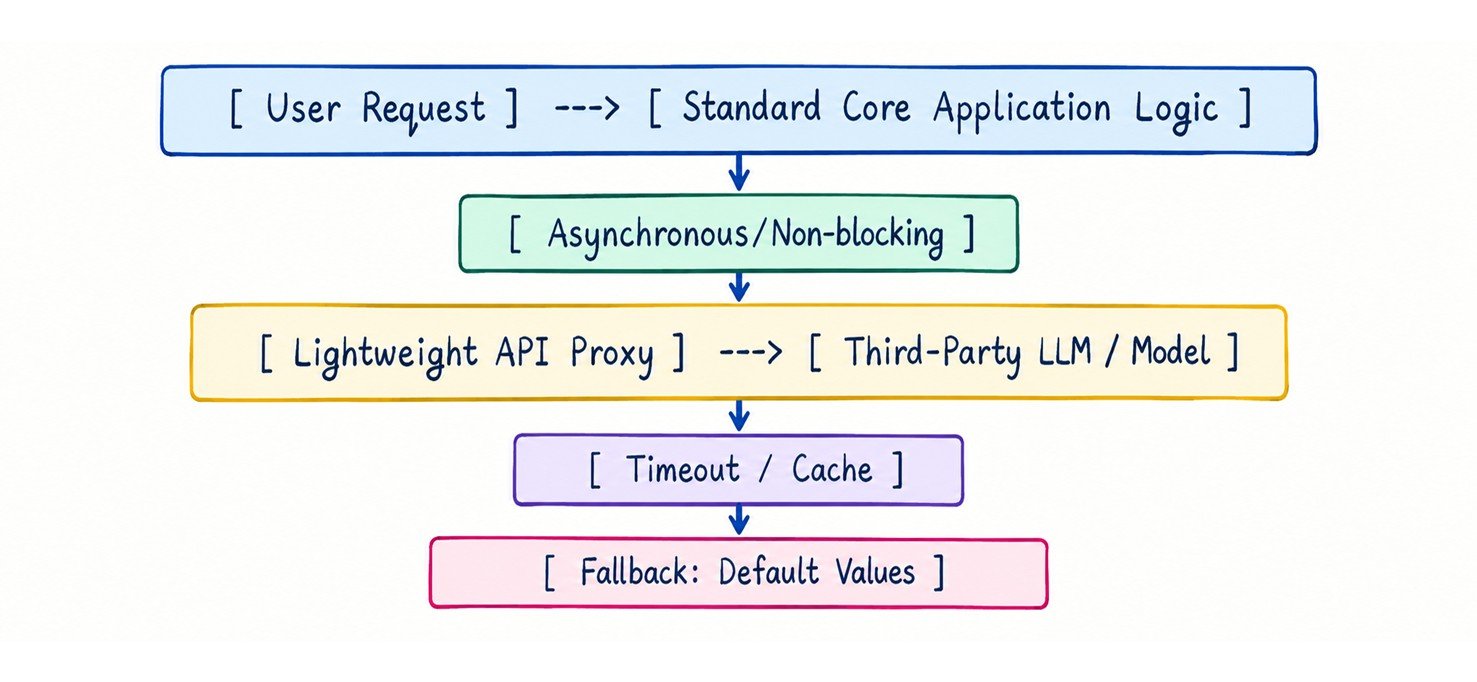
- Decoupled Integration: Treat the AI engine as an untrusted third-party service. Use asynchronous queues (e.g., RabbitMQ, Kafka) or non-blocking API calls so that if the AI times out or returns an error, the main UI thread remains completely unaffected.
- Deterministic Fallbacks: Always hardcode default behaviours. If a semantic search engine fails to return vector matches, instantly fall back to standard keyword matching (SQL LIKE or Elasticsearch lexical queries).
- Lightweight Caching: Implement simple Redis layers to cache common AI responses based on exact or near-exact string matches of input payloads, protecting against unnecessary token spend.
Designing for AI-Native Products
Building AI-native products requires an entirely different architectural paradigm. You are no longer building software that uses AI. You are building a runtime platform for probabilistic behavior.
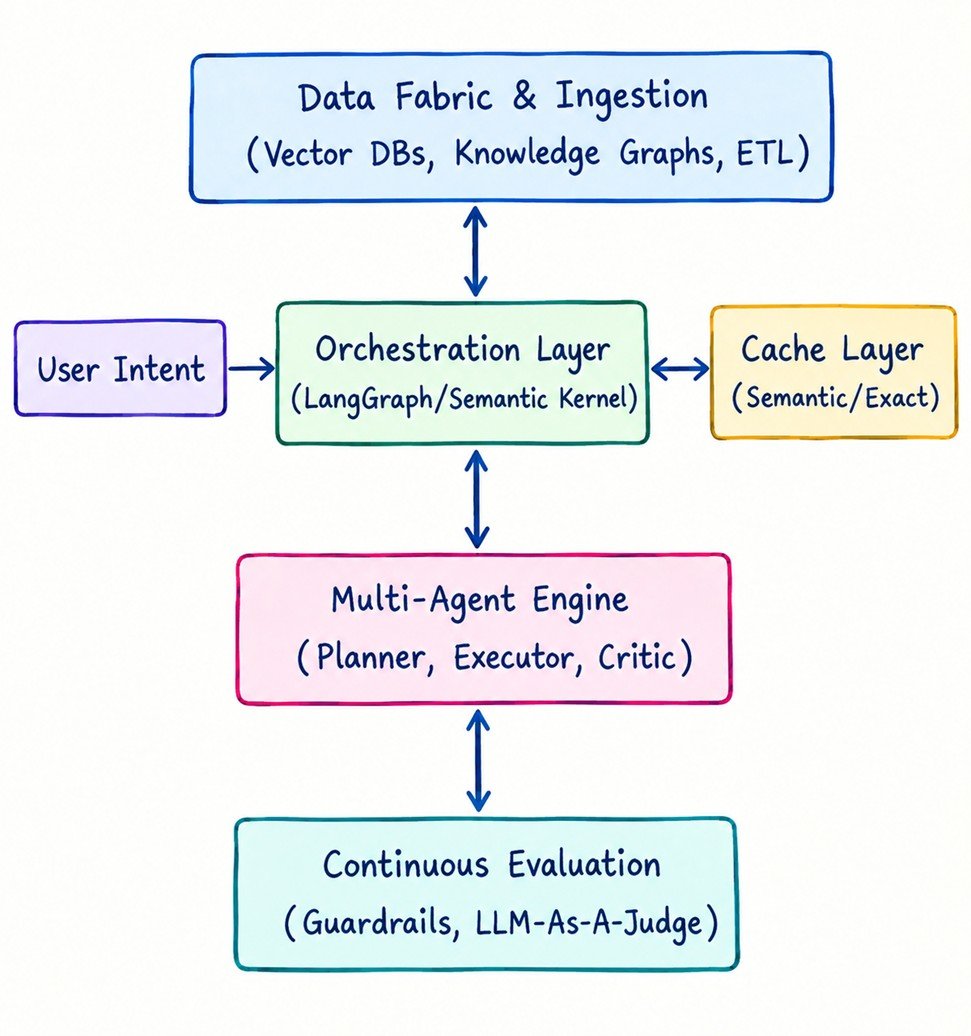
1. Multi-Agent Orchestration & State Management
AI-native architectures rely on multi-agent execution loops. You must design state machines (using frameworks like LangGraph, AutoGen, or custom state-management code) that allow multiple specialized agents—such as a Planner, an Executor, and a Critic—to collaborate.
- The Loop: The Planner creates a strategy, the Executor queries models/tools, and the Critic evaluates the output against standard thresholds. If it fails, the loop repeats up to a set budget ceiling.
- State Persistence: Because these operations are long-running and asynchronous, the state must be externalized in highly available databases to allow for checkpointing, human-in-the-loop intervention, and failure recovery.
2. Advanced Fallbacks & Self-Healing
Since total system utility loss is the default failure state, your fallback systems must be highly sophisticated:
- Model Cascades: Route requests dynamically based on complexity and system health. If your primary frontier model (e.g., GPT-4o or Claude 3.5 Sonnet) fails or experiences high latency, the orchestration layer must automatically downgrade to a faster, open-source model (e.g., Llama-3.1-70B) hosted on dedicated infrastructure.
- Semantic Guardrails: Implement programmatic validation layers (e.g., Guardrails AI, Llama Guard) at the boundary of every model call to validate output structural formats (like strict JSON schemas) before passing the data to down-stream agents.
3. Massive Ingestion & The Data Fabric
AI-native products require deep context. Your storage architecture must support Retrieval-Augmented Generation (RAG) at scale.
- Hybrid Storage: You must maintain a unified data fabric combining vector databases (e.g., Pinecone, Qdrant, pgvector) for semantic proximity, Graph Databases (e.g., Neo4j) for entity-relationship mapping, and traditional relational systems for transactional state.
- Dynamic Chunking & Re-ranking: Implement advanced ingestion pipelines that chunk data contextually, parse hierarchical documents, and utilize cross-encoder re-ranking models (e.g., Cohere Rerank) to ensure the AI engine receives only the highest-signal context window data.
4. Continuous Evaluation Pipelines
You cannot test an AI-native product with traditional unit testing alone.
- LLM-as-a-Judge: Build automated pipelines that sample production traffic and run evaluation suites (using tools like Ragas or TruLens) to score outputs on faithfulness, answer relevance, and context recall.
- Regression Tracking: Maintain gold-standard datasets of inputs and expected semantic outcomes. Run automated CI/CD checks against these datasets every time a prompt is altered or a model version is upgraded to prevent silent degradation.
The Strategic Rule for Technology Leaders
Do not build an AI-native infrastructure for a simple AI-powered feature.
Over-engineering a feature with vector databases, multi-agent frameworks, and dedicated GPU clusters will balloon your cost per monthly active user (MAU), delay time-to-market, and introduce immense operational complexity.
Conversely, failing to build a robust, multi-layered AI-native infrastructure for an autonomous agent product will guarantee a system that fails under edge cases, suffers from extreme latency, and loses customer trust due to unpredictability.
Align your architecture directly to your product classification. Match deterministic foundations with simple integrations, and reserve your highly complex, resilient orchestration engines for the probabilistic platforms of tomorrow.