AI opportunity → AI product
The Strategic Mirage of Generative AI
Many enterprise engineering and product organizations are currently trapped in an expensive loop of superficial innovation. Enticed by the raw capabilities of Large Language Models (LLMs), teams frequently mistake an AI opportunity for an AI product.
The result is almost always the same: a generic LLM chat window hastily bolted onto an existing interface. This "feature plug-in" approach creates immediate technical debt, yields highly fragmented user experiences, and delivers negligible business value.
To move past basic experimentation, CTOs, VPs, and Directors must shift their focus from raw model capabilities to deterministic user outcomes. You cannot deploy an opportunity to production. You must architect a stable, scalable software asset that solves core business problems repeatedly, predictably, and securely.
1. Deconstructing the Paradigm Shift
Enterprise leaders must enforce a clear distinction between these two lifecycle phases:
AI Opportunity
- Definition: A friction point in the business paired with a potential machine learning or generative solution.
- Nature: Theoretical, high-risk, unmapped, and highly volatile.
- Core Question: "Can a probabilistic model generate a plausible output for this problem space?"
AI Product
- Definition: A stable, scalable, and governed software asset that abstracts model complexities to deliver repeatable end-user value.
- Nature: Deterministic, integrated, monitored, and continuously optimized.
- Core Question: "Can we deliver this outcome within strict latency, cost, security, and precision boundaries at scale?"
Linear Computing vs. Probabilistic Realities
Traditional software is deterministic (Input A always yields Output B). AI engineering is probabilistic (Input A yields a statistical distribution of outputs).
Treating an AI product like a standard feature update ignores this fundamental shift. Moving from opportunity to product requires restructuring your data pipeline, system boundaries, and user experience around this inherent unpredictability.
2. Defining the Architectural Boundaries
Before writing code or training models, leaders must establish a strict taxonomy of system responsibilities. This avoids feature creep and prevents agent sprawl across the enterprise.
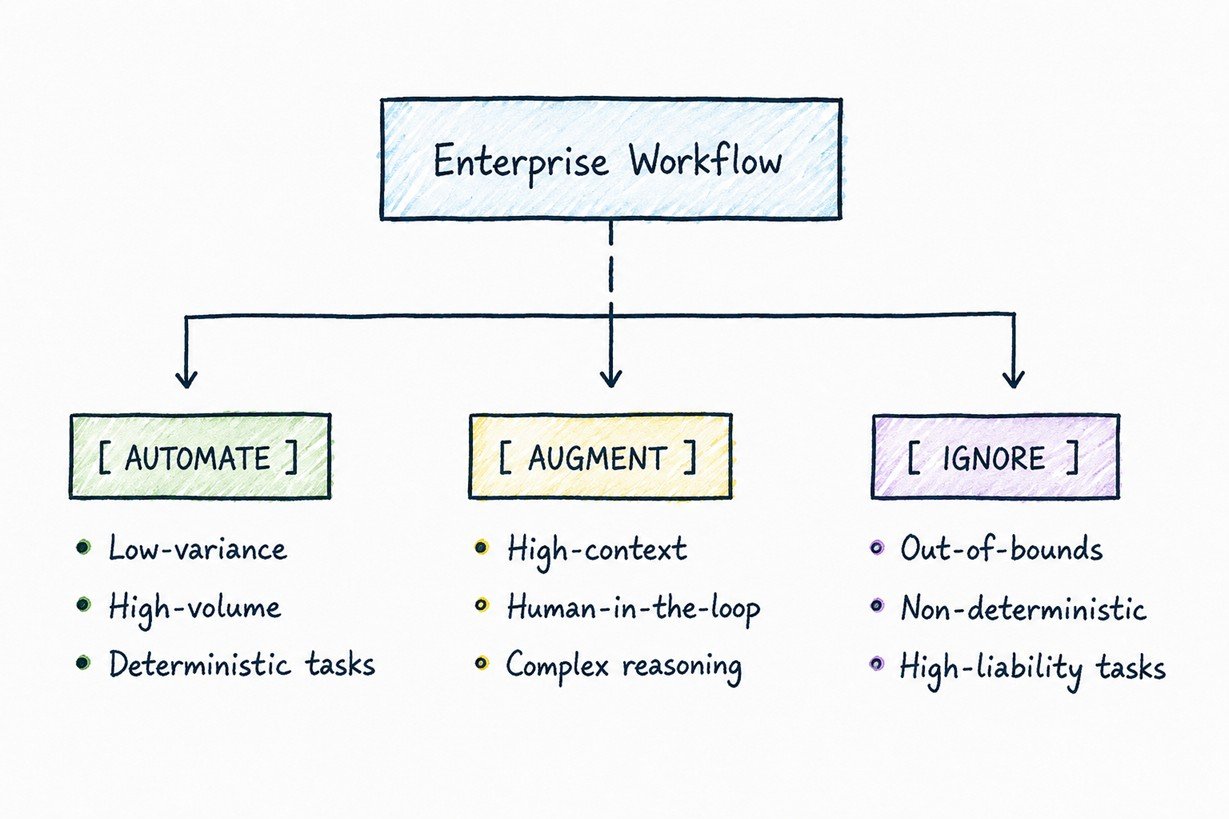
Automate
- Criteria: High-volume, low-variance, repetitive tasks where the cost of a minor error is low, or the error can be instantly caught by validation scripts.
- Enterprise Example: Extracting standardized line items from millions of structured invoices into an ERP database.
Augment
- Criteria: High-context, strategic tasks requiring a human-in-the-loop. The AI serves as an accelerator, not the final decision-maker.
- Enterprise Example: Generating a draft of a highly technical regulatory response that a compliance officer must review, edit, and sign off on.
Ignore
- Criteria: Processes that are highly non-deterministic, tightly coupled with legal liability, or where the data state is too volatile for the model to remain accurate.
- Enterprise Example: Autonomously executing irreversible legal actions or high-value financial transfers without human authentication.
3. The Enterprise AI Product Lifecycle (EAPL)
Google’s DORA research shows that while AI adoption can boost raw delivery throughput, it often introduces structural instability if the underlying engineering framework is weak. To mitigate this risk, replace standard agile cycles with a dedicated, four-stage lifecycle.
| Lifecycle Phase | Core Focus | Engineering Guardrails |
|---|---|---|
| 1. Contextual Framing | Define business outcomes independent of specific model architectures. | Secure the foundational data layer. Set precise vector storage and Retrieval-Augmented Generation (RAG) bounds. |
| 2. Deterministic Testing | Move from singular prompt testing to systemic validation. | Implement synthetic test suites (LLM-as-a-judge) to score system outputs on factual accuracy and alignment before code merges. |
| 3. Guardrailed Launch | Controlled user exposure to manage model drift and runtime variables. | Deploy behind proxy layers with semantic caching, real-time prompt injection filtering, and PII masking. |
| 4. Continuous Optimization | Closing the flywheel loop between user behavior and model tuning. | Route production edge cases directly back into regression testing suites and fine-tuning pipelines. |
4. Operational Metrics: Decoupling Product from Model
A common failure mode for technical leaders is conflating model performance metrics with actual product success metrics. Your users do not care about your model's perplexity; they care about their own time-to-resolution.
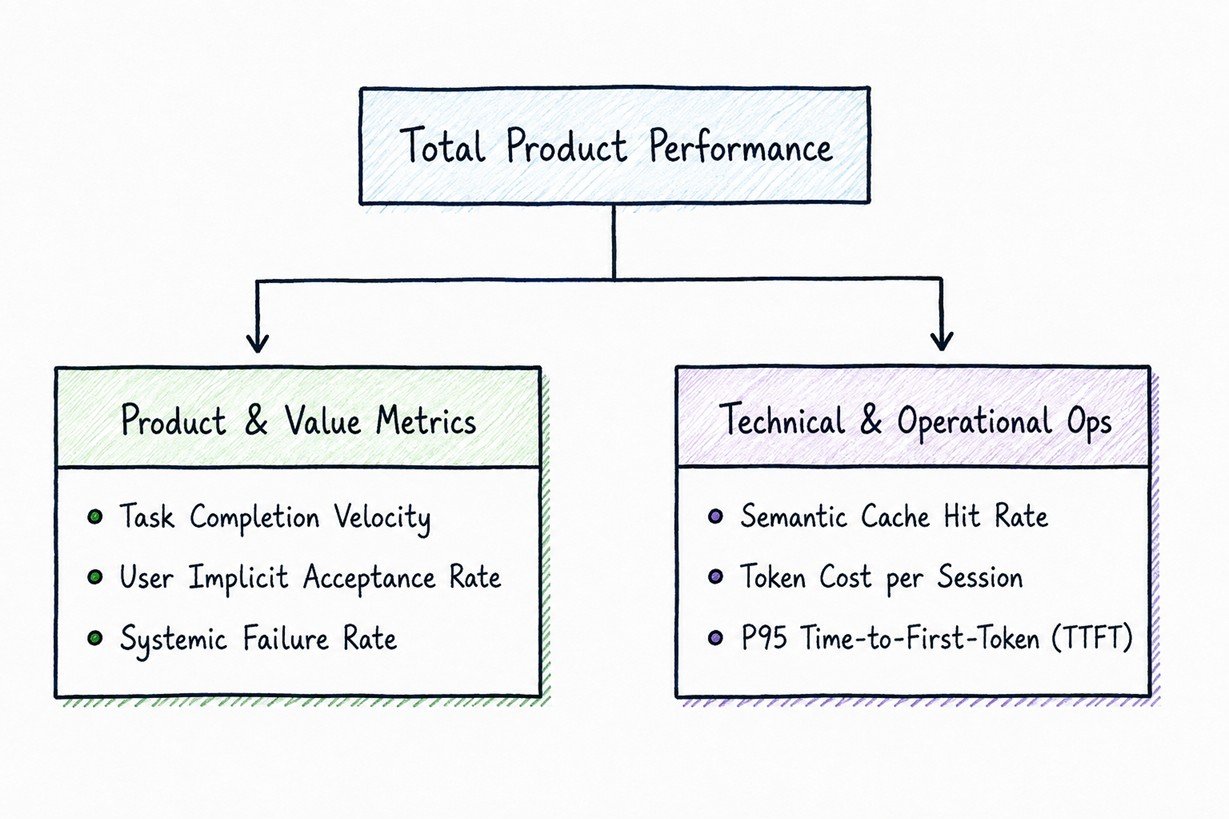
Product & Business Outcomes
- Task Completion Velocity: The net reduction in time required for an end-user to successfully finish a multi-step workflow compared to the legacy non-AI process.
- Implicit Acceptance Rate: The percentage of AI-generated outputs that users accept, copy, or save without making heavy manual edits.
- Systemic Failure Rate: How often an AI failure forces a fallback to traditional, non-automated workflows.
Technical & Cost Performance (LLMOps)
- Semantic Cache Hit Rate: The percentage of user inputs resolved via a vector cache rather than routing to the underlying LLM, reducing latency and platform costs.
- Cost per Session (CPS): The total token spend (input + output) mapped directly against individual user journeys to track unit economics.
- P95 Time-to-First-Token (TTFT): The latency threshold ensuring the user interface remains responsive and avoids looking frozen.
5. Architectural Blueprint for the User Interface
The chat interface is often an antipattern for complex enterprise applications. It forces users to guess how to prompt the system, increasing cognitive load. High-value enterprise AI products require highly contextual, ambient, and structured user interfaces.
- Intent-Driven Contextual Actions: Instead of an open chat box, provide contextual action buttons directly inline where users are working (e.g., "Analyze Anomalies" or "Synthesize Discrepancies").
- The "Confidence Slider" UX: When outputs are probabilistic, the UI should visually reflect system confidence. If confidence falls below a preset threshold, the system should highlight specific values for human verification.
- Dual-State Previews: Always show side-by-side or inline comparisons detailing the original state alongside the AI's proposed state. This lets users quickly audit and verify changes before committing them.