High-Throughput Concurrency and Load Management
Introduction
Scaling traditional corporate IT infrastructure relies heavily on horizontal auto-scaling and database connection pooling. In a standard web environment, an influx of requests can be countered by spawning short-lived microservice containers and scaling read replicas.
However, enterprise Generative AI production environments scale asymmetrically to traditional compute. LLMs are not bound merely by CPU or network interfaces. They are bounded by raw GPU VRAM capacity, memory bandwidth, and strict provider token quotas. A single unexpected high-context request can process millions of input tokens, saturating an entire inference cluster or instantly exhausting enterprise API limits.
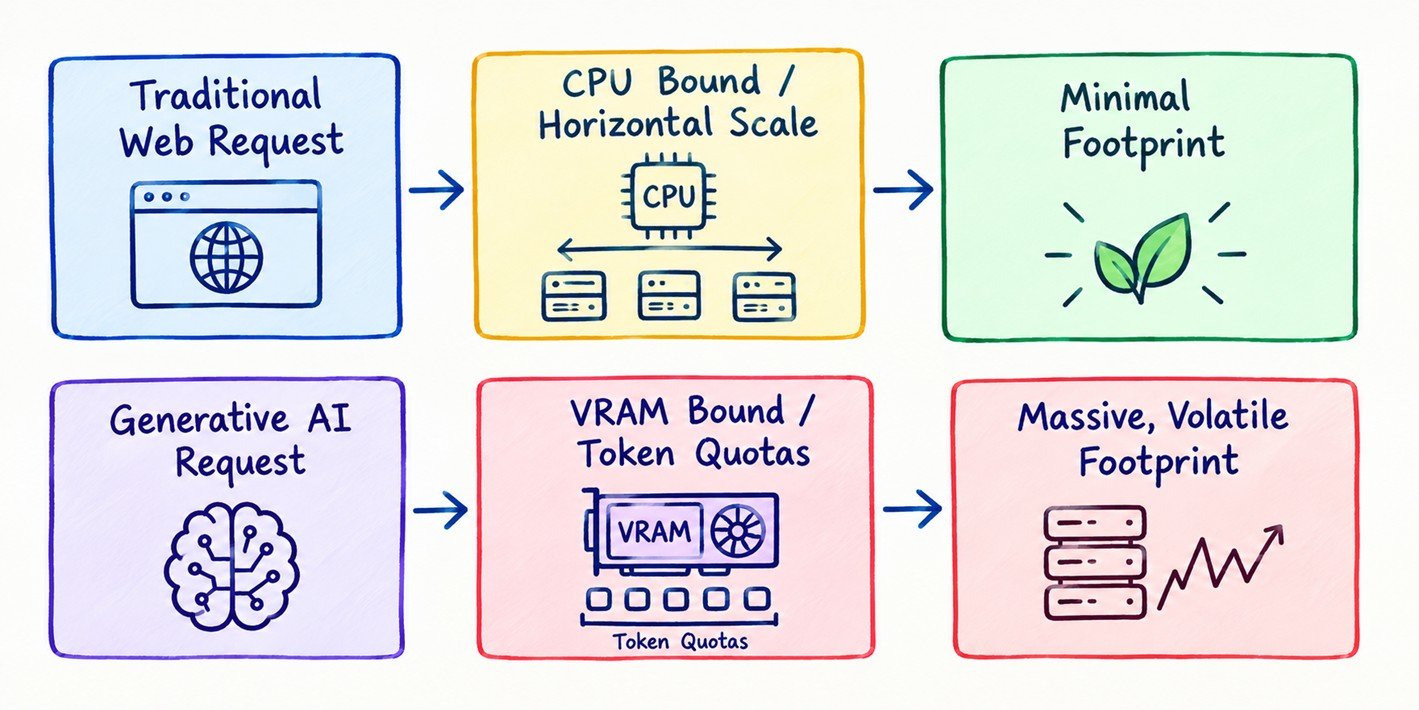
For engineering leaders, designing a high-throughput runtime requires abandoning naive, unthrottled routing. To move past fragile PoCs, you must treat tokens as a constrained, high-cost substrate. This section details the structural design patterns required to architect resilient, load-managed, and highly concurrent AI runtimes capable of handling unpredictable enterprise workloads without system collapse.
1. Rate Limiting and Token-Throttling
Traditional API gateways enforce rate limiting by tracking requests per minute (RPM). In an LLM ecosystem, RPM is a metric that leaves systems vulnerable to failure. A user sending 10 requests containing short phrases consumes negligible compute. Another user sending a single request containing a 100,000-token legal document can completely saturate a vLLM engine or trip upstream cloud provider limits.
Enterprise AI load management must operate on a dual-dimensional model: Requests Per Minute (RPM) coupled with Tokens Per Minute (TPM), broken down into input and output allocations.
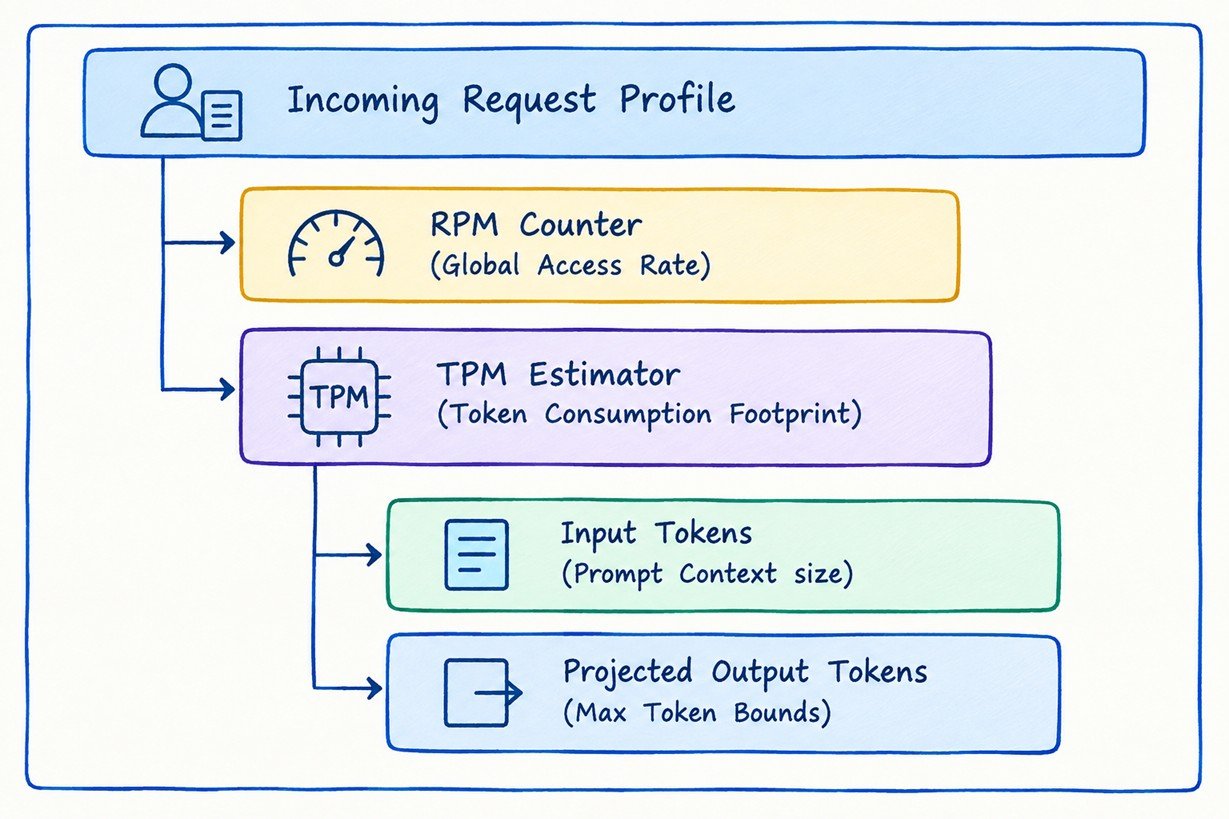
To govern this multi-dimensional space, systems deploy two distinct architectural traffic controllers:
Token-Bucket Algorithm for Burst Allocation
The token-bucket pattern maintains a centralized, high-speed memory store, typically hosted within an active Redis cluster, that holds a defined capacity of "token credits." As time passes, credits refill at a fixed, deterministic rate.
- Application Scope: Best deployed at the organization or business unit gateway level.
- Operational Behavior: When a user requests an inference execution, the gateway assesses the input prompt size plus the requested
max_tokensconfiguration. If the bucket contains sufficient credits, the request proceeds immediately, and the credits are subtracted. This allows applications to burst smoothly during intensive reasoning steps while preventing long-term systemic abuse.
Leaky-Bucket Algorithm for Smooth Egress Traffic
The leaky-bucket pattern accepts incoming inference requests into a bounded queue. The queue drains at a strict, non-negotiable constant velocity, feeding requests smoothly into the underlying inference engines.
- Application Scope: Best deployed directly in front of dedicated open-weights model worker node pools, such as vLLM or TensorRT-LLM host clusters.
- Operational Behavior: Regardless of how jagged or violent the incoming traffic spikes are, the leaky bucket guarantees that the downstream GPU hardware receives a perfectly leveled stream of execution, completely eliminating memory thrashing and out-of-memory (OOM) faults.
Production Architecture: Two-Tier Distributed Rate Limiter
The following implementation shows a concrete, production-grade distributed rate limiter using Redis Lua scripting. This script handles both RPM and TPM checks atomically within a single network round-trip, preventing race conditions under high concurrency.
import redis
import time
from typing import Tuple, Dict, Any

class TokenThrottlingException(Exception):
    """Raised when an enterprise consumer breaches RPM or TPM allocation limits."""

class DistributedLoadGovernor:
    def __init__(self, redis_client: redis.Redis):
        self.redis = redis_client
        # Lua script executes atomically inside the Redis engine memory space
        self.lua_throttler = """
            local client_key = KEYS[1]
            local now = tonumber(ARGV[1])
            local requested_requests = tonumber(ARGV[2])
            local requested_tokens = tonumber(ARGV[3])

            local max_rpm = tonumber(ARGV[4])
            local max_tpm = tonumber(ARGV[5])

            -- Window definitions (60-second tumbling windows)
            local window = math.floor(now / 60)
            local rpm_bucket = client_key .. ":rpm:" .. window
            local tpm_bucket = client_key .. ":tpm:" .. window

            -- Current usage evaluation
            local current_requests = tonumber(redis.call('GET', rpm_bucket) or "0")
            local current_tokens = tonumber(redis.call('GET', tpm_bucket) or "0")

            if current_requests + requested_requests > max_rpm then
                return {0, current_requests, current_tokens, "RPM_LIMIT_BREACHED"}
            end

            if current_tokens + requested_tokens > max_tpm then
                return {0, current_requests, current_tokens, "TPM_LIMIT_BREACHED"}
            end

            -- Commit allocations with TTL padding to ensure self-cleanup
            redis.call('INCRBY', rpm_bucket, requested_requests)
            redis.call('EXPIRE', rpm_bucket, 120)

            redis.call('INCRBY', tpm_bucket, requested_tokens)
            redis.call('EXPIRE', tpm_bucket, 120)

            return {1, current_requests + requested_requests, current_tokens + requested_tokens, "SUCCESS"}
        """
        self.script_sha = self.redis.script_load(self.lua_throttler)

    def evaluate_traffic_clearance(
        self, consumer_id: str, prompt_token_estimate: int, max_output_budget: int,
        limits: Dict[str, int]
    ) -> Tuple[bool, Dict[str, Any]]:

        total_token_footprint = prompt_token_estimate + max_output_budget
        now = time.time()

        # Execute atomic tracking loop
        keys = [f"governor:{consumer_id}"]
        args = [now, 1, total_token_footprint, limits['max_rpm'], limits['max_tpm']]

        clearance, current_req, current_tok, status = self.redis.evalsha(self.script_sha, len(keys), *keys, *args)

        telemetry = {
            "status": status,
            "allocated_rpm": current_req,
            "allocated_tpm": current_tok
        }

        if not clearance:
            raise TokenThrottlingException(f"Rate governance active: {status}. Footprint rejected: {total_token_footprint} tokens.")

        return True, telemetry
2. Async Inference and Streaming Optimization
In traditional microservices, synchronous HTTP request-response patterns are the norm. However, blocks of raw text generation are highly incompatible with synchronous connection models. If an enterprise application forces a client connection to remain open, blocking synchronously until an LLM completes an entire 1,000-token generation loop, it introduces a severe systemic vulnerability.
HTTP connection pools are rapidly exhausted, application thread counts explode, and users face prolonged periods of dead silence while the model processes its context window.
Event-Driven Async Execution Loops
To build a resilient high-throughput framework, decouple the execution lifecycle completely. The incoming client connection should hit an asynchronous edge controller that performs immediate request validation and drops the payload into an active internal memory ring buffer.
The edge controller immediately returns an HTTP 202 Accepted status code along with a tracking correlation ID. This allows the client thread pool to free up instantly. Dedicated inference workers consume from the ring buffer, executing requests asynchronously against the hardware cluster.
Server-Sent Events (SSE) Token Streaming Architecture
For user-facing systems, you must implement Server-Sent Events (SSE) to stream token outputs chunk by chunk as they are calculated in the model's autoregressive loop.
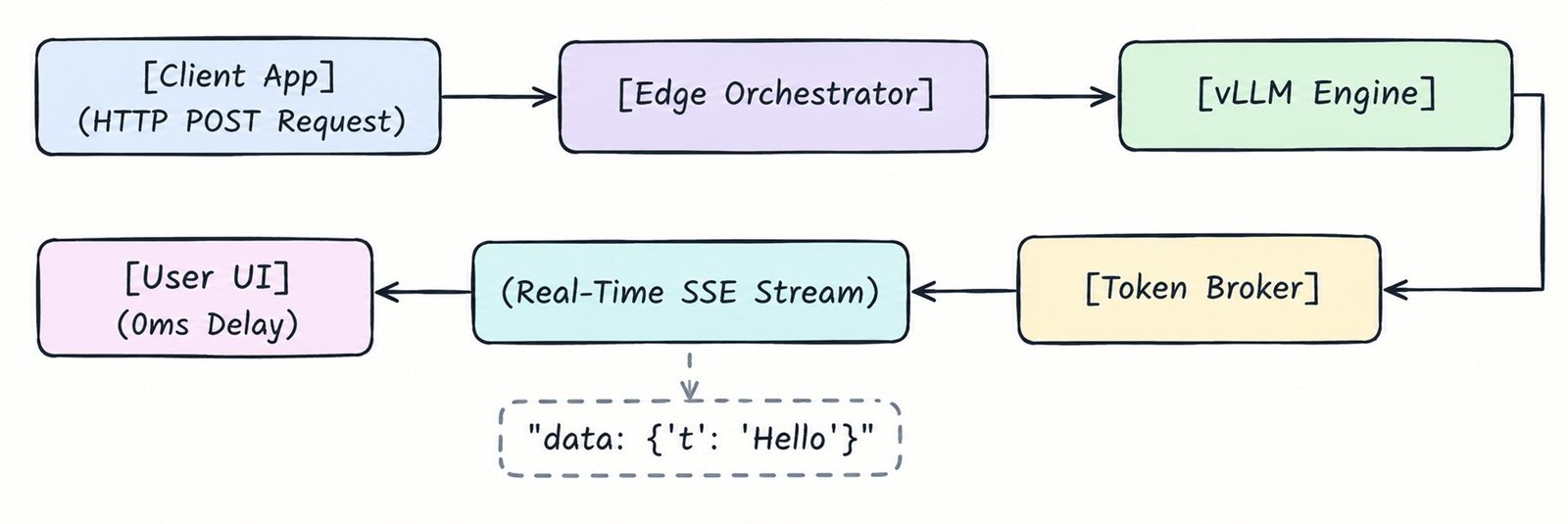
Streaming fundamentally shifts the user experience metric from total request execution time to Time to First Token (TTFT). By delivering the initial generation pieces to the client within milliseconds, the perceived latency of the application drops to zero, even if the complete text block requires several seconds of background computation.
Continuous Batching and PagedAttention Optimizations
When running dedicated open-weights hosting layers, traditional batching methods (static batching) force the inference framework to wait until all requests in a batch complete execution before releasing memory. This approach degrades throughput because short requests are held hostage by long-tail token generation loops.
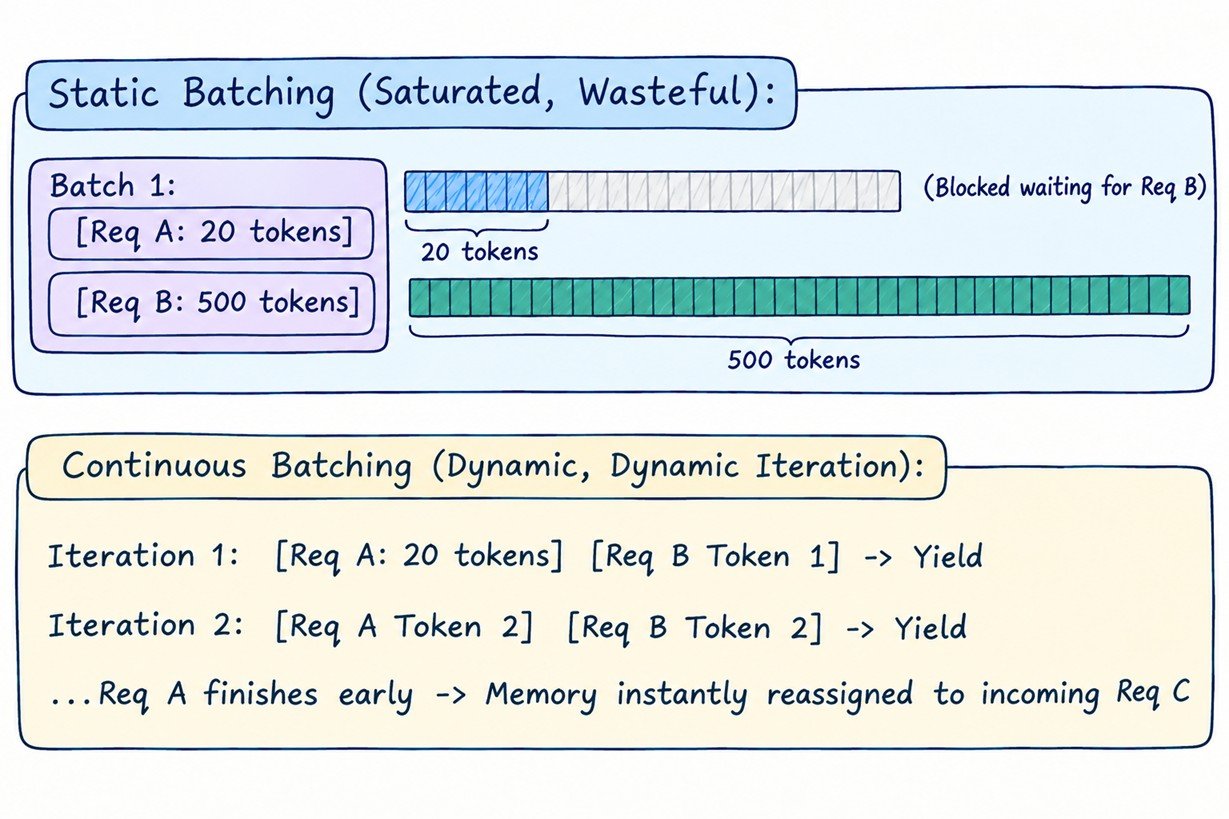
To optimize throughput, enterprise clusters should deploy open-source serving runtimes, such as vLLM or TRT-LLM, configured for Continuous Batching and PagedAttention. Continuous batching operates at the individual token iteration level. As soon as a single request finishes generating its terminal token sequence, it is instantly evicted from the batch pool, and a new waiting request steps into its place.
PagedAttention addresses the VRAM memory fragmentation caused by storing Key-Value (KV) caches. By partitioning the KV cache into discrete, non-contiguous virtual memory pages rather than large contiguous blocks, it significantly reduces VRAM waste. This increases maximum serving concurrency by up to 400% on identical physical GPU clusters.
3. Queue-Based Architectures and Buffer Management
Enterprise environments constantly balance two conflicting workloads: Synchronous API Requests (e.g., real-time customer chatbots) that demand tight sub-second latency bounds, and Asynchronous Batch Extraction Workloads (e.g., processing 50,000 corporate PDF invoices overnight) that prioritize total system throughput over individual execution speeds.
If batch extraction pipelines push heavy workloads directly into the primary inference cluster without an intermediate buffering layer, they create an immediate resource crisis. The system's KV caches saturate, queue lengths grow, and real-time customer interactions experience catastrophic latency spikes or outright timeouts.
Decoupling with Message Brokers
To isolate these systems, place a robust message broker infrastructure, utilizing Apache Kafka or RabbitMQ, between the batch data ingestion layers and the model orchestration components.
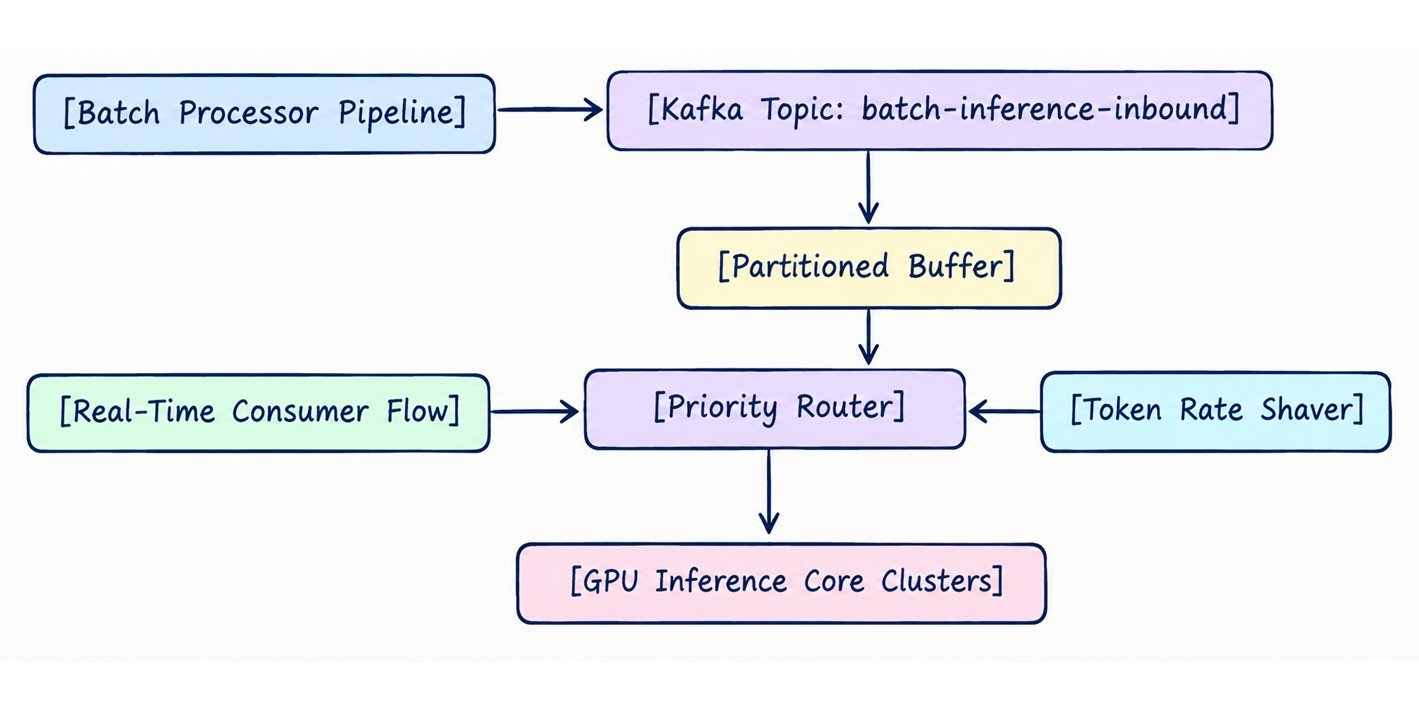
Batch applications are strictly forbidden from hitting model servers directly. Instead, they serialize their payloads into structured queue topics. This setup turns the message broker into a systemic buffer, holding excess volume safely on disk and protecting downstream model engines from sudden traffic overloads.
Priority Queue Routing and Token Rate Shaving
To protect high-priority real-time streams, configure a multi-tiered priority routing layer directly within the consumer orchestration system.
| Queue Category | Processing Priority | Target Task Profile | Max Queue Bounds Control |
|---|---|---|---|
| Priority: Interactive | Tier 1 (Immediate) | Live Customer Chat, Synchronous UI Agents. | Bounded, short queues. Drops into failover on saturation. |
| Priority: Standard | Tier 2 (Leveled) | Internal Employee Dashboards, Async Mail Generators. | Medium capacity. Leaked steadily into execution threads. |
| Priority: Batch | Tier 3 (Opportunistic) | Mass Vector Ingestion, Document Extraction Pipelines. | Massive unbounded disk array. Consumes remaining capacity. |
The inference routing engine continuously monitors the state of the system. It processes Tier 1 requests instantly as they arrive. Tier 3 batch consumers operate using a token rate shaving strategy. The batch worker threads track the real-time capacity usage of the GPU cluster.
If real-time user volume falls during off-peak hours, such as 2:00 AM, the batch workers ramp up their consumption speed, pulling messages rapidly from the Kafka topic to maximize GPU utilization. The moment interactive customer traffic rises, the batch workers scale back their thread counts, ensuring zero interference with live consumer workflows.
4. Load Management and Bulkhead Isolation
When a single application runtime handles multiple distinct agent patterns, it faces the risk of resource starvation. Consider an enterprise HR portal that hosts two distinct capabilities: a high-frequency search autocomplete tool (low context, fast execution) and a complex multi-turn retirement policy analysis agent (large context windows, lengthy iterative tool calls).
If both capabilities share an identical unpartitioned thread pool and upstream model backend, a small group of users interacting with the complex multi-turn agent can quickly exhaust the model's context allocation memory. This leaves the system unable to process simple autocomplete transactions, creating a complete application stall.
Implementing the Bulkhead Isolation Pattern
Named after the physical partitions that prevent a ship's hull from flooding entirely, the Bulkhead Isolation Pattern splits system compute resources into distinct, isolated pools. If a single pool experiences a massive surge or failure, the remaining pools continue operating without issue.
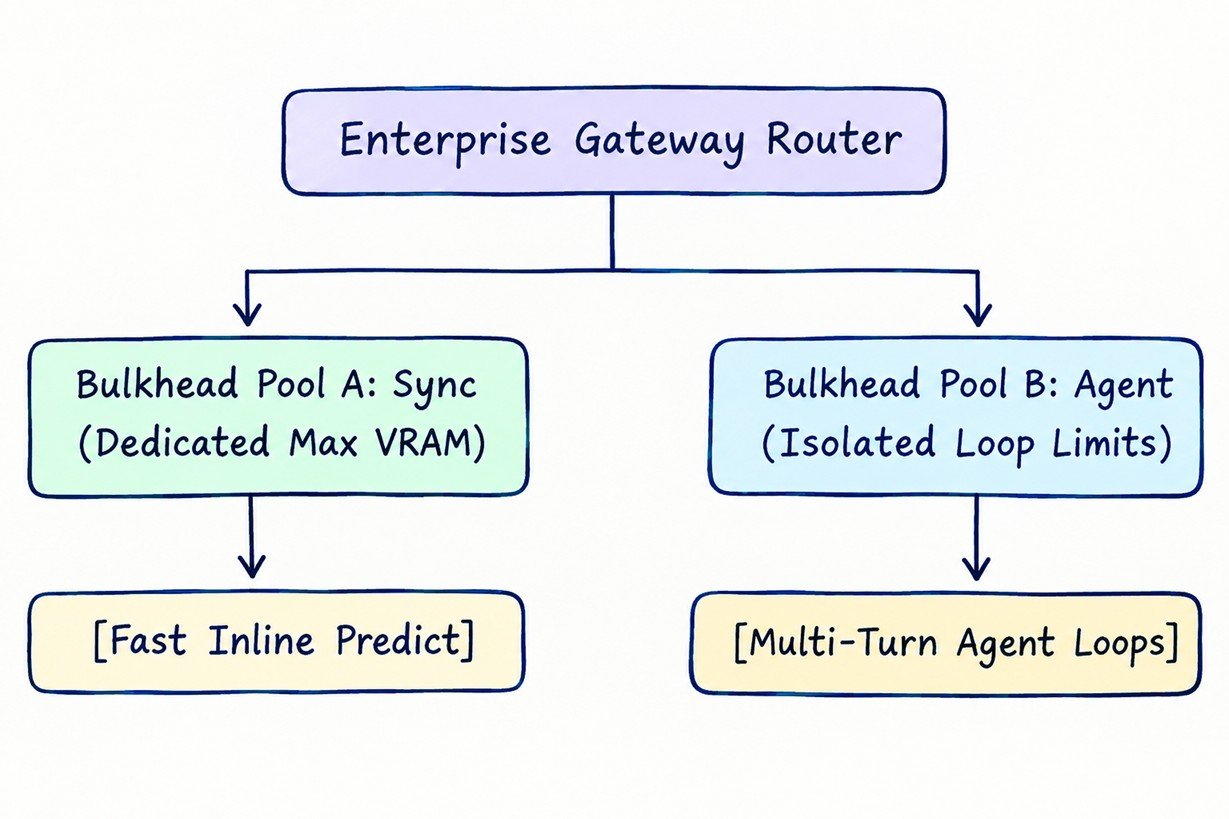
- Dedicated Hardware Partitioning: Map specific application use cases directly to isolated GPU deployments or distinct cloud provider endpoints. Route critical interactive customer traffic to a protected endpoint cluster, such as Azure OpenAI Provisioned Throughput Units, while routing internal research tools to standard pay-as-you-go public endpoints.
- Virtual Resource Bulkheads: Within a shared inference host pool, configure strict runtime isolation using containerized thread restrictions or request routing tags. Enforce maximum concurrent execution bounds per API key or tenant ID, ensuring no single user can claim more than 25% of total system concurrency slots.
Guarding Against Multi-Turn Agent Loop Disruption
Autonomous multi-turn agents are prone to cascading failures, such as falling into infinite execution loops where they call external search tools repeatedly without generating a final response. To insulate the enterprise from these runaway loops, place strict structural limits around the agent execution layer:
IMAGE-8-14
# Production Agent Orchestration Controller with Multi-Turn Bulkhead Controls
class AgentLoopBulkheadController:
    def __init__(self, max_consecutive_turns: int = 5, total_loop_timeout_seconds: float = 30.0):
        self.max_consecutive_turns = max_consecutive_turns
        self.total_loop_timeout_seconds = total_loop_timeout_seconds

    async def execute_agent_workflow(self, agent_runtime_context: dict, initial_input: str) -> dict:
        start_time = time.time()
        turn_count = 0
        current_input = initial_input

        while True:
            # 1. Structural Loop Checks
            turn_count += 1
            elapsed_time = time.time() - start_time

            if turn_count > self.max_consecutive_turns:
                return self._degrade_to_deterministic_fallback(
                    "TURN_LIMIT_EXCEEDED",
                    f"Agent execution halted: Exceeded maximum allowed iterations ({self.max_consecutive_turns})."
                )

            if elapsed_time > self.total_loop_timeout_seconds:
                return self._degrade_to_deterministic_fallback(
                    "TIMEOUT_BREACH",
                    f"Agent execution halted: Execution runtime exceeded safety budget of {self.total_loop_timeout_seconds}s."
                )

            # 2. Execute Isolated Model Turn
            try:
                response = await self._execute_model_step(agent_runtime_context, current_input)

                # Check if agent has reached a valid terminal state
                if response.get("lifecycle") == "FINAL_OUTPUT":
                    return {"status": "SUCCESS", "payload": response.get("text")}

                # If agent requests an external tool execution, step into next turn loop
                current_input = response.get("tool_execution_result")

            except Exception as system_fault:
                # Catch internal system faults and isolate the failure immediately
                return self._degrade_to_deterministic_fallback("INTERNAL_RUNTIME_FAULT", str(system_fault))

    def _degrade_to_deterministic_fallback(self, failure_mode: str, diagnostic_message: str) -> dict:
        # Log failure metrics to centralized enterprise observability pipeline
        log_to_enterprise_observability({"metric": "AGENT_BULKHEAD_TRIP", "mode": failure_mode, "reason": diagnostic_message})

        # Return a clean, safe, deterministic message to protect the user experience
        return {
            "status": "DEGRADED_FALLBACK",
            "payload": "Our system is currently processing high volume. We are unable to complete the detailed analysis at this moment."
        }

    async def _execute_model_step(self, context: dict, input_str: str) -> dict:
        # Core model invocation logic goes here
        return {}

def log_to_enterprise_observability(payload: dict):
    pass
Executive Architectural Summary
Maintaining high availability in an enterprise AI ecosystem requires moving from traditional request management to token-aware load balancing. Implementing isolated queue models, token-based rate limiting, asynchronous processing loops, and strict agent execution boundaries ensures your primary systems remain responsive and resilient under heavy corporate workloads.