Fault-Tolerant Patterns for Non-Deterministic Runtimes
Introduction
Traditional software systems operate within a deterministic paradigm where identical inputs, traversing a static execution path, yield identical outputs. Engineering for resilience in these systems targets hard failures: a crashed process, a TCP timeout, an HTTP 500 error, or a saturated database connection pool.
Generative AI runtimes upend this paradigm. Large Language Models (LLMs) and agentic frameworks introduce stochastic runtimes where the system may return a functionally valid response in a structurally valid format one moment and complete semantic gibberish the next, all while returning an HTTP 200 OK status code.
For technology leaders, moving from a fragile Proof of Concept (PoC) to an enterprise-grade production ecosystem requires a fundamental shift. You must transition from engineering for high availability to engineering for structural and semantic survivability.
This section establishes the architectural patterns required to insulate your enterprise from the systemic instability, latency variability, and unpredictable behaviors inherent to frontier foundation models.
1. Designing for Unpredictable Model Behavior
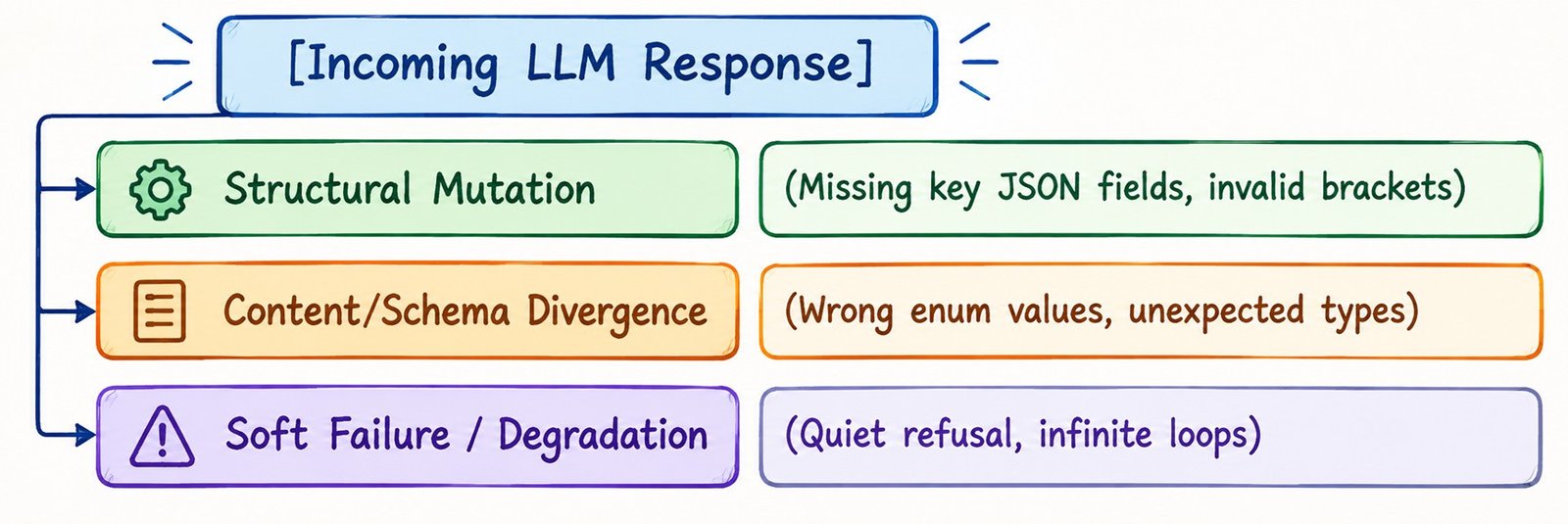
When deploying LLMs to production, engineers encounter soft failures. Unlike traditional hard crashes, a soft failure occurs when the model completes execution successfully but outputs an invalid response profile. These anomalies fall into three primary vectors:
Structural Mutation Mitigation
Frontier models constrained by system prompts or structured schema generation configurations (such as JSON mode or tool definitions) still periodically mutate their output. A model might drop closing brackets under heavy load, encapsulate JSON inside Markdown blocks, or misinterpret nested schemas.
- Defensive Guard: Multi-Tiered Parsing Layer. Never let downstream enterprise applications consume raw model payloads directly. Implement an isolation layer utilizing a structural validation framework such as Pydantic or Zod.
- Self-Healing Parser Pattern: When a parsing exception triggers due to unclosed delimiters or Markdown encapsulation, route the corrupted string through an automated regex or a localized, high-speed grammar parser (e.g., Llama.cpp grammar constraints) to reconstruct valid JSON before throwing an exception.
Content and Schema Divergence Handling
A model may generate syntactically flawless JSON that completely violates semantic business rules. This includes generating enum entries outside the declared schema, outputting arbitrary string lengths that break target database schemas, or generating missing data arrays.
- Defensive Guard: Deterministic Semantic Alignment. Implement strict typing at the boundary. If the schema expects
{"status": "APPROVED" | "DENIED"}and the model outputs{"status": "pending_review"}, the validation layer must intercept this and cast it into a deterministic fallback state or trigger an inline correction loop.
Soft Failures and Graceful Degradation
Soft failures manifest as quiet model refusals (e.g., "As an AI, I cannot..." when no safety violation occurred), repetitive phrase generation loops, or a total loss of context windows during extended multi-turn agent execution.
- Defensive Guard: Real-Time Output Heuristics. Establish anomaly detection proxies directly on the streaming token output chunk stream. Implement token entropy tracking. If the token stream demonstrates repetitive token patterns or n-gram repetition indexes above a critical threshold, flag the generation as an active loop anomaly. Immediately sever the inference request and route the transaction to an alternative model path.
2. Latency and Timeout Management
Frontier AI model inference introduces a highly erratic latency profile. Unlike standard microservices, where latency is primarily bounded by network transit and database indexes, LLM latency is an explicit function of Time to First Token (TTFT), Inter-Token Latency (ITL), and total output token generation length.
Total Request Latency = TTFT + (ITL × Total Generated Tokens)
Because generation is autoregressive, a slight shift in a model's internal pathing can cause it to output 800 tokens instead of the expected 50 tokens, causing severe tail-latency spikes that jeopardize enterprise Service Level Objectives (SLOs).
Managing P99 Latency Bounds and Long-Tail Tokens
Under high concurrency, cloud-hosted model provider endpoints experience severe degradation. TTFT can spike from 200ms to over 5,000ms, pushing P99 metrics past acceptable user experience and system boundaries.
| Latency Metric | Component Source | Enterprise Impact | Core Architectural Control |
|---|---|---|---|
| TTFT (Time to First Token) | Input prompt processing, context loading, queue length. | Directly impacts perceived system responsiveness. | Speculative Execution, Pre-warming Context, Priority Queuing. |
| ITL (Inter-Token Latency) | Model computation per token, hardware saturation. | Compounds linearly with long outputs; degrades user experience. | Token Streaming, Early Window Interrupts. |
| Long-Tail Token Length | Hallucinations, loops, unconstrained generation. | Destroys P99 latency bounds; causes microservice pool exhaustion. | Max Token Budgets, Stop Sequences, Schema Constraints. |
Architectural Blueprint: Asynchronous Speculative Execution
To guarantee strict enterprise response budgets, implement an architecture centered around token-streaming evaluation and speculative dual-execution paths.
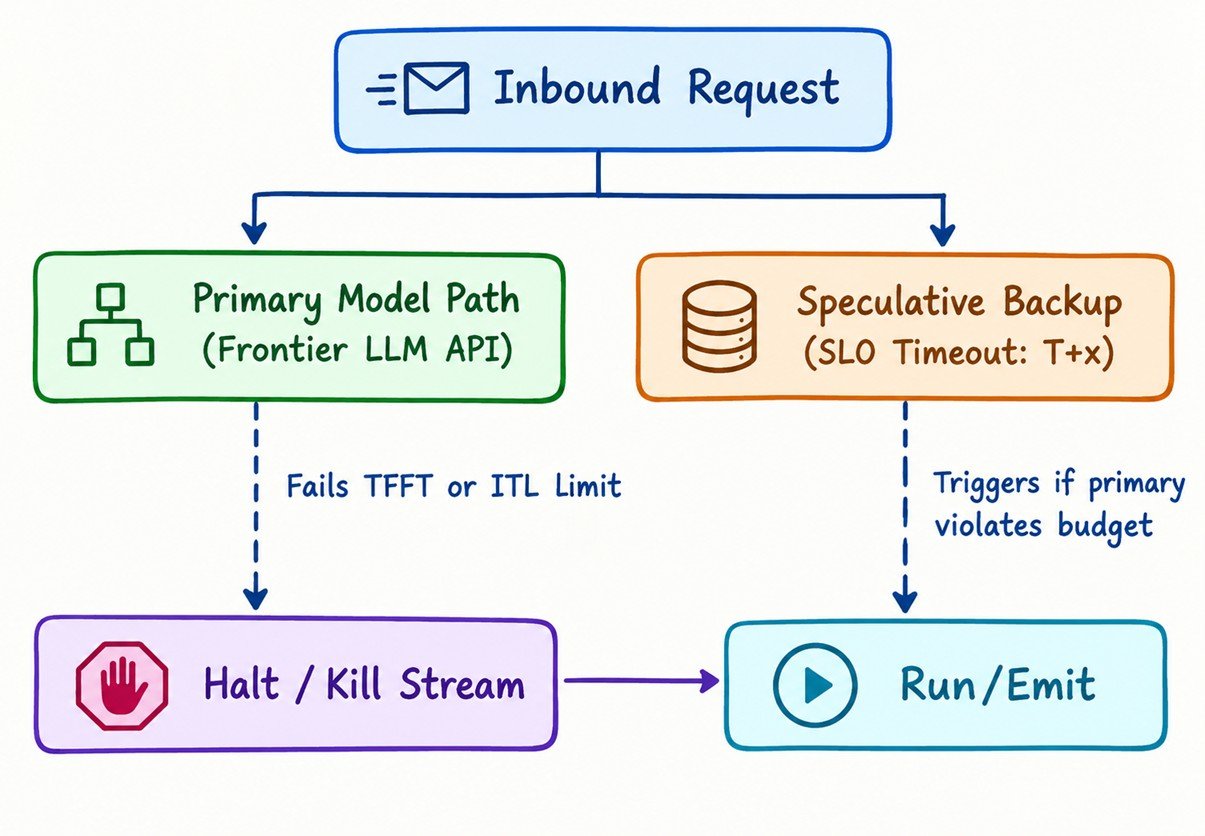
Code Implementation: Token-Aware Timeout Controller
The following production-grade pattern demonstrates an asynchronous execution wrapper designed to interrupt and handle long-tail token anomalies dynamically based on real-time stream performance.
import asyncio
import time
from typing import AsyncGenerator, Dict, Any

class LatencySentryException(Exception): """Raised when token stream violates enterprise SLO bounds."""

class TokenAwareTimeoutController:
    def __init__(self, max_ttft_seconds: float = 1.5, max_itl_seconds: float = 0.15):
        self.max_ttft_seconds = max_ttft_seconds
        self.max_itl_seconds = max_itl_seconds

    async def monitor_stream(self, raw_stream: AsyncGenerator[Dict[str, Any], None]) -> AsyncGenerator[str, None]:
        start_time = time.time()
        first_token_received = False
        last_token_time = start_time
        token_count = 0

        try:
            while True:
                # Calculate dynamic timeout window based on state
                current_timeout = self.max_ttft_seconds if not first_token_received else self.max_itl_seconds

                try:
                    # Await next chunk with a strict timeout boundary
                    chunk = await asyncio.wait_for(raw_stream.__anext__(), timeout=current_timeout)
                except asyncio.TimeoutError:
                    if not first_token_received:
                        raise LatencySentryException(f"TTFT SLA breached. No token within {self.max_ttft_seconds}s.")
                    else:
                        raise LatencySentryException(f"ITL SLA breached at token {token_count} after {self.max_itl_seconds}s.")
                except StopAsyncIteration:
                    break

                # State Updates
                current_time = time.time()
                if not first_token_received:
                    first_token_received = True
                    # Record TTFT for telemetry telemetry
                    enterprise_telemetry_log({"metric": "TTFT", "duration": current_time - start_time})
                else:
                    enterprise_telemetry_log({"metric": "ITL", "duration": current_time - last_token_time})

                last_token_time = current_time
                token_count += 1

                yield chunk.get("text", "")

        except Exception as e:
            # Trigger systemic telemetry alert and handle failure isolation
            enterprise_telemetry_log({"metric": "STREAM_FAILURE", "error": str(e)}, level="CRITICAL")
            raise e

def enterprise_telemetry_log(payload: dict, level: str = "INFO"):
    # Integrated into centralized OpenTelemetry collector pipeline
    pass
3. Retries and Circuit Breakers
When a cloud provider's infrastructure begins throwing HTTP 429 (Too Many Requests) or HTTP 503 (Service Unavailable) statuses, standard naive retry loops cause serious problems. If hundreds of application threads concurrently retry failed requests against a struggling upstream cluster, they trigger a self-inflicted thundering herd problem that deepens the provider's outage and exhausts system resource pools.
Exponential Backoff with Decoherent Jitter
To break system synchronization during upstream failures, retry schedules must use exponential backoff wrapped with non-linear, randomized jitter. This spreads out retry attempts over time and flattens concurrent spikes into a manageable distribution.

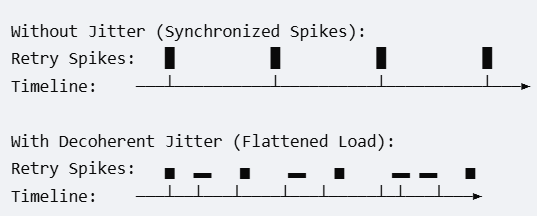
LLM-Isolated Circuit Breaker State Machine
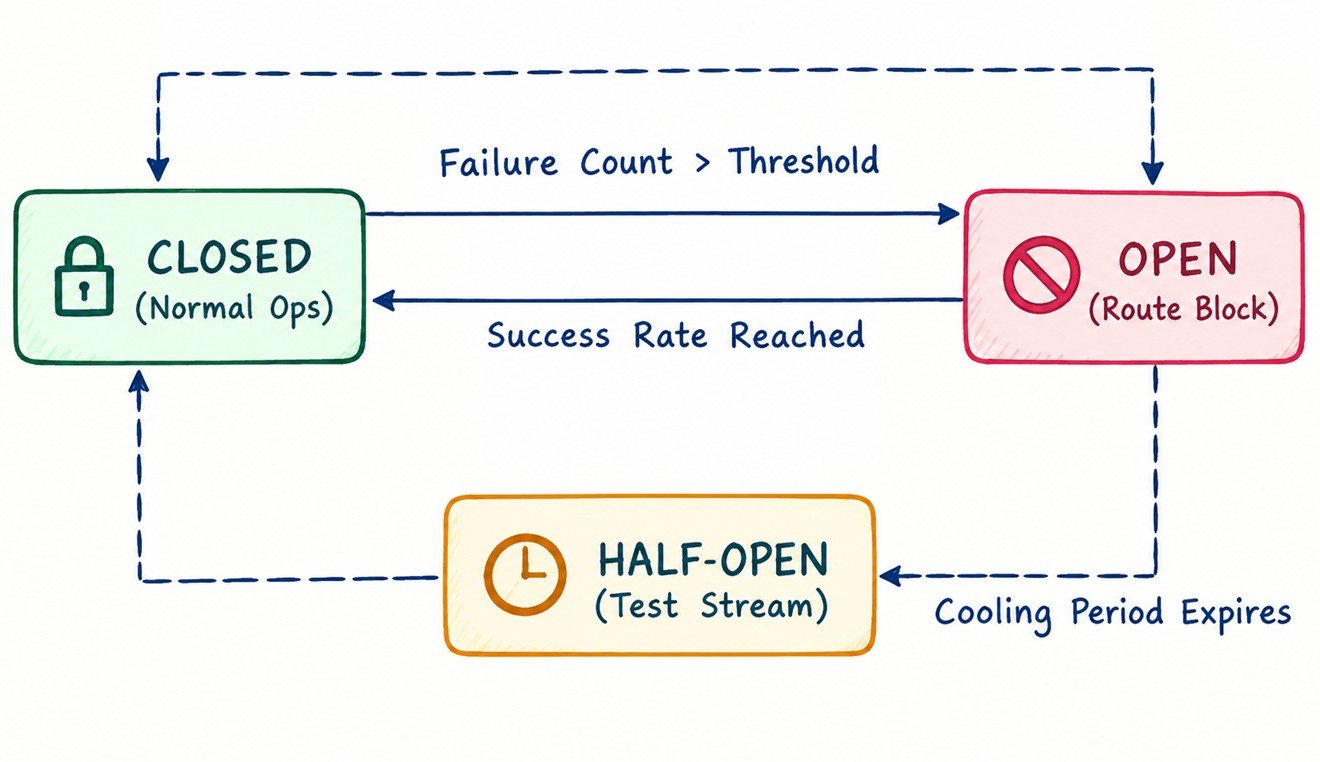
Traditional circuit breakers evaluate failure rates based solely on HTTP status codes. An AI-native circuit breaker must expand its state definitions to account for semantic and structural anomalies, isolating failing inference providers before an application-wide cascade collapse occurs.
-
Closed State: All requests route directly to the primary model provider. If the moving-window failure rate (combining HTTP 429/503 errors, P99 latency exceptions, and structural parse failures) crosses a configured limit (e.g., >15% over a 60-second window), the breaker trips into the Open State.
-
Open State: The breaker short-circuits all traffic immediately. Requests bypass the broken provider completely and route to pre-configured fallback models or cached storage layers. This prevents thread pool exhaustion and isolates the failure boundary.
-
Half-Open State: After a configured cooling-off window (e.g., 30 seconds), the circuit breaker transitions to a Half-Open State. It permits a small canary stream of traffic (e.g., 5% of total volume) to hit the primary provider. If the canary traffic processes cleanly without structural or latency errors, the breaker resets to the Closed State. If any canary request fails, the breaker trips back to Open, resetting the cooling timer.
4. Model Fallbacks and Provider Failover
Enterprise-grade architecture demands decoupling your applications from any single model endpoint or single infrastructure provider. True runtime survivability requires implementing Dynamic Model Routing and Graceful Degradation Tiers. This paradigm categorizes models not just by vendor, but by cost, intelligence density, and deployment architecture.
Granular Tiered Routing Strategy
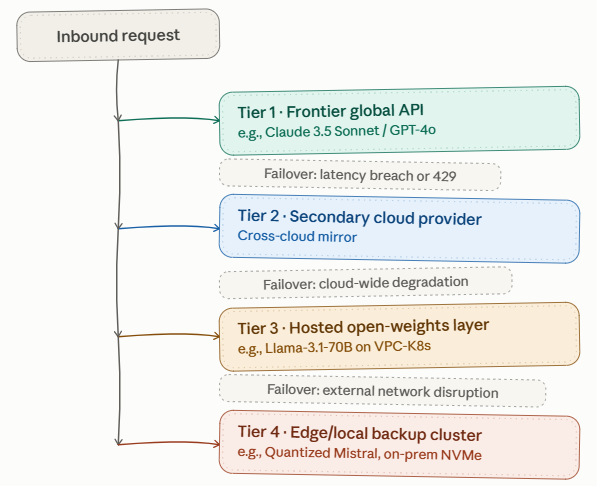
When a failure, rate limit, or timeout occurs on the primary tier, the system routes traffic down through increasingly localized and isolated layers:
-
Tier 1: Frontier Global APIs (Primary Path): Maximizes intelligence density and reasons over complex enterprise workflows.
-
Tier 2: Secondary Cloud Provider (Cross-Cloud Mirror): If Tier 1 suffers an outage, the system immediately switches to an equivalent frontier model hosted on a completely distinct cloud backbone.
-
Tier 3: Enterprise-Hosted Open-Weights Infrastructure: If external API networks drop, traffic fails over to open-weights models (like Llama-3.3-70B) running on your internal virtual private cloud (VPC) Kubernetes clusters backed by dedicated GPU node pools.
-
Tier 4: Localized Edge/On-Premises Failback: For highly critical offline workflows, a minimal viable processing layer is maintained via highly quantized small language models running on local hardware to handle core structured output classification tasks.
The Graceful Degradation Framework
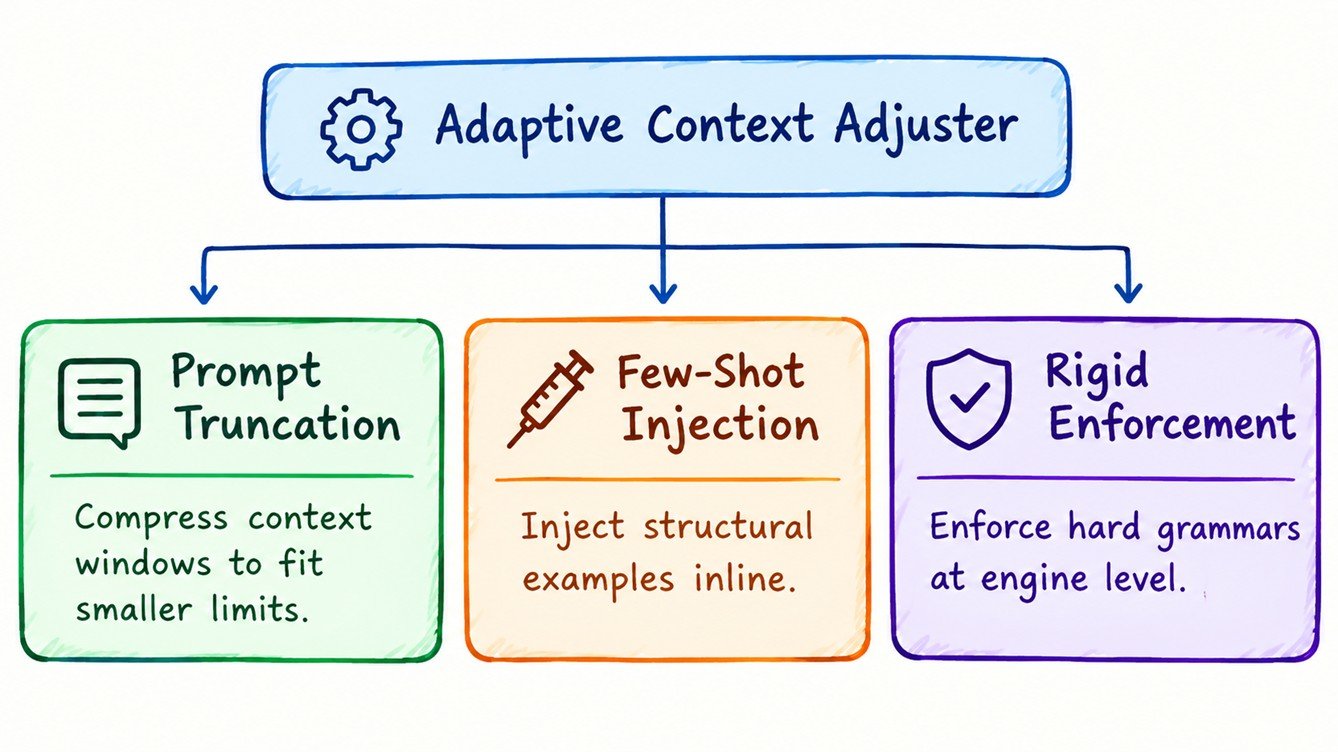
When failing over across distinct model tiers, your system must adjust its parameters dynamically to accommodate the lower reasoning density of smaller backup models. This adjustment is governed by three primary parameters:
-
Prompt Truncation and Compression: Smaller or local backup models have tighter context limits and less effective long-context retrieval capabilities. The routing layer must intercept the original broad prompt, strip out lower-priority metadata, and compress the context window using algorithmic semantic filters (such as token importance ranking) before sending it to the backup model.
-
Dynamic Few-Shot Injection: While a Tier 1 model can generate complex structured outputs from a zero-shot prompt instructions, a Tier 3 open-weights model often requires explicit architectural scaffolding. The fallback router must dynamically inject structural evaluation few-shot examples into the system prompt to keep output schemas aligned.
-
Rigid Execution Enforcement: When transitioning to smaller model tiers, disable raw text generation. Explicitly engage hardware-level token grammar tracking (such as vLLM guided decoding or Hugging Face logits processors) to force the open-weights model to step through the precise syntax tree required by your application schemas.
Executive Architectural Summary
Building an industrialized enterprise AI system means designing for structural and semantic survivability. By implementing a multi-tiered validation layer, token-aware timeouts, jittered exponential backoff, and cross-provider failover routing, you can transition your generative AI applications from fragile, unpredictable PoCs into highly reliable, fault-tolerant enterprise platforms.