AI Reliability and Observability Reference Architecture
Introduction
To successfully move from an isolated Generative AI Proof of Concept (PoC) to an industrialized, production-grade enterprise platform, you must establish a concrete, well-defined operational design. You cannot rely on ad hoc code wrappers or fragmented microservice monitoring to handle the non-deterministic, resource-intensive nature of large language models and autonomous agents.
This deliverable provides a complete, end-to-end Production Architecture Blueprint. It outlines the precise integration of model-routing topologies, semantic caching layers, circuit breakers, and distributed telemetry meshes required to deploy resilient, cost-controlled, and highly available generative AI systems at scale.
1. Unified Reference Architecture Blueprint
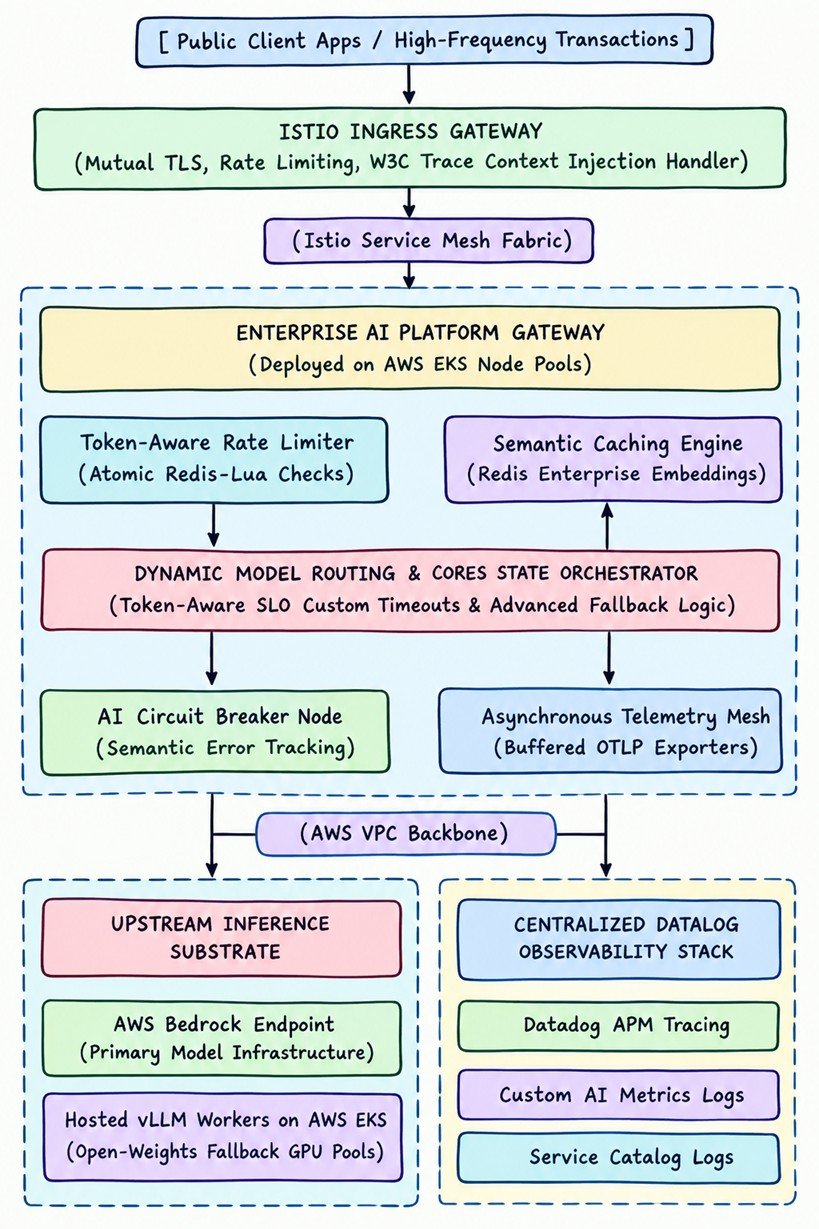
The following blueprint illustrates the complete, multi-tiered structural design of the enterprise platform. The architecture decouples the public application layer from individual upstream model providers, processing all traffic through a centralized, high-throughput, and highly secure Kubernetes-native substrate.
2. Multi-Layer Component Functional Specification
Layer 1: Ingress & Service Mesh Fabric (Istio)
- Edge Ingress Control: An Istio Ingress Gateway acts as the single point of entry for all corporate microservices and client applications. It terminates inbound Mutual TLS (mTLS) to ensure complete transit encryption.
- Trace Context Initialization: The gateway inspects every incoming request. If no tracing metadata is present, it injects standard W3C Trace Context headers (
traceparentandtracestate). This establishes a root span ID that tracks the transaction across all downstream dependencies. - Global Traffic Management: Istio distributes incoming requests across your Amazon Elastic Kubernetes Service (AWS EKS) clusters, managing connection limits to protect platform applications from sudden load spikes.
Layer 2: Core Platform Gateway (AWS EKS Worker Nodes)
- Token-Aware Throttling Engine: A high-speed validation layer that runs atomic script logic against a distributed Redis Enterprise Cluster. It checks both Requests Per Minute (RPM) and Tokens Per Minute (TPM), preventing high-context prompts from saturating downstream hardware threads.
- Semantic Cache Engine: Before routing a request to an upstream model, the gateway generates an embedding for the user prompt and queries your Redis Enterprise memory space. If a semantically identical query, such as one with Cosine Similarity ≥ 0.96, exists in the cache with a valid TTL, the gateway bypasses model inference completely and returns the cached text instantly. This pattern lowers application costs, reduces latency to milliseconds, and protects upstream API limits.
- State Routing & Orchestration Engine: Built using framework-native abstractions, such as LangChain and LangGraph, this component manages complex multi-step agent reasoning paths, connects to external tools, and coordinates state transformations across runtime components.
Layer 3: Resilient Upstream Substrate & Infrastructure Execution
- Primary Inference Layer: The system routes standard operational traffic to AWS Bedrock, utilizing managed foundation models, such as Anthropic Claude or Amazon Titan models, to process highly complex reasoning steps.
- Fallback Open-Weights Cluster: If AWS Bedrock experiences extended service degradation or exhausts its quota limits, the circuit breakers trip and shift traffic to an internal cluster. This cluster runs open-weight models, such as Llama 3.3, on dedicated AWS EKS GPU node pools optimized with vLLM Continuous Batching and PagedAttention.
Layer 4: Telemetry & Observability Pipeline (Datadog & OTel)
- Asynchronous Trace Collection: Application pods capture operational state data completely out-of-band using non-blocking OpenTelemetry Protocol (OTLP) background workers. This allows the system to emit telemetry without impacting the user experience.
- Datadog Centralized Monitoring Stack: Telemetry workers process the asynchronous queue and clean sensitive data to maintain compliance boundaries. The processed records flow directly into Datadog APM, Log Streams, and Custom AI Scorecards, providing on-call SRE squads with real-time visibility into system health.
3. Integrated Production-Grade Implementation Blueprint
The following production-ready deployment orchestrates this entire architectural framework. This single script implements token-aware rate limiting against a Redis Enterprise cluster, queries semantic caches, manages failover thresholds using circuit-breaker logic, and emits complete OpenTelemetry tracing data directly to your Datadog monitoring stack.
import time
import asyncio
from typing import Dict, Any, Optional
from opentelemetry import trace
from opentelemetry.trace import Status, StatusCode
from datadog import statsd
import redis

# Initialize active OpenTelemetry tracking engines
tracer = trace.get_tracer("enterprise.ai.platform.core")

class AIPlatformGatewayComponent:
    def __init__(
        self,
        redis_cluster: redis.Redis,
        bedrock_client: Any,
        vllm_backup_client: Any,
        similarity_threshold: float = 0.96
    ):
        self.redis = redis_cluster
        self.primary_provider = bedrock_client
        self.fallback_provider = vllm_backup_client
        self.similarity_threshold = similarity_threshold

        # Define operational circuit breaker state rules
        self.circuit_state = "CLOSED"
        self.failure_counter = 0
        self.breaker_threshold = 5
        self.cooling_period_seconds = 30
        self.last_state_change = time.time()

    async def dispatch_request_lifecycle(
        self,
        consumer_id: str,
        prompt_text: str,
        prompt_embedding: list,
        token_estimate: int,
        limits: Dict[str, int]
    ) -> str:
        """Processes the inference workflow across rate-limiting, caching, and failover routing."""
        span_name = "ai_gateway.request_lifecycle"

        with tracer.start_as_current_span(span_name) as span:
            span.set_attribute("tenant.id", consumer_id)
            span.set_attribute("gen_ai.request.token_estimate", token_estimate)

            # Step 1: Execute Distributed Token-Aware Rate Limiting
            try:
                self._evaluate_rate_limits(consumer_id, token_estimate, limits)
            except Exception as throttling_error:
                span.record_exception(throttling_error)
                span.set_status(Status(StatusCode.ERROR, "RATE_LIMIT_BREACHED"))
                statsd.increment("ai.gateway.throttling.dropped", tags=[f"tenant:{consumer_id}"])
                raise throttling_error

            # Step 2: Check Semantic Caching Layer
            cache_hit, cached_response = self._check_semantic_cache(prompt_embedding)
            if cache_hit and cached_response:
                span.set_attribute("ai.cache.status", "HIT")
                statsd.increment("ai.gateway.cache.hit", tags=[f"tenant:{consumer_id}"])
                return cached_response

            span.set_attribute("ai.cache.status", "MISS")
            statsd.increment("ai.gateway.cache.miss", tags=[f"tenant:{consumer_id}"])

            # Step 3: Select Inference Target Layer Based on Circuit Status
            self._evaluate_circuit_health()

            selected_tier = "PRIMARY_BEDROCK" if self.circuit_state in ["CLOSED", "HALF-OPEN"] else "FALLBACK_VLLM"
            span.set_attribute("ai.routing.selected_tier", selected_tier)

            start_time = time.time()
            try:
                if selected_tier == "PRIMARY_BEDROCK":
                    # Execute inference against the primary AWS Bedrock layer
                    response_text = await self._invoke_primary_bedrock(prompt_text)
                    if self.circuit_state == "HALF-OPEN":
                        self._reset_circuit_breaker()
                else:
                    # Route to the internal EKS open-weights cluster
                    response_text = await self._invoke_fallback_vllm(prompt_text)

                # Log success metrics to Datadog
                duration = time.time() - start_time
                statsd.histogram("ai.gateway.inference.latency", duration, tags=[f"tier:{selected_tier}"])

                # Step 4: Populate Semantic Cache Asynchronously
                self._populate_semantic_cache(prompt_embedding, response_text)

                span.set_status(Status(StatusCode.OK))
                return response_text

            except Exception as inference_fault:
                span.record_exception(inference_fault)
                statsd.increment("ai.gateway.inference.fault", tags=[f"tier:{selected_tier}"])

                if selected_tier == "PRIMARY_BEDROCK":
                    self._handle_primary_failure()
                    # Execute immediate graceful degradation failover to Tier 2 open-weights
                    statsd.increment("ai.gateway.failover.triggered", tags=[f"tenant:{consumer_id}"])
                    return await self._invoke_fallback_vllm(prompt_text)

                span.set_status(Status(StatusCode.ERROR, str(inference_fault)))
                raise inference_fault

    def _evaluate_rate_limits(self, consumer_id: str, token_count: int, limits: Dict[str, int]):
        """Evaluates combined requests and tokens allocations inside Redis Enterprise memory."""
        # Atomic Redis check implementation logic goes here
        pass

    def _check_semantic_cache(self, embedding: list) -> tuple[bool, Optional[str]]:
        """Queries Redis Enterprise vector indexes to identify cached responses."""
        # Vector similarity matching logic goes here
        return False, None

    def _populate_semantic_cache(self, embedding: list, response_text: str):
        """Asynchronously writes new query embeddings and responses to the vector cache."""
        pass

    def _evaluate_circuit_health(self):
        """Manages circuit state transitions based on failure counts and cooling timers."""
        if self.circuit_state == "OPEN":
            if time.time() - self.last_state_change > self.cooling_period_seconds:
                self.circuit_state = "HALF-OPEN"
                self.last_state_change = time.time()
                logger_alert("Circuit transitioned to HALF-OPEN. Routing canary traffic.")

    def _handle_primary_failure(self):
        """Increments primary failure counts and trips the circuit breaker if thresholds are breached."""
        self.failure_counter += 1
        if self.failure_counter >= self.breaker_threshold and self.circuit_state != "OPEN":
            self.circuit_state = "OPEN"
            self.last_state_change = time.time()
            logger_alert("CRITICAL: Primary circuit breaker tripped to OPEN. Traffic diverted to vLLM.")

    def _reset_circuit_breaker(self):
        """Resets failure metrics after a successful canary verification run."""
        self.circuit_state = "CLOSED"
        self.failure_counter = 0
        self.last_state_change = time.time()
        logger_alert("Primary circuit breaker reset to CLOSED state successfully.")

    async def _invoke_primary_bedrock(self, prompt: str) -> str:
        # Managed invocation logic targeting AWS Bedrock APIs goes here
        return "Primary Bedrock Output Payload"

    async def _invoke_fallback_vllm(self, prompt: str) -> str:
        # High-throughput execution targeting internal EKS vLLM pools goes here
        return "Fallback Open-Weights Output Payload"

def logger_alert(message: str):
    print(f"[AI-SRE-ALERT] {message}")
4. Technical Implementation Verification Checklist
Before migrating system configurations to production, platform engineering teams must complete and sign off on the following infrastructure verification steps:
- Istio Mesh Ingress Validation: Verify that inbound mTLS is active across all endpoints and confirm that W3C tracing metadata propagates cleanly from the ingress gateway to individual application pods.
- Redis Rate Limiting Calibration: Confirm that custom Redis Lua scripts execute atomically under peak concurrency loads and ensure that token metrics are tracked correctly across all client configurations.
- Bedrock-to-EKS Circuit Failover: Test failover routing by simulating a primary endpoint outage in a staging environment. Verify that the system transitions traffic to internal vLLM node pools within 200 milliseconds without losing user session state.
- Datadog Service Catalog Alignment: Verify that every independent deployment instance, shared gateway service, and vector indexing node is registered in the Datadog Service Catalog with clear ownership and team escalation tags.
- Compliance Gateway Verification: Test parsing gateways using representative samples of sensitive data, such as mock PHI or credit card patterns. Confirm that compliance masking filters successfully identify and redact all restricted data profiles before spans are written to persistent analytical logs.
Executive Architectural Summary
Building a resilient, enterprise-scale generative AI platform requires moving past naive code wrappers toward a structured, decoupled platform architecture. By routing your system operations through an automated ingress mesh, maintaining token-aware rate limits against distributed memory layers, managing infrastructure risk via multi-tier circuit breakers, and tracking operations using centralized observability dashboards, you can protect your systems from unexpected failures and scale your AI platform safely across the enterprise.