AI Site Reliability Engineering (SRE) and Operational Governance
Introduction
Traditional Site Reliability Engineering (SRE) manages software availability by applying automation to system operations. In classical deterministic microservice environments, SRE principles treat infrastructure stability, network state, and application logic as manageable boundaries. If a system experiences a regression, standard root-cause analysis looks for explicit failures, such as an unhandled null pointer exception, an out-of-memory container crash, or a network firewall misconfiguration.
However, generative AI systems invalidate traditional post-mortem playbooks. In an AI-native runtime, an incident rarely presents as a complete service outage. Instead, the platform degrades through probabilistic failure modes, such as an agent becoming stuck in a multi-turn logical loop, a subtle prompt injection causing data exfiltration, or a silent backend model update degrading the quality of downstream business reasoning.
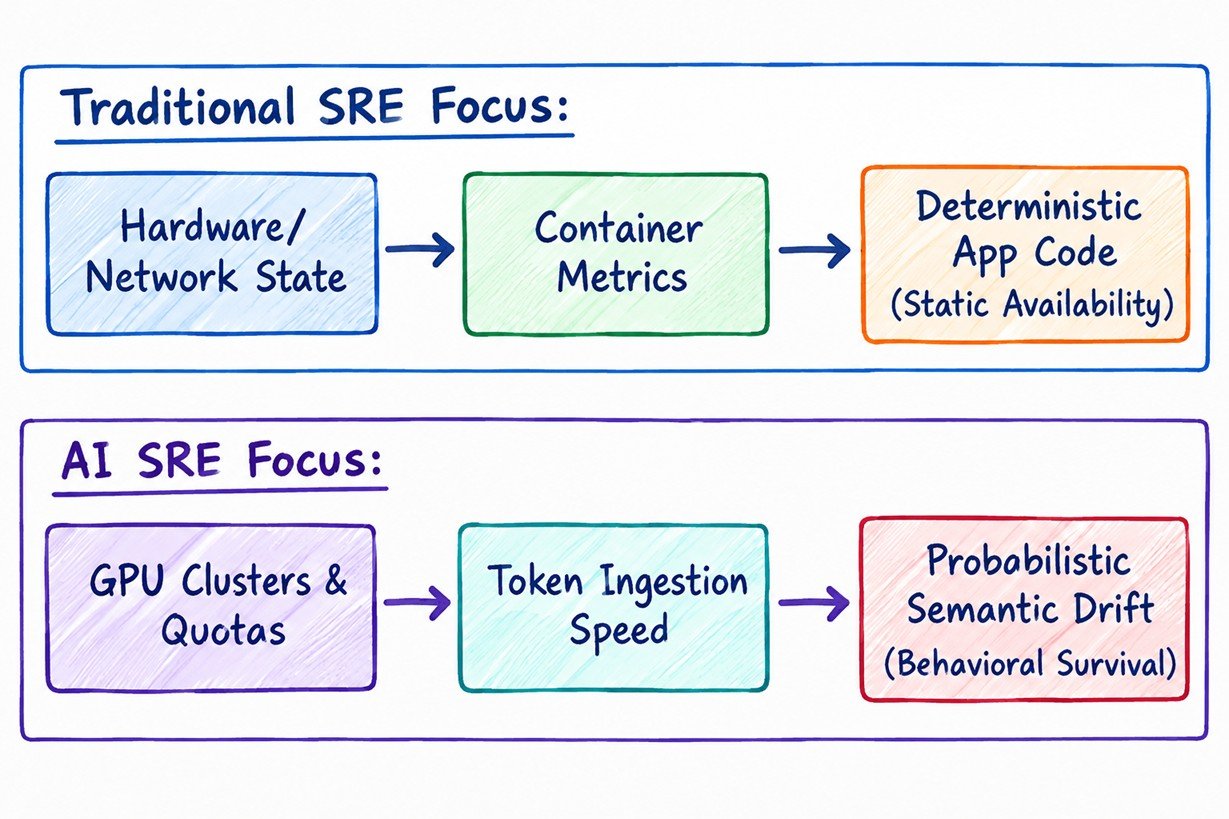
For technology leaders, keeping a production-grade AI platform stable requires evolving the operational playbook. You must transition from standard system monitoring to a specialized AI SRE framework. This section details the patterns required to run behavior-aware on-call operations, establish semantic Service Level Objectives (SLOs), and build automated mitigation playbooks that isolate non-deterministic failures before they impact business operations.
1. The AI SRE Paradigm
Deploying autonomous agents and large language models at enterprise scale changes the scope of production operations. The operational responsibility shifts from simply maintaining infrastructure availability to ensuring behavioral correctness and cost efficiency.
Evolving System Reliability Rules
Traditional SRE relies on the Four Golden Signals: Latency, Traffic, Errors, and Saturation. While these metrics remain essential for underlying container infrastructure, they are blind to several failure modes of large language models. The AI SRE paradigm introduces three unique operational risk domains:
- GPU Substrate and Memory Saturation: LLM inference performance is heavily bound by VRAM capacity and memory bandwidth. When hosting open-weight clusters, such as Llama 3.3 or Mistral models, out-of-memory (OOM) faults do not typically result from standard memory leaks. They can occur when long input prompts saturate Key-Value (KV) cache allocations.
- Stochastic Failure States: A system can remain perfectly healthy from an infrastructure perspective while producing incorrect outputs. A model can pass health checks and return HTTP 200 responses while generating toxic responses, violating safety guardrails, or hallucinating false information.
- Token Economic Volatility: Unlike traditional APIs with relatively stable resource consumption, AI application resource usage can be highly volatile. A single unconstrained user session can process millions of context tokens within minutes, rapidly exhausting enterprise API quotas and increasing operational costs.
Structural Squad Topology: The Centralized AI Platform SRE Team
To manage these unique risks, enterprises should move away from decentralized application team rotations. Instead, establish a dedicated, centralized AI Platform SRE squad.
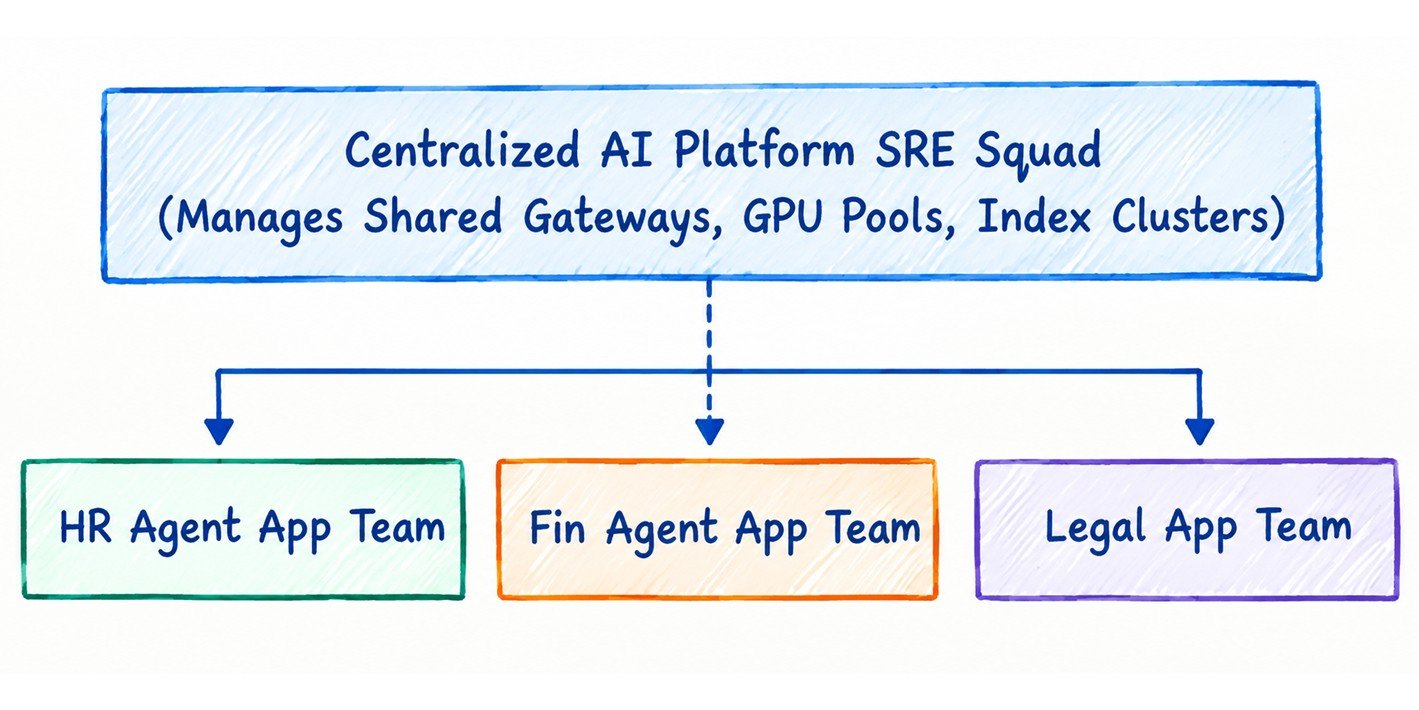
This centralized squad owns the core AI infrastructure layer, including shared model gateways, vector database instances, prompt registries, and continuous evaluation systems.
Application engineering teams focus on building business logic and conversation graphs using LangChain or LangGraph. The centralized AI SRE team manages the platform substrate, providing the deep infrastructure expertise required to handle complex failures such as distributed GPU thrashing and cross-region quota exhaustion.
2. AI SLOs and SLIs
To manage a system effectively, you must be able to measure it accurately. Traditional operational engineering metrics, such as 99.9% uptime, are no longer sufficient to describe the health of a probabilistic system. AI operations teams must translate user expectations into concrete Service Level Indicators (SLIs) and Service Level Objectives (SLOs) that track token generation performance, semantic quality, and financial impact.
Formulating Semantically Aware Service Level Definitions
Your operational monitoring should focus on four distinct pillars that measure the true end-user experience:
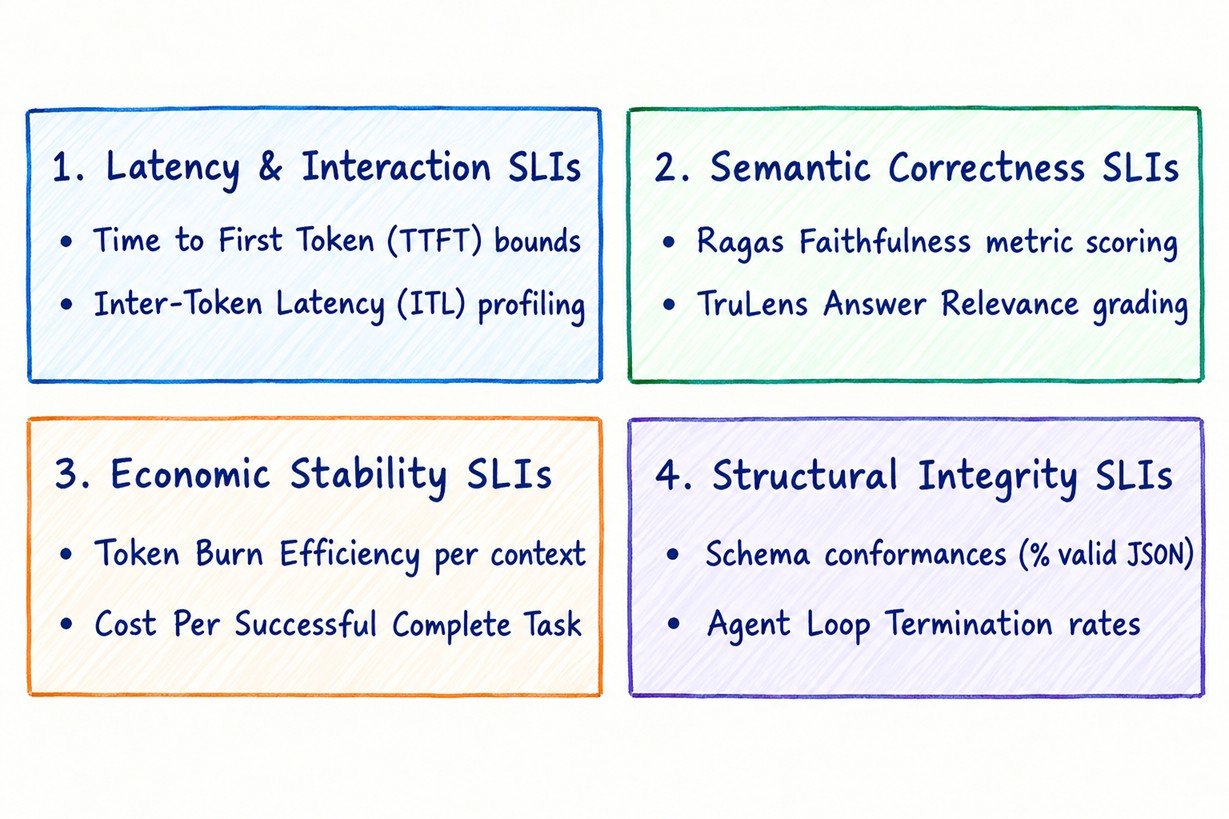
The Enterprise AI Reliability Scorecard
The following matrix shows how to structure production metrics to track the behavioral health of your AI platform:
| Core Service Category | Service Level Indicator (SLI) Formulation | Service Level Objective (SLO) Target | Business Impact and Justification |
|---|---|---|---|
| User Latency | The percentage of chat transactions where the Time to First Token (TTFT) is less than or equal to 1.2 seconds. | ≥ 99.0% over a rolling 30-day window. | Reduces user drop-offs by ensuring real-time application responsiveness. |
| Output Trust | The percentage of evaluated RAG transactions that maintain a Ragas Faithfulness score ≥ 0.85. | ≥ 99.5% over a rolling 7-day window. | Minimizes liability risks by identifying and stopping hallucinations early. |
| Structural Precision | The percentage of structured model outputs that parse into valid schemas without requiring fallback overrides. | ≥ 99.9% over a rolling 24-hour window. | Prevents system failures by protecting downstream microservices from corrupt data. |
| Cost Control | The average operational token cost spent to complete a successful user task transaction. | ≤ $0.05 per completed transaction per week. | Protects profitability by preventing runaway costs from unoptimized agent loops. |
3. AI Incident Management and Auto-Remediation
When an AI system fails in production, resolving the issue requires more than simply checking application logs. Your response framework must connect monitoring tools directly to automated mitigation systems, enabling you to isolate non-deterministic failures rapidly.
Automated Diagnostics with Datadog Service Catalog
Your operational framework should use the Datadog Service Catalog as the source of truth for all system dependencies. Every model-routing endpoint, vector search index, and LangGraph agent node should be registered as an independent service within the catalog.
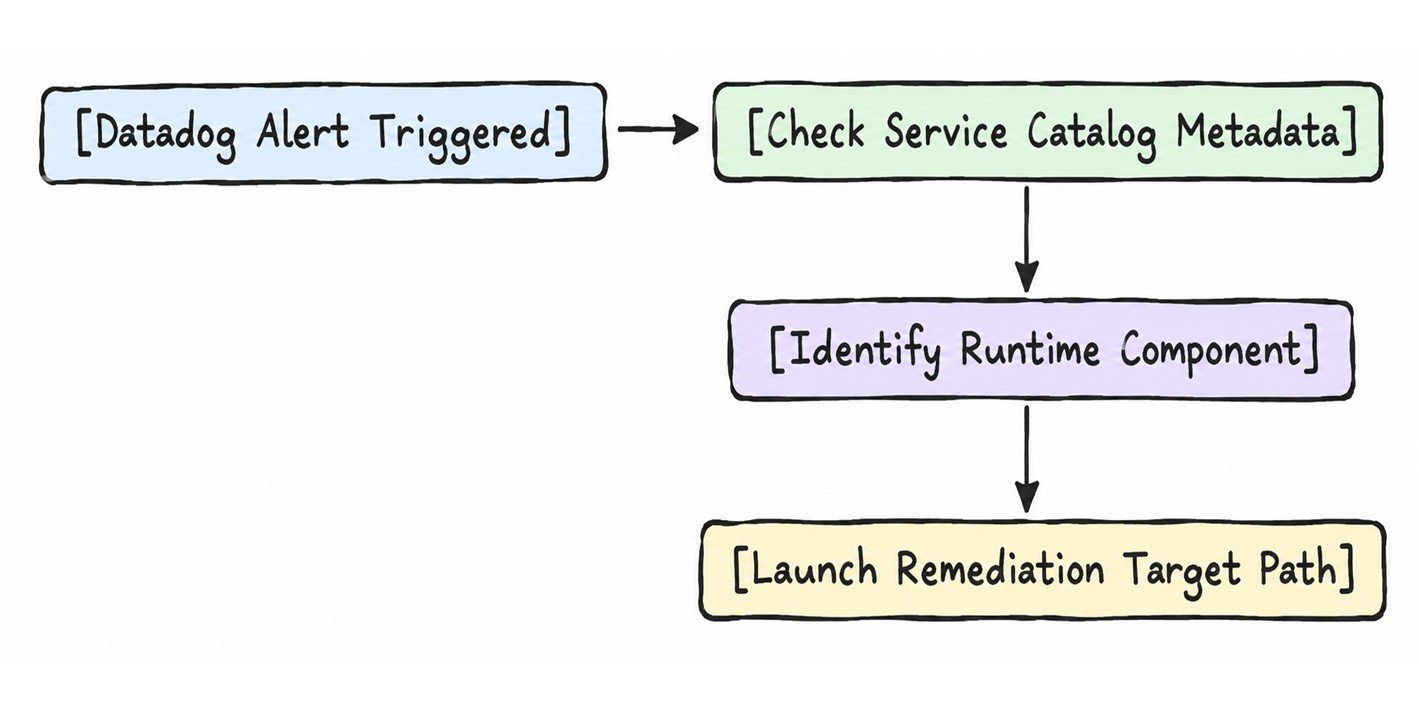
When an alert fires, Datadog cross-references the trace context with your service registry metadata. This allows the system to determine immediately whether a latency spike stems from an infrastructure failure on a specific GPU node or an issue with an upstream model provider API.
Two-Tier Remediation Architecture
To balance platform stability with safety, your SRE teams should organize automated response actions into a two-tier framework:
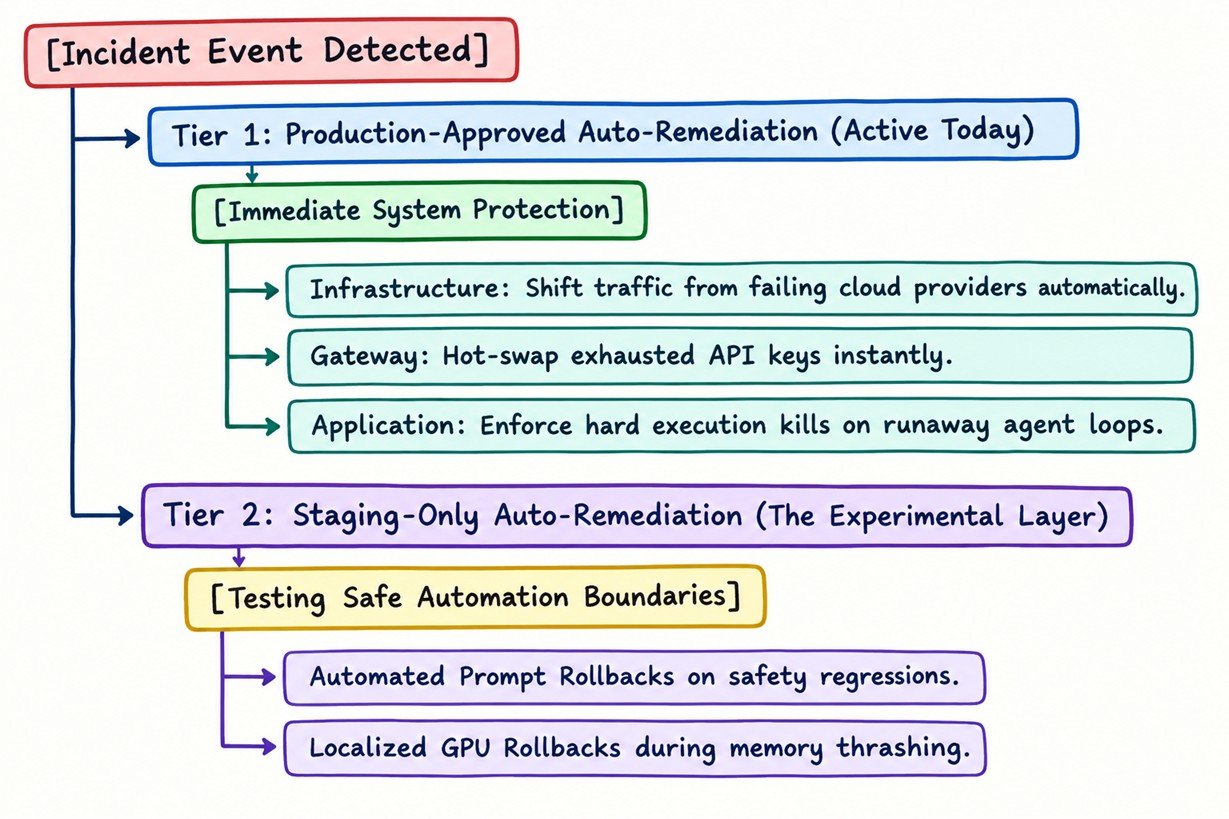
- Tier 1: Production-Approved Auto-Remediation (Active Today): These actions run automatically in production to protect system availability. If an upstream provider returns persistent rate-limit errors (HTTP 429), the gateway immediately shifts traffic to alternative backup regions. If a LangGraph agent enters an infinite loop, the system terminates execution, logs the incident to Datadog, and returns a safe fallback message to the user.
- Tier 2: Staging-Only Auto-Remediation (The Experimental Layer): This layer serves as a testing ground for advanced automation. If a prompt update causes a regression in evaluation scores during staging, the system can automatically test rolling back the prompt template in the registry. These patterns are thoroughly validated in staging environments before being promoted to production workflows.
Production Implementation: AI-Native Incident Remediation Controller
The following production-grade script demonstrates how to implement an automated mitigation controller. This component integrates directly with Datadog alerts, parses incident context, and executes isolated remediation playbooks to protect the production runtime.
import os
import logging
from typing import Dict, Any
from datadog import statsd

logger = logging.getLogger("enterprise.ai.sre.remediation")

class AIRemediationEngine:
    def __init__(self, datadog_catalog_client: Any, gateway_router_client: Any):
        self.catalog = datadog_catalog_client
        self.router = gateway_router_client

    async def process_incident_webhook(self, datadog_alert_payload: Dict[str, Any]) -> bool:
        """Parses inbound Datadog alerts and triggers the appropriate auto-remediation playbook."""
        event_id = datadog_alert_payload.get("id", "unknown_event")
        target_service = datadog_alert_payload.get("service_name")
        failure_mode = datadog_alert_payload.get("alert_type") # e.g., "AGENT_INFINITE_LOOP", "API_QUOTA_EXHAUSTED"

        logger.warning(f"Incident detected: Event ID {event_id} targeting service '{target_service}'. Failure mode: {failure_mode}")
        statsd.increment("ai.sre.incident.received", tags=[f"service:{target_service}", f"failure:{failure_mode}"])

        # 1. Verify service registration within the Datadog Service Catalog
        if not self._validate_catalog_entry(target_service):
            logger.error(f"Remediation halted: '{target_service}' is not registered in the Datadog Service Catalog.")
            return False

        # 2. Route the incident to the appropriate remediation playbook
        try:
            if failure_mode == "API_QUOTA_EXHAUSTED":
                return await self._execute_api_key_failover(target_service)

            elif failure_mode == "AGENT_INFINITE_LOOP":
                return await self._execute_agent_loop_quarantine(target_service, datadog_alert_payload)

            else:
                logger.error(f"Remediation playbook for failure mode '{failure_mode}' is not defined.")
                return False

        except Exception as execution_fault:
            logger.critical(f"Auto-remediation failed for event ID {event_id}: {str(execution_fault)}")
            statsd.increment("ai.sre.remediation.critical_error", tags=[f"service:{target_service}"])
            return False

    def _validate_catalog_entry(self, service_name: str) -> bool:
        """Confirms the service is registered with valid ownership tags in the catalog."""
        # Integrates with Datadog Service Catalog API endpoints
        catalog_metadata = self.catalog.get_service_metadata(service_name)
        return catalog_metadata is not None and "ai_platform_sre" in catalog_metadata.get("teams", [])

    async def _execute_api_key_failover(self, service_name: str) -> bool:
        """Swaps exhausted API keys or shifts endpoints instantly to protect platform uptime."""
        logger.info(f"Executing provider failover playbook for service '{service_name}'...")

        # Shift routing targets at the gateway level
        success = await self.router.shift_traffic_to_backup_region(service_name)

        if success:
            statsd.increment("ai.sre.remediation.success", tags=[f"service:{service_name}", "action:key_failover"])
            logger.info(f"Provider failover completed successfully for service '{service_name}'.")
            return True
        return False

    async def _execute_agent_loop_quarantine(self, service_name: str, payload: Dict[str, Any]) -> bool:
        """Terminates runaway agent execution loops to prevent resource starvation."""
        active_session_id = payload.get("session_id")
        logger.info(f"Executing agent quarantine playbook for session ID '{active_session_id}'...")

        # Enforce an immediate hard kill on the target execution graph thread
        success = await self.router.kill_active_agent_thread(active_session_id)

        if success:
            statsd.increment("ai.sre.remediation.success", tags=[f"service:{service_name}", "action:loop_quarantine"])
            logger.warning(f"Runaway agent thread for session '{active_session_id}' has been isolated and terminated.")
            return True
        return False
Executive Architectural Summary
Operating a resilient enterprise AI platform requires moving past traditional uptime metrics toward behavior-aware system reliability engineering. By establishing a centralized AI SRE team, defining semantic SLOs that monitor the true end-user experience, and deploying automated remediation playbooks linked directly to the Datadog Service Catalog, you can ensure your generative AI platforms remain stable, secure, and cost-effective at scale.