The Paradigm Shift - Why Traditional QA Fails in a Non-Deterministic World
Introduction
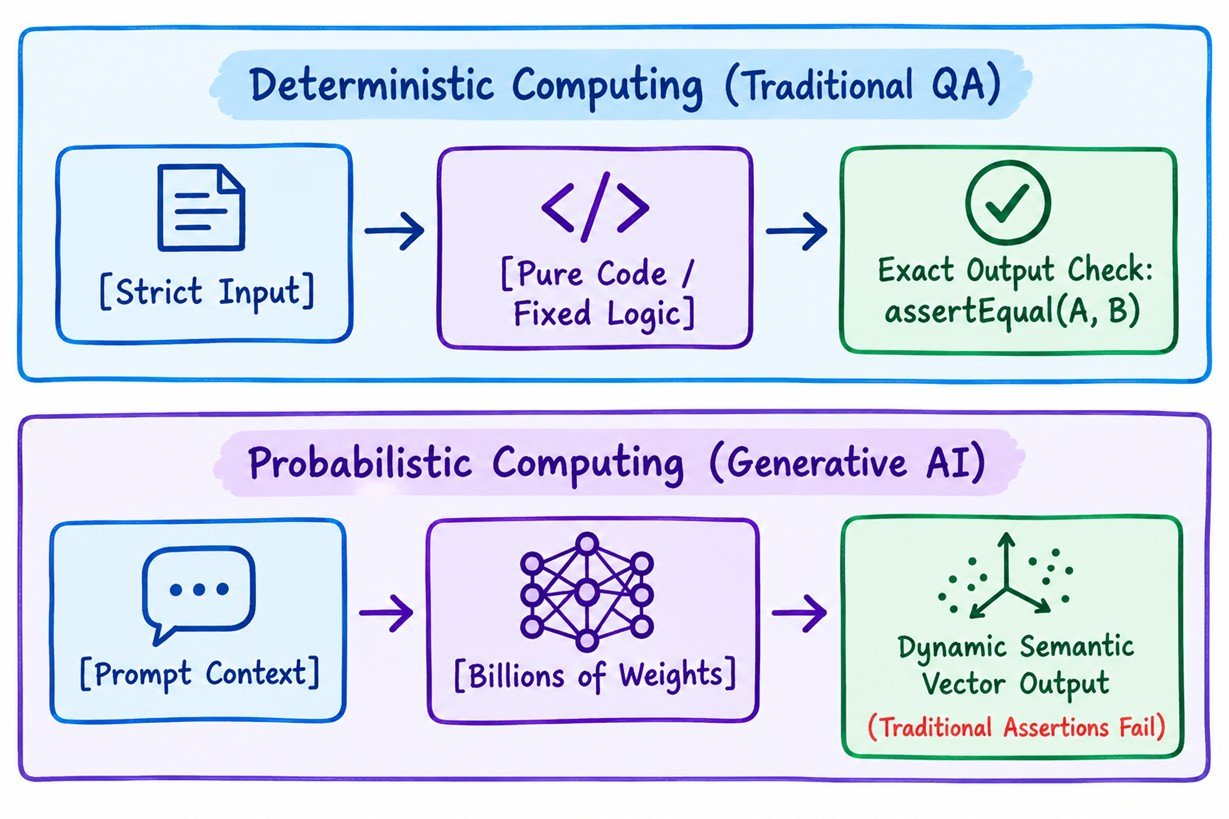
For decades, enterprise software engineering has operated under a comforting, mathematical absolute: determinism. If input A passes through pure function B, it will invariably yield output C. If it does not, you have a bug. This core assumption birthed our modern Quality Assurance (QA) industry, anchoring everything from unit-testing frameworks (like JUnit or pytest) and integration pipelines to strict code-coverage thresholds and automated Selenium sweeps.
When applied to Large Language Models (LLMs) and multi-agent systems, this entire foundational structure collapses.
Generative AI fundamentally changes the underlying math of computing. We have transitioned from processing explicit instructions to orchestrating probabilistic systems. In this non-deterministic world, the exact same input prompt submitted to the exact same model instance can generate radically different text responses on successive calls, even with the model temperature set to zero.
For technology leaders, this transition requires more than just updating a toolset; it demands a total restructuring of how we measure quality, mitigate risk, and engineer confidence.
The Failure of Assertions: The Blindness of Traditional Metrics
Traditional software testing relies on absolute boundaries: strict assertions (assertEqual, assertTrue, assertNotNone). These constraints check specific data types, exact string matches, or strict schema compliance. However, an LLM's primary currency is human language, a medium defined by nuance, semantics, and context. Traditional automated QA is structurally blind to these dimensions, failing in two primary areas:
The Blind Spot of Code-Coverage and Structural Tests
Code-coverage metrics, such as Statement, Branch, or Path Coverage, measure how much of your written source code executes during a test run. In an LLM application, your core application logic often amounts to a small wrapper, such as a Python or TypeScript script that orchestrates a prompt, appends user context, calls an API endpoint, and forwards the response.
You can achieve 100% code coverage on an orchestration layer in a single afternoon. Yet, this metric tells you absolutely nothing about the safety, accuracy, or business viability of the model's output.
The actual logic of a generative application resides within billions of parameters frozen inside a neural network, entirely unreachable by traditional code analysis.
Why String Matching Fails Semantic Evaluation
Consider a customer-facing financial assistant designed to explain credit card terms. If a user asks, "What is my grace period?", the model might respond on Monday with:
"You have 21 days from the closing date to pay your balance without incurring interest."
On Tuesday, the same query might yield:
"Interest charges will not apply if your statement balance is settled within 21 days of the billing cycle end."
To a human or a semantic evaluator, these two responses are identical in meaning. To an automated string-matching script or regex checker, they are completely different. Conversely, a flawed model might hallucinate and output:
"You have 21 months from the closing date to pay your balance without incurring interest."
Because the structure, length, and vocabulary of this hallucination closely mimic the valid responses, simple regex and edit-distance checks, such as Levenshtein distance, will often register it as a near-perfect match. Traditional assertions cannot distinguish between a subtle typographical variance and an expensive, legally non-compliant financial hallucination.
The Challenge of Conversational Context
Traditional unit tests isolate a single component and evaluate it in a static state. LLMs, however, operate inside dynamic conversational histories. A response that appears perfectly valid in isolation may become completely inaccurate, tone-deaf, or highly insecure when evaluated against preceding dialogue turns.
Legacy testing frameworks are not built to evaluate stateful, multi-turn semantic drift. They cannot determine if an agent is slowly veering off its core mission or leaking internal context over a prolonged conversation.
The Confidence Engineering Stack: Shifting the Leadership Mindset
To move Generative AI from a fragile Proof of Concept (PoC) to an enterprise-grade production system, technology leaders must replace the binary mindset of "Pass/Fail" with a new discipline: Confidence Engineering.
Instead of searching for a non-existent state of zero bugs, leadership must learn to manage statistical error margins, establish acceptable ranges of linguistic variability, and build automated guardrails that isolate boundary risks in real time.
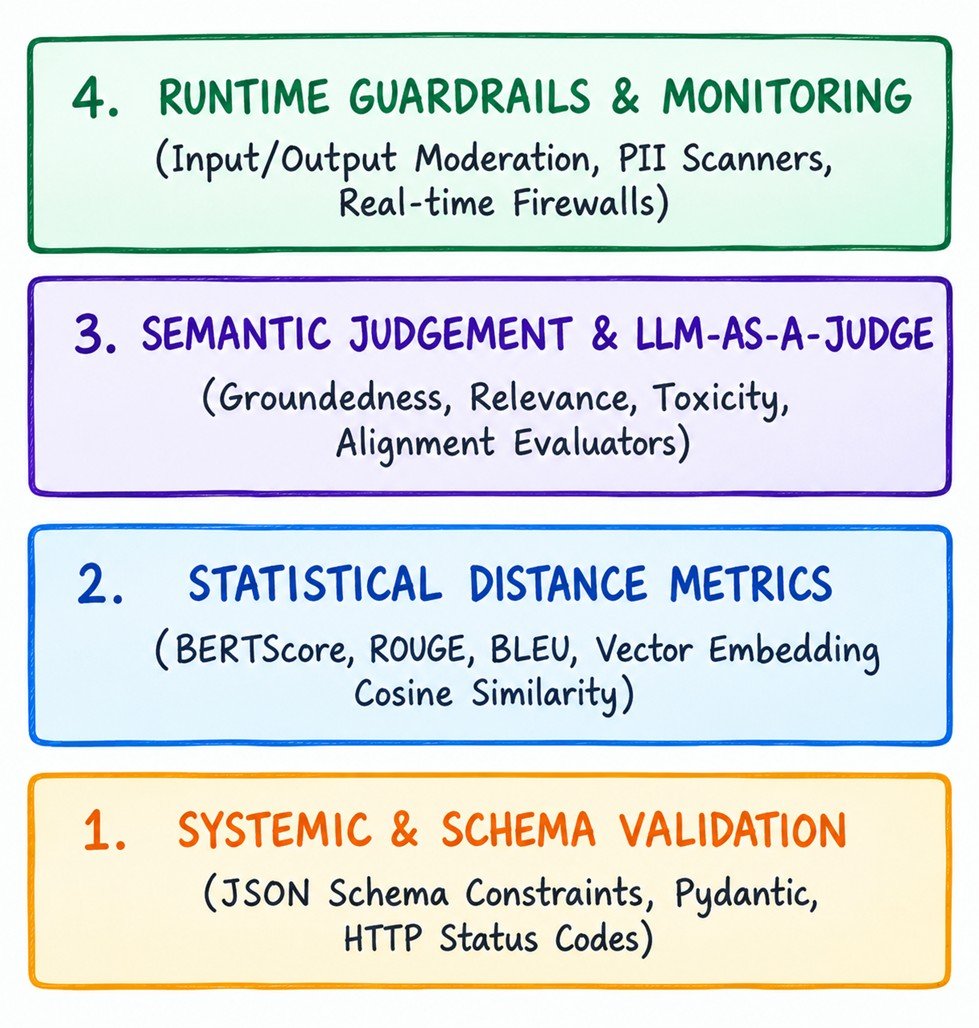
Layer 1: Systemic & Schema Validation (The Baseline)
While traditional assertions cannot evaluate meaning, they are still necessary for checking structure. This layer uses libraries like Pydantic or strict JSON Schema configurations to ensure the model outputs parseable data structures. If a downstream service requires an array of integers, this layer enforces that shape before any semantic evaluation happens.
Layer 2: Statistical Distance Metrics (The Syntactic Bridge)
To transition from hard strings to meaning, we use NLP metrics like ROUGE, BLEU, or BERTScore. Rather than looking for exact characters, these algorithms analyze token overlap and phrase distribution against a known Golden Dataset, a curated collection of high-quality, human-verified prompt-and-response pairings.
By measuring the mathematical distance between the model's output and the golden reference, we can establish an automated baseline for language drift.
Layer 3: Semantic Judgement & LLM-as-a-Judge (The Core)
This layer evaluates complex qualitative dimensions like Groundedness (Is the answer supported only by the provided context?), Relevance (Did the model actually answer the user's question?), and Toxicity.
By using advanced, fine-tuned models acting as objective judges, guided by strict, multi-shot scoring rubrics, we can turn qualitative evaluation into reproducible quantitative data. This allows engineering teams to chart model accuracy across releases just like traditional performance graphs.
Layer 4: Runtime Guardrails & Monitoring (The Perimeter)
Because you cannot predict every possible user input or model output during design time, the final layer sits directly in the production data pathway. Runtime firewalls, such as Llama Guard or NeMo Guardrails, inspect incoming prompts for injection attacks and analyze outgoing responses for PII leaks, brand violations, or hallucinations before they ever reach an end user.
Moving Beyond Binary Quality
For a CTO or VP of Engineering, success in the era of Generative AI requires changing how we define software quality. We must accept that our systems are probabilistic.
Our goal is no longer to eliminate all non-determinism, but to measure it, contain it, and manage its risks systematically.
By trading binary QA assertions for a modern Confidence Engineering Stack, organizations can build the architectural guardrails necessary to safely ship resilient, scalable, and economically viable AI applications to production.