Specialized Evaluation Scopes - From RAG to Autonomous Agents
Introduction
As enterprise applications transition from simple prompt-and-response interfaces to complex, multi-component architectures, a monolithic evaluation strategy becomes inadequate. Testing an advanced AI system as a single black box makes it impossible to isolate the root cause of a failure. A decline in user satisfaction might stem from a hallucinating model, or it could be caused by an upstream retrieval engine fetching outdated corporate data.
To manage this complexity, technology leaders must divide their evaluation architecture into Specialized Evaluation Scopes. By isolating and measuring the unique failure modes of both Retrieval-Augmented Generation (RAG) pipelines and multi-agent autonomous workflows, engineering teams can implement targeted, programmatic fixes rather than relying on trial-and-error prompt tuning.
1. Deconstructing the RAG Evaluation Matrix: Component-Level Isolation
A Retrieval-Augmented Generation (RAG) system is essentially a pipeline with two distinct phases: an information retrieval phase (the database query) and an information synthesis phase (the language generation). Evaluating a RAG application requires measuring both components independently.
The industry standard for this specialized isolation is the RAG Triad framework, which breaks evaluation down into three distinct, measurable vectors:
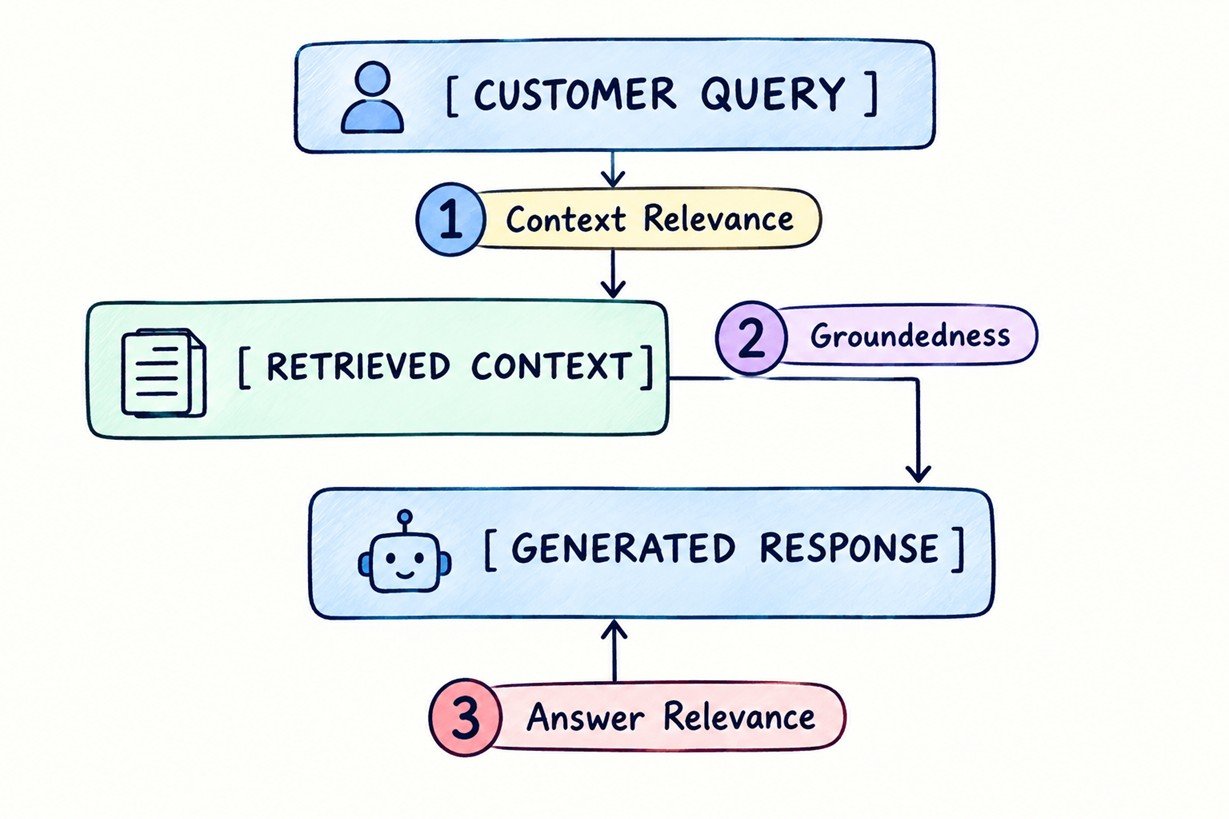
1. Context Relevance (Evaluating the Retrieval Phase)
- The Core Question: Did the system fetch the exact documents needed to answer the user's query, or did it pull in unrelated noise?
- The Metric: Measures the ratio of useful, actionable information within the retrieved text snippets relative to the user's prompt.
- Engineering Fix for Poor Scores: If context relevance scores drop, the issue lies in your data ingestion layer. Engineers should optimize the embedding model, adjust chunk sizes, tune the overlapping strategy, or implement a cross-encoder reranker to better filter vector database outputs before passing them to the LLM.
2. Groundedness / Faithfulness (Evaluating the Generation Phase)
- The Core Question: Is the model's generated answer derived strictly and exclusively from the retrieved context, or did it introduce unverified facts from its pre-training weights?
- The Metric: Measures the percentage of claims in the generated response that can be mathematically mapped back to explicit statements in the retrieved documents.
- Engineering Fix for Poor Scores: If groundedness drops, the model is hallucinating. This can be resolved by tightening system prompt constraints (e.g., "If the provided context does not contain the answer, explicitly state that you do not know"), lowering model temperature, or switching to a model with stronger context window alignment.
3. Answer Relevance (Evaluating the Overall System Utility)
- The Core Question: Did the model actually answer the user's original question, or did it dodge the query with boilerplate text?
- The Metric: Measures how closely the semantic intent of the final output aligns with the core intent of the initial user prompt.
- Engineering Fix for Poor Scores: Low answer relevance typically points to systemic prompt drift or over-constrained system instructions. It suggests the model is so focused on safety or formatting boundaries that it fails to fulfill the user's core request.
2. The Multi-Agent Evaluation Frontier: Measuring Chain-of-Thought and Tool Usage
Moving from a linear RAG pipeline to an Autonomous Agent system introduces significant non-determinism. Autonomous agents do not follow a fixed execution path. They are given a goal, a set of tools (such as database connections, APIs, or calculators), and the autonomy to plan their own step-by-step actions.
Evaluating an agentic architecture requires moving past static output checks and focusing heavily on process tracing, evaluating how the agent makes decisions, handles tool outputs, and manages multi-turn logic loops.
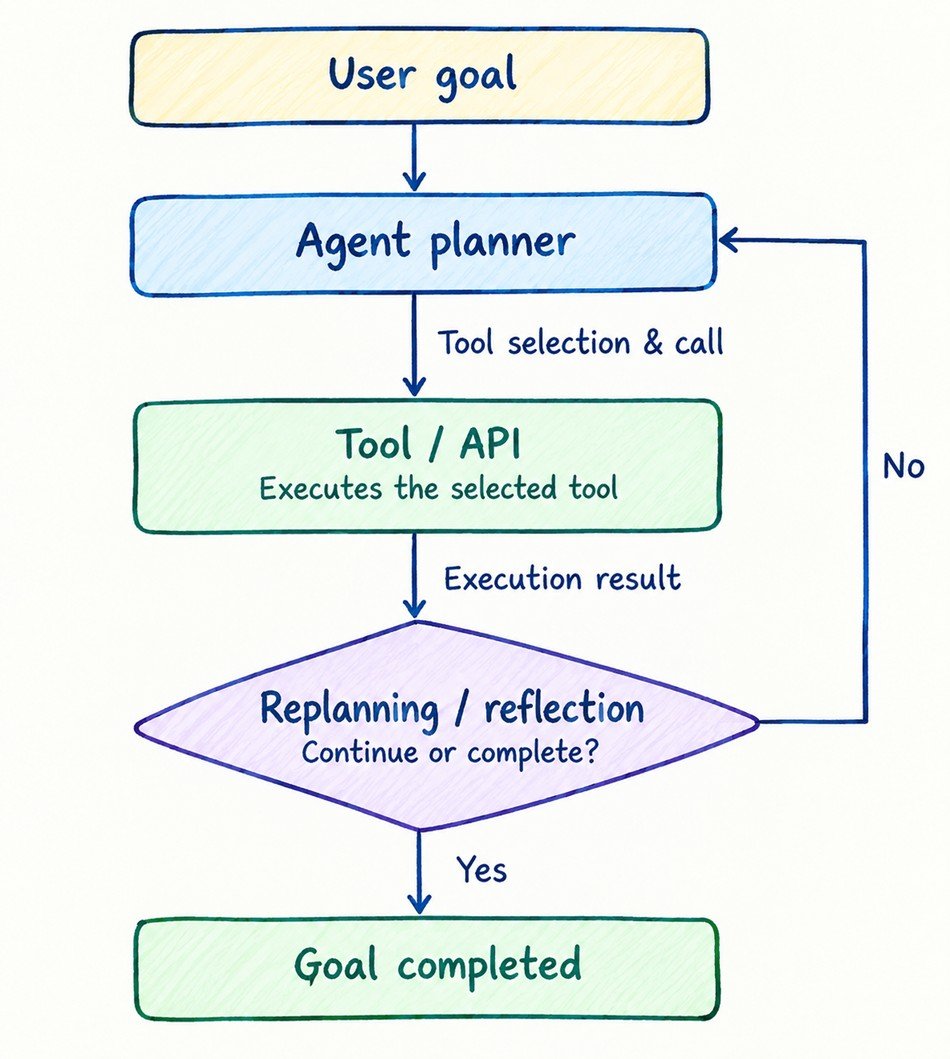
Key Pillars for Agentic Evaluation
1. Tool Selection Accuracy and Parameter Extraction
- The Vulnerability: An agent might choose the wrong API for a given task (e.g., calling a
delete_usertool instead ofupdate_user), or extract parameters in the wrong format (e.g., passing a date asDD/MM/YYYYwhen the underlying system requires an ISO timestamp). - The Evaluation Metric: Teams must maintain tool execution test suites. These verify that when presented with a specific user intent, the model calls the correct tool function with accurately mapped argument signatures.
2. Loop Detection and Execution Efficiency
- The Vulnerability: When a tool returns an unexpected error message or empty payload, a poorly engineered agent can fall into an infinite execution loop, continually retrying the same faulty tool call, consuming thousands of tokens, and driving up runtime latency.
- The Evaluation Metric: The evaluation harness must parse agent execution traces to calculate the Step-to-Resolution Ratio. If an agent takes ten reasoning steps to complete a task that typically requires three, or if it repeats identical tool-call sequences back-to-back, the test case flags a structural execution failure.
3. Resilience to Negative Tool Feedback
- The Vulnerability: Real-world enterprise APIs fail, time out, or throw permission errors. An autonomous agent must be resilient enough to handle these operational hurdles gracefully.
- The Evaluation Metric: The testing pipeline should use chaos engineering tactics, deliberately feeding synthetic errors, timeouts, or malformed data schemas into the agent's tool execution channel. The agent passes the test only if it can catch the error, re-plan its approach, or gracefully communicate the system limitation to the user without crashing.
Implementing Domain-Specific Evaluation
For a technology leader, scaling an enterprise AI footprint means moving away from a one-size-fits-all QA strategy. By splitting the evaluation framework into specialized scopes, engineering teams can establish a clear line of sight into exactly where a system is failing.
Whether diagnosing a vector chunking issue within a RAG pipeline or fixing an infinite loop inside an autonomous agent, component-level metrics provide the clear engineering data required to maintain a resilient, production-ready AI ecosystem.