Enterprise AI Evaluation Framework
Introduction
For technology executives, an architectural philosophy is only as good as its operational execution. To transition from the theoretical concepts explored throughout Chapter 7 into a repeatable, legally defensible, and highly scalable enterprise asset, engineering organizations must deploy a formalized Enterprise AI Evaluation Framework (EAIEF).
This deliverable provides the executive leadership team (CTOs, VPs of Engineering, and Chief Risk Officers) with the definitive blueprint, organizational structure, and architectural checklist required to run production-grade generative AI systems safely.
1. The Production Readiness Checklist: The Go/No-Go Gate
Before any Generative AI application, Retrieval-Augmented Generation (RAG) pipeline, or autonomous agent is granted access to live corporate data or external customer traffic, it must pass a mandatory, multi-disciplinary review gate. This checklist serves as the final, immutable boundary separating a fragile Proof of Concept from an enterprise-grade production asset.
Architectural & Data Readiness Checklist
- Golden Dataset Versioning Alignment: The application code deployment must be deterministically pinned to a specific, version-controlled state of the validation data matrix (e.g., matching a
dvcorgit-lfshash identifier). - Syntactic & Schema Enforcement: Downstream systems must be completely protected by strict runtime typing configurations (such as Pydantic or Instructor schemas), with zero tolerance for untyped or loosely structured string payloads.
- Vector Database Chunk Integrity: For all RAG-enabled workflows, chunking strategies must be documented, and index refresh schedules must be locked to prevent historical context fragmentation.
Safety, Governance, and Alignment Checklist
- Automated PII Scrubbing Sign-Off: Runtime testing must confirm a 100% masking rate for primary data categories (including SSNs, credit card tokens, and corporate account routing numbers) passing through public API layers.
- Adversarial and Jailbreak Stress Testing: The candidate model variant must maintain its system prompt boundaries against a minimum of 200 distinct automated prompt injection variations, showing a Jailbreak Deflection Rate of > = 98%.
- Legal Compliance Alignment: Core system prompts must be audited by internal compliance teams to guarantee output bounds do not violate corporate liability limits or regional consumer protection laws.
Statistical Performance & Cost Checklist
- Distribution Performance Baseline: The candidate model must show no statistically significant drop in semantic groundedness compared to the current production baseline, verified via a Student's t-test with a p-value significance threshold (alpha) set strictly to 0.05.
- Per-Transaction Budget Bounding: The application's moving cost baseline must not exceed a predefined financial ceiling (e.g., $0.02 per standard multi-turn interaction), preventing unconstrained compute spend under heavy load.
- Latency Threshold SLA: The model infrastructure must meet performance SLAs under load, achieving a Time-to-First-Token (TTFT) of < = 400 milliseconds for 95% of active sessions (P_95).
2. Operating Model: The AI Trust & Evaluation Committee (TEC)
Building the technology stack represents only one half of the transformation equation; the other half requires establishing the organizational structure to govern it. Enterprise organizations must form a cross-functional AI Trust & Evaluation Committee (TEC) to break down operational silos and manage the lifecycle of AI performance, safety, and spending.
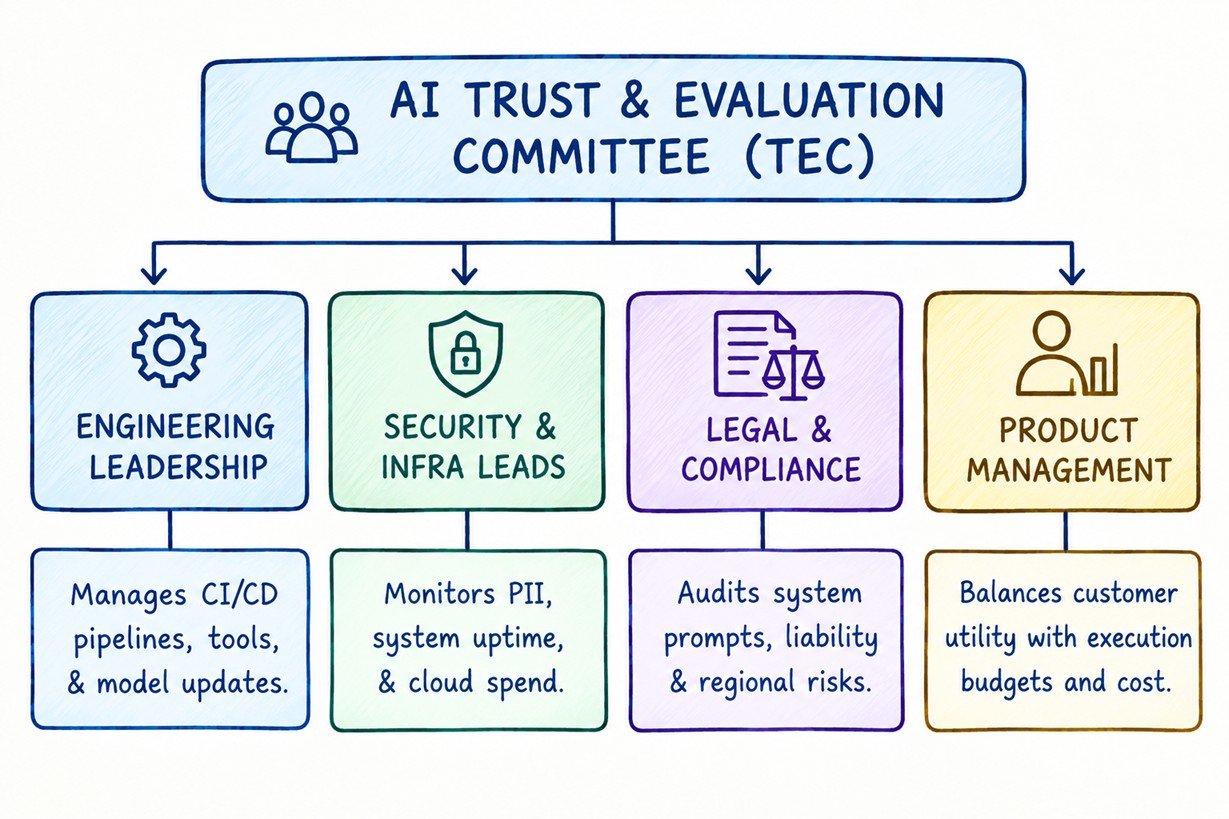
The Core Composition of the TEC
- Engineering Leadership (VPs/Directors of AI Engineering): Responsible for maintaining the evaluation infrastructure, managing continuous integration (CI) test execution, and resolving model regression alerts.
- Security & Infrastructure Leads (CISO/DevSecOps): Responsible for tracking production telemetry anomalies, managing real-time guardrail policies, monitoring PII exposures, and overseeing cloud compute budgets.
- Legal & Compliance Counsel (Chief Risk Officers): Responsible for auditing system prompts, validating golden datasets against regulatory standards, and approving the deployment of applications into highly regulated customer segments.
- Product Management (Director of Product): Responsible for balancing user experience metrics against system constraints, managing accuracy tradeoffs, and aligning model utility goals with business requirements.
The Operational Governance Lifecycle
- Weekly Matrix Refreshes: The committee reviews anomalous production traffic caught by Tier 4 human-in-the-loop dashboards. Verified edge cases are scrubbed, categorized, and added to the Enterprise Golden Dataset Repository to ensure the test suite evolves alongside real-world usage.
- Monthly Prompt & Alignment Audits: System prompt directives, tool schemas, and safety guardrail settings are collectively audited to adjust for updated brand guidelines, new product lines, or shifting legal constraints.
- Quarterly Strategic Rebalancing: The committee assesses the financial value versus compute cost of all running models. It makes high-level decisions to migrate specific workloads to smaller, self-hosted open-weight models (such as Llama-3 or Mistral variants) or transition to high-capacity frontier cloud models based on operational metrics.
3. Executive Scorecard Blueprint: Aligning Metrics with Business KPI Targets
To maintain clear visibility across the enterprise, the evaluation framework must tie granular technical metrics directly to high-level corporate Key Performance Indicators (KPIs). The table below maps these technical measurements to clear business outcomes and executive success targets:
| Evaluation Scope | Technical Metric | Business KPI Linkage | Executive Target Boundary |
|---|---|---|---|
| Semantic & Fidelity | Groundedness / Faithfulness Score (via NLI Evaluation) | Mitigation of corporate legal liability and prevention of public brand-damaging hallucinations. | > = 0.96 out of 1.00 across all core prompt segments. |
| Alignment & Safety | PII Leakage Rate & Toxicity Index (via Guardrail Logs) | Regulatory compliance adherence (such as GDPR, CCPA, and HIPAA) to eliminate financial data fines. | Exactly 0.00% leakage in production test scenarios. |
| Systemic Integrity | Schema Parser Compliance Rate (via Pydantic Validation) | Integration uptime and reduction of silent downstream application crashes or database failures. | > = 99.95% structural accuracy. |
| Operational & Cost | Token Efficiency Ratio (Input vs. Output Financial Spend) | Margin preservation and long-term sustainability of the AI platform's compute cost structure. | < = 0.015 average operational cost per session. |
| Performance SLA | Time-to-First-Token ($P_95$ TTFT Latency) | User engagement metrics, abandonment reduction, and overall customer satisfaction. | < = 400ms before generation streaming begins. |
Executive Summary: Turning Non-Determinism into Competitive Advantage
By establishing this comprehensive Enterprise AI Evaluation Framework, technology leaders change the nature of AI development inside the organization. Moving past unpredictable prompt adjustments, the enterprise builds a system of record for machine learning quality, data privacy, and cost management.
This architectural discipline allows an organization to embrace the non-deterministic nature of large language models, transforming AI software from a fragile experiment into a resilient, scalable engine of competitive differentiation.