The Evaluation Bedrock - Managing Enterprise Test Data
Introduction
If algorithms are the engine of generative applications, test data is the calibration mechanism. In deterministic software systems, mock data is cheap, repeatable, and easily generated by developers using simple scripts or static fixtures. In the probabilistic realm of Large Language Models and multi-agent workflows, however, poorly constructed test data is actively dangerous. It creates a false sense of security, masking systemic hallucinations and boundary failures until they manifest as expensive public liabilities in production.
For technology leaders, establishing an enterprise evaluation pipeline requires treating test data as a core, versioned architectural asset. Moving from a fragile PoC to production-grade engineering means moving beyond ad-hoc prompting and establishing a rigorous framework for building, managing, and maintaining Golden Datasets.
1. Deconstructing the Golden Dataset: The Currency of Enterprise Trust
A Golden Dataset is not a simple collection of random interactions. It is a highly curated, structurally diverse matrix of verified inputs and expected outputs, designed to challenge the specific operational boundaries of an AI application.
For an enterprise system, a Golden Dataset must be divided into three distinct operational categories:
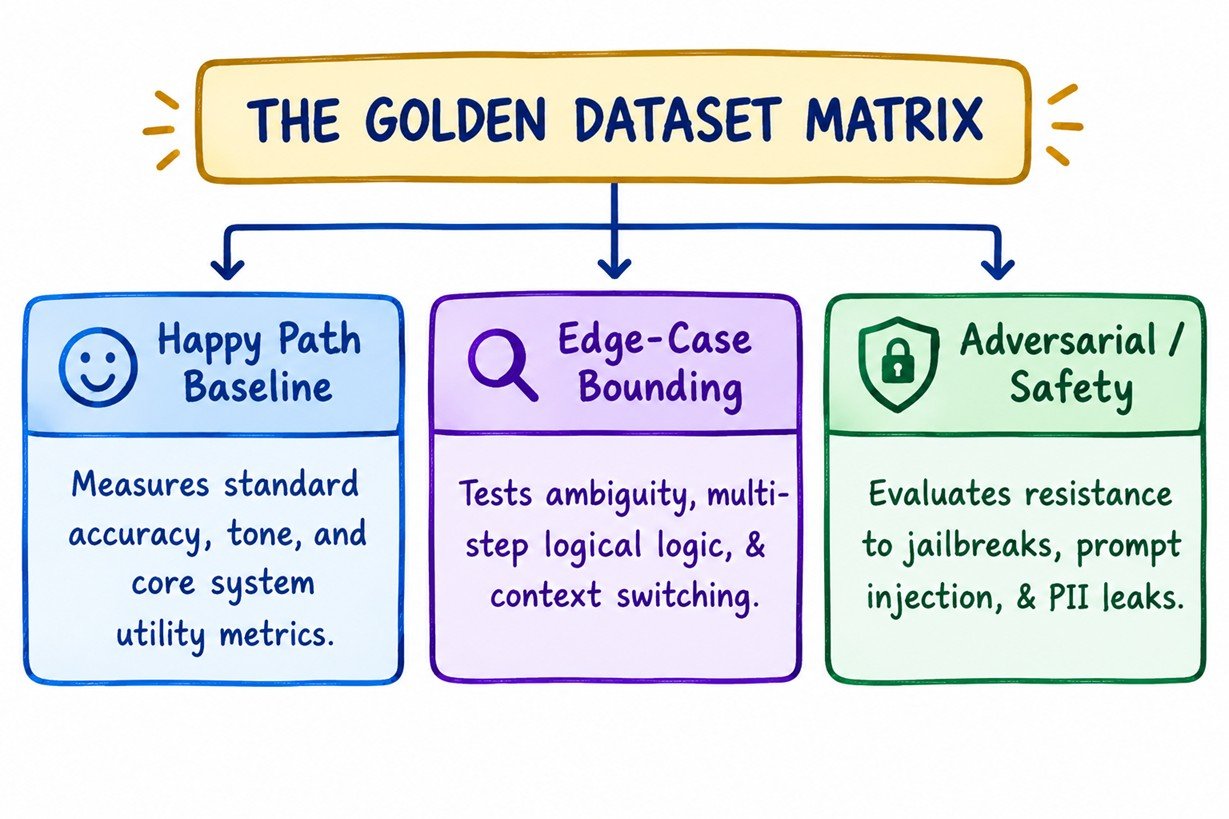
- The Happy Path Baseline (60-70% of the set): This covers typical, high-frequency user interactions. It ensures the system adheres to brand guidelines, achieves correct structural parsing, and maintains its core utility under standard load.
- Edge-Case Bounding (20-25% of the set): This deliberately introduces linguistic ambiguity, missing context, multi-turn conversational contradictions, and complex logic puzzles relevant to the business domain. It tests whether the system knows how to handle uncertainty or ask clarifying questions rather than forcing an incorrect, highly confident response.
- Adversarial and Safety Injections (10-15% of the set): This contains direct prompt injections, jailbreak attempts, toxic overrides, and explicit requests designed to trick the model into leaking its system prompts, accessing restricted enterprise data, or exposing Personally Identifiable Information (PII).
To ensure high-utility evaluation, each record within these categories must contain five core dimensions:
| Component | Description | Purpose in the Pipeline |
|---|---|---|
| System Persona / Prompt | The exact system instructions, tools, and variables active during the test. | Establishes the precise runtime environment for reproduction. |
| User Input / Payload | The raw query or multi-turn conversational history submitted by the user. | Evaluates the model's ability to parse human intent and maintain state. |
| Ground Truth Context | The explicit reference materials, database snippets, or documentation the model should use. | Acts as the mathematical boundary for measuring groundedness and preventing hallucinations. |
| Reference Target Response | A human-verified, gold-standard answer demonstrating ideal tone, structure, and accuracy. | Serves as the baseline for semantic similarity and linguistic distance calculations. |
| Evaluation Rubric & Metadata | Specific scoring rules, classification tags (e.g., billing, adversarial), and risk tiers. | Allows the automated testing framework to apply targeted, granular evaluations across segments. |
2. Data Strategy: Curation, Sizing, and Synthetic Expansion
Balancing statistical significance with execution cost is a key optimization challenge for engineering leadership. Running tens of thousands of complex evaluations on every code commit slows down continuous integration (CI) pipelines and incurs significant token costs. Conversely, testing against a handful of prompts yields no statistically meaningful conclusions.
Establishing Statistical Significance and Sizing
For a single, narrow use-case component, such as an internal expense report agent, a starter dataset of 100 to 200 high-fidelity, human-curated examples is typically sufficient to establish an initial performance baseline.
As the application expands into customer-facing environments with multiple tools and varying tasks, the golden evaluation suite should scale to 1,000+ distinct evaluation matrix rows. This footprint provides enough coverage across distinct classifications to catch regression drops with a high degree of confidence.
The Hybrid Curation Engine
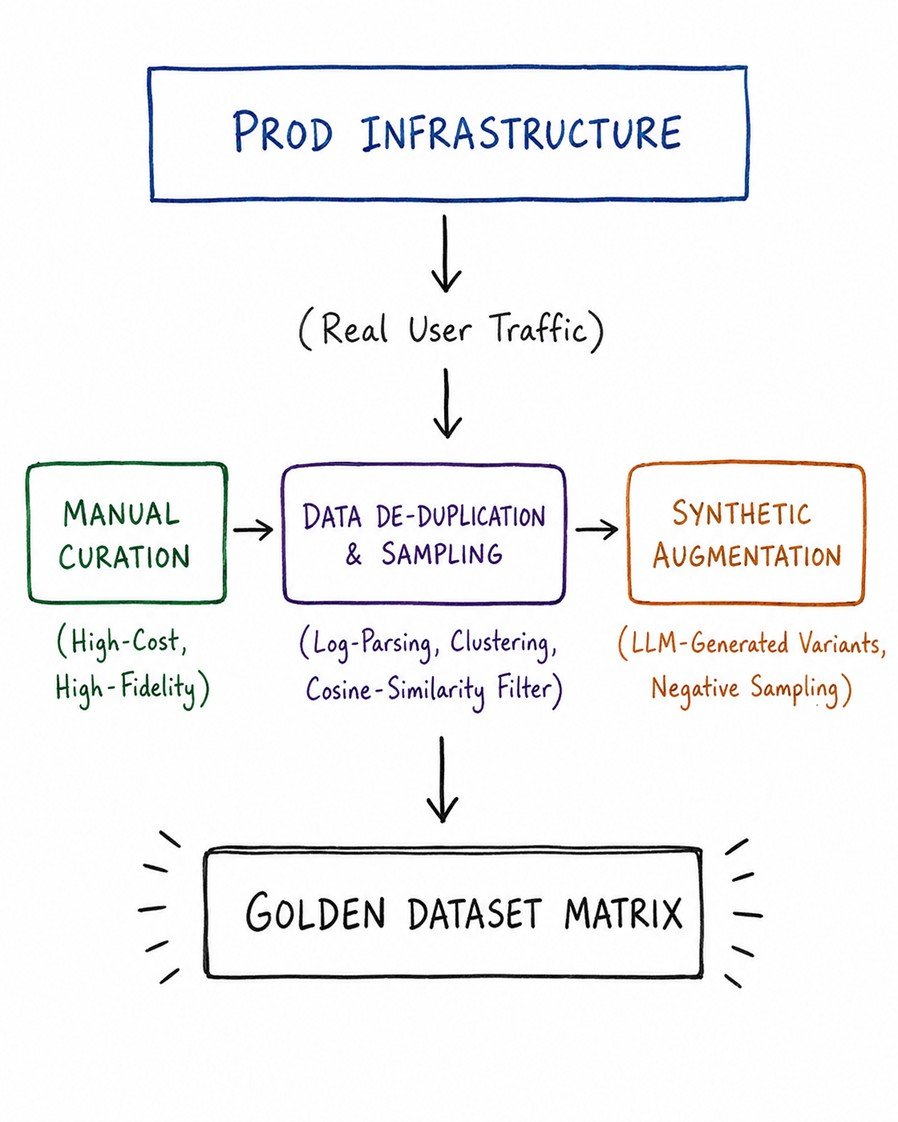
Building a massive dataset purely through manual human writing is slow and expensive. Relying entirely on synthetic data generation leads to an echo-chamber effect, where an LLM creates clean, perfect test cases that fail to capture the chaotic way real humans interact with software. Enterprise data strategies must therefore use a hybrid pipeline.
1. Production Traffic Capture & Log-Parsing
The highest-value test cases come from your actual application logs. Teams should set up automated data pipelines that flag anomalous production interactions, such as conversations that received low user ratings, queries that triggered fallback mechanisms, or sessions with unusually long multi-turn paths.
2. Clustering and De-duplication
Raw production logs contain thousands of repetitive queries, such as "How do I reset my password?", expressed in slightly different ways. Running all of them through an evaluation pipeline wastes resources. Engineering teams should use vector embeddings to cluster production queries, group similar intents together, and then sample from the edges of those clusters to capture unique phrasing variations while discarding redundant data.
3. Synthetic Augmentation and Negative Sampling
Once a core set of human and production foundation records is established, high-capacity models, such as GPT-4o or Claude 3.5 Sonnet, can be used to scale the matrix safely. Engineers can instruct a generator model to take an authentic user query and produce ten distinct variations, including:
- Linguistic mutations: Changing regional idioms, altering grammatical correctness, or introducing typos.
- Negative sampling: Modifying the ground truth context so it no longer contains the answer to the user's query, forcing the evaluation pipeline to test whether the model can correctly say, "I cannot find that information in the provided documents."
3. Data Governance: Lineage, Anonymization, and Versioning
Test data inside the enterprise is subject to the same strict security, privacy, and compliance rules as production data. You cannot simply copy raw database records or customer chat logs into a test environment without risking serious governance violations.
PII Anonymization and Masking
Before any production interaction is promoted to a Golden Dataset, it must pass through an automated data-scrubbing pipeline. Utilizing tools like Microsoft Presidio or specialized Named-Entity Recognition (NER) models, the system must remove or replace sensitive data:
- Names, email addresses, and phone numbers must be fully scrubbed or replaced with realistic synthetic placeholders.
- Account numbers, financial balances, and sensitive corporate identifiers must be systematically masked.
- The scrubbing layer must verify that the semantic intent of the query remains intact so the evaluation value of the test case is not lost during anonymization.
Dataset Versioning and Code Alignment
A Golden Dataset is a dynamic entity. It evolves as your business logic changes, new products launch, and legacy policies are retired. If you update your application's underlying prompt or switch models, evaluating it against an outdated test dataset will flag valid new behaviors as failures.
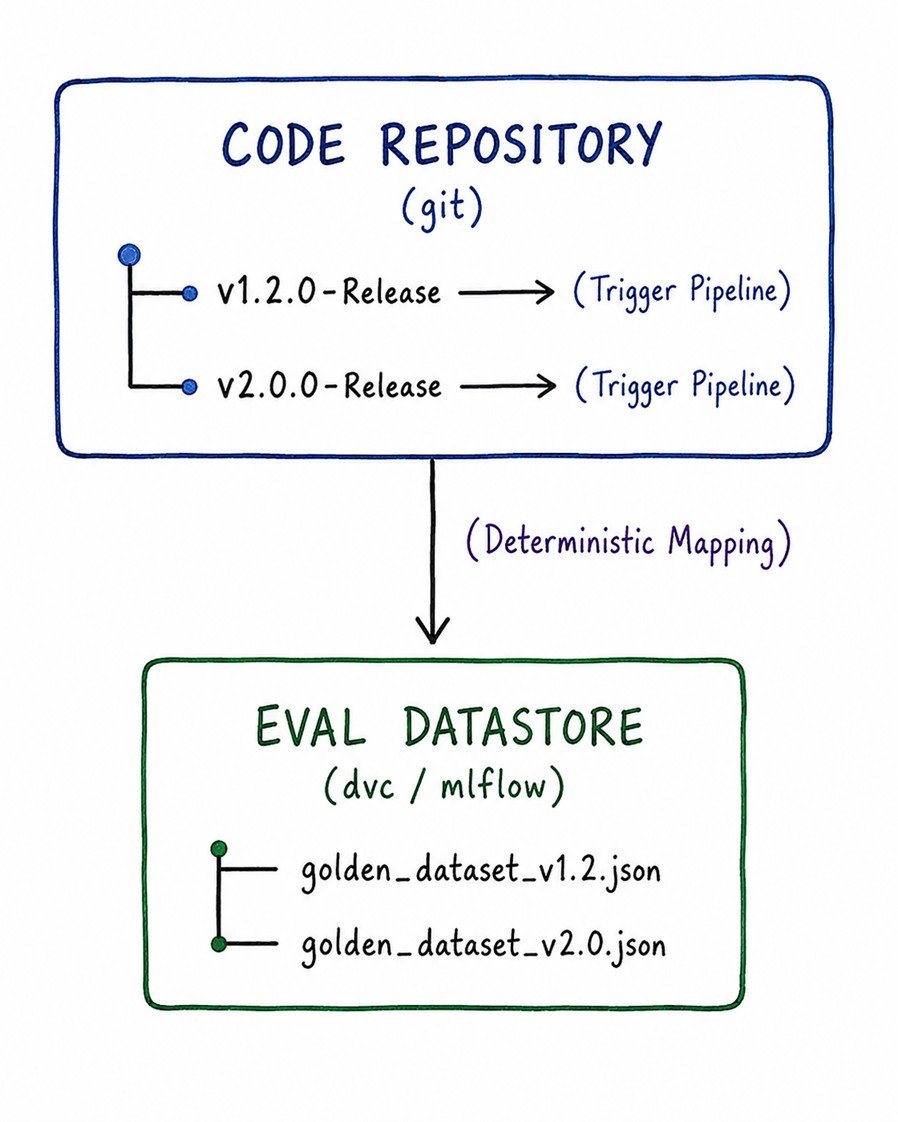
To prevent this mismatch, test datasets must be version-controlled in lockstep with application code. Teams should avoid hosting Golden Datasets in loose corporate drives or static, unversioned databases. Instead, treat them as infrastructure code:
- Use data versioning systems, such as DVC, MLflow, or Git LFS, to tag specific dataset states alongside corresponding code branches.
- Ensure that a change to the core application prompt automatically triggers a review and pull request (PR) to update the corresponding validation data matrices.
- Maintain clear historical logs tracking who added a test record, why a specific ground truth target was updated, and when a legacy test case was retired.
By treating enterprise test data with this level of architectural discipline, technology organizations build an evaluation bedrock that provides reproducible metrics, protects user privacy, and scales cleanly as application complexity grows.