The Orchestration Engine - Hybrid Judging Architectures
Introduction
Building a high-fidelity evaluation dataset solves only half of the probabilistic quality equation. The remaining engineering challenge lies in execution: How does an enterprise process thousands of multi-turn conversational test cases, score them for abstract concepts such as semantic alignment and groundedness, and do so with the speed, cost efficiency, and consistency required by an automated CI/CD pipeline?
Relying entirely on human evaluators is a non-starter. It introduces severe operational bottlenecks and subjective bias, ultimately stalling development velocity. Conversely, relying blindly on a single external LLM to grade system outputs introduces significant token costs, latency spikes, and the paradoxical problem of "grading homework with homework."
To solve this, modern enterprise systems use a Hybrid Judging Architecture. This design combines inexpensive statistical metrics, highly specialized local models, and advanced frontier LLMs into a coordinated orchestration engine.
1. The Multi-Tiered Evaluation Pipeline: Balancing Cost, Speed, and Rigour
An enterprise-grade hybrid judging architecture operates on a cascading triage model. Instead of sending every generated test response straight to an expensive frontier model, such as GPT-4o or Claude 3.5 Sonnet, for evaluation, the orchestration engine routes outputs through a series of increasingly sophisticated and cost-efficient processing tiers.
If a test case fails an early, fast validation checkpoint, it is immediately flagged for review, bypassing the more expensive downstream evaluation layers entirely.
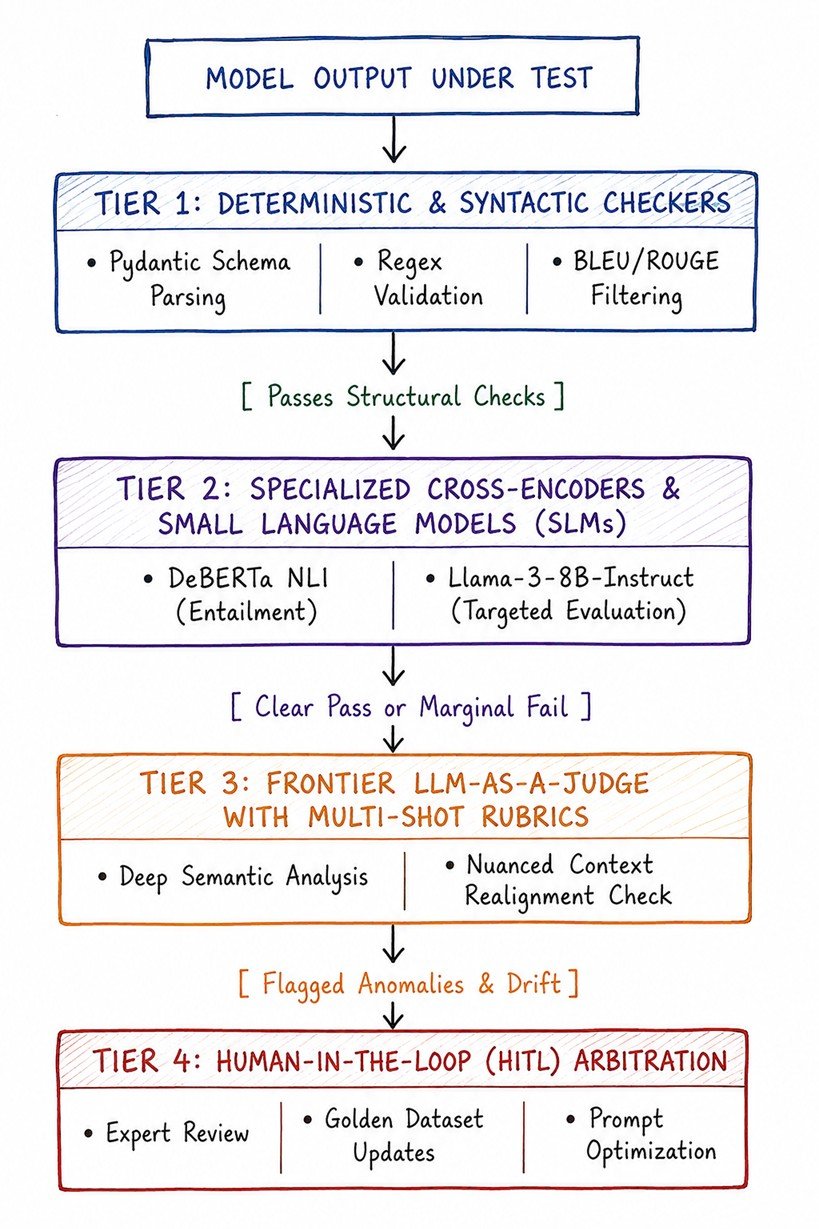
Tier 1: Deterministic and Syntactic Filters (The Millisecond Layer)
- Operational Execution: Runs locally in memory using standard CPU resources.
- Mechanisms: Executes structured schema validation, such as Pydantic parsing, structural integrity checks, such as verifying a valid JSON structure or Markdown format, and token-distance algorithms, such as BLEU, ROUGE, or BERTScore, against the target reference data.
- Leadership Value: Catches obvious system crashes, corrupted formatting, or massive language shifts in milliseconds for fractions of a cent.
Tier 2: Specialized Cross-Encoders and SLMs (The Efficiency Layer)
- Operational Execution: Powered by self-hosted, fine-tuned Small Language Models (SLMs) or specialized cross-encoders, such as DeBERTa-v3, deployed on optimized internal container clusters.
- Mechanisms: Uses Natural Language Inference (NLI) to analyze the strict logical connection between the output text and reference data. It checks for entailment (the statement logically follows), contradiction (the statement explicitly conflicts), or neutrality (the statement introduces unrelated information).
- Leadership Value: Processes semantic evaluations at approximately 1/20th the token cost and 5x the speed of public APIs, isolating standard errors before they reach public model checkpoints.
Tier 3: Frontier LLM-as-a-Judge (The Cognitive Layer)
- Operational Execution: Triggered only when Tier 2 returns ambiguous scores or when high-value conversational nuances, such as evaluating brand tone or handling multi-step reasoning, require deeper analysis.
- Mechanisms: Calls advanced frontier models running explicit, multi-shot evaluation rubrics to score complex dimensions such as contextual relevance, ungrounded assumptions, and toxicity.
- Leadership Value: Restricts the use of expensive cloud-hosted models to complex, high-ambiguity edge cases, keeping cloud compute budgets sustainable.
Tier 4: Human-in-the-Loop (HITL) Arbitration (The Calibration Layer)
- Operational Execution: An asynchronous dashboard workspace where domain experts, such as legal teams, customer success leads, or senior engineers, review edge cases.
- Mechanisms: Focuses on resolving edge cases where the automated models disagree or fall below minimum confidence scores.
- Leadership Value: Feeds verified human corrections back into your Golden Datasets, constantly improving the accuracy of the underlying automated judges.
2. Engineering Deterministic Judge Rubrics
The biggest flaw in basic LLM-as-a-Judge configurations is judge variance. If you ask an LLM to evaluate an output with a loose prompt like "Is this response helpful on a scale of 1 to 5?", the judge itself will exhibit non-deterministic behavior. It may award a "4" in the morning and a "3" in the afternoon for the exact same input string.
To achieve enterprise-grade consistency, judge prompts must be engineered with the same structural rigor as production software code.
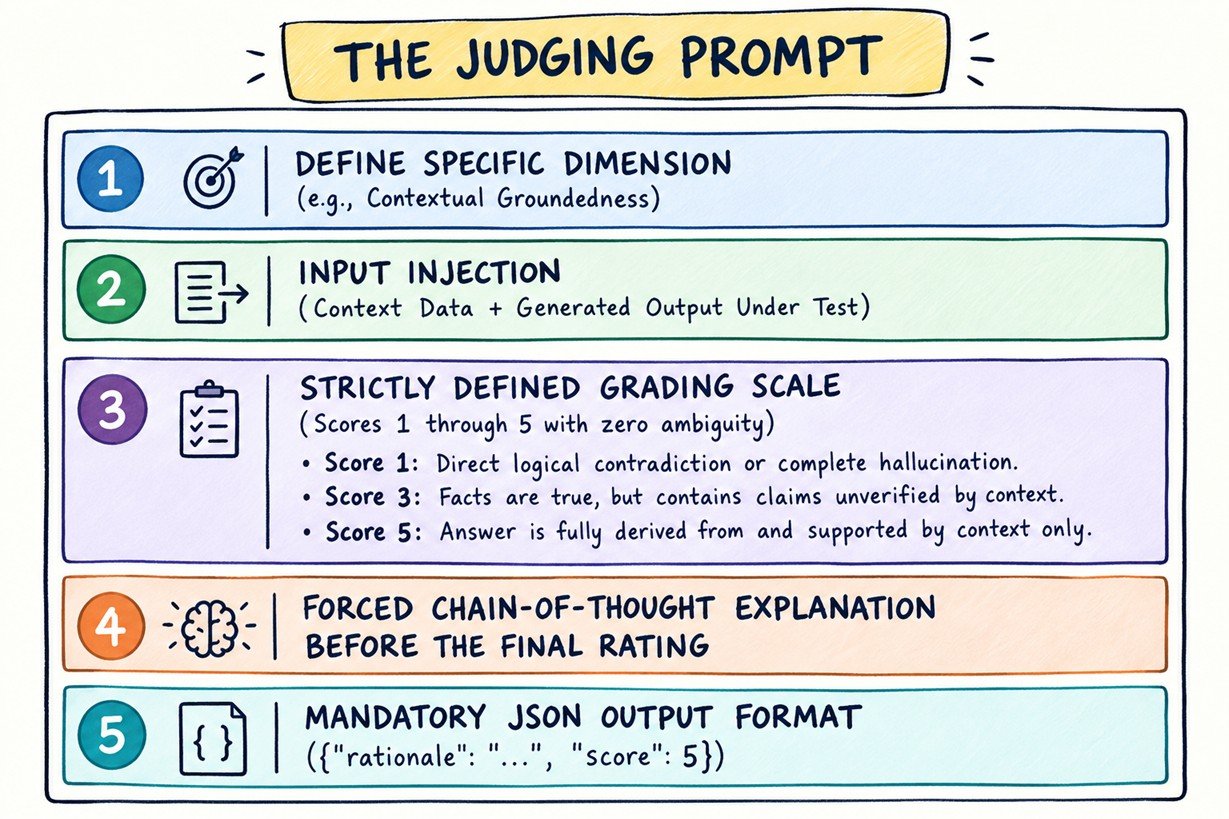
Key Pillars for Standardizing Automated Judges
-
Isolate the Evaluated Dimension: Never ask a single judge model to evaluate multiple qualitative dimensions simultaneously, such as correctness, formatting, and tone. Deploy a separate, dedicated judge query for each independent metric to prevent mixed feedback signals.
-
Enforce Chain-of-Thought (CoT) Reasoning: Instruct the judge model to explicitly isolate, extract, and write down its logical rationale before it generates a numerical rating. Forcing the model to output its step-by-step reasoning can improve the consistency and reliability of the final score.
-
Define Clear Anchors for Each Score: Avoid vague scoring definitions. A rating scale must explicitly state what constitutes a 1, 3, or 5. For example, a groundedness rubric should define a score of
3as: "The response contains no factual falsehoods, but it includes extra claims that cannot be verified by the provided context documents." -
Control the Output Format: Use structured generation options, such as OpenAI's JSON Mode or Instructor, to force the judge to respond in a predictable data schema. This ensures the output can be cleanly parsed by automated testing pipelines.
3. Mitigating Evaluator Bias
Even with structured scoring rubrics, large neural networks can exhibit inherent evaluation biases that distort quality metrics if left unchecked. A resilient hybrid judging architecture must explicitly account for and mitigate three primary evaluator biases.
1. Egocentric and Model-Specific Bias
-
The Vulnerability: LLMs can systematically favor outputs generated by themselves or by models with similar architectures, preferring familiar phrasing styles, response structures, and token patterns over outputs produced by competing architectures.
-
Mitigation: Diversify the evaluation layer. Avoid using the same model family for both generation and judging whenever practical. If a system uses OpenAI models to generate customer answers, consider using Anthropic or self-hosted open-weight models, such as Llama 3, as primary evaluators. This separation reduces the risk of allowing a model to effectively grade its own behavioral signature.
2. Verbosity Bias
-
The Vulnerability: Models can naturally favor longer, more detailed responses. A judge may award a higher quality score to a wordy, padded response over a concise, accurate answer, effectively confusing length with thoroughness.
-
Mitigation: Explicitly include length constraints or information-density metrics within evaluation rubrics. Alternatively, normalize output lengths before evaluation, or instruct the judge to penalize excessive boilerplate that does not add direct informational value.
3. Position Bias
-
The Vulnerability: When an LLM-as-a-Judge is asked to compare two different system outputs, such as Output A versus Output B, it may consistently favor whichever option appears first in the prompt context.
-
Mitigation: Implement pairwise permutation testing. Run every comparative evaluation through the judge twice, swapping the order of the inputs,
A vs. BandB vs. A, across separate calls. If the judge changes its preference based purely on presentation order, treat the result as unreliable and route the case to a Tier 4 human reviewer.
By implementing this hybrid judging structure, enterprise organizations decouple quality assurance from slow, manual human review cycles. This approach provides engineering teams with automated, cost-controlled, and more robust evaluation metrics required to confidently ship generative applications at scale.