The Foundations of Tokenomics and Volatile Cost Structures
Introduction
In traditional enterprise IT paradigms, infrastructure forecasting is largely a deterministic exercise. Solution architects map workloads to predictable primitives, such as virtual machine instances, provisioned IOPS, or gigabytes of object storage, where expenditure scales linearly with time or storage volume. Finance teams can comfortably approve annual budgets based on static capacity-planning models.
Generative AI completely upends this predictability. By introducing foundation model APIs into the enterprise ecosystem, organizations shift from deterministic infrastructure cost models to a stochastic cost paradigm. Under this new model, costs are fundamentally probabilistic and variable, driven by the non-deterministic nature of natural language inputs and model outputs. For technology leaders, such as CTOs, VPs, and Enterprise Solution Architects, managing this volatility is not merely an operational challenge. It is a fundamental architectural requirement that must be institutionalized within the enterprise governance framework.
The Stochastic Cost Paradigm vs. Traditional IT FinOps
To bridge the gap between legacy corporate finance and the economics of intelligence, enterprise leaders must understand how generative AI deviates from classic cloud cost structures:
| Cost Attribute | Traditional Cloud Infrastructure | Probabilistic AI System |
|---|---|---|
| Billing Unit | Deterministic allocation, such as vCPU/hour or GB/month | Variable consumption, based on input and output tokens |
| Predictability | High, bounded by user traffic and static provisioned limits | Low, influenced by prompt complexity, retrieval size, and model behavior |
| Scaling Vector | Linear or stepped, based on auto-scaling thresholds | Exponential or erratic, driven by agent loops and user behavior |
| Architectural Guardrails | Throttling, rate limiting, and horizontal scaling limits | Semantic caching, model routing, and strict context-window limits |
Mapping Volatile Cost Structures to the TOGAF 10 ADM
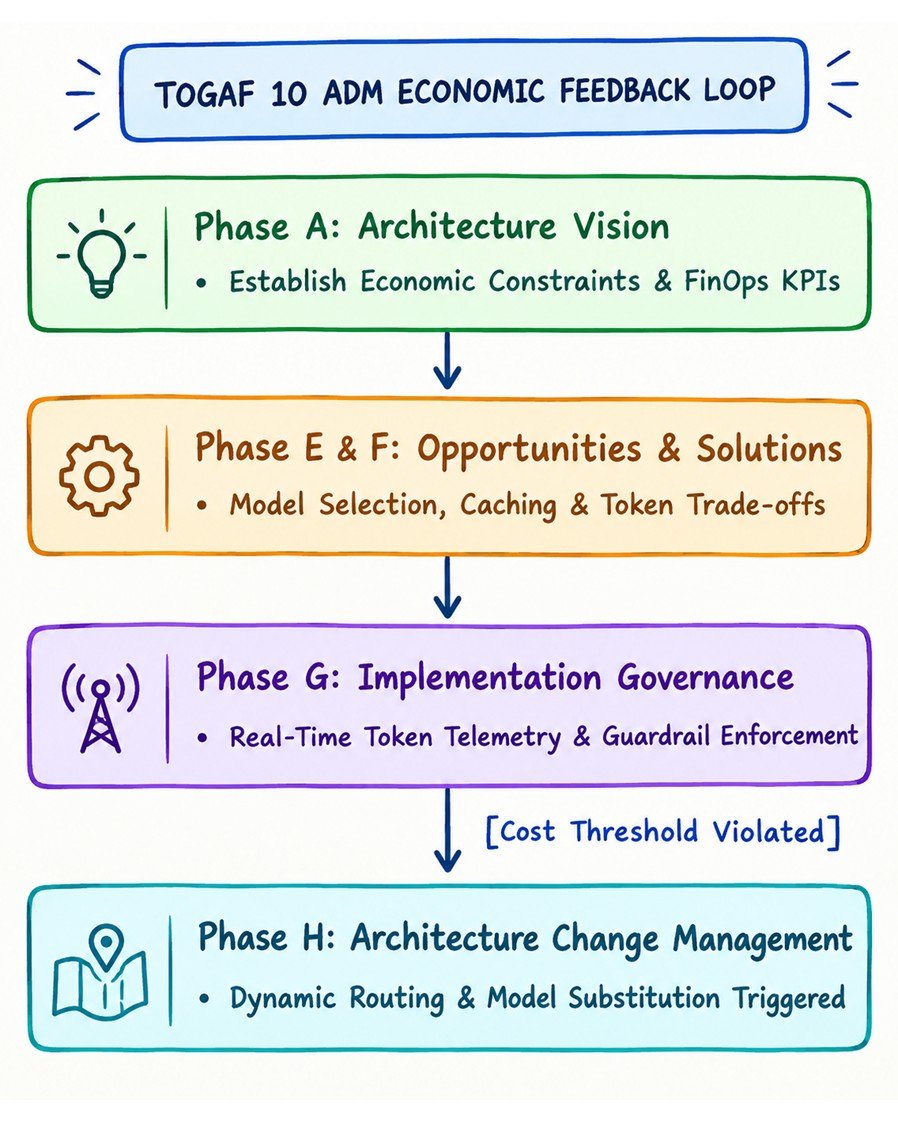
Integrating probabilistic AI systems into a large enterprise requires mapping token-based volatility directly onto the specific phases and artifacts of the TOGAF 10 Architecture Development Method (ADM). Tokenomics cannot be treated as a post-deployment consideration. It must shape the architecture from inception through continuous evolution.
1. Phase A: Architecture Vision - Defining Financial Boundary Conditions
The baseline economic constraints must be codified during the earliest phase of the ADM.
- Statement of Architecture Work: This artifact must define the Target Cost-per-Successful-Task (CPST) and acceptable financial variances alongside traditional service-level agreements (SLAs).
- Business Transformation Readiness Assessment: Architects must evaluate the organization's financial risk tolerance for variable OpEx spikes. If the business unit requires fixed-cost predictability, Phase A must capture this as an unyielding architectural constraint, forcing subsequent phases to prioritize local small language models (SLMs) over frontier APIs.
2. Phases B, C, & D: Domain Architectures - Intersecting Data and Intelligence
The cost of an LLM transaction is inherently bound to the data structure and application logic.
- Phase B (Business Architecture): Decomposing workflows into specific human-in-the-loop validation checkpoints protects against unchecked automated spending.
- Phase C (Information Systems Architecture - Data & Application): The Data Architecture must define embedding strategies, chunking matrices, and metadata schemas. Bloated or poorly chunked data assets directly yield bloated input-token consumption. In the Application Architecture, prompt design must be treated as a structural component, where system prompts are optimized to minimize token footprints without sacrificing contextual efficacy.
- Phase D (Technology Architecture): This phase must explicitly map the Internal AI Platform Gateway infrastructure, identifying where semantic caching layers and API brokers sit relative to cloud service boundaries.
3. Phases E & F: Opportunities, Solutions, and Transition Planning
Here, the architecture evaluates the trade-offs between different technical solutions to meet Phase A's economic KPIs.
- Architecture Roadmap & Coexistence Strategies: Enterprise architects use Model & Intelligence Decision Matrices to map where expensive frontier models, such as Claude 3.5 Sonnet, are absolutely required versus where workloads can coexist on highly optimized, lower-cost utility models or open-source infrastructure, such as Llama 3.1.
- Transition Architectures: The roadmap must detail the phased evolution from an initial, highly capable frontier model implementation to a fine-tuned, narrower, and significantly cheaper enterprise-owned model as training data accumulates.
4. Phase G: Implementation Governance - Real-Time Telemetry and Guardrails
During implementation, the architecture enforces compliance through active governance rather than static reviews.
- Architecture Compliance Reviews: Architects must verify that the deployed system implements strict FinOps Guardrails. This includes validating the existence of hard context-window limits, rate limiters mapped to cost per user role, and semantic cache verification loops.
- Enterprise AI Platform Orchestration: Phase G ensures that the centralized AI Gateway actively injects telemetry hooks. Every API call must emit structured metadata containing
User_ID,Business_Unit,Input_Tokens,Output_Tokens, andModel_Identifierto enable real-time financial attribution and anomaly detection.
5. Phase H: Architecture Change Management - The Algorithmic Feedback Loop
Phase H is traditionally viewed as a slow, governance-driven cycle for managing enterprise system changes. In the world of generative AI, Phase H patterns must be automated and operationalized at the system layer.
- Dynamic Architecture Evolution: When production monitoring detects a severe tail cost variance or a sustained financial spike that violates Phase A's guardrails, Phase H protocols must be triggered programmatically. The system must be architected to automatically adapt by altering its runtime behavior, such as dynamically downgrading the model-routing path, truncating historical conversational context windows, or tightening RAG retrieval parameters until the cost profile stabilizes.
Deconstructing Token Dynamics and Asymmetric Pricing
The atomic unit of generative AI economics is the token. Because frontier models process information using distinct attention mechanisms for reading context versus generating text, cloud providers utilize asymmetric frontier API pricing models. Output tokens are routinely priced 3x to 5x higher than input tokens due to the computational intensity of sequential, autoregressive generation.
Consider the baseline pricing structures of modern industry-standard frontier models, standardized per 1 million tokens:
- GPT-4o: ~$5.00 per 1M input tokens / ~$15.00 per 1M output tokens (1:3 ratio)
- Claude 3.5 Sonnet: ~$3.00 per 1M input tokens / ~$15.00 per 1M output tokens (1:5 ratio)
- Gemini 1.5 Pro: ~$1.25 per 1M input tokens / ~$5.00 per 1M output tokens (up to 128K context)
This asymmetry fundamentally changes software design patterns. In traditional software, sending a larger query payload incurs negligible marginal cost. In generative AI, a bloated prompt directly increases the enterprise's operating costs.
Furthermore, frontier providers introduce complex architectural capabilities such as Prompt Caching, including Claude's 90% discount on cached input tokens, and Batch Processing APIs, which can offer 50% cost reductions for non-real-time workloads. Failing to exploit these features during system implementation can result in significant financial inefficiencies that compound rapidly at enterprise scale.
Tail Cost Variances and Systemic Volatility
The true threat to enterprise AI budgeting is not the average cost per query, but the tail cost variance, the unpredictable and potentially massive expenditure spikes caused by edge-case behaviors in production. These spikes are generally driven by three systemic factors:
1. Unbounded User Sessions
Unlike deterministic forms with character limits, free-form conversational interfaces allow users to submit open-ended queries or maintain hours-long chat histories. If the application architecture continuously appends the entire historical transcript to the prompt window to maintain state, the input token count can grow rapidly with every turn, causing an exponential increase in per-query costs.
2. Recursive Agent Execution Paths
When building agentic workflows, deterministic code execution paths are replaced by LLM-driven reasoning loops. If an autonomous agent encounters an ambiguous tool response or an edge-case error, it may enter a recursive execution loop, repeatedly calling the foundation model to solve the problem.
A single user request that should have cost $0.02 can quickly escalate to hundreds of dollars in minutes if the agent becomes trapped in a reasoning cycle without a hard execution-depth limit.
3. Content Size Variations in Retrieval-Augmented Generation (RAG)
In production-grade RAG systems, the size of the context injected into the prompt depends heavily on the output of a vector database search. If a user query triggers a broad keyword match that pulls in ten dense PDF segments instead of the typical two, the input context window can expand unpredictably.
This variation breaks standard budgeting models and can introduce latency spikes that degrade user experience alongside financial margins.
The Anatomy of a Tail Cost Catastrophe: A Simulated Enterprise Scenario
To appreciate why TOGAF Phase G Governance is non-negotiable for probabilistic systems, consider this simulated post-mortem of an unguarded enterprise deployment.
The Context: "Project SupportIntel"
A global e-commerce enterprise built SupportIntel, an autonomous customer service agent designed to resolve complex shipping and return disputes.
- The Architecture: An agentic workflow powered by Claude 3.5 Sonnet. It had access to three internal enterprise tools through APIs: a CRM lookup, a shipping logistics database, and a refund processing system.
- The Baseline Flaw: The project team optimized for user experience during the PoC. They omitted the Phase G Tokenomics Compliance Checklist, treating the system as a traditional, linear application framework.
The Trigger Event: The Infinite Loop
At 02:14 AM on a Sunday, a user submitted a complex, edge-case query regarding a multi-currency refund across three distinct split-shipment orders. The agent encountered a transient currency mismatch error from the CRM tool. Lacking a hard ceiling, the autonomous agent began retrying alternative execution paths, pulling in broader shipping logs to reconcile the error independently.
Because Phase G guardrails were missing, the agent entered an unchecked recursive reasoning loop. With every turn, it appended the full history of its failed tool attempts, causing the input context window to swell over a 15-minute window before hitting a standard system timeout threshold.
The Cost Escalation Matrix: No Guardrails vs. Guardrailed
| Metric | The Unguardrailed Reality | The Guardrailed Alternative (Phase G Enforced) |
|---|---|---|
| Max Iteration Limit | Unbounded (Reached 412 loops before timeout) | Hard cap enforced at 5 loops |
| Context Window Management | Appended all history raw (180K tokens by loop 200) | Token sliding window applied (Capped at 8K tokens) |
| Prompt Caching | Disabled (Every loop evaluated as new input) | Enabled (Static rules cached at 90% discount) |
| Total Tokens Consumed | 62,000,000 input / 8,500,000 output | 45,000 input / 3,000 output |
| Financial Impact (Single Session) | $313.50 | $0.18 |
The Financial Blast Radius
Because there was no real-time anomaly alerting, the problem compounded rapidly when a localized shipping delay that same night generated 20 simultaneous complex edge-case tickets mirroring this exact loop pattern. Within four hours, these unguarded agent sessions accumulated $6,270 in frontier API fees. The enterprise only realized the breach when an automated cloud infrastructure budget ceiling was reached at dawn, long after the capital had been spent.
This failure was not an LLM model error. It was an Enterprise Architecture governance failure. If the project had been subjected to proper governance, a single conditional loop breaker would have intercepted the agent, gracefully handed the ticket to a human, and preserved corporate capital.
TOGAF Phase G: AI Tokenomics Architecture Compliance Checklist
This checklist acts as a formal Phase G (Implementation Governance) architectural gate. Governance teams and Lead Solution Architects must use it to audit any generative AI system before approving its deployment to production. Every item must be validated against the economic constraints defined in the Phase A Architecture Vision.
1. Edge and Runtime Ingress Guardrails
- User/Session Rate Limiting: Ensure token-based rate limits are enforced per user role, API key, or business unit to prevent malicious or accidental platform resource drain.
- Hard Token Caps: Verify that a structural ceiling (
max_tokens) is explicitly configured for both input context windows and output generation layers on every downstream API call. - Input Sanitization and Truncation: Confirm that the system programmatically trims or summarizes historical conversation logs rather than endlessly appending raw, growing transcripts to the active context window.
2. Telemetry, Instrumentation, and Attribution
- Atomic Cost Metadata: Confirm that every LLM request emits an immutable telemetry payload containing
User_ID,Cost_Center,Prompt_Tokens,Completion_Tokens, andModel_ID. - Asymmetric Billing Tracking: Ensure the FinOps dashboard calculates real-time run rates using separate multipliers for input and output tokens to accurately reflect frontier API pricing asymmetry.
- Anomaly Detection Alerts: Verify that real-time alerting systems are configured to flag sudden volumetric token anomalies or cost-per-session spikes before they breach monthly budgets.
3. Strategic Cost Optimization Mechanics
- Prompt Caching Ingestion: Confirm that system prompts, tool definitions, and static RAG guidelines are structured to maximize cloud provider prompt-caching discounts, such as placing static elements at the beginning of the prompt block.
- RAG Context Chunk Control: Verify that Retrieval-Augmented Generation loops enforce hard boundaries on maximum context injection, such as a cap on the number of retrieved vector chunks or maximum total characters.
- Recursive Loop Breakers: Ensure that autonomous or agentic workflows include a deterministic loop counter (
max_iterations <= 5) to abruptly terminate recursive reasoning cycles and prevent runaway tail costs. - Batch Processing Routing: Confirm that non-real-time workloads, such as daily analytical processing and mass document summarization, are programmatically routed through asynchronous batch APIs to capture available cost reductions.
Architectural Takeaway for Leaders
To survive the transition from PoC to production, technology leaders must abandon the expectation of static infrastructure costs. Tokenomics must be treated as a core design constraint during TOGAF Phase E (Opportunities and Solutions). By treating token consumption as an unyielding architectural metric, engineering teams can build resilient, cost-aware systems capable of operating reliably, securely, and economically at true enterprise scale.