Algorithmic Optimization and Cost Mitigation Strategies
Introduction
Transitioning a generative AI system from an enterprise proof-of-concept (PoC) to a sustainable, production-grade deployment demands the implementation of strict algorithmic guardrails. If the system treats every inbound request as a net-new, highly complex reasoning task requiring raw execution on third-party frontier APIs, the enterprise will quickly face unsustainable operational expenses and latency bottlenecks.
For CTOs, VPs of Engineering, and Enterprise Solution Architects, building an operationally viable system requires shifting the focus toward algorithmic optimization and active cost mitigation strategies. By decoupling the underlying request layer from immediate model execution, the enterprise can systematically minimize token waste, reuse institutional intelligence, and dynamically route compute workloads to the most cost-efficient components available.
The Algorithmic Cost Mitigation Topology
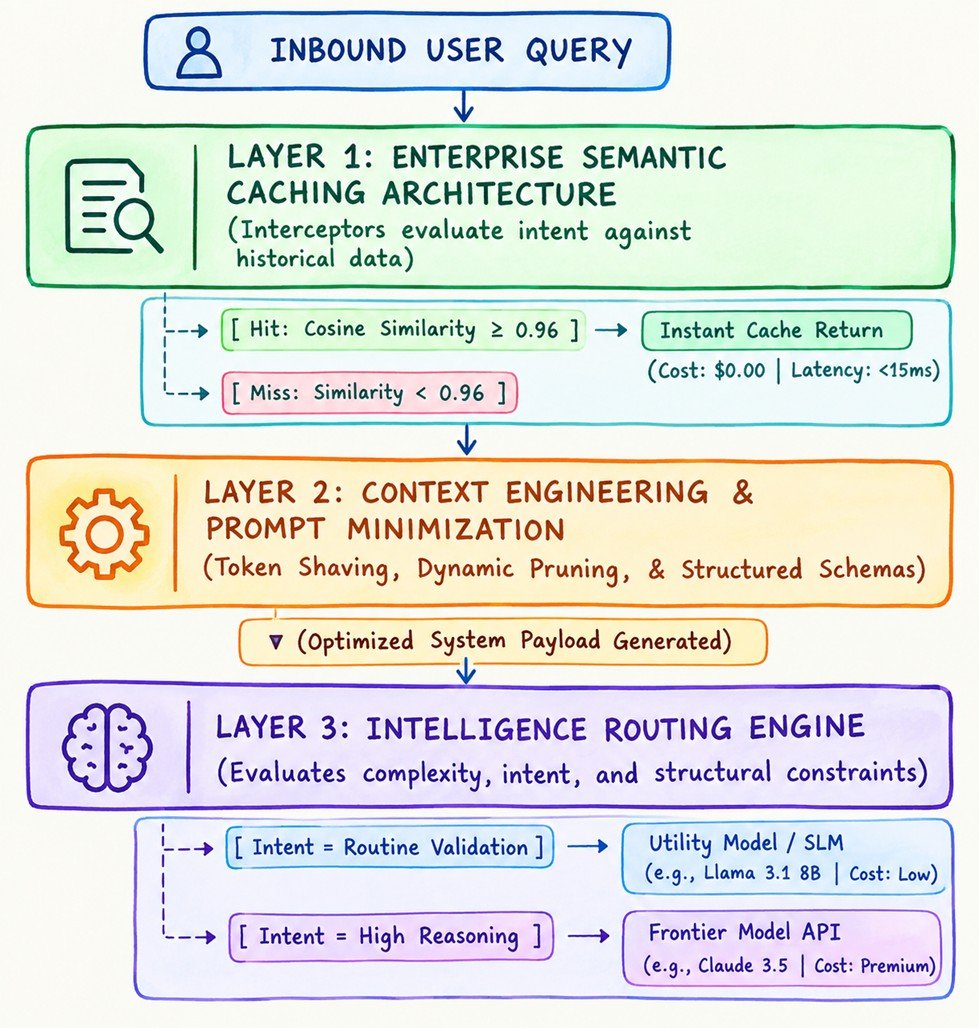
To prevent runaway token costs, the Enterprise AI Platform Reference Architecture must implement an active abstraction layer between the incoming application interface and the downstream foundation models. The following topology illustrates how an inbound query is sequentially intercepted, evaluated, and offloaded to optimize execution costs without sacrificing accuracy:
Context Engineering and Prompt Minimization
The most direct method to stabilize token consumption is to minimize the payload volume before it reaches an inference endpoint. Context Engineering and Prompt Minimization treats prompt assembly as a structured data optimization problem rather than a natural language drafting exercise.
1. Algorithmic Token Shaving
Instead of passing raw text outputs from enterprise data lookups directly into the LLM context, systems must run a deterministic text-normalization pipeline. This includes stripping excess whitespace, removing duplicate Markdown formatting characters, converting verbose conversational headers into dense JSON structures, and filtering out common stop words from injected context that do not contribute to semantic understanding. At scale, regular text normalization can trim 15% to 20% of baseline input token requirements.
2. Dynamic Pruning of Context Windows
In Retrieval-Augmented Generation (RAG) loops, injecting every extracted chunk matching a broad user query creates significant financial overhead. The platform must implement dynamic context pruning using a secondary ranking mechanism, such as a lightweight cross-encoder model, for example, BGE-Reranker.
The system establishes an absolute Token Relevance Cutoff Threshold. If the top three retrieved documentation chunks contain a cumulative relevance score exceeding 85%, the system drops the remaining lower-scoring chunks from the payload, preventing the input context window from expanding unnecessarily.
3. Declarative Structured Generation Schemas
Unstructured text outputs from LLMs are notoriously verbose, making them expensive to process and difficult for downstream enterprise services to parse. System instructions must utilize strict declarative structured schemas, such as JSON Schema or Pydantic definitions, enforced through guided decoding libraries at the inference layer, such as Outlines or Instructor.
By constraining the model to output only the required data properties and explicitly banning conversational filler, output generation lengths can be systematically compressed, lowering premium output-token expenses.
Enterprise Semantic Caching Architecture
Standard key-value caching, such as traditional Redis or Memcached strings, relies on exact character matching. In generative AI applications, if a user queries "How do I reset my account password?" and a second user asks "What is the process to update my password?", an exact-match system registers a cache miss. An Enterprise Semantic Caching Architecture solves this problem by evaluating the conceptual meaning of a query rather than its raw syntax.
Production-Grade Specifications for the Caching Layer
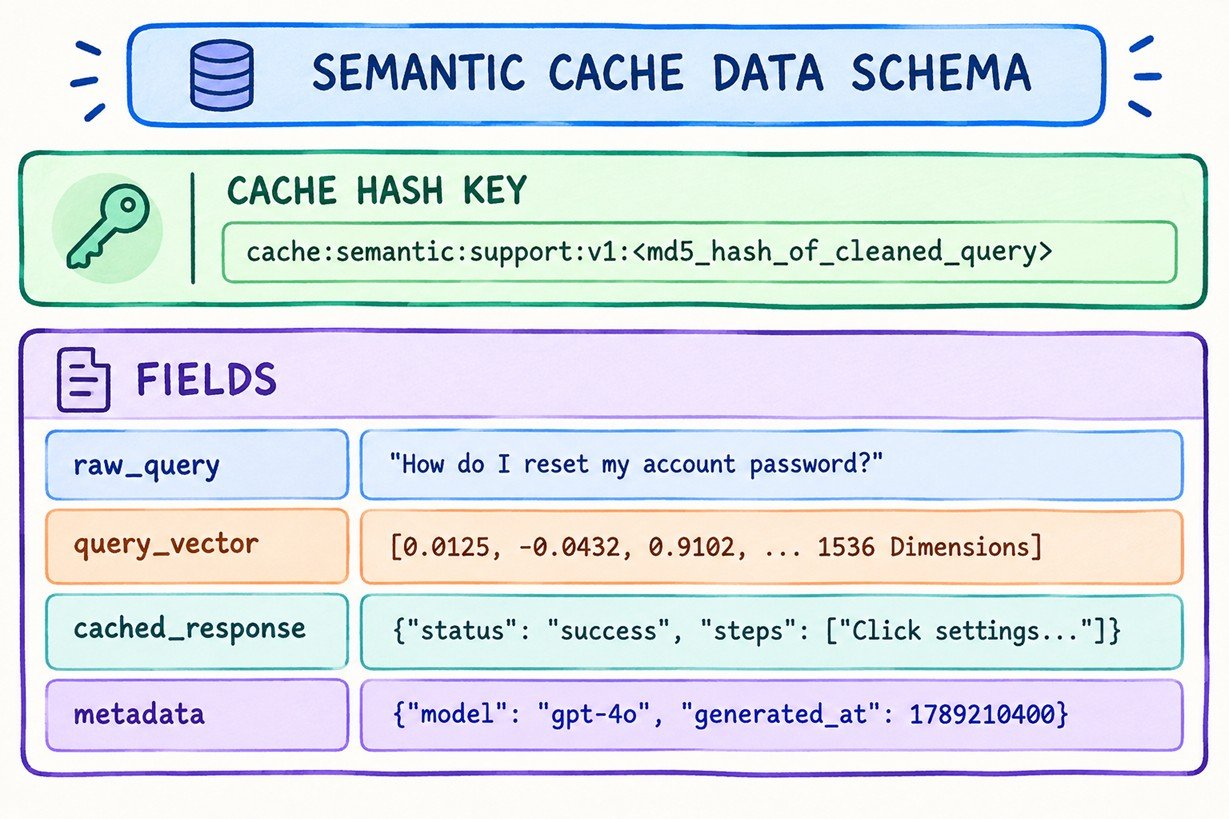
To implement an enterprise-grade semantic cache within a distributed architecture, such as Redis Enterprise vector indices, the solution must adhere to the following configurations:
-
Embedding Cache Key Generation Strategy: Inbound text strings must be normalized, including conversion to lowercase, removal of leading and trailing whitespace, and stripping of punctuation, before being passed to a local, high-throughput embedding model, such as
text-embedding-3-small. The resulting vector array is stored in the cache index alongside the raw query text and the previously generated JSON output string. -
Cosine Similarity Threshold Metric: The vector search query must utilize Cosine Similarity to measure semantic proximity in high-dimensional embedding space. For enterprise production systems, the Similarity Threshold (S_t) must be strictly configured between 0.95 and 0.97.
- Any comparison where Cosine Similarity > = 0.96 is classified as a structural cache hit, returning the cached text string immediately without executing a downstream model.
- Any result where Cosine Similarity < 0.96 triggers a cache miss, passing the request to the routing engine.
-
Time-To-Live (TTL) Invalidation Policies: Probabilistic caches risk serving stale data when underlying business logic changes. The platform must apply a tiered TTL strategy:
- Static/Policy Queries: 7-day expiration (
TTL = 604800seconds). - Dynamic Workflows/Transactional Inquiries: 24-hour expiration (
TTL = 86400seconds), combined with programmatic cache-busting triggers connected to core database updates. For example, an updated shipment status should immediately flush all semantic keys associated with that specific transaction ID.
- Static/Policy Queries: 7-day expiration (
Model Cascading and Intelligence Routing
Not every corporate interaction requires an elite, multi-billion-parameter frontier model. Asking a premium model such as Claude 3.5 Sonnet to categorize a simple inbound email or extract basic entities from an invoice represents a significant misuse of corporate resources. Model Cascading and Intelligence Routing establishes a structured hierarchy of models that evaluates incoming request complexity and matches each workload to the lowest-cost model capable of successfully completing the task.
The routing engine classifies and dispatches workloads across three strategic tiers:
-
Tier 1: Utility Processing (Small Language Models / Local Open-Weights): Simple entity extraction, binary sentiment classification, intent tagging, and structural format transformations are routed to high-throughput, low-cost layers, such as
Llama-3.1-8B-InstructorGPT-4o-mini. Cost: ~$0.15-$0.30 per 1M tokens. -
Tier 2: Specialized Execution (Medium Fine-Tuned Infrastructure): Advanced database query generation, dense domain-specific summaries, and context-dependent tool executions are directed to medium-capability layers or fine-tuned specialized open-weight systems, such as
Llama-3.1-70B-Instruct. Cost: ~$0.60-$1.00 per 1M tokens. -
Tier 3: Elite Cognitive Reasoning (Frontier API Layers): Complex multi-currency financial cross-reconciliations, open-ended strategic reasoning, multi-step agent planning loops, and compliance audits are escalated to premier frontier APIs, such as
Claude-3.5-SonnetorGPT-4o. Cost: ~$3.00-$15.00 per 1M tokens.
Anchoring Algorithmic Controls to TOGAF 10 Domains
To institutionalize these controls across the enterprise, they must be explicitly mapped to the structural blueprints of the TOGAF 10 Architecture Development Method (ADM), transforming abstract coding patterns into formal, auditable enterprise components.
1. Phase D: Technology Architecture Components
In the Technology Architecture, these algorithmic strategies materialize as physical system blocks within the Enterprise AI Platform Reference Architecture. Architects must specify the presence, placement, and network relationships of the following platform primitives:
-
The AI/API Gateway Wrapper:
A centralized reverse proxy acting as the sole ingress point for model consumption across all corporate application teams. This component hosts the context-engineering token-shaving logic and standardizes telemetry outputs.
-
Distributed Vector Ledger Indices: The memory infrastructure dedicated explicitly to cache operations, such as Redis cluster nodes deployed with the
REDISSEARCHvector module, positioned logically in front of external cloud provider boundaries. -
The Intent Broker Service: A decoupled, low-latency execution node running a localized classifier model to evaluate intent tags, acting as the physical deployment container for the Intelligence Routing Engine.
2. Phase E: Opportunities and Solutions Evaluation Criteria
During Phase E, architecture review boards assess competing system solution patterns to balance performance metrics against business costs. The optimization strategies detailed in this section serve as the primary Architecture Evaluation Criteria for probabilistic system designs:
-
Baseline Offloading Ratios: Solutions under review must detail their expected Cache Hit Ratio (CHR) metrics. A target architecture that fails to achieve a projected 30% cache intercept rate on standard utility workloads must be sent back for revision.
-
Model Tier Alignment Index: Architects must provide an explicit mapping matrix demonstrating that at least 60% of aggregate enterprise transactional volume is successfully directed toward Tier 1 and Tier 2 compute components, reserving Tier 3 premium execution pathways strictly for elite cognitive reasoning exceptions.