Platform Budgetary Controls, Capacity Planning & Enterprise Governance
Introduction
Moving generative AI from an isolated team project to an industrialized, enterprise-wide capability demands the implementation of strict platform-level financial guardrails. Without centralized billing structures and operational constraints, the unpredictable cost models of foundation model APIs will quickly undermine traditional corporate accounting paradigms.
For CTOs, VPs of Engineering, and Chief Data Officers, establishing control over this landscape requires implementing formal programmatic limits, traffic governance policies, and value-realization frameworks directly within the Enterprise AI Platform infrastructure. This final section of the FinOps chapter details how organizations can build resilient, cost-aware platforms that protect corporate capital while accurately attributing and validating the business value of every token consumed.
The Shared Platform Accounting and Governance Topology
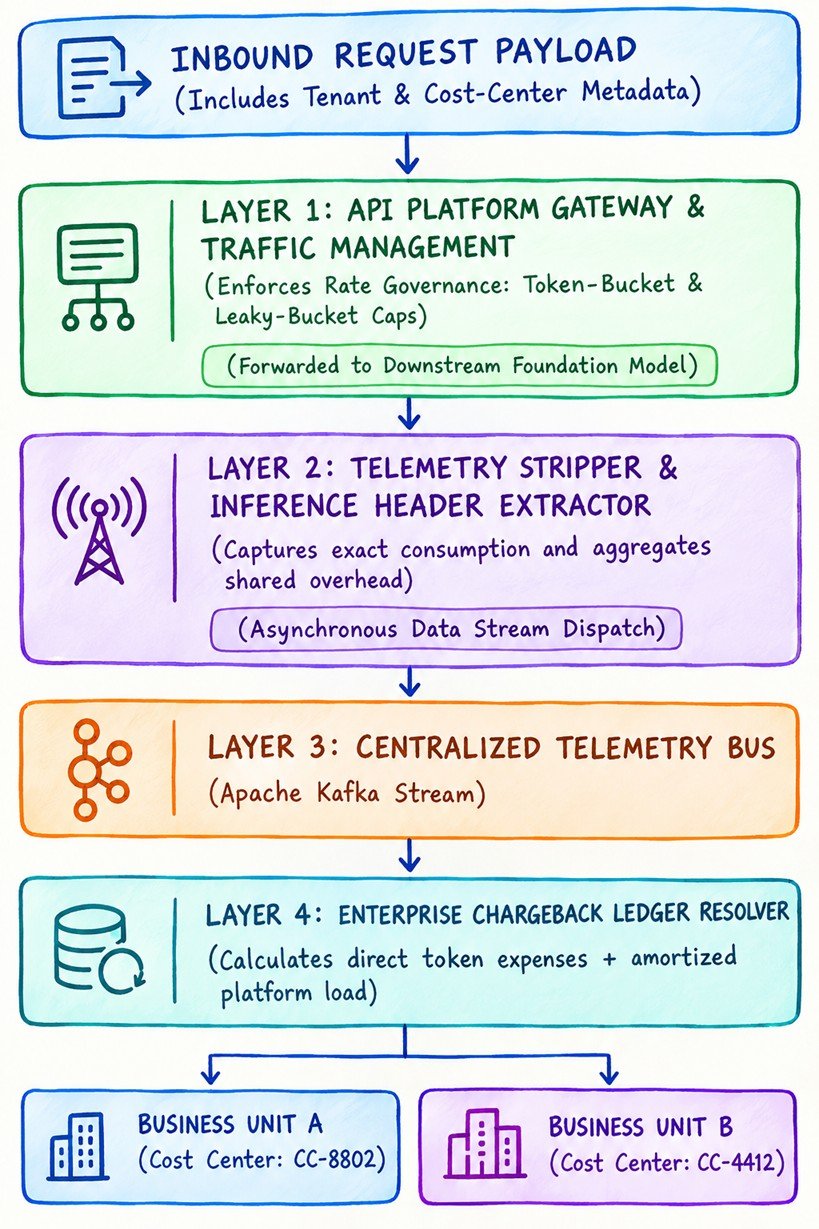
To ensure complete fiscal accountability, the Enterprise AI Platform Reference Architecture must process every model transaction through a centralized telemetry and attribution pipeline. The following diagram illustrates how an inbound payload is routed through traffic-management infrastructure, tracked by telemetry systems, and allocated to the corporate ledger:
Asynchronous Bulk Processing and Workload Offloading
The most effective method for optimizing platform capacity planning is to level out the demand spikes that naturally occur during normal business hours. Running massive, non-real-time data tasks, such as bulk document processing, data extraction, or historical compliance audits, during peak transaction windows forces the platform to maintain artificially high capacity thresholds and increases premium token utilization.
To mitigate this, the platform architecture must decouple synchronous user requests from asynchronous batch data tasks through a high-throughput message broker, such as Apache Kafka or RabbitMQ.
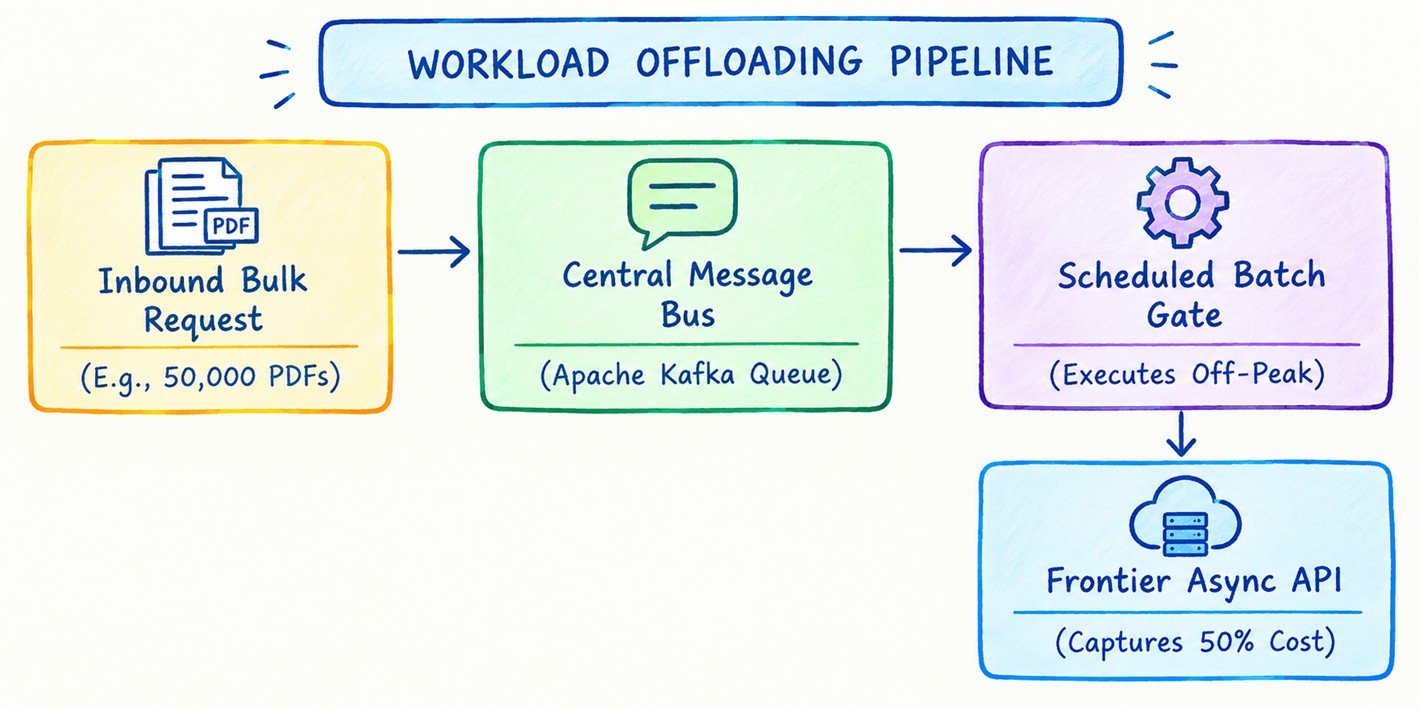
When an enterprise workflow initiates a massive processing run, the platform encapsulates the tasks as discrete messages inside a persistent Kafka queue. A scheduled worker tier processes these queues during off-peak hours, automatically routing the data payloads through Frontier Asymmetric Batch APIs.
By utilizing these specialized endpoints, the enterprise sacrifices immediate real-time execution in exchange for a guaranteed 50% discount on input and output token costs, while flattening the compute load curve across the shared enterprise gateway infrastructure.
Distributed Rate Governance and Hard Token Quotas
To protect the shared platform from runaway costs caused by infinite agent execution loops or malicious denial-of-service attempts, architects must deploy strict traffic limiters at the centralized gateway layer. Standard rate limiters that track Requests Per Minute (RPM) are fundamentally inadequate for probabilistic architectures. Governance must instead be enforced at the level of Tokens Per Minute (TPM) and Tokens Per Day (TPD).
The platform relies on two concurrent traffic-governance patterns implemented through Redis-backed rate engines:
1. The Token-Bucket Algorithm for Burst Control
This mechanism governs short-term transaction spikes. Every business tenant is allocated a bucket that continuously refills with a set number of available execution tokens per second. Short bursts of complex reasoning queries are permitted until the bucket is emptied. Once empty, the gateway automatically throttles subsequent inbound payloads, returning an HTTP 429 Too Many Requests response with a retry header until the bucket refreshes.
2. The Leaky-Bucket Algorithm for Sustained Runaway Loop Interception
To catch recursive agent loops that drain platform capital over several minutes, the leaky-bucket pattern provides a steady, governed processing rate for background tool executions. If an autonomous agent triggers an exceptional volume of recursive execution calls, the input queue buffer overflows, automatically cutting off the agent path and triggering an alert to the platform monitoring tier before a major budget breach occurs.
Enterprise Chargeback and Showback Frameworks
Shared platform architectures require a fair financial distribution strategy. If a centralized architecture team funds the foundation model gateways, vector infrastructure, and governance services from a single corporate budget, there is no structural incentive for individual business lines to optimize their prompt designs or limit token waste.
The platform must implement a dual Chargeback and Showback Framework:
-
The Showback Model (Phase 1): Focuses on complete transparency. By extracting the immutable context metadata headers (
X-FinOps-Tenant-ID,X-FinOps-Cost-Center) captured at the gateway, the platform generates automated daily financial reports distributed to business managers. This visibility highlights exactly which departments are driving corporate token spend without immediately penalizing their departmental budgets. -
The Chargeback Model (Phase 2): Enforces direct accountability. The centralized ledger system calculates the total monthly cost attributed to a specific cost center using an aggregated billing calculation:
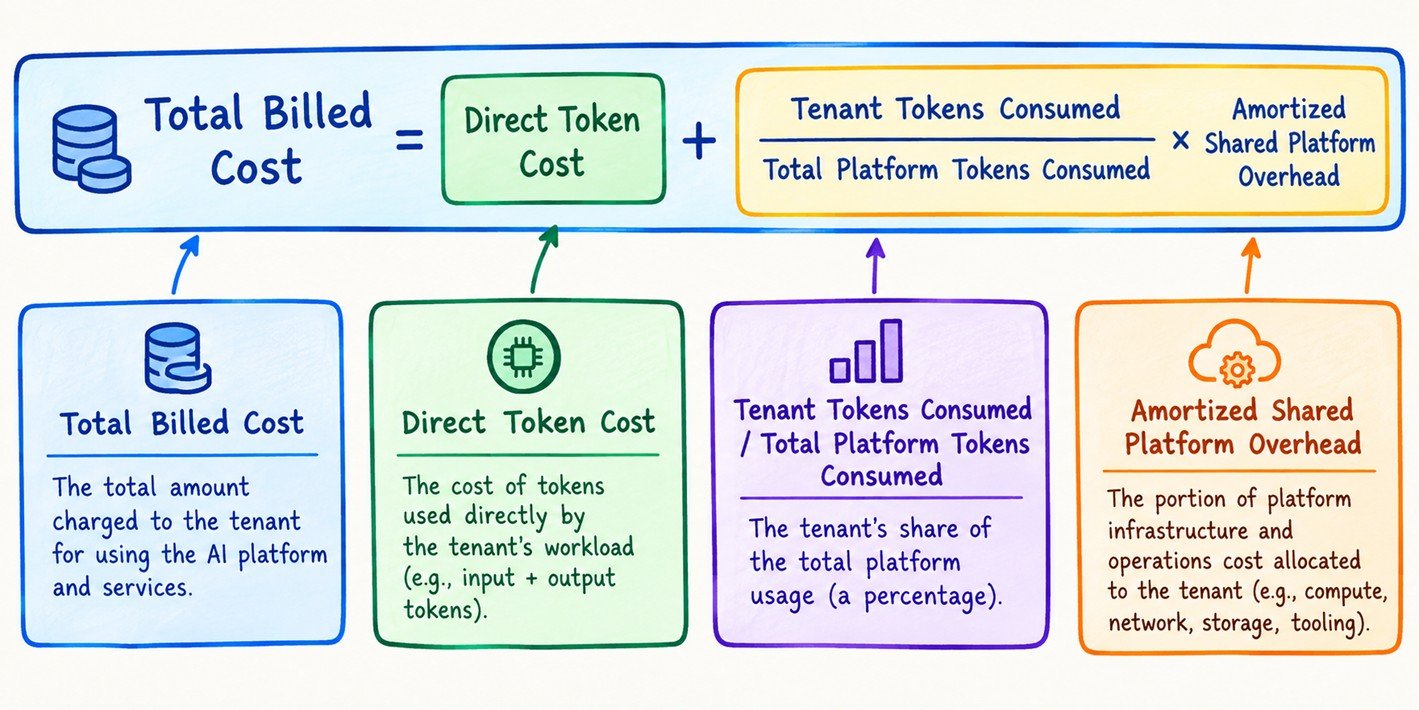
The Amortized Shared Platform Overhead incorporates the baseline fixed expenses of running the internal AI platform infrastructure, including vector database hosting fees, embedding model compute clusters, gateway licensing costs, and operational staff salaries. This model ensures that the shared platform operates as a self-sustaining utility where high-volume consumers fund the upkeep of the infrastructure they rely on.
The Intelligence ROI Calculus
The ultimate validation of any enterprise technology architecture is its ability to deliver positive economic value back to the business. In the generative AI space, this evaluation must be formalized through The Intelligence ROI Calculus—a financial model designed to prove that the tangible value generated by system automation outweighs the ongoing operational expenses of the platform.
To measure this value, architects must apply the following ledger formula:
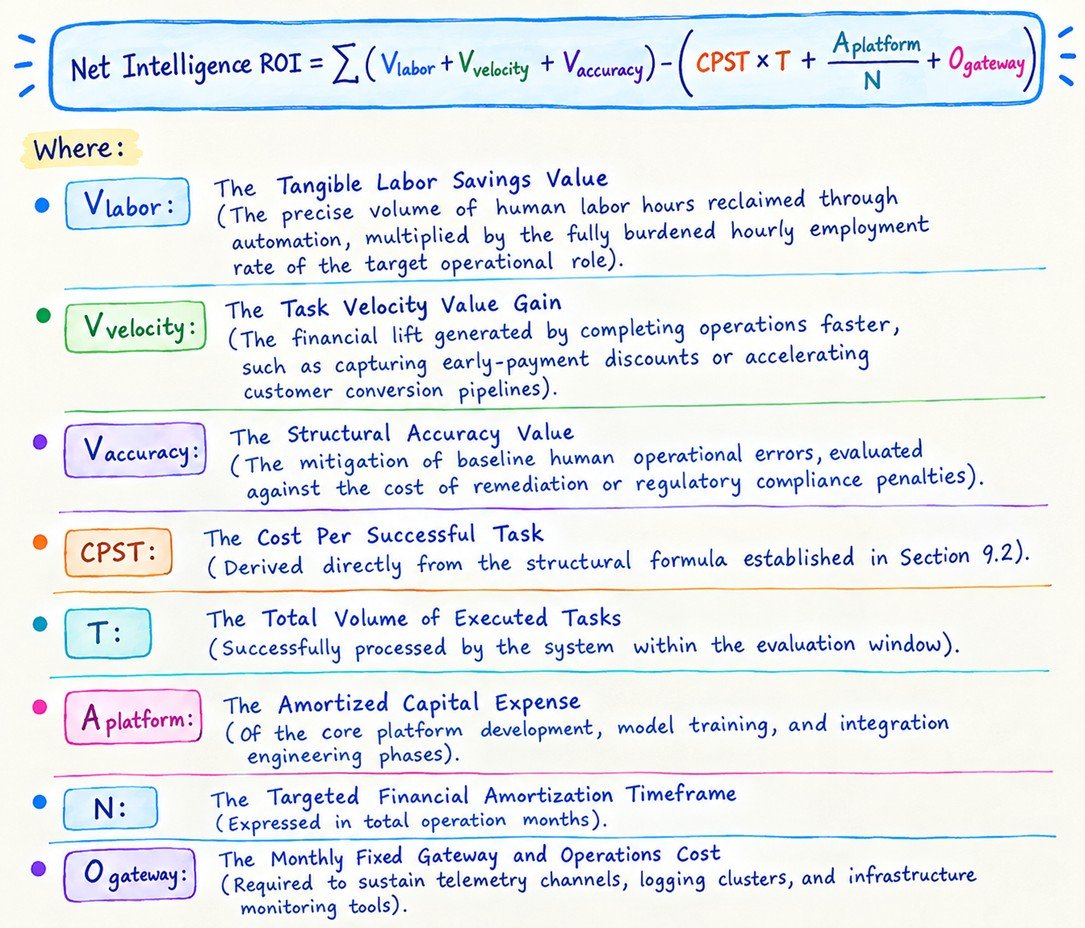
If this calculation yields a negative value over a two-month observation window, it serves as an immediate architectural indicator that the system's cognitive design is misaligned with the business value it provides. This indicator alerts technology leaders that the use case must either be re-engineered on a lower-cost utility model or returned to the transition pipeline for structural evaluation.
Mapping Governance to TOGAF Phase G and Phase H Guidelines
To ensure these economic metrics carry weight across the entire organization, they must be tied directly to the formal guidelines of the TOGAF 10 Architecture Governance Framework.
1. Phase G (Implementation Governance) Alignment
Under the guidelines of Phase G, the Architecture Review Board (ARB) is responsible for ensuring that the implemented solution aligns with the strategic goals defined in the initial architecture blueprints. For generative AI systems, the ARB enforces the following requirements:
-
Telemetry Compliance: No application team may receive live production routing credentials through the enterprise gateway until it demonstrates that its code correctly emits the complete matrix of distributed metadata context headers.
-
Quota Enforcement Verification: The implementation team must demonstrate that the Redis-backed token-bucket and leaky-bucket configurations are active, tested against simulated infinite-loop conditions, and capped according to the financial allocations established by the business unit.
2. Phase H (Architecture Change Management) Operational Criteria
Phase H governs how the enterprise architecture dynamically responds to shifting technology landscapes and operational variations. In a platform driven by the principles of AI FinOps, Phase H patterns are operationalized through the Enterprise AI Target Operating Model using automated triggers:
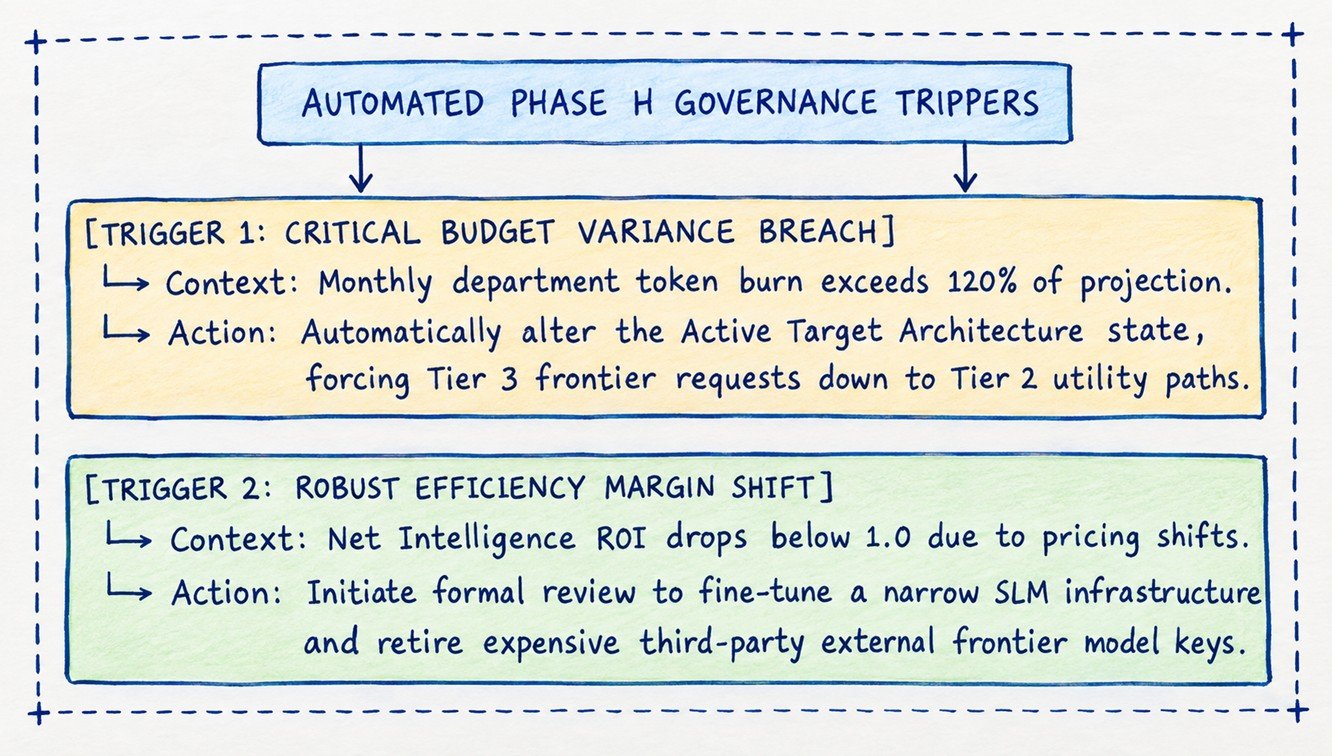
By embedding these financial triggers directly into the fabric of enterprise governance, the organization moves beyond reactive cloud budgeting. Instead, technology leaders establish a self-regulating, operationally resilient architecture capable of safely managing both the capabilities and the costs of generative AI at true enterprise scale.