The AI Unit Economics Hierarchy
Introduction
In traditional cloud operations, unit economics are direct and structural. Calculating the cost of a customer checkout, a database write, or a file download relies on deterministic infrastructure metrics. If a serverless function costs $0.000002 per invocation and executes three times during a user action, the baseline transaction cost is static and predictable.
In probabilistic, LLM-powered systems, this model completely breaks down. A single customer interaction no longer maps to a static compute instruction. Instead, it can trigger a cascade of non-deterministic workflows, multi-step semantic searches, agentic retries, and cross-model evaluations. Treating a single raw API request as the fundamental unit of financial measurement is a dangerous anti-pattern.
For CTOs, VPs of Engineering, and Chief Data Officers, managing the economics of intelligence requires establishing a standardized financial topology: The AI Unit Economics Hierarchy. This framework shifts the enterprise from primitive, isolated cost metrics toward a highly structured, multi-dimensional ledger system that links raw token consumption directly to business outcomes, corporate tenants, and workflow efficiency.
The FinOps Ledger System: Beyond Cost-Per-Request
Measuring enterprise generative AI purely by Cost-Per-Request is the financial equivalent of tracking data center value solely by power consumption. A single request that costs $0.05 might be highly efficient if it resolves a complex billing dispute, while a request costing $0.005 is purely wasteful if it terminates in an unhandled model hallucination or a failed API timeout.
The AI FinOps Ledger System establishes a multi-dimensional ledger that tracks four distinct layers of economic granularity:
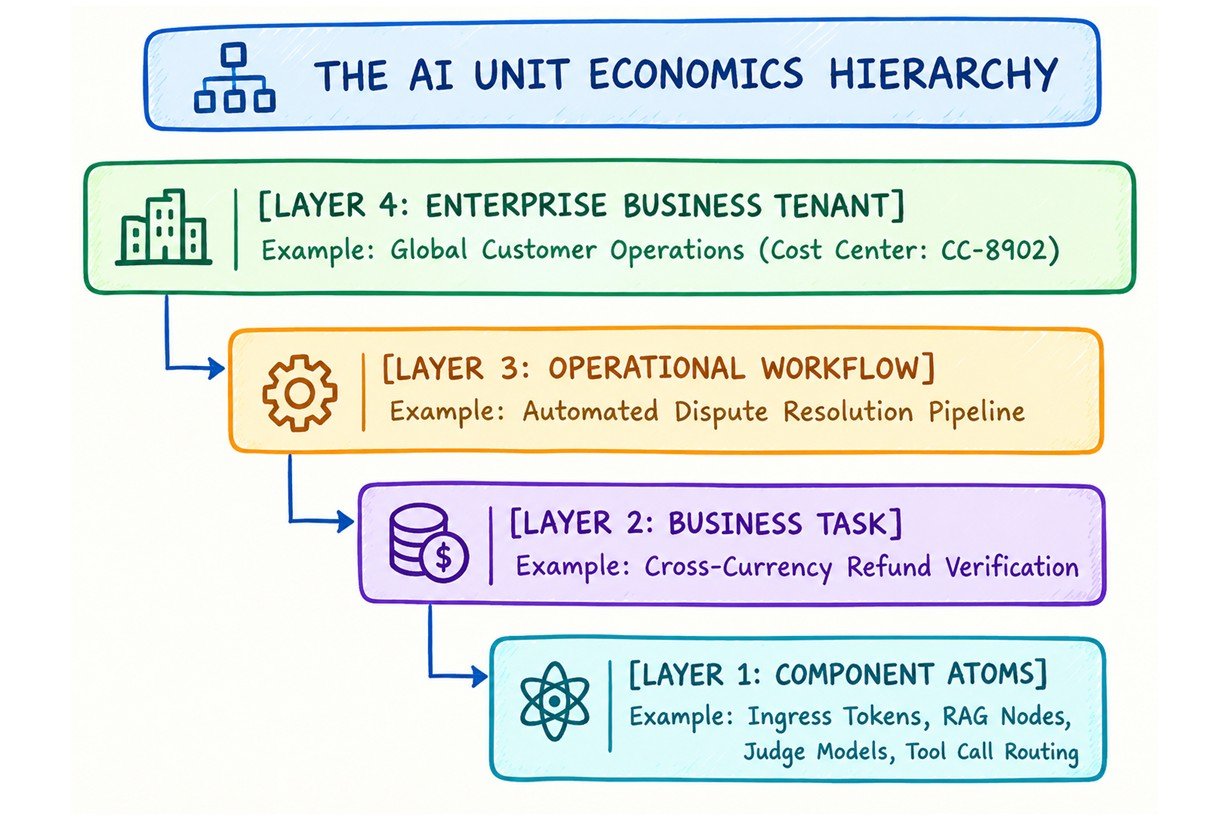
By decoupling these layers, the enterprise can move beyond superficial infrastructure billing summaries. Instead, technology leaders gain the visibility required to calculate the exact ROI of an AI initiative, identify hidden operational inefficiencies, and allocate expenses to specific business lines with complete auditability.
Formulating Cost Per Successful Task (CPST)
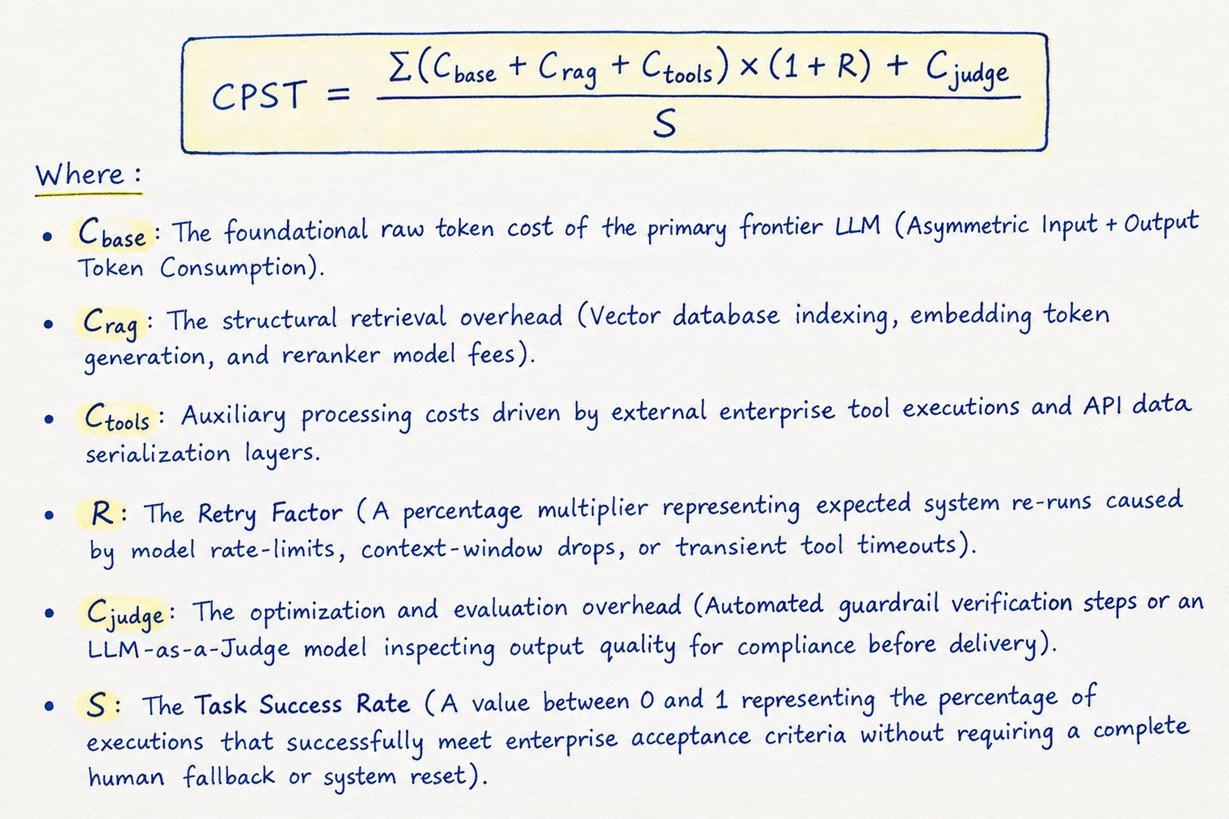
To operationalize this hierarchy, architects must replace the standard Cost Per Request metric with a comprehensive ledger metric: Cost Per Successful Task (CPST). The business does not care how many intermediate API queries an AI system executes. It cares about the total cost incurred to deliver a complete, valid, and business-compliant outcome.
The CPST formula aggregates raw component costs, factors in structural retries, and incorporates validation judge-model overhead into a unified ledger equation:
The Operational Leverage of the CPST Formula
The power of this formula lies in its ability to highlight hidden system inefficiencies. For example, an engineering team might swap out a frontier model for a utility model that cuts C_base by 50%. However, if that cheaper model exhibits reduced reasoning capability, causing the retry factor R to double or the task success rate S to drop from 95% to 75%, the CPST will actually increase. The CPST ledger formula ensures that engineering optimizations remain strictly aligned with overall corporate economic margins.
Hierarchical Cost Attribution and Distributed Metadata Tracking
Enterprise scale demands that every fraction of a cent spent on foundation models can be traced to a specific business unit or customer account. To achieve this without introducing significant runtime latency, the Enterprise AI Platform must enforce Hierarchical Cost Attribution at network ingress and egress points.
This tracking relies on a distributed metadata pipeline embedded directly within the system's asynchronous inference headers. When a user or system interaction occurs, the application orchestrator injects an immutable context object into the AI/API gateway wrapper layer:
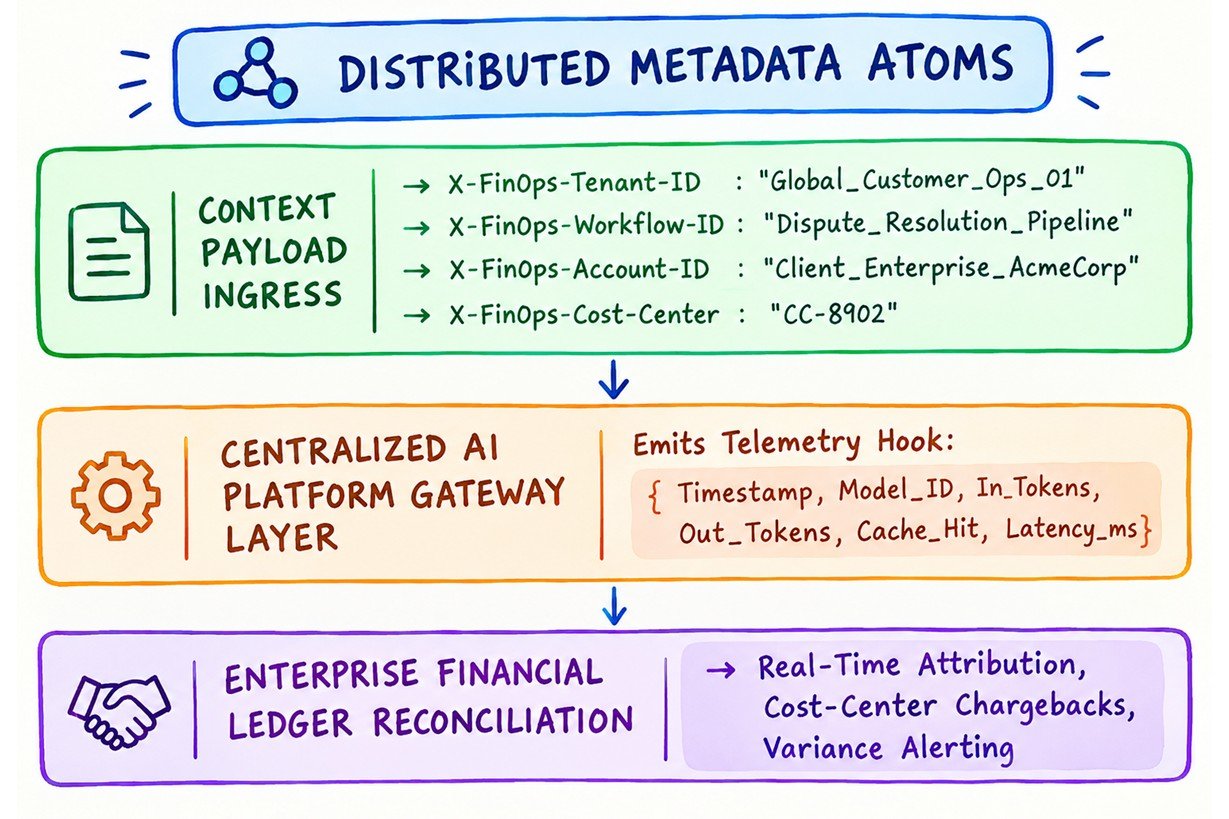
When the frontier API responds, the gateway matches the token usage counts (prompt_tokens, completion_tokens, cached_tokens) returned in the model's usage block with the ingress metadata headers. This consolidated data tuple is instantly pushed through an asynchronous, non-blocking telemetry stream, such as Apache Kafka or AWS Kinesis, to the corporate data lake. This architecture enables real-time corporate financial chargebacks, dynamic per-client margin tracking, and immediate anomaly mitigation without degrading application performance.
Anchoring Unit Economics to TOGAF 10 Phases E and F Deliverables
To institutionalize this economics framework within the enterprise, architects must firmly bind the AI Unit Economics Hierarchy to the core deliverables of TOGAF 10 Phase E (Opportunities & Solutions) and Phase F (Transition Planning). Unit economics cannot be an afterthought managed solely by standard operations teams. They must serve as a core design parameter that dictates how the architecture evolves over time.
1. Integration within the Architecture Definition Document (ADD) - Phase E
The Architecture Definition Document (ADD) acts as the definitive baseline blueprint for the system. In an industrialized AI enterprise, the ADD can no longer outline only the data flows and technology stacks. It must explicitly define the system's financial architecture boundaries:
- Target Cost Metrics Section: The ADD must formalize the expected target CPST across all core business use cases.
- Economic Guardrail Specification: The document must outline the precise technical thresholds for cost mitigation, such as vector similarity thresholds for semantic cache intercepts, prompt caching targets, and maximum allowable token allocation schemas per user persona.
- Model Escalation Maps: The ADD must include formal model-routing rules, explicitly stating when a task can be processed on a highly economical utility model versus the exact business exceptions that warrant escalation to an expensive frontier model.
2. Integration within the Transition Architecture - Phase F
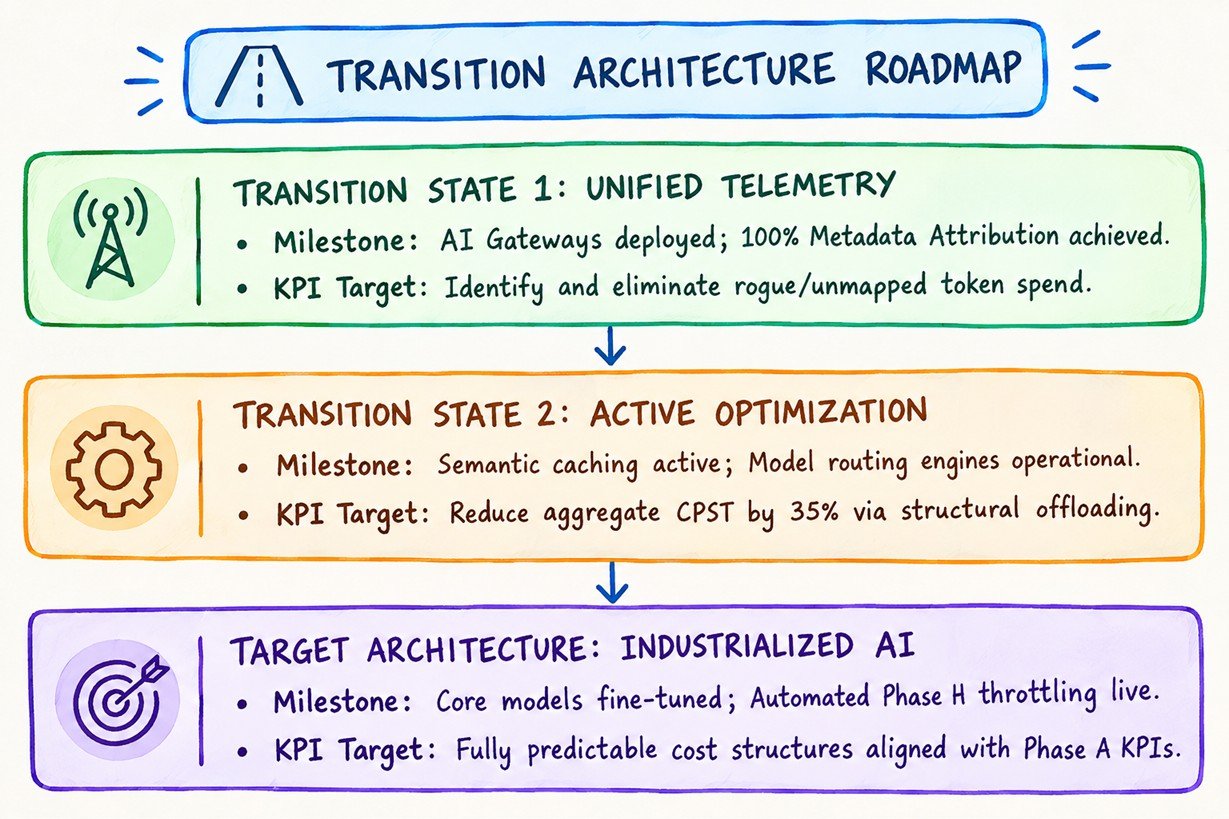
Moving an enterprise from a fragmented array of unguarded AI experiments to an industrialized, platform-driven state requires a phased, carefully governed migration strategy. The Transition Architecture deliverable in Phase F captures these intermediate states, using the AI Unit Economics Hierarchy as a primary gating mechanism.
-
Transition State 1: Financial Transparency & Grounding: The initial migration phase focuses entirely on deploying the AI Platform Gateway architecture to capture 100% of the distributed metadata tracker fields. No model-level optimizations are introduced at this stage. The sole deliverable is an audited, highly accurate baseline financial ledger that eliminates unmapped token spend.
-
Transition State 2: Structural Cost Mitigation: The second transition block introduces core engineering optimizations, specifically activating semantic caching layers and multi-model routing engines. The exit criteria for this state require demonstrating a verified, multi-week reduction in CPST across primary business workflows without degrading overall task accuracy.
-
Target Architecture Integration: The final state achieves full alignment with the Phase A Architecture Vision, featuring highly predictable AI unit economics, fine-tuned corporate models that drastically reduce dependency on third-party frontier APIs, and automated governance hooks that dynamically throttle usage before corporate budget boundaries are breached.