Enterprise AI Unit Economics & FinOps Framework
Introduction
An enterprise architectural destination is only as strong as its verification mechanism. To conclude the economic foundation of the Architectural North Star, technology leaders must transition from abstract design principles to a concrete, operational blueprint.
Designed to be lifted directly from this text and institutionalized by CTOs, VPs of Engineering, and Enterprise Solution Architects, this framework consolidates the mathematical, operational, and reporting standards required to govern probabilistic system expenditures at true enterprise scale.
Component 1: The Enterprise FinOps Executive Dashboard
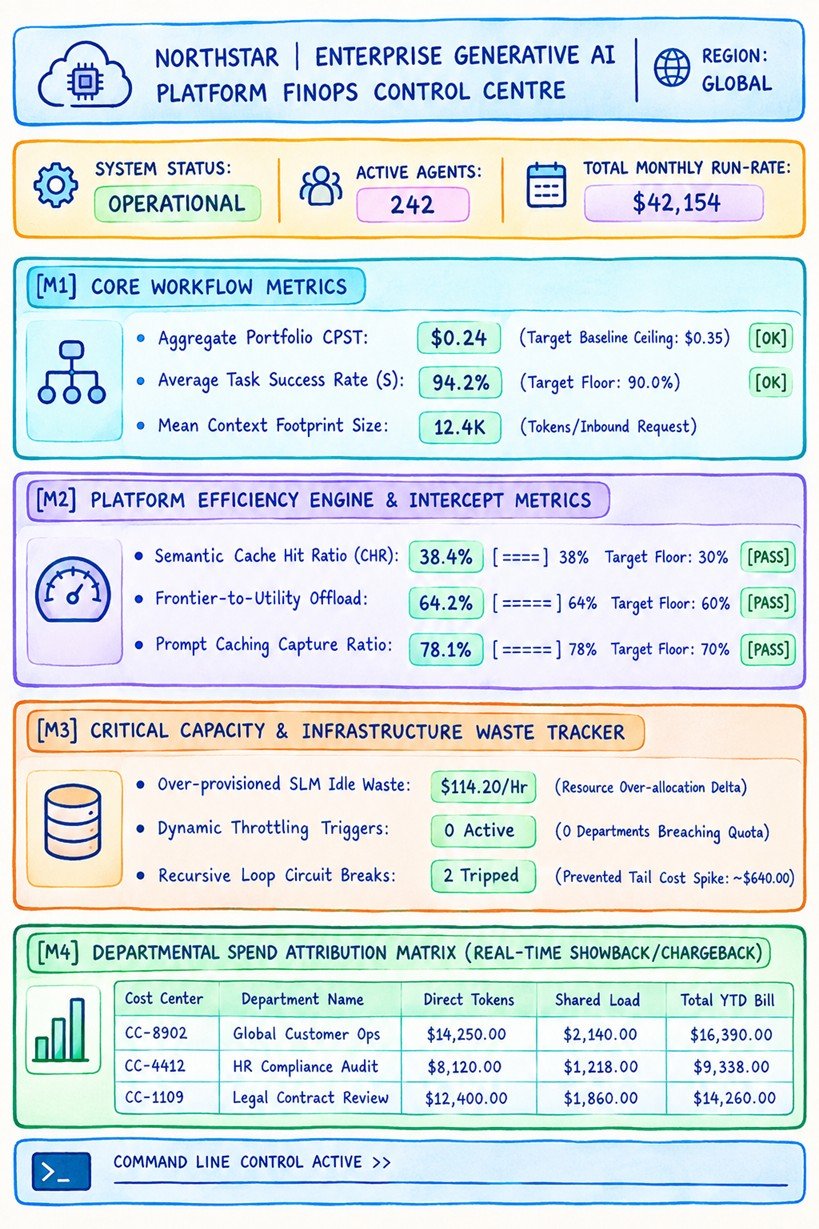
To achieve active financial oversight without inducing operational drag, the centralized Enterprise AI Platform Reference Architecture must expose a real-time tracking interface. This executive dashboard represents the telemetry layout required to fulfill the verification standards of TOGAF Phase G (Implementation Governance).
Component 2: The Enterprise Financial Formula Sheet Matrix
To integrate these mathematical foundations cleanly into an engineering manuscript, the underlying financial metrics must be decoupled from a static table layout and presented as an operational, high-density equation playbook. Enterprise Solution Architects must integrate these sequential formulations directly into their automated analytics pipelines to track runtime system efficiency and value realization.
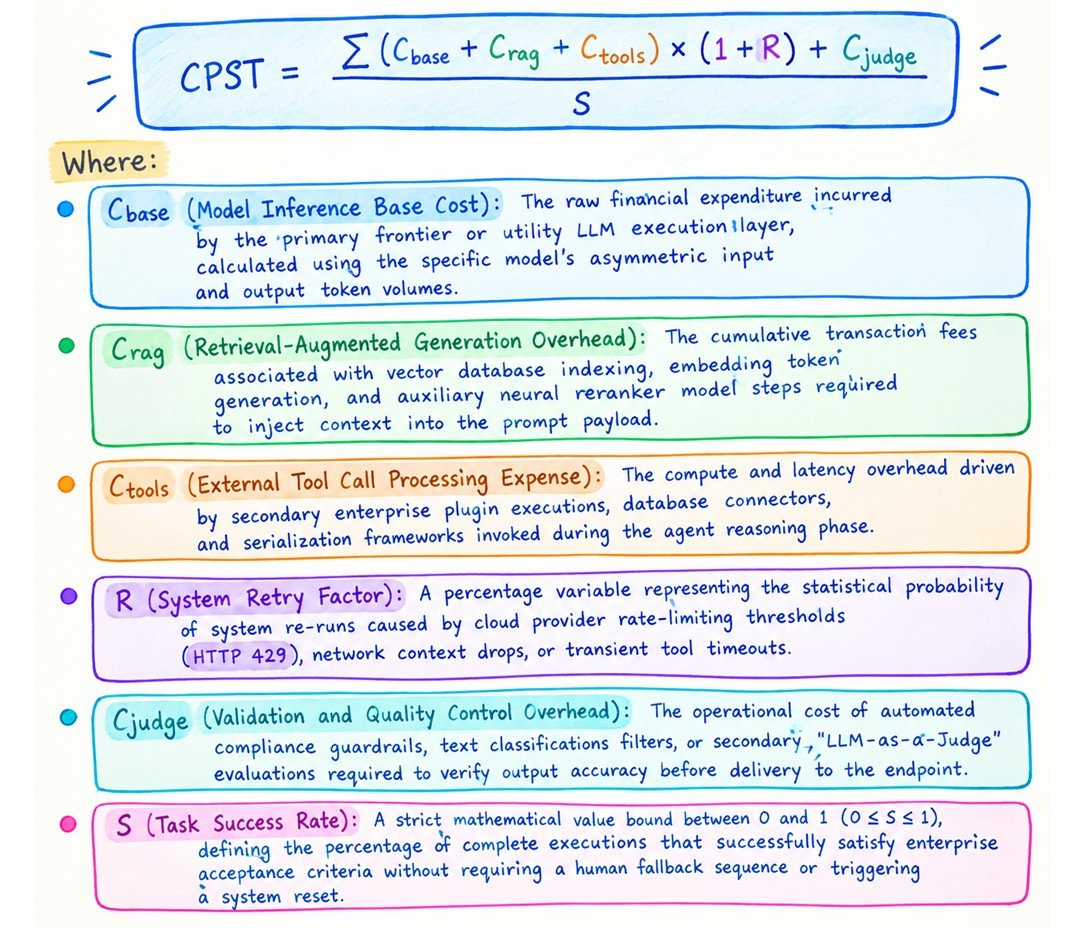
1. Cost Per Successful Task (CPST)
The foundational economic metric of the probabilistic platform is the Cost Per Successful Task. Unlike traditional cloud systems, where request volume scales linearly with execution cost, a single user transaction in a generative AI ecosystem can trigger an unpredictable chain of token allocations, external lookups, and secondary evaluations. The CPST isolates the true, fully loaded cost required to deliver a single business-compliant outcome by factoring in execution waste, tool overhead, and validation cycles.
2. Asymmetric Billing Tracking (ABT)
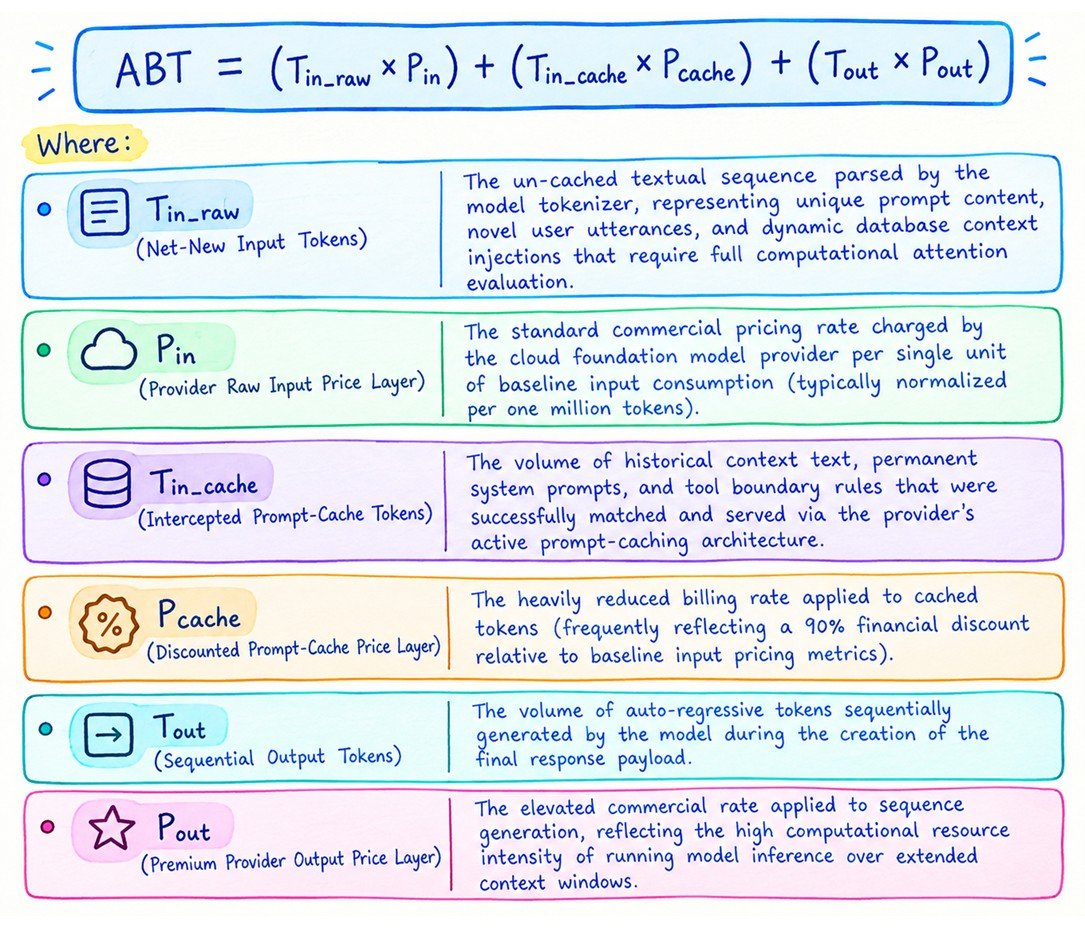
Because frontier model cloud providers process and optimize information using distinct attention mechanisms for context ingestion versus sequence generation, infrastructure expenses are structurally decoupled. Output tokens are consistently priced at a 3x to 5x premium relative to input tokens. The Asymmetric Billing Tracking equation acts as the direct platform metering engine, calculating exact transactional OpEx by separating input, output, and cached token layers.
3. Net Intelligence ROI (NI-ROI)
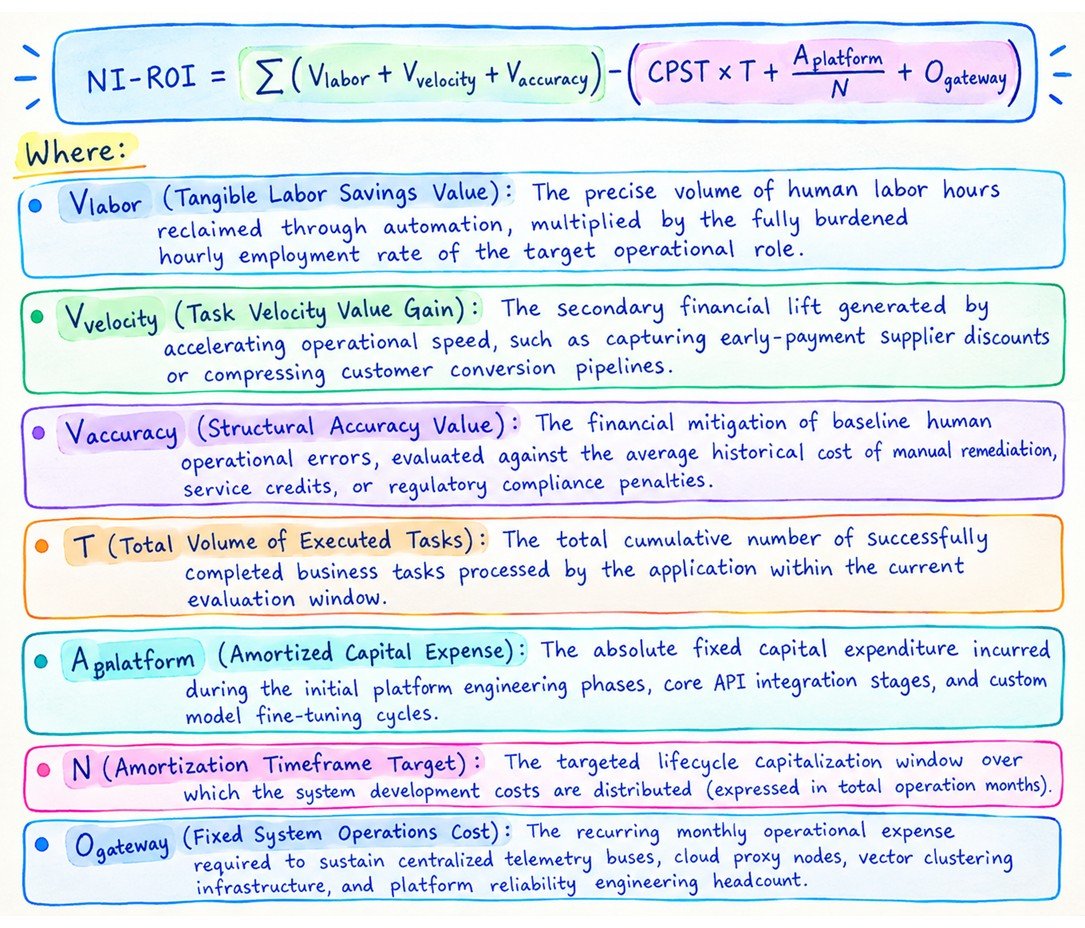
The ultimate validation of an enterprise technology architecture is its ability to deliver positive economic value back to the business. Net Intelligence ROI moves the organization beyond superficial cloud infrastructure cost monitoring by calculating the true net financial return of an AI application. This formulation directly balances the tangible business value generated through automation against the ongoing operational and capital expenses of the enterprise platform.
Component 3: Corporate Chargeback Ledger Workflow Playbook
This step-by-step playbook outlines the computational mechanics required to distribute shared platform infrastructure costs back to specific business lines with complete financial auditability.
Step 1: Extract Ingress Metadata Fields
For every discrete model inference request processed by the Centralized AI Platform Gateway, the logging tier must parse and extract the distributed telemetry context headers:
{
  "tenant_id": "Global_Customer_Ops_01",
  "cost_center": "CC-8902",
  "workflow_id": "Dispute_Resolution_Pipeline"
}
Step 2: Compute Base Direct Asymmetric Consumption
At the conclusion of the monthly billing cycle, query the centralized telemetry stream, such as Apache Kafka or AWS Kinesis log targets, to calculate the raw, isolated model fee for the specific tenant using the Asymmetric Billing Tracking (ABT) equation:

Step 3: Aggregate Platform Fixed Operational Overhead
Consolidate the monthly fixed operational costs required to maintain the shared Enterprise AI Platform infrastructure layer:
Shared Platform Overhead = Vector Base Hosting + Gateway Clustering Fees + Centralized Telemetry Bus Costs + Core Platform Ops Headcount
Step 4: Compute the Tenant Volumetric Consumption Ratio
Determine the specific business unit's exact utilization fraction relative to the entire enterprise platform's consumption payload volume:

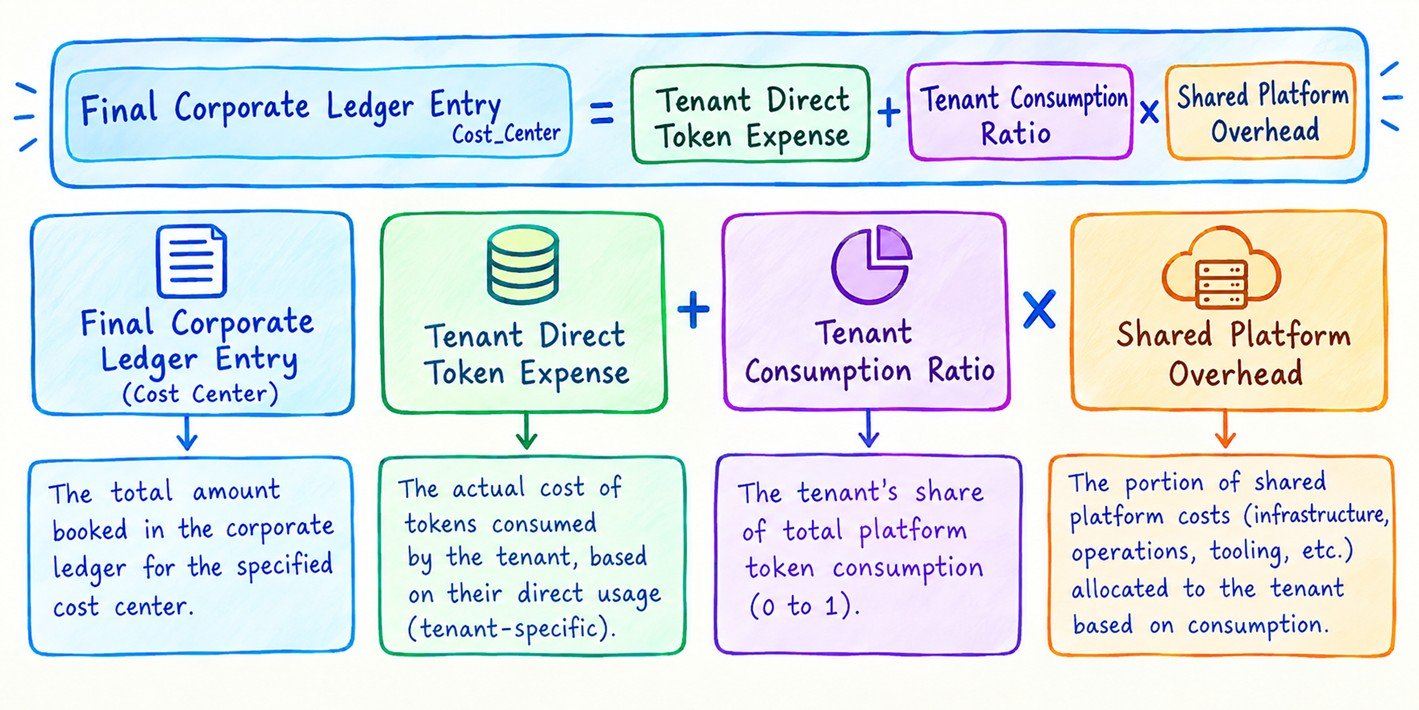
Step 5: Execute Final Corporate Ledger Reconciliation
Calculate the finalized monthly chargeback allocation to apply to the target department's cost center ledger entry:
Framework Architectural Alignment Takeaway
This framework transitions the organization from loose, project-based cloud cost tracking toward an institutionalized AI Production Factory Operating Model. By integrating these technical metrics, dashboard mockups, and structured financial playbooks directly into the Architecture Definition Document (ADD) for TOGAF Phases E and F, Solution Architects establish a transparent, defensible, and cost-controlled enterprise computing environment designed for continuous scale.