OWASP LLM risks
Introduction
For technology executives, treating the Open Worldwide Application Security Project (OWASP) Top 10 for LLM Applications as a mere developer checklist is a critical governance failure. The OWASP LLM risk framework is not a collection of isolated software bugs; it is an architectural exposure map that highlights where the non-deterministic, probabilistic nature of Generative AI threatens corporate assets, regulatory compliance, and fiscal stability.
When a GenAI system transitions into enterprise production, these vulnerabilities manifest as structural liabilities. Rather than managing these 10 risks as disjointed engineering issues, leadership must evaluate them across three systemic categories: Input & Execution Control, Data & Intellectual Property Governance, and Infrastructure & Supply Chain Integrity.
The Three Pillars of Executive OWASP Risk
Pillar 1: Input & Execution Control (Operational Integrity Risks)
This pillar encompasses threats where adversaries exploit the linguistic nature of LLMs to manipulate system behavior, bypass hardcoded guardrails, or execute unauthorized code.
- LLM01: Prompt Injection: Attackers alter the model's behavior via direct prompts (jailbreaks) or indirect data payloads (e.g., malicious customer uploads), forcing the system to violate corporate compliance or policies.
- LLM02: Insecure Output Handling: Downstream enterprise systems accept the LLM's natural language output as inherently trusted text, opening the door to Cross-Site Scripting (XSS) or SQL injection in backend databases.
- LLM07: Insecure Plugin Design (Excessive Agency): AI plug-ins or autonomous agents are granted overly broad permissions, allowing a prompt injection to trigger unauthorized write/delete commands across enterprise APIs.
- LLM09: Overreliance: Users or automated systems blindly trust model outputs without validation, leading to catastrophic business errors, legal liabilities, or operational downtime due to undetected model hallucinations.
Pillar 2: Data & Intellectual Property Governance (Legal & Compliance Risks)
This pillar represents the existential threats to corporate data sovereignty, compliance posture, and proprietary market advantage.
- LLM03: Training Data Poisoning: Malicious actors manipulate the data streams used to fine-tune or pre-train enterprise models, introducing systemic biases, logical blind spots, or hidden backdoors.
- LLM06: Sensitive Data Exposure: The LLM inadvertently leaks proprietary IP, trade secrets, or regulated data (PII/PHI) because that data was improperly appended to prompt context windows or training sets.
- LLM10: Model Theft: Adversaries exfiltrate the weights, parameters, or proprietary fine-tuning data of your enterprise model via direct cyber attacks or continuous, algorithmic prompt-extraction queries.
Pillar 3: Infrastructure & Supply Chain Integrity (Financial & Technical Risks)
This pillar focuses on risks that disrupt business continuity, drive up unbudgeted cloud expenditures, or compromise foundational architecture.
- LLM04: Model Denial of Service (Denial of Wallet): Attackers craft resource-intensive or recursive prompts that exhaust token limits and model processing capacity, causing runaway FinOps costs or system downtime.
- LLM05: Supply Chain Vulnerabilities: The application relies on compromised third-party foundation models, open-source libraries, poisoned public weights, or insecure cloud wrappers, introducing hidden exploits.
- LLM08: Excessive Agency: The systemic architecture grants the AI system broad capabilities to execute destructive actions (e.g., moving money, modifying records) based purely on non-deterministic natural language logic.
Comprehensive OWASP Strategic Mapping Blueprint
The following table provides technology leaders with a standardized dashboard to map the entire OWASP LLM Top 10 directly onto the Enterprise GenAI Threat Model and assess its business impact.
| OWASP Risk ID & Title | Primary Threat Layer | Executive Risk Category | Business & Operational Impact |
|---|---|---|---|
| LLM01: Prompt Injection | Layer 1: Ingestion & Layer 2: Context | Brand Reputation & Compliance | Manipulated inputs override alignment, forcing non-compliant or malicious generations. |
| LLM02: Insecure Output Handling | Layer 4: Integration Boundary | Systemic Infrastructure Security | Traditional backend architectures treat outputs as trusted, triggering code injection. |
| LLM03: Training Data Poisoning | Layer 2: Application Context | Data Sovereignty & Integrity | Systemic corruption of model logic, destroying accuracy and introducing backdoors. |
| LLM04: Model Denial of Service | Layer 3: Model Orchestrator | Infrastructure FinOps Risk | Resource exhaustion and token spikes leading to runaway operational cloud budgets. |
| LLM05: Supply Chain Vulnerabilities | Layer 3: Model Orchestrator | Third-Party Vendor Risk | Compromised upstream models or open-source dependencies inject hidden exploits. |
| LLM06: Sensitive Data Exposure | Layer 2: Context & Layer 3: Orchestrator | Legal & Regulatory Liability | Regulated data or trade secrets are leaked to unauthorized users via model memory. |
| LLM07: Insecure Plugin Design | Layer 4: Integration Boundary | Operational Integrity & Fraud | Flawed plugin code allows prompt injections to trigger unauthorized external API actions. |
| LLM08: Excessive Agency | Layer 4: Integration Boundary | Systemic Privilege Escalation | Autonomous agents execute highly destructive commands without deterministic safety checks. |
| LLM09: Overreliance | Layer 1: User Ingestion Point | Quality Control & Brand Risk | Hallucinations are accepted blindly as fact, leading to massive business operational errors. |
| LLM10: Model Theft | Layer 3: Model Orchestrator | Intellectual Property Loss | Competitors copy or reverse-engineer your proprietary fine-tuned model weights. |
The Expanded Executive OWASP Governance Mandate
To operationalize the complete OWASP LLM framework, leadership must enforce four non-negotiable architectural mandates across all product teams before signing off on production deployment:
- Mandate Dual-Layer Semantic Interception: Treat all linguistic traffic—both incoming prompts and outgoing generations—as untrusted network traffic requiring real-time, independent semantic firewall evaluation.
- Enforce Hardcoded Deterministic Gateways: Never allow an autonomous LLM agent to execute state-changing actions (write, modify, or delete) on core enterprise systems without a hardcoded, rules-based business logic validation layer or an explicit human-in-the-loop checkpoint.
- Establish Software and Data Bill of Materials (SBOM / DBOM): Mandate complete, auditable control over both the software supply chain (upstream models and libraries) and the data lineage feeding your systems, ensuring malicious code or poisoned records are programmatically blocked.
- Implement Rate Limiting and Token Guardrails: Mitigate Financial Denial of Wallet risks by enforcing granular token consumption limits, semantic caching strategies, and automatic session-termination thresholds at the gateway level.
Strategic Execution: Designing Multi-Layered Guardrails and Semantic Firewalls
Identifying the OWASP Top 10 risks is only half the executive challenge; the primary responsibility of leadership is allocating capital toward a resilient defensive architecture. Because Generative AI is inherently non-deterministic, traditional signature-based web application firewalls (WAFs) are completely blind to linguistic attacks. To secure an enterprise production system, architects must deploy an independent, asynchronous infrastructure layer: Semantic Firewalls and Multi-Layered Guardrails.
This defensive architecture does not sit within the model itself. Instead, it acts as an external, multi-stage interception pipeline wrapped around the entire model orchestration lifecycle, evaluating intent before execution and validating accuracy before output delivery.
The Enterprise Guardrail Architecture Reference Blueprint
To systematically mitigate OWASP exposures, enterprise leaders must mandate a three-tier defensive pipeline that sits between the user interface and the core foundation models.
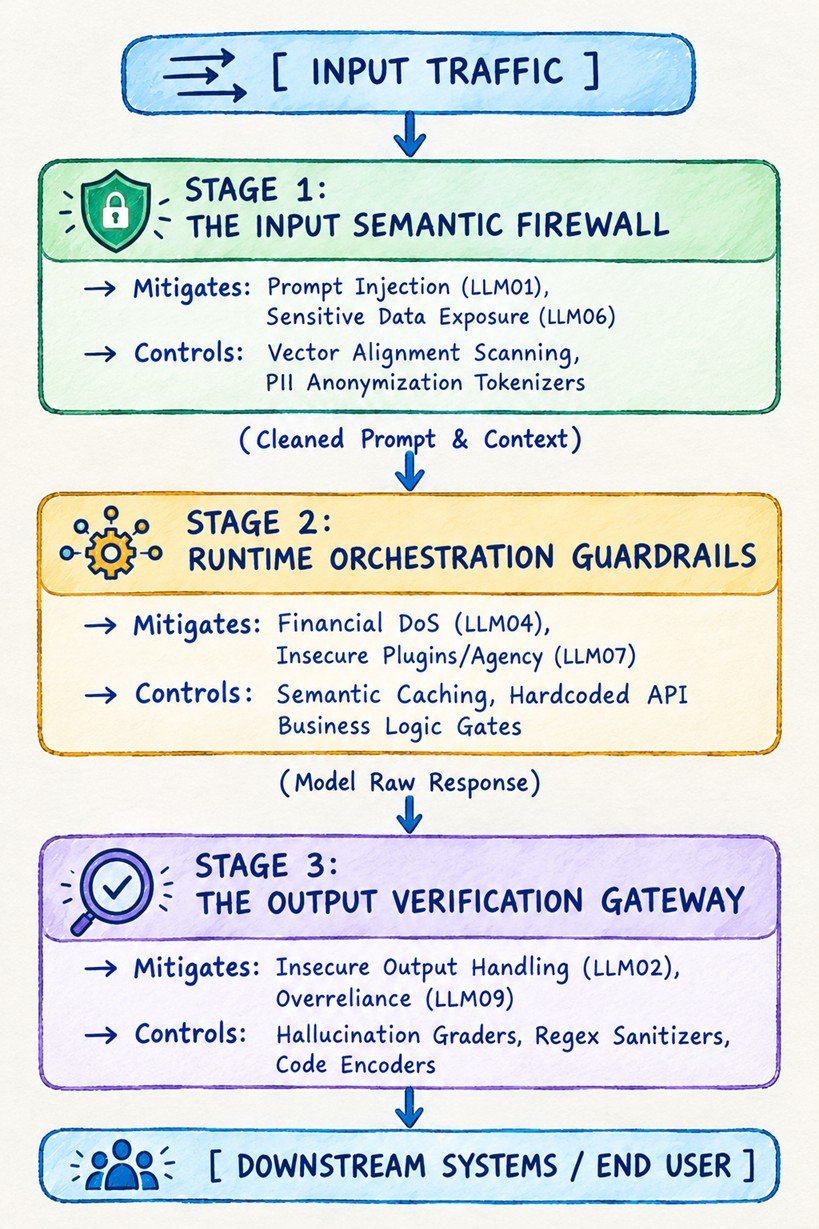
Stage 1: The Input Semantic Firewall (The Ingestion Defenses)
The input firewall is the primary gateway tasked with intercepting malicious intent before a prompt or data payload ever reaches the LLM orchestrator.
- Vector Alignment Scanning: This control translates incoming user prompts into vector embeddings and mathematically compares them against a dynamic database of known adversarial jailbreaks and injection techniques. If a prompt falls within the statistical cluster of an attack, it is rejected instantly at the gateway level.
- PII/PHI Tokenization Shunts: To permanently neutralize LLM06 (Sensitive Data Exposure), automated microservices scan the input for patterns matching corporate IP, social security numbers, medical records, or API keys. These elements are programmatically stripped or replaced with safe tokens (
[MASKED_PII_01]) before the data enters the context window.
Stage 2: Runtime Orchestration Guardrails (The Execution Defenses)
Once a prompt is deemed safe, the runtime orchestration layer manages the model's environment, resource constraints, and connection boundaries.
- Semantic Caching Engines: To mitigate LLM04 (Model Denial of Service / Denial of Wallet), the architecture checks an enterprise semantic cache (e.g., Redis or a dedicated vector index) to see if a conceptually identical query has been answered recently. If a match is found, the system serves the cached response instantly. This completely bypasses the model call, protecting the enterprise cloud budget.
- Deterministic API Proxy Gates: To neutralize LLM07 (Insecure Plugin Design), all tool calls generated by the LLM must pass through a rigid, rules-based software proxy. The model can never invoke an API directly. Instead, it submits a natural language request, which the proxy validates against a hardcoded schema and user privilege matrix before triggering any backend change.
Stage 3: The Output Verification Gateway (The Delivery Defenses)
The final stage protects the enterprise from the model's own output, scanning for hallucinations, structural flaws, or hidden code injections before the text is rendered to a user or database.
- Algorithmic Hallucination Graders: To defend against LLM09 (Overreliance), asynchronous validation models evaluate the generated text against the original source data (the RAG context) to compute a structural "Faithfulness Score." If the model invents facts or references non-existent records, the output gateway intercepts it and returns a standardized error message.
- Output Sanitizers and Encoders: To block LLM02 (Insecure Output Handling), all text generated by the model passes through strict security encoders that strip out Markdown exploits, rogue HTML tags, or executable script segments, ensuring the text can be safely rendered by downstream enterprise applications.
Leadership Capital Allocation Strategy
When designing and funding this guardrail infrastructure, technology leaders must weigh the trade-offs between Latency, Cost, and Accuracy (The GenAI Security Trilemma).
Every security layer added to the semantic firewall introduces computational latency and additional token or infrastructure overhead. For consumer-facing applications, executives must prioritize high-speed, lightweight vector alignment scanners at Stage 1. Conversely, for high-stakes internal applications (such as healthcare record synthesis or legal contract analysis), leadership must accept higher latency costs and mandate exhaustive Hallucination Graders at Stage 3 to ensure absolute data veracity.