Executive Strategy - The Generative AI Incident Response Playbook
Introduction
When an enterprise generative AI system fails in production, traditional IT incident response (IR) protocols are insufficient. Standard cyber incidents, such as network intrusions or malware infections, involve deterministic systems where the boundary between normal operations and compromised code is clear.
In contrast, a Generative AI incident involves probabilistic compromise. The infrastructure may be completely intact, but the model's linguistic output or autonomous actions can actively damage the corporation.
Technology executives must implement an Agile GenAI Incident Response Playbook designed to detect, contain, and remediate probabilistic threats in real time without paralyzing core business operations.
The GenAI Incident Severity Matrix
The corporate incident commander must rapidly classify AI anomalies into standardized severity tiers to mobilize the appropriate executive response teams.
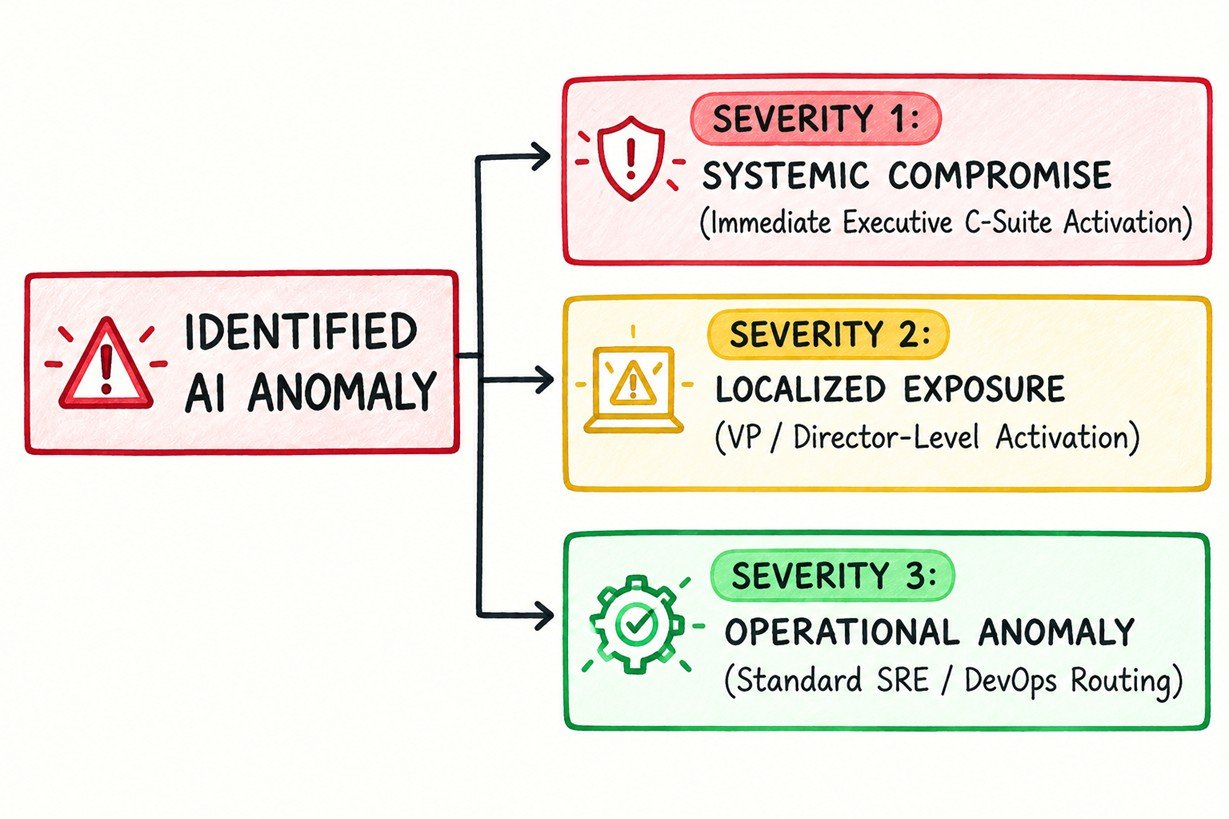
| Severity Tier | Incident Characteristics | Core Vulns (OWASP / Layers) | Executive Activation Level |
|---|---|---|---|
| Severity 1: Systemic Compromise | - Autonomous agent executes unauthorized, destructive backend database deletions or rogue financial transactions. - Unmasked, raw PII/PHI or highly sensitive corporate IP is leaked at scale via prompt extraction or model inversion. | LLM06 (Sensitive Data Exposure) LLM07/LLM08 (Excessive Agency) Layer 4 (Integration Boundary) | Immediate C-Suite Alert: CISO, CTO, General Counsel, and CEO. |
| Severity 2: Localized Exposure | - Adversaries successfully bypass safety alignments (jailbreaking) to generate non-compliant, toxic, or brand-damaging outputs visible to external users. | LLM01 (Prompt Injection) LLM09 (Overreliance) Layer 1 (User Ingestion) | Business Unit Alert: VP of Engineering, Product Director, and Corporate Communications. |
| Severity 3: Operational Anomaly | - Upstream commercial API modifications cause severe model drift, breaking integration schemas or driving up token consumption via recursive loop logic. | LLM04 (Denial of Wallet) LLM05 (Supply Chain) Layer 3 (Model Orchestrator) | Technical Team Alert: Site Reliability Engineering (SRE), DevSecOps, and FinOps Lead. |
The Four-Phase Execution Playbook
Once an incident is classified, the enterprise must execute a strict, four-stage protocol to minimize corporate liability.
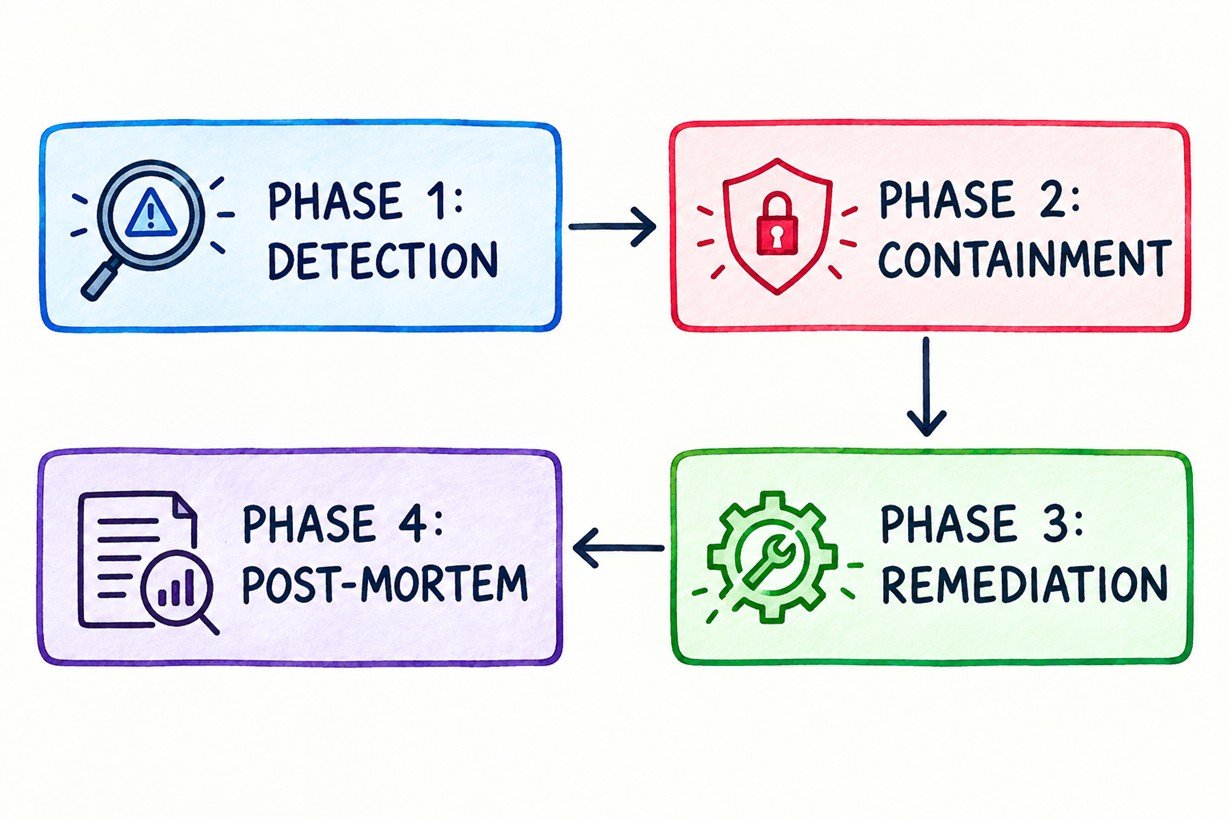
Phase 1: Detection & Triage
- Objective: Verify the probabilistic anomaly and determine data lineage.
- Executive Actions: Pull the immutable session logs from the AI Auditing Vault. The incident commander must immediately cross-reference the user's prompt, the retrieved RAG context snippets, and the generated output to isolate whether the exploit was a Direct Prompt Injection (Layer 1) or an Indirect Prompt Injection via data poisoning (Layer 2).
Phase 2: Containment & Isolation
- Objective: Instantly halt data exfiltration or autonomous state changes.
- Executive Actions: Depending on the severity tier, execute the Automated Circuit Breaker Protocols:
- API Token Revocation: Instantly strip the model orchestrator of its write/delete bearer tokens, forcing the application into a read-only state.
- Semantic Shunting: Inject an adversarial vector signature override into the Input Semantic Firewall, instantly dropping any incoming requests that resemble the attack vector.
- System Quarantine (Severity 1): Sever the connection between the model orchestrator and the public cloud API gateway, serving an optimized, deterministic backup interface to users.
Phase 3: Remediation & Re-Alignment
- Objective: Fix the root vulnerability and restore verified system trust.
- Executive Actions:
- If the exploit leveraged data context (Layer 2), trigger an Automated Vector Re-indexing cycle to purge the poisoned corporate data files.
- If the exploit bypassed linguistic guardrails (Layer 1), update the vector alignment scanners at the Input Firewall with the specific semantic signature of the exploit.
- Run the system against the company's Golden Regression Datasets to verify that the fix closes the vulnerability without causing severe model drift or performance degradation across normal use cases.
Phase 4: Legal, Compliance, & Post-Mortem
- Objective: Fulfill regulatory reporting mandates and protect enterprise intellectual property.
- Executive Actions:
- Regulatory Disclosure: If the triage phase confirms the exposure of customer PII or PHI (Severity 1), Legal Counsel must initiate the mandatory disclosure timelines dictated by GDPR (74-hour notification mandate) or HIPAA breach notification rules.
- Vendor Attestation: If the incident was triggered by an unannounced upstream provider update (LLM05), procurement must log a formal compliance infraction against the cloud provider's SLA framework.
The Executive Incident Command Scorecard
Technology leaders must treat the post-mortem phase as an opportunity to harden enterprise infrastructure. Every incident closure requires the CISO and VP of Engineering to sign off on three structural questions before returning the application to full, non-quarantined production:
-
Was the exploit infrastructure-based or semantic?
Did the attacker breach our cloud firewalls, or did they simply out-linguistic our model's guardrails? -
Did our automated guardrails intercept or fail?
Did Stage 3 Output Verification catch the hallucination or injection, or was the breach discovered through an external third-party report? -
Is our AI-RPN risk score still accurate?
Based on this real-world event, do we need to recalibrate our Exploitability or Detection Difficulty metrics for this application archetype?
By implementing this playbook, enterprise leadership shifts the organization away from panic-driven firefighting toward a mature, auditable system of structural resilience. This framework ensures that even when a probabilistic system fails, the corporate response remains entirely deterministic, controlled, and legally defensible.