Enterprise GenAI threat model
Introduction
Moving generative AI into enterprise production expands your attack surface exponentially. Traditional security frameworks protect infrastructure, including firewalls, identity management, and network segregation, but fail to secure the probabilistic nature of large language models (LLMs).
While a traditional system responds deterministically to predictable code, an LLM reacts contextually to fluid natural language. This architectural shift means security can no longer rely purely on static input validation. You must implement a dedicated enterprise generative AI threat model to identify, assess, and mitigate risks across the entire data and model lifecycle.
This threat model requires technology leaders to analyze four distinct, interconnected layers, establishing rigorous defense-in-depth boundaries at each transition point:
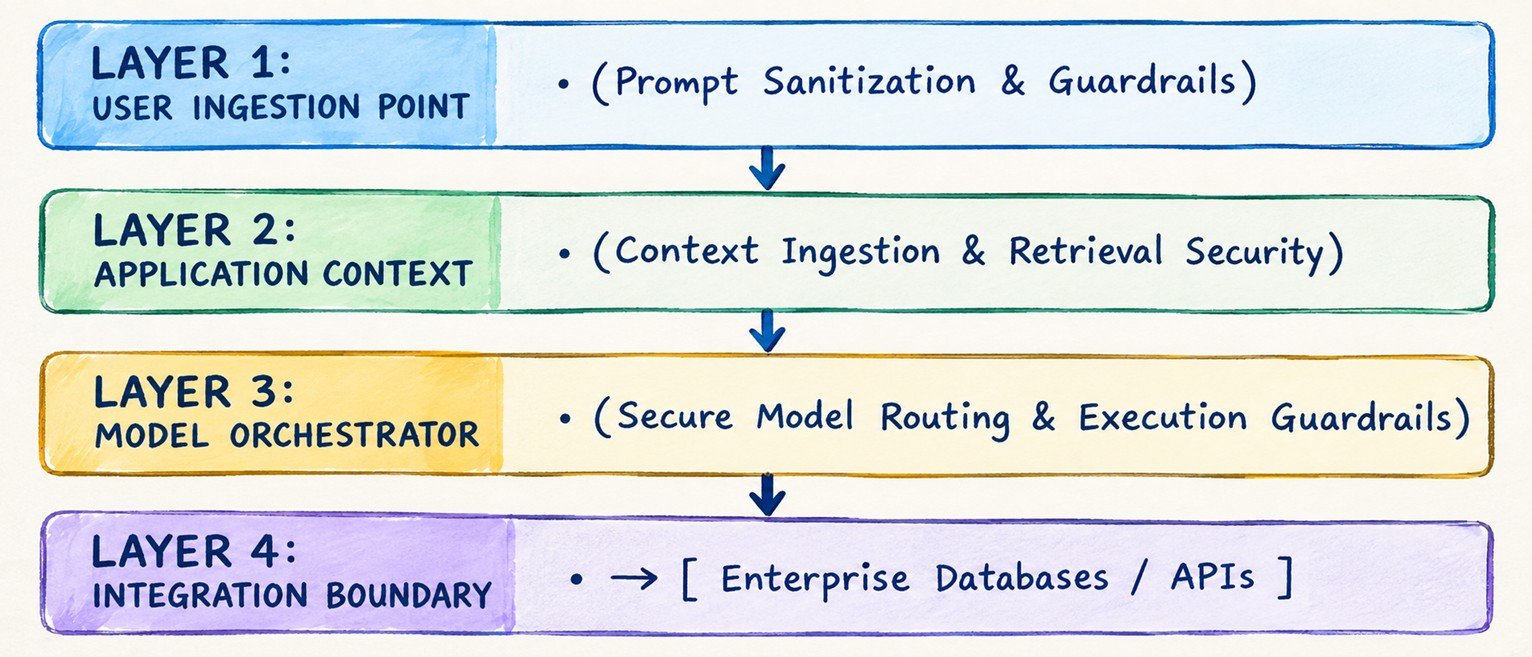
1. The User Ingestion Point (Layer 1)
This is the front line where human users, downstream clients, or automated internal systems interact with the AI interface.
- The Core Vulnerability: Attackers utilize advanced linguistics to execute Direct Prompt Injection. They bypass foundational alignment training using jailbreaks, roleplay scenarios, or adversarial suffixes.
- The Enterprise Impact: A compromised ingestion point forces the LLM to ignore system boundaries. This leads to the generation of toxic content, violation of corporate compliance mandates, or execution of restricted commands.
2. The Application Context Layer (Layer 2)
This layer acts as the processing engine where the application retrieves, constructs, and wraps the user prompt with essential enterprise data before sending it to the foundation model.
- The Core Vulnerability: This layer faces Indirect Prompt Injection. Here, an attacker hides malicious instructions inside an external data payload, such as an uploaded PDF, a scraped webpage, or a synchronized CRM record.
- The Enterprise Impact: When a Retrieval-Augmented Generation (RAG) system ingests an infected document, the hidden payload hijacks the model's instructions mid-session. The model could then silently exfiltrate data, alter summaries, or manipulate business decisions without the user's awareness.
3. The Model Orchestrator (Layer 3)
The orchestrator manages the lifecycle of the model call. It coordinates token allocation, selects internal or external foundation models, applies runtime configurations, and holds system-level API keys.
- The Core Vulnerability: Security risks here include Model Vulnerability Exploitation, insecure model parameters, such as excessively high temperatures that increase unpredictability, and insecure token management.
- The Enterprise Impact: Compromising this layer can allow an attacker to trigger Server-Side Request Forgery (SSRF) via model-routing mechanisms, access raw, unmasked model endpoints, or spoof orchestrator identities to execute unauthorized, high-cost reasoning tasks.
4. The Integration Boundary (Layer 4)
This layer manages the output and outbound capabilities of the model, specifically its integration with external corporate databases, transactional applications, and native enterprise APIs.
- The Core Vulnerability: This introduces Excessive Agency and Insecure Output Handling. When models are granted direct access to read, write, or delete functions via tools or plug-ins, they act as active agents.
- The Enterprise Impact: If an LLM accepts an injection at Layer 1 or Layer 2, its output becomes a malicious command payload. Because traditional systems often treat model outputs as trusted text, the model can execute unauthorized database deletions, invoke dangerous API webhooks, or perform privilege escalation across backend corporate environments.
The Four-Layer Executive Risk Matrix
Leaders must evaluate the GenAI threat model not as isolated software bugs, but as structural business risks. The table below outlines how each layer impacts corporate liability, financial metrics, and operational integrity.
| Threat Layer | Primary Threat Vector | Executive Risk Category | Business & Operational Impact |
|---|---|---|---|
| Layer 1: User Ingestion | Direct Prompt Injection & Jailbreaking | Brand Reputation & Compliance | Malicious prompting forces the model to bypass safety alignments, generating toxic, non-compliant, or legally hazardous output that exposes the brand to severe public and regulatory liability. |
| Layer 2: Application Context | Indirect Prompt Injection via RAG / Data Sources | Data Integrity & Fraud | Untrusted third-party data, such as untrusted emails, customer uploads, or public web scrapes, injects hidden instructions, causing the system to manipulate corporate decisions or misrepresent critical business data. |
| Layer 3: Model Orchestrator | Denial of Wallet (DoW) & Resource Exhaustion | Financial & Infrastructure FinOps | Attackers exploit long, complex contexts or trigger recursive loop logic, driving up token consumption exponentially and resulting in unbudgeted, runaway operational costs. |
| Layer 4: Integration Boundary | Excessive Agency & Unauthorized Action | Systemic Privilege Escalation | Autonomous AI agents translate malicious natural language instructions into valid API calls, triggering unauthorized data deletion, systemic data exfiltration, or rogue transactions in backend ERP/CRM systems. |
Executive Mandates for Threat Mitigation
To protect the enterprise, leadership must enforce three non-negotiable architectural mandates across all engineering groups.
1. Enforce a "Zero Trust AI" Architectural Posture
Traditional network security assumes that once an internal data source or user is authenticated, their inputs are safe. Generative AI breaks this model. Leaders must mandate that every data payload ingested into an LLM context window is treated as completely untrusted.
- Action Item: Require engineering teams to separate instructional prompts from untrusted data context windows within the architecture, minimizing the model's susceptibility to ambient instructions.
2. Decouple Autonomous Agency from Backend Systems
Granting an AI agent direct write or execution privileges to core enterprise systems based purely on natural language processing introduces unacceptable operational risk.
- Action Item: Establish strict Human-in-the-Loop (HITL) approval workflows or hardcoded, deterministic business logic layers. The LLM may suggest an action, such as initiating a wire transfer or altering a client record, but a traditional, rules-based system or a human operator must validate and execute the transaction.
3. Establish Multi-Layered Security Budgets (FinOps)
Because LLMs are billed on a per-token basis, security vulnerabilities can directly translate into immediate financial losses. Malicious actors can construct prompts designed to maximize resource consumption, resulting in Denial of Wallet attacks.
- Action Item: Implement hard, automated rate-limiting gateways, semantic caching strategies, and circuit breakers at the orchestrator layer to terminate runaway, high-cost model calls before they impact the bottom line.
Executive Governance: Aligning the GenAI Threat Model with Regulatory and Compliance Frameworks
For enterprise leadership, a technical vulnerability in a Generative AI system is ultimately a regulatory liability. Because LLMs process, transform, and store vast amounts of data in a non-deterministic manner, they frequently clash with established compliance boundaries.
When establishing your enterprise GenAI threat model, you must evaluate how model vulnerabilities intersect with specific regulatory and compliance frameworks to avoid severe financial penalties, litigation, and loss of corporate licensure.
SOC 2 (Trust Services Criteria)
SOC 2 compliance centers around five core pillars: Security, Availability, Processing Integrity, Confidentiality, and Privacy. GenAI systems fundamentally disrupt traditional auditing controls within these pillars.
- The Executive Risk: Traditional SOC 2 audits look for deterministic access controls and predictable data flows. If an attacker leverages Indirect Prompt Injection (Layer 2) to manipulate an LLM into outputting unmasked database fields to an unauthorized user, your organization fails to maintain both Confidentiality and Processing Integrity. Furthermore, Denial of Wallet or algorithmic exploitation attacks at the Orchestrator layer (Layer 3) can degrade system performance, violating Availability SLAs.
- Leadership Mandate: Enforce strict logging, auditability, and monitoring across the entire GenAI pipeline. Mandate the implementation of independent, deterministic guardrail layers that scan both incoming inputs and outgoing outputs. This provides the verifiable "paper trail" required by auditors to prove data has not been modified or accessed improperly by the probabilistic model.
GDPR (General Data Protection Regulation)
GDPR mandates strict control over how European citizens' Personal Identifiable Information (PII) is processed, stored, and managed, introducing unique existential friction for LLMs.
- The Executive Risk: Under GDPR, citizens possess the "Right to be Forgotten" (Article 17). Once PII is ingested into a foundation model during pre-training or fine-tuning, it becomes mathematically impossible to selectively delete that specific user's data without retraining the entire model, a financially catastrophic requirement. Additionally, if an attacker triggers a data-leakage vulnerability, such as via prompt extraction, it constitutes a severe Data Breach (Article 33), exposing the organization to fines of up to 4% of global annual turnover.
- Leadership Mandate: Implement absolute structural decoupling. Establish an architectural rule that no raw PII may ever enter a model's context window or training dataset. Mandate the deployment of automated, upstream tokenization and anonymization microservices at the Ingestion Point (Layer 1) to strip out PII before the data is processed by the orchestrator.
HIPAA (Health Insurance Portability and Accountability Act)
For healthcare and life sciences enterprises, the integration of GenAI must strictly guard Protected Health Information (PHI) under the HIPAA Security and Privacy Rules.
- The Executive Risk: LLMs are highly prone to "hallucinations" and unpredictable data associations. If a clinician or administrator uses a GenAI system to synthesize patient records, an Indirect Prompt Injection or a complex model hallucination could alter clinical details, leading to catastrophic medical errors. Furthermore, sending unencrypted PHI to a multi-tenant, third-party public LLM cloud API constitutes an immediate, illegal HIPAA violation due to the lack of an enterprise-grade Business Associate Agreement (BAA) and insufficient data isolation.
- Leadership Mandate: Restrict enterprise GenAI workloads handling PHI strictly to isolated, single-tenant private cloud environments or highly secured, on-premises deployments where BAAs are fully executed. Mandate rigorous Evaluation Frameworks (Layer 3) utilizing golden datasets to continuously test the system's medical accuracy, and enforce an absolute Human-in-the-Loop requirement before any GenAI output is acted upon clinically.
EU AI Act
The European Union’s AI Act is the world's first comprehensive, risk-based legal framework specifically targeting artificial intelligence, categorizing applications into unacceptable, high, limited, and minimal risk.
- The Executive Risk: Many enterprise applications, such as GenAI used in HR recruiting, credit scoring, or critical infrastructure management, fall directly into the "High-Risk" category. Failing to meet the EU AI Act's stringent mandates for these categories can result in historic fines, up to €35 million or 7% of global turnover. If your threat model fails to address biases, lacks robust human oversight, or cannot block prompt manipulations that cause discriminatory outputs, your enterprise faces immediate regulatory shutdown within the European market.
- Leadership Mandate: Establish a formal AI Corporate Governance Board chaired by legal, compliance, and technology executives. Mandate that every GenAI initiative undergo a mandatory risk-classification assessment before engineering begins. For high-risk deployments, require the development of extensive technical documentation, continuous model-drift monitoring, and hardcoded logging systems to guarantee compliance with transparency and human-oversight mandates.
Executive Action: The GenAI Risk-Prioritization Framework
Enterprise leaders cannot mitigate every theoretical risk simultaneously without paralyzing innovation. To move safely from PoC to production, executives must implement a repeatable, quantitative framework to prioritize security investments.
This framework utilizes a modified Failure Mode and Effects Analysis (FMEA), adapted specifically for the non-deterministic nature of generative AI systems. Every identified threat vector across the four layers must be scored using three variables on a scale of 1 to 5:
-
Exploitability (E): How easily can an attacker trigger this vulnerability?
1 = Requires deep academic expertise or insider access; 5 = Can be achieved via basic natural language manipulation. -
Business Impact (I): What is the operational, financial, or regulatory damage if breached?
1 = Negligible downtime or no data loss; 5 = Catastrophic data breach, multi-million-dollar regulatory fines, or systemic system deletion. -
Detection Difficulty (D): How hard is it for traditional monitoring tools to catch this attack?
1 = Easily flagged by standard firewalls or WAFs; 5 = Completely invisible to traditional infrastructure monitoring and hidden inside standard semantic traffic.
By calculating the AI Risk Priority Number (AI-RPN), leaders can objectively rank threats and allocate capital efficiently:
IMAGE
The Executive Risk Allocation Matrix
The table below provides a standardized architectural template for scoring, ranking, and prioritizing enterprise GenAI threat vectors.
| Threat Scenario | Exploitability (E) | Business Impact (I) | Detection Difficulty (D) | AI-RPN (E × I × D) | Risk Tier & Leadership Action |
|---|---|---|---|---|---|
| Indirect Prompt Injection (Layer 2) Malicious instructions hidden within third-party data payloads, such as untrusted customer uploads or CRM synchronizations. | 4 (Simple text insertion in raw data files) | 5 (Triggers severe GDPR/SOC 2 compliance failures) | 5 (Bypasses traditional network firewalls entirely) | 100 | Tier 1: Immediate Remediation Mandate structural isolation of context inputs before project approval. |
| Excessive Agency via APIs (Layer 4) Model acts as an autonomous agent with direct write/delete access to core enterprise databases. | 3 (Requires understanding of backend API schemas) | 5 (Systemic data exfiltration or operational deletion) | 4 (Actions mimic valid, authenticated API calls) | 60 | Tier 2: Architectural Redesign Enforce strict Human-in-the-Loop (HITL) gates or rigid deterministic rule layers. |
| Direct Prompt Injection (Layer 1) End-user attempts to jailbreak the model to generate non-compliant or toxic output. | 5 (Trivial; vast public libraries of jailbreaks exist) | 3 (Brand reputational damage; localized exposure) | 3 (Can be partially caught by semantic input scanners) | 45 | Tier 3: Standard Guardrails Deploy commercial LLM firewall gateways and systemic input/output filters. |
| Denial of Wallet Attacks (Layer 3) Adversaries manipulate orchestrator loops to drive up high-cost token consumption. | 3 (Requires optimization of long, recursive prompts) | 3 (Financial FinOps strain; unbudgeted cloud costs) | 4 (Looks like highly engaged, intense usage spikes) | 36 | Tier 4: Monitoring & Rate Limits Implement circuit breakers, semantic caching, and strict token budgets per user session. |
Capital Allocation & Risk Acceptance Thresholds
Based on the calculated AI-RPN scores, the executive leadership team must establish clear risk acceptance thresholds to guide engineering teams:
- AI-RPN 75 to 125 (Tier 1 - Critical Risk): Zero Tolerance. Project development must be paused immediately. Production deployment is strictly barred until architectural changes lower the score below 60.
- AI-RPN 45 to 74 (Tier 2 - High Risk): Architectural Review Required. The application can remain in development, but the solution architecture must pass a dedicated AI Safety Review Board before entering production.
- AI-RPN 30 to 44 (Tier 3 - Moderate Risk): Standard Mitigation. Accepted for production deployment provided standard security controls, such as API rate limiting and commercial guardrail wrappers, are fully operational.
- AI-RPN Below 30 (Tier 4 - Low Risk): Acceptable Risk. Continuously monitor via routine FinOps and logging pipelines. No immediate architectural modifications are required.
By formalizing this framework, leadership shifts the organization away from subjective, fear-driven security discussions toward data-backed, risk-adjusted architectural investments.
Executive Governance: Enterprise GenAI Risk Sign-Off and Governance Template
Every production deployment of a Generative AI system requires explicit accountability. Because LLMs exhibit non-deterministic behavior, residual risk can never be fully engineered down to zero. Consequently, when an AI system enters production with an AI-RPN in the High or Moderate risk tiers (Tier 2 or Tier 3), executive leadership must formally document and sign off on the accepted risk threshold.
This governance template provides technology executives with a legally defensible, standardized framework to audit, review, and authorize production deployments. It ensures that business unit leaders, legal teams, and security executives share accountability, preventing engineering teams from making isolated risk acceptances that expose the broader enterprise to regulatory or financial liability.
Enterprise Generative AI Production Authorization Document
1. System Administrative Profile
- System/Application Name:
[e.g., Enterprise Core RAG Copilot v2.4] - Business Unit / Owner:
[e.g., Global Customer Operations / VP of Customer Success] - Lead Enterprise AI Architect:
[Name / Certification, e.g., TOGAF 10 Practitioner] - Target Production Deployment Date:
[DD/MM/YYYY]
2. Business Intent & Intelligence Classification
- Core Functionality:
[Provide a brief description of the system's operational objective, e.g., auto-summarization of high-value B2B client contracts for account executives.] - Data Classification Level:
- Tier 1: Public / General Corporate Information
- Tier 2: Proprietary Corporate Intellectual Property (IP)
- Tier 3: Regulated Data Context (PII, GDPR, HIPAA, SOC 2 Scope)
- Agency Delegation Level:
- Read-Only: System solely fetches and synthesizes text data.
- Human-in-the-Loop Execution: System suggests actions; a human explicitly triggers APIs.
- Fully Autonomous Execution: System acts as an independent agent writing to APIs.
3. Residual Risk Profile (AI-RPN Summary)
Attach the full Threat Matrix showing calculated AI-RPN scores prior to signing.
- Highest Active Residual Risk Identified:
[e.g., Indirect Prompt Injection via uploaded client documents - Layer 2] - Calculated Peak AI-RPN:
[e.g., RPN = 60 (Exploitability: 3, Impact: 5, Detection: 4)] - Assigned Risk Tier:
- Tier 2: High Risk (Architectural Review Panel Mandated)
- Tier 3: Moderate Risk (Standard Guardrails Deployed)
4. Documented Technical & Governance Mitigations
Provide explicit architectural overrides implemented to lower risk vectors below the Zero Tolerance threshold.
- Ingestion Boundary Protections (Layer 1 & 2):
[e.g., Upstream deployment of an LLM Firewall microservice to sanitize semantic inputs; complete structural stripping of PII prior to model context window ingestion.] - Execution Boundary Protections (Layer 3 & 4):
[e.g., Hardcoded API orchestration gateways blocking write commands; programmatic structural execution boundaries restricting token volume to 4,000 per session.] - Continuous Monitoring Plan:
[e.g., Weekly model-drift evaluations via automated golden datasets; real-time FinOps circuit breakers alerting on a 20% spike in token consumption metrics.]
5. Formal Risk Justification (Executive Override)
To be filled out by the Business Owner if deploying a Tier 2 system.
"We explicitly accept the residual risk of [State the threat scenario] because [Provide clear business justification, e.g., market entry window requirements, highly isolated pilot audience, or alternative manual fail-safes]. The following operational contingencies are established in the event of an adversarial exploit: [Detail immediate response steps, e.g., instant API gateway revocation, failover to deterministic backup applications]."
6. Executive Authorization & Sign-Off
By signing below, the corporate officers acknowledge the residual risks documented above and formally authorize production deployment under the enterprise AI operating model guidelines.
-
Chief Information Security Officer (CISO) / Head of AI Security:
- Signature: _________________________________________
- Date: __________________
- Decision: Approved | [ ] Conditional Approval (See Addendum) | [ ] Denied
-
VP of Engineering / Lead Solution Architect:
- Signature: _________________________________________
- Date: __________________
- Attestation: System Meets Production-Readiness Reference Architecture Standard
-
Executive Sponsor / Business Unit Head (Accountable Officer):
- Signature: _________________________________________
- Date: __________________
- Attestation: Risk Accepted; Financial and Operational Accountability Confirmed
By establishing this formal sign-off cadence, technology leaders turn abstract AI risks into manageable corporate governance items. This process guarantees that every production AI application is backed by institutional visibility, a verified mitigation roadmap, and explicit executive authorization.
Threat Model Sign-Off: The Executive Definition of Done
Before a business unit is permitted to move a Generative AI application past the architectural review phase, leadership must verify that the Enterprise GenAI Threat Model has achieved structural finality. A threat model is officially considered complete when it satisfies the following four conditions:
- Layer-by-Layer Mapping: Every data pipeline, external API connection, and vector database retrieval pathway has been explicitly categorized into one of the four threat layers.
- Quantified Risk Metrics: An AI-RPN score has been assigned to all identified threat scenarios, replacing subjective risk assumptions with objective metrics.
- Regulatory Attestation: The legal and compliance teams have audited the architecture to guarantee it satisfies the specific requirements of GDPR, SOC 2, HIPAA, or the EU AI Act based on its data classification.
- Executed Sign-Off Template: The Formal Risk Sign-Off document has been fully executed, ensuring explicit shared accountability between engineering leaders, security teams, and the funding business unit.
Achieving this Definition of Done ensures that the organization is no longer just shipping AI experiments. It proves you are deploying resilient, governed, and operationally viable enterprise capabilities designed to survive in production.