Operationalizing Trust - Designing the Enterprise AI Governance Control Framework
Introduction
For enterprise leadership, deploying a generative AI threat model is meaningless without a unified system of enforcement. You cannot manage a probabilistic engine using disconnected security policies; you must build a centralized Enterprise AI Governance Control Framework. This framework defines who can interact with specific models, what data classes those models can access, and how the entire lifecycle is audited for corporate compliance.
To move from an ad-hoc security posture to structured governance, technology executives must align three core operational dimensions: Context-Aware Identity Controls, Dynamic Data Classification Rights, and Immutable Audit Trails.
The Three Pillars of Enterprise AI Governance
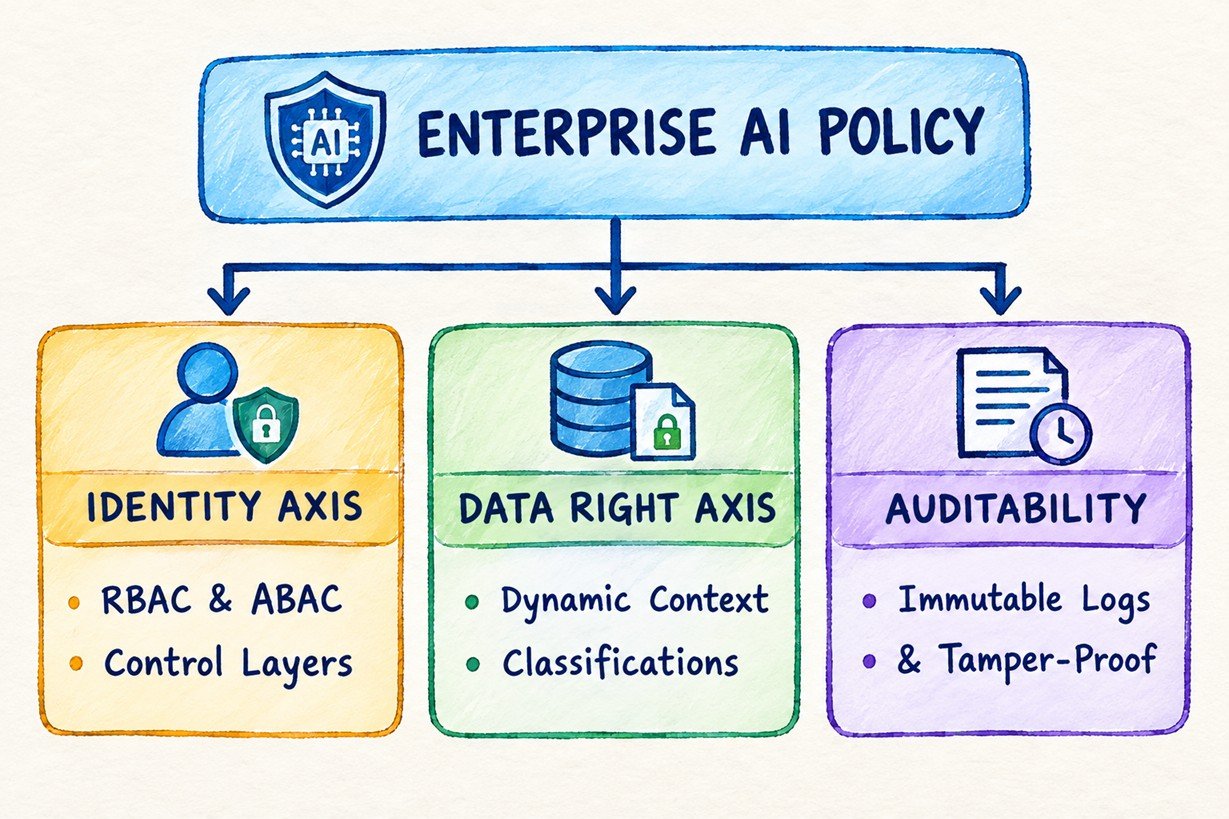
1. The Identity Axis: Shifting from Static RBAC to Dynamic Context Controls
Traditional Role-Based Access Control (RBAC) relies on user identities to grant access to folders or APIs. In GenAI applications, this is insufficient. A user might have clearance to access a system, but their natural language prompt could trick an autonomous agent into bypassing standard security boundaries.
- The Executive Mandate: Leadership must enforce Attribute-Based Access Control (ABAC) across all AI workflows. The system must evaluate the user's role, the data classification of the retrieved context, and the real-time intent of the prompt simultaneously.
- The Control Gate: Implement hardcoded validation proxies between the user interface and the model orchestrator. If a user with "Financial Analyst" clearance attempts to prompt an LLM to retrieve "Human Resources Payroll" data via an internal tool, the proxy blocks the generation instantly, regardless of the user's general application access token.
2. The Data Right Axis: Dynamic Context Classification
An LLM application is only as secure as the raw information flowing through its Retrieval-Augmented Generation (RAG) data pipelines. If you accidentally feed an unencrypted corporate folder into your vector embeddings index, the model will expose those secrets to unauthorized users.
- The Executive Mandate: Mandate a structural data-labeling and ingestion pipeline. All unstructured text files, including PDFs, wikis, and transcripts, must pass through an automated corporate classification filter before being vectorized.
- The Control Gate: Enforce Metadata Tagging Boundaries. When the RAG pipeline indexes enterprise documentation, it must append clear security classification tags (
[CONFIDENTIALITY: HIGH],[RESTRICTED: INTERNAL]) to each vector snippet. At runtime, the model orchestrator must programmatically match the user's credentials against these metadata tags, ensuring the LLM's context window never ingests text segments above the user's explicit security clearance.
3. The Auditability Axis: Building the Immutable AI Ledger
Because Generative AI applications behave non-deterministically, standard system event logs cannot adequately reconstruct a security breach or legal liability incident. If an LLM hallucinates false data or executes an unapproved transactional tool call, a simple network log will only show a valid, encrypted outbound connection.
- The Executive Mandate: Leadership must mandate the deployment of an independent, centralized AI Auditing Vault. This repository must capture the exact lineage of every single AI transaction for forensic compliance review.
- The Control Gate: Every user session must generate an immutable, tamper-proof audit record containing three critical cryptographic pairs:
- The raw, unaltered User Ingestion Prompt alongside its sanitized, tokenized version.
- The exact Vector Context Snippets retrieved from internal enterprise databases to populate the prompt.
- The final Raw Output Text generated by the model, paired with the automated evaluation scores generated by your safety guardrails.
The Executive Governance Control Matrix
The table below acts as an organizational scorecard for C-level executives, mapping these compliance pillars to real-world corporate governance thresholds.
| Governance Dimension | Regulatory Alignment | Enterprise Executive Risk | Strategic Leadership Action |
|---|---|---|---|
| Contextual Access Control | SOC 2 (Security Criteria), ISO 27001 | Unauthorized data exposure and internal lateral movement. | Enforce ABAC validations at the model orchestrator gateway to verify user intent and privilege levels dynamically. |
| Dynamic Vector Classification | GDPR (Data Protection), CCPA | Accidental ingestion and unauthorized exposure of highly restricted corporate IP. | Mandate metadata tag matching on all RAG vector indices to block unauthorized text retrieval at the search layer. |
| Immutable Session Auditing | EU AI Act (Transparency), Compliance Audits | Inability to prove data lineage, protect IP ownership, or defend against regulatory litigation. | Implement a dedicated, write-once-read-many (WORM) log vault to store full-session prompt-to-output context histories. |