Continuous AI Audit and Model Drift Detection - Sustaining Model Trust Post-Deployment
Introduction
For technology executives, approving an AI system for production is not a one-time event; it is the beginning of a continuous monitoring lifecycle. Unlike traditional, deterministic software that remains stable until a code change occurs, Generative AI models degrade over time. The external world shifts, user behavior evolves, and upstream model providers silently update their foundational weights. This results in Model Drift, Concept Drift, and Alignment Decay.
If left unmonitored, an AI system that was secure and accurate at launch will inevitably drift toward unpredictability, exposing the enterprise to structural hallucinations, financial losses, and compliance violations. Leadership must mandate an automated, continuous auditing framework to treat AI monitoring as a core operational discipline.
The Anatomy of Post-Deployment Decay
Executives must allocate resources to track three distinct forms of degradation that target enterprise LLM systems.
1. Data and Concept Drift
- The Strategic Threat: The distribution of operational enterprise data changes relative to the historical data used to tune the system or build the RAG indices. For example, if a financial customer service LLM is deployed, a sudden change in central bank interest rates or regulatory reporting templates will render the model's underlying context obsolete.
- The Corporate Risk: The LLM relies on outdated data to answer user queries, leading to inaccurate summaries, high hallucination rates, and regulatory compliance failures.
2. Upstream Semantic Drift (Silent Updates)
- The Strategic Threat: Commercial model providers, such as OpenAI and Anthropic, frequently release updated versions of their foundation model checkpoints to improve efficiency or alter alignment filters. These updates occur silently behind the API endpoint.
- The Corporate Risk: A subtle shift in the base model's prompt-processing logic can break your internal prompt-engineering templates, radically changing output formatting, eroding accuracy, or causing previously optimized guardrails to fail completely.
3. Alignment Decay and Safety Drift
- The Strategic Threat: Over hundreds of thousands of live sessions, user prompts slowly discover edge cases that circumvent system guidelines, or the model exhibits behavioral drift due to continuous conversational context accumulation.
- The Corporate Risk: The system begins generating non-compliant language, leaking masked data tokens, or failing to enforce systemic corporate policy parameters.
Reference Architecture: The Continuous AI Audit Pipeline
To systematically defend against these vectors, leaders must fund an asynchronous AI Evaluation and Audit Pipeline that operates alongside the live application orchestration path.
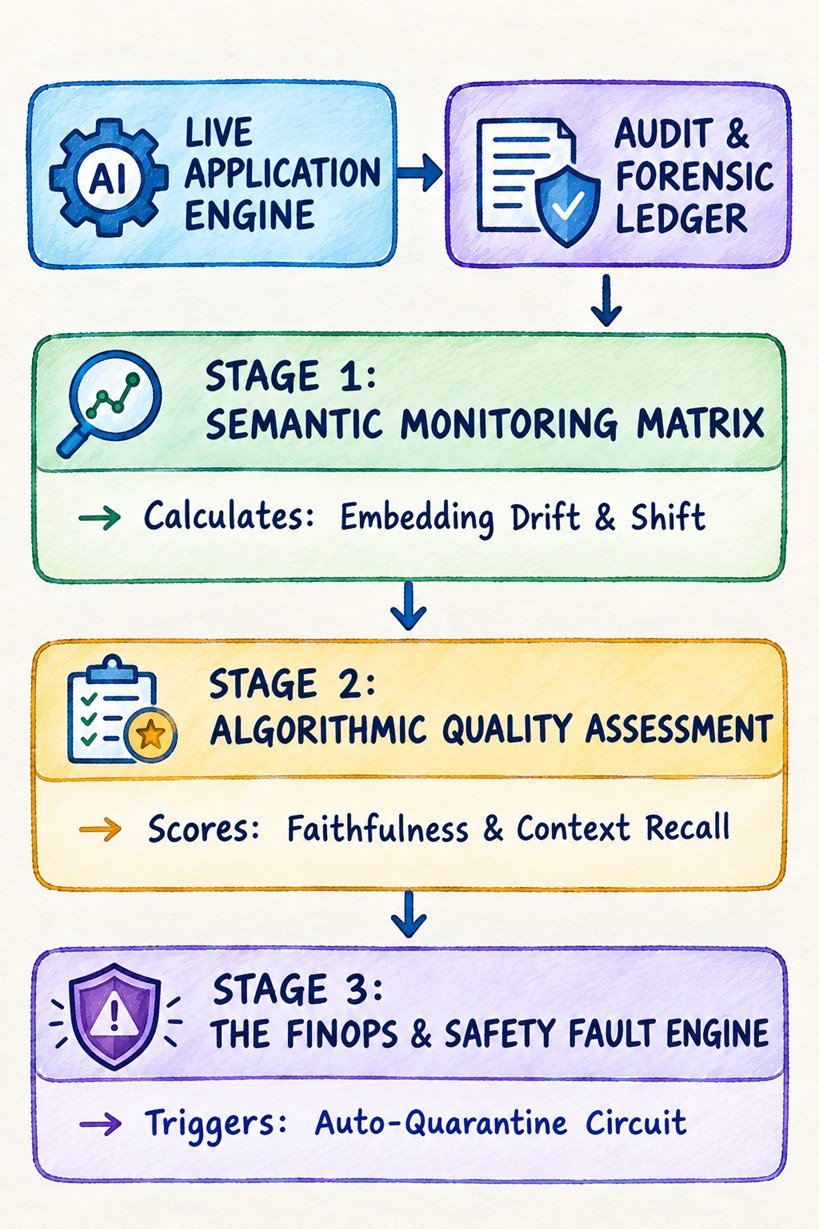
Stage 1: The Semantic Monitoring Matrix
- Operational Control: This engine captures a moving statistical window of production prompt embeddings and compares them mathematically against the baseline embeddings matrix validated during the QA phase.
- The Metric: If the distance between the production vector clusters and the baseline matrix exceeds a set statistical threshold, such as via Jensen-Shannon Divergence calculations, the system automatically flags that Concept Drift is occurring, signaling that user queries or real-world conditions have changed.
Stage 2: Algorithmic Quality Assessment (The Grader Loop)
- Operational Control: An asynchronous, isolated evaluation engine pulls batches of live session logs and runs automated "LLM-as-a-Judge" grading frameworks using frozen, golden evaluation datasets.
- The Metric: It continuously scores generations across three foundational pillars:
- Faithfulness: Does the generated output match only the facts provided in the RAG context? (Detects hallucinations).
- Answer Relevance: Does the generation directly answer the user's core intent? (Detects semantic decay).
- Context Recall: Did the RAG vector engine successfully pull the correct enterprise files to answer the query? (Detects RAG degradation).
Stage 3: The FinOps and Safety Fault Engine
- Operational Control: A system dashboard tracks token-to-cost metrics alongside safety alignment scores across all business applications.
- The Metric: If token consumption spikes abnormally, indicating a potential Denial of Wallet attack or an orchestration loop, or if output safety alignment drops below acceptable operational parameters, the system triggers an Automated Circuit Breaker.
The Executive Drift Remediation Playbook
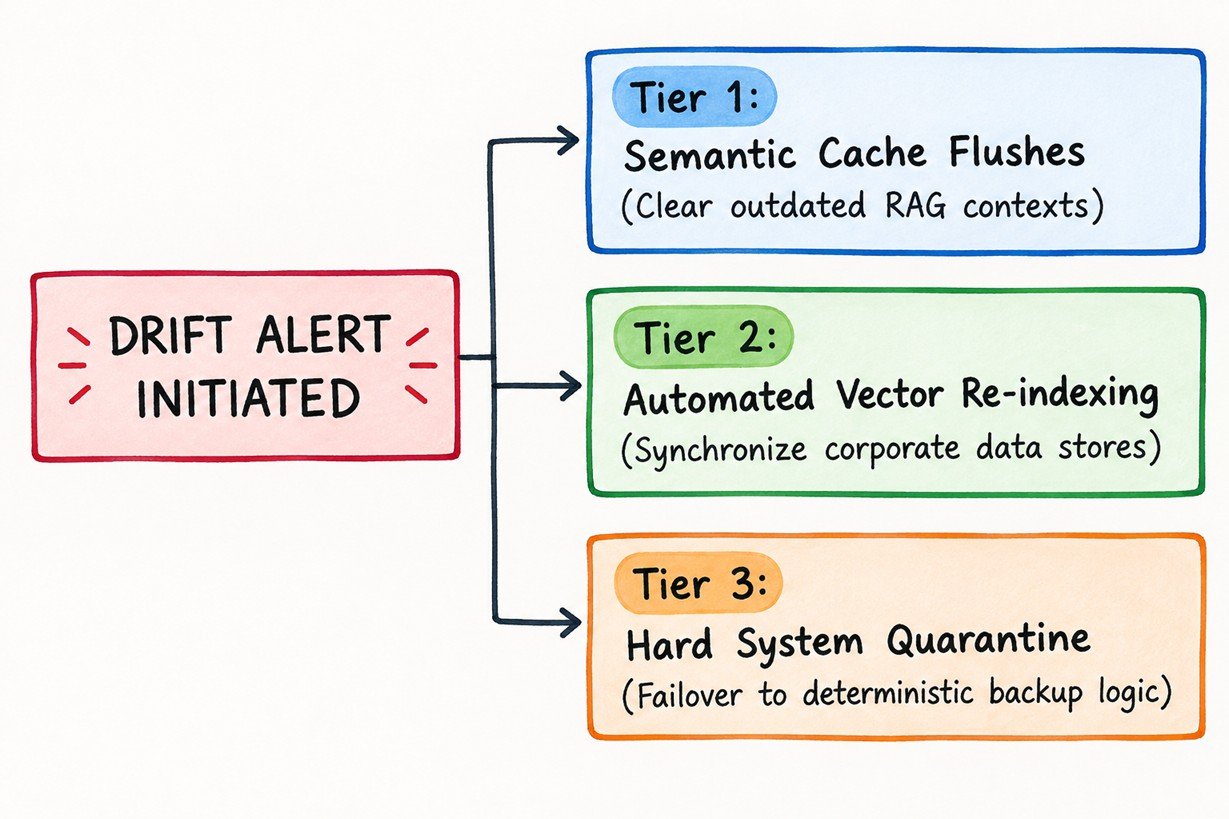
When the continuous audit pipeline triggers a drift or performance anomaly, the governance framework must execute a standardized, tier-based remediation workflow to maintain business continuity:
-
Tier 1 Intervention (Low Decay): Flash-flush the enterprise semantic caching layers. This forces the model orchestrator to rebuild its contextual answers from newly updated enterprise data indices rather than serving stale historical cache blocks.
-
Tier 2 Intervention (Moderate Decay): Initiate automated vector re-indexing. If concept drift is detected in Stage 1, the pipeline automatically spins up data loaders to re-ingest, re-tokenize, and re-vectorize the target enterprise databases, re-aligning the RAG pipeline with current business realities.
-
Tier 3 Intervention (Severe Decay / Safety Breach): Execute a Hard System Quarantine. If Stage 3 identifies structural safety alignment failure or toxic output drift, the orchestrator triggers an immediate cloud circuit breaker. The live application is temporarily decoupled from the LLM endpoint and falls back to a deterministic, static error-handling mode while alert notifications are routed to the engineering and compliance teams.
The Post-Deployment Audit Dashboard
The matrix below provides C-level executives with a unified, standardized view of the critical metrics required to manage a production GenAI system's post-deployment health.
| Audit Metric Type | Measurement Metric | Target Threshold | Executive Remediation Trigger |
|---|---|---|---|
| Semantic Drift | Population Stability Index (PSI) / Embedding Distance | ≤ 0.1 baseline variance | Trigger Tier 2: Automated delta-ingestion and vector database re-indexing. |
| Model Faithfulness | LLM-assisted structural alignment grading | ≥ 98% factual alignment | Trigger Tier 1: Caching flush; audit RAG source documents for factual fragmentation. |
| Safety Compliance | Policy violation error tracking rates | 0.00% allowed failures | Trigger Tier 3: Execute absolute system quarantine and isolate the application instance. |
| Operational FinOps | Average token consumption per session | ± 15% QA baseline target | Trigger Circuit Breaker: Implement instant session rate-limiting boundaries. |
By formalizing this continuous audit layer, technology leaders move away from hoping their models remain safe, shifting instead toward an automated system of verifiable performance engineering. This architecture guarantees that your enterprise AI ecosystem remains accurate, safe, and highly optimized long after its initial production launch.