Architecting an AI-Powered Hospital Command Center for Intelligent Patient Flow and Capacity Optimization
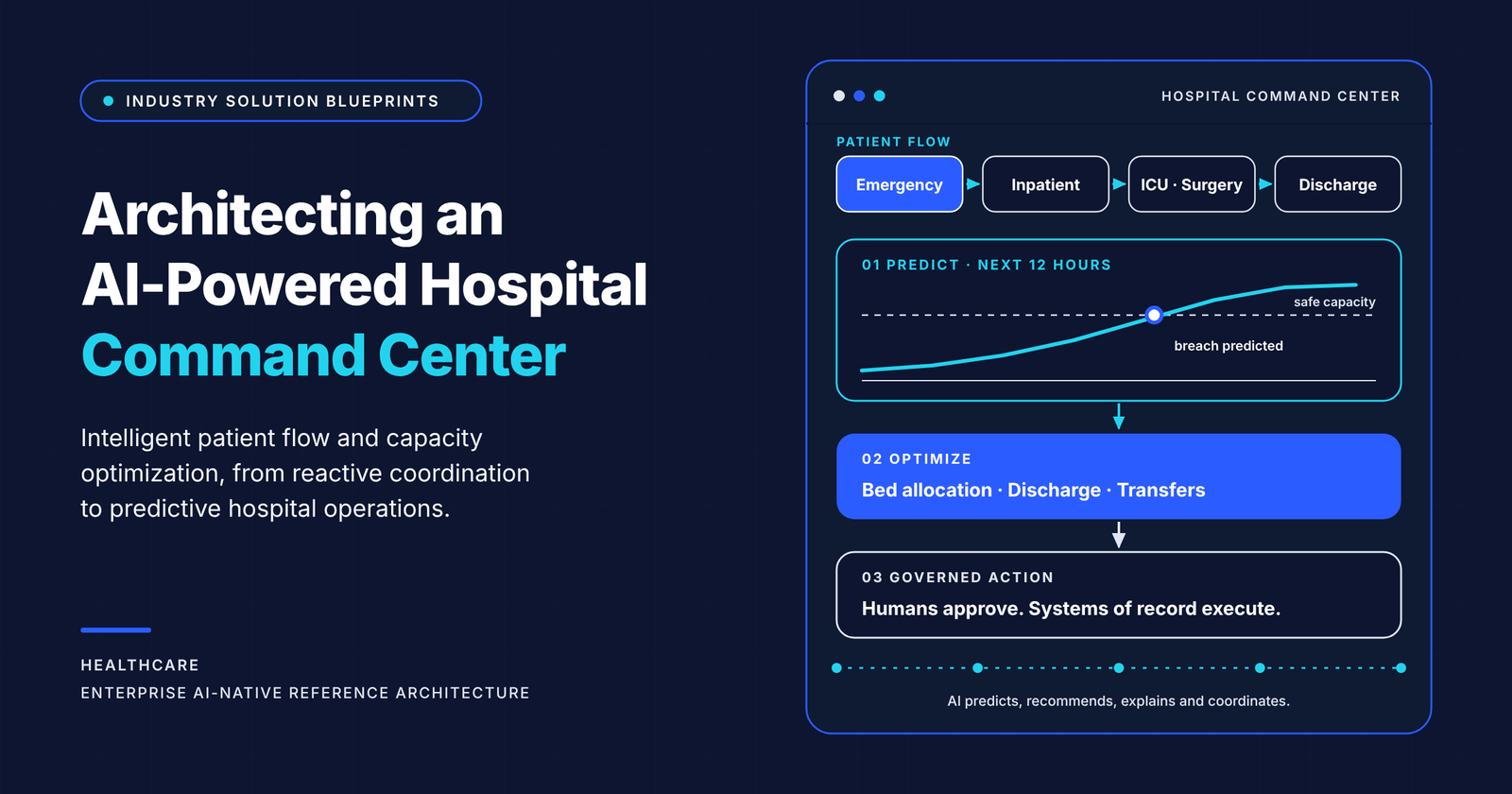
Transforming Hospital Operations from Reactive Resource Management to Predictive, Coordinated and Intelligence-Driven Healthcare Delivery
Industry Solution Blueprints | Architecting the Future of Enterprise Solutions
| Case Study Attribute | Description |
|---|---|
| Industry | Healthcare |
| Architecture Type | Enterprise AI-Native Reference Architecture |
| Business Focus | Patient flow optimization, hospital capacity management, operational efficiency and patient experience |
| Architectural Focus | Predictive AI, Agentic AI, operations research, healthcare interoperability, microservices, event-driven architecture and multi-tenant platforms |
| Technology Ecosystem | AWS, Generative AI, LLMs, intelligent agents, machine learning, HL7 and FHIR |
| Intended Audience | Healthcare CIOs, CTOs, COOs, CMIOs, Chief Nursing Officers, Hospital Administrators, Heads of AI and Enterprise Architects |
Professional Disclosure
This case study presents an independently developed architectural solution for a representative industry challenge. It is intended to demonstrate architectural thinking, technology strategy, design decisions and implementation approaches. Business outcomes are projected rather than independently verified implementation results.
01. Executive Summary
1.1 The Strategic Opportunity
Hospitals represent one of the most complex operational environments in modern enterprises.
Every day, hospitals must coordinate patient admissions, emergency departments, inpatient beds, intensive care units, operating theatres, diagnostic services, clinical staff, discharge processes and inter-hospital transfers.
Despite substantial investments in Electronic Health Records (EHR), Hospital Information Systems (HIS) and other healthcare technologies, operational decision-making frequently remains fragmented and reactive.
Consider a representative scenario:
- The emergency department is operating beyond its planned capacity.
- Several patients are waiting for inpatient beds.
- A number of inpatient beds are occupied by patients approaching discharge.
- Some physically vacant beds cannot be used because of nursing shortages.
- Operating theatres have scheduled procedures requiring postoperative ICU capacity.
- Another hospital within the network has potentially suitable available capacity.
- Hospital administrators lack an accurate forecast of how these conditions will evolve over the next 12 hours.
Each department may possess information about its own operational state. However, no single department has sufficient visibility to optimize the entire hospital.
The fundamental problem is not necessarily insufficient infrastructure.
It is the inability to continuously coordinate demand, capacity, resources and operational decisions across an interconnected healthcare ecosystem.
1.2 Proposed Solution
The proposed AI-Powered Hospital Command Center establishes a continuously updated operational intelligence and coordination layer across a hospital or healthcare network.
The proposed platform combines seven foundational capabilities:
- Real-time hospital-wide operational visibility.
- Predictive intelligence for patient demand and capacity.
- Intelligent patient flow and bed allocation optimization.
- Proactive identification of discharge and operational bottlenecks.
- Governed coordination through specialized AI agents.
- Human-supervised operational decision-making.
- Continuous evaluation of operational and business outcomes.
The architecture deliberately combines multiple forms of intelligence rather than attempting to solve every problem using Generative AI.
| Intelligence Type | Primary Responsibility |
|---|---|
| Descriptive Analytics | Understand what is happening |
| Predictive AI | Anticipate what is likely to happen |
| Prescriptive Optimization | Determine feasible and preferable operational actions |
| Generative AI | Explain conditions, recommendations and supporting evidence |
| Agentic AI | Coordinate approved workflows across departments |
| Deterministic Business Services | Validate, authorize and execute operational transactions |
| Human Intelligence | Exercise clinical judgment, resolve exceptions and approve consequential decisions |
The central architectural principle is:
AI predicts, recommends, explains and coordinates. Authoritative healthcare systems and accountable healthcare professionals retain control over clinical and consequential operational decisions.
1.3 Strategic Value Proposition
| Strategic Dimension | Expected Value |
|---|---|
| Patient Access | Reduced waiting times and emergency department boarding |
| Patient Experience | Smoother transitions between healthcare services |
| Capacity Optimization | Improved utilization of safely staffed hospital resources |
| Clinical Operations | Better coordination between care teams |
| Workforce Productivity | Reduced administrative coordination effort |
| Financial Performance | Lower avoidable operational costs and improved capacity productivity |
| Operational Resilience | Earlier identification of emerging capacity crises |
| Healthcare Governance | Traceable, explainable and accountable decisions |
| Enterprise Modernization | Reusable intelligence capabilities across the healthcare network |
The objective is not merely to create another hospital dashboard.
It is to establish the architectural foundation for an intelligent, anticipatory and coordinated hospital operating model.
02. Industry and Business Context
2.1 The Evolution of Hospital Operations
Hospital operational management can be understood through a conceptual maturity model.
| Generation | Operating Model | Primary Capability |
|---|---|---|
| Hospital Operations 1.0 | Manual coordination | Telephone calls, spreadsheets and departmental communication |
| Hospital Operations 2.0 | Digitized operations | Department-specific hospital information systems |
| Hospital Operations 3.0 | Connected operations | Enterprise integration and centralized dashboards |
| Hospital Operations 4.0 | Predictive operations | Machine learning and operational forecasting |
| Hospital Operations 5.0 | Intelligent coordinated operations | Continuous sensing, prediction, optimization and governed agentic coordination |
These generations represent a conceptual maturity framework rather than a formal industry classification.
The proposed solution focuses on the transition from connected and predictive operations to intelligent coordinated operations.
2.2 Understanding the Patient Flow Ecosystem
Patient flow is not an isolated bed management problem. It represents the movement of patients through an interconnected system of healthcare services.
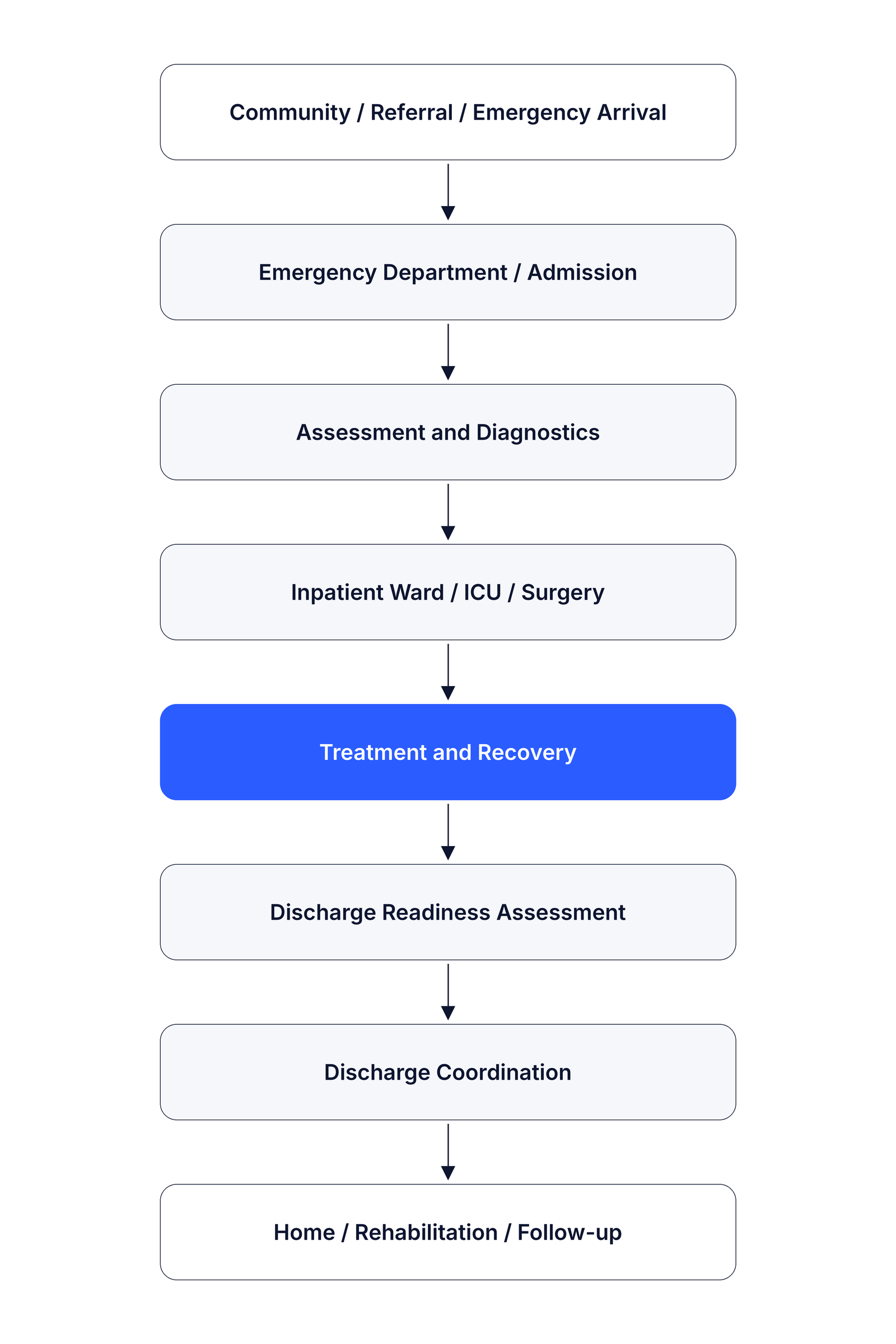
Figure 1 — Representative Patient Flow Lifecycle
A constraint anywhere in this lifecycle can propagate across the hospital.
For example, delayed discharge transportation may prevent bed availability, which may increase emergency department boarding, which may subsequently reduce the emergency department's ability to accommodate new patients.
This makes patient flow a systems engineering and operations management problem as much as a healthcare technology problem.
2.3 Representative Enterprise Scenario
This case study considers a hypothetical multi-hospital healthcare network operating acute care hospitals, specialized clinical facilities and centralized healthcare services.
The following assumptions establish the representative architectural design envelope.
| Business Parameter | Illustrative Design Assumption |
|---|---|
| Hospitals | 10 |
| Independently governed healthcare organizations | 3 |
| Licensed inpatient beds | 2,000 |
| Normally staffed inpatient beds | 1,800 |
| Annual inpatient admissions/discharges | Approximately 100,000 |
| Annual emergency department visits | 500,000 |
| Annual surgical procedures | 40,000 |
| Healthcare and operational staff | 12,000 |
| Integrated healthcare systems | 40+ |
| Average daily operational events | 2 million |
| Peak event ingestion | 1,000 events/second |
| Concurrent command center users | 500 |
| Operating model | 24×7 |
| Initial prediction horizons | 4, 12, 24 and 72 hours |
These assumptions are illustrative sizing parameters rather than data obtained from an existing healthcare organization.
2.4 Healthcare Ecosystem Participants
| Participant | Primary Responsibility |
|---|---|
| Hospital Administrators | Capacity planning and operational performance |
| Emergency Department Teams | Emergency assessment and patient stabilization |
| Bed Management Teams | Bed allocation and admission coordination |
| Physicians | Clinical decisions and care progression |
| Nursing Teams | Patient care and staffing coordination |
| Case Managers | Discharge planning and care transitions |
| Surgical Teams | Procedure scheduling and postoperative requirements |
| Diagnostic Services | Laboratory and imaging services |
| Environmental Services | Bed cleaning and room readiness |
| Transport Teams | Internal and external patient transportation |
| Transfer Centers | Inter-hospital transfer coordination |
| Command Center Operators | Hospital-wide monitoring and exception management |
| AI Services and Agents | Forecasting, optimization, explanation and governed coordination |
2.5 Scope and Clinical Boundaries
The initial blueprint focuses on healthcare operations rather than autonomous medical practice.
In scope
- Hospital capacity forecasting.
- Emergency department boarding management.
- Operational bed matching.
- Discharge barrier identification.
- Surgical capacity coordination.
- Workforce capacity visibility.
- Inter-hospital transfer coordination.
- Operational decision support.
Out of scope
- Autonomous medical diagnosis.
- Treatment selection.
- Medication prescribing.
- Independent determination of clinical discharge readiness.
- Autonomous emergency triage.
- Unsupervised patient transfers.
- Patient prioritization based on financial profitability.
Any future expansion into clinical decision support would require a separate intended-use assessment, clinical validation and applicable regulatory review.
03. Business Challenges
3.1 Fragmented Operational Visibility
Hospital operations depend on information distributed across multiple systems.
| Information | Typical Source |
|---|---|
| Patient admissions and transfers | EHR / HIS / ADT systems |
| Bed occupancy | Bed management systems |
| Clinical care progression | EHR |
| Nursing availability | Workforce management systems |
| Surgical schedules | Operating theatre systems |
| Laboratory status | Laboratory Information Systems |
| Imaging status | Radiology Information Systems |
| Bed cleaning | Environmental services systems |
| Patient transportation | Transport management systems |
The absence of a unified operational picture results in inconsistent information, repeated communication and delayed decisions.
3.2 Emergency Department Boarding
Patients who have been admitted but remain in the emergency department awaiting appropriate inpatient placement consume emergency department capacity.
Prolonged boarding can contribute to overcrowding, staff pressure, delayed access for incoming patients and patient safety risks.
The underlying problem may originate outside the emergency department itself.
3.3 Inefficient Bed Capacity Utilization
Traditional bed management frequently treats a bed as either occupied or vacant.
In practice, availability depends on multiple conditions.
| Capacity Dimension | Example Constraint |
|---|---|
| Physical Capacity | Bed or room exists |
| Operational Capacity | Bed is clean and functional |
| Staffing Capacity | Appropriately qualified staff are available |
| Clinical Compatibility | Appropriate specialty and care level |
| Infection Control | Required isolation facilities are available |
| Equipment Availability | Necessary equipment is operational |
| Reservation Status | Bed is not committed to another patient |
A vacant bed does not necessarily represent usable capacity.
3.4 Delayed Patient Discharges
Discharge delays may arise from operational dependencies such as pending transportation, equipment arrangements, pharmacy fulfillment, documentation, rehabilitation placement or caregiver coordination.
Identifying these barriers late reduces the hospital's ability to proactively release capacity when clinically appropriate.
3.5 Demand and Capacity Imbalance
Hospital demand fluctuates across hours, days, seasons and geographic locations.
Elective admissions, emergency arrivals, infectious disease outbreaks, local events and workforce shortages can create significant differences between expected demand and available capacity.
Static planning approaches struggle to accommodate this variability.
3.6 Uncoordinated Surgical and Inpatient Operations
An operating theatre may have available surgical capacity while postoperative ICU or inpatient capacity remains constrained.
Optimizing surgical schedules independently of downstream resources can lead to cancellations, delays and inefficient utilization.
3.7 Excessive Manual Coordination
Healthcare professionals frequently spend time contacting other departments, confirming operational status, tracking discharge dependencies and resolving capacity conflicts.
This reduces the time available for higher-value activities.
3.8 Risks of Uncontrolled AI Adoption
| AI-Related Risk | Potential Consequence |
|---|---|
| Incorrect capacity forecasts | Inadequate operational preparation |
| Hallucinated bed availability | Unsafe placement recommendations |
| Stale operational information | Conflicting or inappropriate actions |
| Inaccurate discharge predictions | Pressure toward premature discharge |
| Biased optimization | Inequitable patient access |
| Unauthorized agent actions | Patient safety and compliance incidents |
| Excessive automation | Loss of human oversight |
| Cross-tenant data leakage | Exposure of sensitive healthcare information |
The architectural challenge is to introduce intelligence without compromising patient safety, clinical accountability or operational integrity.
04. Existing State and Limitations
4.1 Representative Current-State Architecture
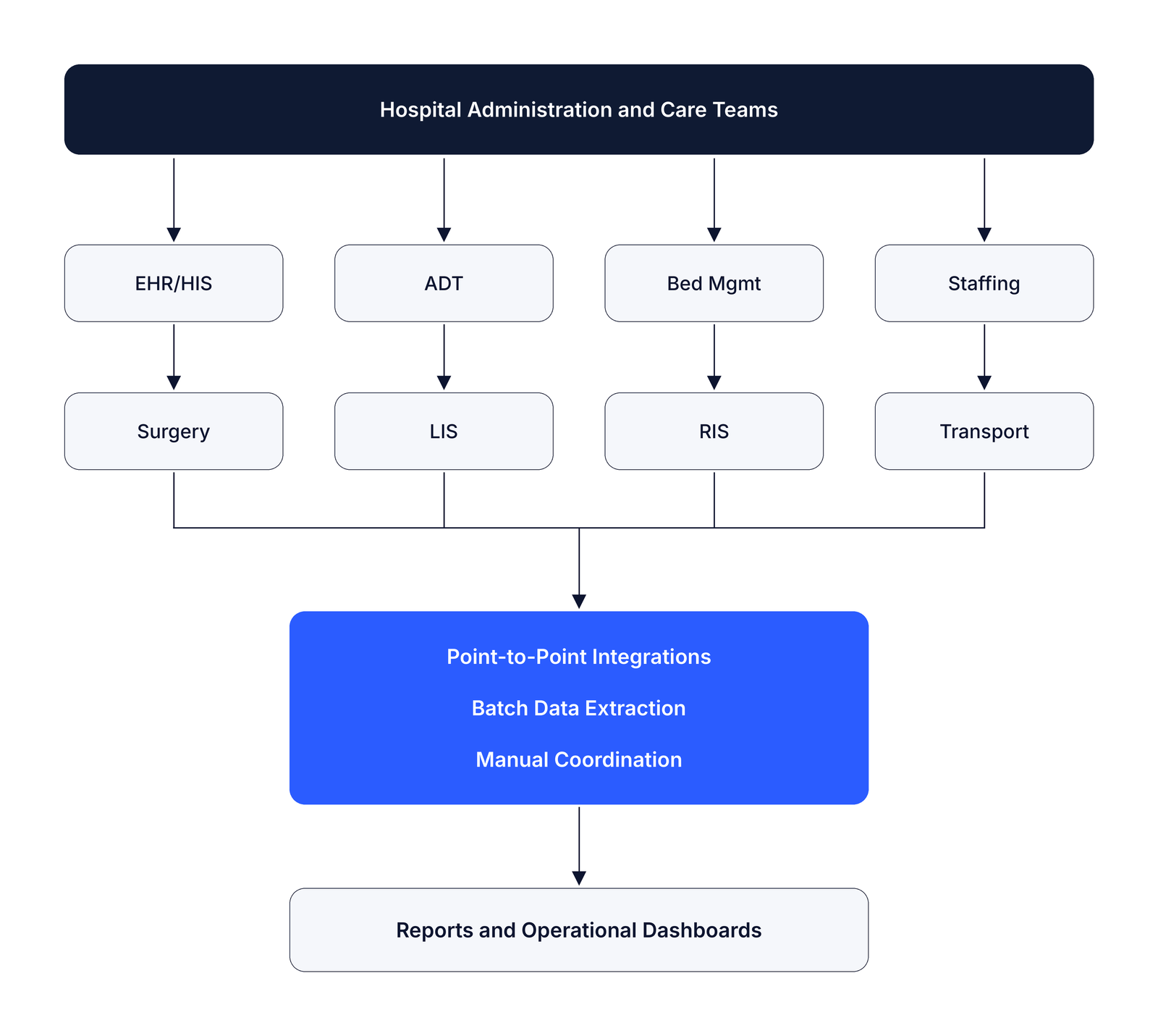
Figure 2 — Fragmented Hospital Operational Architecture
4.2 Current-State Assessment
| Capability | Existing State | Architectural Limitation |
|---|---|---|
| Operational visibility | Departmental dashboards | No consistent enterprise-wide state |
| Bed management | Occupancy tracking | Limited understanding of usable capacity |
| Demand forecasting | Historical reports | Weak short-term predictive intelligence |
| Discharge management | Manual follow-ups | Reactive barrier identification |
| Workforce planning | Static rosters | Limited dynamic capacity awareness |
| Surgical planning | Department-specific schedules | Insufficient downstream capacity awareness |
| Interoperability | Point-to-point interfaces | High coupling and integration complexity |
| Decision-making | Human analysis of fragmented data | Limited decision support |
| Workflow coordination | Telephone and messaging | Weak accountability and traceability |
| AI governance | Isolated experiments | No enterprise-wide control framework |
| Observability | Application and infrastructure logs | No end-to-end decision lineage |
4.3 Architectural Gap
Adding a predictive dashboard or conversational assistant would address only a subset of these limitations.
The healthcare enterprise requires an integrated architectural capability for:
- Continuous operational state management.
- Multi-horizon prediction.
- Constraint-aware optimization.
- Cross-department workflow orchestration.
- Governed agent execution.
- Human approval management.
- Operational outcome measurement.
05. Business Objectives and Success Criteria
5.1 Strategic Business Objectives
The proposed transformation has eight primary objectives.
- Improve timely access to appropriate healthcare capacity.
- Reduce avoidable patient flow delays.
- Improve utilization of existing safely staffed resources.
- Anticipate operational bottlenecks before they materialize.
- Reduce avoidable administrative coordination effort.
- Improve collaboration across hospitals and departments.
- Preserve clinical accountability and patient safety.
- Establish an economically sustainable enterprise AI platform.
5.2 Target Success Criteria
| Business Objective | Target KPI | Illustrative Target |
|---|---|---|
| Emergency access | Median admitted-patient ED boarding time | 15–25% reduction |
| Bed management | Median bed assignment time | 20–35% reduction |
| Discharge efficiency | Time from discharge authorization to departure | 15–25% reduction |
| Capacity management | Avoidable bed-days among eligible encounters | 10–20% reduction |
| Surgical coordination | Capacity-related surgical cancellations | 15–25% reduction |
| Workforce productivity | Manual coordination effort | 20–30% reduction |
| Forecasting effectiveness | 24-hour admission forecast WAPE | ≤15%, subject to local validation |
| Platform adoption | Eligible operational workflows supported by the platform | ≥80% |
| Decision integrity | Executed actions violating mandatory safety constraints | Zero tolerance |
These targets are proposed for controlled validation and do not represent achieved results or established industry benchmarks.
5.3 Safety-Constrained Value Realization
Operational improvement must not be achieved at the expense of patient safety.
The following balancing measures must accompany throughput and efficiency KPIs.
| Balancing Measure | Success Condition |
|---|---|
| Risk-adjusted 30-day readmission rate | No clinically significant deterioration |
| Inappropriate patient placement | Zero tolerance for violations of mandatory placement rules |
| Patient safety incidents | No clinically significant deterioration |
| Nursing workload | Remains within approved staffing constraints |
| Patient experience | No material deterioration |
| Equity of patient access | No unacceptable disparities |
| Clinical override effectiveness | Authorized overrides remain available and effective |
The business objective is safe and timely access to care, not maximum occupancy or minimum length of stay in isolation.
06. Functional and Non-Functional Requirements
6.1 Functional Requirements
| ID | Capability | Functional Requirement |
|---|---|---|
| FR-01 | Enterprise integration | Integrate EHR, HIS, ADT, staffing and ancillary systems |
| FR-02 | Operational visibility | Maintain current hospital-wide operational state |
| FR-03 | Capacity management | Calculate usable bed capacity by specialty, staffing and constraints |
| FR-04 | Demand prediction | Forecast patient arrivals, admissions and resource demand |
| FR-05 | Occupancy prediction | Forecast occupancy at ward, hospital and network levels |
| FR-06 | Bed matching | Recommend clinically compatible operational placement options |
| FR-07 | Discharge prediction | Estimate likely discharge windows for operational planning |
| FR-08 | Barrier management | Identify outstanding discharge dependencies |
| FR-09 | Workforce intelligence | Identify staffing-related capacity constraints |
| FR-10 | Surgical coordination | Assess downstream capacity for scheduled procedures |
| FR-11 | Transfer management | Identify feasible inter-hospital transfer options |
| FR-12 | Bottleneck detection | Identify emerging resource and workflow constraints |
| FR-13 | Scenario simulation | Evaluate alternative demand and capacity scenarios |
| FR-14 | Operational optimization | Generate feasible resource allocation recommendations |
| FR-15 | Conversational intelligence | Support authorized natural-language operational queries |
| FR-16 | Agent orchestration | Coordinate approved operational workflows |
| FR-17 | Approval management | Obtain required human authorization before consequential actions |
| FR-18 | Exception management | Escalate uncertain, infeasible and conflicting recommendations |
| FR-19 | Decision explainability | Present constraints, evidence, uncertainty and alternatives |
| FR-20 | Auditability | Reconstruct material recommendations and executed actions |
| FR-21 | Tenant management | Support tenant-specific policies, integrations and isolation |
| FR-22 | Outcome measurement | Measure operational, safety and economic outcomes |
6.2 Non-Functional Requirements
| Dimension | Proposed Requirement |
|---|---|
| Core platform availability | 99.99% monthly |
| AI-assisted capability availability | 99.9% monthly |
| Operational read API latency | P95 below 300 ms |
| Event processing freshness | P95 within 5 seconds of platform ingestion |
| Source freshness | Source-specific monitoring and approved freshness thresholds |
| Dashboard propagation | P95 within 10 seconds for supported real-time events |
| Simple AI-assisted query | P95 completion within 8 seconds |
| Ward-level optimization | P95 completion within 30 seconds |
| Network-wide optimization | Asynchronous execution with progress reporting |
| Peak ingestion capacity | 1,000 events/second |
| Burst tolerance | Validated through load testing and backpressure controls |
| Regional disaster recovery | Core platform RTO ≤30 minutes; RPO ≤5 minutes |
| Transaction integrity | Version-aware, idempotent and reconciled execution |
| Tenant isolation | Enforced across every data and execution boundary |
| Explainability | Evidence-backed material recommendations |
| Accessibility | Accessible and human-factors-tested operator interfaces |
| Cost governance | Tenant-level and workflow-level cost attribution |
| Maintainability | Independently deployable services and versioned contracts |
These are architectural targets. Achievability must be demonstrated through integration, performance, reliability and disaster recovery testing.
07. My Solution Approach
7.1 Establish an Intelligence-Driven Operational Control Loop
The proposed command center architecture is centered around a continuous operational intelligence loop.
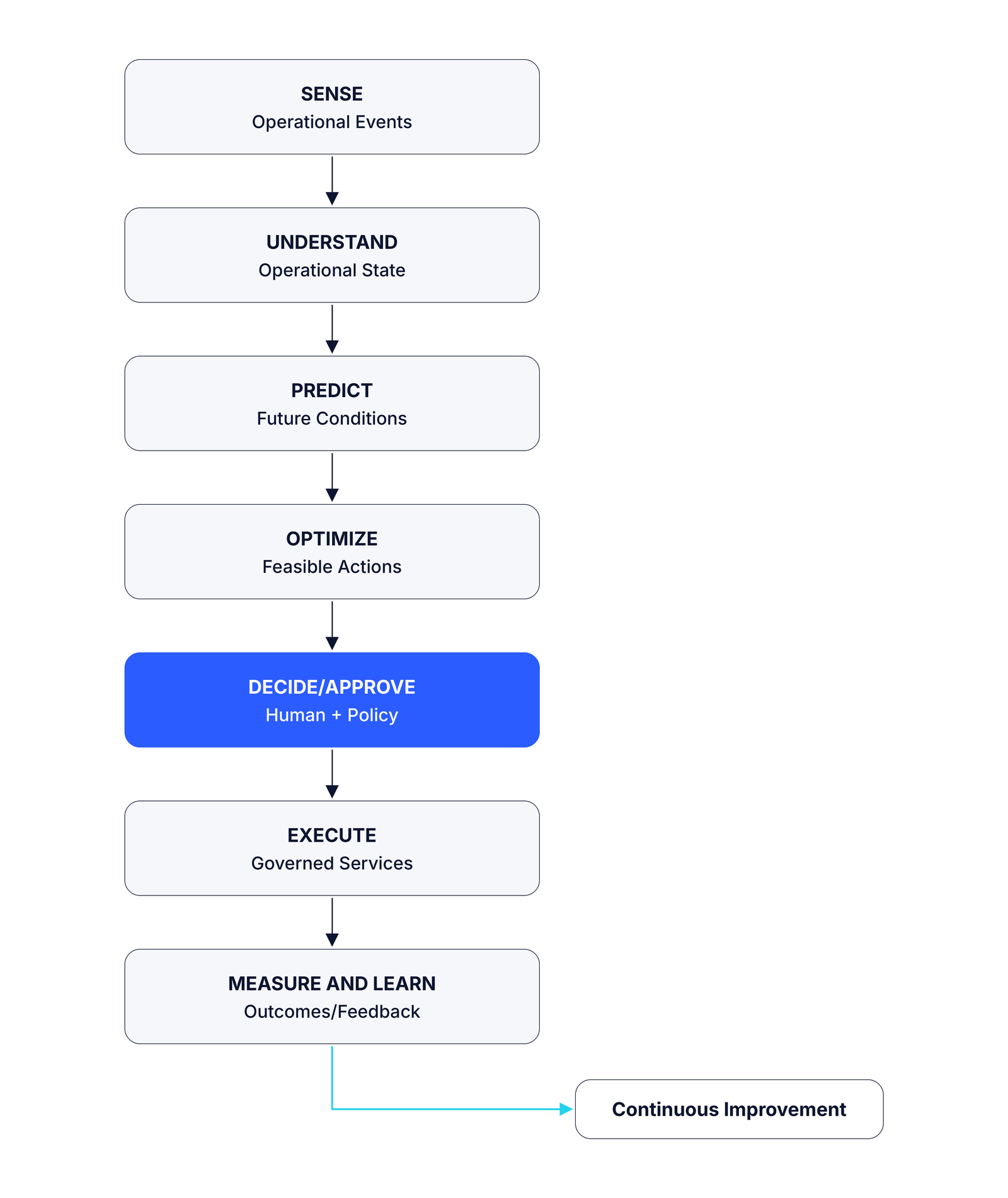
Figure 3 — Hospital Operational Intelligence Loop
The feedback loop is essential. A recommendation has limited business value unless its execution and subsequent operational outcome can be measured.
7.2 Establish an Operational Digital Twin
The Operational Digital Twin represents the continuously updated state of the hospital's operational ecosystem.
It would maintain representations of:
| Entity | Representative State |
|---|---|
| Patient encounter | Current location, care requirements and operational milestones |
| Bed | Availability, reservation, readiness and compatibility |
| Ward | Occupancy, staffed capacity and specialty |
| Hospital | Demand, available capacity and constraints |
| Clinical workforce | Skill availability and approved staffing capacity |
| Operating theatre | Schedule, procedure dependencies and resource requirements |
| Discharge workflow | Outstanding operational tasks and authorized milestones |
| Diagnostic services | Queue status and turnaround estimates |
| Transfer workflow | Acceptance status and transportation dependencies |
The Operational Digital Twin is not a substitute for the EHR or a physiological model of the patient.
It is a versioned, time-aware operational representation optimized for monitoring, forecasting, simulation and coordination.
7.3 Introduce Predictive Intelligence
Predictive AI would anticipate future operational conditions.
| Prediction Capability | Prediction Horizon | Proposed Technique |
|---|---|---|
| Emergency department arrivals | 4–24 hours | Time-series forecasting |
| Inpatient admissions | 4–72 hours | Probabilistic forecasting |
| Ward occupancy | 4–72 hours | Forecast reconciliation and simulation |
| Remaining length of stay | 12–72 hours | Survival analysis or gradient boosting |
| Likely discharge window | 4–48 hours | Calibrated classification or survival models |
| ICU capacity demand | 4–24 hours | Probabilistic resource forecasting |
| Bed cleaning turnaround | 1–4 hours | Regression |
| Staffing shortfalls | 24–72 hours | Demand and roster gap prediction |
| Surgical capacity conflict | 24–72 hours | Constraint and risk analysis |
Model selection would be determined through empirical evaluation rather than technological preference.
A simple statistical or machine learning model should remain preferred when it satisfies the required accuracy, explainability and operational economics.
7.4 Introduce Prescriptive Intelligence
Predictions alone cannot determine the most appropriate operational action.
The proposed architecture incorporates an optimization engine that evaluates patient flow requirements against available capacity, operational policies and clinical constraints.
For example, the engine may evaluate:
- Which clinically compatible beds could accommodate waiting patients?
- Which operational discharge dependencies require immediate attention?
- Which surgical schedules may experience downstream capacity constraints?
- Which hospital has feasible capacity for an approved transfer?
- Which temporary capacity changes could relieve an emerging bottleneck?
The engine would generate feasible alternatives, explain constraint violations and return an explicit infeasible result when no safe allocation exists.
7.5 Introduce Governed Agentic Intelligence
Specialized agents would coordinate operational tasks across hospital departments.
| Agent | Primary Responsibility |
|---|---|
| Command Center Supervisor Agent | Coordinate bounded operational investigations |
| Capacity Intelligence Agent | Investigate emerging capacity shortages |
| Patient Flow Agent | Identify placement and movement bottlenecks |
| Discharge Coordination Agent | Track and coordinate outstanding discharge dependencies |
| Workforce Coordination Agent | Identify staffing-related operational constraints |
| Surgical Coordination Agent | Investigate downstream surgical capacity conflicts |
| Transfer Coordination Agent | Coordinate approved transfer workflows |
| Exception Management Agent | Escalate unresolved operational exceptions |
| Executive Intelligence Agent | Generate evidence-backed operational summaries |
These are logical agents, not necessarily independently deployed agent runtimes.
The supervisor would select only the capabilities required for a particular operational objective.
7.6 Apply Selective Autonomy
Not every hospital workflow should be agentic.
| Autonomy Level | Permitted Capability | Example |
|---|---|---|
| Level 0 | Observe | Display bed occupancy |
| Level 1 | Explain | Explain an emerging capacity shortage |
| Level 2 | Recommend | Propose feasible bed placement alternatives |
| Level 3 | Coordinate | Send an approved internal task reminder |
| Level 4 | Execute after authorization | Submit an approved bed reservation |
| Level 5 | Fully autonomous consequential decision | Excluded from the proposed scope |
The platform would initially operate primarily at Levels 0–2, with autonomy expanded only after sufficient evidence of safety, reliability and governance effectiveness has been established.
08. Architectural Principles
| Principle | Architectural Implication |
|---|---|
| Patient safety by design | Mandatory clinical and safety constraints cannot be overridden by AI |
| Human accountability | Consequential decisions remain attributable to authorized professionals |
| Business-driven architecture | Technology choices support measurable healthcare objectives |
| Source-of-truth preservation | EHR and domain systems retain authoritative business records |
| Interoperability by design | Use standards-based interfaces wherever supported |
| Event-driven coordination | Propagate operational changes through decoupled event contracts |
| Domain-driven design | Establish explicit healthcare operational bounded contexts |
| Intelligence specialization | Select ML, optimization, rules or LLMs according to the problem |
| Minimum necessary intelligence | Avoid unnecessary model invocations and agent complexity |
| Governed tool access | Agents cannot bypass authorization or deterministic validation |
| Privacy by design | Minimize sensitive data exposure throughout execution |
| Tenant isolation by design | Enforce organizational and facility-level access boundaries |
| Temporal correctness | Account for data freshness, ordering and state version |
| Explainability by design | Preserve decision evidence, uncertainty and policy context |
| Resilience by design | Core operations continue when AI capabilities are unavailable |
| Economic sustainability | Measure cost per successful operational outcome |
| Evolutionary architecture | Support incremental adoption without replacing core systems |
The architecture must optimize for trustworthiness and operational effectiveness rather than technological sophistication alone.
09. Target-State Reference Architecture
9.1 Enterprise Logical Architecture
The proposed solution adopts a seven-layer enterprise reference architecture supported by a cross-cutting governance and control plane.
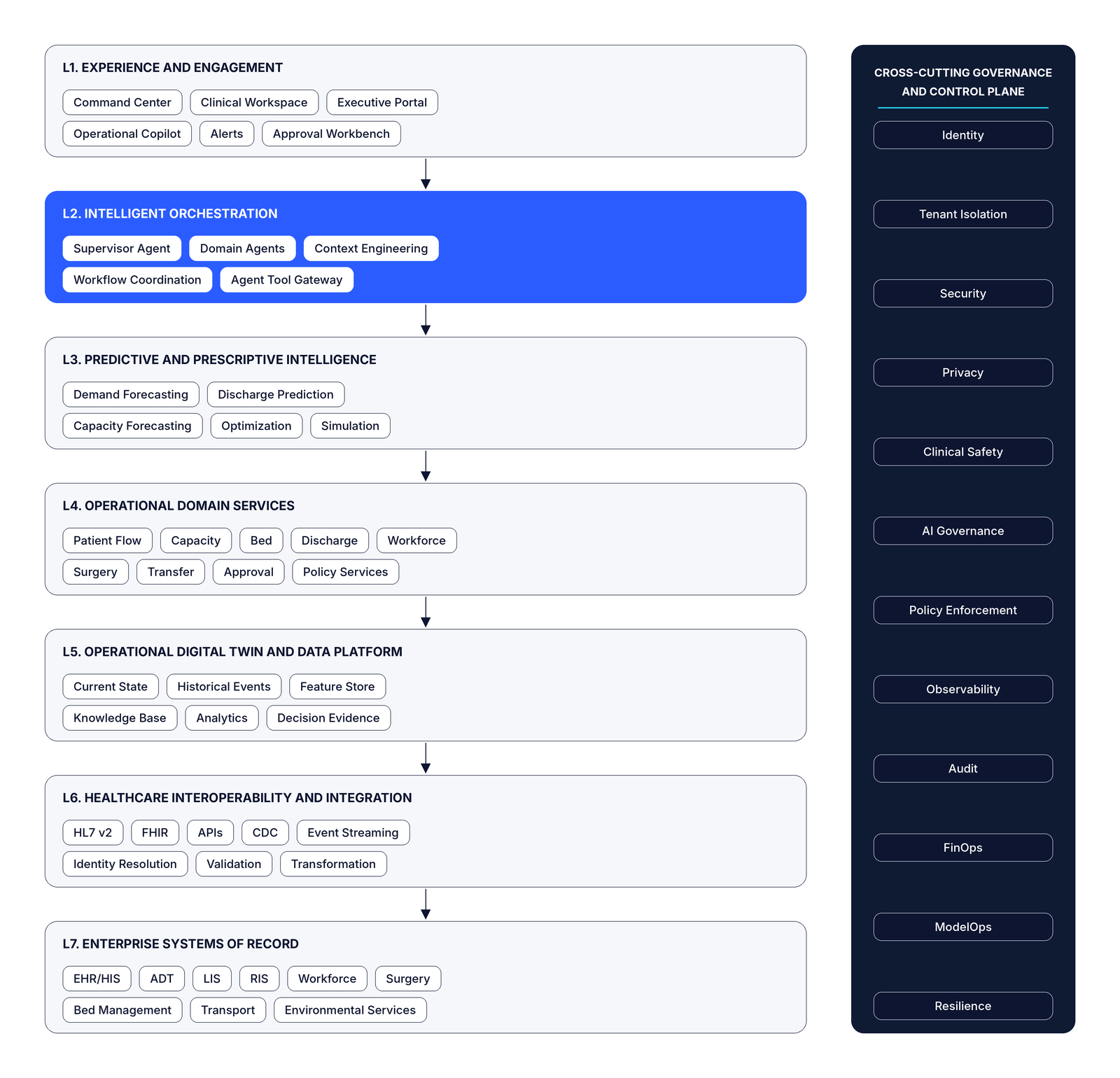
Figure 4 — AI-Powered Hospital Command Center Reference Architecture
The layers represent logical responsibility boundaries rather than a mandatory synchronous call chain.
9.2 AWS Deployment Reference Architecture
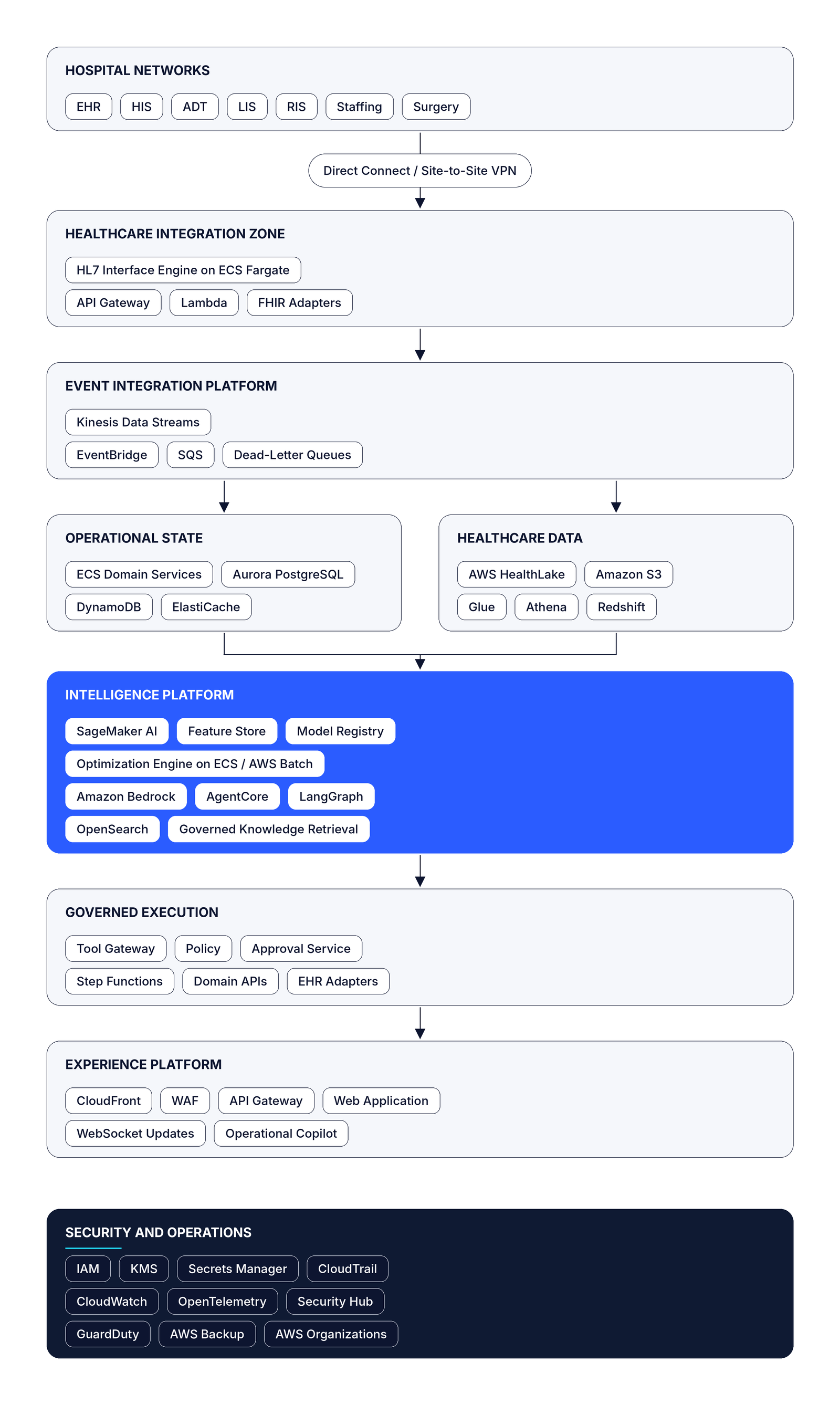
Figure 5 — Proposed AWS Architecture
9.3 Domain-Driven Microservices Architecture
| Bounded Context | Primary Service | Responsibility |
|---|---|---|
| Patient Flow | Patient Flow Service | Encounter movement and operational milestones |
| Bed Management | Bed Management Service | Bed readiness, availability and reservation coordination |
| Capacity | Capacity Service | Staffed capacity and operational constraints |
| Discharge | Discharge Coordination Service | Operational discharge dependencies |
| Workforce | Workforce Capacity Service | Approved staffing and skill availability |
| Surgery | Surgical Coordination Service | Procedure-related capacity dependencies |
| Transfer | Transfer Service | Transfer coordination and acceptance tracking |
| Forecasting | Forecast Service | Prediction generation and retrieval |
| Optimization | Optimization Service | Feasible operational recommendations |
| Approval | Approval Service | Human authorization and approval lifecycle |
| Policy | Policy Service | Operational and safety constraint enforcement |
| Notification | Notification Service | Role-aware alerts and escalations |
| Tenant Management | Tenant Management Service | Tenant configuration and lifecycle |
| Audit | Decision Audit Service | Decision lineage and action evidence |
These bounded contexts define service ownership boundaries. Closely related capabilities may initially be deployed together to avoid unnecessary distributed-system complexity.
9.4 Systems of Record and Operational Ownership
| Business Entity | Authoritative System | Command Center Responsibility |
|---|---|---|
| Patient identity | EHR / Enterprise Master Patient Index | Authorized identity reference |
| Clinical diagnosis | EHR | Consume permitted information when necessary |
| Admission and transfer status | EHR / ADT | Maintain operational projection |
| Bed assignment | Designated bed management system | Recommend and submit approved requests |
| Clinical discharge authorization | EHR | Observe authorization and coordinate dependencies |
| Staffing roster | Workforce management system | Calculate effective staffing capacity |
| Surgical schedule | Theatre management system | Identify capacity conflicts |
| AI recommendation | Command Center | Own recommendation lifecycle |
| Operational approval | Command Center or designated source system | Record authorization evidence |
| Command center task | Command Center | Own coordination task lifecycle |
Every material business entity must have an explicitly identified authoritative owner.
The command center must not silently become a competing system of record.
9.5 Healthcare Interoperability Architecture
The integration layer would support existing healthcare standards and organization-specific interfaces.
| Standard / Interface | Purpose |
|---|---|
| HL7 v2 ADT | Admission, discharge and transfer events |
| HL7 FHIR R4 | Standardized healthcare resource exchange |
| SMART on FHIR | Authorized integration with supported EHR environments |
| REST APIs | Operational system integration |
| Change Data Capture | Approved legacy data synchronization |
| SFTP / Batch Interfaces | Controlled integration for legacy applications |
| DICOM / DICOMweb | Optional imaging workflow interoperability |
| SNOMED CT / LOINC | Terminology normalization where applicable |
Representative FHIR resources include:
| FHIR Resource | Operational Purpose |
|---|---|
| Patient | Patient identity reference |
| Encounter | Admission, care setting and encounter status |
| Location | Hospital, ward, room and bed representation |
| Organization | Healthcare organization representation |
| HealthcareService | Available healthcare services |
| PractitionerRole | Clinical workforce roles |
| Task | Operational workflow tasks where supported |
| Procedure | Procedure-related information |
| ServiceRequest | Relevant service dependencies |
| Appointment | Scheduling information |
| Provenance | Resource origin and lineage |
| AuditEvent | Healthcare activity auditing |
FHIR alone does not represent every hospital operational constraint. Staffing rules, reservations, detailed bed readiness and optimization entities may require dedicated domain models.
AWS HealthLake would provide a standards-based FHIR R4 repository for selected longitudinal healthcare data, where regional availability and regulatory requirements permit.
It would not be used as the primary high-frequency transactional store for bed reservations or operational locking.
9.6 Event-Driven Architecture
Representative operational domain events include:
| Domain Event | Typical Consumer |
|---|---|
| PatientAdmitted | Patient Flow, Capacity, Forecasting |
| PatientTransferred | Patient Flow, Bed Management |
| BedOccupied | Capacity, Operational Digital Twin |
| BedReleased | Environmental Services |
| BedCleaningCompleted | Bed Management |
| BedAvailable | Patient Flow, Optimization |
| StaffingCapacityChanged | Capacity, Forecasting |
| DischargeAuthorized | Discharge Coordination |
| DischargeBarrierIdentified | Discharge Coordination Agent |
| PatientDeparted | Bed Management, Analytics |
| CapacityShortagePredicted | Command Center, Optimization |
| OptimizationCompleted | Approval Service |
| RecommendationApproved | Workflow Orchestration |
| BedAssignmentConfirmed | Operational Digital Twin |
Each event would carry a standardized envelope containing:
- Event identifier and event type.
- Tenant and facility identifiers.
- Aggregate identifier and version.
- Source system and source event identifier.
- Event occurrence and ingestion timestamps.
- Correlation and causation identifiers.
- Schema version and sensitivity classification.
- Minimal operational payload.
Events containing patient references must remain protected even when direct identifiers are replaced with opaque identifiers.
Consumers would implement idempotency, duplicate detection, version validation and reconciliation.
Kinesis partitioning would preserve appropriate aggregate-level ordering where required. EventBridge would distribute operational domain events without assuming global ordering guarantees.
9.7 Real-Time Capacity Modeling
Capacity must be represented as a multidimensional operational resource.
For each patient, the system would determine candidate bed availability by evaluating:
| Constraint | Evaluation |
|---|---|
| Physical availability | Is the bed physically vacant? |
| Readiness | Has cleaning and preparation been completed? |
| Clinical compatibility | Does it support the required care level and specialty? |
| Staffing | Are sufficient appropriately qualified staff available? |
| Infection control | Are required isolation conditions satisfied? |
| Equipment | Is necessary equipment available? |
| Reservation | Is the bed already committed? |
| Freshness | Is the supporting information sufficiently current? |
Only beds satisfying all mandatory constraints would be included in the feasible candidate set.
The architecture would avoid presenting a misleading enterprise-wide availability number without accounting for specialty and compatibility differences.
9.8 Patient Flow Optimization Engine
The proposed architecture implements the optimization capability as an independently deployable service rather than embedding optimization logic within an LLM.
Optimization objectives
Minimize avoidable patient waiting time, operational delays, unnecessary movement and approved operational costs while improving appropriate access to available resources.
| Constraint Category | Representative Constraint |
|---|---|
| Clinical | Required specialty, acuity and care level |
| Safety | Infection control and equipment requirements |
| Workforce | Approved nurse-to-patient and skill constraints |
| Capacity | Staffed and operationally ready beds |
| Temporal | Reservation validity and expected availability |
| Continuity | Avoid unnecessary patient movement |
| Organizational | Transfer agreements and local operating policies |
| Fairness | Approved clinical priority and equitable waiting-time rules |
Mandatory constraints define feasibility. Soft constraints allow feasible alternatives to be ranked.
The proposed optimization engine leverages Google OR-Tools CP-SAT or an appropriate mathematical optimization solver, complemented by discrete-event simulation.
The optimizer would return:
- Proposed action.
- Alternative feasible actions.
- Expected operational impact.
- Constraints satisfied.
- Remaining uncertainty.
- Input state version.
- Recommendation validity period.
- Required approval level.
A future bed release may be used for scenario planning. It must not be treated as an immediately assignable bed until its availability has been confirmed.
9.9 Enterprise Context Engineering
The quality of agentic intelligence depends on the quality and authority of its context.
| Context Category | Source |
|---|---|
| Identity context | Enterprise identity provider |
| Authorization context | Tenant membership and policy services |
| Encounter context | Authorized operational projection |
| Capacity context | Operational Digital Twin |
| Predictive context | Forecast Service |
| Optimization context | Optimization Service |
| Policy context | Approved operational policies |
| Workflow context | Workflow and Approval Services |
| Knowledge context | Governed enterprise knowledge repository |
| Temporal context | Source freshness, state version and validity |
| Audit context | Correlation and decision identifiers |
Context engineering would assemble only the information necessary to complete the operational objective.
The LLM would not receive unrestricted access to patient records or the enterprise operational database.
Dynamic operational facts would be retrieved through authoritative APIs. RAG would primarily support retrieval of approved policies, operating procedures and escalation playbooks.
9.10 Agent Execution Architecture
The agent execution layer would separate orchestration, runtime and execution infrastructure.
| Component | Responsibility |
|---|---|
| Agent Harness | LangGraph-based orchestration, tool selection and bounded execution |
| Agent Runtime | Agent application lifecycle, session handling and execution |
| Runtime Environment | Managed isolation, compute, networking and resource controls |
| Agent Gateway | Governed access to operational tools |
| Agent Identity | Workload identity and delegated authorization |
| Workflow Engine | Durable and deterministic business workflow execution |
| Agent Observability | Tracing, tool-call monitoring and evaluation |
Amazon Bedrock AgentCore would be considered for hosting and governing the agent execution layer, subject to feature availability and security validation.
Long-running business workflows and human approval waits would be maintained by durable workflow services rather than relying on an agent session to remain active.
9.11 Multi-Tenant Architecture
A tenant represents an independently governed healthcare organization.
A hospital represents a facility within that organizational boundary and is not automatically treated as a separate tenant.
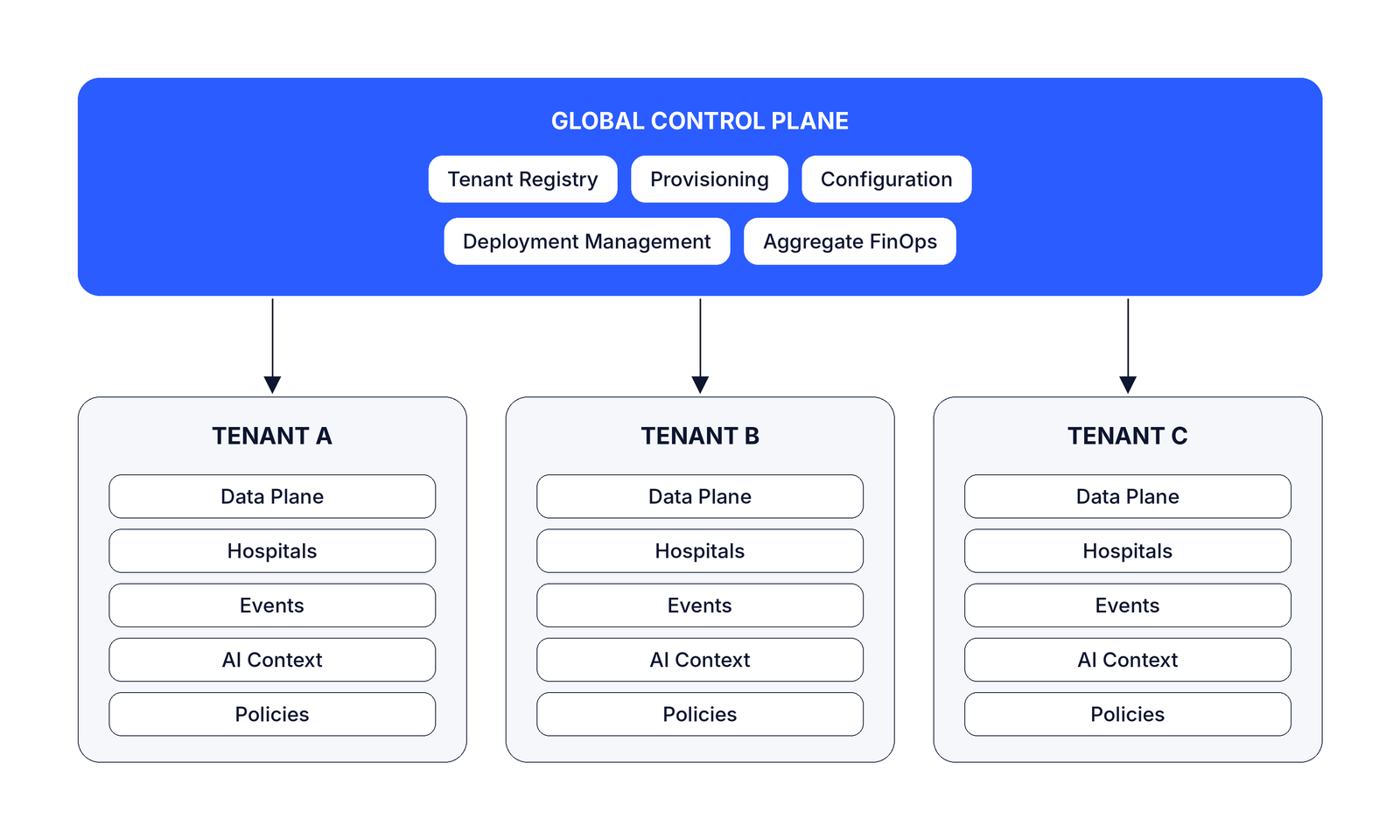
Figure 6 — Multi-Tenant Healthcare Platform
| Isolation Dimension | Proposed Approach |
|---|---|
| Organizational identity | Tenant-scoped identity and authorization |
| Facility access | Hospital and department-level permissions |
| Compute | Tenant or cell-level workload isolation |
| Operational databases | Dedicated tenant databases or approved pooled partitions |
| Healthcare data repository | Tenant-specific data stores |
| Encryption | Tenant-specific keys where appropriate |
| Knowledge retrieval | Tenant-scoped indexes and access filters |
| Agent sessions | Tenant and user-scoped execution context |
| Audit | Tenant-scoped decision evidence |
| Model training | No cross-tenant patient data aggregation by default |
| Cost | Tenant-level metering and budgets |
For the representative healthcare scenario, the proposed solution adopts a bridge architecture with a shared control plane and strongly isolated tenant data planes.
The global control plane would not contain patient-level healthcare data.
Cross-tenant patient transfers would require explicitly authorized information exchange and appropriate organizational agreements rather than unrestricted access to another tenant's data.
10. Key Architectural Decisions
| ADR | Architectural Decision | Rationale |
|---|---|---|
| ADR-01 | Preserve existing EHR and HIS systems | Avoid disruptive replacement of authoritative healthcare systems |
| ADR-02 | Establish an Operational Digital Twin | Enable continuous operational state awareness |
| ADR-03 | Adopt event-driven integration | Reduce coupling and improve operational responsiveness |
| ADR-04 | Use domain-driven service boundaries | Preserve domain ownership and independent evolution |
| ADR-05 | Separate predictive AI from Generative AI | Improve forecasting accuracy, predictability and economics |
| ADR-06 | Use mathematical optimization for resource allocation | Enforce explicit hard and soft constraints |
| ADR-07 | Introduce probabilistic forecasting | Represent demand and capacity uncertainty |
| ADR-08 | Apply bounded agentic orchestration | Coordinate complex workflows without uncontrolled autonomy |
| ADR-09 | Keep consequential decisions human-supervised | Preserve clinical accountability |
| ADR-10 | Use deterministic services for business transactions | Maintain transactional integrity |
| ADR-11 | Establish an Enterprise Context Layer | Control the quality, relevance and authority of AI context |
| ADR-12 | Use FHIR and HL7 integration | Support healthcare interoperability |
| ADR-13 | Separate operational and analytical storage | Optimize different access and consistency requirements |
| ADR-14 | Adopt strongly isolated tenant data planes | Reduce sensitive healthcare data exposure |
| ADR-15 | Deploy across multiple availability zones | Improve workload resilience |
| ADR-16 | Make core operations independent of LLM availability | Prevent AI failures from disrupting hospital operations |
| ADR-17 | Preserve complete decision provenance | Enable audit and incident investigation |
| ADR-18 | Use incremental implementation | Reduce organizational, clinical and delivery risk |
Each decision would be documented in an Architecture Decision Record containing the context, alternatives considered, consequences and conditions for reconsideration.
10.1 Intelligence Allocation Strategy
A key decision is selecting the appropriate form of intelligence for each operational problem.
| Operational Problem | Preferred Intelligence |
|---|---|
| Determine whether a bed is occupied | Deterministic state retrieval |
| Predict tomorrow's admissions | Predictive ML |
| Determine feasible patient placement | Constraint optimization |
| Assess a hypothetical capacity shortage | Discrete-event simulation |
| Explain an emerging bottleneck | Grounded Generative AI |
| Retrieve infection control policy | Permission-aware RAG |
| Coordinate multiple operational tasks | Bounded agentic orchestration |
| Validate a bed reservation | Deterministic policy and transaction service |
| Authorize patient discharge | Accountable clinical professional |
This intelligence allocation strategy avoids the architectural anti-pattern of using an LLM as a universal problem-solving engine.
11. Technology Stack and Rationale
11.1 Application and Integration Technologies
| Architectural Capability | Proposed Technology | Rationale |
|---|---|---|
| Command center application | Next.js, React, TypeScript | Interactive enterprise user experience |
| Edge delivery | Amazon CloudFront, AWS WAF | Secure application delivery |
| User authentication | Enterprise IdP, Amazon Cognito where appropriate | Federated authentication |
| API management | Amazon API Gateway | Controlled enterprise API exposure |
| Real-time updates | API Gateway WebSocket APIs | Operational dashboard updates |
| Domain microservices | Amazon ECS Fargate | Independently scalable containerized services |
| Business API development | Java Spring Boot / Python FastAPI | Domain and integration service development |
| Event ingestion | Amazon Kinesis Data Streams | Continuous operational event ingestion |
| Event distribution | Amazon EventBridge | Decoupled event routing |
| Asynchronous processing | Amazon SQS | Durable queues and workload isolation |
| Workflow orchestration | AWS Step Functions | Deterministic workflow and approval coordination |
| Healthcare integration | NextGen Connect or equivalent HL7 interface engine | Legacy healthcare system interoperability |
| FHIR development | HAPI FHIR | Standards-based healthcare adapters |
| Legacy integration | AWS Lambda / AWS DMS where applicable | Controlled transformation and synchronization |
11.2 Data and Analytics Technologies
| Capability | Proposed Technology | Rationale |
|---|---|---|
| Healthcare data repository | AWS HealthLake | FHIR R4 healthcare data management |
| Transactional operational data | Amazon Aurora PostgreSQL | ACID transactions and relational constraints |
| Operational projections | Amazon DynamoDB | Scalable state retrieval |
| Caching | Amazon ElastiCache | Low-latency non-authoritative reads |
| Historical data lake | Amazon S3 | Durable event and analytical storage |
| Data governance | AWS Lake Formation | Governed analytical data access |
| Data transformation | AWS Glue | Data preparation and transformation |
| Analytical queries | Amazon Athena | Serverless analytical workloads |
| Data warehousing | Amazon Redshift | Enterprise-scale analytical reporting |
| Executive dashboards | Amazon QuickSight capabilities | Business performance reporting |
| Knowledge retrieval | Amazon OpenSearch Service | Hybrid search over authorized knowledge |
11.3 AI and Optimization Technologies
| Capability | Proposed Technology | Rationale |
|---|---|---|
| Model development | Amazon SageMaker AI | Managed ML development and deployment |
| Demand forecasting | StatsForecast, LightGBM or PyTorch | Evaluate statistical and ML forecasting approaches |
| Length-of-stay prediction | XGBoost, survival analysis libraries | Structured and time-to-event prediction |
| Feature management | SageMaker Feature Store | Consistent training and inference features |
| Model governance | SageMaker Model Registry | Versioning and deployment approval |
| Optimization | Google OR-Tools / Pyomo | Constraint-based resource allocation |
| Simulation | SimPy | Discrete-event operational simulation |
| Generative AI | Amazon Bedrock | Governed foundation model inference |
| Agent orchestration | LangGraph | Explicit stateful and bounded execution |
| Agent hosting | Amazon Bedrock AgentCore Runtime | Managed agent execution infrastructure |
| Tool governance | AgentCore Gateway and domain policy services | Controlled tool invocation |
| AI safeguards | Amazon Bedrock Guardrails | Additional prompt and response protection |
| Agent evaluation | AgentCore Evaluations and custom evaluation suites | Execution quality measurement |
| Optimization compute | ECS Fargate / AWS Batch | Scalable solver execution |
11.4 Platform Engineering Technologies
| Capability | Proposed Technology |
|---|---|
| Infrastructure as Code | AWS CDK or Terraform |
| Container registry | Amazon ECR |
| CI/CD | GitHub Actions or AWS CodePipeline |
| Observability | Amazon CloudWatch and OpenTelemetry |
| Distributed tracing | AWS X-Ray |
| Security posture | AWS Security Hub |
| Threat detection | Amazon GuardDuty |
| Identity and permissions | AWS IAM |
| Encryption | AWS KMS |
| Secrets | AWS Secrets Manager |
| Audit | AWS CloudTrail and application audit services |
| Backup and recovery | AWS Backup |
Technology selection would be finalized through an architecture assessment covering regional availability, healthcare compliance scope, existing enterprise standards, licensing and total cost of ownership.
12. End-to-End Solution Workflows
12.1 Workflow 1 — Predicting and Preventing a Capacity Crisis
Representative scenario
At 08:00 AM, the command center identifies an emerging capacity shortage expected during the afternoon.
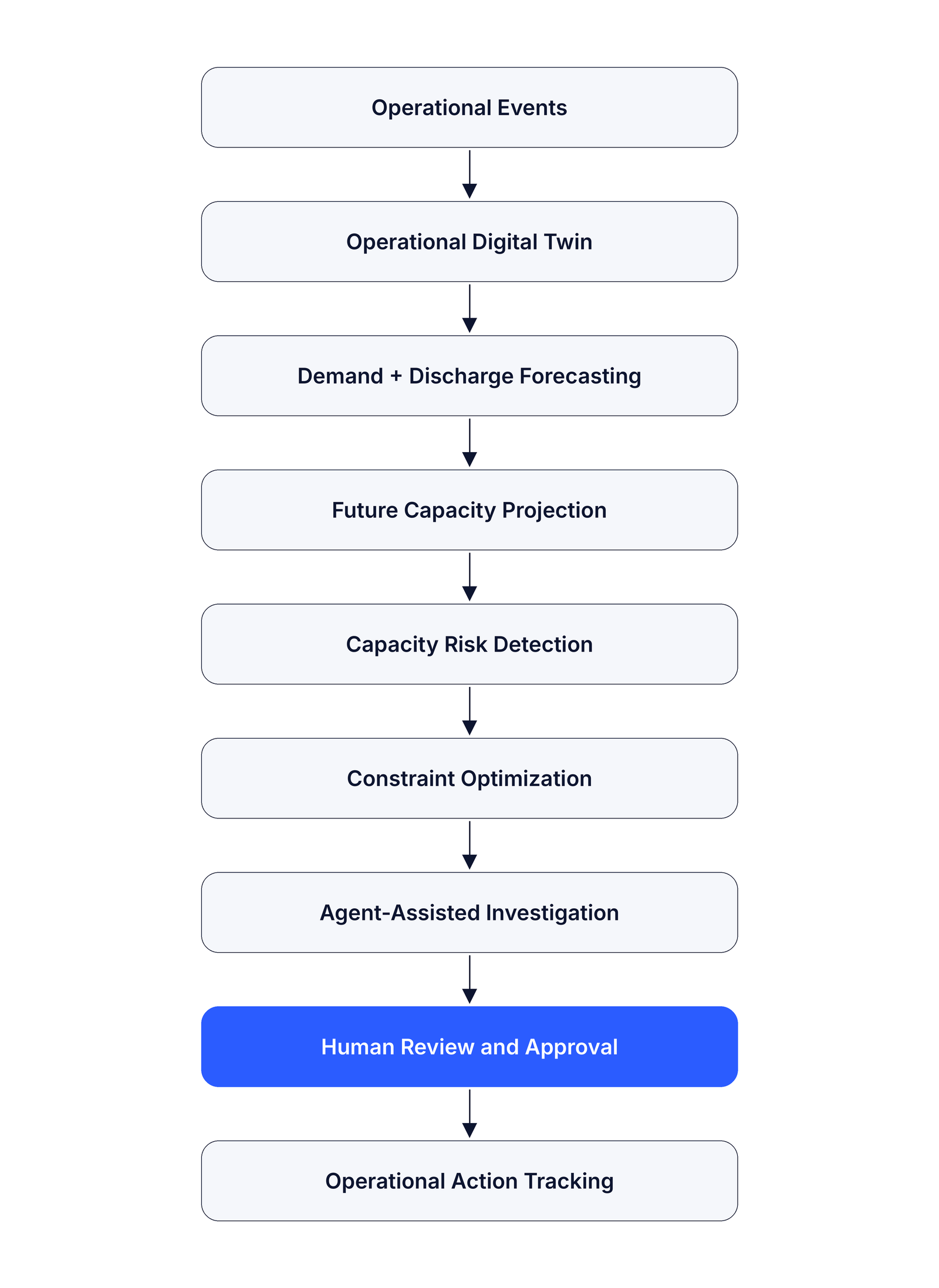
Figure 7 — Predictive Capacity Management Workflow
| Step | Activity |
|---|---|
| 01 | Ingest current occupancy, arrivals, staffing and discharge events |
| 02 | Update the operational state |
| 03 | Predict admission demand over the next 12 hours |
| 04 | Predict likely discharge windows |
| 05 | Evaluate capacity by specialty and staffed resources |
| 06 | Identify potential demand-capacity imbalances |
| 07 | Generate feasible mitigation alternatives |
| 08 | Invoke agents to investigate relevant dependencies |
| 09 | Present recommendations with evidence and uncertainty |
| 10 | Obtain required operational authorization |
| 11 | Execute approved actions |
| 12 | Monitor whether the anticipated bottleneck is resolved |
The command center may identify a potential shortage of general medical beds and present options such as reviewing discharge barriers, assessing approved staffing contingencies and evaluating permitted transfer alternatives.
It must not independently authorize premature discharges or unsafe staffing changes.
12.2 Workflow 2 — Intelligent Emergency Department Patient Placement
Consider a patient who has been clinically approved for admission to an inpatient ward.
| Step | Activity |
|---|---|
| 01 | EHR publishes an admission-related event |
| 02 | Integration layer validates and normalizes the event |
| 03 | Patient Flow Service creates or updates the placement workflow |
| 04 | Authorized care requirements are retrieved |
| 05 | Capacity Service identifies potential beds |
| 06 | Mandatory clinical and operational constraints are evaluated |
| 07 | Optimization Service ranks feasible candidates |
| 08 | Recommendation is presented to an authorized bed manager |
| 09 | Bed manager reviews and approves the proposed placement |
| 10 | Transaction service revalidates bed availability and constraints |
| 11 | Authoritative bed management system receives the reservation or assignment request |
| 12 | Confirmed assignment is published as an operational event |
| 13 | Digital Twin and command center dashboards are updated |
| 14 | The workflow tracks completion of the patient movement |
If the source system rejects the request or cannot confirm the result, the workflow enters an exception or reconciliation state.
The platform must not assume that approval or request submission means that the bed has been successfully assigned.
12.3 Workflow 3 — Intelligent Discharge Coordination
Discharge intelligence is designed to identify operational opportunities, not independently determine clinical readiness.
| Step | Activity |
|---|---|
| 01 | Prediction service estimates likely discharge windows |
| 02 | Discharge Coordination Service retrieves permitted task status |
| 03 | Outstanding operational dependencies are identified |
| 04 | Discharge Coordination Agent investigates unresolved barriers |
| 05 | Approved administrative reminders are issued |
| 06 | Unresolved dependencies are escalated to accountable teams |
| 07 | Clinician independently determines and authorizes discharge |
| 08 | Operational arrangements are completed |
| 09 | Patient departure is confirmed |
| 10 | Bed cleaning and preparation workflow begins |
| 11 | Bed availability is confirmed and published |
Representative discharge barriers include transportation arrangements, equipment availability, medication fulfillment, documentation and rehabilitation placement.
A predicted discharge must never be interpreted as clinical authorization to discharge a patient.
12.4 Workflow 4 — Surgical Capacity Coordination
| Step | Activity |
|---|---|
| 01 | Retrieve upcoming surgical schedules |
| 02 | Retrieve approved postoperative care requirements |
| 03 | Forecast ICU and inpatient capacity |
| 04 | Identify potential downstream capacity conflicts |
| 05 | Evaluate feasible operational alternatives |
| 06 | Present scenarios to surgical and capacity management teams |
| 07 | Obtain required clinical and operational decisions |
| 08 | Submit approved schedule modifications |
| 09 | Monitor downstream resource readiness |
The architecture prevents isolated optimization of operating theatre utilization while ignoring postoperative care capacity.
12.5 Workflow 5 — Inter-Hospital Transfer Coordination
| Step | Activity |
|---|---|
| 01 | Authorized clinician initiates a transfer request |
| 02 | Transfer Service retrieves permitted care requirements |
| 03 | Capacity Service identifies feasible receiving facilities |
| 04 | Optimization Service evaluates operational alternatives |
| 05 | Receiving clinical team confirms acceptance |
| 06 | Capacity and transportation arrangements are validated |
| 07 | Required approvals and information-sharing controls are enforced |
| 08 | Transfer workflow coordinates approved activities |
| 09 | Transfer completion is confirmed |
| 10 | Both facilities reconcile operational state |
Transfer decisions must account for clinical suitability, patient preferences and applicable transfer requirements.
Available capacity alone does not justify transferring a patient.
12.6 Workflow 6 — Conversational Operational Intelligence
A hospital administrator asks:
“Why are we expecting an ICU capacity shortage this evening, and what operational options are available?”
The system would execute the following sequence:
- Authenticate the user and resolve authorized facility access.
- Retrieve current ICU capacity and staffing constraints.
- Retrieve relevant admission and postoperative demand forecasts.
- Retrieve approved operational escalation policies.
- Invoke the optimization service if scenario analysis is required.
- Generate a grounded explanation.
- Present feasible options, supporting evidence and uncertainty.
- Escalate consequential actions through the approval workflow.
A representative response could state:
Projected condition: ICU demand may exceed currently staffed capacity between 18:00 and 22:00.
Contributing factors: Scheduled postoperative demand, uncertain discharge timing and a staffing constraint.
Recommended operational review: Validate the postoperative schedule, review clinically approved step-down opportunities and evaluate approved staffing contingencies.
Authorization: No patient movement or staffing change has been executed.
12.7 Workflow 7 — Governed Agent Action Execution
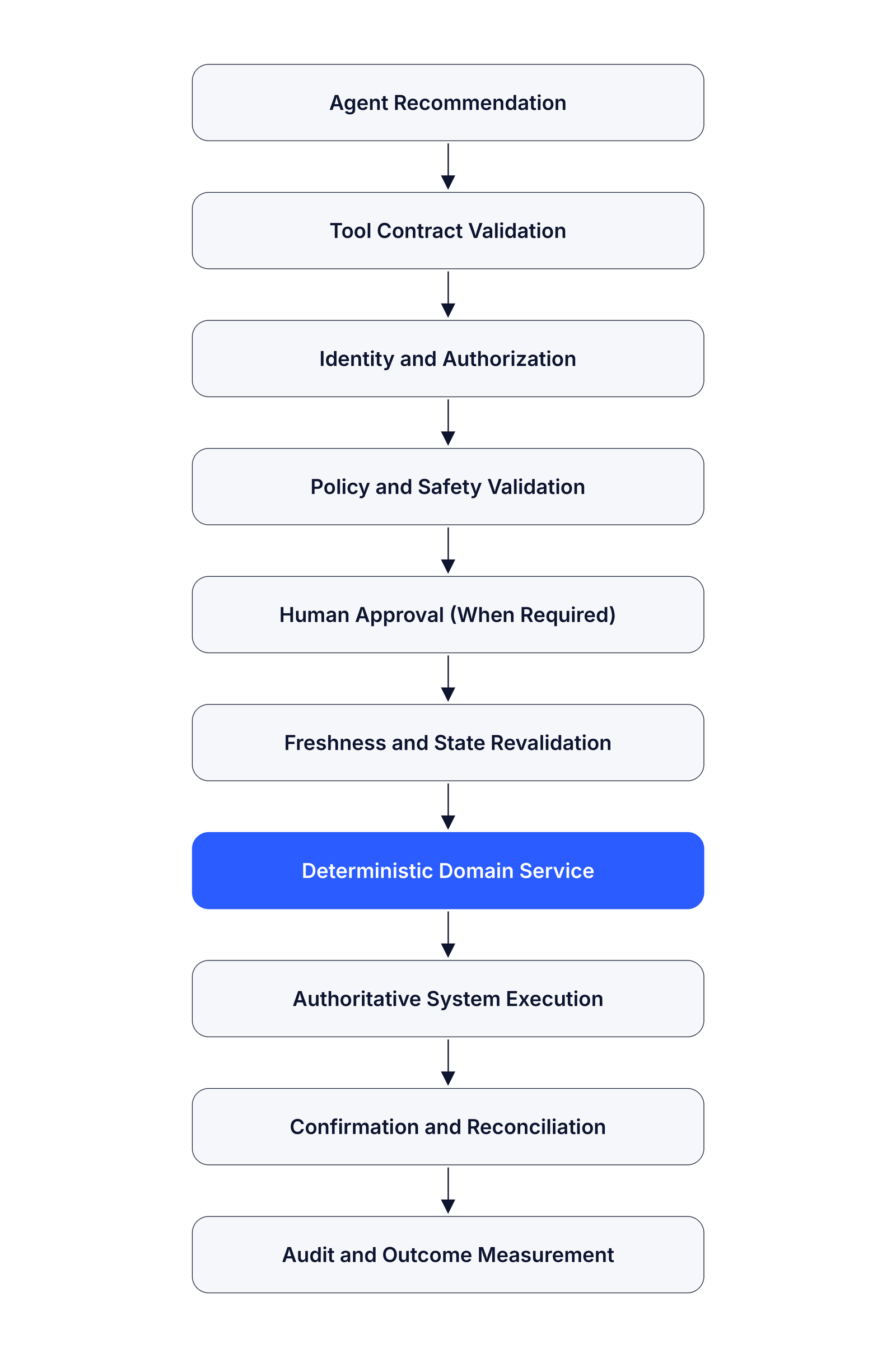
Figure 8 — Governed Execution Boundary
Agents must not directly execute SQL updates, manipulate authoritative patient records or bypass domain services.
Every consequential tool invocation would include the relevant tenant, user, workflow, recommendation and authorization context.
13. Security, Governance and Compliance
13.1 Healthcare Security Architecture
The platform would adopt a zero-trust security model.
| Security Dimension | Proposed Control |
|---|---|
| Authentication | Enterprise federation, MFA and workload identities |
| Authorization | RBAC and attribute-based access controls |
| Tenant isolation | Tenant-scoped identity, data and execution policies |
| Facility isolation | Hospital and department-level authorization |
| Network security | Private subnets, segmentation and controlled connectivity |
| Data encryption | Encryption in transit and at rest |
| Key management | AWS KMS and appropriate tenant-level key separation |
| Secrets management | AWS Secrets Manager |
| Audit | Infrastructure and application-level audit trails |
| Data leakage prevention | Data minimization, masking and egress restrictions |
| Privileged access | Time-bound access and administrative monitoring |
| Threat detection | Continuous security posture and threat monitoring |
13.2 Regulatory and Healthcare Compliance
Compliance obligations depend on the operating jurisdiction, organizational role and intended use of the solution.
| Framework / Regulation | Applicability |
|---|---|
| HIPAA | Applicable US healthcare entities and business associates |
| GDPR | Applicable EU/EEA personal data processing |
| Digital Personal Data Protection Act | Applicable Indian personal data processing, subject to operative provisions and rules |
| ISO 27001 | Information security management |
| ISO 27701 | Privacy information management |
| NIST AI RMF | AI risk management |
| Local healthcare regulations | Jurisdiction-specific healthcare obligations |
| Medical device regulations | Where the intended use brings a capability within regulatory scope |
For HIPAA-regulated deployments, applicable Business Associate Agreements and eligible service configurations must be established before processing protected health information.
Using a HIPAA-eligible AWS service does not automatically make the overall healthcare solution compliant.
Formal privacy, security, clinical safety and regulatory assessments would be mandatory before production deployment.
13.3 AI Governance Framework
| Governance Dimension | Proposed Control |
|---|---|
| Model governance | Model inventory, versioning and approval |
| Data governance | Authorized datasets and lineage |
| Prompt governance | Version-controlled prompt templates |
| Agent governance | Registered agents and explicit capability boundaries |
| Tool governance | Approved tool contracts and access policies |
| Context governance | Minimum necessary context and access validation |
| Execution governance | Step, time and cost budgets |
| Decision governance | Risk-based approval requirements |
| Evaluation governance | Pre-release and continuous production evaluation |
| Incident governance | Investigation, containment and rollback procedures |
13.4 Clinical and Operational Safety Matrix
| Action | AI Capability | Required Authority |
|---|---|---|
| Display operational metrics | Automated | Authorized access |
| Generate capacity forecast | Automated | Approved model and intended use |
| Recommend feasible bed placement | Decision support | Bed management and applicable clinical policies |
| Send administrative task reminders | Bounded automation | Preapproved policy |
| Reserve or assign a bed | Governed execution | Authorized human approval |
| Modify staffing commitments | Recommendation only before approval | Authorized workforce leadership |
| Modify surgical schedule | Recommendation only before approval | Authorized surgical and operational leadership |
| Determine clinical discharge readiness | Not delegated | Responsible clinician |
| Approve inter-hospital patient transfer | Not delegated | Authorized clinical and receiving teams |
| Change treatment or medication | Prohibited | Outside platform scope |
13.5 AI Guardrails and Prompt Injection Protection
The platform must assume that retrieved documents, operational notes and tool responses can contain untrusted content.
Controls would include:
- Separation of instructions from retrieved content.
- Permission-aware knowledge retrieval.
- Structured tool inputs and outputs.
- Explicit tool allowlists.
- Prompt attack detection.
- Sensitive information filtering.
- Output schema validation.
- Evidence and citation validation.
- Deterministic enforcement of operational policies.
- Human approval for consequential actions.
- Restrictions on external network access.
LLM guardrails provide an additional defense layer. They do not replace authorization, privacy controls, clinical safety constraints or transactional validation.
13.6 Decision Provenance and Explainability
Every material recommendation would have a decision evidence record.
| Evidence | Representative Information |
|---|---|
| Decision identifier | Unique recommendation reference |
| Request context | Authorized initiating user or workflow |
| State snapshot | Relevant operational state version |
| Source evidence | Data references and timestamps |
| Forecast evidence | Model version, prediction and uncertainty |
| Optimization evidence | Constraints, objective and alternatives |
| AI configuration | Model, prompt and policy versions |
| Authorization | Applicable policy decisions |
| Human decision | Approval, rejection or override |
| Execution | Confirmed action and source-system response |
| Outcome | Subsequent operational result |
The objective is to reconstruct what information was available, what recommendation was generated, which controls were applied and what action was ultimately executed.
It does not require storing private model reasoning traces.
13.7 Fairness and Ethical Optimization
The optimization engine must not prioritize patients according to profitability, insurance status or other inappropriate non-clinical factors.
Models and allocation recommendations should be evaluated across relevant patient populations, care settings and geographic locations.
Features that may introduce unfair proxy relationships must be reviewed by the appropriate healthcare governance bodies.
Where relevant attributes are legitimately collected for fairness assessment, their use must be separately governed and access-controlled.
Human override mechanisms must remain available to correct inappropriate recommendations.
14. Scalability, Reliability and Resilience
14.1 Workload Characteristics
| Workload | Scaling Characteristic |
|---|---|
| Healthcare events | Continuous with burst periods |
| Operational dashboards | Sustained low-latency reads |
| Predictive inference | Scheduled and event-triggered |
| Optimization | Computationally intensive and variable |
| Agent workflows | Bursty and potentially long-running |
| Analytical reporting | Scheduled and ad hoc |
| Operational transactions | Consistency-sensitive |
| Knowledge retrieval | Interactive and permission-sensitive |
These workloads should be independently scalable rather than sharing a single execution environment.
14.2 Scalability Strategy
| Architectural Component | Scaling Approach |
|---|---|
| Integration adapters | Horizontal scaling with source-system throttling |
| Event streams | Partition-based scaling |
| Domain services | Container autoscaling |
| Operational projections | DynamoDB adaptive capacity and suitable partition keys |
| Transactional database | Read scaling, connection pooling and workload optimization |
| Forecast inference | Batch and endpoint autoscaling |
| Optimization engine | Queue-based worker scaling |
| Agent runtimes | Independently governed concurrency |
| Dashboard distribution | Incremental updates and scoped subscriptions |
| Analytics | Independent analytical compute |
14.3 Transactional Integrity
A critical scenario occurs when multiple users or agents attempt to reserve the same bed.
The architecture would enforce:
- Current-state verification.
- Approval validity verification.
- Optimistic concurrency or conditional updates.
- Idempotency keys.
- Time-bound reservations where supported.
- Authoritative system confirmation.
- Duplicate-event handling.
- Periodic reconciliation.
Where the authoritative bed management system supports atomic reservation, that capability would be used.
Where it does not, a local platform reservation can reduce command center contention but cannot guarantee exclusivity against external writers. Such integrations require additional coordination or manual confirmation.
14.4 Event Consistency and Temporal Correctness
Healthcare source systems may produce duplicate, delayed, corrected or out-of-order events.
The operational platform would use:
- Aggregate-level version tracking.
- Source event identifiers.
- Occurrence-time and ingestion-time distinction.
- Event replay.
- Conflict resolution policies.
- Dead-letter queues.
- Transactional outbox patterns.
- Source reconciliation.
- Freshness-aware operational projections.
A stale bed availability record must not be considered valid simply because it exists in the operational database.
14.5 Graceful Degradation
| Failure Scenario | Required Platform Behavior |
|---|---|
| LLM unavailable | Continue dashboards, forecasts and deterministic workflows |
| Prediction service unavailable | Use clearly identified historical baselines or disable forecasting |
| Optimization engine unavailable | Display valid candidates without optimization |
| Agent runtime unavailable | Continue manual operational coordination |
| EHR integration unavailable | Mark affected data stale and suspend unsafe automated actions |
| Staffing feed unavailable | Treat affected staffing-dependent availability as unconfirmed |
| Knowledge retrieval unavailable | Suppress unsupported policy explanations |
| Conflicting patient identity | Quarantine affected workflow for verification |
| Regional outage | Activate approved disaster recovery procedures |
| Recommendation infeasible | Escalate to an accountable human operator |
The system must fail safely rather than attempting to preserve apparent automation success.
14.6 High Availability and Disaster Recovery
The proposed architecture deploys the core operational platform across multiple AWS Availability Zones, with regional disaster recovery aligned with tenant-specific data residency requirements.
| Component | Resilience Strategy |
|---|---|
| Application services | Multi-AZ deployment |
| Transactional databases | Multi-AZ Aurora with tested failover |
| Operational state | Managed resilient data stores |
| Event ingestion | Durable streaming and queue buffering |
| Historical data | Versioned S3 storage and approved replication |
| Model artifacts | Versioned and recoverable model registry |
| Policy configuration | Version-controlled deployment artifacts |
| Audit records | Protected retention and recovery strategy |
Core command center disaster recovery targets would be RTO of 30 minutes and RPO of 5 minutes, subject to validation.
Before write operations resume following recovery, the platform must reconcile in-flight actions and authoritative source-system state.
Hospitals must also retain established downtime procedures for essential clinical and operational activities.
14.7 End-to-End Observability
| Observability Plane | Representative Metrics |
|---|---|
| Infrastructure | CPU, memory, network and service availability |
| Application | API latency, error rate and throughput |
| Integration | Interface availability, rejected events and source lag |
| Data | Completeness, consistency and freshness |
| Prediction | Forecast error, calibration and model drift |
| Optimization | Feasibility rate, solver latency and objective quality |
| Agents | Workflow completion, tool failures and escalation rate |
| Governance | Policy violations and approval latency |
| Business | Boarding time, bed turnaround and capacity availability |
| Economics | Cost per forecast, agent workflow and operational outcome |
14.8 AI Evaluation Strategy
| AI Capability | Evaluation Method |
|---|---|
| Demand forecasting | Rolling-origin time-series validation and WAPE |
| Low-volume forecasting | Absolute error metrics where percentage metrics are unstable |
| Discharge prediction | Calibration, discrimination and time-to-event evaluation |
| Capacity forecasting | Prediction interval coverage and forecast bias |
| Optimization | Constraint satisfaction, feasibility and optimality gap |
| RAG | Retrieval relevance, grounding and citation correctness |
| Generative AI | Factual accuracy, uncertainty handling and policy adherence |
| Agents | Task completion, tool authorization and bounded execution |
| Safety | Adversarial testing and prohibited-action scenarios |
| Fairness | Subgroup and facility-level performance evaluation |
Historical model evaluation must use information available at the original prediction timestamp to prevent temporal leakage.
The AI evaluation framework would include offline evaluation, shadow deployment, production monitoring and controlled model promotion.
15. Implementation and Deployment Strategy
15.1 Incremental Transformation Roadmap
The proposed implementation strategy avoids introducing enterprise-wide agentic automation as the initial implementation milestone.
The program would progressively establish reliable data, operational visibility, predictive intelligence and governed execution.
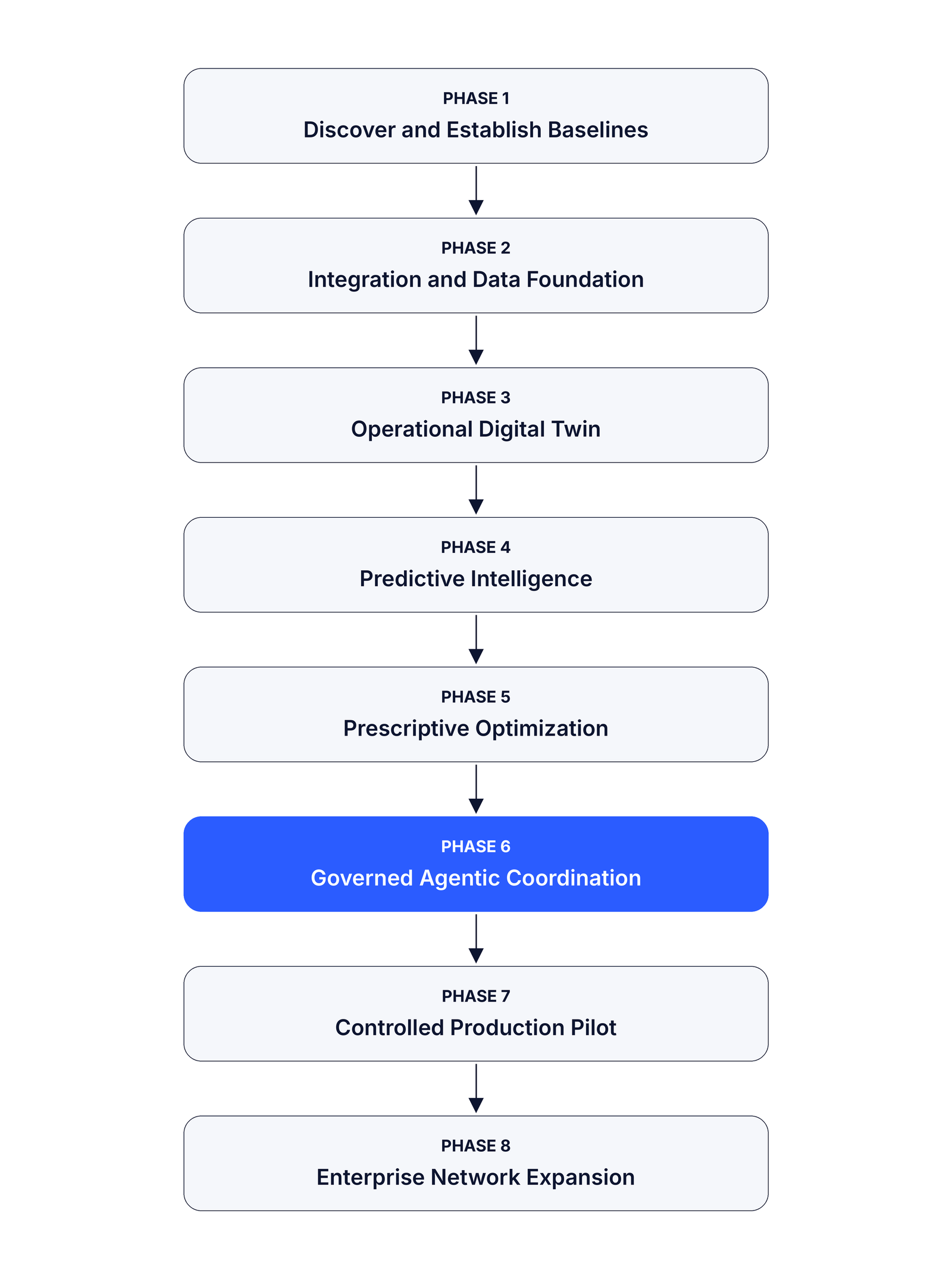
Figure 9 — Implementation Roadmap
15.2 Delivery Phases
| Phase | Primary Deliverables | Illustrative Duration |
|---|---|---|
| 1. Discovery | Process assessment, baseline KPIs, integration inventory and safety assessment | 4–6 weeks |
| 2. Foundation | AWS landing zone, connectivity, integration and event platform | 6–10 weeks |
| 3. Operational Twin | Real-time state management, capacity model and dashboards | 8–10 weeks |
| 4. Predictive Intelligence | Forecasting models, feature pipelines and evaluation | 6–10 weeks |
| 5. Optimization | Bed matching, capacity optimization and simulation | 6–8 weeks |
| 6. Agentic Intelligence | Operational copilot, agents and approval integration | 6–8 weeks |
| 7. Production Pilot | Shadow operations, controlled live workflows and outcome validation | 8–12 weeks |
| 8. Network Expansion | Tenant onboarding, facility rollout and operating model adoption | 3–6 months |
With parallel workstreams, a representative program could target an initial predictive operational deployment within 4–6 months and progressively expanded capabilities over 12–18 months.
Actual timelines would depend heavily on source-system integration, procurement, data readiness and clinical governance.
15.3 Minimum Viable Product
The MVP would focus on a single high-value operational journey:
Emergency Department Admission to Appropriate Inpatient Bed Placement
| MVP Capability | Included |
|---|---|
| EHR / ADT integration | Yes |
| Bed management integration | Yes |
| Staffing capacity integration | Yes |
| Operational Digital Twin | Yes, limited scope |
| Real-time capacity dashboard | Yes |
| Admission and occupancy forecasting | Yes |
| Constraint-aware bed matching | Yes |
| Human approval workflow | Yes |
| Operational copilot | Read-only |
| Autonomous patient movement | No |
| Multi-hospital transfer optimization | No |
| Full surgical optimization | No |
The MVP would establish measurable operational value without introducing unnecessary agent complexity.
15.4 Enterprise Delivery Workstreams
| Workstream | Responsibility |
|---|---|
| Enterprise Architecture | Architecture governance and domain boundaries |
| Healthcare Integration | EHR, HIS and ancillary system interfaces |
| Platform Engineering | Cloud infrastructure and deployment automation |
| Data Engineering | Event pipelines, operational state and analytics |
| ML Engineering | Forecasting, evaluation and ModelOps |
| Operations Research | Constraint modeling, optimization and simulation |
| Agentic AI Engineering | Context engineering, orchestration and tool governance |
| Application Engineering | User interfaces and operational services |
| Security and Privacy | Security architecture and privacy compliance |
| Clinical Safety | Hazard analysis and clinical validation |
| Operational Transformation | Workflow redesign, training and adoption |
| Quality Engineering | Functional, reliability, safety and integration testing |
| Value Realization | KPI baselines, financial analysis and outcome measurement |
15.5 Deployment and Release Strategy
| Environment | Purpose |
|---|---|
| Development | Feature implementation using synthetic or approved data |
| Integration | Healthcare interface and contract validation |
| Testing | Functional and non-functional validation |
| AI Evaluation | Model, prompt, agent and safety evaluation |
| Preproduction | Production-like operational simulation |
| Shadow Production | Evaluate recommendations without executing them |
| Production Pilot | Restricted deployment to authorized teams |
| Enterprise Production | Governed deployment across approved facilities |
Deployment techniques would include infrastructure as code, automated testing, feature flags, canary releases, model versioning and rollback controls.
15.6 Production Readiness Gates
| Gate | Required Evidence |
|---|---|
| Data Readiness | Reliable, sufficiently fresh and reconciled operational data |
| Integration Readiness | Validated source contracts and recovery procedures |
| Prediction Readiness | Approved forecast accuracy and calibration |
| Optimization Readiness | No mandatory constraint violations in validation |
| Security Readiness | Completed security and privacy assessments |
| Clinical Safety Readiness | Approved hazard register and intended-use assessment |
| Operational Readiness | Trained operators, ownership and downtime procedures |
| Agent Readiness | Successful authorization and adversarial testing |
| Reliability Readiness | Validated SLOs, failover and recovery |
| Business Readiness | Agreed measurement framework and accountable owners |
15.7 Target Operating Model
A command center is not solely a technology platform. It also requires an operational governance structure.
| Stakeholder | Accountability |
|---|---|
| Chief Operating Officer | Operational transformation and business outcomes |
| Chief Medical Officer | Clinical accountability and safety |
| Chief Nursing Officer | Nursing capacity and staffing governance |
| CIO / CTO | Technology strategy and platform reliability |
| CMIO | Clinical informatics and workflow alignment |
| Command Center Director | Day-to-day operational coordination |
| Data and AI Governance Board | Model approval and AI risk management |
| Hospital Operations Teams | Execution of approved operational actions |
| Platform Engineering Team | Reliability, security and technical evolution |
| Finance and Quality Teams | Independent outcome measurement |
The command center should operate as an enterprise coordination capability with clearly defined authority rather than creating ambiguity between centralized and facility-level decision ownership.
16. Architectural Trade-offs and Alternatives
| Architectural Decision | Alternative | Trade-off |
|---|---|---|
| Event-driven integration | Synchronous point-to-point APIs | Greater decoupling but more consistency complexity |
| Operational Digital Twin | Direct queries against source systems | Faster unified visibility but requires reconciliation |
| Healthcare integration layer | Direct application-to-EHR integration | Reusable interfaces but additional platform responsibility |
| Microservices | Modular monolith | Independent scaling versus distributed-system overhead |
| Predictive ML | LLM-generated predictions | Greater empirical rigor but dedicated model lifecycle |
| Constraint optimization | Rule-only allocation | Better global optimization but higher modeling complexity |
| Specialized agents | Single general-purpose agent | Stronger capability boundaries but orchestration overhead |
| Governed agent execution | Fully autonomous execution | Safer operations but additional approval latency |
| Tenant-isolated data plane | Fully pooled SaaS | Stronger isolation but potentially higher infrastructure costs |
| Managed AI services | Self-hosted models | Lower operational burden but greater provider dependency |
| Eventual consistency for views | Strong consistency everywhere | Higher scalability but freshness must be managed |
| Regional DR | Active-active multi-region writes | Lower complexity versus reduced regional recovery speed |
| Real-time processing | Batch analytics | Greater responsiveness but increased operational complexity |
| Custom command center | Commercial hospital command center product | Greater control and adaptability versus implementation effort |
16.1 Build Versus Buy
Healthcare enterprises should not assume that building a custom command center is always preferable.
| Option | Appropriate When |
|---|---|
| Extend existing EHR capabilities | Existing systems adequately support the required workflows |
| Commercial command center platform | Standardized workflows and rapid implementation are priorities |
| Custom AI-native platform | Enterprise-specific intelligence, extensibility and interoperability are strategic differentiators |
| Hybrid approach | Existing commercial capabilities can be combined with differentiated intelligence services |
The proposed approach begins with a capability gap assessment and favors a hybrid strategy that leverages existing solutions wherever they adequately satisfy business and architectural requirements.
16.2 The Case Against Excessive Agentic Architecture
Many hospital operational workflows are predictable and repeatable.
For example, generating a bed-cleaning task after a confirmed patient departure may require only deterministic event-driven orchestration.
Introducing an AI agent into such a workflow could increase latency, cost and failure probability without adding meaningful value.
Agentic execution should be reserved for activities requiring dynamic investigation, contextual interpretation, alternative generation or cross-domain coordination.
17. Cost and Unit Economics
17.1 Cost Architecture
| Cost Category | Principal Cost Drivers |
|---|---|
| Application infrastructure | Compute, networking and API traffic |
| Event platform | Event throughput, retention and processing |
| Operational storage | Transactions, storage and backup |
| Healthcare interoperability | Interface volume, licensing and integration maintenance |
| Data platform | Historical storage, transformation and analytics |
| Predictive AI | Training, inference and feature processing |
| Optimization | Solver frequency, complexity and compute duration |
| Generative AI | Model selection, input/output tokens and context size |
| Agentic AI | Tool calls, execution duration and workflow steps |
| Governance | Security, evaluation and audit retention |
| Resilience | Redundancy, backup and disaster recovery |
| Operating model | Platform support, governance and personnel |
17.2 Illustrative Annual Operating Cost
The following is a hypothetical financial planning scenario for the representative ten-hospital deployment. It is not an AWS pricing quotation.
| Cost Category | Illustrative Annual Cost |
|---|---|
| Core application infrastructure | $100,000 |
| Data and event platform | $120,000 |
| ML forecasting and optimization | $75,000 |
| Generative AI and agent execution | $55,000 |
| Security, observability and disaster recovery | $90,000 |
| Incremental integration maintenance and platform support | $160,000 |
| Total Annual Operating Cost | $600,000 |
An illustrative one-time implementation investment of $1.5 million is assumed.
Additional EHR vendor charges, significant third-party software licensing, new command center staffing or facility renovation costs would need to be included where applicable.
17.3 AI Unit Economics
AI economics should be evaluated at the operational outcome level rather than exclusively at the token or infrastructure level.
| Unit Economic Metric | Purpose |
|---|---|
| Cost per operational event processed | Integration efficiency |
| Cost per capacity forecast | Predictive intelligence efficiency |
| Cost per optimization run | Prescriptive intelligence efficiency |
| Cost per agent workflow | Agent execution efficiency |
| Cost per accepted recommendation | Decision support effectiveness |
| Cost per successfully executed action | Operational automation efficiency |
| Cost per avoidable bed-day released | Capacity value realization |
| Cost per hospital onboarded | Platform scalability |
| Cost per successful operational outcome | End-to-end economic effectiveness |
Cost optimization techniques would include model routing, selective agent invocation, incremental state processing, batch inference, context minimization and execution budgets.
17.4 Illustrative Business Value Model
Assume 40,000 annual inpatient encounters are eligible for interventions addressing avoidable operational delays.
| Financial Parameter | Illustrative Assumption |
|---|---|
| Eligible annual inpatient encounters | 40,000 |
| Average avoidable stay reduction | 0.25 days |
| Gross bed-days released | 10,000 |
| Financially realizable proportion | 35% |
| Financially realizable bed-days | 3,500 |
| Net economic value per realizable bed-day | $250 |
| Annual capacity-related benefit | $875,000 |
The capacity-related benefit represents an assumed net contribution or avoidable cost value, not gross hospital revenue.
Additional operational productivity assumptions:
| Financial Parameter | Illustrative Assumption |
|---|---|
| Annual administrative hours released | 20,000 |
| Loaded value per hour | $35 |
| Financially realizable proportion | 30% |
| Annual realizable productivity benefit | $210,000 |
17.5 Illustrative Return on Investment
| Financial Measure | Illustrative Value |
|---|---|
| Annual capacity-related benefit | $875,000 |
| Annual productivity benefit | $210,000 |
| Total annual realizable benefit | $1,085,000 |
| Annual incremental operating cost | $600,000 |
| Annual net operating benefit | $485,000 |
| One-time implementation investment | $1,500,000 |
| Simple steady-state payback period | Approximately 3.1 years |
This calculation excludes implementation ramp-up, discounting, taxes and other organization-specific financial considerations.
The model must also avoid double-counting overlapping capacity and workforce benefits.
17.6 Financial Sensitivity Analysis
| Scenario | Conservative | Base | Upside |
|---|---|---|---|
| Gross bed-days released | 6,000 | 10,000 | 15,000 |
| Financial realization | 25% | 35% | 45% |
| Net value per realizable bed-day | $200 | $250 | $300 |
| Capacity benefit | $300,000 | $875,000 | $2,025,000 |
| Productivity benefit | $100,000 | $210,000 | $350,000 |
| Annual operating cost | $650,000 | $600,000 | $650,000 |
| Annual net benefit | -$250,000 | $485,000 | $1,725,000 |
| Simple payback | Not achieved | 3.1 years | 0.9 years |
The conservative scenario demonstrates that positive financial returns are not guaranteed.
Value realization depends on operational adoption, addressable delays, available demand, staffing capacity and the ability to convert released capacity into genuine economic benefits.
18. Expected Business Outcomes and KPIs
18.1 Projected Operational Outcomes
| KPI | Illustrative Baseline | Illustrative Target |
|---|---|---|
| Median ED boarding time for admitted patients | 6 hours | 4.8 hours |
| Median bed assignment time | 60 minutes | 45 minutes |
| Median discharge authorization-to-departure time | 180 minutes | 144 minutes |
| Annual avoidable bed-days among eligible encounters | 60,000 | 50,000 |
| Annual capacity-related surgical cancellations | 800 | 640 |
| Annual manual coordination effort | 80,000 hours | 60,000 hours |
| 24-hour admission forecast WAPE | 22% | ≤15% |
| Operational event freshness after ingestion | 15 minutes | P95 ≤5 seconds |
These baselines and targets are hypothetical and intended to demonstrate a representative value measurement framework.
18.2 Business Value Dimensions
| Value Dimension | Expected Outcome |
|---|---|
| Patient access | Reduced avoidable placement delays |
| Patient experience | More coordinated transitions through healthcare services |
| Capacity productivity | Better utilization of safely staffed resources |
| Clinical operations | Earlier awareness of operational dependencies |
| Workforce | Reduced repetitive administrative coordination |
| Hospital leadership | Predictive visibility into emerging constraints |
| Financial performance | Improved use of existing capacity |
| Network resilience | Better coordination across healthcare facilities |
| Technology modernization | Reusable enterprise operational intelligence platform |
18.3 KPI Measurement Framework
| KPI | Measurement Method |
|---|---|
| ED boarding time | Admission decision or order to physical departure from ED, using agreed definitions |
| Bed assignment time | Valid placement request to confirmed assignment |
| Discharge coordination time | Clinical discharge authorization to confirmed departure |
| Avoidable bed-days | Validated operational delay attribution methodology |
| Forecast accuracy | Actual versus forecast demand at fixed prediction horizons |
| Optimization effectiveness | Feasible recommendations and realized operational outcomes |
| Agent effectiveness | Successfully completed authorized workflows |
| Workforce productivity | Validated time-and-motion assessment |
| Economic benefit | Finance-approved net contribution or avoided expenditure |
| Patient safety | Risk-adjusted clinical and operational balancing measures |
18.4 Business Outcome Validation
The proposed approach incorporates a formal value realization program encompassing the following:
- Baseline data collected before deployment.
- Clearly defined eligible patient and operational cohorts.
- Shadow-mode assessment.
- Controlled or phased implementation.
- Matched comparison units where feasible.
- Adjustment for seasonality, case mix and demand variation.
- Monitoring of patient safety and equity balancing measures.
- Independent financial validation.
- Periodic architecture and operating model reviews.
A reduction in waiting time following implementation does not by itself establish that the platform caused the improvement.
Value attribution must account for concurrent staffing changes, clinical process improvements and other hospital initiatives.
19. Risks and Mitigation Strategies
19.1 Enterprise Risk Register
| Risk | Impact | Mitigation |
|---|---|---|
| Inaccurate source data | High | Validation, reconciliation and data ownership |
| Stale capacity information | Critical | Freshness thresholds and fail-safe execution |
| Incorrect patient identity matching | Critical | Enterprise identity resolution and manual verification |
| Forecasting errors | High | Calibrated predictions and continuous monitoring |
| Model drift | High | Drift detection, retraining and controlled promotion |
| Unsafe optimization constraints | Critical | Clinical validation and versioned safety policies |
| Premature discharge pressure | Critical | Separate discharge prediction from clinical authorization |
| Inappropriate bed placement | Critical | Mandatory compatibility checks |
| Unauthorized agent actions | Critical | Tool authorization and deterministic execution boundaries |
| Prompt injection | High | Layered prompt, retrieval and tool security |
| Cross-tenant data leakage | Critical | Strong isolation and authorization testing |
| Integration outages | High | Buffering, downtime procedures and reconciliation |
| Duplicate reservations | High | Authoritative concurrency control and idempotency |
| Alert fatigue | High | Alert prioritization, deduplication and escalation policies |
| Algorithmic bias | High | Fairness evaluation and governance review |
| Staff resistance | High | Co-design, training and phased adoption |
| Excessive AI expenditure | Medium | Model routing, quotas and cost attribution |
| Vendor lock-in | Medium | Portable interfaces and modular architectural boundaries |
| Unrealized business benefits | High | Controlled outcome measurement and financial validation |
| Regulatory scope expansion | High | Intended-use governance and formal reassessment |
19.2 Representative Clinical Safety Hazard Analysis
| Hazard | Potential Consequence | Safety Control |
|---|---|---|
| Predicted discharge interpreted as authorized | Unsafe discharge | Explicit state separation and clinician authorization |
| Stale bed state treated as current | Conflicting placement | Freshness validation and source confirmation |
| Optimizer ignores staffing constraints | Unsafe care environment | Mandatory staffing constraints |
| Agent recommends unsupported policy | Incorrect operational action | Approved knowledge sources and policy engine validation |
| Transfer initiated without acceptance | Unsafe care transition | Mandatory receiving-team confirmation |
| AI failure disrupts hospital operations | Operational interruption | Independent deterministic workflows and manual fallback |
Every safety-critical hazard would require an accountable owner, defined preventive and detective controls, verification evidence and formal residual-risk acceptance.
19.3 Organizational Change Risk
The success of a hospital command center depends as much on workflow redesign and organizational trust as on architecture.
A technically sophisticated platform may fail if:
- Operators do not trust its recommendations.
- Clinical teams perceive it as overriding professional judgment.
- Departments optimize their own KPIs at the expense of hospital-wide performance.
- Alerts create additional workload.
- Decision authority is ambiguous.
- Existing operational processes remain unchanged.
The proposed implementation approach emphasizes the active involvement of clinicians, nurses, bed managers, case managers and operational leaders throughout design, simulation, validation and rollout.
Human factors engineering must be treated as a core architectural and implementation concern.
20. Future Evolution Roadmap
20.1 Capability Maturity Roadmap
| Horizon | Strategic Focus | Emerging Capabilities |
|---|---|---|
| Horizon 1 | Connected Hospital Operations | Real-time visibility, event integration and operational state |
| Horizon 2 | Predictive Hospital Operations | Demand forecasting, discharge intelligence and capacity prediction |
| Horizon 3 | Prescriptive Hospital Operations | Constraint optimization and operational simulation |
| Horizon 4 | Agentic Hospital Operations | Governed cross-department coordination |
| Horizon 5 | Intelligent Healthcare Network | Multi-hospital optimization and broader care ecosystem coordination |
20.2 Advanced Operational Digital Twins
The Operational Digital Twin could evolve into a simulation environment supporting strategic hospital planning.
Potential capabilities include:
- Emergency demand surge simulation.
- Capacity expansion assessment.
- Workforce planning.
- Ward reconfiguration analysis.
- Seasonal demand preparation.
- Operating theatre capacity planning.
- Hospital network resilience assessment.
- Infrastructure investment evaluation.
Hospital leadership could assess operational strategies in a simulated environment before introducing changes into live healthcare operations.
20.3 Healthcare Network Intelligence
The architecture could expand beyond individual hospital boundaries to coordinate:
- Acute care hospitals.
- Rehabilitation facilities.
- Community healthcare providers.
- Home healthcare services.
- Specialized care centers.
- Ambulance and transportation networks.
- Approved external healthcare partners.
Such expansion would require additional interoperability, organizational trust, data-sharing agreements and governance.
20.4 Privacy-Preserving Collaborative Intelligence
Future research and engineering could explore:
| Capability | Potential Value |
|---|---|
| Federated learning | Collaborative model development without routine centralized patient-data pooling |
| Differential privacy | Controlled aggregate data sharing |
| Privacy-preserving analytics | Cross-organizational operational benchmarking |
| Synthetic healthcare data | Safer simulation and testing |
| Confidential computing | Additional protection for sensitive processing |
| Tenant-specific model adaptation | Improved local prediction performance |
These capabilities would require independent security, privacy and model-quality validation.
20.5 Multimodal Operational Intelligence
Future command center capabilities may incorporate authorized signals from medical equipment, environmental sensors, real-time location systems and smart hospital infrastructure.
Potential applications include equipment availability tracking, environmental services coordination and improved operational resource awareness.
Any patient or workforce monitoring must be proportionate, appropriately authorized and assessed for privacy implications.
20.6 From Intelligent Hospital to Intelligent Healthcare Ecosystem
The long-term opportunity extends beyond hospital capacity optimization.
An intelligent healthcare ecosystem could coordinate demand, resources and operational decisions across the broader continuum of care.
However, increasing architectural intelligence must not imply increasing autonomy without limits.
The future healthcare enterprise should be characterized by greater situational awareness, better coordination, stronger evidence-based decision support and more effective use of resources while preserving clinical responsibility and patient dignity.
Conclusion
Hospital capacity management has traditionally been approached as a combination of infrastructure planning, departmental coordination and reactive operational decision-making.
AI creates an opportunity to fundamentally improve this operating model.
However, building an intelligent hospital command center requires considerably more than integrating an LLM with an Electronic Health Record or introducing a collection of predictive dashboards.
It requires an integrated enterprise architecture that combines:
- Healthcare interoperability.
- Continuous operational state awareness.
- Predictive machine learning.
- Constraint-based optimization.
- Operational digital twins.
- Governed agentic orchestration.
- Deterministic business execution.
- Human accountability.
- Clinical safety and enterprise governance.
- Continuous measurement of business value.
The proposed architecture establishes a clear separation between systems that observe, systems that predict, systems that optimize, systems that coordinate and systems that execute.
This separation is essential for building trustworthy, resilient and economically sustainable AI-native healthcare platforms.
The ultimate measure of intelligence in a hospital is not how many decisions AI makes autonomously, but how effectively the healthcare ecosystem delivers appropriate care to the right patient, at the right place and at the right time.
Selected References and Further Reading
The following resources provide industry, interoperability, governance and technology context for the proposed architecture. They do not establish or verify the illustrative business outcomes in this case study.
- Institute for Healthcare Improvement — Achieving Hospital-wide Patient Flow
- Use of Hospital Capacity Command Centers to Improve Patient Flow and Safety: A Scoping Review
- Hospital Capacity Command Centers: A Benchmarking Survey on an Emerging Mechanism to Manage Patient Flow
- The Impact of Hospital Command Centre on Patient Flow and Data Quality: Findings from the UK National Health Service
- Application of a Human Factors Systems Approach to Healthcare Control Centres for Managing Patient Flow
- HL7 FHIR R4 Specification
- AWS HealthLake Documentation
- Amazon Bedrock Guardrails
- Amazon Bedrock AgentCore — Compliance Validation
- AWS HIPAA Eligible Services Reference
- NIST Artificial Intelligence Risk Management Framework — Generative AI Profile
- US Department of Health and Human Services — HIPAA Security Rule
Industry Solution Blueprints — Architecting the Future of Enterprise Solutions