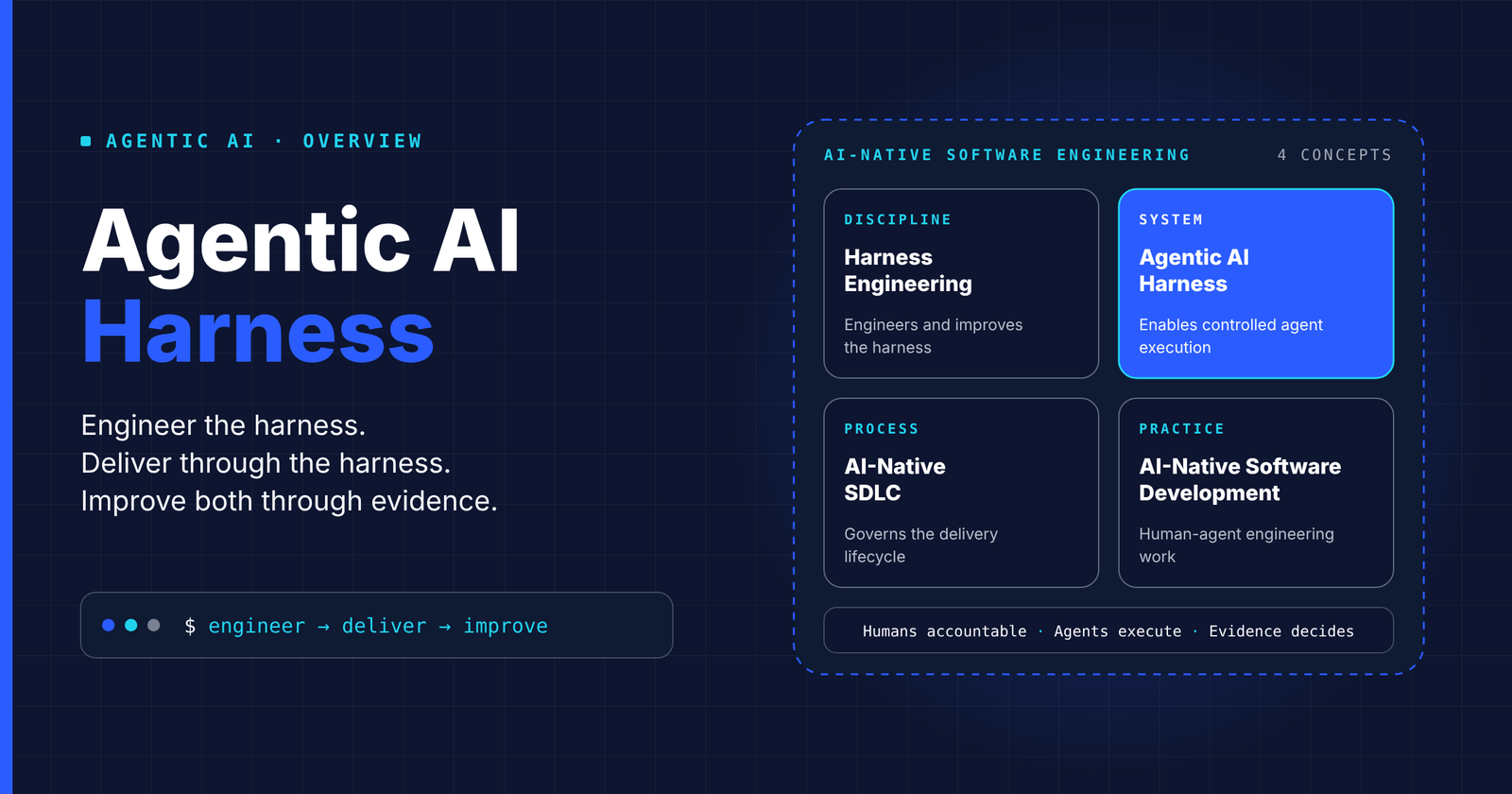
Engineering the System That Builds Software. Engineering Software Through That System.
Artificial intelligence is changing not only the software that organizations build but also the way they build it.
Software engineers increasingly work with AI agents that can understand codebases, interpret specifications, plan implementation tasks, modify code, execute tests, investigate failures, and prepare changes for release. Yet the ability of an AI model to generate code is not sufficient to establish a dependable software delivery capability.
An enterprise must create an engineering environment in which agents can access the right context, use the right tools, operate within defined architectural and security boundaries, recover from failures, and produce independently verifiable results. It must also establish a disciplined development lifecycle through which these capabilities translate into production-ready software.
This is where an overarching paradigm and four closely related concepts come together. The paradigm is AI-Native Software Engineering. Within it sit Harness Engineering, the Agentic AI Harness, AI-Native SDLC, and AI-Native Software Development.
This page explores both sides of the transformation: how to engineer the system that enables agentic software development, and how to use that system to deliver complete business features from intent to production.
The focus is specifically on agentic software engineering harnesses: systems used by engineering teams to build software. Harnesses also exist for business-facing agents, such as customer service or financial analysis agents, but those are outside the primary scope of this page. Throughout this page, "Agentic AI Harness" and "harness" refer to an agentic software engineering harness unless stated otherwise. The business application produced using a software engineering harness may itself be AI-enabled or entirely conventional.
Explore the two learning paths:
- Engineering the Agentic AI Harness: Architecture, Components, and Design Patterns
- Delivering with the Agentic AI Harness: An End-to-End Feature Delivery Playbook
Why an Agentic AI Harness Matters
An AI coding agent can generate a service, modify an API, or write a test. A business feature, however, may require coordinated changes across a frontend, a backend, a database, an integration layer, and cloud infrastructure. Those changes must satisfy architectural constraints, security requirements, functional acceptance criteria, and operational expectations.
The engineering challenge is therefore not simply getting an agent to produce code. It is creating the conditions under which agents can contribute reliably to the delivery of working software.
A capable harness helps address six recurring challenges:
- Context: How does an agent understand the existing application, domain, architecture, and engineering standards?
- Execution: How does it plan, perform, and coordinate multi-step engineering tasks?
- Continuity: How does it preserve progress and recover when work is interrupted or an execution fails?
- Control: How does it operate within authorized repositories, tools, environments, and permissions?
- Verification: How do engineers establish that the resulting software satisfies its original requirements?
- Economics: How does the organization improve delivery outcomes without allowing execution costs, rework, or engineering risk to grow unchecked?
These are engineering and system-design problems, not merely prompting problems.
Understanding the Fundamental Concepts
AI-Native Software Engineering: The Overarching Discipline
AI-Native Software Engineering is a comprehensive engineering discipline in which AI agents, models, tools, and automated verification mechanisms are systematically integrated into the software engineering lifecycle, architectural practices, governance mechanisms, and organizational operating model to deliver reliable, secure, and production-ready software through human-agent collaboration.
It encompasses technology, processes, engineering practices, people, governance, quality, reliability, and engineering economics.
Within this page, AI-Native Software Engineering is the overarching paradigm. The other four concepts describe complementary dimensions of it:
- Engineering enablement: Harness Engineering creates and improves the enabling capabilities; the Agentic AI Harness embodies or integrates those capabilities as a technical system.
- Process and governance: AI-Native SDLC defines the lifecycle, controls, and verification gates.
- Practice: AI-Native Software Development performs the engineering work through human-agent collaboration.
- Cross-cutting dimensions: People and skills, the organizational operating model, quality, reliability, and engineering economics span all of the above.
Taken individually, the four concepts that follow explain the building blocks. AI-Native Software Engineering is what makes them a coherent engineering system.
Its central question is:
How does an engineering organization systematically integrate AI agents into its technology, processes, practices, people, and governance so that humans and agents together deliver reliable, secure, and production-ready software?
Harness Engineering: The Enablement Discipline
Harness Engineering is the discipline of designing, building, configuring, evaluating, operating, and continuously improving the mechanisms that enable AI agents to execute tasks reliably, securely, and within defined constraints.
In software engineering, it focuses on creating reusable capabilities that allow agents to contribute effectively throughout the software development lifecycle. These include orchestration, context retrieval, tool integration, execution environments, agent skills, evaluation, verification, guardrails, and observability.
Harness Engineering is not a software product, a runtime, or a deployable component. It is a discipline practiced by engineers, and its outputs (software components, policies, workflows, configuration, tests, and integrations) collectively establish and improve the harness. This page concentrates on software engineering harness design, a specialization within AI-Native Software Engineering. As a discipline, Harness Engineering also applies more broadly to other kinds of agents, such as business-facing agents.
The central question of Harness Engineering is:
How do we engineer an environment in which AI agents can perform software engineering tasks dependably and measurably?
Agentic AI Harness: The Engineering Enablement System
An Agentic AI Harness is the software system that surrounds and enables AI models to operate as agents, providing the execution mechanisms, context, tools, controls, and feedback required to accomplish tasks.
In the context of AI-Native Software Engineering, the harness enables human engineers and AI agents to collaboratively design, implement, test, verify, and deliver business applications. It is software that helps build other software.
A harness may be embedded in a local coding-agent application, consumed through a managed service, or integrated into a distributed enterprise engineering platform. Repository-level instructions, tests, and workflows can extend the harness but are not, by themselves, a complete agent execution system. Organizations can adopt coding-agent tools such as Claude Code or OpenAI Codex and extend them with enterprise-specific workflows, policies, and integrations. Building an enterprise harness does not necessarily mean developing a new agent loop from scratch.
The harness is distinct from the underlying model and the execution environment. The model supplies inference capabilities; the harness manages the interaction between model outputs, context, tools, state, and execution controls. An agent runtime manages the execution lifecycle, while the runtime environment supplies the compute and isolation boundaries. These responsibilities may be packaged together or distributed across separate components.
Unlike Harness Engineering, the harness consists of software and configuration that can be installed, deployed, or consumed as a managed service. It executes within environments such as local workspaces or isolated containers, hosted on infrastructure such as developer workstations or cloud compute. The model service may be hosted separately.
Its central question is:
What technical capabilities enable agents to perform engineering work within a controlled execution environment?
AI-Native SDLC: The Lifecycle and Process Framework
AI-Native SDLC is a software development lifecycle (SDLC) process framework that integrates AI agents into engineering activities, defining the phases, responsibilities, artifacts, controls, and verification gates required to deliver software through governed human-agent collaboration.
It defines how business intent progresses through requirements, specifications, architecture, implementation, testing, release, and production operations. It also determines where agent assistance is appropriate, what evidence is required, and which decisions require human authorization.
AI-Native SDLC is not the harness. It is the process framework that guides the harness's use. The framework itself is not deployed as an application, although its workflows, approval gates, and policy checks may be implemented in the harness or in CI/CD systems.
Its central question is:
How should an engineering organization systematically deliver software using AI agents without compromising accountability, quality, or security?
AI-Native Software Development: The Engineering Practice
AI-Native Software Development is the practice of building and evolving software through human-agent collaboration, integrating AI capabilities into engineering execution while following an appropriate development lifecycle.
Engineers translate business requirements into specifications, design solutions, prepare context, decompose features, direct agents, review implementations, independently verify outcomes, and deliver software into production. They also write or modify code directly whenever that is the most effective approach.
In this operating model, the Agentic AI Harness supplies the technical capabilities, while the AI-Native SDLC provides the process discipline.
Its central question is:
How do engineers actually deliver complete, maintainable, and production-ready software through AI-enabled engineering practices?
The five terms are used here as an explicit conceptual framework, not a universally standardized industry taxonomy. Industry terminology is still evolving, and "AI-native software development" is sometimes used more broadly to encompass the lifecycle, tools, and operating model themselves. In this page, that broader meaning is assigned to AI-Native Software Engineering for conceptual clarity.
How the Concepts Fit Together
AI-Native Software Engineering is the umbrella. Within it, the other four concepts interact as an enablement discipline, a system, a process, and a practice. They are not four successive phases of a single execution pipeline.
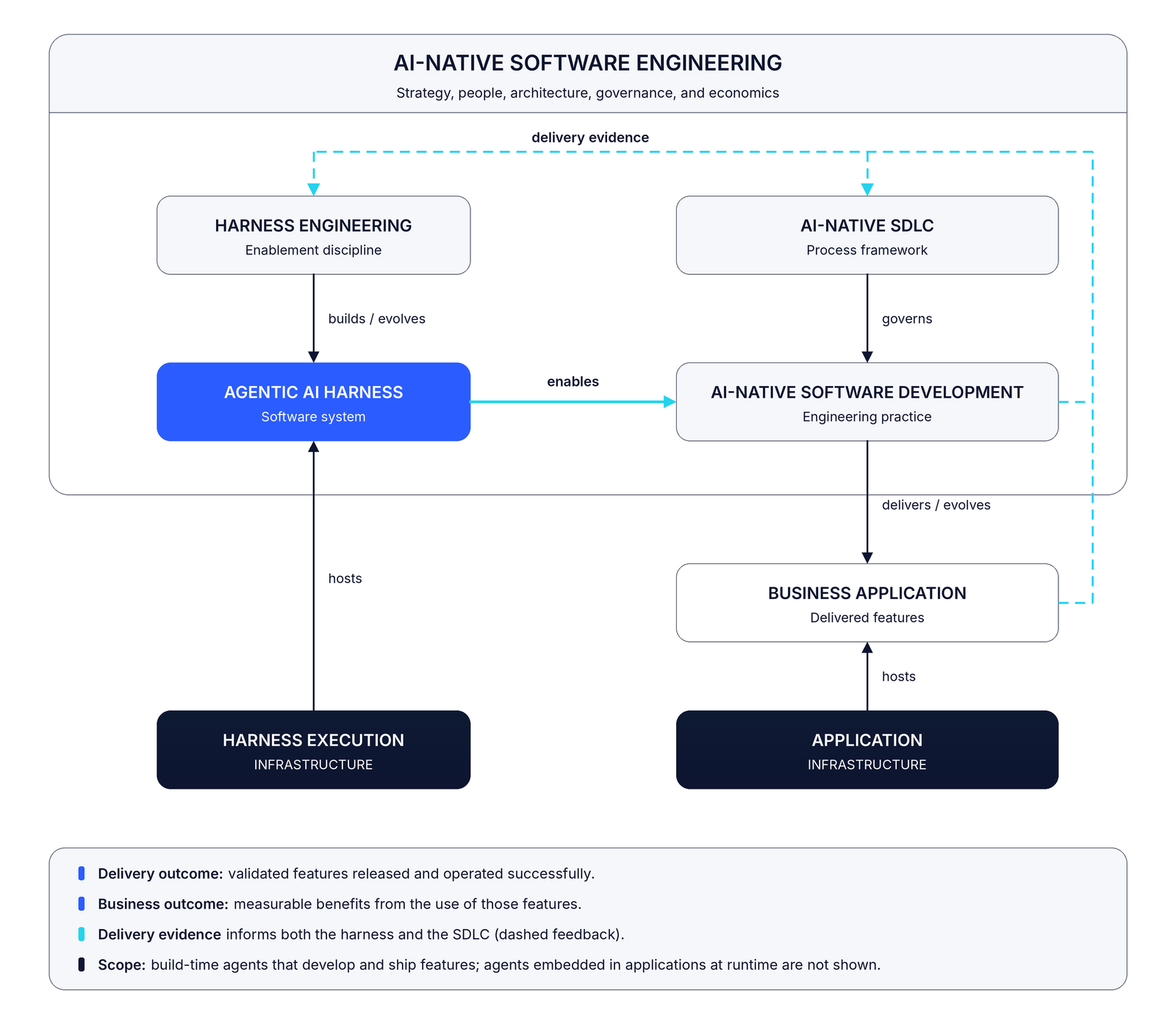
Figure 1. Conceptual relationships: the discipline, technical system, process, and practice have distinct responsibilities; the two infrastructure boundaries support different workloads.
The harness is used by the development practice, not necessarily embedded in the resulting application. The distinction between the harness's execution infrastructure and the target application infrastructure is logical. The two may use common cloud services, but they should have explicitly defined trust boundaries, identities, permissions, and operational responsibilities.
| Concept | Classification | Primary purpose |
|---|---|---|
| AI-Native Software Engineering | Overarching engineering discipline | Integrate AI agents, models, tools, and automated verification into the engineering lifecycle, architecture, governance, and operating model. |
| Harness Engineering | Enablement discipline | Engineer and improve the harness. |
| Agentic AI Harness | Software system | Enable controlled agentic engineering execution. |
| Harness Execution Infrastructure | Infrastructure | Host, isolate, and execute harness workloads. |
| AI-Native SDLC | Process framework | Govern the software delivery lifecycle. |
| AI-Native Software Development | Engineering practice | Perform engineering work through human-agent collaboration. |
| Business Application | Software product | Address business needs through delivered features. |
| Application Infrastructure | Infrastructure | Host and operate the delivered business application. |
| End-to-End Feature Delivery | Engineering outcome | Deliver validated business capabilities into production and confirm their operational readiness. |
| Business Value Realization | Business outcome | Achieve measurable benefits from those capabilities. |
AI-Native Software Engineering is the paradigm that unifies the other concepts. Harness Engineering creates the capabilities. The harness provides the execution system. AI-Native SDLC establishes the process. AI-Native Software Development performs the engineering work.
These concepts also differ in how they are realized. The harness is installable or deployable software; infrastructure is provisioned or consumed; the SDLC is defined and institutionalized; engineering disciplines and practices are established and performed. Deployable workflows, policies, and quality gates can implement parts of the SDLC, but the process itself is not a software application.
What Exists Inside an Agentic AI Harness?
At its core, a harness connects model-driven decisions with controlled actions and observable results. A software engineering harness extends this execution foundation with capabilities appropriate to software development.
| Capability | Architectural responsibility |
|---|---|
| Agent execution and orchestration | Manage agent loops, task planning, tool dispatch, and workflow coordination. |
| Context engineering | Make relevant repository content, specifications, architecture decisions, and domain knowledge available. |
| Skills and instructions | Package reusable engineering procedures, conventions, and domain-specific guidance. |
| Tool integration | Provide controlled access to source control, terminals, test runners, APIs, and, where appropriate, MCP servers. |
| State and continuity | Preserve task progress, artifacts, and checkpoints across execution sessions. |
| Model integration | Invoke authorized models, manage model configuration, and apply routing or fallback where justified. |
| Agent runtime | Manage session lifecycle, concurrency, cancellation, and execution resource coordination. |
| Runtime environment | Provide workspace, process, filesystem, network, and credential isolation for agent execution. |
| Harness evaluation | Assess agent task success, tool-use correctness, reliability, and cost against representative engineering tasks. |
| Software verification | Collect evidence of feature correctness against independently established acceptance criteria and engineering constraints. |
| Security and governance | Enforce permissions, trust boundaries, policies, approval requirements, and auditability. |
| Reliability and observability | Provide timeouts, recovery, execution tracing, failure diagnostics, and operational metrics. |
| Delivery integration | Connect engineering workflows to existing source control, CI/CD, security scanning, and release processes. |
These are logical capabilities, not a prescription for separate services. Some reside in the core harness; others reside in a managed runtime, a repository, an enterprise platform service, or an integrated engineering toolchain. A single agent can be sufficient, and multi-agent orchestration should be introduced only when the workload justifies it.
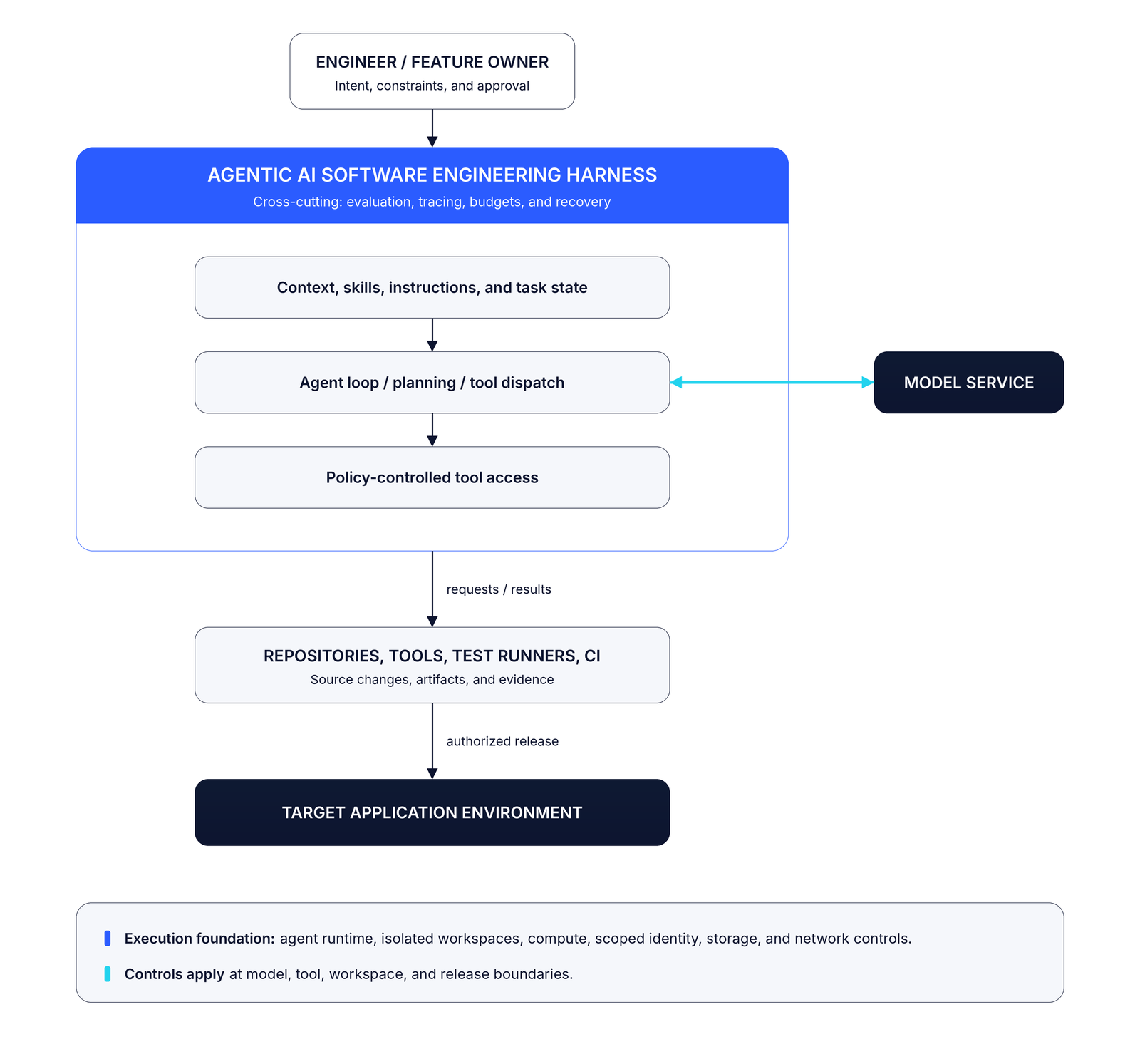
Figure 2. Logical harness architecture. Model services, engineering tools, and the target application are integration boundaries; the harness may integrate with, rather than own, these systems.
The core execution loop is iterative: assemble context, request model inference, validate any proposed tool action, execute the authorized action, capture its result, and determine whether to continue, stop, recover, or escalate. An agent's ability to request an action is not authority to perform it. Permissions and critical controls must be enforced outside model-generated instructions, at the appropriate tool, runtime, and delivery boundaries.
From Business Intent to Production
AI-native delivery is not a single prompt followed by generated code. It is a sequence of engineering decisions and verified changes, often executed iteratively.
| AI-Native SDLC activity | AI-Native Software Development in practice | Evidence or deliverable |
|---|---|---|
| Discovery and requirements | Clarify intent, scope, risks, and user needs. | Agreed feature requirements. |
| Specification | Establish acceptance criteria and non-functional requirements. | Verifiable feature specification. |
| Architecture and design | Define system boundaries, contracts, data models, and constraints. | Architecture decisions and design artifacts. |
| Planning | Break the feature into bounded, testable changes. | Dependency-aware execution plan. |
| Implementation | Direct agents and engineers to modify code and infrastructure. | Version-controlled changes. |
| Testing and verification | Execute independent acceptance, regression, security, and architecture checks. | Test results and verification evidence. |
| Release and deployment | Review changes, satisfy release controls, and deploy through authorized pipelines. | Approved release and deployment records. |
| Production operations | Validate real-world behavior, monitor outcomes, and address incidents. | Operational evidence and improvement backlog. |
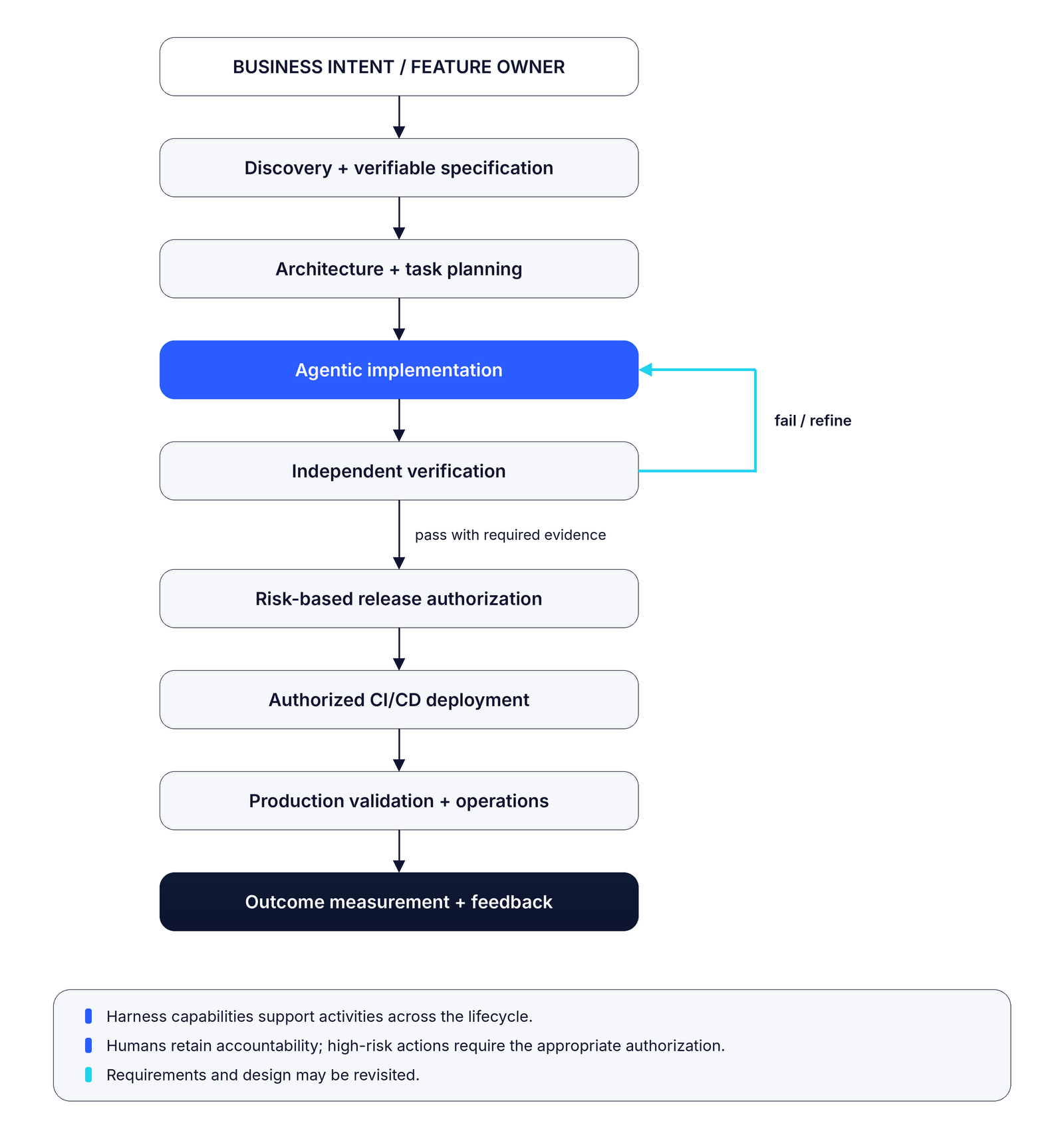
Figure 3. Illustrative AI-Native SDLC execution. Verification and authorization are distinct controls; the lifecycle is iterative, not a mandatory waterfall.
Throughout this lifecycle, autonomy should be proportional to the risk of the task. The ability to execute a command must not be confused with authorization to execute it. An agent's report of success must not substitute for evidence that the intended outcome occurred. Acceptance criteria should be established independently of the implementation, and critical checks should run in a controlled environment. Where risk warrants it, the acceptance suite and release policy should be protected from unilateral changes by the implementing agent. Independence is a property of the criteria, execution controls, and evidence, not merely of using a second model or agent.
A Practical Example: Delivering Tenant Onboarding
Consider a multi-tenant SaaS platform that needs a new tenant onboarding and provisioning capability.
From the Harness Engineering perspective, the organization establishes reusable architecture guidance, repository context retrieval, secure cloud tool access, tenant-isolation checks, execution workflows, and automated verification capabilities.
From the Agentic AI Harness perspective, those capabilities become available to the engineering team through coding agents, scoped tools, execution workspaces, test runners, and policy enforcement mechanisms.
From the AI-Native SDLC perspective, the team must define acceptance criteria, approve the design at the appropriate risk level, validate tenant isolation, test provisioning failures, and satisfy release gates before production deployment.
From the AI-Native Software Development perspective, engineers design the tenant registry, provisioning workflow, API contracts, and infrastructure; direct agents to implement the changes; review the results; and independently test both successful onboarding and partial-failure scenarios.
The feature is complete only when the intended tenant can be provisioned and operated correctly, with the required isolation, recovery, and operational evidence, not merely when the agent has generated code or opened a pull request. For example, the verification suite should establish that duplicate onboarding requests are handled safely, that the system recovers from partial provisioning failures, and that one tenant cannot access another tenant's resources. The production rollout should confirm that the tenant reaches the expected operational state, not simply that a provisioning API returned success.
Suppose agents repeatedly produce changes that violate tenant boundaries. The engineering team can fix the immediate defects and then encode the underlying requirement into reusable architecture fitness tests and repository guidance. That second step is Harness Engineering: improving the system so that future delivery benefits from the lessons learned today.
The Continuous Improvement Loop
The relationship between harness development and feature delivery is reciprocal. The harness enables delivery, and real delivery provides evidence about the harness's limitations.
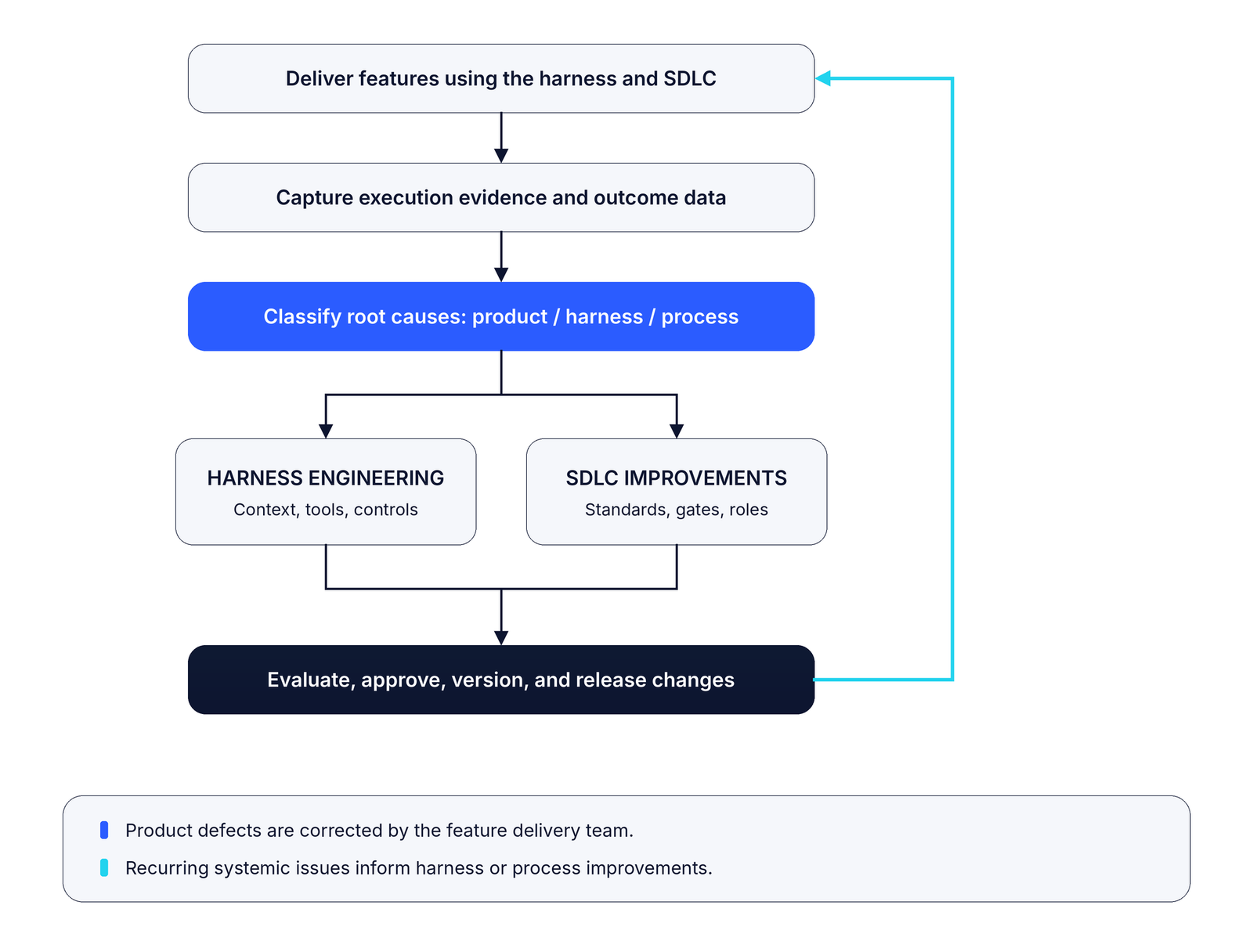
Figure 4. Evidence-driven continuous improvement. Product corrections and systemic improvements have different ownership and verification requirements.
This feedback loop should be governed and versioned; agents should not be allowed to modify their own controls without review. Improvements must be evaluated against representative tasks before wider adoption.
The objective is not maximum agent autonomy or maximum code generation. It is a sustained improvement in engineering throughput, quality, reliability, and economics. Measure outcomes at distinct levels rather than treating code volume or agent activity as evidence of productivity.
| Measurement level | Illustrative measures |
|---|---|
| Harness effectiveness | Verified task success rate, execution failure rate, rework, cost per verified successful task. |
| Software delivery | Feature lead time, change failure rate, defect escape rate, cost per delivered feature. |
| Business value | Feature adoption, customer outcomes, operational efficiency, or other agreed business indicators. |
Compare results against an appropriate baseline and comparable task complexity; faster execution alone is not an improvement if quality or risk deteriorates. For cost metrics, include retries and verification effort, and distinguish model and tool execution cost from total engineering delivery cost.
Explore the Two Learning Paths
This page is organized into two complementary paths. The first concentrates on the engineering enablement system; the second concentrates on the engineering practice that uses it.
Engineering the Agentic AI Harness
Architecture, Components, and Design Patterns
Explore how to architect, build, integrate, deploy, and operate a production-grade software engineering harness. Understand its execution model, component responsibilities, integration boundaries, context and skills architecture, runtime environments, evaluation, reliability, security, observability, and operational design. Examine the architectural decisions and trade-offs involved in extending an existing harness or building enterprise-specific capabilities.
This path is designed for AI architects, platform engineers, harness engineers, and technology leaders responsible for establishing reusable agentic engineering capabilities.
Explore Engineering the Agentic AI Harness: Architecture, Components, and Design Patterns
Delivering with the Agentic AI Harness
An End-to-End Feature Delivery Playbook
Explore how engineering teams use the harness across the AI-Native SDLC to deliver real business features. Understand specification-driven development, solution design, task decomposition, context preparation, agentic implementation, independent verification, governed CI/CD, production operations, and continuous improvement.
This path is designed for engineering leaders, architects, technical leads, and software engineers responsible for translating business intent into reliable production software through human-agent collaboration.
Explore Delivering with the Agentic AI Harness: An End-to-End Feature Delivery Playbook
The Engineering Philosophy
The emergence of AI agents does not remove the need for sound software engineering. It changes where engineering effort is invested and how execution is organized.
Humans remain accountable for business intent, architectural decisions, risk acceptance, and software outcomes. Agents contribute execution capabilities. The harness provides the technical environment and controls. The lifecycle provides process discipline. Independent verification establishes whether the work satisfies its intended purpose. AI-Native Software Engineering is the discipline that integrates all of them into a single operating model.
The long-term advantage is not simply having more powerful coding agents. It is the ability to build an engineering system that learns from delivery experience and consistently turns business intent into secure, maintainable, and reliable software.
Engineer the harness. Deliver through the harness. Improve both through evidence.
Further Reading
- OpenAI (February 11, 2026), Harness engineering: leveraging Codex in an agent-first world. An industry example of an agent-first software engineering environment with repository scaffolding, architectural constraints, and feedback mechanisms.
- Anthropic (November 26, 2025), Effective harnesses for long-running agents. An examination of incremental execution, progress preservation, and testing across agent sessions.