Architecting an Agentic Commerce Ecosystem
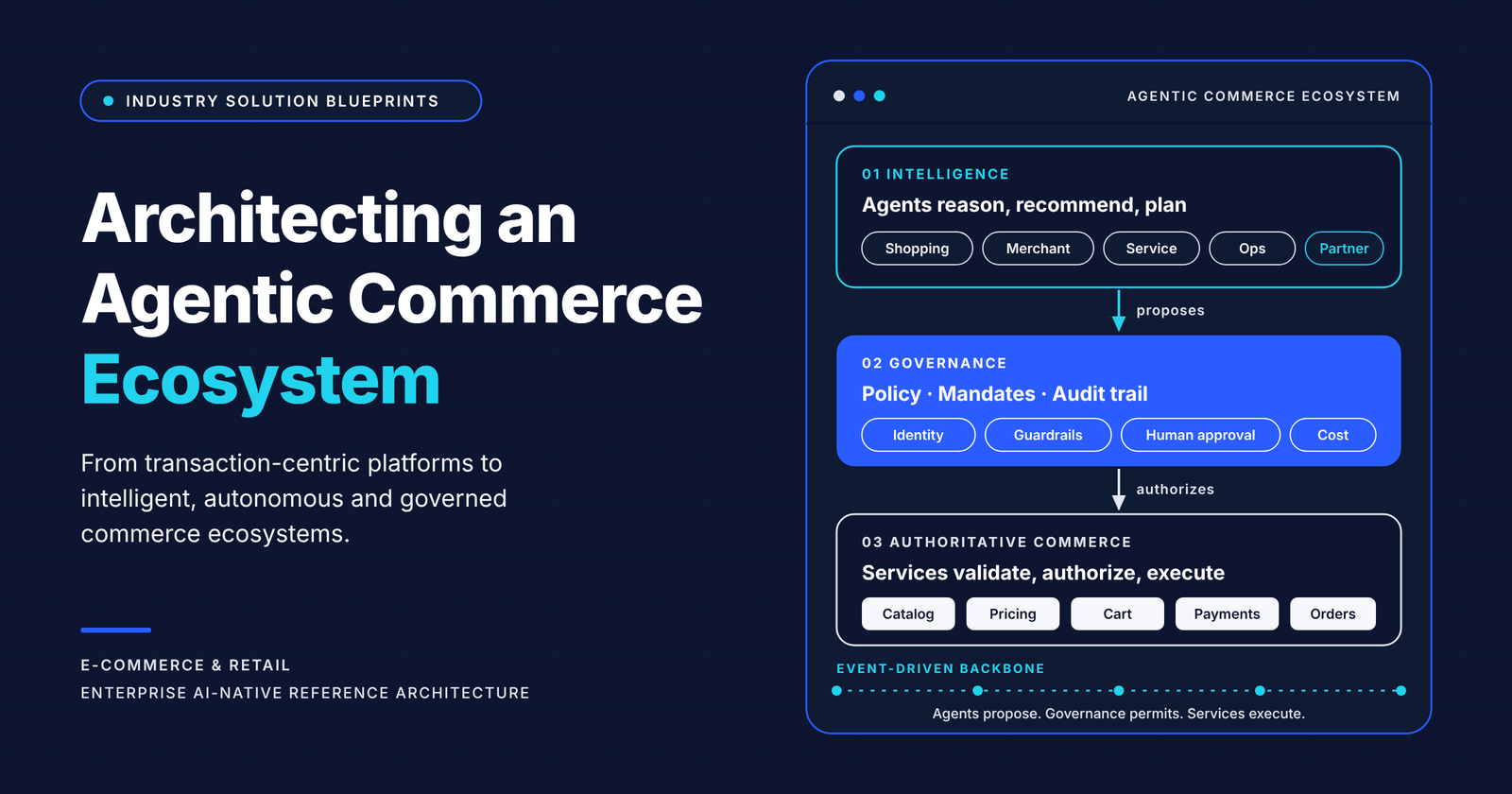
Transforming Digital Commerce from Transaction-Centric Platforms to Intelligent, Autonomous and Governed Commerce Ecosystems
Industry Solution Blueprints | Architecting the Future of Enterprise Solutions
| Case Study Attribute | Description |
|---|---|
| Industry | E-commerce and Retail |
| Architecture Type | Enterprise AI-Native Reference Architecture |
| Business Focus | Commerce transformation, customer experience and operational efficiency |
| Architectural Focus | Agentic AI, composable commerce, multi-tenant SaaS, event-driven architecture and distributed systems |
| Technology Ecosystem | AWS, Generative AI, LLMs, intelligent agents and enterprise commerce protocols |
| Intended Audience | CIOs, CTOs, CDOs, Heads of AI, Digital Commerce Leaders and Enterprise Architects |
Professional Disclosure
This case study presents an independently developed architectural solution for a representative industry challenge. It is intended to demonstrate architectural thinking, technology strategy, design decisions and implementation approaches. Business outcomes are projected rather than independently verified implementation results.
01. Executive Summary
1.1 The Strategic Opportunity
For decades, digital commerce platforms have been designed around a fundamental assumption: customers interact with digital interfaces, navigate product catalogs, evaluate alternatives, make purchasing decisions and initiate transactions.
Agentic AI challenges this assumption.
The next generation of commerce platforms will increasingly accommodate intelligent agents that understand customer intent, discover products, evaluate alternatives, coordinate transactions, manage fulfillment and provide post-purchase assistance within explicitly authorized boundaries.
The traditional journey of searching, filtering, comparing, adding to a cart and checking out can evolve into an outcome-oriented experience.
Consider a customer expressing the following intent:
I am setting up a home office. Recommend a complete setup within $1,500, prioritize ergonomic products, ensure everything is compatible, and arrange delivery before Friday.
Fulfilling this request requires more than conversational intelligence. It requires coordination across product discovery, customer preferences, inventory, pricing, promotions, compatibility analysis, delivery commitments, payment authorization and order fulfillment.
This represents a fundamental architectural shift.
Commerce platforms must evolve from systems that primarily respond to human interactions into ecosystems capable of supporting governed interactions among humans, intelligent agents, enterprise systems and external commerce participants.
1.2 Proposed Solution
I propose an Agentic Commerce Ecosystem built around five foundational capabilities:
- Intelligent, intent-driven customer experiences.
- Governed orchestration of specialized commerce agents.
- Deterministic and composable commerce services.
- Event-driven coordination across the enterprise value chain.
- Secure interoperability with external agents, merchants and payment ecosystems.
The proposed architecture deliberately separates probabilistic intelligence from authoritative business transaction execution.
Agents reason, recommend, plan and coordinate. Enterprise commerce services validate, authorize and execute transactions.
1.3 Strategic Value Proposition
| Strategic Dimension | Expected Value |
|---|---|
| Revenue Growth | Higher conversion, improved product discovery and relevant cross-selling |
| Customer Experience | Reduced friction and personalized, outcome-oriented shopping |
| Operational Efficiency | Automation of repetitive commerce and service workflows |
| Ecosystem Growth | Participation in emerging third-party agent-driven commerce channels |
| Platform Modernization | Reusable, composable and independently scalable commerce capabilities |
| Risk Management | Governed autonomy, traceable decisions and controlled transaction execution |
| Commercial Sustainability | Measurable AI unit economics and contribution margin optimization |
The objective is not merely to introduce AI into an existing commerce platform.
It is to establish the architectural foundation for a new commerce operating model.
02. Industry and Business Context
2.1 The Evolution of Digital Commerce
Digital commerce has progressed through several architectural and business models.
| Generation | Commerce Model | Primary Interaction |
|---|---|---|
| Commerce 1.0 | Web storefronts | Browse and purchase |
| Commerce 2.0 | Mobile and omnichannel commerce | Shop across channels |
| Commerce 3.0 | Personalized commerce | Receive relevant recommendations |
| Commerce 4.0 | Conversational commerce | Discover and interact through natural language |
| Commerce 5.0 | Agentic commerce | Delegate objectives to governed intelligent agents |
These generations represent a conceptual maturity model rather than a formal industry classification.
Agentic commerce introduces a new participant into the commerce value chain: the intelligent agent acting on behalf of a customer, merchant or business function.
2.2 The Emerging Commerce Ecosystem
The ecosystem extends beyond a retailer's website or mobile application.
| Participant | Role |
|---|---|
| Customers | Express objectives, preferences, constraints and authorization |
| Customer Shopping Agents | Discover, compare and coordinate purchases |
| Merchant Agents | Expose products, capabilities, availability and offers |
| Commerce Platforms | Manage authoritative business transactions |
| Marketplace Sellers | Supply products and fulfill commercial obligations |
| Payment Providers | Validate payment authorization and process transactions |
| Logistics Providers | Provide delivery commitments and fulfillment services |
| Enterprise Operations Agents | Support inventory, merchandising and operational decisions |
| Human Operators | Resolve exceptions and oversee high-risk decisions |
2.3 Representative Enterprise Scenario
For this case study, I consider a hypothetical multinational digital commerce enterprise operating multiple retail brands, marketplace sellers, regional storefronts and fulfillment networks.
The proposed platform supports a multi-tenant operating model in which different brands or independently governed commerce businesses can consume shared platform capabilities.
The following assumptions establish a representative design envelope.
| Business Parameter | Illustrative Design Assumption |
|---|---|
| Monthly shopping sessions | 10 million |
| Monthly orders | 300,000 |
| Product catalog | 5 million SKUs |
| Marketplace sellers | 10,000 |
| Enterprise tenants | 50 |
| Geographic markets | 12 |
| Average order value | $80 |
| Peak commerce API traffic | 1,500 requests/second |
| Peak agent journey starts | 100/second |
| Monthly sessions eligible for initial AI rollout | 2 million |
A tenant represents an independently governed commerce business or brand. A marketplace seller is a separately authorized commercial participant within a tenant and is not automatically treated as a platform tenant.
The initial transaction model assumes one tenant, one legal merchant of record and one settlement currency per checkout. Multi-merchant-of-record transactions are considered a future extension.
03. Business Challenges
3.1 Fragmented Customer Journeys
Customers frequently navigate multiple pages, applications and channels to complete relatively straightforward purchasing objectives.
A customer may need to independently research product compatibility, compare prices, evaluate reviews, verify availability and determine delivery options.
Traditional commerce interfaces expose information but leave much of the decision-making burden to the customer.
3.2 Limitations of Conventional Product Discovery
Keyword-based search and conventional recommendation engines often struggle with complex, multidimensional intent.
For example:
Find a lightweight laptop suitable for software development, with 32 GB RAM, strong battery life, Linux compatibility and a maximum budget of $1,200.
Such requests require semantic understanding, structured constraint evaluation and reasoning across multiple product attributes.
3.3 Fragmented Enterprise Commerce Capabilities
Product catalogs, inventory, pricing, promotions, customer profiles, order management and fulfillment frequently operate through separate systems.
The resulting fragmentation creates:
- Inconsistent product and inventory information.
- Delayed availability updates.
- Inconsistent pricing across channels.
- Limited end-to-end personalization.
- Increased integration and maintenance complexity.
3.4 Limited Operational Intelligence
Many enterprise commerce operations remain reactive.
Inventory shortages, fulfillment delays, abandoned carts, return requests and customer complaints are frequently identified only after the underlying issue has materialized.
3.5 Emerging External Commerce Channels
Commerce discovery may increasingly occur through third-party AI assistants rather than directly through merchant storefronts.
An enterprise that cannot securely expose its product and transaction capabilities to authorized external agents risks losing access to these emerging customer acquisition channels.
3.6 Uncontrolled Agentic Execution
Introducing autonomous agents without adequate controls creates new commercial and operational risks.
| Challenge | Potential Business Consequence |
|---|---|
| Incorrect product recommendations | Returns and loss of customer trust |
| Hallucinated prices | Revenue leakage and customer disputes |
| Unauthorized purchases | Financial loss and regulatory exposure |
| Duplicate transactions | Reconciliation failures and chargebacks |
| Cross-tenant information leakage | Confidentiality violations |
| Agent manipulation by malicious sellers | Biased recommendations and fraudulent transactions |
| Excessive agent execution | Unpredictable operational expenditure |
| Incorrect fulfillment commitments | Customer dissatisfaction and compensation costs |
The architectural challenge is to introduce meaningful autonomy without compromising transaction integrity.
04. Existing State and Limitations
4.1 Representative Current-State Architecture
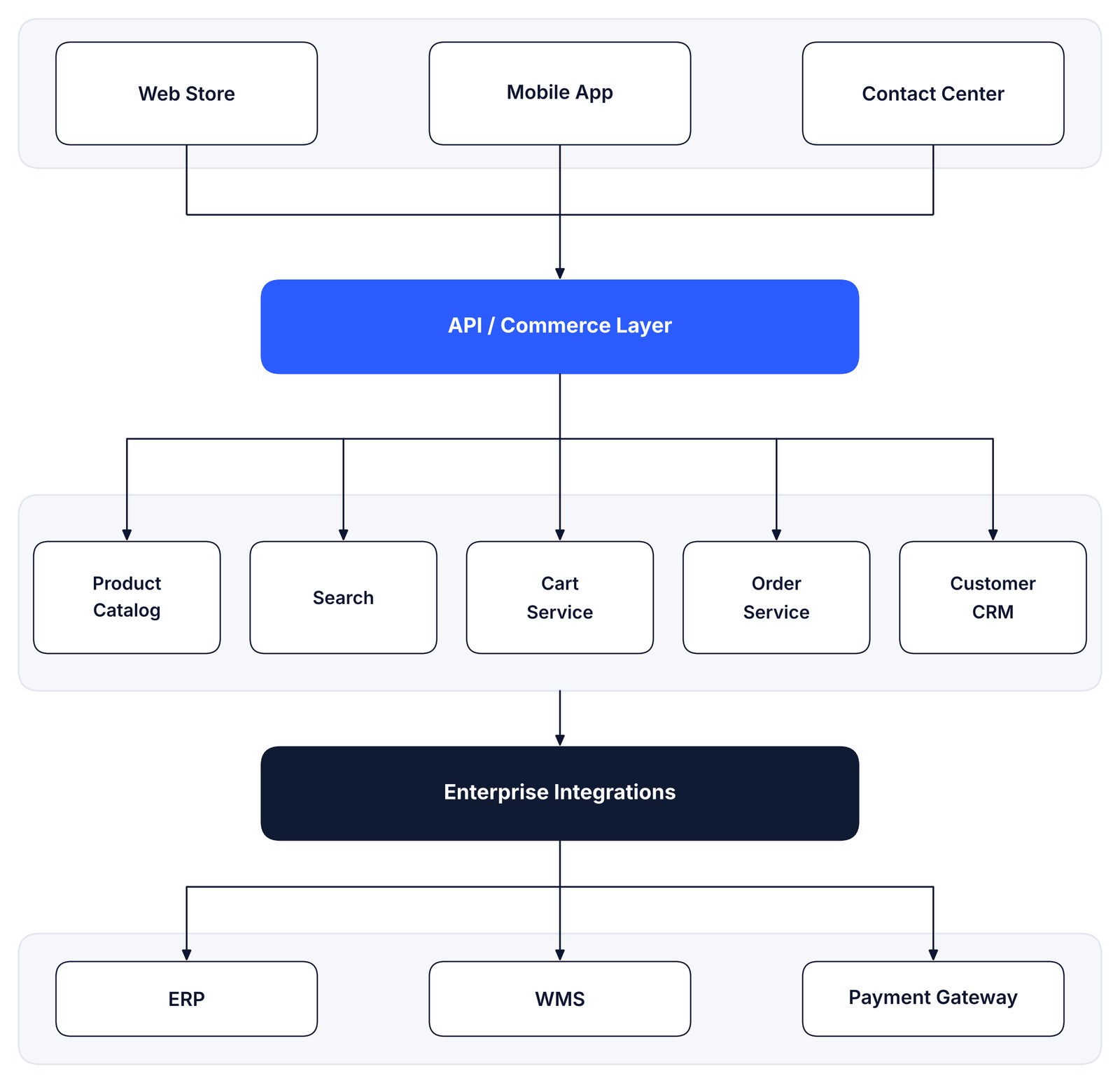
Figure 1 — Representative traditional digital commerce architecture
Although this architecture can support conventional e-commerce, it is not inherently designed for intelligent agent participation.
4.2 Current-State Assessment
| Capability | Existing State | Architectural Limitation |
|---|---|---|
| Product discovery | Keyword search and filters | Weak interpretation of complex intent |
| Recommendations | Historical behavioral models | Limited contextual reasoning |
| Customer journey | Predefined navigation paths | Minimal dynamic orchestration |
| Business integration | APIs and point-to-point integrations | No standardized agent tool contracts |
| Transaction execution | Application-driven | Limited delegated authorization |
| Personalization | Channel-specific | Fragmented customer context |
| Governance | Application RBAC | Insufficient controls for autonomous actions |
| Observability | Infrastructure and application monitoring | Limited agent-level traceability |
| Ecosystem integration | Human-centric channels | Limited external agent interoperability |
| AI economics | Isolated AI experiments | No task-level cost attribution |
4.3 Architectural Gap
Adding a conversational chatbot to the existing architecture would address only a small portion of the problem.
The enterprise requires new capabilities for context management, intelligent orchestration, governed tool access, delegated authorization, AI evaluation and cross-system workflow execution.
05. Business Objectives and Success Criteria
5.1 Strategic Business Objectives
The proposed transformation has six primary business objectives:
- Increase revenue through intelligent product discovery and assisted purchasing.
- Reduce the effort required to complete customer shopping objectives.
- Improve operational productivity through governed automation.
- Establish an extensible foundation for agent-driven commerce channels.
- Preserve customer trust, security and transaction integrity.
- Maintain economically sustainable AI operations.
5.2 Target Success Criteria
| Business Objective | Target KPI | Illustrative Target |
|---|---|---|
| Revenue growth | Relative conversion uplift | 5–10% |
| Customer experience | Time to purchase decision | 20–40% reduction |
| Basket optimization | Average order value | 3–8% improvement |
| Service efficiency | Eligible support requests resolved without human intervention | 30–50% |
| Operational productivity | Manual effort for selected workflows | 20–40% reduction |
| AI effectiveness | Successful eligible agent journeys | ≥90% |
| Economic sustainability | Incremental contribution after AI costs | Positive |
| Customer trust | Unauthorized agent purchases | Zero tolerance |
These are proposed targets for validation through controlled pilots, not claims of industry benchmarks or achieved results.
Conversion, average order value and operational savings must be evaluated independently to avoid double-counting overlapping business benefits.
06. Functional and Non-Functional Requirements
6.1 Functional Requirements
| ID | Capability | Functional Requirement |
|---|---|---|
| FR-01 | Intent understanding | Interpret natural-language shopping objectives |
| FR-02 | Intelligent discovery | Retrieve products using semantic, lexical and structured search |
| FR-03 | Product reasoning | Compare products and evaluate compatibility |
| FR-04 | Personalization | Incorporate authorized customer preferences |
| FR-05 | Pricing | Retrieve authoritative prices, taxes and promotions |
| FR-06 | Inventory | Verify availability and create time-bound reservations |
| FR-07 | Cart management | Construct and update customer baskets |
| FR-08 | Fulfillment | Retrieve available delivery options and commitments |
| FR-09 | Authorization | Capture explicit customer approval or valid delegated authority |
| FR-10 | Checkout | Coordinate secure, idempotent purchase execution |
| FR-11 | Order management | Track orders and coordinate lifecycle events |
| FR-12 | Post-purchase support | Assist with returns, refunds and order inquiries |
| FR-13 | Seller integration | Expose controlled product and fulfillment capabilities |
| FR-14 | External agents | Support compatible agentic commerce interfaces |
| FR-15 | Human oversight | Escalate uncertain, sensitive or exceptional decisions |
| FR-16 | Agent governance | Enforce action boundaries and approval policies |
| FR-17 | Auditability | Reconstruct material agent decisions and business actions |
| FR-18 | Tenant management | Configure tenant-specific policies, catalogs, integrations and budgets |
6.2 Non-Functional Requirements
| Dimension | Proposed Requirement |
|---|---|
| Availability | 99.99% monthly availability for critical checkout capabilities |
| Agent availability | 99.9% monthly availability for AI-assisted capabilities |
| Commerce latency | P95 below 500 ms for selected internal read APIs |
| AI responsiveness | P95 first meaningful response within 2 seconds; completed simple discovery response within 5 seconds |
| Complex journeys | Asynchronous execution with progress reporting where necessary |
| Scalability | Support 1,500 commerce API requests and 100 agent journey starts per second |
| Transaction integrity | Idempotent transaction processing and reconciliation |
| Tenant isolation | Enforced across application, data, retrieval, agent and execution boundaries |
| Disaster recovery | Critical commerce RTO ≤30 minutes; RPO ≤5 minutes for regional disaster scenarios |
| Security | Zero-trust access, encryption and least-privilege execution |
| Governance | Policy enforcement before material business actions |
| Cost control | Per-tenant, per-agent and per-journey execution budgets |
| Maintainability | Independently deployable domain services and versioned contracts |
| Explainability | Evidence-backed recommendations and traceable business decisions |
Payment processor response time and third-party fulfillment dependencies must be explicitly addressed in end-to-end SLO definitions.
Agentic capabilities must not become a mandatory dependency for conventional commerce transactions.
07. My Solution Approach
7.1 Business-Driven Architecture Transformation
My approach begins with business capability assessment rather than technology selection.
The proposed approach begins by identifying commerce journeys where intelligent agents can create measurable business value, determining the appropriate degree of autonomy and establishing the business constraints within which agents may operate.
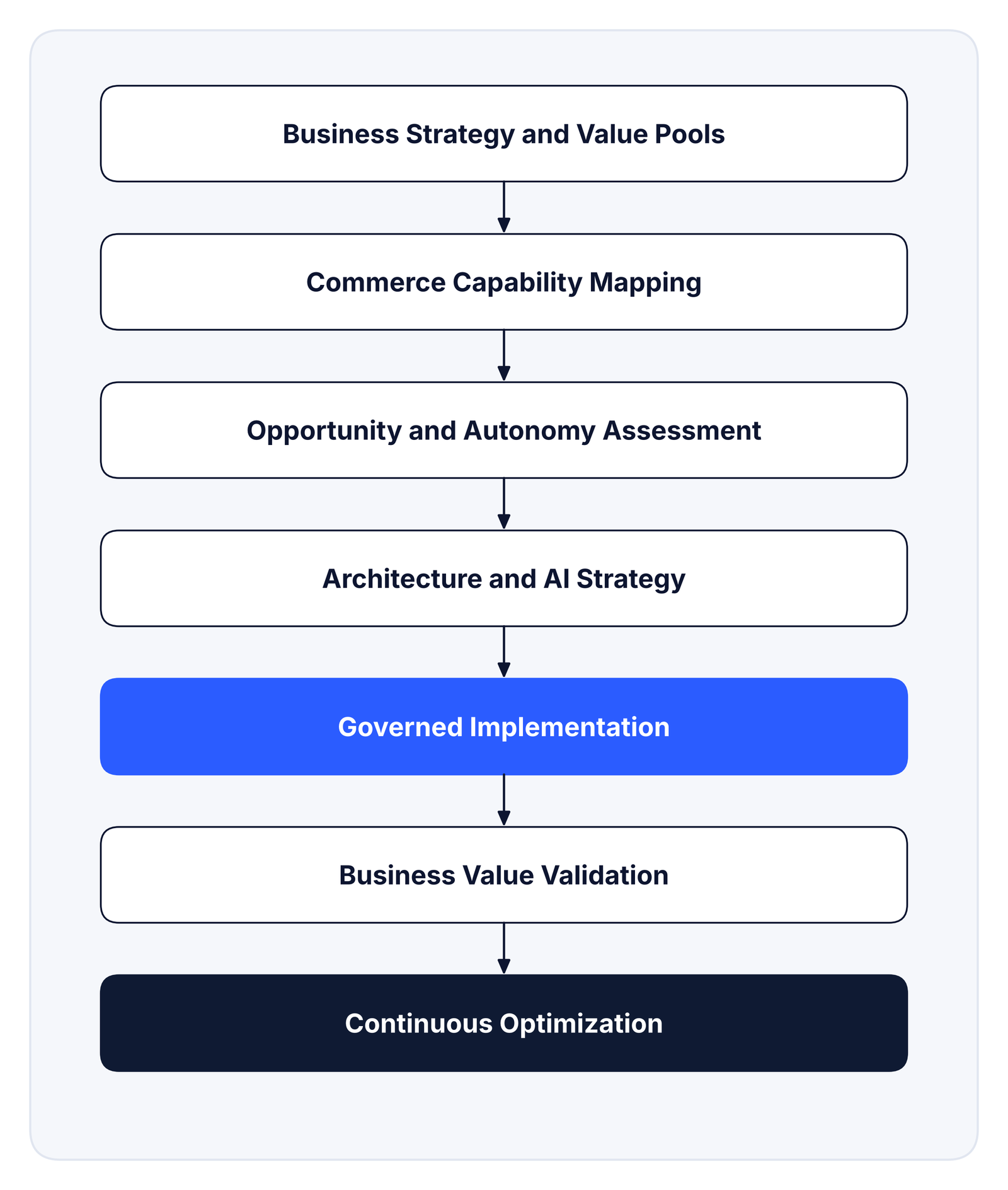
Figure 2 — Business-driven solution transformation methodology
7.2 Establish Six Strategic Solution Pillars
| Pillar | Strategic Intent |
|---|---|
| Composable Commerce | Establish reusable, authoritative business capabilities |
| Agentic Intelligence | Introduce goal-oriented and context-aware orchestration |
| Enterprise Context | Provide relevant, current and permission-aware information |
| Governed Autonomy | Constrain intelligence using deterministic business policies |
| Ecosystem Interoperability | Enable participation by authorized external agents |
| Value-Oriented Operations | Continuously optimize reliability, quality and unit economics |
7.3 Introduce Progressive Autonomy
Not every commerce workflow requires an autonomous agent.
The proposed architecture incorporates an autonomy maturity model that enables the enterprise to introduce intelligence incrementally.
| Level | Autonomy Model | Example |
|---|---|---|
| L0 | Conventional deterministic automation | Rule-based checkout |
| L1 | Information assistance | Product question answering |
| L2 | Recommendation | Personalized product comparison |
| L3 | Assisted action | Prepare a shopping cart for approval |
| L4 | Bounded delegated execution | Reorder approved consumables within a spending mandate |
| L5 | Policy-governed goal execution | Coordinate a multi-step purchase within narrowly defined constraints |
L5 does not imply unrestricted autonomy. Financial, legal, security and commercial constraints remain enforceable at every level.
The initial production release should concentrate on L1–L3. L4 and L5 should be introduced only after demonstrating adequate controls, customer acceptance and operational reliability.
7.4 Select the Right Intelligence Mechanism
A mature AI architecture does not use an LLM for every operation.
| Business Task | Preferred Mechanism |
|---|---|
| Intent classification | Small language model or classifier |
| Product discovery | Hybrid search |
| Product ranking | Ranking models and structured scoring |
| Product compatibility | Rules, structured attributes and knowledge graphs |
| Complex shopping reasoning | LLM-assisted reasoning |
| Pricing and tax computation | Deterministic business services |
| Inventory reservation | Transactional inventory service |
| Fraud assessment | Risk models and business rules |
| Payment execution | Authorized payment service |
| Order processing | Deterministic workflow orchestration |
| Complex exception handling | Agent-assisted human resolution |
The architecture allocates intelligence according to business complexity, risk, performance and economic constraints.
08. Architectural Principles
The proposed architecture establishes the following principles as mandatory architectural guardrails.
| Principle | Architectural Implication |
|---|---|
| Business Value First | Every agent capability must be justified by measurable business value |
| Deterministic Transaction Integrity | Financial and inventory transactions remain under authoritative services |
| Intelligence as a Composable Capability | AI is not tightly embedded into every business service |
| Minimum Necessary Autonomy | Grant only the autonomy needed for a specific business objective |
| Policy Before Action | Validate permissions and business constraints before consequential execution |
| Context Is Not Authority | Retrieved information and model responses cannot grant transaction permissions |
| Tenant Isolation by Design | Tenant boundaries apply to every architectural layer |
| Event-Driven Coordination | Business capabilities communicate lifecycle changes through durable events |
| Human Agency | Customers retain control over consequential decisions |
| Open Standards Where Appropriate | External interfaces should support interoperable protocols |
| Failure Containment | AI failures must not cascade into critical commerce operations |
| Observable by Design | Agent execution and business transactions must be correlated |
| Economics by Design | AI consumption must be measurable and controllable |
| Evolutionary Architecture | Components and models must be replaceable without platform-wide redesign |
The governing architectural principle is:
Allow intelligence to be probabilistic, but keep business commitments deterministic.
09. Target-State Reference Architecture
9.1 Target-state Agentic Commerce Ecosystem reference architecture
The proposed architecture is organized into seven logical layers supported by cross-cutting platform capabilities.
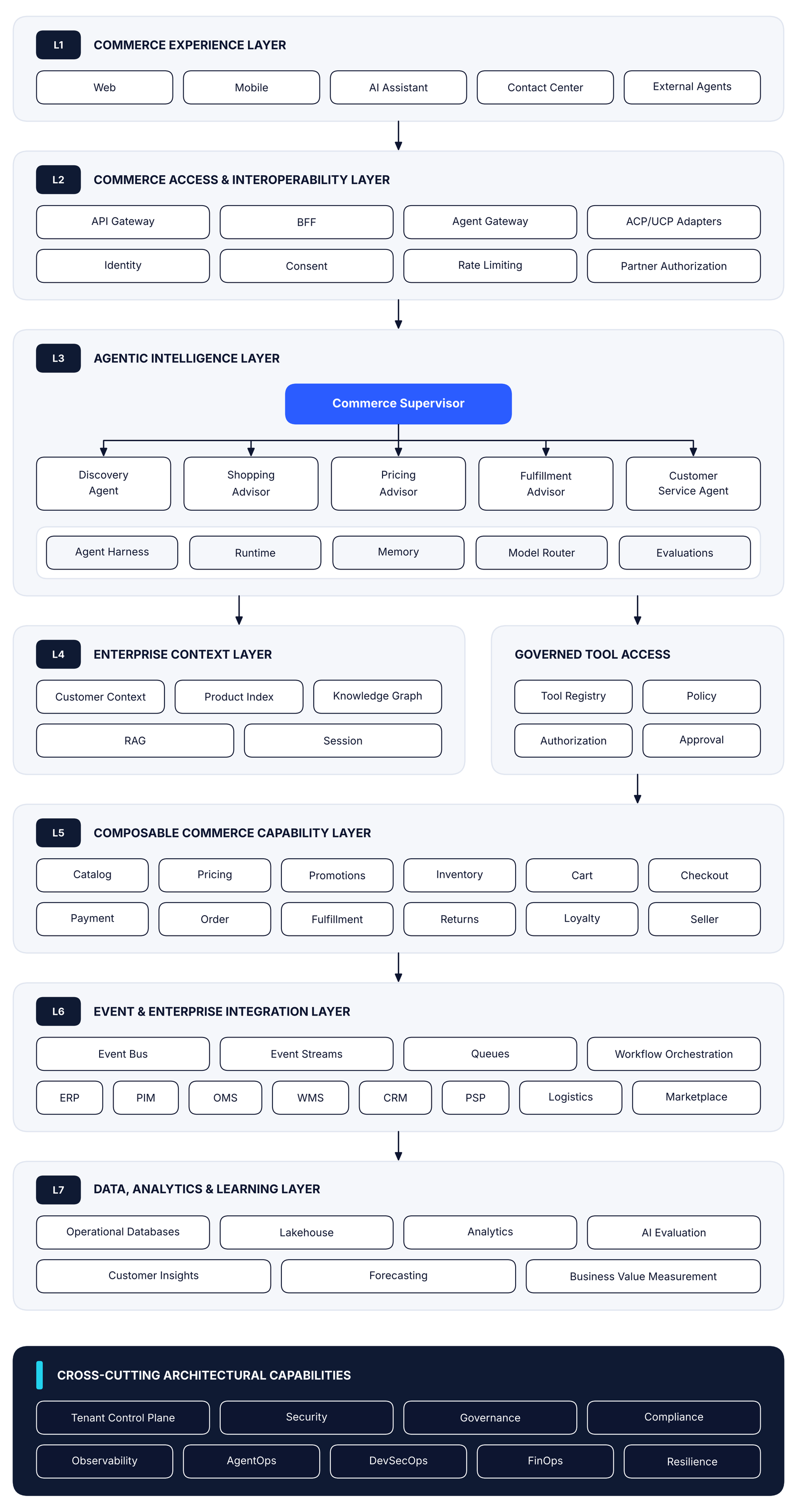
Figure 3 — Target-state Agentic Commerce Ecosystem reference architecture
This architecture distinguishes between the systems that determine what should happen and the systems authorized to make it happen.
9.2 Architecture Layer Responsibilities
| Layer | Primary Responsibility |
|---|---|
| Commerce Experience | Customer and enterprise interactions |
| Access and Interoperability | Secure access, channel abstraction and protocol adaptation |
| Agentic Intelligence | Intent understanding, planning, reasoning and coordination |
| Enterprise Context | Relevant, trusted and permission-aware information |
| Composable Commerce | Authoritative domain operations and business transactions |
| Event and Integration | Reliable distributed coordination and enterprise connectivity |
| Data and Learning | Analytics, evaluation, operational insight and improvement |
9.3 Commerce Domain Architecture
The commerce capability layer should follow domain-driven design principles.
| Bounded Context | Authoritative Responsibility |
|---|---|
| Product Catalog | Product identity, attributes, variants and published descriptions |
| Pricing | Current prices and price validity |
| Promotions | Offer eligibility and discount computation |
| Inventory | Availability, reservations and stock allocation |
| Cart | Customer purchase intent and selected items |
| Checkout | Validated purchase proposal and transaction coordination |
| Payment | Payment authorization, capture, void and refund |
| Order | Order identity and lifecycle |
| Fulfillment | Allocation, shipment and delivery status |
| Returns | Return eligibility and return merchandise authorization |
| Customer | Customer identity relationships and preferences |
| Seller | Seller onboarding, policies and commercial agreements |
| Loyalty | Points, benefits and rewards |
These are logical service boundaries. Physical microservice decomposition should depend on team ownership, transactional cohesion, scalability and operational maturity.
Creating a separate microservice for every capability prematurely would introduce unnecessary distributed system complexity.
9.4 Agentic Intelligence Architecture
Specialized Commerce Agents
| Agent | Responsibility | Authorized Actions | Autonomy |
|---|---|---|---|
| Commerce Supervisor | Interpret goals and coordinate workflows | Select approved agents and tools | Bounded |
| Product Discovery Agent | Identify relevant products | Search and retrieve | Read-only |
| Shopping Advisor Agent | Compare and assemble recommendations | Generate proposed selections | Advisory |
| Compatibility Agent | Evaluate product compatibility | Query compatibility rules and graphs | Advisory |
| Pricing Advisor Agent | Evaluate offers and budget constraints | Retrieve authoritative quotes | Read-only |
| Cart Agent | Construct proposed baskets | Create or modify authorized carts | Controlled |
| Fulfillment Advisor Agent | Evaluate delivery alternatives | Retrieve delivery options | Read-only |
| Checkout Coordinator Agent | Prepare the purchase workflow | Submit validated, authorized checkout commands | Highly constrained |
| Customer Service Agent | Resolve post-purchase inquiries | Read orders and initiate eligible requests | Controlled |
| Merchant Operations Agent | Analyze seller operations | Recommend approved operational actions | Advisory |
| Inventory Optimization Agent | Identify replenishment opportunities | Submit replenishment proposals | Approval-based |
These are logical agent responsibilities, not mandatory independent agent processes.
Several responsibilities may initially be implemented as deterministic tools or nodes within a shared orchestration graph. Dedicated agent deployment should be introduced only when justified by reasoning requirements, security boundaries or scaling needs.
9.5 Agent Execution Architecture
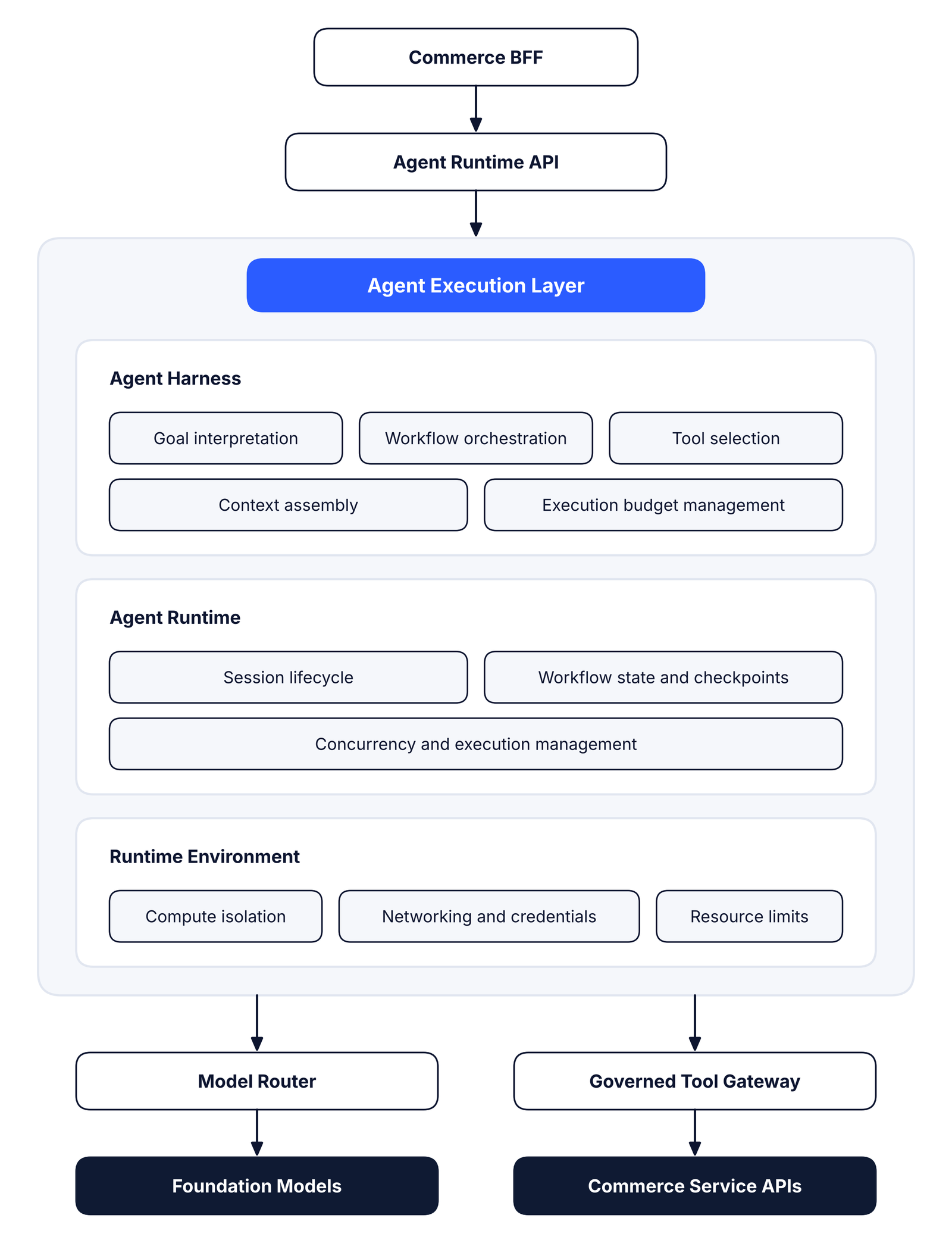
Figure 4 — Agent execution layer
The agent harness implements reasoning and orchestration behavior. The agent runtime manages execution lifecycle, while the runtime environment provides infrastructure isolation and operational resources.
These are distinct architectural responsibilities even when a managed platform provides more than one of them.
9.6 Separation of Intelligence and Transaction Execution
This is the most important design boundary in the proposed ecosystem.
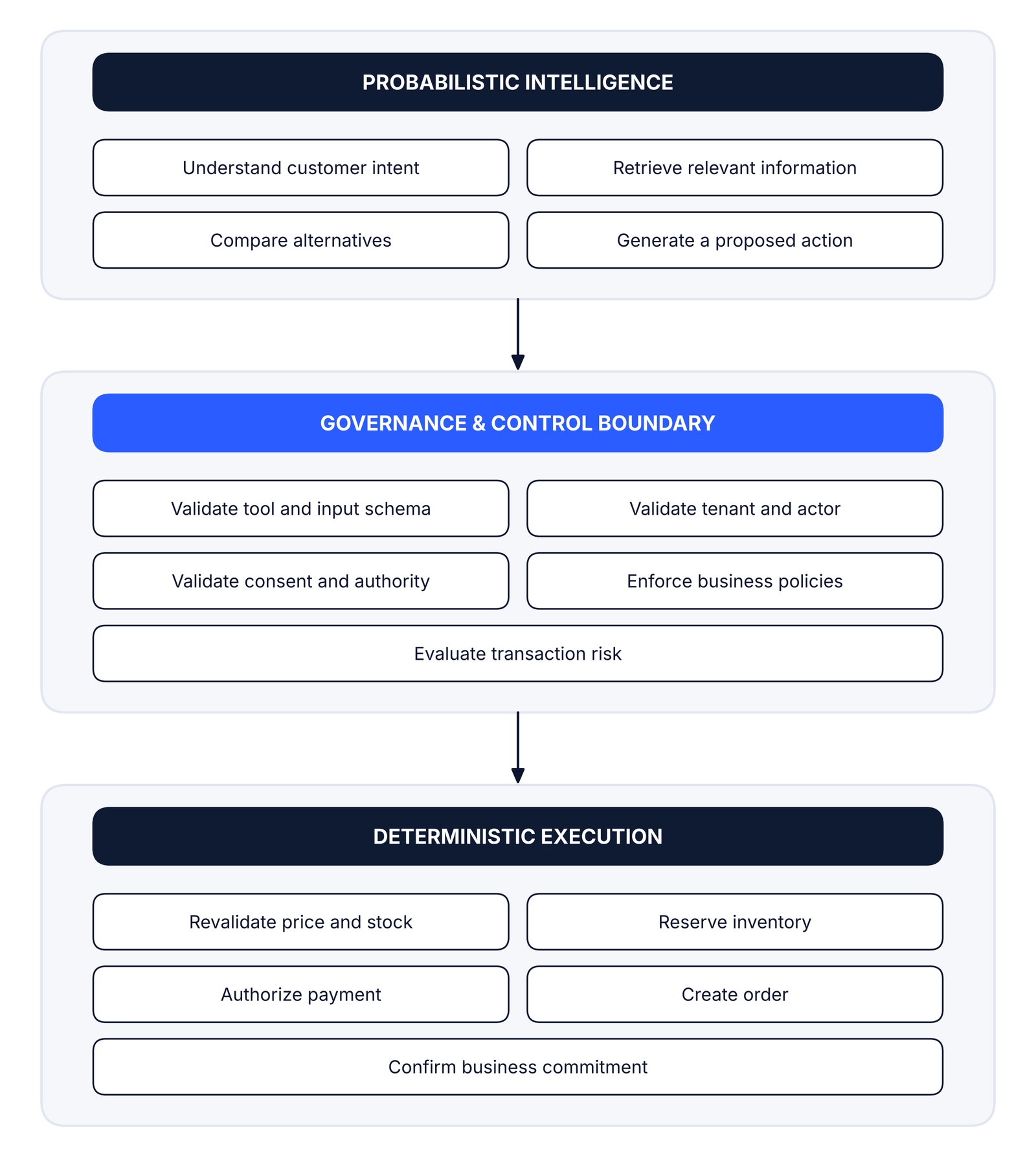
Figure 5 — Intelligence-to-transaction execution boundary
An agent may recommend a product costing $500. Only the pricing service may establish the authoritative price.
An agent may propose a purchase. Only the checkout service may establish the business conditions under which that purchase is executed.
9.7 Multi-Tenant Architecture
The proposed ecosystem separates tenant management from tenant-specific commerce execution.
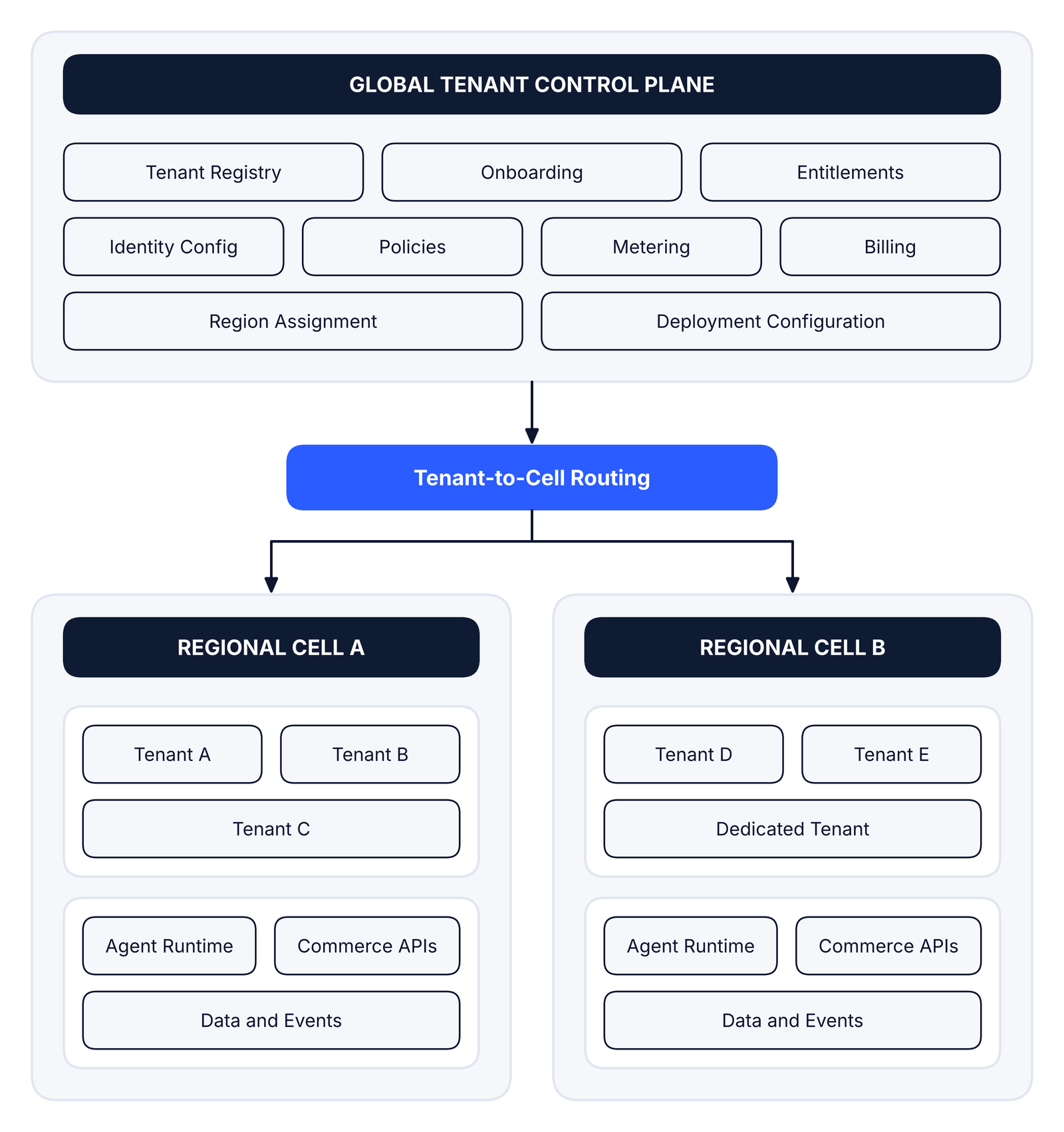
Figure 6 — Multi-tenant, cell-based deployment architecture
The platform should support multiple isolation models.
| Tenancy Model | Design | Applicability |
|---|---|---|
| Pooled | Shared infrastructure with enforced logical isolation | Standard tenants |
| Bridge | Shared platform with dedicated selected data or agent resources | Larger or regulated tenants |
| Silo | Dedicated deployment boundary | Strategic enterprises with strict isolation needs |
Tenant isolation must be enforced across:
- Identity and authorization.
- Databases and caches.
- Product search indexes and embeddings.
- Agent memory and workflow state.
- Tool execution.
- Event subscriptions.
- Logs, traces and analytics.
- Model consumption and execution budgets.
Tenant identity must originate from verified authentication and membership context. It must never be established solely from an LLM-generated value or untrusted request parameter.
Each tenant is assigned a home region and cell. Regional routing and failover policies must respect residency constraints and transaction consistency requirements.
9.8 Enterprise Context Architecture
Agent quality depends on the quality, relevance and freshness of its context.
| Context Category | Source | Usage |
|---|---|---|
| Customer Context | CRM and customer profile service | Preferences and personalization |
| Session Context | Conversation and workflow state | Current shopping objective |
| Product Context | PIM, catalog and search indexes | Product reasoning |
| Commercial Context | Pricing and promotions services | Current commercial terms |
| Inventory Context | Inventory and warehouse services | Availability validation |
| Fulfillment Context | Logistics and fulfillment systems | Delivery feasibility |
| Policy Context | Enterprise policy repositories | Returns and commercial guidance |
| Authorization Context | Identity and consent services | Permitted actions |
The architecture distinguishes between indexed knowledge and authoritative live state.
Product descriptions can be indexed for semantic retrieval. Prices, stock levels and delivery commitments must be validated against the corresponding operational services before purchase execution.
Context Retrieval Strategy
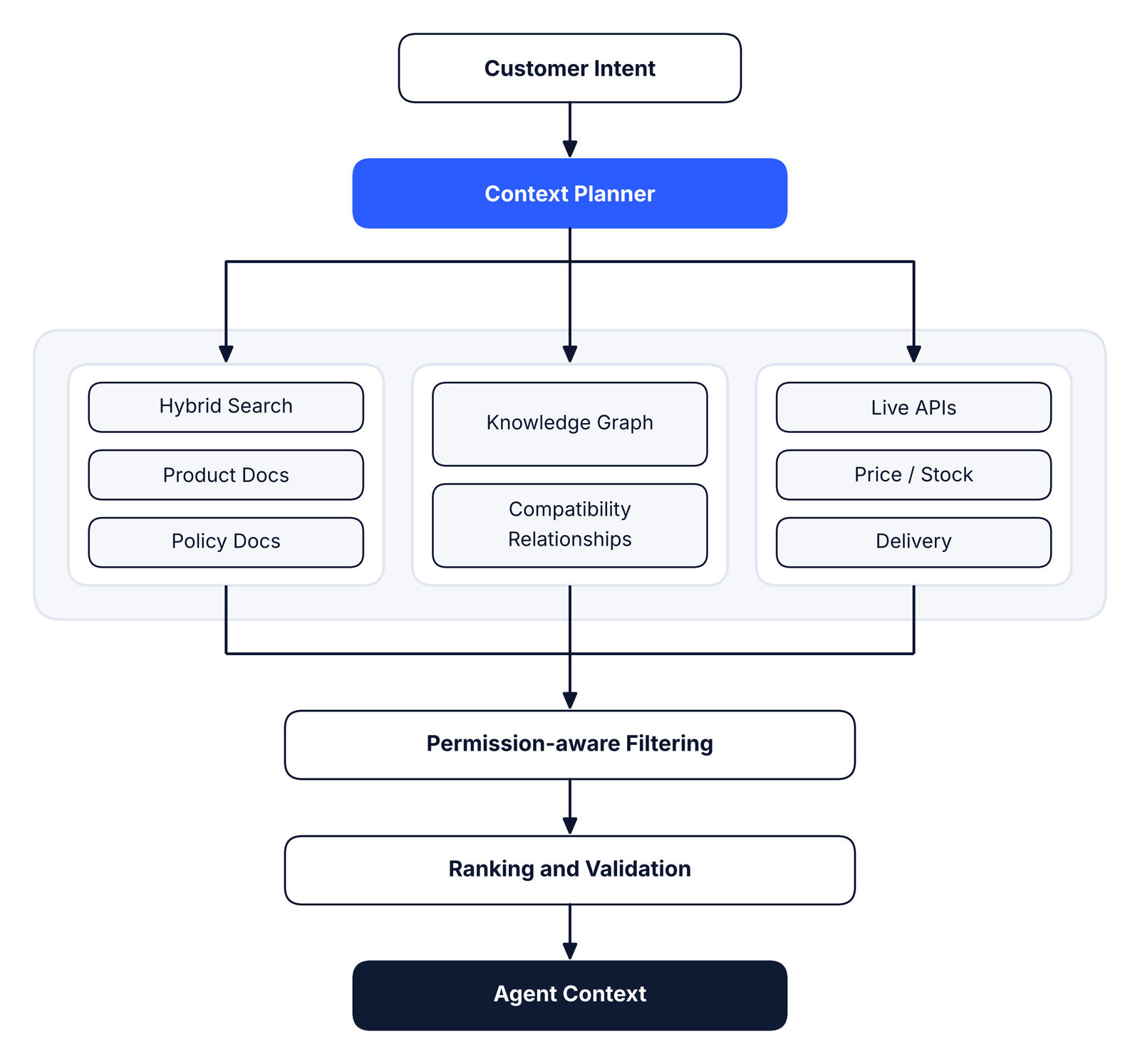
Figure 7 — Hybrid enterprise context architecture
Context engineering should dynamically assemble the smallest sufficient context required to accomplish the business task.
9.9 External Agentic Commerce Interoperability
The platform should support both first-party agents and authorized third-party commerce agents.
Emerging commerce protocols should be integrated through an anti-corruption layer that maps external protocol semantics into the enterprise's canonical commerce model.
| Protocol | Primary Purpose | Proposed Usage |
|---|---|---|
| ACP | Programmatic commerce interactions and checkout | Enable compatible external purchasing agents |
| UCP | Interoperable commerce capabilities across participating ecosystems | Product discovery and commerce integration |
| AP2 | Mandate-based authorization for agent-initiated payments | Delegated payment authorization where supported |
| MCP | Standardized agent access to tools and contextual resources | Governed commerce tool exposure |
| A2A | Agent-to-agent interaction | Partner agent coordination where justified |
ACP and UCP may overlap in the commerce capabilities they expose. They should be treated as alternative or complementary ecosystem adapters, rather than mandatory sequential stages of every purchase.
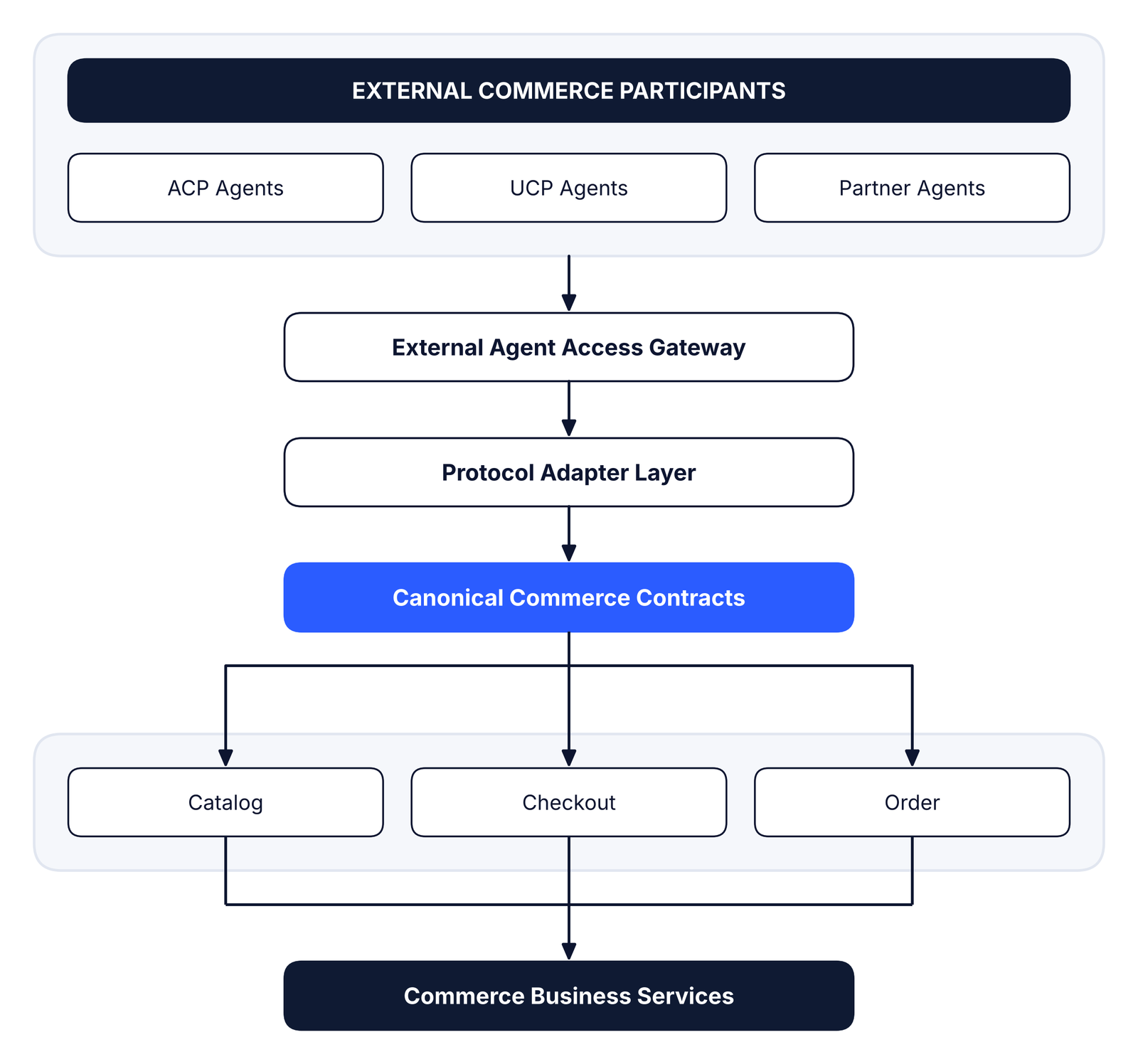
Figure 8 — Protocol-independent commerce interoperability
External agents must not receive unrestricted access to internal tools, enterprise memory or customer databases.
External protocol specifications and partner capabilities should be versioned and validated during integration. Protocol compatibility alone does not establish identity, trust or authorization.
9.10 Event-Driven Commerce Architecture
The commerce ecosystem should publish meaningful domain events representing completed business state transitions.
| Domain Event | Producer | Example Consumers |
|---|---|---|
| ProductUpdated | Catalog Service | Search indexing, analytics |
| PriceChanged | Pricing Service | Catalog projections, offer monitoring |
| InventoryReserved | Inventory Service | Checkout workflow |
| InventoryReservationExpired | Inventory Service | Checkout reconciliation |
| PaymentAuthorized | Payment Service | Checkout workflow |
| OrderConfirmed | Order Service | Fulfillment, notifications, analytics |
| ShipmentDelayed | Fulfillment Service | Customer Service Agent |
| ReturnRequested | Returns Service | Order management, warehouse |
| RefundCompleted | Payment Service | Returns, finance, customer notification |
The architecture should use transactional outbox patterns, idempotent consumers, schema versioning and controlled replay mechanisms.
Event-driven architecture must not be mistaken for unbounded agent-triggered automation. Events that initiate agents require explicit subscriptions, execution quotas, loop detection and business policy enforcement.
10. Key Architectural Decisions
The following Architecture Decision Records establish the core design rationale.
| ADR | Architectural Decision | Rationale |
|---|---|---|
| ADR-01 | Separate agent orchestration from commerce transaction execution | Prevent probabilistic reasoning from compromising business integrity |
| ADR-02 | Adopt domain-driven composable commerce | Enable reusable capabilities and independent evolution |
| ADR-03 | Use centralized orchestration for critical checkout workflows | Improve state management, reconciliation and compensation |
| ADR-04 | Use event-driven choreography for non-critical lifecycle propagation | Reduce temporal coupling |
| ADR-05 | Prefer hybrid search and structured retrieval over vector-only RAG | Improve precision for SKUs, attributes and hard constraints |
| ADR-06 | Validate commercial facts through authoritative APIs | Prevent stale price and availability commitments |
| ADR-07 | Introduce progressive autonomy | Manage financial and operational risk |
| ADR-08 | Enforce tenant isolation through cell-based architecture | Contain failure and support differentiated isolation |
| ADR-09 | Use policy-governed agent tool access | Limit excessive agency |
| ADR-10 | Introduce model routing | Balance quality, latency, cost and privacy |
| ADR-11 | Isolate external protocol adapters | Reduce dependency on evolving commerce standards |
| ADR-12 | Use tokenized payment references | Minimize exposure of payment credentials |
| ADR-13 | Maintain an independent authorization and consent ledger | Provide durable evidence of customer authority |
| ADR-14 | Preserve conventional commerce fallback | Avoid making AI a single point of business failure |
| ADR-15 | Evaluate agent quality continuously | Detect regressions across models, prompts and tools |
10.1 Architecture Decision: Multi-Agent versus Single-Agent
A multi-agent architecture should not be selected merely because the business domain contains multiple responsibilities.
For predictable workflows, a single orchestration graph with specialized tools is often more efficient.
Dedicated agents are justified when there are materially different:
- Reasoning objectives.
- Security permissions.
- Context requirements.
- Organizational ownership.
- Scaling characteristics.
- Failure isolation requirements.
My recommendation is to begin with a supervisor-controlled graph containing specialized agent and deterministic nodes, then extract independently deployed agents as operational evidence justifies the additional complexity.
10.2 Architecture Decision: Workflow Orchestration versus Choreography
The proposed architecture adopts a hybrid coordination model.
Checkout, inventory reservation and payment authorization require explicit state transitions and compensation. They are best handled through a deterministic orchestration workflow.
Notifications, analytics, search indexing and customer insight updates can use event-driven choreography.
This avoids both excessive centralization and uncontrolled distributed coordination.
11. Technology Stack and Rationale
11.1 Proposed AWS Technology Architecture
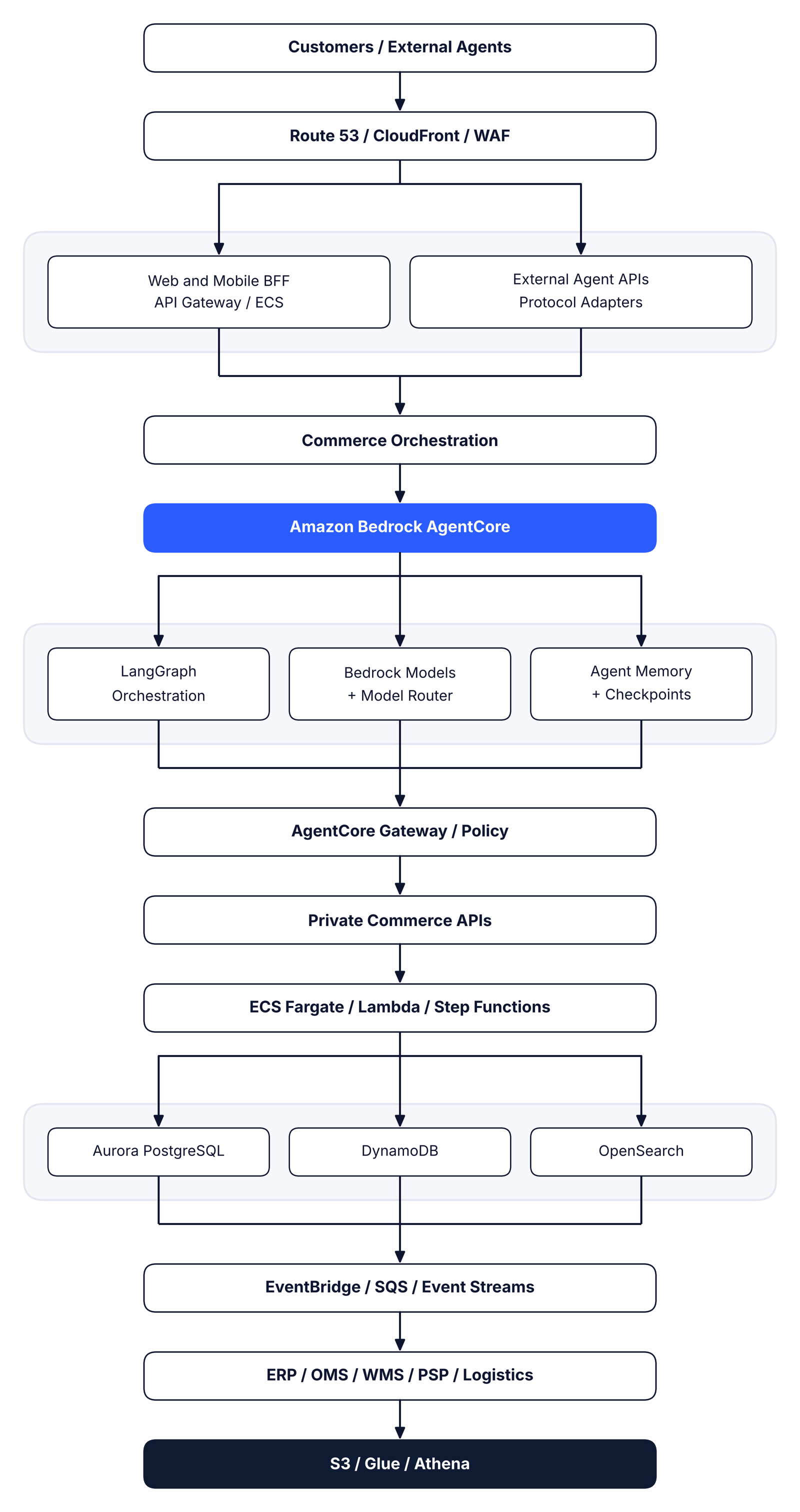
Figure 9 — Proposed AWS technology architecture
The diagram is a logical service mapping, not an assertion that managed AWS services are physically deployed within the same VPC boundary.
11.2 Technology Selection
| Capability | Proposed Technology | Rationale |
|---|---|---|
| DNS | Amazon Route 53 | Geographic and health-aware routing |
| Edge delivery | Amazon CloudFront | Global content acceleration |
| Edge protection | AWS WAF and AWS Shield | Application and network protection |
| Frontend | Next.js and React | Flexible commerce experiences |
| Customer identity | Amazon Cognito or enterprise CIAM | Authentication and federation |
| API management | Amazon API Gateway | Managed API access |
| Commerce BFF | Amazon ECS Fargate or Lambda | Channel-specific orchestration |
| Commerce microservices | Amazon ECS Fargate | Managed containerized services |
| Agent hosting | Amazon Bedrock AgentCore Runtime | Managed agent execution infrastructure |
| Agent orchestration | LangGraph | Explicit stateful workflow graphs |
| Foundation models | Amazon Bedrock | Managed model inference |
| Model routing | Custom policy-based model router | Dynamic intelligence allocation |
| Agent tool gateway | AgentCore Gateway | Governed tool integration |
| Agent identity | AgentCore Identity | Agent and downstream credential management |
| Agent policy | AgentCore Policy plus domain authorization | Fine-grained tool and business controls |
| Agent safety | Amazon Bedrock Guardrails | Supported content and model interaction controls |
| Agent memory | AgentCore Memory | Controlled conversational context |
| Workflow checkpoints | DynamoDB or Aurora PostgreSQL | Durable application workflow state |
| Transaction orchestration | AWS Step Functions | Explicit business workflow coordination |
| Relational transactions | Amazon Aurora PostgreSQL | Transactional commerce records |
| High-scale operational data | Amazon DynamoDB | Carts, metadata and suitable access patterns |
| Hybrid search | Amazon OpenSearch Service | Keyword, vector and structured retrieval |
| Knowledge graph | Amazon Neptune | Product and relationship reasoning where justified |
| Caching | Amazon ElastiCache | Low-latency projections |
| Event routing | Amazon EventBridge | Domain event distribution |
| Durable queues | Amazon SQS | Reliable asynchronous processing |
| High-volume event streams | Amazon MSK or Kinesis | Ordered or high-throughput streaming use cases |
| Object storage | Amazon S3 | Product assets, datasets and approved audit artifacts |
| Data integration | AWS Glue | Data processing and cataloging |
| Analytics | Amazon Athena and Redshift | Business and operational analytics |
| Secrets | AWS Secrets Manager | Credential lifecycle management |
| Encryption | AWS KMS | Managed encryption keys |
| Observability | Amazon CloudWatch and OpenTelemetry | Correlated application and agent telemetry |
| Agent evaluation | AgentCore Evaluations and custom evaluation suites | Agent quality assessment |
| Infrastructure as Code | AWS CDK or Terraform | Repeatable infrastructure deployments |
11.3 Model Selection and Dynamic Routing
| Workload | Preferred Model Category |
|---|---|
| Simple intent classification | Small, low-cost model |
| Attribute extraction | Small model with structured output |
| Product question answering | Cost-effective general-purpose model |
| Complex product comparison | Medium-capability model |
| Multi-constraint planning | Advanced reasoning model |
| High-risk ambiguous scenarios | Advanced reasoning with human review |
| Final transaction validation | No LLM |
Model selection should consider required capability, data classification, regional availability, context size, latency, inference cost and evaluated task performance.
Specific foundation model versions should be selected through representative workload benchmarks rather than hard-coded into the long-term reference architecture.
11.4 Technology Selection Boundaries
Managed services are preferred where they reduce undifferentiated operational effort.
However, business policies, canonical commerce contracts, customer authorization semantics and transaction integrity should remain application-owned capabilities.
Amazon Bedrock Guardrails and AgentCore Policy complement these controls; neither replaces authoritative transaction validation.
12. End-to-End Solution Workflows
12.1 Workflow A — Intelligent Product Discovery and Assisted Shopping
Customer objective:
Find a complete home office setup within $1,500 and ensure delivery before Friday.
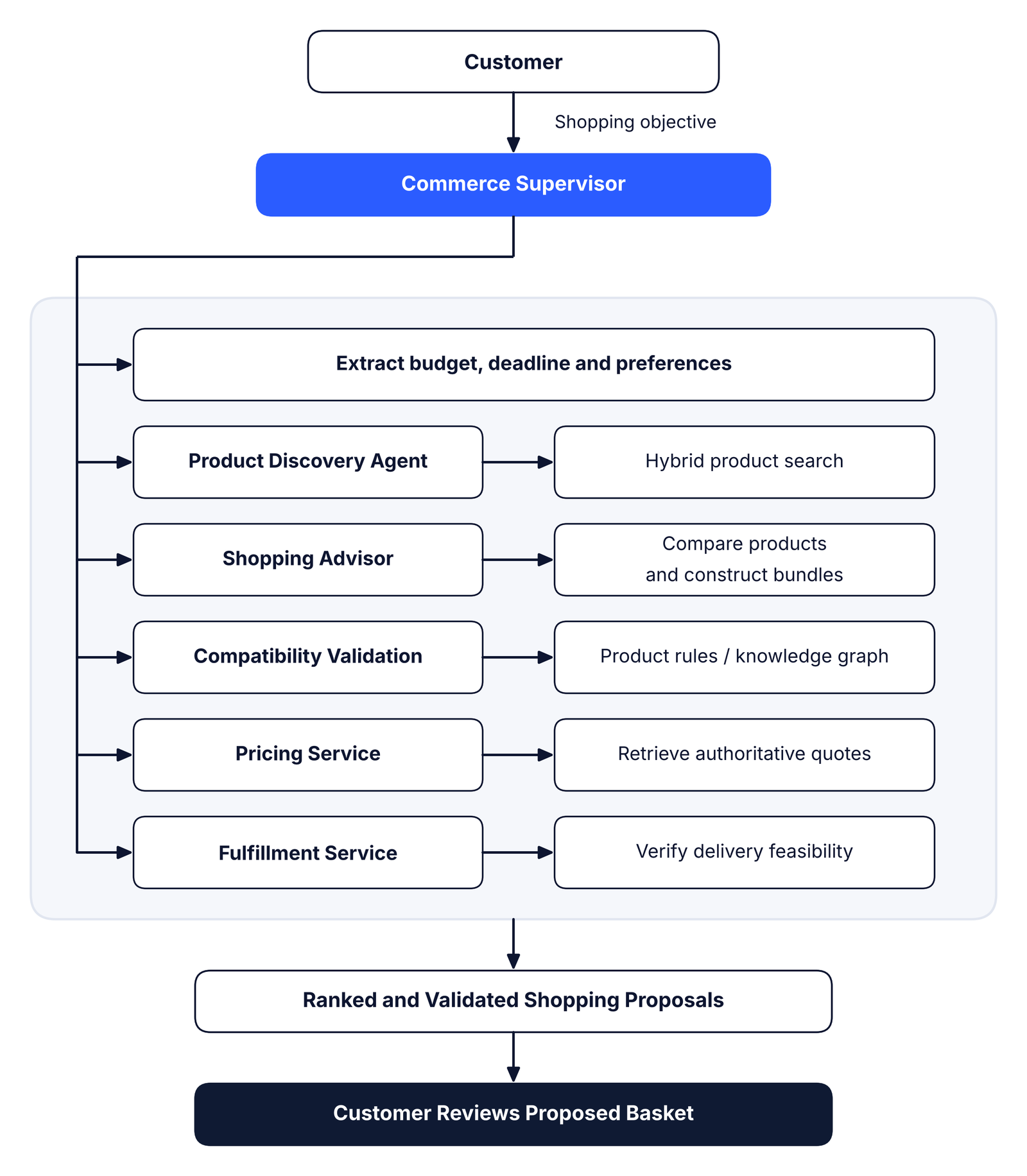
The agent should treat the customer's budget and required delivery date as hard constraints.
If no valid combination exists, the system should explain the conflict and request authorization to relax a constraint rather than silently violate it.
12.2 Workflow B — Governed Agentic Checkout
The customer selects an approved basket.
| Step | Component | Execution Responsibility |
|---|---|---|
| 01 | Customer | Review items, total price, delivery terms and merchant identity |
| 02 | Checkout Service | Create a versioned, time-bound checkout proposal |
| 03 | Authorization Service | Capture customer approval bound to the proposal |
| 04 | Checkout Coordinator | Submit an authorized checkout command |
| 05 | Policy Enforcement | Validate actor, tenant, mandate, limits and risk |
| 06 | Pricing Service | Revalidate prices, discounts and taxes |
| 07 | Inventory Service | Reserve requested inventory |
| 08 | Order Service | Create an order in pending state |
| 09 | Payment Service | Authorize payment using scoped payment credentials |
| 10 | Checkout Workflow | Confirm order or initiate compensation |
| 11 | Event Infrastructure | Publish committed order lifecycle events |
| 12 | Fulfillment Service | Initiate authorized fulfillment |
| 13 | Customer Experience | Present confirmed order details |
If the final price, product selection or material delivery terms differ from the authorized proposal, the system must request renewed approval unless the existing mandate explicitly permits that variation.
Checkout Saga
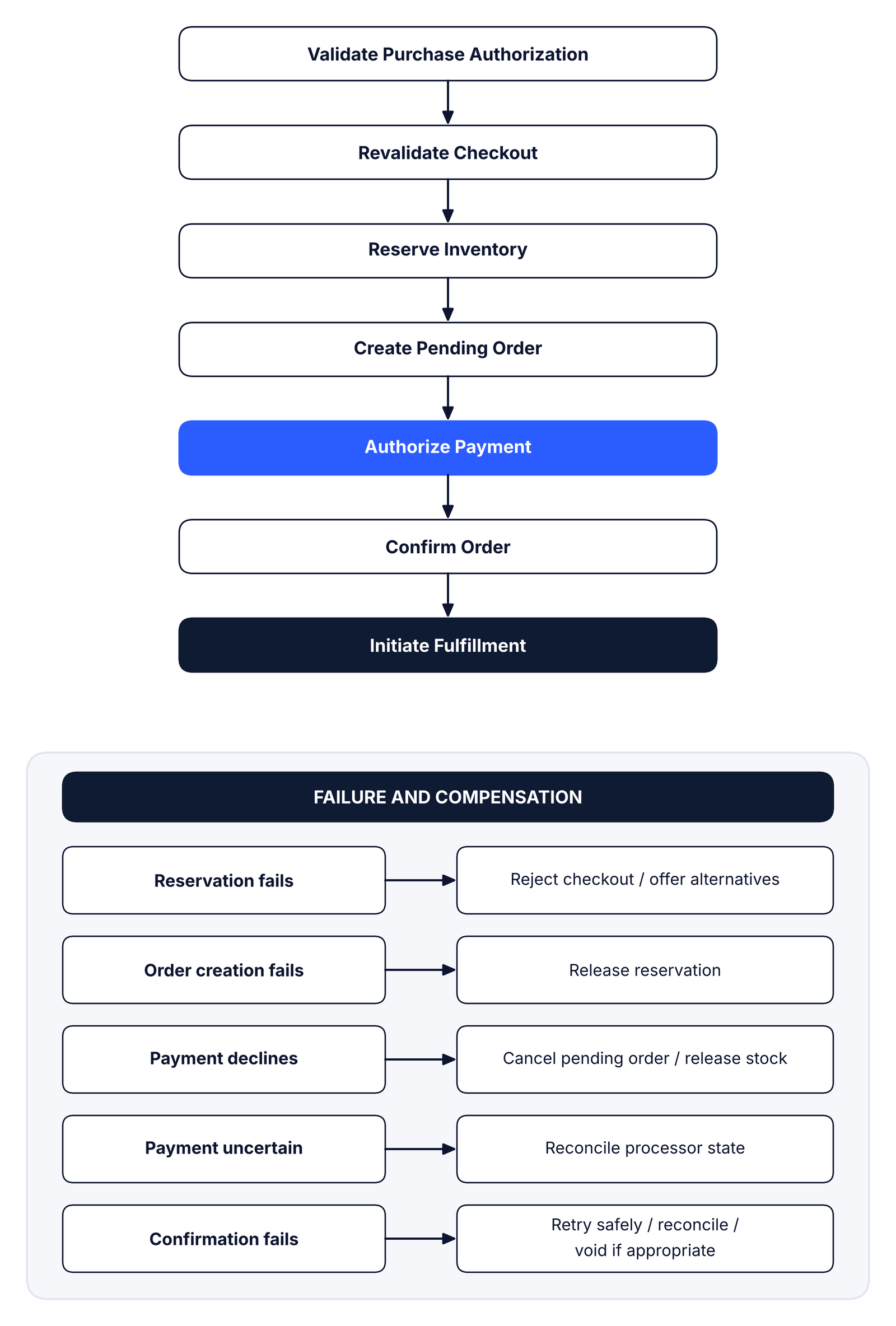
Figure 10 — Deterministic checkout saga
Payment capture timing should follow merchant policy and payment-provider requirements, potentially occurring at order confirmation or shipment.
An uncertain payment result must never be treated automatically as a failed payment. The payment service must reconcile its state with the processor before issuing another authorization attempt.
12.3 Workflow C — Delegated Autonomous Reordering
A customer establishes a bounded purchasing mandate:
Reorder my usual household supplies whenever required, provided each order remains below $100 and the monthly spending limit is $300.
The authorization service records:
| Mandate Attribute | Example |
|---|---|
| Authorized customer | Verified customer identity |
| Authorized agent | Approved shopping agent |
| Permitted products | Approved product categories or SKUs |
| Permitted merchant | Authorized tenant or merchant |
| Maximum transaction value | $100 |
| Monthly spending limit | $300 |
| Delivery address | Approved destination |
| Validity | Defined start and expiration |
| Revocation | Customer-controlled cancellation |
| Payment instrument | Scoped token or mandate reference |
| Risk policy | No restricted or high-risk products |
The agent may propose an order, but the mandate service must atomically validate and reserve the available spending allowance before purchase execution.
Concurrent agent requests must not be able to bypass aggregate spending limits.
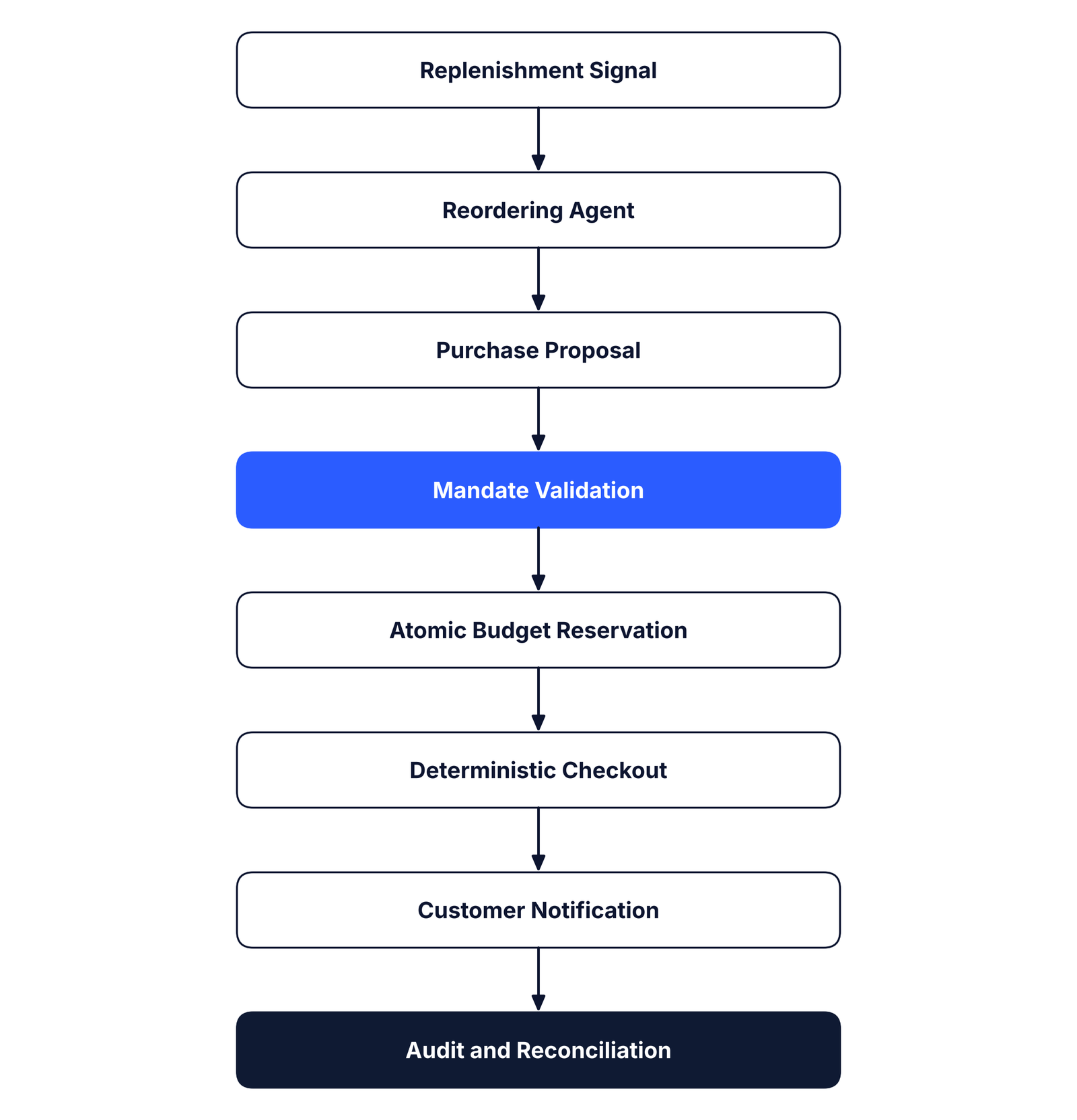
Bounded delegated purchasing should be introduced only where the relevant merchant, payment-provider and jurisdictional requirements permit it.
12.4 Workflow D — External Shopping Agent Purchase
An authorized third-party agent discovers products and initiates checkout through an ACP or UCP-compatible interface.
The enterprise's protocol adapter translates the external checkout request into canonical commerce commands.
The merchant independently validates product availability, prices, customer authority, delivery commitments and payment authorization before accepting the transaction.
The external agent receives only the information and transaction status necessary to complete its authorized objective.
12.5 Workflow E — Proactive Post-Purchase Assistance
A fulfillment event indicates that a shipment may miss its promised delivery date.
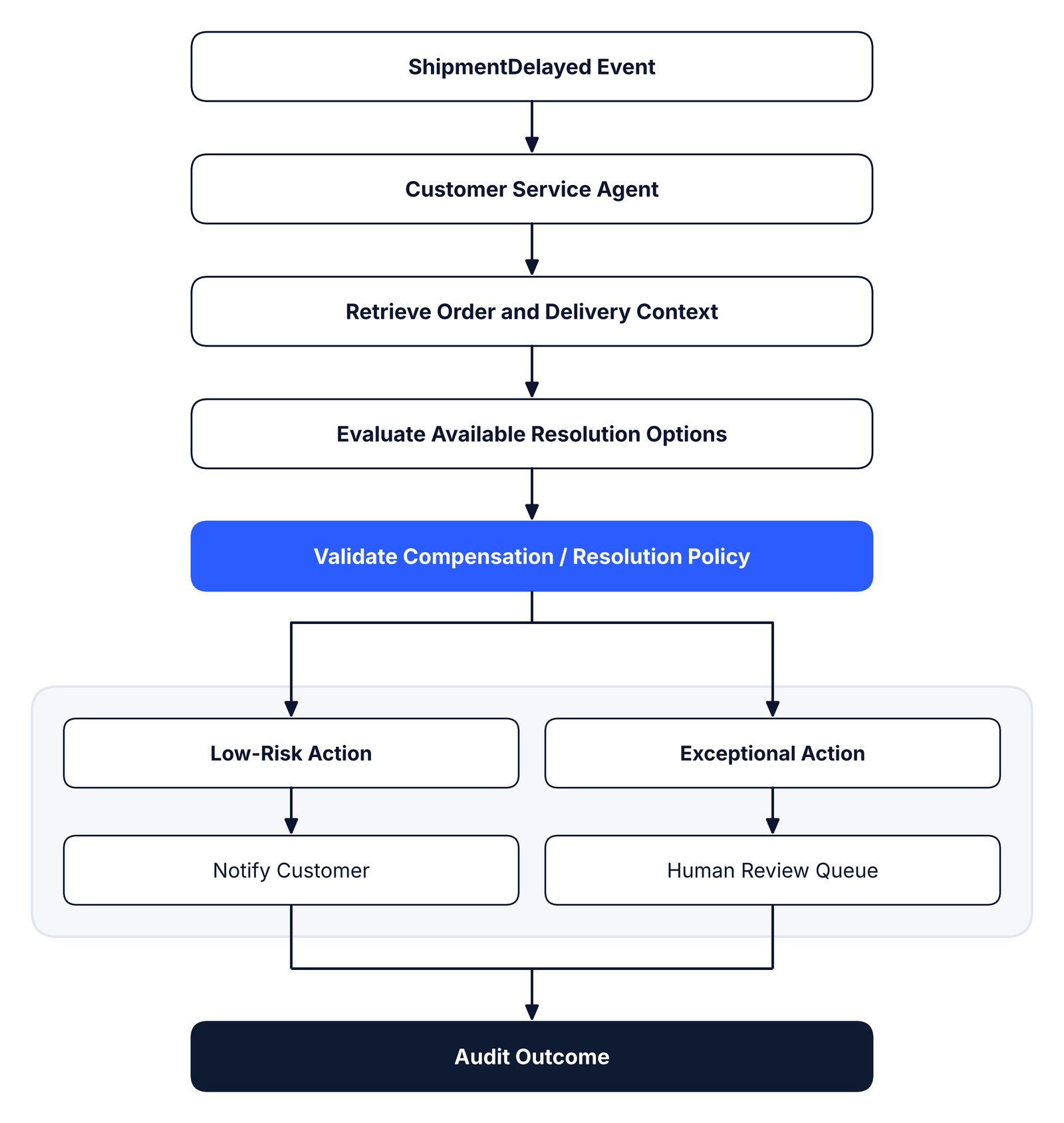
The agent may proactively communicate the delay or recommend alternatives. Refunds, credits and order changes must remain subject to business policy and authorization.
12.6 Workflow F — Intelligent Merchant Operations
Merchant-facing agents may identify:
- Unusual conversion drops.
- Inconsistent product attributes.
- Potential inventory shortages.
- Excessive return rates.
- Uncompetitive delivery commitments.
- Missing catalog metadata.
Initially, these agents should generate evidence-backed recommendations for merchant operators.
Autonomous price changes, campaign launches and supplier orders should remain outside the initial scope because of their wider commercial consequences.
13. Security, Governance and Compliance
13.1 Enterprise Trust Model
Agentic commerce introduces multiple identities and trust relationships.
The architecture must distinguish between:
- The authenticated customer.
- The agent acting on the customer's behalf.
- The merchant or tenant.
- The workload executing the action.
- The external payment or fulfillment provider.
An authenticated agent is not automatically authorized to perform every action available to the customer.
13.2 Layered Authorization Architecture
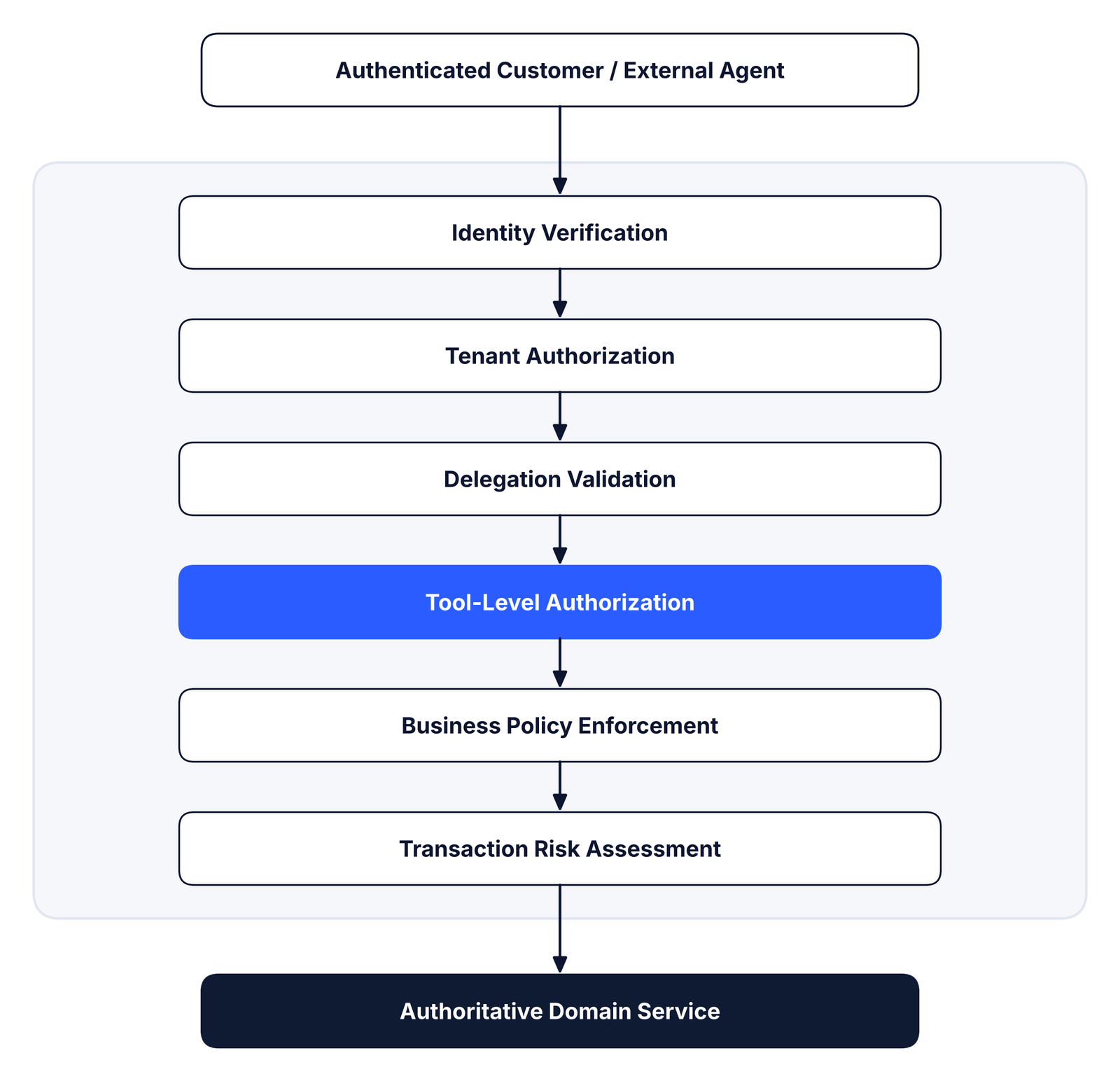
Figure 11 — Layered agent authorization architecture
Authorization must be independently enforced at the tool gateway and the receiving business service.
13.3 Agent Governance Matrix
| Business Action | Default Execution Policy |
|---|---|
| Search public products | Permitted within access and rate limits |
| Read customer preferences | Requires authorized customer context |
| Recommend products | Permitted within recommendation policies |
| Create proposed cart | Permitted for authorized customer |
| Modify cart | Allowed within session and customer authority |
| Place order | Requires transaction-specific approval or valid mandate |
| Change delivery address | Requires appropriate customer verification |
| Execute refund | Policy-limited service action with approval where required |
| Modify product prices | Merchant authorization and controlled approval |
| Access another tenant's data | Denied |
| Reveal payment credentials | Denied |
| Override spending limits | Denied |
13.4 Agentic AI Threat Model
| Threat | Proposed Mitigation |
|---|---|
| Prompt injection | Treat user and retrieved content as untrusted data |
| Malicious product descriptions | Sanitize content and prevent data from becoming instructions |
| Tool misuse | Allowlisted tools, structured inputs and policy checks |
| Excessive agency | Explicit permissions, approval gates and execution budgets |
| Agent impersonation | Workload identity and short-lived credentials |
| Memory poisoning | Validate memory writes, isolate namespaces and retain provenance |
| Cross-tenant retrieval | Server-enforced tenant filters and authorization checks |
| Payment replay | Single-use or appropriately scoped credentials and idempotency |
| Agent execution loops | Maximum steps, token budgets and circuit breakers |
| Fraudulent recommendations | Verified product facts and ranking governance |
| Supply chain compromise | Artifact signing, dependency scanning and controlled deployment |
| Cascading agent failures | Isolation cells, concurrency limits and failure containment |
The security testing strategy should incorporate the OWASP Top 10 for LLM Applications and the OWASP Top 10 for Agentic Applications.
13.5 Payment Security
Payment processing should be isolated from the general agent execution environment.
Foundation models, agent prompts, conversation histories and general-purpose memory must not contain raw card numbers, CVV values or unrestricted payment credentials.
The payment architecture should use appropriate payment-provider tokenization, scoped credentials and mandate verification.
PCI DSS v4.0.1 applicability, assessment scope and responsibilities must be determined with the payment provider and qualified compliance professionals.
Tokenization alone does not guarantee PCI DSS compliance.
13.6 Regulatory and Ethical Considerations
| Area | Architectural Consideration |
|---|---|
| Data protection | Consent, minimization, retention and deletion |
| GDPR and regional privacy requirements | Lawful processing, data rights and cross-border restrictions |
| Payment regulations | Appropriate authentication and delegated payment controls |
| Consumer protection | Transparent pricing, order terms and cancellation rights |
| Accessibility | Accessible conversational and conventional interfaces |
| AI governance | Risk classification, oversight and evaluation |
| Sponsored recommendations | Clear commercial disclosure |
| Restricted products | Deterministic age, eligibility and jurisdiction checks |
| Data residency | Region-aware processing and storage |
Applicability must be established for each target market rather than assumed to be uniform globally.
13.7 Auditability and Non-Repudiation
For consequential actions, retain a governed record of:
| Audit Attribute | Purpose |
|---|---|
| Journey and correlation ID | End-to-end traceability |
| Tenant and actor identities | Accountability |
| Agent and model versions | Execution provenance |
| Tool inputs and validated outputs | Business action reconstruction |
| Context source references | Evidence provenance |
| Policy and rule versions | Governance reconstruction |
| Authorization and mandate references | Evidence of customer authority |
| Checkout proposal version | Approved commercial terms |
| Transaction identifiers | Financial reconciliation |
| Final outcome | Business accountability |
Audit records should be access-controlled, tamper-evident and subject to retention policies.
The architecture should capture evidence and structured decision summaries without requiring storage of private model reasoning or unnecessary sensitive information.
14. Scalability, Reliability and Resilience
14.1 Independent Scaling
Traditional commerce traffic and AI workloads exhibit different scaling characteristics.
Agent execution may involve several model calls, multiple tool invocations and longer-running workflows.
Consequently, the platform should independently scale:
- Customer-facing APIs.
- Agent execution runtimes.
- Model inference consumption.
- Retrieval infrastructure.
- Transactional services.
- Event-processing workloads.
At an illustrative peak of 100 new agent journeys per second and an average execution duration of eight seconds, approximately 800 concurrent journeys may exist under steady-state conditions.
This excludes additional capacity required for traffic bursts, retries and long-running workflows.
14.2 Cell-Based Failure Containment
Regional deployment cells should contain bounded sets of tenants and independent execution capacity.
A heavily consuming tenant must not exhaust resources needed by unrelated tenants.
Controls should include per-tenant quotas, model concurrency limits, queue limits, token budgets and admission control.
14.3 Multi-Region Resilience
| Component | Resilience Strategy |
|---|---|
| Experience layer | Global edge delivery and regional routing |
| Agent runtime | Independent regional deployments |
| Product discovery | Regional indexes and rebuildable projections |
| Commerce transactions | Tenant home-region ownership |
| Transaction database | Multi-AZ deployment and tested regional recovery |
| Customer context | Residency-aware replication |
| Event infrastructure | Durable queues, outbox and replay procedures |
| Tenant control plane | Replicated configuration and recoverable control services |
Active-active experiences and discovery do not require unrestricted active-active transaction writes.
For critical financial and inventory operations, a designated write authority simplifies consistency. Regional failover must fence the previous writer to avoid split-brain transaction execution.
14.4 Graceful Degradation
| Failure Scenario | Expected Platform Behavior |
|---|---|
| Advanced model unavailable | Route to an evaluated alternative or reduce AI functionality |
| AI runtime unavailable | Preserve conventional storefront and checkout |
| Search index unavailable | Use approved catalog fallback where feasible |
| Pricing service unavailable | Prevent new purchase commitments |
| Inventory service unavailable | Do not promise unverified availability |
| Payment provider timeout | Maintain pending state and reconcile |
| Agent execution limit exceeded | Return safe partial results or escalate |
| External commerce protocol failure | Isolate affected integration |
| Regional disruption | Execute approved regional recovery procedures |
For commerce transactions, failing safely is more important than appearing continuously available.
14.5 AgentOps and Observability
Traditional operational monitoring must be extended to cover agent execution.
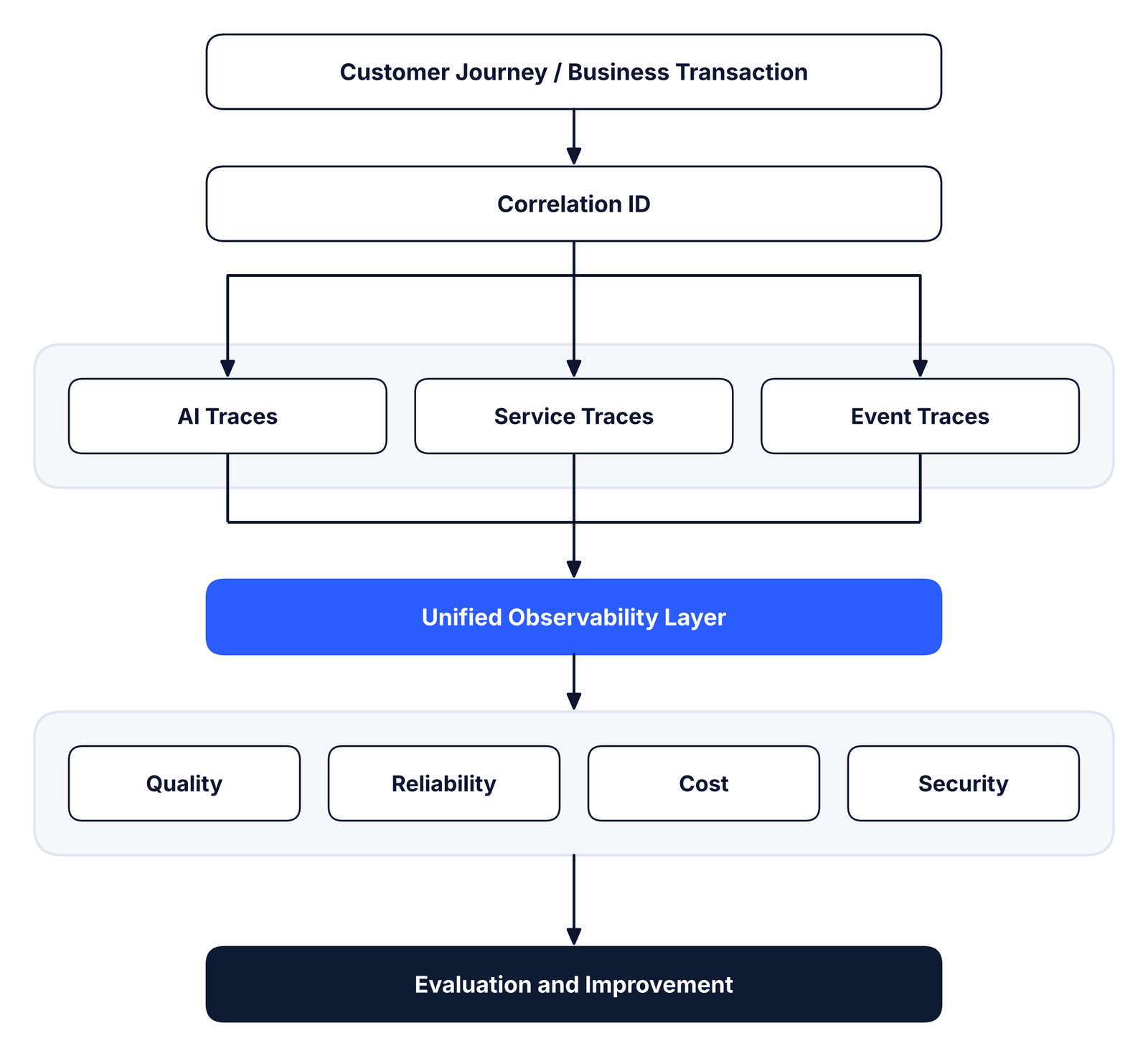
Figure 12 — Unified commerce and agent observability
| Metric Category | Representative Metrics |
|---|---|
| AI quality | Task success, groundedness, recommendation relevance |
| Agent execution | Steps per journey, retries, tool failures |
| Transaction health | Checkout completion, compensation, duplicate prevention |
| Performance | P50, P95 and P99 latency |
| Security | Policy denials, anomalous actions, injection detection |
| Cost | Tokens, model consumption and cost per successful task |
| Customer experience | Abandonment, satisfaction and escalation rates |
| Platform reliability | Availability, error budgets and recovery time |
14.6 Continuous Evaluation
Evaluation should cover more than response quality.
| Evaluation Dimension | Validation Approach |
|---|---|
| Intent understanding | Representative shopping objective dataset |
| Product relevance | Labeled relevance judgments |
| Constraint satisfaction | Automated budget and compatibility checks |
| Groundedness | Product claim verification |
| Tool correctness | Expected versus actual tool execution |
| Authorization | Adversarial permission and mandate tests |
| Transaction integrity | Failure injection and reconciliation tests |
| Tenant isolation | Cross-tenant penetration tests |
| Economic efficiency | Cost-per-task regression tests |
| Business value | Controlled experimentation |
Unauthorized transactions, cross-tenant leakage and duplicate financial commitments should be release-blocking failures.
15. Implementation and Deployment Strategy
15.1 Transformation Roadmap
A program of this scale should be delivered through incremental releases rather than a big-bang replacement of existing commerce infrastructure.
| Phase | Indicative Duration | Primary Deliverable |
|---|---|---|
| Phase 0 | 4–6 weeks | Discovery, business case and architecture assessment |
| Phase 1 | 6–8 weeks | Commerce API enablement and platform foundations |
| Phase 2 | 6–8 weeks | Intelligent product discovery |
| Phase 3 | 6–8 weeks | Assisted shopping and cart orchestration |
| Phase 4 | 8–12 weeks | Governed checkout and transactional integration |
| Phase 5 | 8–12 weeks | External agent interoperability |
| Phase 6 | 8–12 weeks | Bounded autonomous workflows |
| Phase 7 | Continuous | Regional expansion and business optimization |
These are indicative workstream durations. Parallel delivery may enable an initial enterprise release within approximately 9–12 months, subject to legacy integration complexity, regulatory requirements, staffing and organizational readiness.
15.2 Recommended MVP Scope
The first production MVP should focus on one commercially meaningful journey:
Intent-driven product discovery, comparison and assisted cart construction.
| Included in MVP | Deferred |
|---|---|
| One tenant and one geographic market | Global multi-region expansion |
| Selected product categories | Entire marketplace catalog |
| Hybrid product retrieval | Comprehensive knowledge graph |
| Product comparison | Autonomous price negotiation |
| Read-only inventory and price tools | Delegated inventory actions |
| Customer-approved cart creation | Autonomous checkout |
| Existing conventional checkout | New delegated payment infrastructure |
| Core agent governance | Advanced multi-party mandates |
| Evaluation and observability | Full enterprise agent fleet |
This MVP allows the organization to validate customer demand, AI quality and economic viability without exposing payment infrastructure to unnecessary early-stage risk.
15.3 AI-Native Software Delivery Lifecycle
Each agent capability should progress through a governed lifecycle.
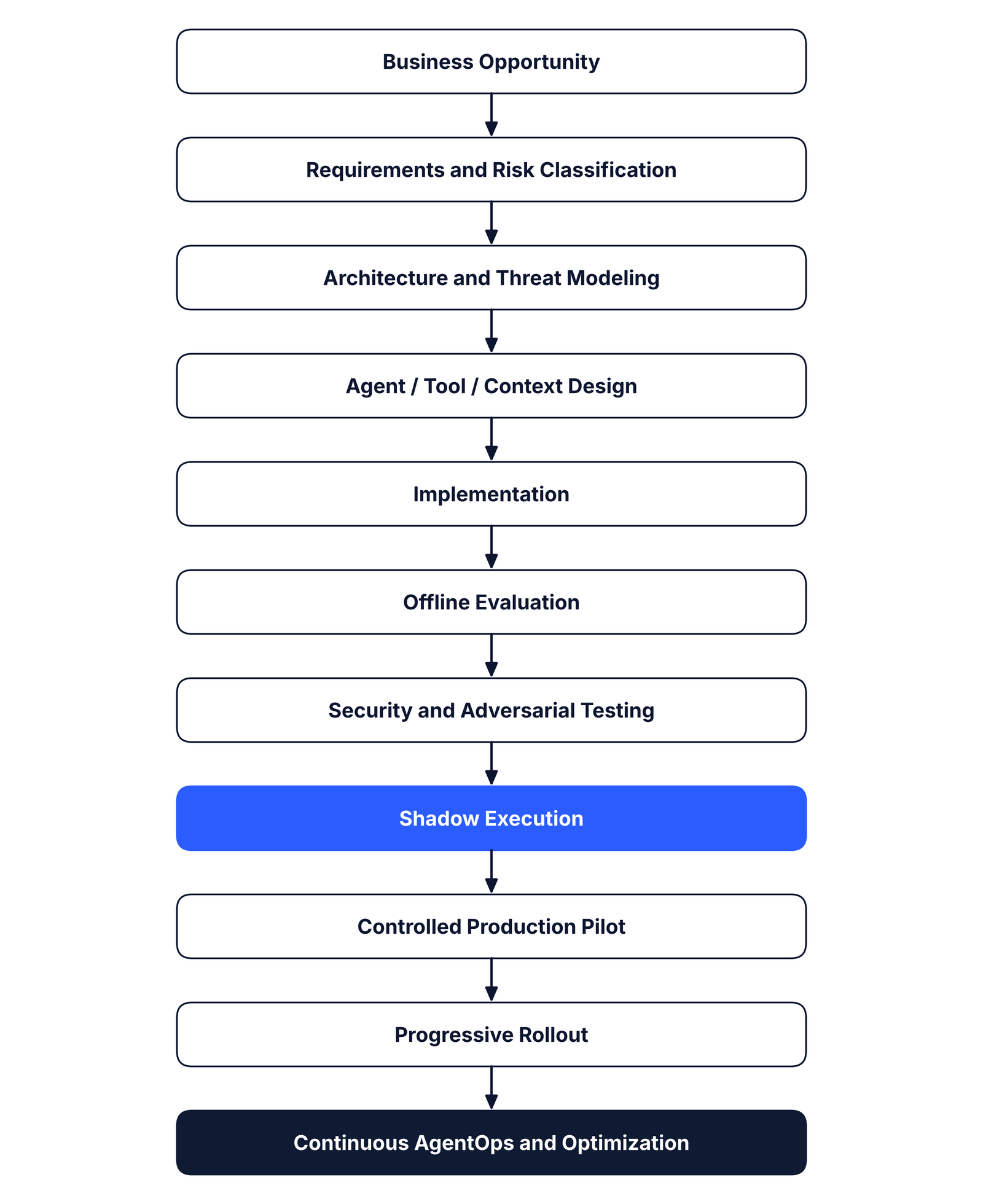
Figure 13 — Governed agentic software delivery lifecycle
15.4 Production Release Gates
| Gate | Exit Criteria |
|---|---|
| Business Gate | Journey and measurable value hypothesis approved |
| Architecture Gate | Integration contracts and ADRs reviewed |
| Data Gate | Data quality, permissions and freshness validated |
| Evaluation Gate | Task quality exceeds agreed thresholds |
| Security Gate | Critical threats mitigated and authorization tests passed |
| Reliability Gate | Load, failure and recovery tests passed |
| Economic Gate | Cost-per-task within agreed limits |
| Pilot Gate | Controlled production results justify expansion |
| Operational Gate | Runbooks, ownership and incident processes established |
Models, prompts, agent graphs, tools, retrieval configurations and policy versions should be treated as independently versioned deployment artifacts.
15.5 Enterprise Operating Model
The proposed ecosystem requires clear ownership boundaries.
| Team | Primary Accountability |
|---|---|
| Commerce Product Teams | Customer journeys and business outcomes |
| Commerce Domain Teams | Authoritative services and transaction integrity |
| Enterprise AI Platform Team | Agent runtimes, shared tools, evaluation and model access |
| Data and Context Team | Product knowledge, context quality and retrieval |
| Security and Governance | Policies, risk assessment and security controls |
| Platform Engineering and SRE | Infrastructure reliability and delivery automation |
| FinOps | AI cost attribution and optimization |
| Risk and Compliance | Financial and regulatory control |
| Merchant Operations | Seller readiness and commercial policies |
The proposed governance framework establishes an architecture governance forum to review high-impact architectural decisions and an AI governance mechanism to evaluate and approve transitions to higher levels of autonomy.
The commerce business remains accountable for commercial outcomes; the AI platform team is accountable for the enabling intelligence infrastructure.
15.6 Organizational Adoption
Technology delivery alone will not establish a successful agentic commerce ecosystem.
The transformation also requires customer education, merchant onboarding, support-team training, revised incident procedures and clear ownership of agent-generated recommendations.
Adoption should be measured by successful customer outcomes rather than the number of agents deployed.
16. Architectural Trade-offs and Alternatives
Enterprise architecture requires evaluating alternatives rather than assuming one design is universally optimal.
| Decision Area | Alternative | Selected Approach | Trade-off |
|---|---|---|---|
| Agent architecture | Fully autonomous agent swarm | Supervisor-controlled orchestration | More control, less unconstrained flexibility |
| Intelligence allocation | Frontier model for every task | Policy-based model routing | Additional routing and evaluation complexity |
| Commerce execution | Direct agent execution | Authoritative domain services | Stronger integrity with additional integration effort |
| Product retrieval | Vector-only search | Hybrid and structured retrieval | Higher indexing and retrieval complexity |
| Agent hosting | Self-managed Kubernetes | Managed AgentCore runtime | Reduced infrastructure effort but platform dependency |
| Workflow execution | Agent-only orchestration | Agent planning plus deterministic transaction workflows | Separate execution models |
| Tenant isolation | Fully dedicated deployment | Pooled, bridge and silo options | More sophisticated tenant governance |
| Multi-region | Unrestricted active-active writes | Regional transaction ownership | Lower write flexibility with improved consistency |
| External interoperability | Protocol-specific core platform | Canonical contracts and adapters | Additional abstraction |
| Modernization | Replace existing commerce systems | Incremental API enablement and modernization | Temporary coexistence complexity |
16.1 Build versus Buy
| Capability | Recommended Strategy |
|---|---|
| Commodity commerce capabilities | Reuse existing commerce platforms where adequate |
| Payment processing | Integrate established payment providers |
| Foundation model serving | Prefer managed services initially |
| Agent execution infrastructure | Prefer managed infrastructure |
| Business-specific orchestration | Build |
| Enterprise context composition | Build or customize |
| Commerce authorization policies | Build and retain ownership |
| Product intelligence differentiation | Build selectively |
| Monitoring infrastructure | Combine managed and open standards |
| Evaluation datasets | Build using enterprise-specific scenarios |
The organization should invest engineering effort in differentiating commerce experiences, reliable orchestration and business intelligence rather than recreating mature commodity infrastructure.
17. Cost and Unit Economics
17.1 AI Economic Architecture
Traditional commerce economics are substantially affected by agentic AI because intelligent interactions introduce variable computation and execution costs.
The platform must measure the cost of completing a useful business objective rather than only the cost of model inference.
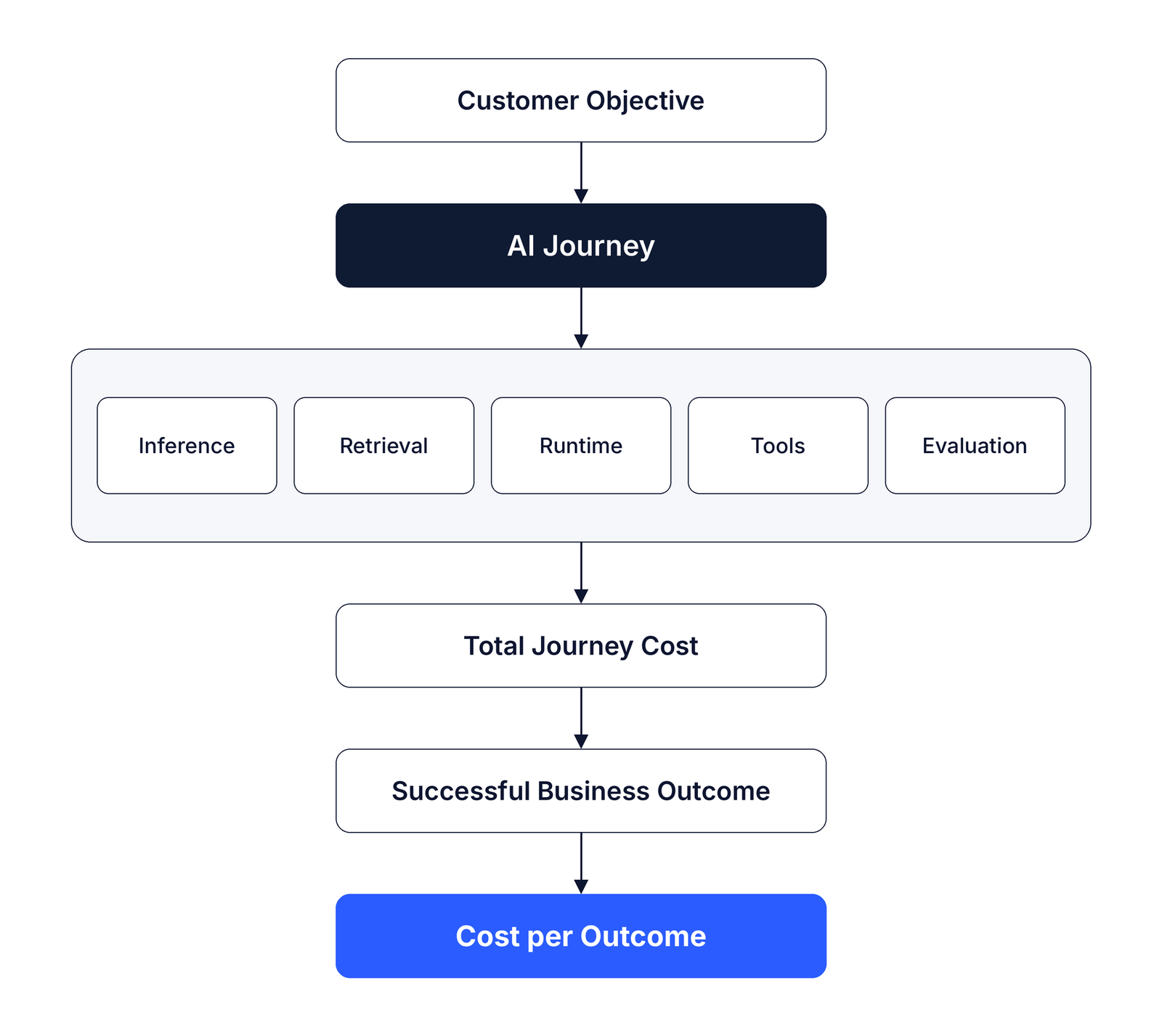
Figure 14 — AI unit economics model
17.2 Illustrative Monthly Cost Model
Assume 400,000 monthly AI-assisted journeys during an initial rollout.
| Variable Cost Component | Assumed Cost per Journey | Monthly Cost |
|---|---|---|
| Model inference | $0.020 | $8,000 |
| Search and retrieval | $0.006 | $2,400 |
| Agent execution | $0.005 | $2,000 |
| Tool execution | $0.004 | $1,600 |
| Variable evaluation and telemetry | $0.005 | $2,000 |
| Total variable cost | $0.040 | $16,000 |
These values are scenario assumptions, not AWS service quotations.
Actual costs depend on model choice, tokens, tool execution frequency, cache effectiveness, region and workload characteristics.
| Recurring Fixed Cost Component | Illustrative Monthly Cost |
|---|---|
| Incremental shared platform infrastructure | $10,000 |
| Fixed security and monitoring services | $5,000 |
| Production operations allocation | $20,000 |
| Total recurring fixed cost | $35,000 |
Total illustrative recurring monthly AI operating cost: $51,000.
17.3 Illustrative Revenue and Contribution Model
Assume the following:
| Parameter | Value |
|---|---|
| Monthly sessions exposed to AI-enabled experience | 2,000,000 |
| Sessions actively using AI assistance | 400,000 |
| Baseline conversion rate | 3.0% |
| Target treatment conversion rate | 3.3% |
| Relative conversion improvement | 10% |
| Average order value | $80 |
| Incremental contribution margin | 20% |
The conversion uplift is measured across all eligible treatment sessions, not only customers who choose to use AI.
| Business Impact | Monthly Projection |
|---|---|
| Baseline orders | 60,000 |
| Projected treatment orders | 66,000 |
| Incremental orders | 6,000 |
| Incremental gross merchandise value | $480,000 |
| Incremental contribution before AI costs | $96,000 |
| Recurring AI operating costs | $51,000 |
| Projected incremental contribution after AI costs | $45,000 |
The 20% contribution margin is an assumption after relevant merchandise and variable commerce costs, but before incremental AI operating costs.
For a marketplace commission-based business, the model must instead account for take rate, seller settlement economics and attributable platform contribution.
17.4 Break-Even Analysis
At an average order value of $80 and an incremental contribution margin of 20%, each additional order contributes $16 before AI operating costs.
The illustrative monthly recurring operating break-even point is approximately 3,188 incremental orders.
Across two million eligible monthly sessions, this corresponds to an absolute conversion improvement of approximately 0.159 percentage points, or a relative improvement of approximately 5.31% over the 3% baseline.
| Relative Conversion Uplift | Incremental Orders | Incremental Contribution Before AI Cost | Net Monthly Contribution |
|---|---|---|---|
| 2% | 1,200 | $19,200 | -$31,800 |
| 5% | 3,000 | $48,000 | -$3,000 |
| 10% | 6,000 | $96,000 | $45,000 |
| 15% | 9,000 | $144,000 | $93,000 |
| 20% | 12,000 | $192,000 | $141,000 |
This sensitivity analysis holds AI usage and operating costs constant to isolate the effect of conversion uplift.
17.5 Cost per Successful Agent Journey
If 90% of the 400,000 AI-assisted journeys are successful, the fully allocated recurring cost per successful journey would be approximately $0.142.
The marginal cost of $0.04 per attempted journey should not be confused with the fully allocated cost per successful outcome.
17.6 Investment Evaluation
The preceding analysis represents recurring operating contribution, not complete project ROI.
A full investment assessment must also include:
- Initial engineering and integration expenditure.
- Legacy modernization costs.
- Data remediation.
- Compliance and security assessment.
- Merchant onboarding and organizational change.
- Dual-running and migration costs.
- Future platform expansion.
- Discounted cash flow and capital recovery.
No investment payback period should be claimed until these costs have been established.
17.7 Cost Optimization Strategies
| Strategy | Expected Economic Benefit |
|---|---|
| Small-model routing | Reduce routine inference expenditure |
| Context compression | Reduce token consumption |
| Semantic and deterministic caching | Avoid unnecessary repeated operations |
| Parallel independent tool calls | Improve task completion efficiency |
| Maximum reasoning budgets | Contain unproductive execution |
| Deterministic workflow substitution | Eliminate unnecessary inference |
| Tenant-level metering | Enable accurate cost attribution |
| Asynchronous processing | Improve resource utilization |
| Continuous model evaluation | Identify cost-effective alternatives |
The economic objective is not to minimize AI cost in isolation. It is to maximize incremental business contribution per unit of intelligence consumed.
18. Expected Business Outcomes and KPIs
18.1 Enterprise Value Realization
| Value Dimension | Expected Outcome | Measurement |
|---|---|---|
| Revenue | Improved conversion | Controlled conversion experiments |
| Basket value | More relevant product bundles | Average order value and margin |
| Customer experience | Reduced shopping effort | Task completion time |
| Product discovery | Improved relevance | Search success and relevance scores |
| Customer service | Reduced routine workload | Eligible ticket containment |
| Merchant productivity | Faster operational insight | Time to identify and resolve issues |
| Platform agility | Faster capability reuse | Integration and release lead time |
| Ecosystem participation | New agent-driven sales channels | Incremental external-agent orders |
| Commercial sustainability | Positive incremental contribution | Finance-validated unit economics |
18.2 Executive KPI Scorecard
| KPI | Illustrative Baseline | Target |
|---|---|---|
| Conversion rate | 3.0% | 3.15–3.30% |
| Average order value | $80 | $82.40–$86.40 |
| Shopping decision time | 12 minutes | 7.2–9.6 minutes |
| Customer satisfaction | 78/100 | 85+/100 |
| Eligible support containment | 15% | 30–50% |
| Successful agent journeys | Not available | ≥90% |
| Hard constraint compliance | Not available | 100% for accepted test transactions |
| Unauthorized purchases | Zero target | Zero tolerance |
| Checkout availability | To be measured | 99.99% |
| Fully allocated AI cost per successful journey | Not available | ≤$0.15 under the modeled workload |
| Incremental recurring contribution | Not available | Positive |
The assumed average order value improvement is not included in the conversion-only financial projection in Section 17.
18.3 Business Value Validation Framework
The program should establish a controlled experimentation methodology.
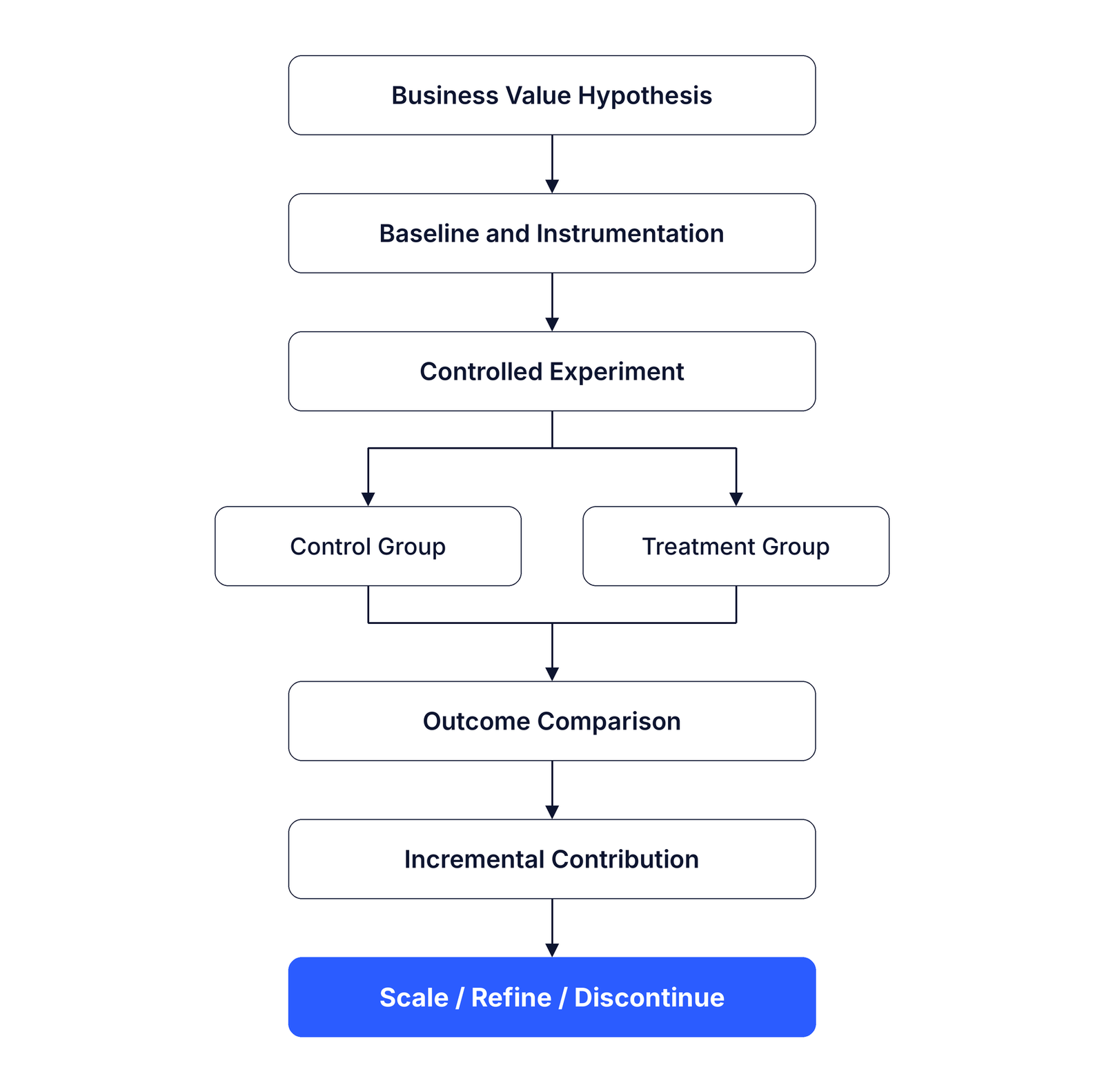
Figure 15 — Evidence-driven business value validation
Experiments should account for product category, seasonality, customer segment, traffic source, promotions and selection bias.
The organization should monitor returns, chargebacks, customer complaints, trust indicators and contribution margin as guardrail metrics.
A higher conversion rate is not a successful outcome if it results in disproportionate returns, misleading purchases or customer harm.
19. Risks and Mitigation Strategies
19.1 Enterprise Risk Register
| Risk | Impact | Priority | Mitigation | Accountable Owner |
|---|---|---|---|---|
| Incorrect recommendations | Returns and reputational damage | High | Grounded retrieval and structured validation | Commerce Product |
| Unauthorized purchases | Financial and regulatory exposure | Critical | Mandate validation and deterministic authorization | Risk and Payments |
| Prompt injection | Tool abuse and data disclosure | Critical | Isolation, allowlisted tools and adversarial testing | Security |
| Cross-tenant leakage | Confidentiality violations | Critical | Tenant-aware authorization and isolation testing | Platform Engineering |
| Stale inventory | Failed fulfillment | High | Live validation and reservations | Inventory Domain |
| Duplicate charges | Financial loss and disputes | Critical | Idempotency and payment reconciliation | Payment Domain |
| Unbounded AI costs | Margin deterioration | High | Budgets, quotas and model routing | FinOps |
| Agent workflow failure | Customer abandonment | High | Checkpoints, safe fallback and observability | AI Platform |
| Vendor dependency | Reduced architectural flexibility | Medium | Portable orchestration and canonical contracts | Architecture |
| Protocol fragmentation | Integration complexity | High | Versioned protocol adapters | Integration Platform |
| Legacy integration failure | Program delays | High | Incremental API enablement | Commerce Engineering |
| Biased recommendations | Loss of customer trust | High | Ranking governance and disclosures | Product and Compliance |
| Low customer adoption | Insufficient business returns | High | Controlled pilots and experience optimization | Commerce Product |
| Regulatory change | Compliance exposure | High | Jurisdiction-specific policy reviews | Compliance |
19.2 Architectural Stop Conditions
Certain conditions must automatically suspend the affected agent capability.
Examples include confirmed unauthorized purchases, cross-tenant data exposure, unexplained duplicate charges, critical policy bypass, uncontrolled expenditure and material discrepancies between approved and executed commercial terms.
The architecture must support independently disabling an agent, tool, model, tenant integration or autonomy level without requiring the entire commerce platform to be taken offline.
19.3 Strategic Risks Beyond Technology
The most consequential risk may not be model failure.
It may be delivering a technically sophisticated platform that customers do not trust, merchants do not adopt or the business cannot operate profitably.
For this reason, each major architectural investment should be tied to a validated business hypothesis.
20. Future Evolution Roadmap
20.1 From AI-Assisted Commerce to Ecosystem Intelligence
The proposed architecture creates a foundation for progressive commerce transformation.
| Horizon | Strategic Focus | Emerging Capabilities |
|---|---|---|
| Horizon 1: 0–6 months | AI-assisted commerce | Product discovery, comparison and assisted cart creation |
| Horizon 2: 6–12 months | Governed agentic commerce | Controlled checkout, customer service and merchant assistance |
| Horizon 3: 12–24 months | Interoperable commerce | External shopping agents, bounded mandates and partner integration |
| Horizon 4: 24–36 months | Autonomous commerce operations | Replenishment, intelligent fulfillment and supervised merchandising |
| Horizon 5: 36+ months | Intelligent commerce ecosystems | Cross-enterprise coordination, delegated purchasing and multi-party commerce |
These horizons represent an illustrative evolution strategy, not predictions of guaranteed industry adoption.
20.2 Future Architectural Extensions
Personal Commerce Agents
Persistent, customer-authorized agents capable of managing shopping preferences, budgets, recurring requirements and purchase objectives across compatible commerce channels.
Intelligent Merchant Agents
Merchant agents that evaluate demand signals, improve catalog quality, propose promotions and coordinate inventory actions within approved commercial policies.
Autonomous Supply Chain Coordination
Agent-assisted coordination among commerce, warehouse, logistics and supplier systems to improve fulfillment planning and exception management.
Cross-Enterprise Agent Networks
Secure interoperability between customer agents, merchant agents, payment providers and logistics agents through standardized interfaces and verifiable authorization.
Multimodal Commerce
Shopping experiences that incorporate images, voice, video and structured product information into a unified interaction.
Enterprise Commerce Digital Twins
Simulation environments capable of evaluating inventory strategies, fulfillment policies, promotional campaigns and operational interventions before approved production execution.
20.3 Long-Term Architectural Vision
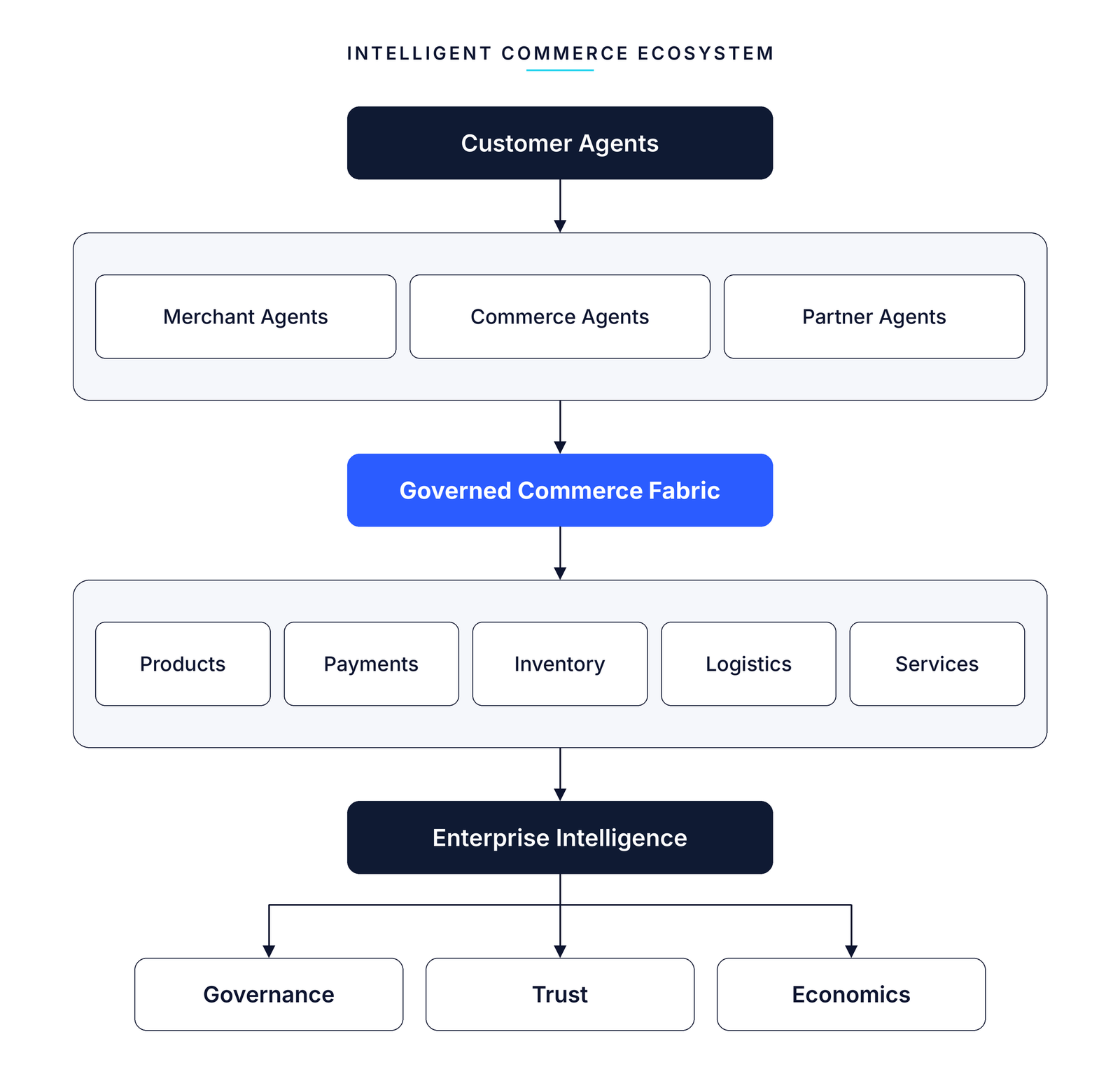
Figure 16 — Long-term intelligent commerce ecosystem vision
The long-term opportunity is not simply to automate the storefront. It is to create a governed commerce fabric in which intelligent participants coordinate business objectives through interoperable capabilities, verifiable permissions and authoritative transaction systems.
Conclusion
Architecting the Future of Commerce
The emergence of agentic commerce represents more than another evolution in digital customer experience.
It challenges the fundamental architectural assumptions upon which modern commerce platforms have been built.
Enterprises must prepare for an environment in which customers increasingly delegate objectives, agents coordinate complex interactions, and commerce capabilities are consumed across organizational and technological boundaries.
However, the success of agentic commerce will not be determined solely by the sophistication of foundation models or the number of autonomous agents deployed.
It will depend on the enterprise's ability to combine intelligent reasoning with reliable business execution, contextual awareness with privacy, autonomy with accountability, and innovation with economic sustainability.
The proposed Agentic Commerce Ecosystem demonstrates how composable commerce, enterprise context engineering, agentic orchestration, multi-tenant platforms, event-driven architecture and governed transaction execution can converge into a coherent enterprise architecture.
My architectural perspective is that the next generation of commerce platforms must be designed around three complementary responsibilities:
- Intelligence determines what could or should happen.
- Governance determines what is permitted to happen.
- Authoritative commerce services determine what actually happens.
This separation provides the foundation for commerce ecosystems that are intelligent, scalable, interoperable, trustworthy and commercially sustainable.
The future of commerce is not merely conversational. It is intelligent, agent-enabled and governed by architecture.
Technical References and Further Reading
- AWS — Guidance for Unified Commerce on AWS
- Amazon Bedrock AgentCore
- AWS Prescriptive Guidance — Cloud Design Patterns
- AWS Prescriptive Guidance — Saga Orchestration Pattern
- AWS Prescriptive Guidance — Transactional Outbox Pattern
- Agentic Commerce Protocol — Official Specification
- Google — Universal Commerce Protocol
- Agent Payments Protocol — AP2 Documentation
- OWASP — Top 10 for Agentic Applications
- PCI Security Standards Council — PCI DSS
These references support the underlying technological capabilities, architectural patterns and security considerations. The integrated architecture, enterprise scenario and projected business outcomes presented in this case study constitute a proposed conceptual solution.
Industry Solution Blueprints
Architecting the Future of Enterprise Solutions
Business-Driven · Architecture-Led · Technology-Enabled · Outcome-Oriented