Defining the AI Technology Roadmap
From Business Strategy to a Sequenced, Architecture-Informed Target State
A practical guide to business outcomes, opportunity portfolios, capability and architecture definition, trust and governance, economics, sequencing, and defensible technology decisions
Definition is the controlled conversion of business strategy into an evidence-based, sequenced plan of capabilities, architecture, technology choices, and investments that an organization can authorize and execute.
Contents
- Preface
- Executive Summary
- [Part I. Establish the Meaning and Boundaries]
- [Part II. Start with Business Outcomes]
- [Part III. Build and Prioritize the Opportunity Portfolio]
- [Part IV. Assess the Current State]
- [Part V. Define the Target Capabilities and Architecture]
- [Part VI. Define Trust, Governance, and Operating Requirements]
- [Part VII. Evaluate Economics and Investment]
- [Part VIII. Sequence the Roadmap]
- [Part IX. Make Technology Decisions Defensible]
- [Part X. Govern the Roadmap as a Portfolio]
- [Part XI. The End-to-End Method]
- [Part XII. Worked Example]
- [Part XIII. Roadmap Artefacts and Templates]
- 32. Recommended Deliverable Structure
- 33. Template: Business Outcome Register
- 34. Template: AI Opportunity Assessment
- 35. Template: Current-to-Target Capability Gap
- 36. Template: Technology Decision Record
- 37. Template: Roadmap Initiative
- 38. Template: Roadmap Assumption and Trigger Register
- 39. Template: Executive Roadmap View
- [Part XIV. Common Failure Modes]
- [Part XV. Quality Criteria and Final Checklist]
- Conclusion
- Appendix A. Engineering Practice Crosswalk
- Appendix B. Framework and Regulatory Crosswalk
- Appendix C. Glossary
Preface
Most enterprise AI programs do not fail because the models are weak. They fail because the surrounding decisions were never made explicitly: which business outcomes justify the investment, which capabilities are missing, which architecture those capabilities require, and in what order they should be established. A list of use cases, a vendor shortlist, and a set of delivery dates can look like a roadmap while leaving every one of those decisions unanswered.
This guide offers a disciplined method for making those decisions. It translates business outcomes into opportunities, capabilities, architecture, technology choices, investment options, and a defensible sequence. Every commitment carries a rationale and supporting evidence, so that the result can be reviewed by executives, architecture boards, and engineering teams with equal confidence.
Who This Guide Is For
The primary readers are CTOs, CIOs, Chief AI Officers, Heads of AI, principal AI architects, enterprise architects, and engineering and platform leaders who must decide what to build, buy, partner on, or reuse in order to apply AI at scale. The guide assumes familiarity with enterprise architecture, portfolio planning, and technology governance. It does not assume deep knowledge of model training.
Engineering organizations that already operate mature software, data, ML, and reliability practices will find that the method plugs into what they have rather than replacing it. Appendix A maps each stage of the method to familiar engineering artefacts and rituals: design documents, architecture decision records, SLOs, launch reviews, threat models, experimentation, and FinOps.
How This Guide Is Organized
The guide has fifteen parts. Parts I to X define the method. Parts XI to XV show how to apply it, package the result, and assess its quality. Appendices provide an engineering-practice crosswalk, a regulatory and framework crosswalk, a glossary, and suggested reading.
| Stage | Question it answers | Parts |
|---|---|---|
| Frame | What is a roadmap, how does it differ from neighboring plans, and what is in scope? | I |
| Anchor in the business | Which outcomes matter, and where can AI contribute to them? | II |
| Build the portfolio | Which opportunities are worth pursuing, and how do they fit together? | III |
| Assess the current state | Where does the organization stand, and what constrains it? | IV |
| Define the target | Which capabilities, architecture, sourcing choices, and platform boundaries are required? | V |
| Establish trust and operations | Which governance, risk, and operating requirements must be designed in? | VI |
| Evaluate economics | What will it cost to build and operate, and what value is expected? | VII |
| Sequence | In what order should capabilities and investments be established? | VIII |
| Make decisions defensible | How are technology choices evaluated and recorded? | IX |
| Govern as a portfolio | Who decides, and how is progress measured and the roadmap refreshed? | X |
| Apply and check | How does the method run end to end, and is the result decision-ready? | XI–XV |
Scope and Boundaries
This guide covers roadmap definition: the decisions and artefacts required to authorize execution. Delivery management, engineering implementation, deployment, and day-to-day operations belong to the companion volume, Executing the AI Technology Roadmap.
Using This Guide in a Large Organization
Organizations with established strategy, architecture, and portfolio processes do not need a parallel AI process. The method is designed to connect to existing governance:
- Placement. The roadmap sits between business and AI strategy on one side and the use-case portfolio, reference architecture, and delivery plans on the other. Chapter 2 shows how these artefacts differ so that each is owned and reviewed in the right forum.
- Planning cycles. Scope, horizons, and decision rights are set explicitly (Chapters 3, 22, and 27) so the roadmap aligns with existing planning and funding cycles.
- Decision records. Technology choices are recorded with criteria, alternatives, and evidence (Chapters 24 and 36), which fits architecture review boards and investment committees.
- Living governance. Chapters 28 and 29 describe roadmap governance and portfolio-level measures, including review triggers that keep the roadmap current as evidence changes.
Conventions Used in This Guide
- Technology neutrality. The guide describes capabilities and decision criteria, not specific products or vendors.
- Templates. Tables and templates show the shape of an artefact. Adapt them to your organization's formats and tooling.
- Hypotheses, not commitments. Examples of objectives, opportunities, and technology implications are hypotheses to investigate.
- Illustrative figures. Weights, thresholds, and percentages are examples. Calibrate them to your context.
- Checklists. Checklists use
- [ ]so they can be pasted into review documents. - Callouts. Engineering lens notes connect a concept to common engineering practice. Key takeaways close each part.
A Note on Terminology
| Term | Meaning in this guide |
|---|---|
| Capability | An enduring ability of the organization, independent of any specific product |
| Initiative | A bounded body of work that establishes, improves, or retires a capability or delivers an outcome |
| Horizon | A planning band (Establish, Scale, Transform) rather than a fixed calendar date |
| Decision gate | An evidence-based checkpoint that must be passed before further commitment |
| Commitment class | The firmness of a roadmap item: approved, planned, conditional, exploratory, deferred, or rejected |
| Enabler | A shared capability (data, platform, governance, identity, integration) that unlocks multiple use cases |
Executive Summary
An AI technology roadmap is a strategically sequenced plan to establish, acquire, integrate, govern, and evolve the technology capabilities needed to achieve business objectives through AI.
It is not a product catalogue, a proof-of-concept list, a use-case inventory, or a delivery schedule disguised as strategy. It translates strategic intent through a chain of explicit decisions:
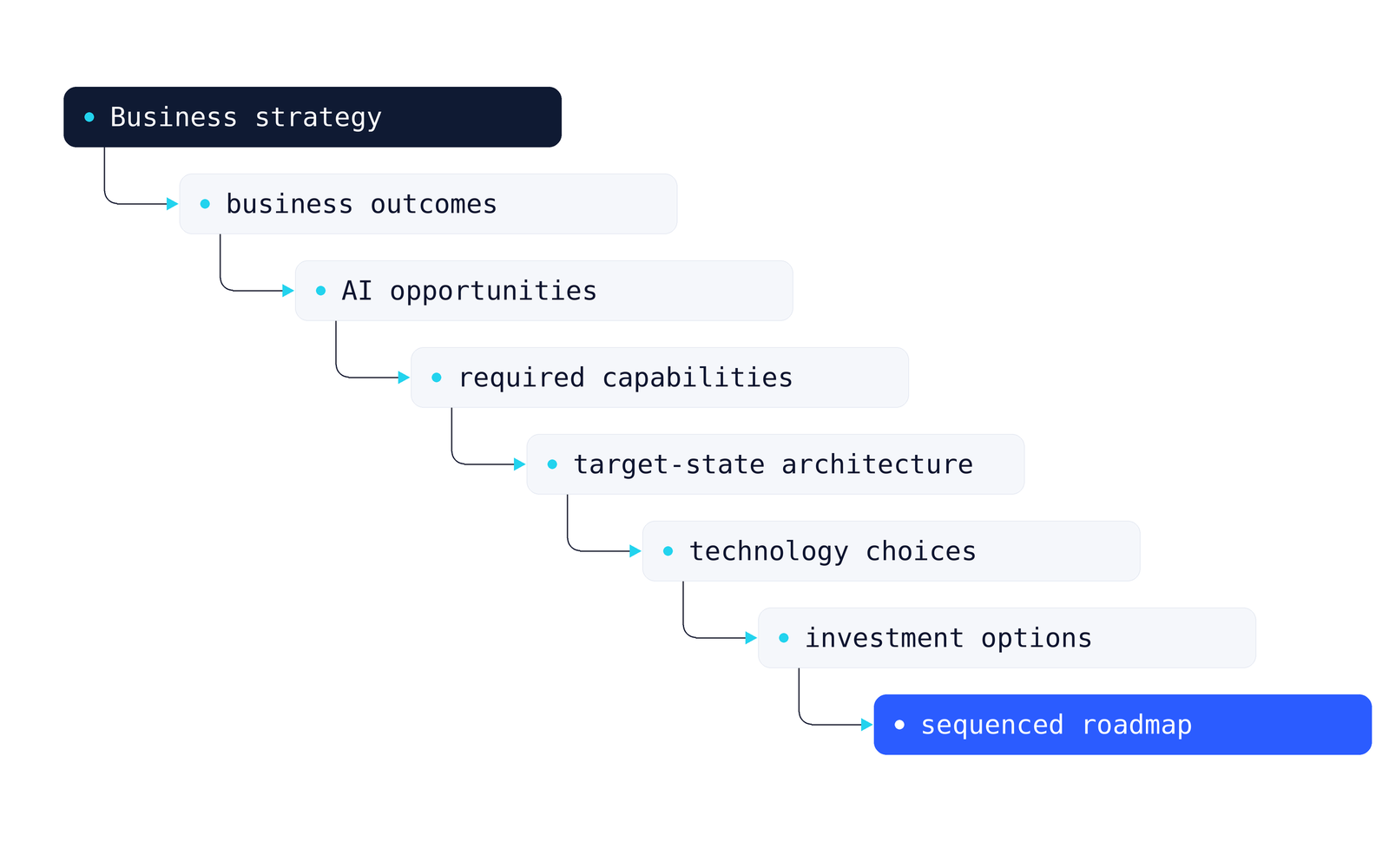
Figure 1. The roadmap translation chain. Each arrow is a decision that should be recorded, evidenced, and reviewable.
The Five Questions
| # | Question | What the roadmap must provide |
|---|---|---|
| 1 | Why | The business outcomes AI should help achieve |
| 2 | What | The AI-enabled business capabilities and technology capabilities required |
| 3 | How | The data, model, platform, integration, security, and operating foundations needed |
| 4 | When | The order of capabilities and investments, given dependencies, risk, readiness, and value |
| 5 | How will success be judged | The business, technology, operational, adoption, and risk measures that demonstrate progress |
Eight Properties of a Sound Roadmap
- Business-led. It begins with enterprise objectives and measurable business problems.
- Capability-oriented. It describes enduring capabilities, not only individual projects.
- Architecture-informed. It establishes coherent principles, boundaries, patterns, and standards.
- Evidence-based. It reflects the current state, constraints, maturity, and validated assumptions.
- Economically grounded. It considers total cost, value, opportunity cost, and the cost of operating AI at scale.
- Risk-aware. It incorporates privacy, security, safety, legal, regulatory, and model-related risks.
- Sequenced. It exposes dependencies and distinguishes foundational work from use-case delivery.
- Adaptive. It is reviewed as business conditions, technology, evidence, and readiness change.
The defining principle. An AI technology roadmap is not a plan to adopt AI technologies. It is a plan to establish the enterprise capabilities through which AI can deliver measurable, secure, reliable, and economically sustainable business value.
Part I. Establish the Meaning and Boundaries
In this part: what a roadmap is, how it differs from adjacent artefacts, and how to scope it so it stays manageable.
1. What Is an AI Technology Roadmap?
An AI technology roadmap is a business-aligned, time-phased plan defining the capabilities, architecture, platforms, data foundations, governance, skills, and investments required to deliver and sustain the organization's AI ambitions.
The definition contains three ideas.
1.1 It Is an Organizational Plan, Not a Technology Shopping List
A roadmap defines the enterprise's future ability to apply AI across business domains, applications, data, infrastructure, people, processes, suppliers, controls, and operating models.
Choosing a foundation model or a cloud AI service is a decision within the roadmap. It is not the roadmap itself.
1.2 It Is Technology-Focused but Business-Derived
The roadmap does not replace business or AI strategy. It translates their intent into technology direction.
| Business objective | Possible AI contribution | Technology implications |
|---|---|---|
| Reduce claims-processing cost | Extract, classify, validate, and summarize claims information | Document intelligence, workflow integration, rules, human review, model evaluation |
| Improve customer retention | Identify churn risk and recommend interventions | Governed customer data, predictive models, decision services, CRM integration |
| Improve employee productivity | Make enterprise knowledge easier to find and use | Search, retrieval-augmented generation (RAG), identity-aware access, source attribution |
| Shorten service resolution time | Assist agents and automate suitable workflow steps | Conversational interfaces, knowledge services, agent orchestration, tool controls |
| Reduce fraud losses | Detect unusual patterns and prioritize investigations | Feature pipelines, anomaly detection, graph analytics, case-management integration |
The technology implications are hypotheses to investigate, not automatic commitments to specific products.
1.3 It Is Sequenced and Revisable
A roadmap identifies the order in which capabilities and investments should be established, and recognizes that some capabilities are prerequisites for others. Scaling enterprise RAG, for example, may depend on:
- reliable source systems and clear data ownership;
- identity-aware access to information;
- content classification and retention policies;
- retrieval and evaluation standards;
- application integration and operational monitoring.
The roadmap exposes these dependencies. It is revised when evidence invalidates an assumption or when business priorities change.
Engineering lens. Treat the roadmap as you would a long-lived design document: it has an owner, a change history, explicit assumptions, and review triggers. It is a living artefact, not a one-time deliverable.
2. Distinguish the Roadmap from Related Strategies and Plans
The following artefacts are connected but answer different questions.
| Artefact | Primary question | Typical content |
|---|---|---|
| Business strategy | Where will the organization compete and what outcomes matter? | Growth, customer, cost, product, market, operating priorities |
| AI strategy | Where and why should the organization apply AI? | AI ambition, strategic domains, value thesis, risk appetite, adoption principles |
| AI technology roadmap | What technology capabilities and investments are needed, and in what sequence? | Capability gaps, target architecture, platforms, standards, dependencies, investment horizons |
| AI use-case portfolio | Which specific opportunities should be explored or delivered? | Descriptions, owners, value hypotheses, feasibility, risk, status |
| Enterprise AI reference architecture | What reusable structures and patterns should solutions follow? | Architecture views, components, interfaces, controls, deployment patterns |
| AI implementation or delivery plan | How will an approved initiative be delivered? | Scope, backlog, team, milestones, engineering tasks, testing, release |
| AI operating model | How will AI capabilities be owned, governed, supported, and improved? | Roles, decision rights, service ownership, controls, support model |
A quick diagnostic.
- If the document mainly lists business opportunities, it is a use-case portfolio.
- If it mainly describes products and vendors, it is a technology inventory or selection document.
- If it describes components and their relationships, it is an architecture.
- If it describes tasks, sprints, and release dates, it is an implementation plan.
- If it connects business outcomes to required capabilities, architectural direction, investment choices, and sequencing, it is functioning as a technology roadmap.
3. Define the Scope Before Designing the Roadmap
An enterprise roadmap becomes unmanageable without clear boundaries. Define scope across these dimensions.
| Scope dimension | Questions to resolve |
|---|---|
| Organizational | Enterprise-wide, business unit, geography, subsidiary, or product line? |
| Business domains | Which processes, products, customer journeys, and internal functions are included? |
| AI scope | Traditional ML, predictive analytics, deep learning, GenAI, RAG, agents, optimization, or a combination? |
| Technology estate | Cloud, on-premises, edge, SaaS, legacy applications, data platforms, and integration estate? |
| Risk and regulation | Which jurisdictions, data classes, industry rules, and assurance obligations apply? |
| Planning horizon | What is the near-term window, and what longer-term direction is useful? |
| Investment boundary | Does the roadmap include people, data remediation, platform engineering, licensing, and operating expenditure? |
| Exclusions | Which systems, domains, experiments, or technology decisions are explicitly out of scope? |
Include only technologies justified by business need, risk, existing assets, and organizational capacity.
3.1 Choose a Useful Planning Horizon
Distinguish three horizons:
- Near term: establish urgent capabilities and deliver opportunities with a credible path to value.
- Medium term: scale reusable capabilities, address cross-domain dependencies, and expand adoption.
- Longer term: position the enterprise for emerging capabilities and strategic options without pretending distant forecasts are certain.
A three-year view is common but not universal. Fast-changing environments may need a shorter rolling horizon. Use dates only when they inform investment or governance decisions.
Key Takeaways — Part I
- A roadmap is an organizational plan for capabilities, not a list of products or pilots.
- It is business-derived, technology-focused, sequenced, and revisable.
- Scope it explicitly before designing it, and say what is out of scope.
Part II. Start with Business Outcomes
In this part: how to ground the roadmap in measurable business outcomes and decide where AI is, and is not, the right intervention.
4. Understand the Business Before Selecting AI
Start from the organization's strategy, operating model, economics, customers, constraints, and performance, not from a model. A roadmap that begins with fashionable technology tends to produce disconnected pilots. A roadmap that begins with business outcomes can make defensible choices about where AI is useful, where it is not, and what must change around it.
4.1 Examine the Business Context
Review sources such as:
- corporate and business-unit strategy;
- annual operating plans and financial targets;
- product and market strategy;
- customer experience objectives;
- process performance and service-level reports;
- cost, productivity, and quality baselines;
- risk registers, audit findings, and compliance obligations;
- digital, cloud, data, and application modernization plans;
- existing automation and analytics initiatives;
- leadership interviews and domain workshops.
4.2 Express Objectives as Measurable Outcomes
Avoid vague objectives such as "become AI-driven" or "adopt agentic AI." Convert them into observable outcomes.
| Statement | |
|---|---|
| Weak | Use GenAI to improve customer service. |
| Strong | Reduce average handling time for eligible customer-service interactions by 15% while maintaining or improving customer satisfaction, policy compliance, and first-contact resolution. |
A well-formed outcome specifies:
- the population or process;
- the metric and its baseline;
- the target and timeframe;
- quality and risk guardrails;
- the accountable owner.
Engineering lens. This is the same discipline as writing an OKR with a guardrail metric, or defining an SLO before building a service. If you cannot state the metric and the guardrail, you cannot tell whether the system worked.
4.3 Build an Outcome Hierarchy
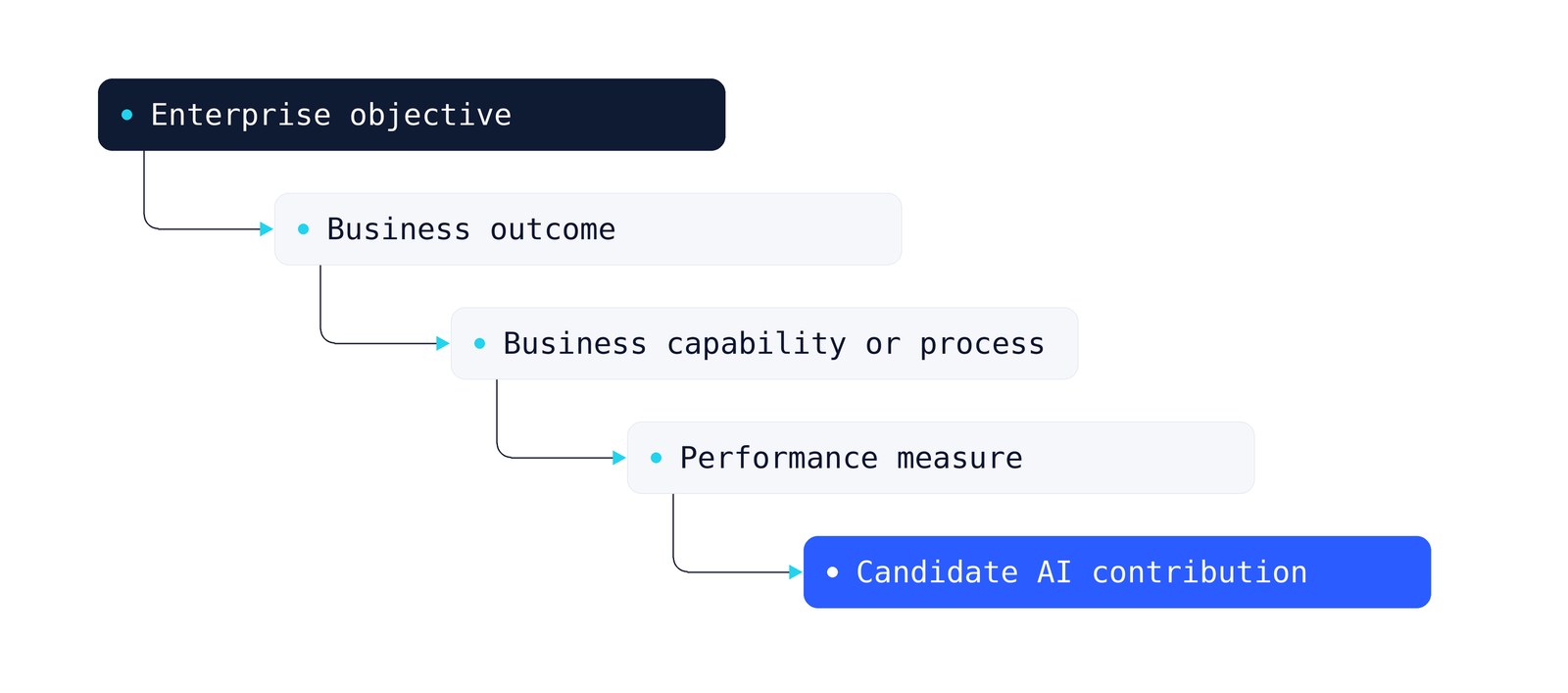
Figure 2. The outcome hierarchy links enterprise objectives to operational measures and candidate AI contributions.
Example:
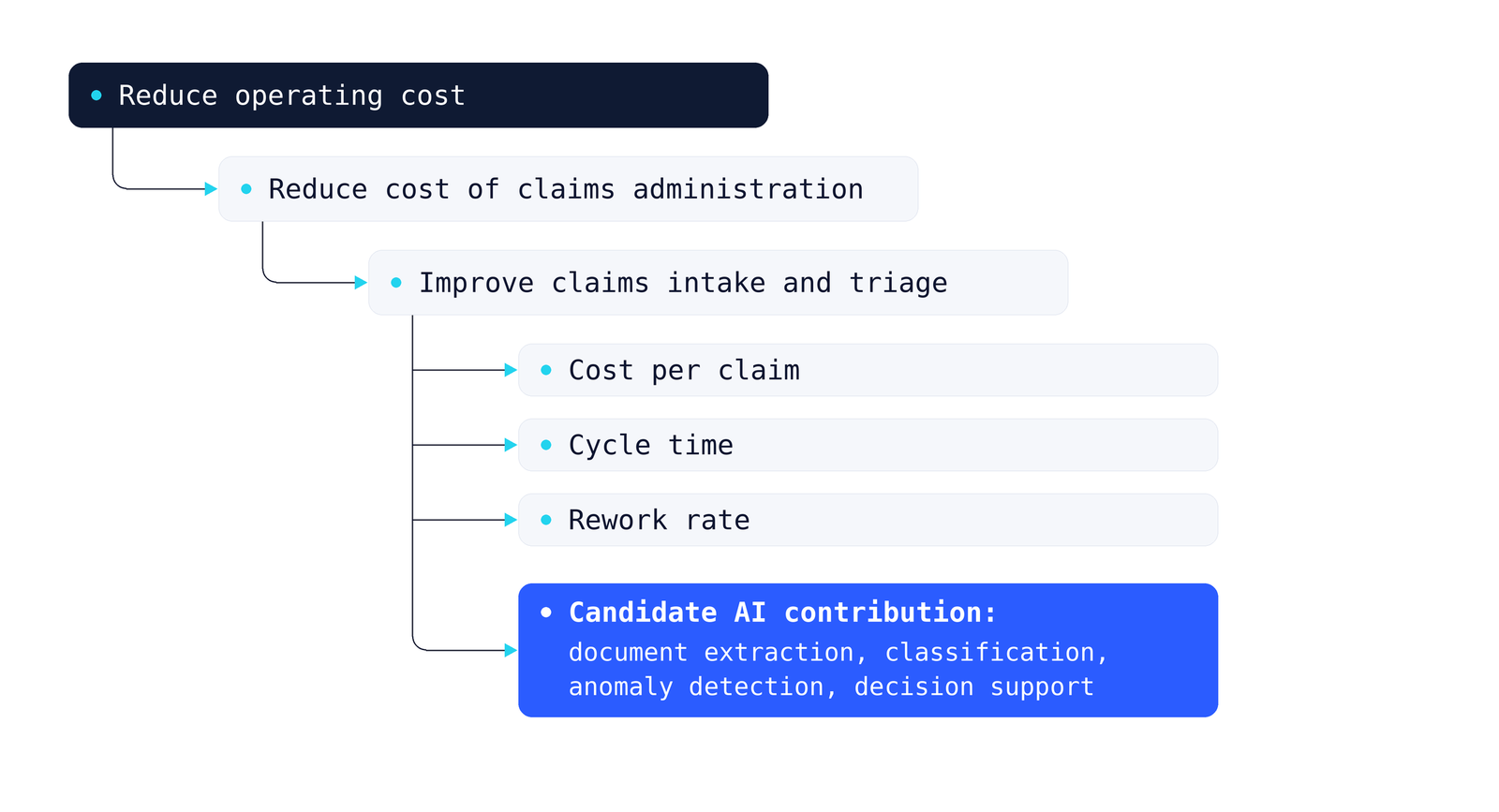
AI is only one part of the solution. Process redesign, policy, integration, data remediation, and workforce adoption may matter just as much.
5. Identify Where AI Can Create Value
AI is appropriate only when it addresses a meaningful business problem better than feasible alternatives. The presence of data or repetitive work alone does not justify it.
5.1 Recognize the Major AI Capability Families
| Capability family | What it does | Illustrative applications |
|---|---|---|
| Descriptive and diagnostic analytics | Explains what happened and helps investigate why | Operational dashboards, root-cause analysis |
| Predictive machine learning | Estimates future outcomes or class membership | Churn, fraud, demand, risk, forecasting |
| Prescriptive optimization | Recommends or optimizes actions under constraints | Scheduling, routing, inventory, resource allocation |
| Perception and document intelligence | Interprets images, audio, video, and documents | OCR, document classification, speech processing, quality inspection |
| Generative AI | Generates or transforms content using learned patterns | Summarization, drafting, code assistance, content generation |
| Retrieval-augmented generation | Grounds model responses in retrieved information | Enterprise knowledge assistants, policy support |
| Agentic systems | Coordinate model reasoning with tools and actions to pursue goals | Controlled workflow execution, research and case preparation |
| Hybrid intelligent systems | Combine models, rules, optimization, retrieval, and human decisions | Claims, underwriting, service operations, compliance workflows |
These categories overlap within a single production solution.
5.2 Ask Whether AI Is the Right Intervention
For each opportunity, ask:
- Is the problem important enough to justify intervention?
- Is the process understood and sufficiently stable?
- Is relevant data available, lawful to use, and of adequate quality?
- Does the problem require learning, prediction, language understanding, perception, or adaptive decision support?
- Could deterministic rules, conventional software, search, workflow automation, or process redesign solve it more reliably?
- What happens when the AI system is wrong, uncertain, unavailable, or manipulated?
- Can a human review or override the outcome where necessary?
- Can the organization measure whether the intervention improves the business outcome?
A deterministic rule is often preferable when the decision is fully specified, stable, and auditable. An LLM should not be introduced merely to replace a straightforward rule engine.
5.3 Form a Value Hypothesis
A value hypothesis explains how an AI intervention should change a business measure, and under which conditions.
Template
For [user, customer, or process], introduce [AI-enabled capability] into [workflow or decision] to improve [business metric] from [baseline] toward [target], subject to [quality, risk, and operational constraints]. The hypothesis will be tested through [measurement method].
Example
For claims operations, introduce document classification and extraction at intake to reduce manual triage effort and rework, while maintaining agreed extraction accuracy, auditability, and human review for low-confidence or high-impact cases. Measure the change using handling time, rework rate, exception rate, and cost per claim.
Treat untested value hypotheses as hypotheses, not guaranteed benefits.
Key Takeaways — Part II
- Express objectives as measurable outcomes with baselines, targets, guardrails, and owners.
- Build an outcome hierarchy so every AI contribution traces to an enterprise objective.
- Always ask whether a simpler, non-AI intervention would work better.
- Write value hypotheses and treat them as testable claims.
Part III. Build and Prioritize the Opportunity Portfolio
In this part: how to inventory opportunities, prioritize them transparently, and reason about them as a portfolio rather than in isolation.
6. Create a Structured Opportunity Inventory
The opportunity inventory connects business outcomes to technology capabilities. It should span relevant domains while supporting consistent comparison.
| Field | Description |
|---|---|
| Opportunity ID and name | Unique identifier and concise title |
| Business domain | Function, product, journey, or process |
| Business owner | Person accountable for the business outcome |
| Problem statement | Current friction, loss, delay, risk, or unmet need |
| Target users | Customers, employees, partners, or systems affected |
| Outcome linkage | Enterprise objective and measurable business KPI |
| Proposed AI contribution | Prediction, classification, generation, retrieval, agentic execution, etc. |
| Process impact | Steps changed, removed, augmented, or introduced |
| Data requirements | Sources, sensitivity, quality, access, ownership, freshness |
| Integration requirements | Applications, APIs, events, workflow systems |
| Risk profile | Potential harm, regulatory exposure, security and privacy concerns |
| Feasibility | Technical and organizational readiness |
| Value hypothesis | Expected benefit and assumptions |
| Dependencies | Shared data, platform, policy, or process prerequisites |
| Evidence status | Idea, assessed, tested, validated, or production-proven |
Keep the opportunity distinct from its proposed solution. Understand the problem and constraints before selecting technology.
7. Prioritize Opportunities Transparently
Prioritization balances value, strategic relevance, feasibility, risk, and dependencies. Not every opportunity should proceed.
7.1 Suggested Assessment Dimensions
| Dimension | Questions |
|---|---|
| Strategic alignment | Does it directly support a stated business objective? |
| Economic value | What measurable financial or productivity benefit is plausible? |
| Customer or employee impact | Does it improve experience, access, quality, or time? |
| Feasibility | Are data, technology, process, and skills sufficiently ready? |
| Time to evidence | How quickly can the hypothesis be tested credibly? |
| Reusability | Will it create capabilities useful to other domains? |
| Risk and consequence | What is the impact of incorrect, biased, unsafe, or unauthorized output? |
| Change complexity | How much process, policy, training, and behavior change is required? |
| Dependency value | Does it unlock several higher-value opportunities? |
7.2 Use Scoring as Decision Support, Not as an Automatic Answer
A weighted model exposes assumptions. An illustrative weighting:
| Dimension | Illustrative weight |
|---|---|
| Business value | 25% |
| Strategic alignment | 20% |
| Feasibility and readiness | 15% |
| Reusability and strategic leverage | 15% |
| Time to evidence | 10% |
| Risk manageability | 10% |
| Change complexity | 5% |
| Total | 100% |
Use a defined scale (for example, 1–5) with agreed scoring guidance. A higher risk score should indicate more manageable risk.
Scoring supports judgment; it does not replace it. Legal restrictions, unacceptable harm, unlawful data access, or inadequate human oversight can disqualify an otherwise high-value use case.
7.3 Classify the Portfolio
| Class | Description |
|---|---|
| Strategic bets | High business relevance, potentially transformative, often requiring foundational investment |
| Near-term value | Strong value hypothesis and a manageable implementation path |
| Enabling investments | Shared data, platform, governance, identity, integration, or engineering capabilities that unlock multiple use cases |
| Experiments | Bounded tests designed to resolve a material uncertainty |
| Defer or reject | Low value, poor fit, unacceptable risk, or insufficient evidence |
Do not run pilots for activity's sake. Each experiment needs a specific question and explicit success, failure, and stop criteria.
Engineering lens. An experiment should look like a well-formed A/B test or a design spike: a hypothesis, a metric, a sample that represents production, a time box, and a pre-agreed decision rule.
8. Consider the Portfolio, Not Just Individual Use Cases
Optimizing use cases independently can duplicate platforms, fragment data access, weaken control consistency, and increase operating cost.
Assess the portfolio for:
- common data sources and data products;
- repeated model or embedding requirements;
- shared retrieval and knowledge needs;
- common identity, authorization, and audit requirements;
- reusable workflow and agent capabilities;
- common evaluation datasets and quality measures;
- integration patterns and application boundaries;
- infrastructure, capacity, and cost constraints;
- concentration risk from vendors or foundation-model providers.
Portfolio analysis shows where shared capabilities are justified economically and architecturally.
Key Takeaways — Part III
- Describe opportunities as business problems, separately from proposed solutions.
- Make prioritization criteria and weights explicit, and allow judgment to override scores.
- Classify the portfolio into bets, near-term value, enablers, experiments, and deferrals.
- Look across use cases to find shared capabilities worth funding once.
Part IV. Assess the Current State
In this part: how to establish an evidence-based baseline, surface constraints and architectural debt, and define capability gaps.
9. Establish an Evidence-Based Baseline
Base the roadmap on the organization's evidenced position, not an assumed maturity level. Assess current capabilities across business, data, applications, infrastructure, AI engineering, governance, people, and operations, using interviews, architecture reviews, inventories, data profiling, risk assessments, and evidence from existing initiatives.
9.1 Current-State Assessment Domains
| Domain | Assessment questions | Evidence to collect |
|---|---|---|
| Business and process | Are target processes documented, measured, and owned? | Process maps, KPIs, operating procedures |
| Data | Are data sources discoverable, governed, accessible, and fit for use? | Catalogues, lineage, quality reports, access controls |
| Applications and integration | Can AI capabilities be safely embedded into workflows? | Application maps, APIs, event patterns, interface contracts |
| Cloud and infrastructure | Can the estate support required performance, scale, resilience, and deployment constraints? | Landing zones, network design, compute, storage, resilience patterns |
| AI and ML | Are models, datasets, features, and model lifecycle practices established? | Model inventory, experiments, registries, validation records |
| GenAI and agentic systems | Are retrieval, prompting, tool access, evaluation, and runtime controls mature? | RAG designs, model gateways, tool policies, traces, evaluation results |
| Security and privacy | Are data, identities, models, and actions protected? | Threat models, IAM policies, privacy assessments, security testing |
| Governance and compliance | Are accountability, approval, documentation, and monitoring defined? | Policies, risk registers, audit findings, control evidence |
| Engineering and operations | Can teams build, test, deploy, observe, and support AI systems? | CI/CD, test suites, SLOs, incident records, runbooks |
| People and organization | Are roles, skills, decision rights, and capacity sufficient? | Skills inventory, team structure, training plans |
| Procurement and vendors | Are suppliers, contracts, data terms, and exit options understood? | Contracts, service terms, due diligence, vendor assessments |
| Economics | Are costs and benefits measurable across the lifecycle? | Cloud bills, licences, unit costs, budgets, benefit reports |
9.2 Assess Maturity Without Creating False Precision
| Level | Name | Description |
|---|---|---|
| 1 | Ad hoc | Activity is isolated, informal, person-dependent, and inconsistently controlled |
| 2 | Emerging | Repeatable practices exist in some teams, but standards and ownership are inconsistent |
| 3 | Defined | Documented standards, accountable owners, and repeatable processes are established |
| 4 | Managed | Performance, quality, risk, cost, and adoption are measured and actively managed |
| 5 | Optimized | Capabilities are continuously improved using evidence, automation, and portfolio-level learning |
Rate each domain separately and support every score with evidence and a confidence level. An organization may be mature in cloud engineering yet immature in data governance or AI evaluation.
10. Identify Constraints and Architectural Debt
Typical constraints include:
- fragmented or poorly governed data;
- unclear data ownership and access rights;
- legacy applications with limited integration options;
- inconsistent identity and authorization models;
- multiple uncoordinated cloud environments;
- lack of model evaluation and production monitoring;
- duplicated experimentation platforms;
- weak software delivery or testing practices;
- limited AI security expertise;
- procurement restrictions or vendor lock-in;
- insufficient operational ownership;
- regulatory or contractual restrictions on data and model use.
Record each constraint's evidence, impact, affected opportunities, and remediation. Separate genuine blockers from preferences and untested assumptions.
Engineering lens. ML systems accumulate a distinctive form of technical debt: entangled data dependencies, undeclared consumers of model outputs, unversioned prompts and configurations, and glue code around models. Include these explicitly in the debt register (see Appendix D).
11. Define the Gap Between Current and Required Capability
A capability gap is the difference between the current state and what the portfolio and target architecture require.
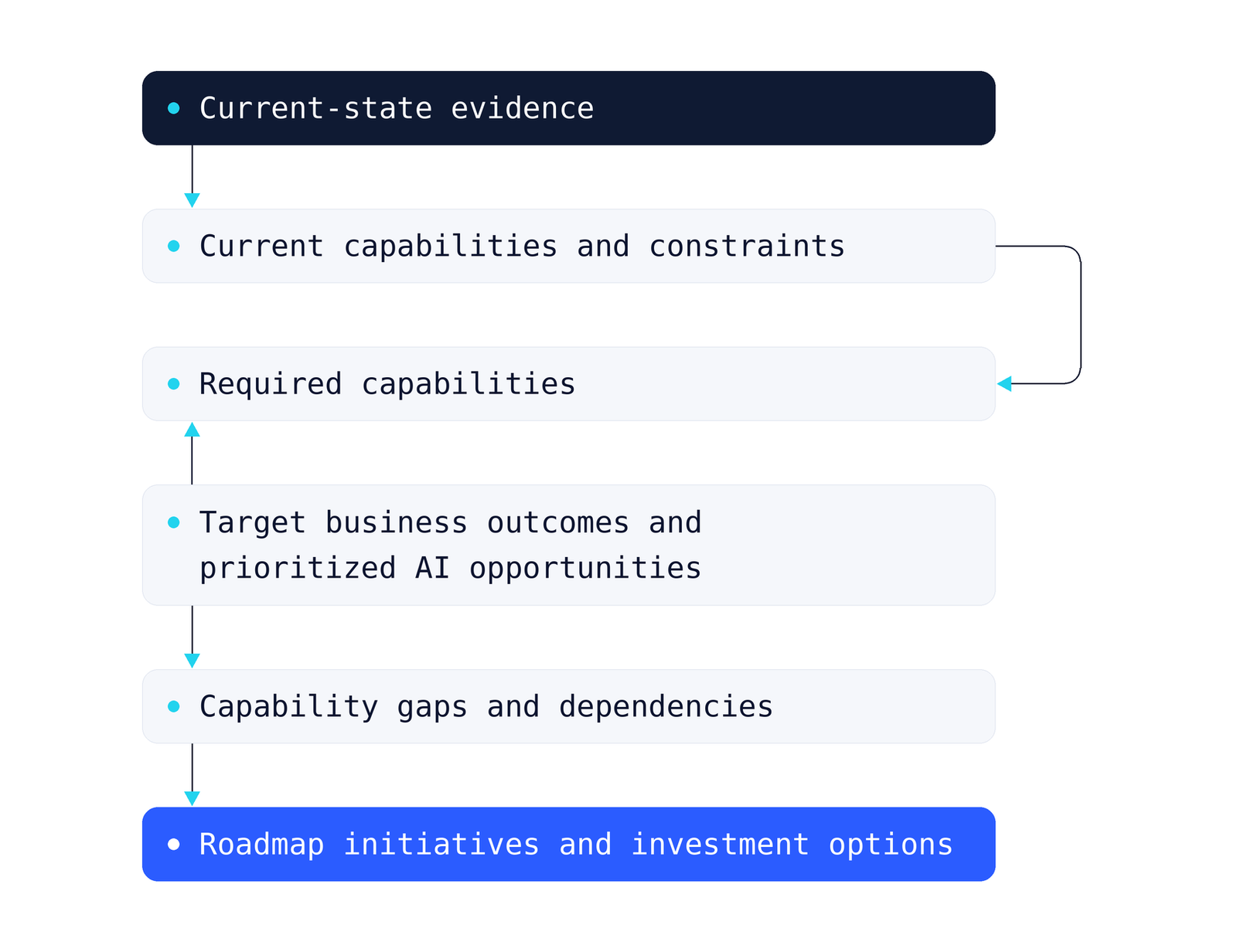
Figure 3. Deriving capability gaps from current-state evidence and target outcomes.
A useful gap record includes:
| Field | Description |
|---|---|
| Capability | The capability that is missing or insufficient |
| Current condition | What exists today, supported by evidence |
| Required condition | What the target state needs |
| Gap | The specific shortfall |
| Business impact | Which outcomes or opportunities are affected |
| Risk of inaction | Consequence of leaving the gap unresolved |
| Options | Build, buy, partner, reuse, redesign, or defer |
| Dependencies | Other capabilities or decisions required |
| Priority | Relative urgency and strategic importance |
Key Takeaways — Part IV
- Score maturity per domain, with evidence and confidence, never as a single number.
- Distinguish true blockers from preferences and untested assumptions.
- Gaps are defined against the required capability, not against an abstract maturity ideal.
Part V. Define the Target Capabilities and Architecture
In this part: the capability model, target-state architecture, technology strategy by AI family, sourcing decisions, and platform boundaries.
12. Define the Target Capability Model
Define required capabilities independently of vendors and products so the roadmap remains durable as technology changes.
| Capability area | Capabilities to consider |
|---|---|
| Business enablement | Opportunity discovery, process redesign, product integration, value measurement |
| Data foundation | Data ingestion, quality, cataloguing, lineage, access, governance, feature management |
| Knowledge foundation | Content ingestion, parsing, chunking, metadata, indexing, retrieval, source authority and freshness |
| Model capability | Model selection, training or fine-tuning where justified, evaluation, registry, versioning |
| AI application engineering | Prompt and context design, application orchestration, API integration, user experience |
| Agentic execution | Planning, task decomposition, tool invocation, workflow state, approvals, action boundaries |
| AI platform | Model access, gateways, reusable services, deployment environments, tenancy, quotas |
| Runtime and infrastructure | Compute, storage, networking, accelerators, scaling, resilience, deployment topology |
| Trust and governance | Identity, authorization, privacy, security, safety, audit, policy enforcement, human oversight |
| Quality and observability | Evaluation, tracing, monitoring, drift, incident response, feedback |
| Economics and FinOps | Cost attribution, budgets, usage controls, model routing, capacity and unit economics |
| People and operating model | Product ownership, architecture, engineering, risk, operations, support, training |
This is a reference model, not a mandate for centralization. Select capabilities according to portfolio needs and risk.
13. Define the Target-State Architecture
The target-state architecture shows how business applications, AI services, data, infrastructure, and controls fit together. Make it concrete enough to guide technology decisions, but avoid turning it into a low-level design for every use case.
13.1 A Conceptual Enterprise AI Architecture
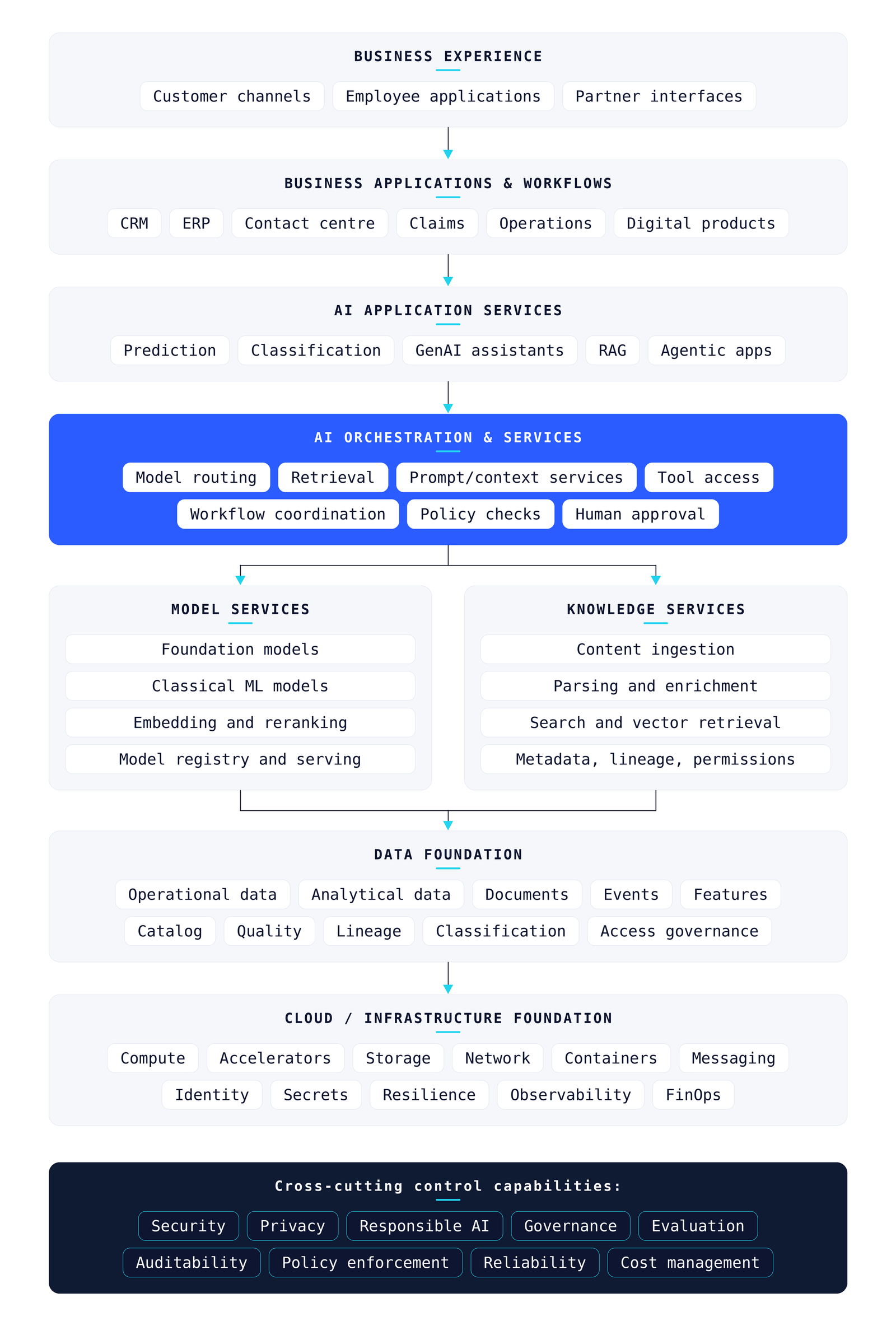
Figure 4. A conceptual enterprise AI architecture. Adapt it to combine, split, or distribute capabilities.
Governance, security, identity, evaluation, and observability must cut across layers. They cannot sit only at the bottom of the stack.
13.2 Define Architectural Principles
Principles provide decision guidance when teams face competing implementation options. Illustrative principles:
| # | Principle | Intent |
|---|---|---|
| 1 | Business outcome first | Every material AI investment traces to an approved business outcome or a justified enabling capability |
| 2 | Simplest sufficient technique | Prefer deterministic software, rules, search, or conventional ML when they meet the need more reliably and economically |
| 3 | Data and access are inseparable | Retrieval and model context respect source permissions, classification, purpose, and retention |
| 4 | Secure by design | Identity, authorization, privacy, threat modelling, and auditability are built in |
| 5 | Risk-proportionate human oversight | Consequential decisions and actions require controls appropriate to their impact |
| 6 | Reusable where justified | Shared services reduce duplication without creating unnecessary central bottlenecks |
| 7 | Model and provider flexibility | Avoid unnecessary coupling to a single model or provider where portability has material strategic value |
| 8 | Observable by default | Systems expose quality, latency, cost, reliability, and relevant decision traces |
| 9 | Production readiness designed in | Evaluation, testing, deployment, rollback, support, and incident response are considered from the start |
| 10 | Explicit tenant and domain boundaries | Data isolation, authorization, quotas, and operational ownership match the organization's tenancy model |
| 11 | Cost is an architectural concern | Optimize lifecycle cost and cost per successful business task, not only the price of a model call |
| 12 | Controlled autonomy | Agentic systems receive only the tools, permissions, and action scope necessary for their purpose |
Make each principle testable by documenting its rationale, implications, and conformance criteria.
Engineering lens. Express principles the way mature platform teams express "paved road" expectations: a default that is easy to follow, a clear rationale, and a documented exception process.
14. Determine the AI Technology Strategy
Technology strategy defines the technology categories and sourcing approaches needed to realize the target architecture.
14.1 Traditional ML and Predictive Systems
Consider:
- data and feature pipelines;
- experimentation and training environments;
- model validation and approval;
- model registry and versioning;
- online and batch inference;
- feature freshness and drift monitoring;
- explainability appropriate to the use case;
- integration with decision and workflow systems.
Do not assume every predictive problem requires deep learning. Model complexity should be justified by measurable performance, robustness, maintainability, and cost.
14.2 Generative AI and Foundation Models
Consider:
- managed model APIs versus self-hosted models;
- model capability, quality, latency, context limits, and availability;
- model routing and fallback;
- prompt and context management;
- structured output and schema validation;
- grounding and source attribution;
- safety and policy enforcement;
- model evaluation and regression testing;
- token usage, caching, quotas, and cost attribution.
Select models using representative tasks and explicit evaluation criteria, not public benchmarks or demonstrations alone.
14.3 Retrieval-Augmented Generation and Enterprise Knowledge
Consider:
- authoritative source systems and content ownership;
- ingestion and change detection;
- parsing and structure-aware chunking;
- metadata and access-control propagation;
- embedding and indexing;
- lexical, vector, and hybrid retrieval;
- reranking and context selection;
- freshness, deletion, and retention;
- citation and provenance;
- retrieval and answer evaluation.
Semantic similarity alone does not make retrieval trustworthy. Relevance, authority, freshness, sufficiency, permissions, and source quality all matter.
14.4 Agentic AI
Consider agentic architecture only where a workflow benefits from model-mediated planning, tool use, dynamic task coordination, or controlled action execution. Required capabilities may include:
- agent or workflow definitions and versioning;
- task and state management;
- tool and API catalogues;
- identity and delegated authorization;
- policy checks before tool execution;
- input and output validation;
- approval and escalation paths;
- bounded retries, timeouts, and budgets;
- durable execution and idempotency;
- traceability and audit;
- evaluation of task completion and action correctness;
- isolation and containment of runtime execution.
Multi-agent design is not inherently better than deterministic workflow. Choose the least complex architecture that meets business and control requirements.
15. Make Build, Buy, Partner, and Reuse Decisions
Neither building everything nor outsourcing every capability is a sound default. Evaluate sourcing at the capability level.
| Option | Appropriate when | Key considerations |
|---|---|---|
| Build | The capability is differentiating, requires deep control, or is not adequately served by the market | Engineering cost, ownership, maintenance, security, talent |
| Buy | A mature product meets requirements with acceptable integration and risk | Product fit, vendor viability, contract terms, data handling, portability |
| Partner | Specialized expertise or delivery capacity is needed | Knowledge transfer, accountability, dependency, quality |
| Reuse | An existing enterprise capability meets the need | Fitness for purpose, service ownership, capacity, roadmap alignment |
| Compose | Multiple managed and internal capabilities must be combined | Integration complexity, failure modes, observability, end-to-end accountability |
For each material decision, document:
- business and technical requirements;
- options considered;
- evaluation criteria;
- assumptions and evidence;
- security, privacy, legal, and operational implications;
- total cost of ownership;
- portability and exit strategy;
- selected option and rationale;
- decision owner and review trigger.
16. Define Platform Boundaries and Centralization Choices
An important enterprise decision is the degree of AI centralization.
| Model | Strengths | Risks |
|---|---|---|
| Centralized platform | Approved model access, common identity and policy controls, reusable retrieval/evaluation/observability services, cost attribution, standard deployment patterns, common audit | Bottlenecks, over-standardization, poor domain fit |
| Federated (domain-led) | Domain fit and speed within enterprise standards | Duplication, inconsistent controls, procurement fragmentation, uneven maturity |
| Hybrid | Shared enterprise foundation with domain-owned applications and selected domain services | Requires clear interfaces, standards, and funding models |
A common pattern is the hybrid model. The roadmap should decide:
- which capabilities must be centrally controlled;
- which should be shared services;
- which can be owned by domains;
- what standards and interfaces make the model coherent;
- how platform funding and service ownership work.
Centralize only when it delivers measurable enterprise benefit.
Engineering lens. This is the platform-engineering question: treat the shared AI platform as a product with internal customers, a roadmap, service-level objectives, and a feedback loop with the domain teams that consume it.
Key Takeaways — Part V
- Define capabilities independent of vendors; evaluate products against them.
- Make architectural principles testable, with conformance criteria and an exception path.
- Match technology strategy to the AI family: predictive, generative, retrieval, and agentic systems each have distinct requirements.
- Decide sourcing per capability, and plan the exit before you commit.
- Prefer a hybrid platform model: shared foundations, domain-owned applications.
Part VI. Define Trust, Governance, and Operating Requirements
In this part: how to turn risk and governance obligations into architectural requirements and a credible operating model.
17. Treat Trust and Governance as Architectural Requirements
AI risk extends beyond model accuracy to data misuse, unauthorized access, harmful output, automation errors, prompt injection, supply-chain exposure, opaque decisions, and uncontrolled actions. Governance requirements should shape architecture and investment from the beginning.
17.1 Establish an AI System Risk Classification
Classify AI systems using factors such as:
- decision impact on individuals or business outcomes;
- sensitivity of input and output data;
- degree of autonomy and action authority;
- scale and reversibility of potential harm;
- regulatory and contractual obligations;
- external exposure and threat surface;
- reliance on third-party models and services.
The classification should determine the level of review, testing, approval, monitoring, documentation, and human oversight required.
17.2 Define Cross-Cutting Controls
| Control area | Roadmap questions |
|---|---|
| Identity and access | How are users, services, agents, and tools authenticated and authorized? |
| Data protection | How are sensitive data, retention, residency, and purpose limitations enforced? |
| Model governance | How are models assessed, approved, versioned, monitored, and retired? |
| Safety and policy | How are prohibited or constrained outputs and actions detected and handled? |
| Human oversight | Which actions require review, confirmation, or escalation? |
| Auditability | Can the organization reconstruct inputs, model versions, retrieved sources, tool calls, approvals, and outcomes? |
| Security | How are prompt injection, data exfiltration, insecure tools, supply-chain risks, and abuse addressed? |
| Resilience | What happens when a model, provider, retrieval service, or dependent system fails? |
| Compliance | How are applicable laws, standards, contracts, and internal policies translated into controls? |
17.3 Distinguish Answer Generation from Authority to Act
A system that generates a recommendation does not automatically have authority to execute it. For agentic systems, explicitly separate:
- the model's ability to propose an action;
- the application's authority to request an action;
- the identity and permissions under which the action executes;
- the policy decision that permits or rejects it;
- any human approval requirement;
- the system that records and verifies the result.
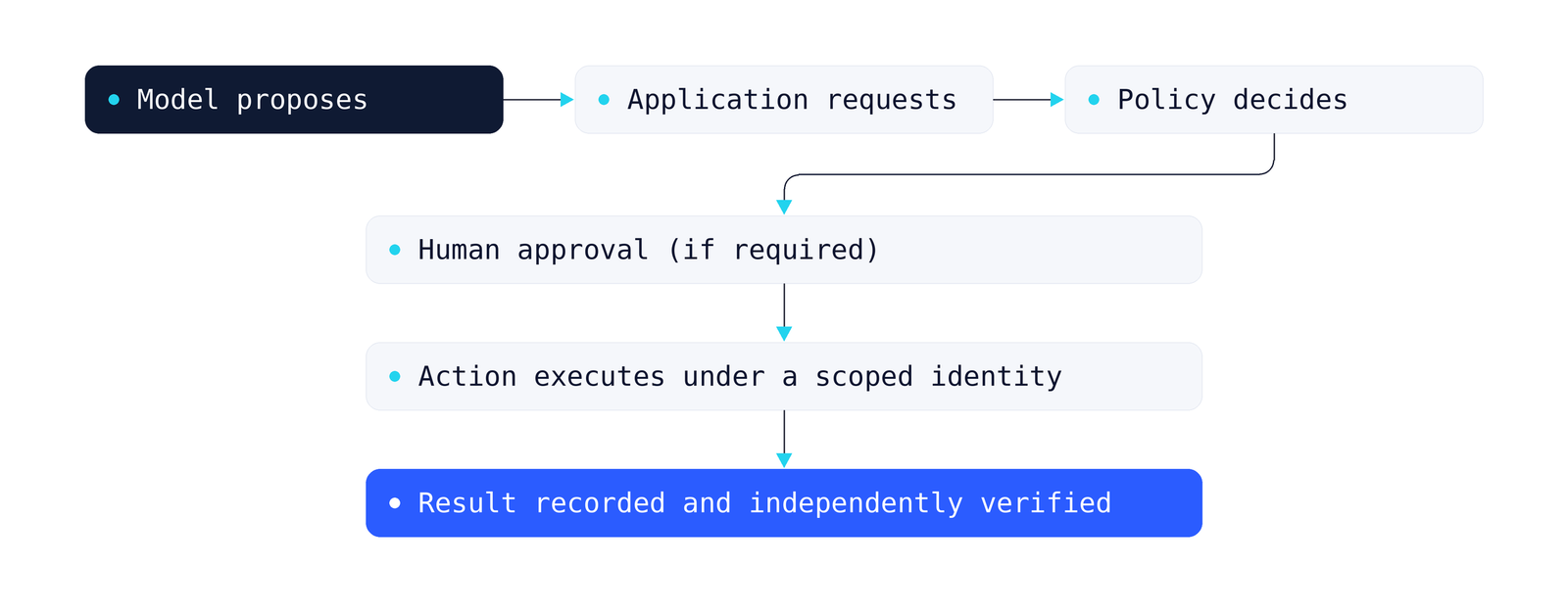
Figure 5. Separating proposal, request, authorization, execution, and verification for agentic actions.
This separation is essential for safe enterprise automation.
Engineering lens. Apply least privilege and defense in depth exactly as you would for any service that can mutate production state. Treat model output as untrusted input to the next system, validate it, and make every action reversible or approval-gated in proportion to its blast radius.
18. Define the Operating Capabilities the Roadmap Must Enable
Although this guide addresses roadmap definition, the target state must include a credible operating model. Determine:
- who owns business outcomes and AI products;
- who owns shared AI platform services;
- who approves models and high-risk use cases;
- who owns data quality and access;
- who is accountable for security and privacy controls;
- who operates production services and responds to incidents;
- who manages vendor relationships and technology standards;
- how architecture exceptions are reviewed;
- how model, prompt, retrieval, and agent changes are approved;
- how business feedback drives continuous improvement.
A responsibility model should clarify decision rights, not merely list committees.
Key Takeaways — Part VI
- Classify AI systems by risk and scale controls to the class.
- Distinguish a model's ability to propose from the authority to act.
- Design the operating model, including change control for prompts, retrieval, and agents, as part of the target state.
Part VII. Evaluate Economics and Investment
In this part: how to model lifecycle cost and benefit, and how to use unit economics to keep the roadmap honest.
19. Build a Lifecycle Economic View
Evaluate AI economics across design, development, deployment, operation, and change. Prototype costs can understate production costs once usage, context, retrieval, evaluation, support, and resilience are included.
19.1 Cost Categories
| Cost category | Examples |
|---|---|
| Data | Integration, cleansing, labelling, storage, cataloguing, governance |
| Platform | Cloud services, networking, storage, compute, accelerators |
| Models | API usage, hosting, fine-tuning, embeddings, reranking |
| Engineering | Product, data, ML, platform, security, architecture teams |
| Integration | APIs, workflow changes, application modernization |
| Risk and assurance | Security testing, privacy reviews, validation, audit |
| Operations | Monitoring, support, incident response, reliability engineering |
| Adoption | Training, process redesign, change management |
| Vendor and procurement | Licences, support, professional services, contractual commitments |
19.2 Estimate Value Conservatively
Potential benefits include reduced manual effort, lower error and rework rates, faster cycle times, improved conversion or retention, lower fraud or loss, improved quality and consistency, increased capacity without proportional headcount growth, and improved employee or customer experience.
Separate the following benefit types:
| Benefit type | Meaning |
|---|---|
| Cashable savings | Expenditure removed or avoided |
| Released capacity | Time available for other work |
| Revenue impact | Incremental revenue attributable to the capability |
| Risk reduction | Lower expected loss or exposure |
| Strategic option value | Future choices without a defensible near-term financial estimate |
Do not count released employee time as cash savings unless the operating plan specifies how that capacity will be converted into financial benefit.
19.3 Use Unit Economics
Aggregate cost can conceal poor economics. Define a unit that reflects the business task, for example:
- cost per successfully processed claim;
- cost per resolved customer interaction;
- cost per validated document;
- cost per completed research task;
- cost per qualified lead;
- cost per successful agentic workflow.
Cost per successful task =
    Total attributable AI system cost
    / Number of successfully completed tasks
Define "success," the included costs, and the measurement period. Include material human-review and exception costs.
Engineering lens. This is the AI counterpart to cost-per-request and cost-per-transaction in conventional services. Attribute cost by workload and team, set budgets and alerts, and review unit cost alongside latency and quality in operational reviews.
19.4 Compare Options Using Total Cost of Ownership
For each major platform or sourcing decision, estimate:
- initial implementation cost;
- recurring infrastructure and model cost;
- licensing and support;
- integration and migration;
- security and compliance;
- staffing and operations;
- scaling and capacity;
- exit, portability, and replacement cost.
Use ranges and explicit assumptions. Transparent uncertainty is better than false precision.
Key Takeaways — Part VII
- Model cost across the full lifecycle, not just model API fees.
- Distinguish cashable savings from released capacity.
- Use cost per successful task as the anchor metric, and include human-review cost.
- Present ranges and assumptions rather than single-point estimates.
Part VIII. Sequence the Roadmap
In this part: how to turn gaps into initiatives, sequence them, express horizons honestly, and make uncertainty visible.
20. Convert Capability Gaps into Roadmap Initiatives
A roadmap initiative is a coherent body of work to establish, improve, or retire a capability, or to deliver a business outcome. Examples:
- establish governed enterprise model access;
- implement identity-aware knowledge retrieval;
- create a model evaluation and release framework;
- modernize a source application to expose secure APIs;
- deliver a predictive fraud-detection capability;
- introduce a controlled agent runtime for selected workflows;
- establish cost attribution for AI workloads.
Each initiative should have:
- a clear outcome or capability objective;
- an accountable owner;
- scope and boundaries;
- measurable acceptance criteria;
- dependencies;
- indicative effort and cost range;
- risk and assurance requirements;
- target horizon;
- assumptions and confidence;
- a decision gate or review point.
Avoid initiatives such as "implement AI" or "adopt an LLM." They are too unbounded to guide investment or architecture.
21. Sequence by Value, Dependency, Risk, and Readiness
The highest-value use case is not always the first priority. A foundational capability may unlock several opportunities while reducing future cost and risk. Consider four sequencing forces:
| Force | Question |
|---|---|
| Value | How much business benefit can be realized, and how soon? |
| Dependency | What must exist before the initiative can succeed? |
| Readiness | Are data, process, technology, people, and controls sufficiently prepared? |
| Risk | What must be validated or controlled before broader deployment? |
A dependency example:
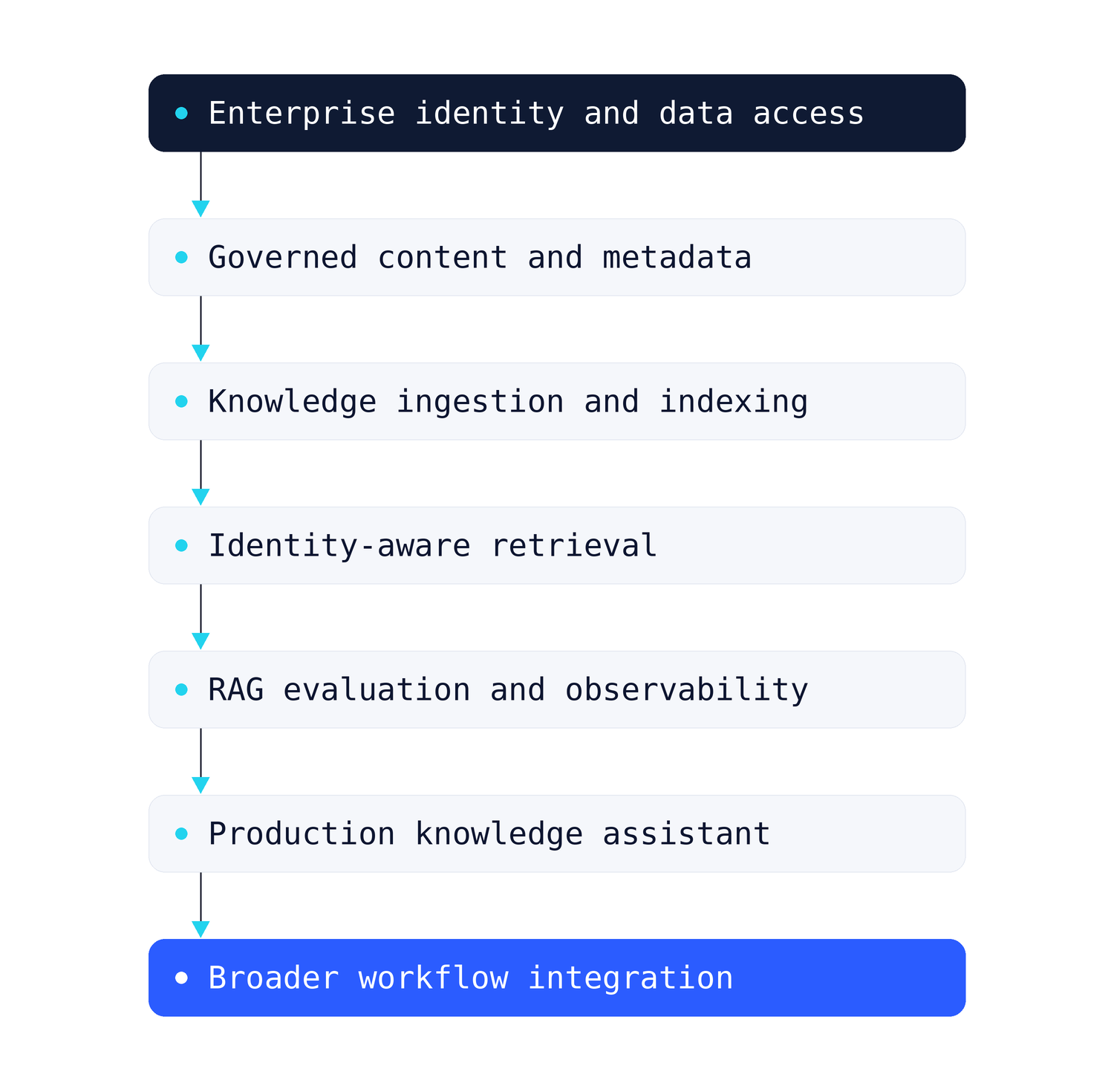
Figure 6. An illustrative dependency chain for enterprise knowledge assistance.
This sequence is illustrative. Activities may run in parallel, and bounded pilots can test assumptions before all foundations are complete. Distinguish experimentation from production-scale commitment.
22. Use Horizons Without Turning Them into Arbitrary Dates
| Horizon | Primary intent | Typical initiative types |
|---|---|---|
| H1 — Establish | Prove priority value and address essential foundations | Current-state remediation, initial use cases, governance baseline, platform decisions |
| H2 — Scale | Reuse capabilities across domains and improve operational maturity | Shared services, domain expansion, standard evaluation, integration patterns |
| H3 — Transform | Enable broader process and product transformation where evidence supports it | Advanced decision systems, controlled agentic workflows, new AI-enabled products |
For each horizon, show intended business outcomes, capabilities to establish, initiatives and major milestones, dependencies, investment envelope, key risks, decision gates, and the evidence required to move to the next horizon.
Avoid implying that every initiative in a distant horizon is an approved commitment. Label items as options, directional intent, or conditional investments where appropriate.
23. Represent Uncertainty Explicitly
Because business and technology assumptions change, distinguish commitment levels.
| Commitment class | Meaning |
|---|---|
| Approved | Funding and sponsorship are authorized, subject to stated controls |
| Planned | Intended for a defined horizon, but not necessarily fully funded |
| Conditional | Proceeds only if specified evidence, dependencies, or conditions are met |
| Exploratory | A bounded investigation to reduce uncertainty |
| Deferred | Deliberately postponed pending a trigger or prerequisite |
| Rejected | Not pursued, with rationale recorded |
Record the assumptions that would change a roadmap item, such as model quality thresholds, data access approval, regulatory interpretation, vendor capability, unit economics, and adoption evidence.
Key Takeaways — Part VIII
- Initiatives must be bounded, owned, measurable, and gated.
- Sequence by value, dependency, readiness, and risk; foundations often precede the highest-value use case.
- Use horizons for intent, not as dates the organization is falsely committed to.
- Label every item with a commitment class.
Part IX. Make Technology Decisions Defensible
In this part: how to record decisions, evaluate candidates against representative workloads, and set non-functional requirements early.
24. Establish a Decision Framework
A consistent decision framework makes interdependent choices comparable and reviewable. For each significant decision, record:
- Decision statement: what exactly must be decided?
- Business driver: which outcome or constraint makes the decision necessary?
- Requirements: functional, non-functional, security, regulatory, and operational.
- Options: credible alternatives, including doing nothing or deferring.
- Evaluation criteria: quality, latency, scale, resilience, cost, integration, portability, support, risk.
- Evidence: tests, benchmarks, vendor assessments, architecture analysis, stakeholder input.
- Trade-offs: what is gained, what is sacrificed, and what new risks are introduced.
- Decision: the selected option and rationale.
- Consequences: required changes, dependencies, and constraints.
- Review trigger: conditions that would justify revisiting the decision.
Maintain these as architecture decision records (ADRs) or an equivalent decision register.
25. Evaluate Models and Platforms Against Representative Workloads
Do not select models, vector databases, agent frameworks, or serving platforms from feature checklists alone. Create representative workload tests reflecting:
- real input distributions;
- expected context lengths;
- language and domain requirements;
- retrieval corpus characteristics;
- concurrency and traffic patterns;
- output format and tool-use requirements;
- security and access constraints;
- acceptable latency and availability;
- evaluation criteria and failure costs.
Measure quality, latency, throughput, cost, reliability, operational effort, and failure behavior. Generic benchmark strength does not guarantee domain performance.
25.1 Treat Evaluation as a First-Class Capability
The most durable asset in a technology evaluation is often the evaluation harness itself. Plan for:
| Element | Purpose |
|---|---|
| Golden datasets | Curated, representative, versioned examples with agreed expected behavior |
| Offline evaluation | Repeatable comparison of candidates before release |
| Regression gates | Automatic checks that block changes degrading quality, safety, latency, or cost |
| Online evaluation | Controlled experiments and shadow or canary traffic to validate in production conditions |
| Human review | Calibrated expert grading where automated judgment is insufficient |
| Failure taxonomy | A shared classification of error types to focus improvement |
Automated graders, including model-based graders, should themselves be validated against human judgment before being trusted as release gates.
Engineering lens. Evaluation-driven development is the AI analogue of test-driven development and continuous integration: changes to models, prompts, retrieval configuration, and tools are evaluated on every change, and a failing evaluation blocks the release as a failing test would.
26. Define Non-Functional Requirements Early
| Quality attribute | Questions |
|---|---|
| Availability | What service availability is required, and during which business periods? |
| Latency | What end-to-end response time is acceptable for each workflow? |
| Throughput | What are expected average, peak, and burst workloads? |
| Scalability | How should capacity respond to growth and concurrency? |
| Resilience | How does the system degrade or recover when a dependency fails? |
| Security | What threat model, trust boundaries, and authorization rules apply? |
| Privacy | What data may be processed, retained, or transferred, and under what conditions? |
| Explainability and traceability | What evidence is needed to understand or challenge an output? |
| Maintainability | How can models, prompts, retrieval, tools, and application logic be changed safely? |
| Portability | What degree of provider, model, or platform substitution is strategically necessary? |
| Cost efficiency | What unit economics and budget limits must be met? |
| Accessibility and usability | Can intended users understand, use, and appropriately challenge the system? |
Set requirements by workload and risk class, not uniformly across applications.
Key Takeaways — Part IX
- Record significant decisions with options, criteria, evidence, and review triggers.
- Test candidates on representative workloads, and invest in a reusable evaluation harness.
- Define quality attributes per workload and risk class before selecting technology.
Part X. Govern the Roadmap as a Portfolio
In this part: ownership, decision rights, governance mechanisms, and the measures that keep the roadmap accountable.
27. Establish Ownership and Decision Rights
A roadmap needs named, accountable owners. Committees cannot replace them.
| Role | Primary accountability in roadmap definition |
|---|---|
| Executive sponsor | Confirms strategic intent, resolves major trade-offs, sponsors investment |
| Business outcome owner | Defines the business problem, target measures, process impact, and adoption |
| AI or technology strategy leader | Connects AI ambition to enterprise capability and investment direction |
| Principal AI Architect / Enterprise Architect | Defines target architecture, principles, standards, dependencies, and technology options |
| Data leader | Assesses data readiness, ownership, quality, access, and data investment |
| Security and privacy leaders | Define risk requirements, controls, and assurance expectations |
| Risk, legal, and compliance leaders | Interpret obligations and review higher-risk use cases |
| Engineering and platform leaders | Assess feasibility, delivery capacity, platform needs, and operational readiness |
| Finance and procurement | Validate investment assumptions, sourcing options, and commercial constraints |
| Product and change leaders | Assess user needs, workflow redesign, adoption, and value realization |
Titles and reporting lines vary. Accountability for business outcomes, architecture, data, risk, engineering, and investment must not.
28. Define Roadmap Governance
Governance must answer:
- Who can propose an initiative?
- Who validates the business case?
- Who approves architecture and technology standards?
- Who classifies AI risk?
- Who approves data use and model deployment?
- Who authorizes investment?
- Who can accept an exception?
- Who can stop or defer an initiative?
- How are dependencies and conflicts resolved?
- How are roadmap changes communicated?
Scale governance to impact. A low-risk experiment does not need the same approvals as a system making consequential decisions or taking external actions.
29. Define Portfolio-Level Measures
Manage the roadmap through a balanced set of measures.
| Dimension | Example measures |
|---|---|
| Strategic alignment | Share of investment mapped to approved business objectives |
| Business value | Validated benefit, value realized, outcome attainment |
| Portfolio health | Initiative status, dependency health, decision latency |
| Capability maturity | Progress against defined capability gaps |
| Reuse | Adoption of shared capabilities, reduction in duplicated services |
| Technology quality | Reliability, latency, quality, scalability |
| AI quality | Task success, groundedness, error and escalation rates |
| Risk and control | Control coverage, unresolved high risks, incidents, audit findings |
| Economics | Total cost, cost per successful task, budget variance |
| Adoption | Active usage, workflow adoption, user confidence, override patterns |
Separate leading from lagging indicators:
- Leading: data readiness, platform availability, evaluation coverage, user adoption.
- Lagging: cost reduction, revenue impact, lower losses, improved customer outcomes.
Technical milestones do not guarantee business value. Measure both.
Key Takeaways — Part X
- Name accountable owners; do not substitute committees.
- Scale governance to risk and impact.
- Balance leading and lagging indicators, and measure outcomes, not activity.
Part XI. The End-to-End Method
30. A Practical Roadmap-Definition Lifecycle
Use this lifecycle to define an enterprise AI technology roadmap. Activities may overlap, but the sequence provides a logical progression.

Figure 7. The eleven-step roadmap-definition lifecycle.
Step 1 — Establish Mandate and Scope
- Activities: confirm executive sponsorship and business drivers; define organizational and technology boundaries; agree planning horizon and decision authority; identify stakeholders and source documents.
- Outputs: roadmap charter; scope and assumptions; stakeholder and decision-rights map.
Step 2 — Understand Business Strategy and Outcomes
- Activities: review strategy and operating plans; interview business leaders; identify target processes and performance gaps; translate goals into measurable outcomes.
- Outputs: business outcome map; KPI baseline and target register; strategic constraints.
Step 3 — Discover and Assess AI Opportunities
- Activities: conduct domain workshops; identify candidate AI contributions; challenge whether AI is the right intervention; form value hypotheses and identify risk.
- Outputs: AI opportunity inventory; initial value hypotheses; early risk and feasibility assessment.
Step 4 — Prioritize the Opportunity Portfolio
- Activities: apply agreed criteria; compare value, feasibility, risk, readiness, and dependencies; identify bets, near-term opportunities, enablers, and experiments; record deferred and rejected items.
- Outputs: prioritized AI portfolio; portfolio rationale; experiment and decision backlog.
Step 5 — Assess Current-State Capabilities
- Activities: review business processes, data, applications, cloud, AI, security, governance, skills, and operations; inspect existing pilots and production systems; identify constraints; rate maturity using evidence.
- Outputs: current-state capability assessment; architecture and technology baseline; constraint and risk register.
Step 6 — Define Target Capabilities and Architecture
- Activities: derive capabilities from the prioritized portfolio; define target-state architecture and principles; establish platform boundaries and shared-service candidates; define non-functional and control requirements.
- Outputs: target capability model; architecture views; principles and standards; non-functional requirements.
Step 7 — Evaluate Technology and Sourcing Options
- Activities: identify viable technology categories and sourcing options; benchmark representative workloads; assess build, buy, partner, reuse, and compose alternatives; document trade-offs and decisions.
- Outputs: technology strategy; option assessments and ADRs; vendor and platform decision criteria.
Step 8 — Establish the Capability Gap and Investment View
- Activities: compare current and target capabilities; define initiatives to close material gaps; estimate lifecycle costs and potential benefits; identify skills, operating model, and change requirements.
- Outputs: capability gap register; investment options and cost ranges; resource and sourcing implications.
Step 9 — Sequence and Construct the Roadmap
- Activities: map dependencies; balance quick evidence, foundational work, and strategic investments; assign horizons and decision gates; label commitment levels and uncertainty.
- Outputs: time-phased roadmap; dependency map; investment and milestone view; assumptions and trigger register.
Step 10 — Validate and Obtain Decisions
- Activities: review with business, architecture, engineering, data, security, risk, finance, and operations; test feasibility and economic assumptions; resolve conflicts and record exceptions; obtain sponsorship and investment decisions.
- Outputs: validated roadmap; decision log; approved, conditional, exploratory, and deferred portfolio.
Step 11 — Establish Review and Refresh Mechanisms
- Activities: set review cadence and ownership; define trigger events for reassessment; track outcomes and changing assumptions; feed execution evidence back into roadmap decisions.
- Outputs: roadmap governance process; review calendar; KPI and portfolio reporting model.
Part XII. Worked Example
31. Defining a Roadmap for a Financial Services Enterprise
This example is illustrative. It demonstrates a reasoning process, not a universal financial-services architecture.
31.1 Business Context
Assume the enterprise has identified four objectives:
- Reduce the cost and cycle time of claims administration.
- Improve fraud detection and investigation effectiveness.
- Improve customer-service resolution.
- Strengthen information governance and auditability.
31.2 Translate Objectives into Candidate Opportunities
| Business objective | Candidate opportunity | Potential AI contribution | Important constraints |
|---|---|---|---|
| Reduce claims cost | Automate document intake and triage | Document intelligence, classification, extraction | Accuracy, exceptions, source quality, human review |
| Reduce fraud losses | Prioritize suspicious claims | Predictive ML, anomaly detection, network analysis | Label quality, explainability, false positives |
| Improve service resolution | Assist service representatives | RAG, summarization, workflow assistance | Permission-aware retrieval, grounded answers |
| Strengthen governance | Improve policy and procedure discovery | Enterprise search and RAG | Authority, freshness, access control, audit |
31.3 Assess Shared Capability Needs
The opportunities reveal shared requirements:
- governed access to enterprise data and documents;
- reliable identity and authorization;
- document ingestion and metadata;
- model access and evaluation;
- application and workflow integration;
- observability and audit;
- human review and exception handling;
- cost attribution and operational ownership.
These are potential roadmap enablers. Validate them against the current estate before funding.
31.4 Define Target Capabilities
| Capability | Target condition |
|---|---|
| Data governance | Named data owners, classification, quality controls, lineage, approved access |
| Document intelligence | Reusable ingestion, extraction, classification, validation, exception handling |
| Predictive ML | Repeatable training, validation, deployment, monitoring, and review |
| Enterprise knowledge | Governed content ingestion, permission-aware retrieval, source attribution |
| Model services | Approved model access, versioning, evaluation, routing, usage controls |
| Workflow integration | Secure APIs and event-driven integration with claims and service applications |
| Trust controls | Identity, policy enforcement, human oversight, audit, security testing |
| AI operations | Monitoring for quality, reliability, latency, incidents, and cost |
31.5 Construct an Illustrative Roadmap
| Horizon | Initiatives | Intended outcome |
|---|---|---|
| Establish | Confirm data ownership; assess claims and service processes; define AI risk classification; establish approved model access; validate document-intake opportunity | Reduce uncertainty and establish minimum viable foundations |
| Scale | Build reusable document ingestion and evaluation; deploy selected claims triage capability; establish governed enterprise retrieval; integrate service-assistance workflow | Deliver measurable domain value and reusable services |
| Transform | Expand validated capabilities across eligible processes; introduce controlled workflow agents where justified; optimize model routing and unit economics | Broader transformation with managed risk and cost |
Adjust the sequence when evidence shows that data access, integration, or another constraint is a greater blocker than model availability.
31.6 Define Decision Gates
- Do not scale document extraction until accuracy and exception-handling thresholds are met on representative documents.
- Do not deploy knowledge assistance broadly until retrieval respects source permissions and answer quality is evaluated.
- Do not permit an agent to execute a consequential action until identity, authorization, policy, approval, idempotency, and audit controls are validated.
- Do not expand a workload until its cost per successful task is within an approved range.
These gates make roadmap assumptions testable.
Part XIII. Roadmap Artefacts and Templates
32. Recommended Deliverable Structure
The roadmap package must support executive decisions and detailed architecture and investment planning.
- Executive summary and decision requests
- Business context, objectives, and measurable outcomes
- Scope, assumptions, constraints, and planning horizon
- AI ambition and opportunity portfolio
- Opportunity prioritization and rationale
- Current-state capability and architecture assessment
- Capability gaps and risk exposure
- Target AI capability model
- Target-state architecture and principles
- Technology and sourcing strategy
- Security, privacy, governance, and responsible AI requirements
- Operating model and skills implications
- Investment options and economic assumptions
- Sequenced roadmap and dependencies
- Measures, decision gates, and review triggers
- Decisions required, unresolved questions, and appendices
33. Template: Business Outcome Register
| ID | Business objective | Outcome measure | Baseline | Target | Target date | Accountable owner | Constraints |
|---|---|---|---|---|---|---|---|
| BO-01 | [Objective] | [Metric] | [Value] | [Value] | [Date] | [Owner] | [Constraints] |
| BO-02 | [Objective] | [Metric] | [Value] | [Value] | [Date] | [Owner] | [Constraints] |
34. Template: AI Opportunity Assessment
| Field | Entry |
|---|---|
| Opportunity ID and name | [ID and name] |
| Business domain and owner | [Domain / owner] |
| Problem statement | [Problem] |
| Business objective | [Linked objective] |
| Current baseline | [Measured condition] |
| Proposed AI contribution | [Capability] |
| Non-AI alternatives considered | [Rules, workflow, search, process redesign, etc.] |
| Data and integration needs | [Requirements] |
| Expected benefit | [Hypothesis, not unsupported promise] |
| Feasibility and readiness | [Assessment and evidence] |
| Risk and controls | [Risk class, mitigations, oversight] |
| Dependencies | [Prerequisites] |
| Recommendation | [Advance / experiment / defer / reject] |
35. Template: Current-to-Target Capability Gap
| Capability | Current state and evidence | Required state | Gap | Business impact | Proposed initiative | Priority |
|---|---|---|---|---|---|---|
| [Capability] | [Evidence] | [Target] | [Gap] | [Impact] | [Initiative] | [Priority] |
36. Template: Technology Decision Record
| Field | Entry |
|---|---|
| Decision ID | [ID] |
| Decision statement | [Question to resolve] |
| Business driver | [Outcome or constraint] |
| Requirements | [Functional and non-functional] |
| Options considered | [Option A, B, C, defer] |
| Evaluation criteria | [Criteria and relative importance] |
| Evidence | [Tests, analysis, due diligence] |
| Trade-offs | [Benefits and disadvantages] |
| Decision and rationale | [Selected option and why] |
| Consequences | [Dependencies, changes, risks] |
| Owner and approvers | [Roles] |
| Review trigger | [Condition for reconsideration] |
37. Template: Roadmap Initiative
| Field | Entry |
|---|---|
| Initiative ID and name | [ID and title] |
| Business outcome or capability | [What it enables] |
| Scope | [Included and excluded] |
| Accountable owner | [Owner] |
| Target horizon | [H1 / H2 / H3] |
| Commitment class | [Approved / planned / conditional / exploratory] |
| Dependencies | [Prerequisites] |
| Cost range | [Estimate and confidence] |
| Benefit hypothesis | [Expected measurable change] |
| Risks and controls | [Key risks and required assurance] |
| Success criteria | [Acceptance and outcome measures] |
| Decision gate | [Evidence required to proceed] |
38. Template: Roadmap Assumption and Trigger Register
| ID | Assumption or uncertainty | Why it matters | Evidence needed | Owner | Review trigger | Consequence if false |
|---|---|---|---|---|---|---|
| A-01 | [Assumption] | [Impact] | [Validation] | [Owner] | [Trigger] | [Response] |
39. Template: Executive Roadmap View
An executive roadmap shows business outcomes and major capability investments, not engineering tasks.
| Strategic theme | Near term | Medium term | Longer term |
|---|---|---|---|
| Business value | [Priority outcomes] | [Scale outcomes] | [Transformation outcomes] |
| Data and knowledge | [Critical foundations] | [Reusable data/knowledge services] | [Advanced data products] |
| AI platforms | [Initial platform decisions] | [Shared platform capabilities] | [Optimization and evolution] |
| Architecture and integration | [Reference patterns and priority integrations] | [Domain expansion] | [Modernization and simplification] |
| Trust and governance | [Risk baseline and essential controls] | [Automated assurance and monitoring] | [Continuous governance improvement] |
| People and operations | [Ownership and critical skills] | [Scaled operating model] | [Continuous capability development] |
Populate the view only after initiatives, dependencies, and investment assumptions have been validated.
Part XIV. Common Failure Modes
40. Mistakes That Weaken an AI Technology Roadmap
| # | Failure | Why it fails | Better approach |
|---|---|---|---|
| 40.1 | Starting with products and vendors. The roadmap becomes a list of models, cloud services, vector databases, and frameworks. | Technology choices are detached from business outcomes and workload requirements. | Start with objectives, assess opportunities, derive capabilities, then evaluate products against explicit requirements. |
| 40.2 | Treating every problem as an AI problem. AI is applied where rules, workflow automation, conventional software, or process redesign would be simpler. | Complexity and cost rise without proportional benefit. | Compare AI with viable non-AI interventions and choose the simplest sufficient solution. |
| 40.3 | Building disconnected proofs of concept. Demonstrations have no production owner, integration path, evaluation criteria, or operating model. | A successful demo does not establish production readiness or business value. | Give each experiment a hypothesis, representative test data, success and stop criteria, and a follow-on decision. |
| 40.4 | Ignoring data readiness. The roadmap assumes data can be used because it exists somewhere. | Data may be incomplete, stale, poorly classified, inaccessible, or legally restricted. | Treat ownership, quality, lineage, permission, purpose, and freshness as explicit prerequisites. |
| 40.5 | Treating governance as a late approval step. Controls are added after architecture decisions. | Rework is expensive, and some designs cannot be made compliant afterward. | Translate risk and governance requirements into architecture, platform, and delivery capabilities from the outset. |
| 40.6 | Over-centralizing the platform. Every domain must use one central service. | The platform becomes a bottleneck and may not fit domain needs. | Centralize where consistency or economics justify it; federate where domain ownership produces better outcomes. |
| 40.7 | Underestimating operating cost. The case includes model API cost but omits retrieval, evaluation, data, infrastructure, support, human review, and change. | Production economics differ materially from prototype economics. | Estimate lifecycle cost and track cost per successful business task. |
| 40.8 | Confusing autonomy with value. Multi-agent or autonomous designs are chosen because they seem advanced. | More autonomy adds failure modes, security exposure, and operational complexity. | Use bounded autonomy only where it improves the workflow and can be governed, observed, and evaluated. |
| 40.9 | Creating a static multi-year plan. The roadmap is approved once and treated as fixed. | Priorities, model capabilities, regulations, vendor terms, and evidence change. | Maintain a rolling roadmap with explicit assumptions, review triggers, and decision gates. |
| 40.10 | Measuring activity instead of outcomes. Success is reported as pilots, models, prompts, or agents deployed. | These are activity measures, not evidence of value. | Measure business outcomes alongside technical quality, adoption, risk, and economics. |
| 40.11 | Skipping the evaluation harness. Quality is judged by demos and anecdotes. | Regressions go unnoticed and model or vendor comparisons are not defensible. | Build versioned golden datasets and regression gates before scaling. |
Part XV. Quality Criteria and Final Checklist
41. What Makes a Roadmap Decision-Ready?
A roadmap is decision-ready when these questions can be answered with evidence or explicit assumptions.
Business Alignment
- Are the organization's strategic objectives understood?
- Are target outcomes measurable and owned?
- Does every major initiative trace to an outcome or a justified enabling capability?
- Have non-AI alternatives been considered?
Opportunity Portfolio
- Are opportunities described as business problems rather than technology demonstrations?
- Are value hypotheses explicit?
- Have feasibility, readiness, risk, and dependencies been assessed?
- Are experiments bounded by success and stop criteria?
Current State
- Is the current technology and capability baseline evidence-based?
- Are data, application, infrastructure, security, governance, skills, and operational constraints understood?
- Are maturity ratings supported by evidence?
- Are architectural debts and dependencies visible?
Target State
- Are required AI capabilities defined independently of specific products?
- Is the target architecture coherent and aligned to enterprise architecture?
- Are architecture principles explicit and testable?
- Are non-functional requirements defined by workload and risk?
- Are platform boundaries and ownership decisions clear?
Trust and Operations
- Are security, privacy, safety, compliance, and auditability built into the target state?
- Are human oversight and action authority defined where relevant?
- Are evaluation, observability, incident response, and lifecycle management included?
- Is there a credible operating model?
Economics and Sequencing
- Are lifecycle costs and benefits estimated transparently?
- Are unit economics considered?
- Are dependencies and prerequisite capabilities mapped?
- Are initiatives sequenced by value, readiness, risk, and dependency?
- Are commitment levels and uncertainties explicit?
Governance and Adaptability
- Are decision rights and accountable owners defined?
- Are investment and architecture decisions recorded?
- Are success measures and review triggers established?
- Is there a process to refresh the roadmap as evidence changes?
Record unanswered material questions as open decisions or conditions. Do not conceal them behind confident dates or diagrams.
Conclusion
Defining an AI technology roadmap is strategic translation expressed through architectural and investment decisions.
It begins with the organization's business objectives, not with a preferred model, framework, or cloud service. It identifies where AI can create measurable value, assesses whether the organization can realize that value, defines the capabilities and architecture required, evaluates technology and sourcing options, and sequences investments by value, readiness, risk, and dependency.
The roadmap connects six elements:
- Business outcomes: the results the organization intends to achieve.
- AI opportunities: the problems where AI can make a defensible contribution.
- Enterprise capabilities: the enduring capabilities needed across use cases.
- Target architecture and technology choices: the structures, platforms, standards, and controls that enable those capabilities.
- Investment and sequencing: the initiatives, dependencies, and horizons that make the target state attainable.
- Measures and governance: the evidence and decision mechanisms that keep the roadmap accountable and adaptable.
An AI technology roadmap is not a plan to adopt AI technologies. It is a plan to establish the enterprise capabilities through which AI can deliver measurable, secure, reliable, and economically sustainable business value.
This guide produces a validated, business-aligned roadmap and the decisions required to authorize execution. The next step is to translate it into owned initiatives, engineering plans, delivery milestones, production systems, and measurable outcomes.
Appendix A. Engineering Practice Crosswalk
The method is intentionally compatible with practices that mature engineering organizations already run. Use this table to connect each roadmap concept to an existing artefact or ritual rather than creating parallel processes.
| Roadmap concept | Familiar engineering practice | How to connect them |
|---|---|---|
| Business outcome with guardrails (Ch. 4) | OKRs with guardrail metrics; product requirements | Express each outcome as an objective and key results plus guardrail metrics for quality, risk, and cost |
| Value hypothesis and experiments (Ch. 5, 7) | A/B test design; design spikes; experiment review | Require hypothesis, metric, sample, time box, and decision rule before an experiment starts |
| Capability model (Ch. 12) | Service catalog; platform capability map | Map each capability to an owning team and service in the catalog |
| Architecture principles (Ch. 13) | Engineering principles; paved road or golden path | Publish principles with defaults, rationale, and an exception process |
| Target-state architecture (Ch. 13) | Reference architecture; system design review | Review at the architecture board; keep per-system designs in design docs |
| Technology decision record (Ch. 24, 36) | ADRs; RFCs | Store ADRs alongside code or in the architecture repository; link to roadmap initiatives |
| Representative workload evaluation (Ch. 25) | Load testing; benchmark suites; offline evaluation | Version golden datasets and run them in CI for every model, prompt, retrieval, or tool change |
| Non-functional requirements (Ch. 26) | SLIs, SLOs, error budgets | Set SLOs by workload and risk class; add quality and cost SLOs alongside availability and latency |
| Risk classification and controls (Ch. 17) | Threat modeling; security and privacy review; launch review | Use risk class to determine review depth; require threat models for tool-using and agentic systems |
| Authority to act (Ch. 17.3) | Least privilege; scoped service identities; approval workflows | Give agents scoped, auditable identities; gate high-impact actions with policy and approval |
| Unit economics (Ch. 19) | FinOps; cost per request and per transaction | Tag and attribute AI spend by workload; review cost per successful task in operations reviews |
| Platform boundaries (Ch. 16) | Platform engineering; internal developer platform | Run the shared AI platform as a product with customers, SLOs, and a roadmap |
| Decision gates (Ch. 22, 31) | Launch readiness review; stage-gated rollout; canary and shadow deployment | Define quantitative entry criteria per gate; stage releases with rollback and kill switches |
| Observability (Ch. 13, 26) | Tracing, metrics, logging; incident response | Trace prompts, retrieved sources, tool calls, and outputs; include AI incidents in on-call and postmortems |
| Architectural debt (Ch. 10) | Tech-debt register; ML technical debt analysis | Track entangled data dependencies, undeclared consumers, unversioned prompts, and glue code |
| Roadmap refresh (Ch. 28) | Quarterly planning; architecture review cadence | Align refresh triggers and cadence to existing planning cycles |
Appendix B. Framework and Regulatory Crosswalk
This appendix helps relate roadmap activities to widely used frameworks. It is a navigational aid, not legal or compliance advice. Confirm applicable obligations with your legal, risk, and compliance functions.
| Framework or reference | Relevance to the roadmap | Where it connects |
|---|---|---|
| NIST AI Risk Management Framework (AI RMF 1.0) | Organizes AI risk work into Govern, Map, Measure, and Manage functions | Govern → Ch. 27–28; Map → Ch. 5, 6, 17.1; Measure → Ch. 25, 29; Manage → Ch. 17, 23 |
| ISO/IEC 42001 (AI management systems) | Management-system requirements for governing AI within an organization | Ch. 17–18, 27–28 |
| ISO/IEC 23894 (AI risk management guidance) | Guidance on integrating risk management for AI | Ch. 17 |
| EU AI Act | Risk-tiered regulation of AI systems with obligations that vary by risk category | Ch. 3 (jurisdictions), 17.1 (risk classification), 17.2 (controls) |
| OWASP Top 10 for LLM Applications | Catalog of security risks specific to LLM-based systems, including prompt injection | Ch. 17.2, 14.4, 26 |
| Sector regulation (for example, model risk management in financial services, medical-device and health-data rules) | Domain-specific validation, documentation, and oversight expectations | Ch. 3, 9.1, 17 |
Appendix C. Glossary
| Term | Definition |
|---|---|
| ADR | Architecture decision record: a short, versioned record of a significant decision, its options, and rationale |
| Agentic system | A system in which a model plans and invokes tools or actions to pursue a goal, within defined limits |
| Capability | An enduring organizational ability, defined independently of products |
| Commitment class | The firmness of a roadmap item: approved, planned, conditional, exploratory, deferred, or rejected |
| Decision gate | An evidence-based checkpoint required before further commitment |
| Enabler | A shared capability that unlocks multiple use cases |
| Evaluation harness | The datasets, graders, and automation used to measure and gate quality |
| FinOps | Practices for attributing, governing, and optimizing technology spend |
| Golden dataset | A curated, versioned set of representative cases with agreed expected behavior |
| Groundedness | The degree to which an output is supported by the provided or retrieved sources |
| Horizon | A planning band expressing intent rather than a fixed date |
| Model gateway | A shared service that mediates model access, policy, routing, quotas, and logging |
| RAG | Retrieval-augmented generation: grounding model output in retrieved information |
| SLI / SLO | Service-level indicator and objective: a measured quality signal and its target |
| Unit economics | Cost and value expressed per unit of business work, such as per successful task |
| Value hypothesis | A testable statement of how an AI intervention should change a business measure |
Companion Volume
Executing the AI Technology Roadmap takes the approved roadmap forward: mobilizing teams, operationalizing governance, delivering foundations, engineering and integrating solutions, validating readiness, deploying safely, operating services, measuring value, and adapting the portfolio.