The Algorithmic Factory
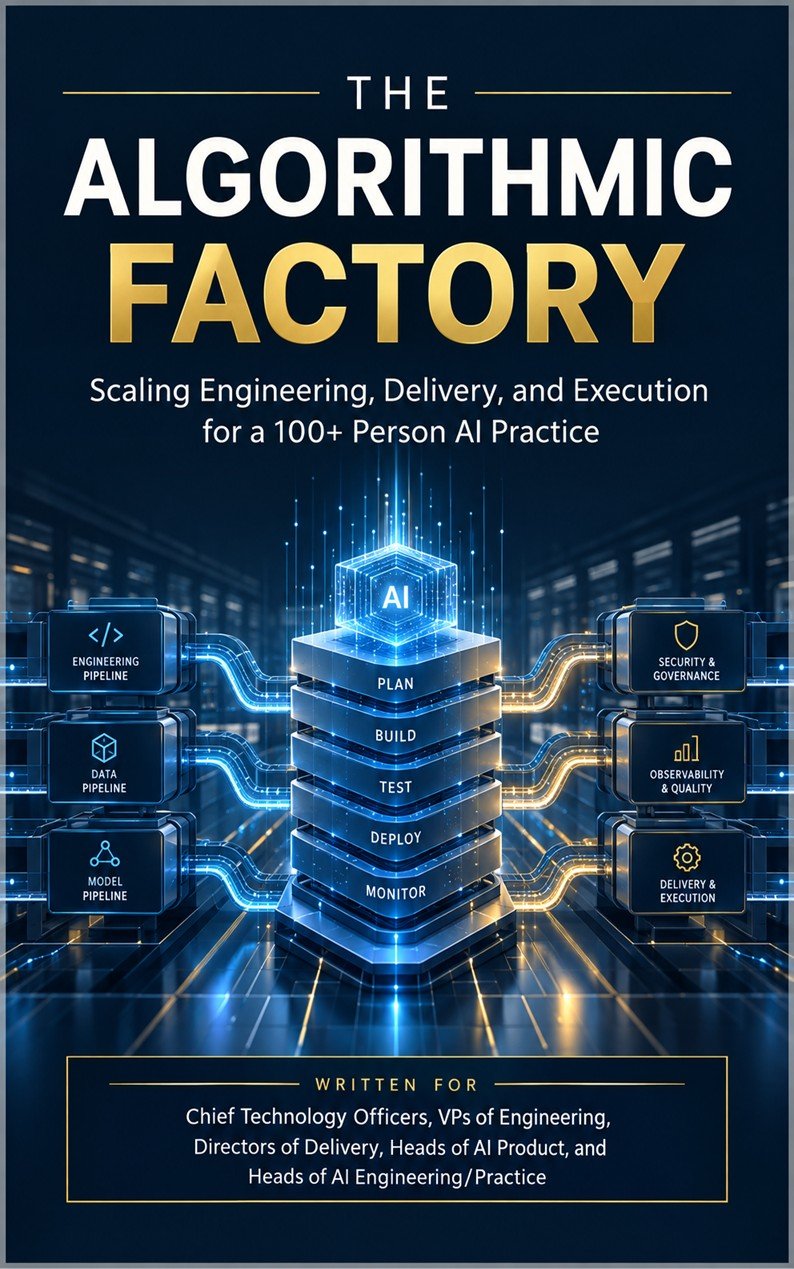
The Algorithmic Factory: Scaling Engineering, Delivery, and Execution for a 100+ Person AI Practice
✍️ About the Author
Sanjoy Kumar Malik — Senior Engineering & Technology Leader with over two decades of distinguished corporate IT experience bridging complex systems engineering, cloud-native architecture, and production-grade AI strategy. A TOGAF 10 Certified Enterprise Architecture Practitioner and AWS Professional Certified leader.
Sanjoy focuses on turning AI possibilities into scalable products. His work connects business opportunity and product vision with enterprise architecture to establish an architectural foundation for engineering teams.
Launching late November 2026
Overview
The operating playbook for building a 100+ person AI practice that can move from experimentation to predictable, profitable production.
Traditional software organizations are built around repeatability.
AI organizations aren't.
AI development is experimental, data-dependent, compute-heavy, and inherently uncertain. Yet many engineering leaders still manage AI teams using the same planning, delivery, organizational structures, and metrics designed for conventional software.
The result? More people. More meetings. More tickets. More prototypes. But not necessarily more predictable delivery.
The Algorithmic Factory presents a practical operating model for leaders who need to turn AI experimentation into an organization capable of delivering reliable production systems at scale.
For VPs of Engineering, Directors of Delivery, Heads of AI Practice, and CTOs building the next generation of AI organizations.
Coming End of November 2026
Your AI Organization Isn't a Software Factory
You've probably inherited a delivery system that works reasonably well for conventional software.
Roadmaps.
Sprints.
Story points.
Velocity.
Release plans.
Team capacity.
Then AI enters the picture.
Suddenly, the assumptions underneath that system begin to break.
A model behaves differently than expected.
A dataset isn't good enough.
An evaluation reveals that the prototype doesn't actually solve the problem.
A prompt change creates an unexpected regression.
Infrastructure costs grow faster than anticipated.
A promising experiment takes weeks longer than planned.
A production system requires far more engineering than the original prototype suggested.
And the natural response is often to add more Agile.
More ceremonies.
More tickets.
More developers.
More planning.
But more process doesn't eliminate uncertainty.
AI development follows a fundamentally different loop:
Problem → Data → Experiment → Evaluation → Model/Prompt → System → Production → Observation → Re-evaluation
That loop is inherently more variable than:
Idea → Requirements → Code → Test → Release
The answer isn't to eliminate uncertainty.
The answer is to contain it.
The Algorithmic Factory introduces an operating model designed around the realities of AI development: experimentation, evaluation, automation, economics, organizational design, and production reliability.
Because the goal of an AI factory isn't to make AI predictable.
It's to make the organization predictable despite AI's inherent uncertainty.
Inside The Algorithmic Factory
This isn't another book about AI tools, prompts, or model trends.
It's a practical operating playbook for leaders responsible for making AI work at organizational scale.
Part I — The AI Factory Mindset
Understand why conventional engineering management breaks down in AI—and what needs to replace it.
You'll learn how to:
- Recognize the different sources of AI variability
- Separate exploration from industrialization
- Plan around uncertainty instead of pretending it doesn't exist
- Design the discovery-to-delivery pipeline
- Move from the "AI lab" mindset to the factory mindset
Key frameworks include:
The AI Variability Map
Classify work as deterministic, semi-deterministic, experimental, or research-heavy.
The AI Estimation Matrix
Assess technical, data, model, integration, evaluation, regulatory, and infrastructure uncertainty before making commitments.
The AI Factory Operating Model
Structure the organization around Strategy, Product, AI Engineering, Platform, and Governance.
Part II — Building the Organization
A 100+ person AI practice cannot be created simply by hiring more engineers.
You need the right capabilities, team structures, ownership boundaries, and leadership layers.
You'll learn how to:
- Design a scalable AI capability map
- Define the modern AI skills grid
- Structure hub-and-spoke AI organizations
- Design platform, product, enabling, and specialized AI teams
- Establish clear ownership across the AI lifecycle
- Build teams around business outcomes rather than technologies
Key frameworks include:
- The 100+ Person AI Organization Blueprint
- The AI Responsibility Matrix - A practical way to clarify who owns the model, prompts, evaluation, production, and cost.
Part III — Industrializing AI Delivery
This is where experimentation becomes an engineered production capability.
You'll learn how to:
- Make model selection an engineering and business decision
- Evaluate models and AI systems systematically
- Build continuous evaluation into the development lifecycle
- Establish production-readiness criteria
- Manage model and prompt drift
- Design rollbacks, fallbacks, and model-routing strategies
- Move from prototype to reliable production system
Key frameworks include:
- The Enterprise Model Selection Matrix
- The AI Evaluation Pyramid
- The AI Production Readiness Checklist
And a developer lifecycle built around:
Continuous Integration → Continuous Evaluation → Continuous Delivery
Part IV — Running the Algorithmic Factory
Building the organization is only the beginning.
The final challenge is running it economically, measuring what matters, and scaling without creating organizational entropy.
You'll learn how to:
- Understand the true cost of AI features
- Plan engineering, evaluation, compute, and vendor capacity
- Measure cost per successful outcome
- Build an executive AI scorecard
- Balance standardization with team autonomy
- Scale from 20 people to 100—and eventually 500—without losing control
Key frameworks include:
- The AI Unit Economics Model
- The AI Factory Executive Scorecard
- And a practical approach to standardizing platforms, evaluation, security, governance, deployment, observability, and architecture while preserving flexibility where it matters.
One Operating System. Four Critical Challenges.
Mindset → Understand AI uncertainty.
Organization → Build teams that scale.
Delivery → Industrialize experimentation.
Economics & Execution → Run the factory.
The result is an AI organization designed not to eliminate uncertainty but to operate effectively in spite of it.
Stop Managing AI Like Conventional Software
AI is changing more than your technology stack.
It's changing how you need to structure teams, plan delivery, measure performance, control costs, and operate engineering organizations.
If you're building an AI practice that needs to move beyond prototypes and operate at meaningful scale, you need more than another methodology.
You need an operating model built for AI.
The Algorithmic Factory gives you the frameworks to build it.
Build the organization.
Contain the uncertainty.
Scale the execution.
The Algorithmic Factory: Scaling Engineering, Delivery, and Execution for a 100+ Person AI Practice
Coming End of November 2026
Follow Sanjoy on LinkedIn and receive updates about The Algorithmic Factory: Scaling Engineering, Delivery, and Execution for a 100+ Person AI Practice through his LinkedIn post.