Orchestrating the Enterprise
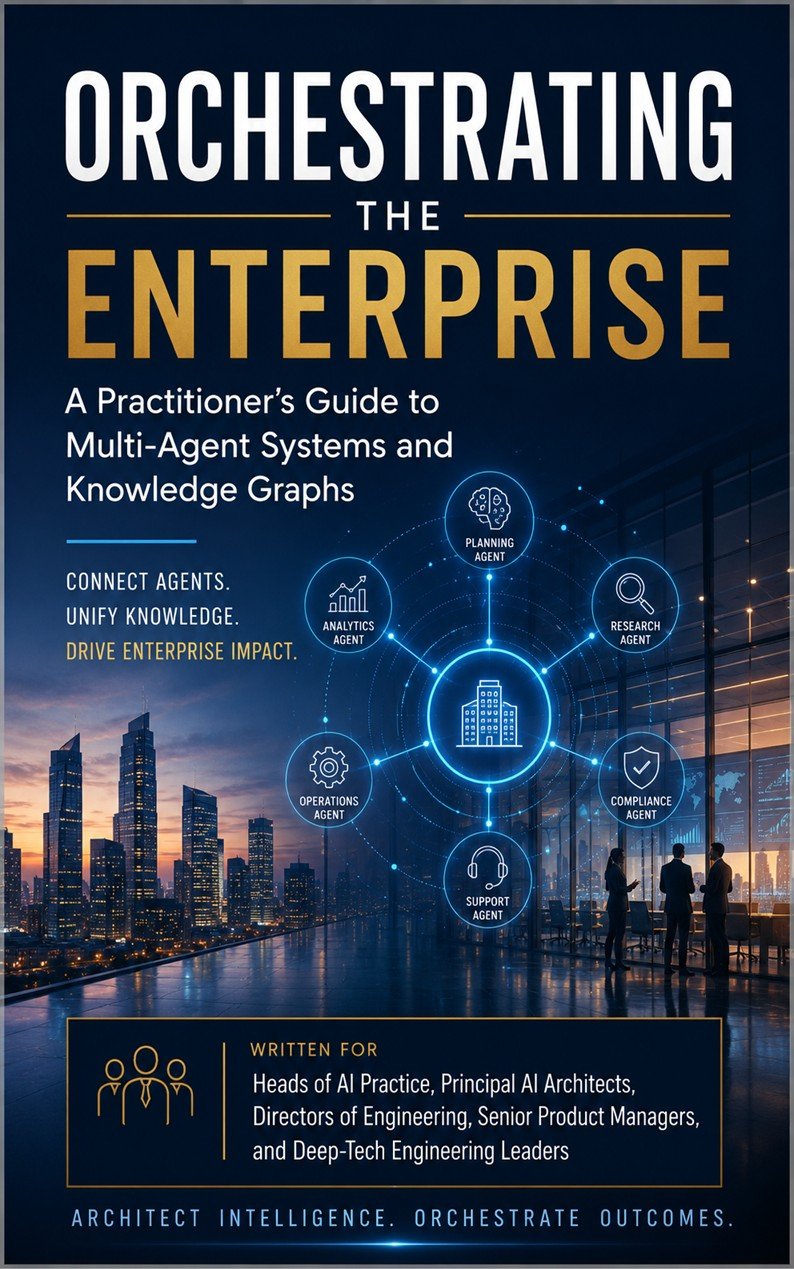
Orchestrating the Enterprise: A Practitioner’s Guide to Multi-Agent Systems and Knowledge Graphs
✍️ About the Author
Sanjoy Kumar Malik — Senior Engineering & Technology Leader with over two decades of distinguished corporate IT experience bridging complex systems engineering, cloud-native architecture, and production-grade AI strategy. A TOGAF 10 Certified Enterprise Architecture Practitioner and AWS Professional Certified leader.
Sanjoy focuses on turning AI possibilities into scalable products. His work connects business opportunity and product vision with enterprise architecture to establish an architectural foundation for engineering teams.
Launching late October 2026
Overview
Build AI systems that can reason across enterprise knowledge, orchestrate specialized agents, execute governed actions, and operate reliably in the real world.
Vector search and naive RAG can help AI find relevant information. But enterprise problems rarely live inside isolated chunks of text.
They live across entities, relationships, dependencies, business rules, events, systems of record, and constantly changing operational context.
This book shows you how to architect beyond flat retrieval by combining Multi-Agent Orchestration, Knowledge Graphs, GraphRAG, enterprise memory, systems of action, reliability engineering, observability, and governance into a cohesive enterprise architecture.
From AI that answers questions to AI that orchestrates outcomes.
Your Enterprise AI Has Outgrown RAG
For simple questions, semantic search and conventional RAG can work remarkably well.
But enterprise intelligence is rarely simple.
Ask a system to reason across a global supply chain, understand a multi-tier customer relationship, determine which automotive parts are compatible with a specific vehicle configuration, or execute a business process across multiple enterprise systems—and the limitations of flat retrieval quickly become apparent.
The problem is not a lack of information.
It is a lack of structure, context, state, and controlled action.
Enterprise knowledge is a network of:
- Entities and identities
- Relationships and dependencies
- Hierarchies and business structures
- Events and temporal context
- Rules and constraints
- Evidence and provenance
- Systems of record and transactional truth
A collection of semantically similar document chunks cannot, by itself, provide the structural context required for complex multi-hop reasoning.
And adding more agents does not automatically solve the problem.
More agents ≠ more intelligence.
Enterprise AI becomes genuinely operational when agents can reason over structured knowledge, maintain state, use constrained tools, coordinate specialized capabilities, verify results, recover from failure, and operate within enterprise policies.
That is the architectural shift this book explores.
Vectors help you discover what sounds relevant.
Graphs help you understand what is connected.
Systems of record tell you what is true.
Orchestration turns that intelligence into governed action.
The question is no longer whether enterprise AI can reason, but how to architect the intelligence fabric that makes that reasoning reliable, actionable, and scalable.
What’s Inside the Book
This is not a conceptual tour of AI agents.
It is a practitioner’s architectural playbook for designing enterprise-grade systems where knowledge, reasoning, orchestration, action, and governance work together.
Part I — The Architectural Shift
Understand why conventional RAG and single-agent approaches reach their limits—and when enterprise AI needs structure, orchestration, and explicit control.
You’ll explore:
- The RAG plateau and the limits of flat vectors
- Semantic relevance versus structural relevance
- Single-agent versus multi-agent architectures
- Supervisor, planner, router, worker, and critic patterns
- Determinism versus autonomy
Part II — The Intelligence Fabric
Learn how to engineer the knowledge and orchestration layers that give agents the context and control they need.
You’ll explore:
- Enterprise Knowledge Graph engineering
- Ontologies, entity resolution, provenance, and confidence
- GraphRAG and hybrid retrieval
- Multi-hop and entity-centric retrieval
- The Agentic Control Plane
- State, checkpoints, routing, recovery, and human approval
Part III — From Reasoning to Enterprise Action
Move beyond agents that merely think and retrieve toward agents that can safely interact with the enterprise.
You’ll explore:
- Enterprise APIs, tools, and systems of action
- CRM, ERP, DMS, legacy-system integration
- Transactional boundaries and idempotency
- Safe tool interfaces and constrained capabilities
- Enterprise memory and persistent business state
- An end-to-end Automotive BDC case study
Part IV — Engineering for Trust
Because an autonomous system that cannot be trusted cannot become an enterprise system.
You’ll explore:
- Reliability engineering for agentic systems
- Failure recovery, retries, circuit breakers, and resumability
- Agent observability and evaluation
- Groundedness, task completion, safety, latency, and cost
- Security, governance, identity, least privilege, and auditability
- Responsible autonomy and human-in-the-loop controls
Part V — The Enterprise Reference Architecture
Bring everything together into a complete architectural model—and learn how to make the decisions that determine whether an agentic system should actually be built.
You’ll explore:
- The Enterprise Multi-Agent + Knowledge Graph Reference Architecture
- Experience, orchestration, knowledge, memory, tool, data, security, and governance layers
- Model routing and deployment architecture
- Scalability, multi-tenancy, disaster recovery, and cost architecture
- Build-versus-buy decisions
- Agent versus workflow versus RAG versus GraphRAG
- Prototype → Pilot → Production → Scale
And throughout the book...
You’ll encounter architectural principles, decision frameworks, failure scenarios, trade-offs, and practitioner-oriented models designed to help you take these ideas into architecture reviews, technical discussions, and production systems.
The goal is not to convince you to use more AI.
The goal is to help you decide where autonomy belongs, where structure is essential, and where enterprise control must never be compromised.
Ready to Architect the Autonomous Enterprise?
The next generation of enterprise AI will not be defined by who has the most agents.
It will be defined by who can orchestrate intelligence across knowledge, workflows, systems, and people—reliably and responsibly.
Orchestrating the Enterprise gives architects and technology leaders a practical framework for making that transition.
Move beyond:
Flat vectors → Structured knowledge
Single prompts → Agentic orchestration
Answers → Actions
Context windows → Enterprise memory
Experiments → Reliable systems
Autonomy → Governed autonomy
Build AI that does more than retrieve.
Build AI that understands, reasons, orchestrates, and acts.
Be Ready for the Next Architectural Shift
Enterprise AI is moving beyond applications that retrieve information and generate responses. The emerging challenge is designing systems that can reason across structured knowledge, coordinate specialized agents, execute actions, and remain reliable under enterprise constraints.
That requires more than another framework, another model, or another RAG pipeline. It requires a coherent architectural approach to intelligence, orchestration, memory, action, reliability, security, and governance.
Orchestrating the Enterprise is being written for the architects and technology leaders who will have to make those decisions.
Launching late October 2026, this practitioner’s guide will give you the architectural principles, patterns, decision frameworks, and reference architectures to move from promising agentic experiments to enterprise-grade autonomous systems.
The future of enterprise AI will not be built by adding intelligence alone.
It will be built by orchestrating intelligence into systems that enterprises can trust.
Follow Sanjoy on LinkedIn and receive updates about Orchestrating the Enterprise: A Practitioner’s Guide to Multi-Agent Systems and Knowledge Graphs through his LinkedIn post.