Deconstructing the Monolith with AI
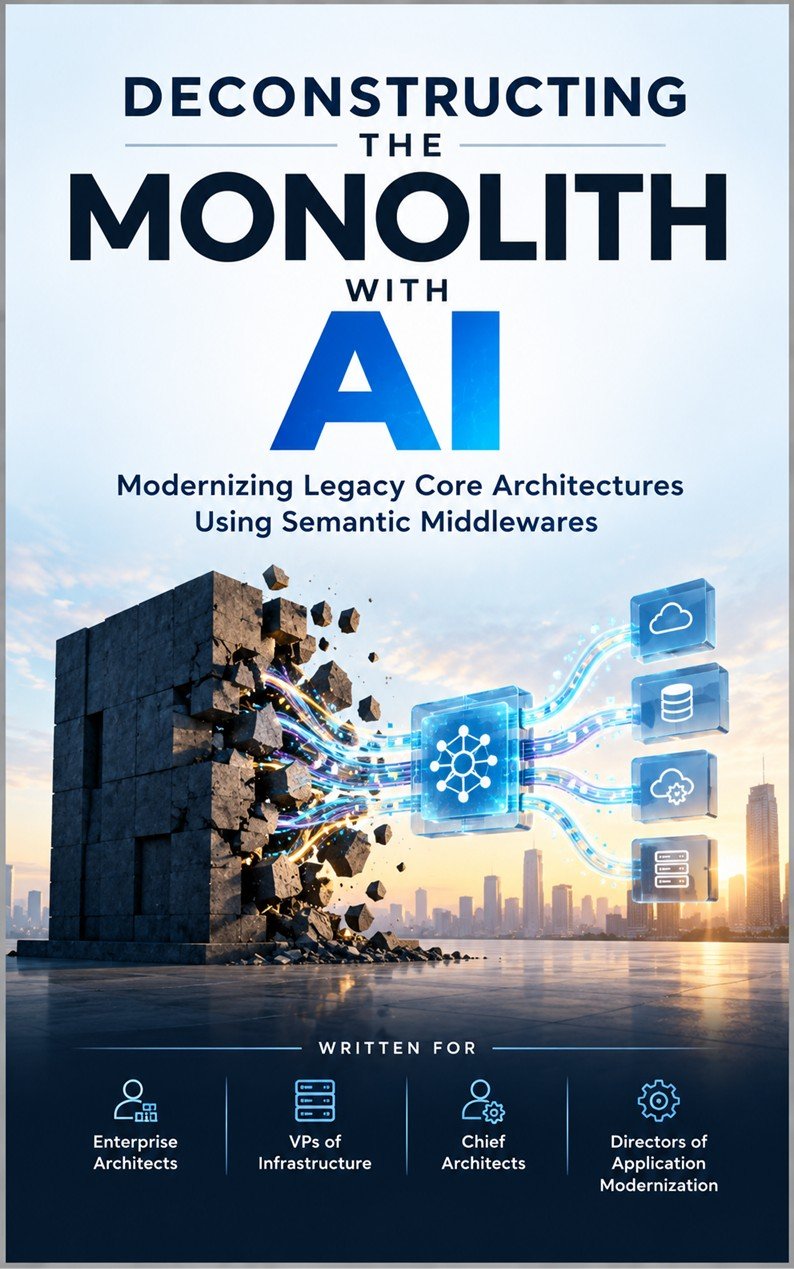
Deconstructing the Monolith with AI: Modernizing Legacy Core Architectures Using Semantic Middlewares
✍️ About the Author
Sanjoy Kumar Malik — Senior Engineering & Technology Leader with over two decades of distinguished corporate IT experience bridging complex systems engineering, cloud-native architecture, and production-grade AI strategy. A TOGAF 10 Certified Enterprise Architecture Practitioner and AWS Professional Certified leader.
Sanjoy focuses on turning AI possibilities into scalable products. His work connects business opportunity and product vision with enterprise architecture to establish an architectural foundation for engineering teams.
Launching late December 2026
Overview
A pragmatic architectural playbook for Enterprise Architects, Chief Architects, and modernization leaders who need to unlock legacy systems for modern applications and AI—without putting enterprise operations at risk.
Your legacy core isn't simply old code.
It contains decades of business rules, transactions, data, integrations, workflows, and institutional knowledge.
And that is precisely why replacing it is so difficult.
The question is no longer: “How do we rewrite the monolith?”
The better question is:
“How do we progressively transform what surrounds the monolith—while keeping the core operational?”
Deconstructing the Monolith with AI presents a practical architecture for doing exactly that.
You will learn how AI-driven semantic middleware, composable service abstractions, event-driven integration, and governed agentic workflows can create a modernization runway between today's legacy core and tomorrow's modular enterprise platform.
Your Legacy System Is Not the Problem.
Your Modernization Strategy Might Be.
For decades, enterprises have accumulated COBOL applications, mainframes, undocumented ERPs, relational databases, proprietary interfaces, batch processes, and deeply embedded business rules.
The instinctive answer is often:
Rewrite it. Replace it. Start again.
But rip-and-replace introduces its own risks:
- Hidden dependencies you didn't know existed
- Business rules buried inside decades-old applications
- Complex data migration
- Requirement reconstruction
- Parallel-run challenges
- Operational disruption
- The enormous cost of achieving behavioral equivalence
And simply putting an API wrapper around the old system doesn't solve the deeper problem.
An API can expose legacy complexity. It doesn't necessarily abstract it.
The alternative explored in this book is a more controlled path:
**Understand → Abstract → Govern → Compose → Decouple → Modernize → Replace**
The legacy core stays operational while its capabilities are progressively exposed through intelligent, governed semantic interfaces.
The goal isn't to create a permanent AI wrapper.
The goal is to create an architectural runway toward a more modular, progressively replaceable enterprise core.
What's Inside the Book
PART I — Rethinking Legacy Modernization
01 — The Modernization Paradox
Wrap, Rewrite, or Reimagine?
Learn how to decide what should remain, what should be abstracted, what should be decoupled, and what should eventually be replaced.
You'll examine why technical age doesn't necessarily mean business obsolescence—and why rip-and-replace frequently underestimates the complexity hidden inside legacy systems.
02 — Finding the Business Capabilities Inside the Monolith
Before you modernize a monolith, you need to understand what it actually does.
Learn how to move beyond classes, tables, and technical modules to identify business capabilities, processes, transactions, data ownership, dependencies, and modernization boundaries.
The outcome is a Legacy Capability Map that becomes the foundation for subsequent architecture decisions.
PART II — Building the Semantic Boundary
03 — Reverse-Engineering the Legacy Core with AI and Graph Analytics
Turn an opaque legacy estate into an architecturally navigable knowledge graph.
Explore AI-assisted code understanding, business-rule extraction, data lineage, dependency analysis, architecture graphs, and human validation.
The objective:
Dramatically reduce the manual effort required to reconstruct architecture, dependencies, and business rules.
04 — Designing the Semantic Middleware
The technical centerpiece of the book.
Discover how semantic middleware creates a controlled translation boundary between modern intent and deterministic legacy capabilities.
You'll explore:
**Intent → Context → Plan → Validate → Execute → Verify**
And one of the book's central architectural principles:
AI may determine what should happen; deterministic systems must determine whether and how it is allowed to happen.
PART III — Making the Bridge Enterprise-Grade
05 — The Intelligent Composable Bridge
AI workloads move at a very different velocity from legacy transactional systems.
Learn how to design the bridge between them using:
- Semantic layers
- APIs
- Orchestration
- Queues and events
- Adapters
- State management
- Retry and timeout patterns
- Circuit breakers
- Backpressure
- Idempotency
- Graceful degradation
Because failure is not an exception to architecture. It is an architecture concern.
06 — Governing and Securing AI at the Legacy Boundary
The critical enterprise question isn't:
“Can AI talk to the mainframe?”
It is:
“Under what conditions should AI be allowed to talk to the mainframe?”
Explore identity, authorization, trust boundaries, tool governance, transaction limits, validation, sensitive-data protection, auditability, explainability, and regulatory considerations.
The governing principle:
Never allow probabilistic reasoning to bypass deterministic controls.
PART IV — From Bridge to Modernization Platform
07 — Operating the Semantic Modernization Platform
Modernization doesn't end when the bridge goes live.
Learn how to turn semantic middleware into a reusable platform capability—with observability, operational metrics, AI-specific metrics, model lifecycle management, reusable adapters, policy services, and developer experience.
Then build toward a Modernization Factory:
**Identify → Discover → Abstract → Govern → Expose → Measure → Decouple → Replace**
08 — The Modernization Endgame
The bridge is not the destination.
Learn how semantic contracts can become the foundation for progressively extracting capabilities, migrating data, applying strangler patterns, and replacing legacy implementations without rewriting the world.
The evolution becomes:
Legacy Monolith
↓
Semantic Boundary
↓
Composable Capabilities
↓
Event-Driven Architecture
↓
Modular Core
↓
Progressively Replaceable Enterprise Platform
Don't Rewrite the Monolith.
Deconstruct It.
If you are responsible for modernizing an enterprise architecture, you don't need another argument for or against rewriting legacy systems.
You need a way forward.
Deconstructing the Monolith with AI gives you an architectural model for moving from legacy complexity toward modern, composable, governed, and progressively replaceable capabilities—while the existing core continues to run.
Get the Book
Launching December 2026
Follow Sanjoy on LinkedIn and receive updates about Deconstructing the Monolith with AI: Modernizing Legacy Core Architectures Using Semantic Middlewares through his LinkedIn post.