Why an LLM wrapper is not an enterprise architecture
An LLM wrapper is not an enterprise architecture because it treats a non-deterministic, third-party AI model as the entire foundation of the system rather than a single, replaceable component. While a wrapper is sufficient for simple, low-stakes automation, enterprise systems require strict guarantees around reliability, security, compliance, data sovereignty, and predictability—none of which a basic API wrapper can provide.
We should undertsand why this approach fails at scale and what a true enterprise architecture looks like instead.
Architectural Vulnerabilities of an LLM Wrapper
A wrapper acts as a direct pass-through, creating a tight coupling between your business application and an external API. This introduces several critical failure points:
- Vendor and Model Lock-in: If your code is designed entirely around a specific provider's API structure and behavior, migrating to a cheaper, faster, or open-source model requires rewriting the application.
- Systemic Fragility: Models are living systems. When a provider updates model weights (even a minor patch), the model's tone, reasoning path, and output formatting change. This "model drift" can instantly break downstream parsers and code logic.
- Zero Architectural Redundancy: If the provider experiences an outage, faces a rate-limit choke, or suffers a data breach, your enterprise application goes offline immediately.
- Compliance and Data Leakage: Sending raw enterprise data directly to a third-party API without an internal governance layer risks violating regulations like GDPR, HIPAA, or strict corporate data residency policies.
The Components of a True Enterprise AI Architecture
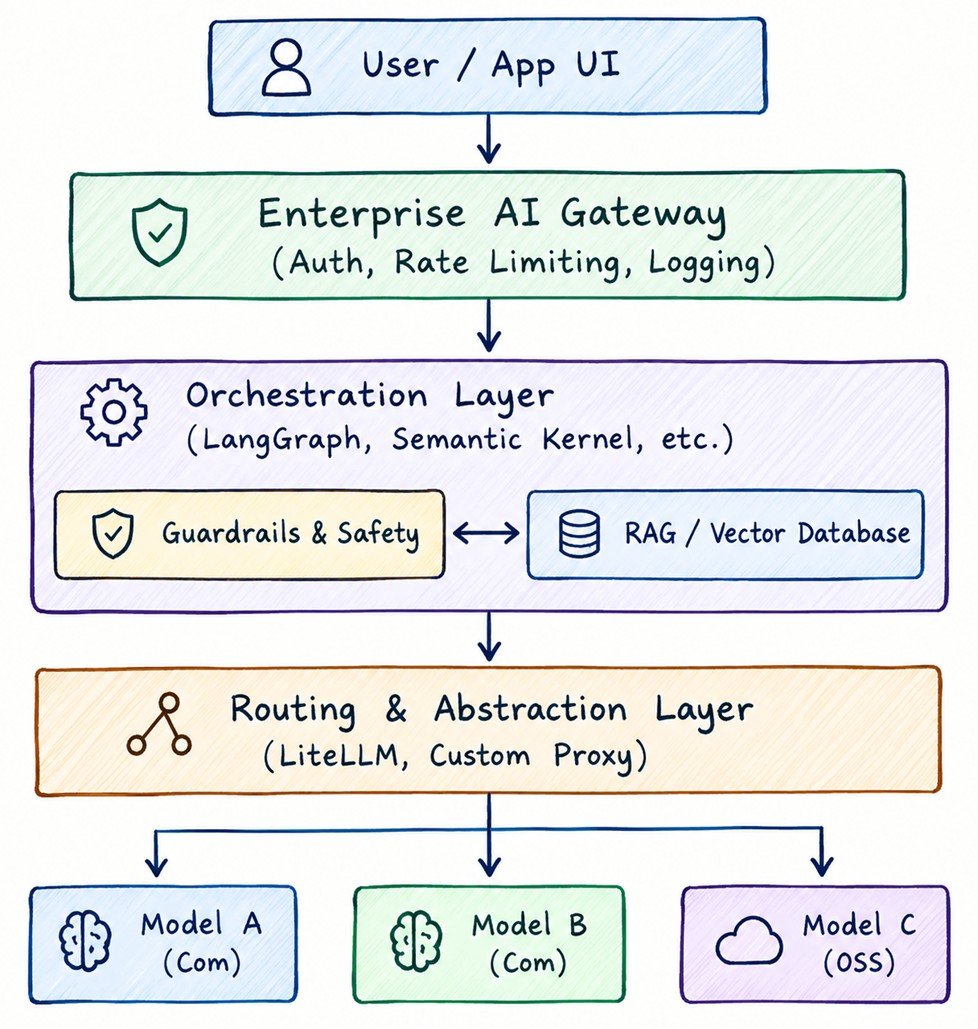
To build a resilient enterprise system, the LLM must be decoupled from the application logic. At very high-level, the architecture must surround the model with specialized layers that handle data, routing, safety, and monitoring.
The Gateway & Security Proxy
Instead of calling the model directly, all requests flow through an internal API gateway. This layer enforces enterprise-grade authentication, manages API keys, controls rate limits, and scrubs Personally Identifiable Information (PII) or proprietary code before it leaves the corporate network.
The Orchestration Layer
This is the true "brain" of the application logic. Using frameworks like LangGraph or Semantic Kernel, the orchestration layer manages state, memory, and sequential reasoning steps. It treats the LLM as a calculator—a tool to process data at a specific step—rather than the controller of the entire workflow.
The Context & Semantic Data Store
Enterprises do not rely on the LLM's static training data. They utilize Retrieval-Augmented Generation (RAG) backed by enterprise data pipelines, graph databases, and vector databases (like Pinecone, Milvus, or pgvector). This layer fetches relevant, permission-checked corporate data and injects it into the context window, ensuring the output is grounded in corporate truth.
The Model Abstraction & Routing Layer
A routing layer abstracts the specific API endpoints. It allows the system to dynamically switch models based on cost, latency, or capability. For example, a simple classification task might be routed to a small, cheap open-source model hosted internally, while a complex reasoning task is routed to a premium commercial model. If a provider goes down, the router automatically fails over to a backup provider seamlessly.
Observability & Evaluation Agents
Enterprise architectures require rigorous monitoring. Continuous evaluation frameworks track cost, latency, token usage, and output quality (hallucination scores, toxicity, and alignment). This allows developers to catch model drift or regressions in production before users notice them.
Comparison Matrix
| Capability | LLM Wrapper | Enterprise AI Architecture |
|---|---|---|
| System Dependency | Tightly coupled to one specific API. | Loosely coupled; agnostic to the underlying model. |
| Data Governance | Direct data exposure to third-party providers. | Strict internal filtering, PII scrubbing, and RBAC. |
| Resilience & Uptime | Vulnerable to vendor outages and rate limits. | Built-in failovers, caching, and model redundancy. |
| Behavioral Stability | Subject to sudden changes via model drift. | Managed through regression testing and prompt versioning. |
| Cost Control | Linear scaling costs dictated by the vendor. | Dynamic routing and semantic caching to optimize spend. |
An LLM wrapper is a feature. An enterprise AI architecture is a sustainable, secure environment that allows an enterprise to swap models as the technology evolves without breaking the business.
A simple LLM wrapper acts as a thin feature layer that connects a specific model directly to a user interface, making the application highly vulnerable to breaking or becoming obsolete if that specific underlying model changes. In contrast, an enterprise AI architecture is an abstraction framework that decouples your business logic from any single AI vendor or model.