Deterministic software vs. probabilistic AI systems
Introduction
The traditional software engineering paradigm is undergoing its most profound structural disruption since the advent of cloud computing. For decades, enterprise technology architectures have been anchored on determinism—systems governed by explicit logic, rigid pathways, and predictable states. The integration of Large Language Models (LLMs) and Generative AI introduces a fundamentally opposing paradigm: probabilistic computing.
For CTOs, VPs, and Engineering Directors, treating probabilistic AI as "just another API call" is a critical architectural error. This strategic blueprint delineates the core divergence between these two paradigms and provides actionable frameworks, engineering best practices, and templates to safely govern, build, and scale AI-native enterprise architectures.
1. The Core Divergence: Deterministic vs. Probabilistic
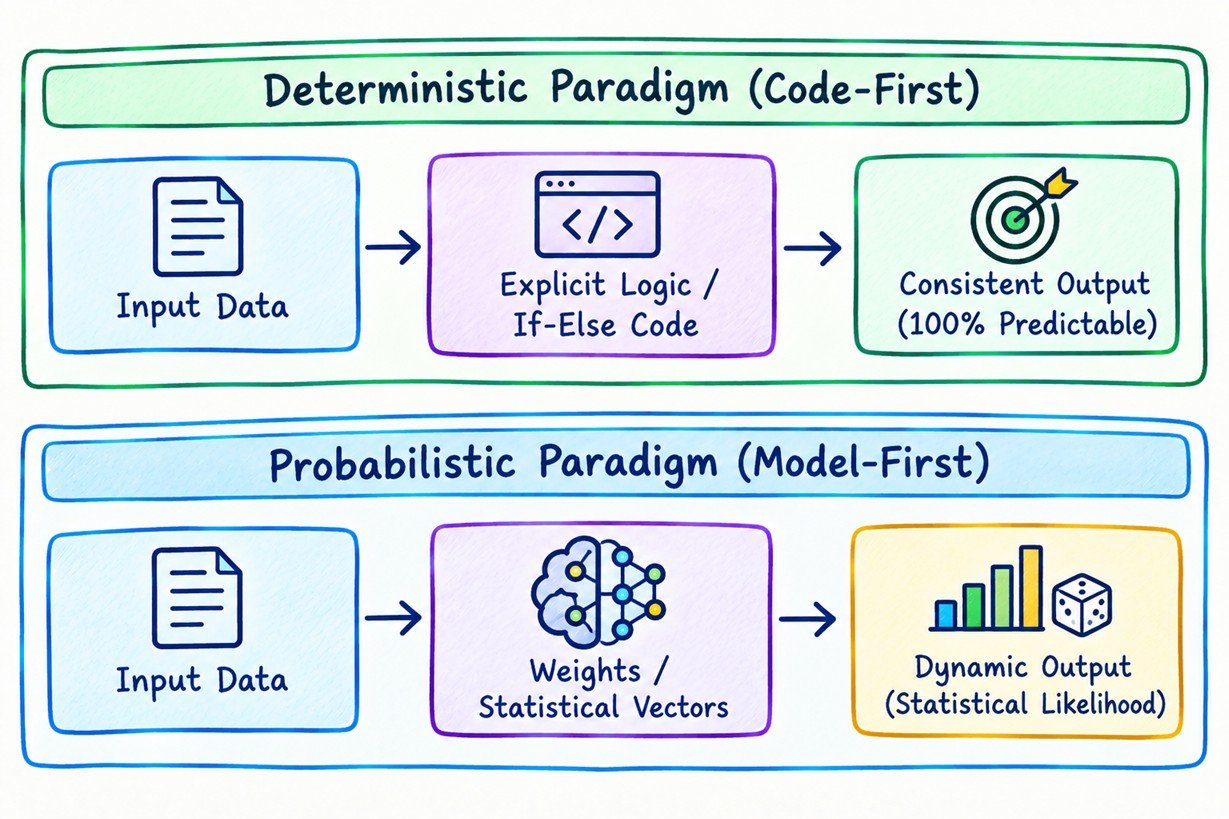
Deterministic Software Engineering
Traditional enterprise software is built on mathematical and logical certainty. Systems operate within a closed-world assumption: given input (X) and system state (S), the output will always be (Y).
- Failure Modes: Explicit and traceable. Root-cause analysis (RCA) maps directly to a specific line of code, unhandled edge cases, race conditions, or schema mismatches.
- Testing Philosophy: Verification-based. Code coverage, unit testing, and integration assertions confirm alignment with an absolute specification.
- Scale Dynamics: Linear or stepped infrastructure scaling. Performance optimization focuses on computational efficiency, indexing, and I/O bottlenecks.
Probabilistic AI Engineering
Generative AI systems operate on high-dimensional vector spaces and statistical distributions. LLMs do not "understand" business logic; they compute the conditional probability of token sequences.
- Failure Modes: Silent, emergent, and non-linear. A system can fail via semantic drift, hallucination, prompt injection, or latent toxicity without throwing a single runtime exception or 500 error code.
- Testing Philosophy: Evaluation-based. Because the output space is mathematically infinite, verification must pivot from pass/fail assertions to statistical distribution metrics over large evaluation datasets.
- Scale Dynamics: Non-linear and non-deterministic. Context window inflation, token-generation latency, and non-deterministic routing fundamentally alter how compute resources are budgeted and optimized.
Comparative Architectural Reality
| Architectural Vector | Deterministic Software | Probabilistic AI Systems |
|---|---|---|
| Execution Path | Explicit execution paths defined by code. | Dynamic generation via neural network weight layers. |
| Output Consistency | Identical inputs guarantee identical outputs. | Same input can yield varying semantic responses. |
| Debugging Mechanism | Stack traces, breakpoints, step-through logs. | Embedding visualizations, logprobs, semantic tracing. |
| Core Vulnerability | Code bugs, memory leaks, security exploits. | Prompt injection, hallucinations, data leakage. |
| Reliability Metric | Uptime, SLA, Zero-defect delivery. | Semantic accuracy, alignment, precision/recall curves. |
2. The Hybrid Architectural Paradigm
The modern enterprise application is neither purely deterministic nor purely probabilistic. The AI Architectural North Star requires a Dual-Engine Architecture where deterministic guardrails encapsulate and govern probabilistic cores. The Dual-Engine Architecture (Deterministic + Probabilistic) must be mapped directly into the Eight Pillars of the AI Architectural North Star.
Mapping the Hybrid Paradigm to the 8 Pillars
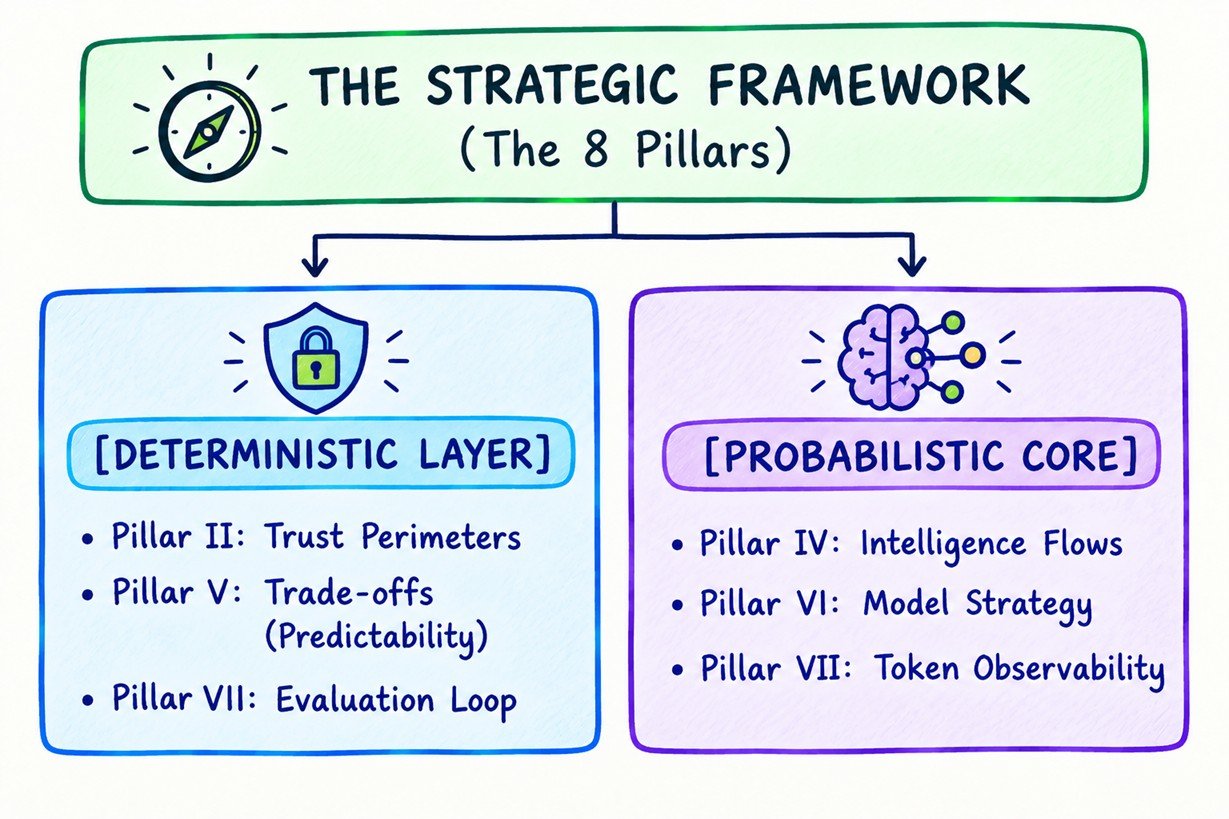
Pillar I: Architectural Intent
- Alignment: The hybrid architecture ensures that the business outcome (e.g., trust, accuracy, compliance) drives the technical split. The intent is explicitly defined: Leverage the reasoning capabilities of probabilistic AI without inheriting its structural instability.
Pillar II: System Boundaries & Trust Perimeters
- Alignment: This is the literal foundation of the Deterministic Guardrail/Evaluation Layers. The North Star boundary dictates that no untrusted user prompt directly touches the core model (Ingress Perimeter), and no unvalidated model output touches downstream microservices or UIs (Egress Perimeter).
Pillar III: Major Design Choices
- Alignment: The decision to enforce a Dual-Engine Architecture instead of a pure-play probabilistic approach is a defining Pillar III choice. It mandates that logic and statistical prediction are decoupled from day one.
Pillar IV: Intelligence Flows
- Alignment: The hybrid paradigm establishes the exact choreography: Data flows from a deterministic state, transforms into high-dimensional vectors inside the probabilistic core, and is forced back into a deterministic JSON/structured state before exiting.
Pillar V: Critical Trade-offs
- Alignment: The hybrid framework explicitly trades away raw, unfettered creativity and unconstrained speed (probabilistic freedom) in exchange for absolute corporate compliance, schema adherence, and predictability (deterministic control).
Pillar VI: Intelligence & Model Strategy
- Alignment: By isolating the "Probabilistic Cognitive Core," you allow the intelligence strategy to remain modular. The engineering team can swap an underlying model (e.g., moving from an external LLM API to an internal fine-tuned SLM) without rewriting the surrounding deterministic guardrail infrastructure.
Pillar VII: Evaluation, Observability & Reliability
- Alignment: Because the core is statistical, reliability cannot be measured by uptime alone. This pillar mandates the deployment of semantic drift metrics, logprobs tracking, and Golden Dataset regression testing alongside standard APM metrics.
Pillar VIII: Evolution & Governance
- Alignment: By versioning prompts as code and decoupling business rules from model weights, the architecture avoids becoming a legacy liability. The deterministic wrapper remains stable while the probabilistic brain evolves.
3. Engineering Frameworks for Probabilistic Systems
To transition from ad-hoc AI prototyping to enterprise-grade production engineering, leadership must mandate the implementation of three operational frameworks.
Framework A: The Continuous Evaluation Loop (LLMOps)
Traditional CI/CD pipelines check if code compiles and tests pass. AI pipelines require an Evaluation CI/CD Pipeline that benchmarks model performance across semantic slices.
-
Golden Dataset Curation: Build a production-representative dataset containing fixed input-output pairs representing edge cases, safety boundaries, and core business transactions.
-
Automated Evaluation Metrics: Run regression testing against the golden dataset using algorithmic metrics (ROUGE, BLEU, BERTScore) and Model-as-a-Judge evaluations (using an advanced model to grade output quality based on strict criteria).
-
Hard Threshold Gates: Block production deployments if semantic accuracy drops even by a fraction of a percent.
Framework A: The Continuous Evaluation Loop (LLMOps) is mapped directly to Pillar VII: Evaluation, Observability & Reliability (and codified in the CI/CD Gate section of the template).
Framework B: Structured Output Enforcement
Never allow a raw LLM text stream to touch downstream core systems or databases. Utilize deterministic state machines and parsing engines to enforce structural constraints.
- Use tools like Pydantic Logfire, Instructor, or Outlines to force models to output structured data types (JSON/YAML) directly at the token-generation level by modifying logits.
- Apply strict regex pattern filtering at the inference gateway to guarantee formatting before parsing execution blocks.
Framework B: Structured Output Enforcement is mapped directly to Pillar II: System Boundaries & Trust Perimeters and Pillar IV: Intelligence Flows (operationalizing the Egress Perimeter).
Framework C: Defensive Prompt Engineering & Context Lifecycle Management
Treat prompts as production source code. They must be versioned, unit-tested, and dependency-managed.
- Context Isolation: Explicitly separate user-supplied data from system instructions using structural delimiters (e.g., XML tags like
<user_query></user_query>) to prevent prompt injection. - Dynamic Context Pruning: Implement strict sliding window strategies and semantic chunk re-ranking (e.g., Cohere Rerank) to guarantee that high-density context does not dilute model attention or induce middle-of-the-prompt hallucinations.
Framework C: Defensive Prompt Engineering & Context Lifecycle Management is mapped directly to Pillar II (Ingress Perimeter), Pillar VI (Context Management), and Pillar VIII (Git versioning of prompts).
4. Strategic Alignment & Templates
Tech Stack Assessment Template
Engineering leaders can utilize this matrix to audit the current software portfolio and identify structural vulnerabilities stemming from improper probabilistic architecture. This template bridges the gap between traditional IT systems and probabilistic nodes by assigning concrete, actionable engineering mitigations.
| Evaluation Vector | Deterministic Standard | Probabilistic AI Integration Goal | Risk Mitigation Action Item |
|---|---|---|---|
| Error Handling | try/catch blocks handling known exceptions. | Semantic catch blocks identifying hallucinatory loops, alignment failures, and non-terminating agent behaviors. | Implement a fallback routing policy to a lower-temperature model, alternative model vendor, or human-in-the-loop queue when confidence scores drop below a strict threshold. |
| Observability | APM tracing (latency, memory, CPU utilization, HTTP 5xx error rates). | Token tracking, embedding drifts, cost/1k tokens, prompt-to-response drift, and context window density. | Integrate LLM-native observability tools (e.g., Arize, Langfuse, Phoenix) into the existing telemetry collector pipelines. |
| Security & Compliance | Static analysis (SAST/DAST), SQL injection prevention, cross-site scripting (XSS) filters. | Prompt injection defense, PII scrubbing, model poisoning defense, and data exfiltration shielding. | Deploy a dedicated inference firewall proxy layer (e.g., NeMo Guardrails) at the network perimeter to intercept inputs and outputs. |
| Data Versioning | Relational migration scripts (Flyway, Liquibase) and schema tracking. | Vector database index checkpointing, semantic corpus snapshotting, and prompt asset lifecycle tracking. | Link vector index embeddings to a specific cryptographic hash version of the underlying raw documentation and version prompts directly in Git. |
Architectural Review Scorecard (The Production Readiness Checklist)
Before any AI-enabled service receives sign-off for enterprise production deployment, VPs and Directors must verify the following criteria:
- Deterministic Parsing: Is there a zero-trust parsing layer validating model output structure before it hits external databases or UIs?
- Regression Testing Benchmarks: Has the service been tested against an evaluation dataset containing at least 200+ multi-turn business scenarios?
- Context Window Protections: Is there a deterministic token-counter clipping user inputs to prevent unexpected context exhaustion or massive surge billing?
- Cost and Latency Guardrails: Is there a configured circuit-breaker that falls back to a faster, smaller model or a hard error state if inference latency exceeds a defined budget?
- Semantic Drift Tracking: Are production inputs and outputs continually logged and projected into an embedding space to detect user behavior changes or model degradations over time?
5. Executive Checklist: Leading the Cultural Shift
To successfully navigate this paradigm shift, technology leadership must evolve engineering cultures from a binary "works/broken" mindset to a statistical, risk-managed discipline.
-
Upskill Teams from Verification to Evaluation: Ensure QA and testing engineers transition from writing static unit tests to curating high-quality evaluation datasets and designing synthetic test pipelines.
-
Re-Architect Funding Models for Volatile Infrastructure Costs: Unlike predictable server instances, AI computing costs correlate directly with semantic complexity and token volumes. Budget using variable forecasting models that account for token density and prompt/response amplification factors.
-
Decouple Business Logic from Model Versions: Never embed critical enterprise rules directly inside a prompt. Keep business logic codified in deterministic microservices, and leverage the AI system solely for contextual extraction, classification, translation, and synthesis.
By enforcing a clear separation between deterministic guardrails and probabilistic cognitive engines, enterprise technology organizations can scale AI systems that are innovative, structurally sound, resilient, and safe for production workloads.