The four enterprise killers - cost, reliability, latency, and security
Introduction
Deploying Generative AI (GenAI) at enterprise scale transforms the software engineering paradigm from deterministic computation to probabilistic systems. While proof-of-concept (PoC) environments frequently mask structural architectural flaws, production scaling exposes these vulnerabilities ruthlessly.
Enterprise deployments are bounded by four non-negotiable operational constraints: Cost, Reliability, Latency, and Security. Failure to architect your systems explicitly to manage these vectors will guarantee project failure, budget exhaustion, or catastrophic compliance breaches.
1. Cost: The Explosion of Multiplied Scale
At enterprise scale, usage costs scale non-linearly with user adoption. Unlike traditional software where marginal infrastructure costs approach zero, GenAI architectures incur recurring variable expenses tied directly to token volume.
The Vulnerability Mechanics
Model providers monetize workflows via input and output tokens. A PoC confined to ten users masks this reality through artificial constraints. When that system scales to 10,000 active concurrent users, financial predictability breaks down due to two distinct vectors:
- Context Inflation: Unchecked user prompts, recursive chat histories, and bloated Retrieval-Augmented Generation (RAG) payloads append thousands of tokens of historical context to every single transaction.
- Recursive Agent Loops: Multi-agent architectures and autonomous reasoning loops (e.g., ReAct frameworks) frequently generate dozens of internal model calls to resolve a single user query. If an agent enters an infinite loop or poorly bounded recursion, a single user session can exhaust thousands of dollars of API credits in minutes.
Enterprise Mitigation Architecture
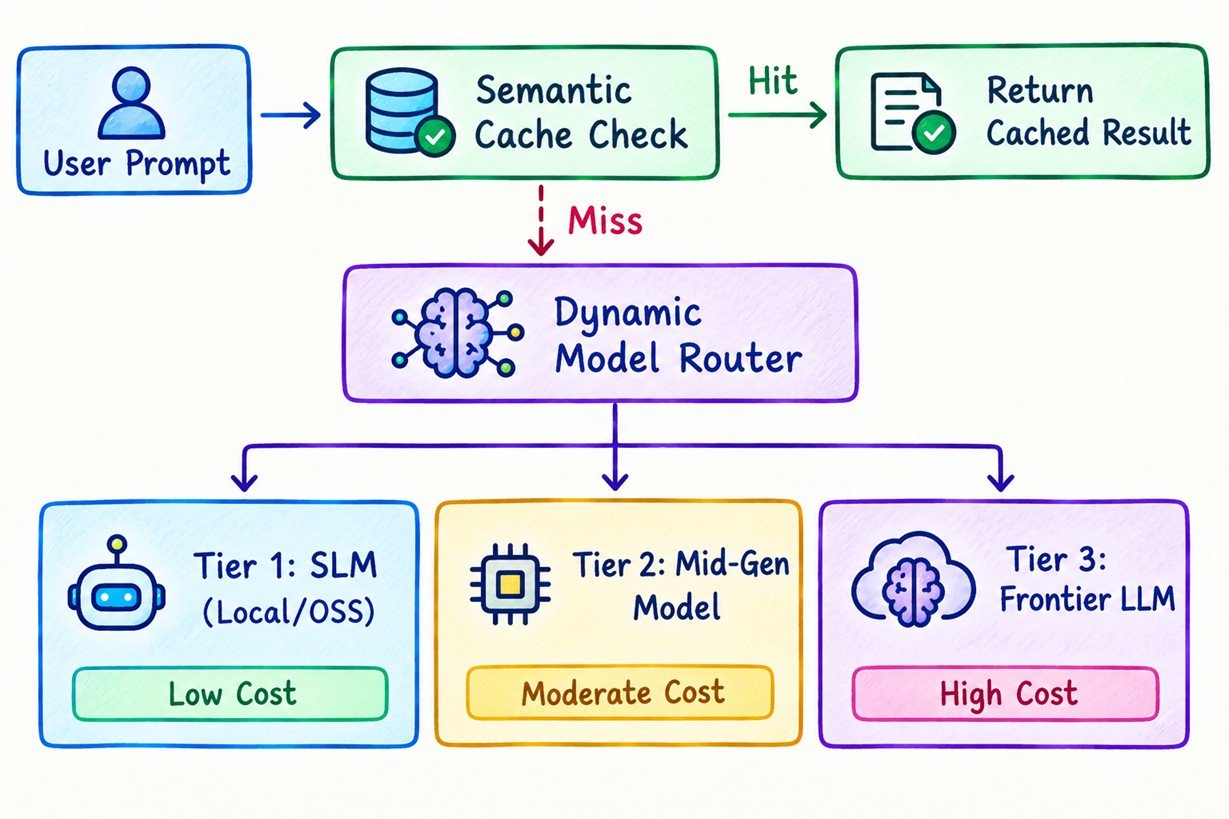
Semantic Caching Layers
Implement an aggressive, localized vector database cache (e.g., Redis, Milvus) downstream of your API gateway. Before routing any query to an external LLM, convert the incoming prompt into an embedding and execute a cosine similarity search against previous queries. If a match exceeds a strict threshold (e.g., >0.95), return the cached response within milliseconds at zero token cost.
Hard Token Budgeting & Windowing
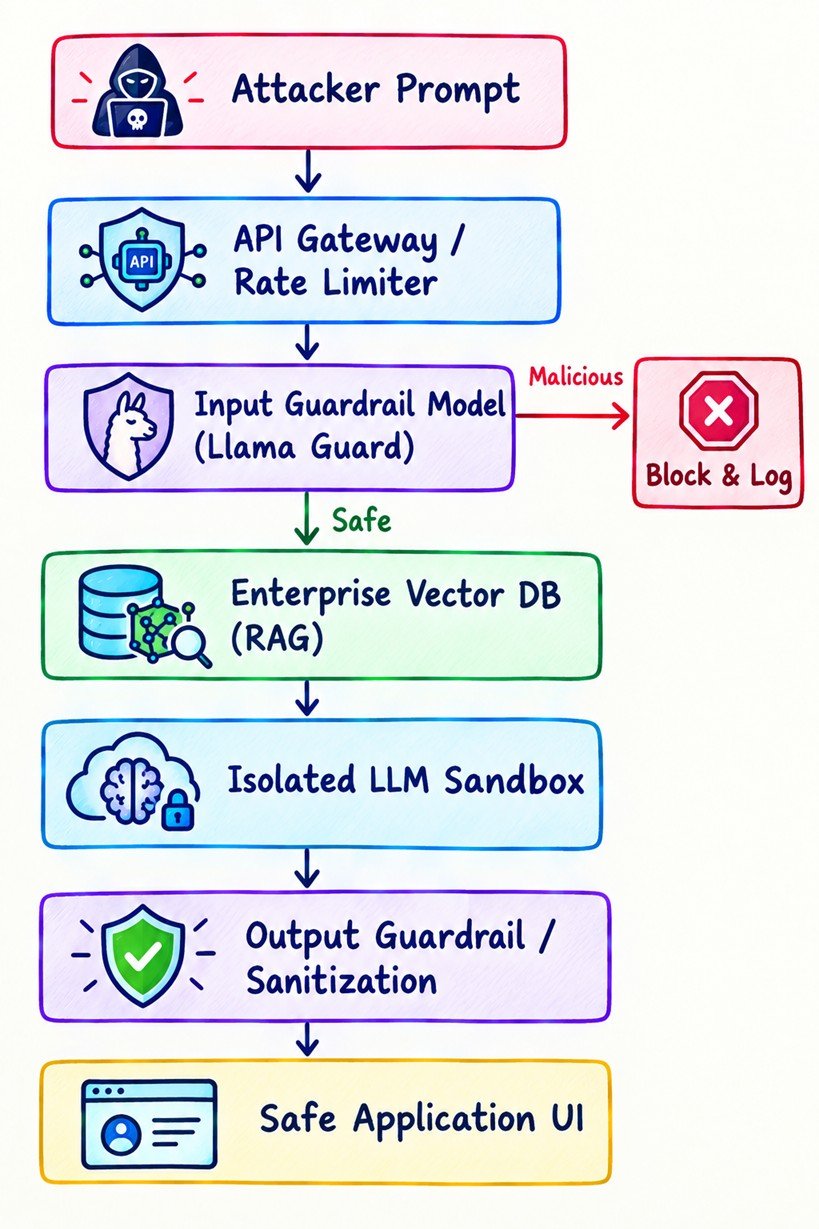
Enforce strict rate-limiting policies at the API gateway level. Implement rolling context windows using truncation strategies (like conversation token counting via tiktoken) or summarize historical interactions using highly compressed, low-cost models. Never pass raw, unbounded chat history back to a frontier model.
Dynamic Model Routing & Tiering
Abandon the design pattern of routing all enterprise workloads to a single frontier model (e.g., GPT-4 or Claude 3.5 Sonnet). Build an intelligent orchestration router that classifies inbound requests by complexity:
- Tier 1 (Low Complexity): Route basic data extraction, classification, and formatting tasks to highly optimized Small Language Models (SLMs) hosted internally (e.g., Llama 3 8B or Mistral 7B).
- Tier 2 (Medium Complexity): Route structured reasoning or multi-lingual tasks to mid-tier commercial models.
- Tier 3 (High Complexity): Reserve expensive frontier models exclusively for highly complex reasoning, advanced math, or ambiguous creative logic.
2. Reliability: Stabilizing Probabilistic Core Systems
Traditional enterprise software relies on deterministic predictability: Input A plus System B always yields Output C. Generative AI shatters this assumption by introducing non-deterministic, probabilistic engines into core business workflows.
The Vulnerability Mechanics
LLMs are mathematical next-token predictors, completely unanchored from conceptual truth or contextual consistency. They suffer inherently from three core failure modes:
- Hallucinations: Models invent plausible-sounding facts, citations, data points, and legal precedents with absolute statistical confidence.
- Structural Degradation: Models frequently fail to strictly adhere to programmatic formatting requirements (such as JSON or XML schemas), causing downstream application parsers to break.
- Upstream Model Drift: Model providers regularly update underlying weights or alignment layers of their API endpoints without changing the version string. A system that passes integration tests on Friday can experience silent accuracy degradation, prompt-adherence failure, or behavioral drift by Monday morning.
Enterprise Mitigation Architecture
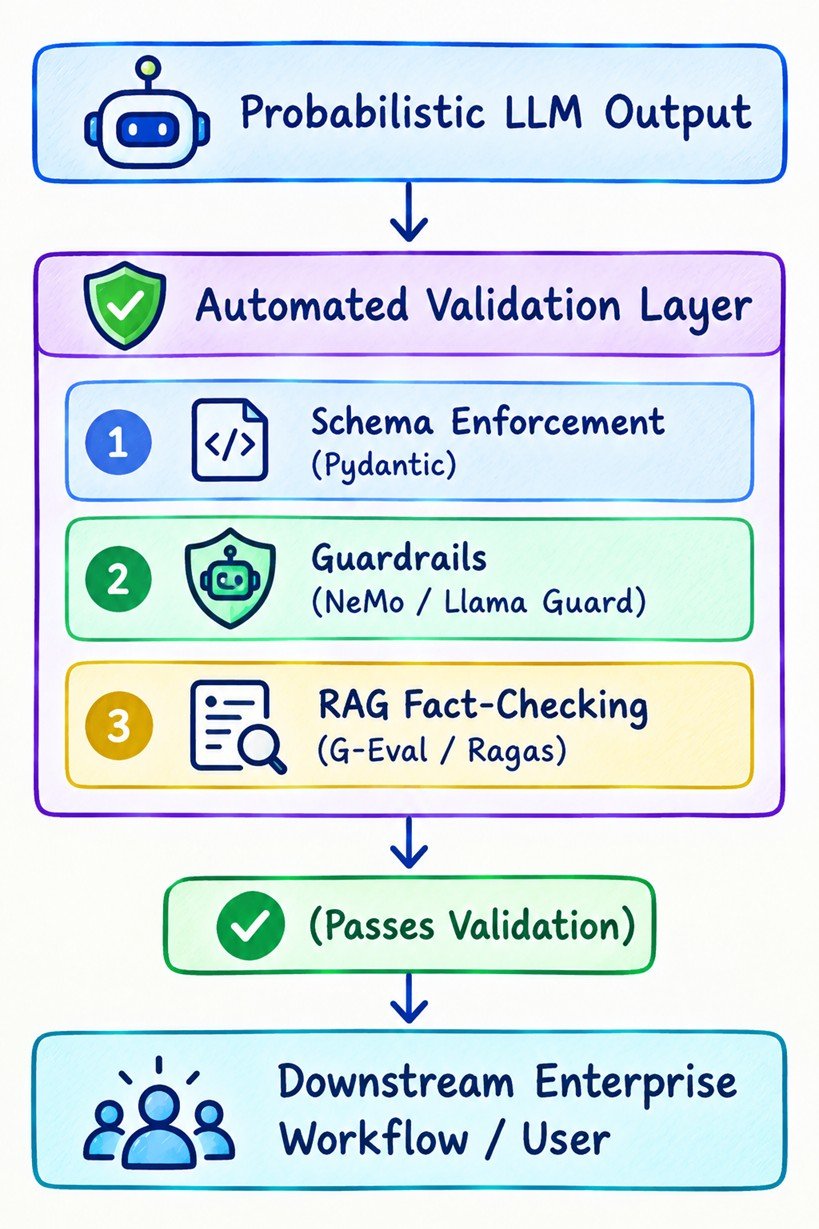
Deterministic Guardrails
Never expose raw, unvalidated LLM output directly to a customer, client UI, or automated transaction system. Wrap all model invocations in automated programmatic guardrail frameworks (such as NeMo Guardrails or Llama Guard). These programmatic layers intercept, evaluate, and sanitize both inbound prompts and outbound generations against pre-defined safety, alignment, and semantic boundaries.
Programmatic Schema Enforcement
Enforce absolute structural conformity at the code execution level. Utilize library abstractions like Pydantic, Instructor, or Outlines to force the model's token selection probabilities to comply strictly with a defined JSON schema. If a model output fails to parse or validate against the schema, the system must intercept the error, discard the payload, and execute an automated, isolated retry loop with a corrected system prompt.
Continuous Evaluation & Regression Pipelines
Treat model accuracy like code quality. Implement automated continuous evaluation pipelines (CI/CD for GenAI) using frameworks like Ragas, TruLens, or Phoenix. Run regular, synthetic evaluation datasets (Gold Sets) against your production pipelines to measure key metrics over time:
- Faithfulness: Is the answer derived only from the provided context?
- Answer Relevance: Does the output directly address the user's specific query?
- Context Recall: Did the RAG retrieval pipeline successfully capture all necessary source data?
3. Latency: Overcoming the Generation Bottleneck
Modern user experience design dictates that interface responses must occur within 100 to 300 milliseconds to maintain perceived fluid continuity. Large Language Models natively violate this standard, often requiring multiple seconds to complete a complex response generation cycle.
| Processing Stage | Target Latency | Architectural Strategy |
|---|---|---|
| Time to First Token (TTFT) | < 200ms | Edge-routed semantic caching, aggressive token pruning |
| Token Generation Rate | > 50 tokens/sec | FlashAttention, speculative decoding, model quantization |
| RAG Document Retrieval | < 50ms | HNSW indexing, hybrid lexical/vector searching |
| End-to-End Async Job | Non-blocking | Distributed message queues (Celery/Kafka), event-driven webhooks |
The Vulnerability Mechanics
The latency profile of an LLM request is broken down into two parts: Time to First Token (TTFT) and the total generation time (which scales linearly with output token length).
- When processing RAG pipelines, latency compounds exponentially: text embedding generation + vector database similarity searching + document reranking + model inference = high latency.
- Synchronous API integrations or blocking background processes that wait for a complete LLM payload before proceeding will quickly trigger application gateway timeouts, database connection pool exhaustion, and severe drop-offs in user retention.
Enterprise Mitigation Architecture
Native Streaming & Chunked UI Delivery
Architect your entire application stack—from the model gateway, through the backend microservices, to the client frontend—to support native HTTP Server-Sent Events (SSE) or WebSockets. By streaming individual tokens to the user interface as they are generated in real time, you drop the perceived latency (TTFT) down to a few hundred milliseconds, masking the fact that the total background generation may take several seconds.
Asynchronous Event-Driven Orchestration
For background processing, analytical pipelines, or automated multi-step workflows, completely decoupling the user request from the model execution is mandatory. Route inbound tasks into a robust distributed message broker (e.g., Apache Kafka or RabbitMQ) and process them asynchronously using worker pools. Notify downstream systems or client interfaces via decoupled webhooks or long-polling architectures once the entire execution graph resolves.
Speculative Decoding & Quantization
If hosting models internally, optimize the hardware serving infrastructure using advanced inference engines like vLLM, TensorRT-LLM, or TGI. Implement speculative decoding, where a tiny, ultra-fast draft model guesses the tokens ahead of time, and a larger target model validates them in parallel batches. Utilize specialized quantization strategies (FP8, AWQ, or GPTQ) to reduce the model's memory footprint, maximizing throughput and reducing token-generation latency without noticeable losses in reasoning capacity.
4. Security: Defending an Unbounded Attack Surface
Generative AI introduces entirely new security vectors that bypass traditional network perimeters, firewalls, and signature-based intrusion detection systems. In a GenAI architecture, the user input acts not just as data, but as executable runtime instructions.
The Vulnerability Mechanics
Because LLMs blend control code (system instructions) and data (user prompts) into a single processing stream, they are highly susceptible to manipulation:
- Prompt Injection: Attackers craft adversarial inputs that trick the model into ignoring its system boundaries, leaking intellectual property, bypassing safety filters, or executing unauthorized system commands.
- Indirect Prompt Injection: A massive vector for enterprise RAG applications. If an LLM reads and summarizes an untrusted external asset (such as an uploaded client PDF, a third-party email, or a scraped webpage), that document can contain hidden instructions that quietly hijack the model's behavior during processing.
- Data Leakage & Training Exfiltration: If user interactions or proprietary company data are fed back into public model APIs without enterprise-grade data protection agreements (DPAs), confidential trade secrets, PII, and sensitive intellectual property can permanently leak into public foundational model training sets.
Enterprise Mitigation Architecture
Strict Dual-Model Security Enclaves
Never trust user inputs to self-police. Implement an isolated Input Guardrail Enclave that treats every prompt as hostile. Before passing text to your primary reasoning model, process it through a highly specialized, fine-tuned binary classifier model (such as Llama Guard or specialized regex engines) specifically trained to detect prompt injection signatures, jailbreak methodologies, and hidden execution commands.
Sandboxed Indirect Data Processing
When building RAG systems or automated document parsers, isolate the retrieval and processing engine. Never give the model direct, unmonitored execution access to internal corporate databases, administrative APIs, or system backplanes. Treat retrieved context strictly as untrusted data. Ensure all downstream tools or function calls executed by the model require explicit, human-in-the-loop (HITL) authorization or are tightly bounded within restricted, ephemeral execution containers.
Enterprise Data Isolation & Zero-Data Retention (ZDR)
Enforce an ironclad data privacy policy at the network layer. Ensure all commercial API contracts explicitly enforce Zero-Data Retention (ZDR) agreements, ensuring user prompts and enterprise data payloads are never logged, inspected, or utilized by the provider for downstream model training. For highly regulated industries (such as Finance, Healthcare, or Defense), bypass public APIs entirely: host open-weights foundational models within your own private cloud infrastructure (VPC) or secure on-premise enclaves behind enterprise Identity and Access Management (IAM) perimeters.
Summary: The Enterprise Architecture Checklist
| Killer Vector | Core Architectural Solution | Measurable KPI |
|---|---|---|
| Cost | Semantic caching, token budgeting, dynamic model routing | Average Cost per Active User Session |
| Reliability | Programmatic guardrails, schema enforcement, continuous evaluation pipelines | Hallucination Rate / Schema Match % |
| Latency | Token streaming, async event loops, optimized inference engines (vLLM) | Time to First Token (TTFT) / End-to-End SLA |
| Security | Input/Output enclaves, isolated RAG contexts, Zero-Data Retention policies | Injection Block Rate / Zero PII Leakage |